
5G Fixed Wireless Access Market Trends, Share & Demand by 2034
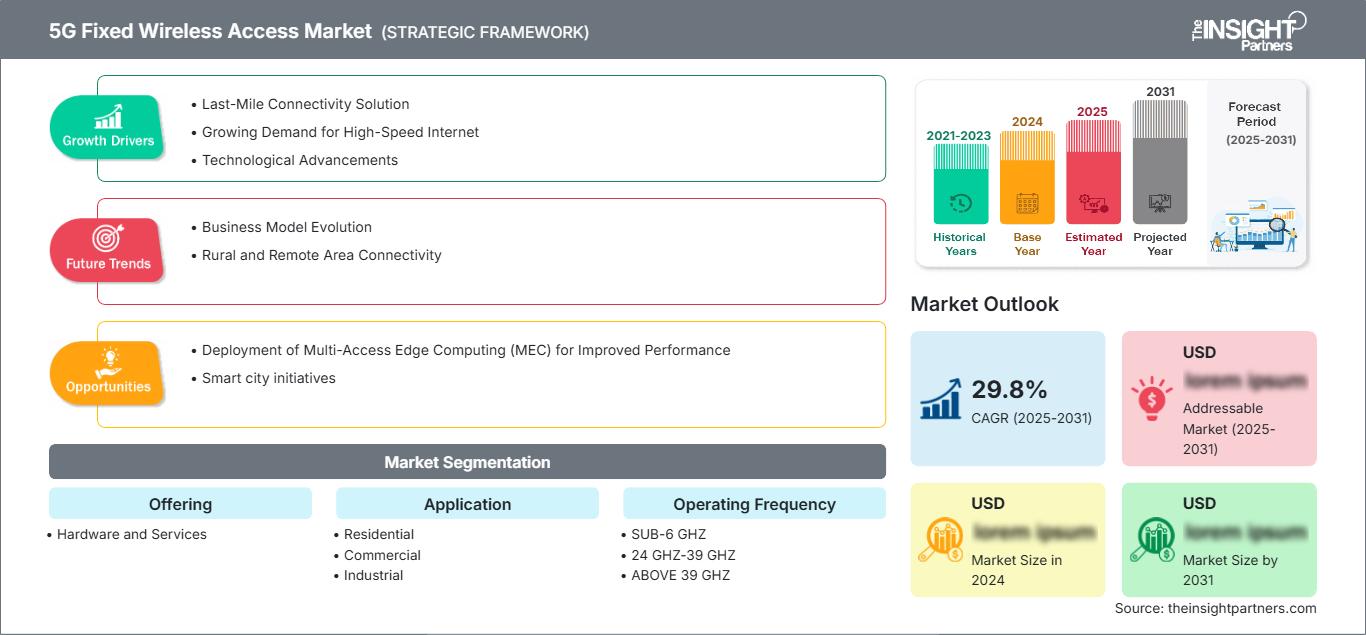
Coverage: By Offering (Hardware, Services); Application (Residential, Commercial, Industrial); Operating Frequency (SUB-6 GHZ, 24 GHZ-39 GHZ, ABOVE 39 GHZ) , and Geography (North America, Europe, Asia Pacific, and South and Central America)
- Status : Data Released
- Report Code : TIPRE00005691
- Category : Electronics and Semiconductor
- No. of Pages : 150
- Available Report Formats :


- Last update date : July 13, 2026


2025 Market Size
US$ 63.68 Bn
Base year value
2034 Forecast
US$ 341.12 Bn
Projected by 2034
CAGR 2026-2034
23.34 %
Growth rate
Addressable Market
US$ 1,886.49 Bn
(2026-2034)
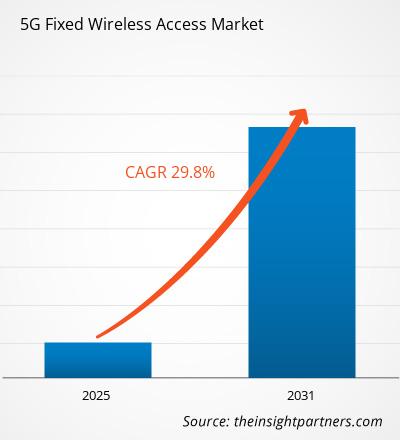
The 5G fixed wireless access market was valued at US$ 63.68 Billion in 2025 and is projected to reach US$ 341.12 Billion by 2034, expanding at a CAGR of 23.34% from 2026 to 2034. Operators are using 5G radio networks to deliver fixed broadband to residential, commercial, and industrial users where fiber deployment remains costly, slow, or commercially uneven.
The 5G fixed wireless access market is considered a leader in North America, with the regional CAGR expected to be between 21.8% and 23.6%. This is due to carrier monetization, substitution of suburban broadband, wireless backhaul for enterprises, and expanded mid-band spectrum usage. The presence of developed 5G network infrastructure and robust customer-premises equipment makes FWA a feasible alternative to existing solutions such as cable and underserved fixed lines.
5G Fixed Wireless Access Market Assessment and Insights
- North America held 31%–36% share in 2025 and is growing at a CAGR of 21.8%–23.6% between 2026–2034, supported by mid-band coverage, suburban broadband substitution, and fixed-mobile convergence.
- US represented 82%–88% of North American demand in 2025 and is growing at a CAGR of 22.1%–24.0% between 2026–2034, driven by carrier-led home internet expansion.
- Europe held 18%–23% of the 5G Fixed Wireless Access Market share in 2025 and is growing at a CAGR of 20.4%–22.2% between 2026–2034, led by Germany, the UK, France, Italy, and Spain.
- Asia Pacific held 29%–35% share in 2025 and is growing at a CAGR of 24.8%–27.3% between 2026–2034, with China, Japan, South Korea, India, and Australia shaping deployment models.
- Largest Segment: Hardware held 58%–64% market share in 2025 and is growing at a CAGR of 22.4%–24.2% between 2026–2034 as CPE, antennas, and gateways determine service quality.
- High Growth Segment: Industrial applications held 14%–19% market share in 2025 and are growing at a CAGR of 25.6%–28.4% between 2026–2034 due to site automation and resilient broadband needs.
- Key companies analyzed in detail: Cohere Technologies, Inc., Cisco Systems, Inc., Nokia Corporation, Huawei Technologies Co., Ltd., Qualcomm Incorporated, Samsung Electronics Co., Ltd., Verizon Communications Inc., Airspan Networks Holdings Inc., Siklu Communication Ltd., Telefonaktiebolaget LM Ericsson, Inseego Corp., and ZTE Corporation.
Source: The Insight Partners' analysis based on proprietary research, government publications, company annual reports, investor presentations, industry databases, and expert interviews.
The 5G Fixed Wireless Access (FWA) has transformed from an alternative broadband deployment technology to a strategic connectivity platform facilitating digital transformation of homes, businesses, and industries. Service providers have been developing spectrum optimization, beamforming, CPE, and network management technologies while consumers have been evaluating their services based on deployment time, TCO, and reliability of service. It is advantageous for suppliers who can offer solutions integrating radio, core network, and CPE technologies since deployment of FWA services will be driven by factors such as spectrum availability and network design rather than just number of subscribers.
The impetus towards progress is most pronounced in North America, the Asia Pacific, Europe, and nascent broadband regions that are characterized by demand for high-speed connectivity, digital inclusion policies, and issues related to fiber deployment. Capital is being invested in independent 5G networks, increasing use of mmWave and mid-band spectrum, AI-based network optimization, and enterprise FWA solutions. The 5G Fixed Wireless Access Market scope is expanding due to the belief of governments, telecom companies, and enterprises that wireless broadband can be an efficient way to expand high-speed connectivity.
5G Fixed Wireless Access Market Report Scope
| Report Attribute | Details |
|---|---|
| Market size in 2025 | US$ 63.68 Billion |
| Market Size by 2034 | US$ 341.12 Billion |
| Global CAGR (2026 - 2034) | 23.34% |
| Historical Data | 2021-2024 |
| Forecast period | 2026-2034 |
5G Fixed Wireless Access Market Analysis
The 5G fixed wireless access market is driven by the need to close broadband gaps without waiting for extensive trenching, permitting, or last-mile fiber construction. Demand is strongest in places where operators can repurpose their mobile spectrum and tower resources to serve residential, business, and industrial customers. Fixed Wireless Access is a way for operators to enter the broadband market competitively against cable incumbents while leveraging their investments in 5G radio access technologies.
The market has evolved from a means of extending coverage to a way of expanding broadband services. Initially, operators were focused on providing their services to homes in rural areas and places that could not be wired. The market today includes services for suburbs, homes, small business premises, retail premises, pop-up offices, and industrial facilities.
Outlook remains strong as operators treat FWA as both a broadband access product and a 5G monetization lever, supporting the long-term 5G Fixed Wireless Access Market Forecast. The strongest opportunities are emerging where people want faster Internet access beyond DSL or cable, and where companies require rapid deployment of wireless broadband. Competitive differentiation will be based on assured speed, ease of installation, efficient spectrum use, service provisioning, and customer-premises equipment capable of handling high-speed usage.
The ecosystem includes radio access networks, core platforms, spectrum holdings, outdoor and indoor CPE, antennas, chipsets, installation tools, OSS/BSS systems, cloud management, distribution channels, and customer support. Cohere Technologies, Inc., Cisco, Nokia Corporation, Huawei Technologies Co., Ltd., Qualcomm Technologies, Inc., Samsung Electronics Co., Ltd., Verizon Communications Inc., Mimosa Networks, Inc. (Airspan Networks Inc.), Siklu Communication, and Telefonaktiebolaget LM Ericsson contribute through network equipment, silicon, software, broadband services, and wireless access devices.
● REPORT CUSTOMIZATION
Tailor This Report To Align With Your Specific Business Requirements
This report can be customized to align precisely with your business objectives, scope, and target markets. Customization options include tailored segmentation, geography, competitive analysis, and strategic insights to support informed decision-making.
Customize This Report →WHAT YOU CAN ADJUST
- ● Segmentations
- ● Geography
- ● Competitive Analysis
- ● Language Preferences
5G Fixed Wireless Access Market: Strategic Insights
Regional Insights
North America 5G fixed wireless access Market
North America is estimated to grow at a CAGR of 21.8%–23.6% in the 5G fixed wireless access market. The region benefits from mature 5G coverage, strong mid-band holdings, suburban broadband demand, and operators seeking incremental returns from mobile network investment. FWA is especially attractive in areas where fiber construction faces high labor costs or slow permitting.
These structural factors comprise speed-sensitive broadband packages, customers' readiness to do-it-yourself gateway installation, wireless backup for business applications, and integrated mobile-fixed solutions. The key driving factor in the region is Verizon Communications Inc., with the technology provided by Cisco, Qualcomm Technologies Inc., Samsung Electronics Co., Ltd., Nokia Corporation, and Telefonaktiebolaget LM Ericsson.
U.S. 5G fixed wireless access Market
The U.S. represents approximately 82%–88% of North American demand and is estimated to advance at a CAGR of 22.1%–24.0%. Growth is linked to suburban broadband replacement, rural connectivity programs, small-business broadband, and carrier strategies that monetize 5G coverage beyond mobile subscriptions. FWA is gaining traction where cable pricing dissatisfaction and limited fiber availability create switching opportunities.
Company presence is wide-ranging across services, infrastructure, and devices. Among the operators is Verizon Communications Inc., while Qualcomm Technologies, Inc., Samsung Electronics Co., Ltd., Nokia Corporation, Cisco, and Telefonaktiebolaget LM Ericsson play roles in chipsets, RAN, gateways, and enterprise networking. Examples of application trends involve residential broadband, branch office connectivity, retail backup, temporary locations, and industrial campus with quick deployment without wiring construction.
Europe 5G fixed wireless access Market
Europe accounts for an estimated 18%–23% share of the global market and is projected to grow at a CAGR of 20.4%–22.2%. Germany is the leading country because of industrial connectivity needs, rural broadband gaps, private network interest, and strong operator investment in mid-band 5G. Adoption is shaped by national broadband policy, spectrum availability, and fiber competition.
The advantages in the UK market include suburban broadband competition, wireless backup for enterprises, and efforts to provide access to expensive-to-fiber-connect premises. The German market is more commercially and industrially oriented, where manufacturers, logistics facilities, and cities analyze FWA as a quickly deployable alternative. Among the key players in technology are Nokia Corporation, Huawei Technologies Co., Ltd., Samsung Electronics Co., Ltd., Cisco, and Telefonaktiebolaget LM Ericsson.
France, Italy, and Spain add demand through rural connectivity, tourism zones, public-sector broadband, retail sites, and small-business access. France emphasizes regulated broadband expansion and alternatives for underserved households, Italy benefits from geographically fragmented fixed-line economics, and Spain supports FWA in suburban and rural locations. Across Europe, operators must balance FWA growth with network quality expectations and national fiber deployment targets.
APAC 5G fixed wireless access Market
Asia Pacific is the fastest-growing region, with an estimated share of 29%–35% and a projected CAGR of 24.8%–27.3%. China is the leading country because of large-scale 5G infrastructure, domestic equipment depth, smart city activity, industrial parks, and broadband expansion priorities. Japan and South Korea support premium deployments where dense networks, advanced devices, and high service expectations enable differentiated offers.
India is gaining momentum as operators evaluate FWA for homes, small businesses, education access, and semi-urban broadband where wired infrastructure remains uneven. Australia uses FWA to address distance, rural premises, and enterprise connectivity across remote operations. Huawei Technologies Co., Ltd., Samsung Electronics Co., Ltd., Nokia Corporation, Qualcomm Technologies, Inc., Cisco, and Telefonaktiebolaget LM Ericsson influence regional network equipment, devices, and service enablement.
The industrial and policy motivators include national broadband projects, digitized manufacturing operations, automated ports, logistics transformation, and public connectivity objectives. The segmentation of the opportunity in APAC is significant: in mature economies, performance and enterprise-grade service are important considerations, whereas in developing economies, cost and fast deployment are the key considerations. Operators who have both sub-6 GHz coverage and selective mmWave can support different density scenarios.
Middle East & Africa 5G fixed wireless access Market
The Middle East & Africa 5G fixed wireless access market is projected to grow at a CAGR of 22.6%–25.1%. Saudi Arabia is the leading country, supported by national digital infrastructure programs, new urban developments, enterprise connectivity demand, and large-scale venues. The UAE follows closely through smart city projects, premium residential broadband, tourism infrastructure, and enterprise wireless adoption.
Energy and infrastructure contexts are central to regional demand. Oil and gas facilities, mining sites, ports, airports, logistics corridors, and construction zones need broadband that can be deployed faster than fixed lines. FWA supports temporary offices, remote monitoring, worker accommodation, and operational connectivity. Huawei Technologies Co., Ltd., Nokia Corporation, Samsung Electronics Co., Ltd., Cisco, and Telefonaktiebolaget LM Ericsson are relevant across network and enterprise layers.
The countries of MEA offer opportunities where broadband adoption remains uneven due to factors such as affordability, spectrum policy, handset costs, and power availability. Value creation for operators may include providing business-class fixed wireless access services across the retail, education, healthcare, and municipal sectors, using residential packages to expand broadband adoption.
Segmentation Analysis
Offering
The offering segment is growing at a CAGR of 22.8%–24.6% between 2026–2034 as operators balance upfront hardware deployment with lifecycle services. Hardware remains the revenue anchor because gateway performance, antenna quality, and radio planning determine household eligibility and customer experience. Services are becoming more strategic as managed installation, monitoring, optimization, and enterprise support reduce churn and improve network utilization.
- Hardware: Hardware leads because CPE, antennas, radios, gateways, and mmWave units determine installation quality, throughput consistency, and service eligibility across residential, commercial, and industrial premises.
- Services: Services are scaling as operators and integrators support installation, service assurance, network optimization, customer support, managed connectivity, and enterprise SLAs for sites requiring reliable broadband continuity.
Application
The application segment is growing at a CAGR of 23.6%–25.8% between 2026–2034 as residential broadband scale combines with premium commercial and industrial use cases. Residential adoption drives volume, while businesses use FWA for branch continuity, rapid activation, and temporary connectivity. Industrial users are increasingly evaluating wireless broadband for automation, monitoring, and remote-site operations where wired infrastructure is difficult to deploy.
- Residential: Residential demand is strongest where households need faster broadband, easier self-installation, predictable pricing, and alternatives to cable, DSL, or delayed fiber deployment.
- Commercial: Commercial users adopt 5G FWA for branch broadband, retail backup, temporary locations, office failover, pop-up operations, and rapid connectivity without waiting for fixed-line installation.
- Industrial: Industrial adoption is rising in ports, mines, utilities, factories, logistics yards, and construction sites where wireless broadband supports monitoring, automation, worker connectivity, and mobile operations.
Operating Frequency
The operating frequency segment is growing at a CAGR of 22.9%–25.0% between 2026–2034 as operators combine broad sub-6 GHz reach with selective mmWave capacity. SUB-6 GHZ supports scalable residential coverage, while 24 GHZ-39 GHZ enables dense, high-throughput broadband zones. ABOVE 39 GHZ remains earlier-stage but is strategically relevant for future ultra-capacity and specialized enterprise links.
- SUB-6 GHZ: SUB-6 GHZ supports broad coverage, better indoor reach, and economical scaling, making it central for residential broadband and wider-area commercial connectivity.
- 24 GHZ-39 GHZ: 24 GHZ-39 GHZ delivers high-capacity mmWave performance for dense neighborhoods, business districts, venues, and premium broadband zones needing fiber-like speeds.
- ABOVE 39 GHZ: ABOVE 39 GHZ remains emerging, suited to ultra-high-capacity trials, specialized enterprise links, and future dense deployments where short-range performance outweighs propagation limits.
Opportunity Snapshot
| Application | Revenue Contribution | Trend Tag | Adoption Stage |
| Residential | High | Home Broadband | Scaling |
| Commercial | Medium | Branch Failover | Scaling |
| Industrial | Medium | Site Automation | Emerging |
5G Fixed Wireless Access Market Growth Drivers and Impact Analysis
Operators need faster broadband monetization beyond mobile subscriptions
The most important driver for the 5G fixed wireless access market is the operator need to monetize 5G networks beyond mobile data plans. Spectrum licenses, radio upgrades, core modernization, and tower densification require revenue streams that can justify capital intensity. FWA allows operators to sell fixed broadband using assets already deployed for mobile coverage, particularly where network capacity exists during off-peak hours or in locations with underutilized cell resources.
Practical effects include increased service diversification for carriers and increased use of radio networks. Verizon Communications Inc. illustrates how FWA may be considered a conventional broadband offering, with Nokia Corporation, Samsung Electronics Co., Ltd., Qualcomm Technologies, Inc., Huawei Technologies Co., Ltd., Cisco, and Telefonaktiebolaget LM Ericsson providing the required infrastructure and devices. With more operators launching tiered packages, bundles, and qualification mechanisms, FWA is becoming an effective monetization strategy rather than a best-effort wireless offering.
High fiber deployment costs strengthen wireless last-mile economics
Fiber optics continues to represent the gold standard in fixed broadband, but the cost-benefit ratio associated with its deployment is not equally favorable everywhere. Trenching, permitting, labor, civil works, rights-of-way, and sparse population can render last-mile fiber deployment slow and/or uneconomic. The 5G Fixed Wireless Access (FWA) solution provides the operator with a faster means of serving end users in these circumstances.
The market impact is a more flexible broadband investment toolkit, reinforcing the positive 5G Fixed Wireless Access Market Forecast. Operators can use FWA to test demand before committing fiber, serve low-density areas, or offer interim connectivity while wired infrastructure is planned. Hardware suppliers benefit from demand for indoor gateways, outdoor receivers, high-gain antennas, and mmWave CPE. Mimosa Networks, Inc. (Airspan Networks Inc.), Siklu Communication, Nokia Corporation, Huawei Technologies Co., Ltd., and Samsung Electronics Co., Ltd. are relevant where device performance and cost directly influence service economics.
Enterprise and industrial sites require rapid, resilient connectivity
Commercial and industrial demand is rising because many sites need connectivity that can be activated quickly, relocated, or used as backup to wired broadband. Retail branches, pop-up stores, warehouses, ports, mines, utilities, construction offices, and temporary venues often cannot wait for fixed-line provisioning. 5G FWA supports business continuity, cloud applications, security systems, digital signage, connected equipment, and remote monitoring without requiring complex cabling across every location.
The real-world impact is higher demand for managed services, enterprise routers, service-level monitoring, and installation support. Cisco is important in enterprise networking, while Qualcomm Technologies, Inc. underpins gateway and device innovation. Cohere Technologies, Inc. contributes to spectral efficiency discussions that matter as enterprise traffic grows. Operators can convert FWA from a consumer broadband product into a business continuity solution by offering priority support, traffic management, and multi-site dashboards.
5G Fixed Wireless Access Market Future Trends
Speed-tiered and experience-based FWA plans will mature
The next phase of the 5G fixed wireless access market will be shaped by service models that look less like mobile data plans and more like fixed broadband packages. Operators are moving toward speed tiers, usage transparency, home entertainment bundles, business-grade options, and eligibility checks that protect network quality. This shift helps customers understand what they are buying while giving operators a clearer path to premium pricing where capacity and signal quality support it.
Forward-looking strategies will rely on tighter coordination between radio planning, CPE placement, tariff design, and service assurance. Operators that offer guaranteed minimum speeds, professional installation options, and intelligent troubleshooting can reduce churn and customer support costs. Vendors that support real-time diagnostics, remote gateway management, and capacity-aware provisioning will gain influence, reflecting evolving 5G Fixed Wireless Access Market Trends. The trend also favors analytics platforms that can identify which homes, buildings, and business sites are profitable candidates before service activation.
mmWave and advanced antenna systems will target capacity hotspots
mmWave will not replace sub-6 GHz for broad FWA coverage, but it will become more important in high-capacity zones where dense households, enterprise parks, campuses, or venues need fiber-like wireless performance. The 24 GHZ-39 GHZ range offers strong throughput when line-of-sight, antenna alignment, and cell density are favorable. Above 39 GHZ remains earlier-stage, but it signals where future capacity experimentation may occur as device ecosystems mature.
Forward-looking deployment will combine sub-6 GHz reach with mmWave precision. Samsung Electronics Co., Ltd., Qualcomm Technologies, Inc., Nokia Corporation, Huawei Technologies Co., Ltd., Siklu Communication, and Telefonaktiebolaget LM Ericsson are positioned around radio, antenna, and device capabilities that support this evolution. The strongest deployments will use advanced antenna systems, beamforming, and placement guidance to improve reliability. Operators will increasingly reserve mmWave for neighborhoods and business zones where capacity monetization justifies higher network density.
5G Fixed Wireless Access Market Opportunities
Residential broadband expansion in underserved and cable-heavy areas
A major opportunity lies in residential broadband expansion where households face limited choices, high cable bills, slow DSL, or delayed fiber availability. 5G FWA can be marketed as a simpler broadband alternative when self-install gateways, transparent pricing, and predictable speeds are available. The opportunity is strongest in suburban and semi-rural neighborhoods where mobile operators have sufficient spectrum depth and where fixed incumbents have left customers dissatisfied with price, reliability, or installation timelines.
Investment should focus on address-level qualification, customer education, gateway logistics, and churn management, supporting the long-term 5G Fixed Wireless Access Market Size. Operators can prioritize neighborhoods where 5G signal strength, household density, and competitive broadband pricing create attractive economics. Device makers should reduce installation friction through indoor-outdoor options, signal guidance, and remote troubleshooting. Verizon Communications Inc., Nokia Corporation, Qualcomm Technologies, Inc., Samsung Electronics Co., Ltd., Huawei Technologies Co., Ltd., and Telefonaktiebolaget LM Ericsson can capture value by aligning network performance with consumer-grade broadband expectations.
Managed FWA for distributed enterprises and industrial operations
Managed FWA offers a compelling opportunity for distributed enterprises that need consistent connectivity across many sites without complex fixed-line procurement. Retail chains, logistics companies, clinics, banks, construction firms, utilities, and industrial operators can use 5G FWA for primary access, backup, temporary connectivity, or rapid site activation. The value proposition improves when providers combine routers, SIM management, security, monitoring, support, and performance reporting into one service contract.
Action-oriented strategies should emphasize vertical-specific bundles. Retailers need point-of-sale continuity and video support; industrial sites need ruggedized equipment and coverage planning; construction teams need transportable broadband; public-sector sites need secure connectivity. Cisco can support enterprise networking integration, while Qualcomm Technologies, Inc., Nokia Corporation, Samsung Electronics Co., Ltd., Mimosa Networks, Inc. (Airspan Networks Inc.), Siklu Communication, and Telefonaktiebolaget LM Ericsson contribute across devices, access networks, and service enablement. Managed FWA can command premium pricing when uptime and simplicity matter more than headline speed alone, supporting the long-term 5G Fixed Wireless Access Market Forecast.
Recent Developments
- May, 2026: Cohere Technologies, the innovator behind the award-winning Universal Spectrum Multiplier (USM) software for 4G and 5G networks and Pulsone™ Technology powered by Zak-Orthogonal Time Frequency and Space (Zak-OTFS) waveform, today announced ECHO, a new feature that leverages USM to generate unprecedented real-time wireless channel insights for mobile operators worldwide. Enhanced Channel Insight with Holographic Observability (ECHO) delivers complete, real-time observability of the wireless channel—exposing millions of previously invisible data points every second.
- April, 2026: Inseego announced an agreement to acquire Nokia Corporation’s Fixed Wireless Access CPE business, with Nokia becoming a significant shareholder and both companies planning joint go-to-market and innovation initiatives around 6G, wireless edge, AI opportunities, and continued FWA customer support.
- June, 2025: Telefonaktiebolaget LM Ericsson reported that fixed wireless access continued to gain appeal among communications service providers, with more than half of sampled FWA providers offering speed-based plans and FWA projected to account for more than 35% of new fixed broadband connections by 2030.
Frequently Asked Questions

- Comprehensive Market Sizing and Forecast Analysis
- Detailed Segmentation Analysis
- In-Depth Market Dynamics Assessment
- Regional and Country-Level Insights
- Competitive Landscape and Company Benchmarking
- Strategic Business Intelligence
Recent Reports
Testimonials

The Insight Partners' SCADA System Market report is comprehensive, with valuable insights on current trends and future forecasts. The team was highly professional, responsive, and supportive throughout. We are very satisfied and highly recommend their services.
RAN KEDEM Partner, Reali Technologies LTDs
I requested a report on a very specific software market and the team produced the report in a few days. The information was very relevant and well presented. I then requested some changes and additions to the report. The team was again very responsive and I got the final report in less than a week.
JEAN-HERVE JENN Chairman, Future Analytica
We worked with The Insight Partners for an important market study and forecast. They gave us clear insights into opportunities and risks, which helped shape our plans. Their research was easy to use and based on solid data. It helped us make smart, confident decisions. We highly recommend them.
PIYUSH NAGPAL Sr. Vice President, High Beam Global
The Insight Partners delivered insightful, well-structured market research with strong domain expertise. Their team was professional and responsive throughout. The user-friendly website made accessing industry reports seamless. We highly recommend them for reliable, high-quality research services
YUKIHIKO ADACHI CEO, Deep Blue, LLC.
This is the first time I have purchased a market report from The Insight Partners.While I was unsure at first, I visited their web site and felt more comfortable to take the risk and purchase a market report.I am completely satisfied with the quality of the report and customer service. I had several questions and comments with the initial report, but after a couple of dialogs over email with their analyst I believe I have a report that I can use as input to our strategic planning process.Thank you so much for taking the extra time and making this a positive experience.I will definitely recommend your service to others and you will be my first call when we need further market data.
JOHN SUZUKI President and Chief Executive Officer, Board Director, BK Technologies
I wish to appreciate your support and the professionalism you displayed in the course of attending to my request for information regarding to infectious disease IVD market in Nigeria. I appreciate your patience, your guidance, and the fact that you were willing to offer a discount, which eventually made it possible for us to close a deal. I look forward to engaging The Insight Partners in the future, all thanks to the impression you have created in me as a result of this first encounter.
DR CHIJIOKE ONYIA MANAGING DIRECTOR, PineCrest Healthcare Ltd.Reason to Buy
- Informed Decision-Making
- Understanding Market Dynamics
- Competitive Analysis
- Identifying Emerging Markets
- Customer Insights
- Market Forecasts
- Risk Mitigation
- Boosting Operational Efficiency
- Strategic Planning
- Investment Justification
- Tracking Industry Innovations
- Aligning with Regulatory Trends





 Get Free Sample for