
Catheter Market Size, Demand & Growth by 2034
Coverage: By Product Type (Cardiovascular Catheters, Urology Catheters, Intravenous Catheters, Neurovascular Catheters, Specialty Catheters); Distribution Channel (Hospital Stores, Retail Stores, Others); End User (Hospitals, Long-term Care Facilities, Diagnostic Imaging Centers, Others) , and Geography (North America, Europe, Asia Pacific, and South and Central America)
- Status : Data Released
- Report Code : TIPRE00026350
- Category : Life Sciences
- No. of Pages : 150
- Available Report Formats :


- Last update date : September 07, 2026


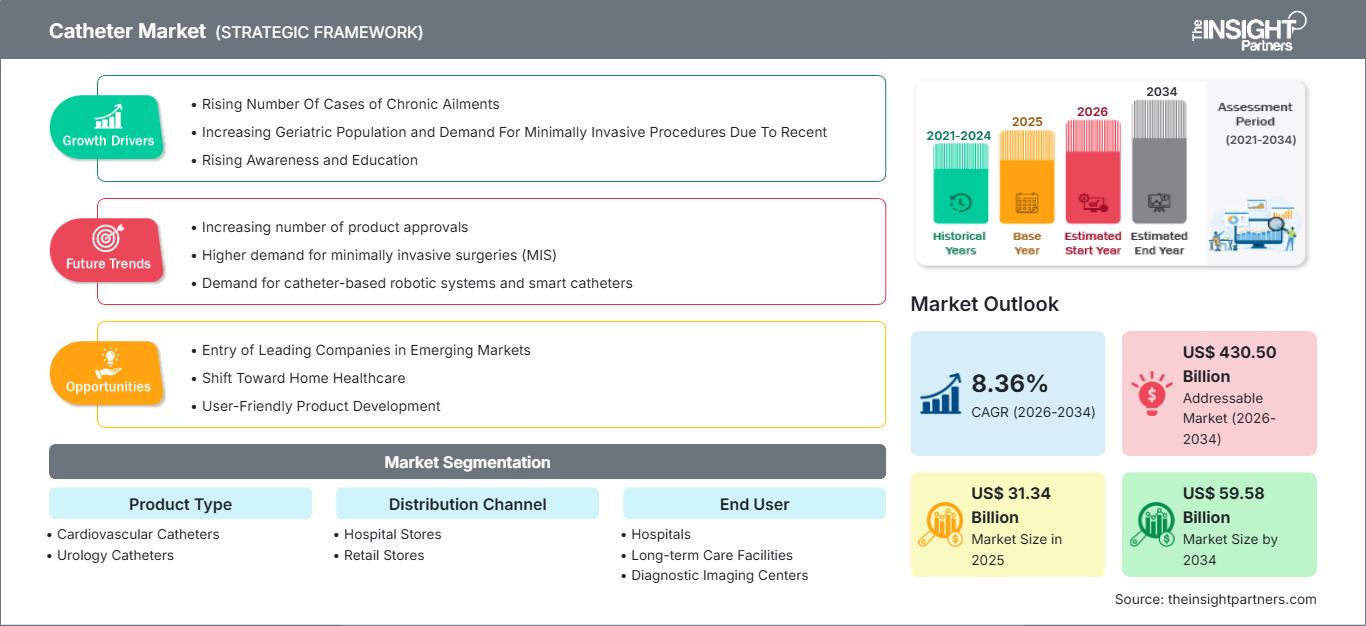
2025 Market Size
US$ 31.34 Bn
Base year value
2034 Forecast
US$ 59.58 Bn
Projected by 2034
CAGR 2026-2034
8.36 %
Growth rate
Addressable Market
US$ 430.50 Bn
(2026-2034)
The Catheter Market was valued at US$ 31.34 Billion in 2025 and is expected to reach US$ 59.58 Billion by 2034, registering a CAGR of 8.36% during 2026–2034. Expansion will be driven by growing applications of minimally invasive cardiovascular procedures, increasing requirements for urinary drainage, and increasing adoption of more advanced catheters for diagnosing conditions, delivering therapy, monitoring pressure, ablating tissues, accessing vessels, and managing patients.
In North America, the Catheter Market Share is expected to grow at a CAGR of 7.6% to 8.4% during 2026 to 2034. Increasing volume of procedures, reimbursement policies, catheterization facility, and quick adoption of electrophysiology technologies make the regional scenario favorable. According to the American Heart Association, about 127.9 million US adults had one or more types of cardiovascular disease from 2017 to 2020.
Catheter Market Assessment and Insights
- North America: The region held 34–36% share in 2025 and is expected to grow at a CAGR of 7.6–8.4% during 2026–2034, supported by advanced cardiovascular care, reimbursement coverage, and high adoption of premium catheter technologies.
- US: The country represented 83–85% of North American revenue in 2025 and is projected to expand at a CAGR of 7.8–8.6% during 2026–2034.
- Europe: Europe accounted for 27–29% share in 2025 and is expected to register a CAGR of 7.4–8.2% during 2026–2034, led by Germany, the UK, France, Italy, and Spain.
- Asia Pacific: Asia Pacific captured 25–27% share in 2025 and is anticipated to record a CAGR of 9.2–10.2% during 2026–2034, with China, Japan, India, and South Korea driving procedural expansion.
- Largest Segment: Cardiovascular Catheters held 40–44% market share in 2025 and are projected to grow at a CAGR of 8.2–9.0% during 2026–2034.
- High Growth Segment: Diagnostic Imaging Centers accounted for 10–12% market share in 2025 and are expected to expand at a CAGR of 9.4–10.6% during 2026–2034.
- Key companies analyzed in detail: Medtronic plc, Teleflex Incorporated, Abbott Laboratories, B. Braun Melsungen AG, Edwards Lifesciences Corporation, Coloplast A/S, Terumo Corporation, Becton, Dickinson and Company, Boston Scientific Corporation, and ConvaTec Group Plc.
Source: The Insight Partners' analysis based on proprietary research, government publications, company annual reports, investor presentations, industry databases, and expert interviews.
Technology developments have caused the design of catheters to evolve from traditional tubes to procedure-specific devices which feature hydrophilic coatings, antimicrobial properties, contact force measurement, multilumen construction, enhanced maneuverability, and imaging capability. Companies are working on developing extrusion, braiding, bonding, and coating technologies in order to increase torque performance and decrease dimensions. The production approach is becoming more focused on combining mass-produced basic parts with custom distal segments, thus allowing companies to find a balance between hospital pressures on prices and need for clinically differentiating products.
Investments will be directed towards electrophysiology, structural heart interventions, infection resistant vascular access, intermittent urinary catheters, and local manufacturing in Asia. Regulatory framework which incentivizes the submission of clinical data will be favorable for companies able to perform multicenter trials and monitor their products after market entry. New healthcare systems are opening catheterization laboratories, diagnostic imaging facilities, and tertiary hospitals, creating an opportunity for regional distributors and manufacturers with affordable and reliable products.
Catheter Market Report Scope
| Report Attribute | Details |
|---|---|
| Market size in 2025 | US$ 31.34 Billion |
| Market Size by 2034 | US$ 59.58 Billion |
| Global CAGR (2026 - 2034) | 8.36% |
| Historical Data | 2021-2024 |
| Forecast period | 2026-2034 |
Catheter Market Analysis
The Catheter Market growth is influenced by the interaction between chronic diseases, ageing population, decreased length of stay in hospitals, and growing trend towards minimal invasiveness. In 2022, cardiovascular diseases resulted in 19.8 million deaths, which demonstrates clinical need driving the interventional segment. Hospitals are still the main value-chain gatekeepers because the procurement committee evaluates performance, infection risk, training needs, and cost of procedure.
The upstream suppliers offer medical-grade polymers, nitinol, stainless-steel braiding, balloons, coatings, sensors, hubs, and sterilized packaging. The finished device companies use all these materials as an input and assemble the products via extrusion and distribution through direct sales or specialized distributors. Availability of sterilization, coating processes, resins, and regulatory paperwork can limit the supply, especially for the more complicated cardiovascular systems.
The Catheter Market Report indicates the existence of competitive rivalry in which diversified firms are present along with specialists. Competing aggressively in the cardiovascular intervention segment are Medtronic plc, Abbott Laboratories, Boston Scientific Corporation, Terumo Corporation, and Edwards Lifesciences Corporation, whereas Coloplast A/S and ConvaTec Group Plc compete in the continence care segment. Vascular access and clinical consumables solutions providers include Teleflex Incorporated, B. Braun Melsungen AG, and Becton, Dickinson and Company.
Current investments are focused on dual-energy ablation, pulsed field ablation, antimicrobial materials, neurovascular access, and platforms involving capital equipment along with recurrent catheter revenues. Abbott was granted with the approval by Europe to launch its TactiFlex Duo catheter with dual-energy ablation in January 2026. Clinical evidences, training of physicians, compatibility with installed systems, contractability, and ability to commercialize innovation across multiple regulatory regions become the key elements of competitive positioning.
● REPORT CUSTOMIZATION
Tailor This Report To Align With Your Specific Business Requirements
This report can be customized to align precisely with your business objectives, scope, and target markets. Customization options include tailored segmentation, geography, competitive analysis, and strategic insights to support informed decision-making.
Customize This Report →WHAT YOU CAN ADJUST
- ● Segmentations
- ● Geography
- ● Competitive Analysis
- ● Language Preferences
Catheter Market: Strategic Insights
Regional Insights
North America Catheter Market
North America constitutes 34–36% of global revenue in 2025 and is estimated to report a CAGR of 7.6–8.4% from 2026 to 2034. The catheter market share is driven by an ample catheterization lab capability, intensive-care setup, and rapid adoption of technologies such as electrophysiology, structural heart, neurovascular, and vascular access. Cardiovascular disease deaths amounted to 941,652 in the United States in 2022.
The requirement is further driven by the use of catheters in the urinary tract across hospitals, rehab centers, and other institutions requiring long-term care. Purchase of catheters is increasingly being done by companies that have antimicrobial features, closed systems, navigation capabilities, and proven clinical efficacy. Canada makes its contribution in terms of universal health care procurement and expanded specialty care capacity, while Mexico provides manufacturing and procedural opportunities.
U.S. Catheter Market
The US accounted for 83–85% of North American revenue in 2025 and is projected to grow at a CAGR of 7.8–8.6% during 2026–2034. Demand is underpinned by high cardiovascular disease prevalence, sophisticated reimbursement infrastructure, and widespread availability of interventional cardiology and electrophysiology services. Approximately 48.6% of US adults had some form of cardiovascular disease during 2017–2020.
Medtronic plc, Abbott Laboratories, Boston Scientific Corporation, Teleflex Incorporated, and Becton, Dickinson and Company conduct substantial business, training, or manufacturing activities in the country. Trends in application are moving towards pulsed field ablation, complex coronary interventions, structural heart deliveries, image-guided vascular procedures, and infection awareness central access. Large network providers are increasingly making portfolio level agreements which make product range and product availability key factors besides clinical differentiators. Intermittent catheterization at home is another source of recurring business opportunities.
Europe Catheter Market
In 2025, Europe was estimated at 27-29% share, which will see growth of a CAGR of 7.4-8.2% in 2026-2034. Germany will be leading the market through specialized hospitals, experience in medical devices manufacture, and wide spread of interventional cardiology. France, Italy, and Spain will be driving through aging population, presence of public hospital systems, and development of minimal invasivity.
The UK will benefit from centralized technology assessment and attempts to reduce waiting times, however, procurement pressures will drive towards products showing clinical and operational evidence of their value. Hospital reform and creation of specialized centers in Germany will favor the use of high-quality catheters. France will be developing outpatient clinics, while Italy and Spain offer the opportunity for development of regional hospitals and facilities for electrophysiology, continence management, and diagnostic imaging.
Regulations in Europe generate more evidence and surveillance requirements, adding implementation costs and creating stronger demands on demonstrated performance. Companies with regional clinical expertise and sound quality system will have an advantage for better managing market access. Development of dual energy and pulsed field ablation systems will facilitate higher end cardiovascular market. Infection prevention and continence management community programs will be supporting recurrent demand.
APAC Catheter Market
In Asia Pacific, the share in 2025 is estimated at 25–27%, and the forecast CAGR during 2026–2034 is estimated at 9.2–10.2%. China is leading due to large hospitals and local production; Japan drives up high-end cardiovascular and urological indications. India has investments into tertiary hospitals and catheterization laboratories; and South Korea allows advanced technological procedures.
Australia has high clinical maturity and reimbursement availability. Throughout the region, insurance penetration, local production initiatives, aging population, and investments into urban hospitals improve accessibility. The price sensitivity fosters tiered portfolios, contract manufacturing, and local clinical process-oriented products.
Middle East & Africa Catheter Market
In the Middle East & Africa region, the forecasted growth rate will range between 7.0% and 8.0%. This region is dominated by Saudi Arabia through hospital investments, localization measures, and specialty care development; meanwhile, the United Arab Emirates favor premium purchasing and medical tourism initiatives. South Africa serves as the key sub-Saharan market due to its private hospital segment.
For other countries, demand relies upon the healthcare infrastructure budget, distributor coverage, presence of physicians, and availability of sterile products. Cardiac centers, intensive care units, and imaging technologies present potential opportunities for growth despite non-uniform payments and product imports.
Segmentation Analysis
Product Type
The product type segment is anticipated to expand at a CAGR of 8.0–8.8% during 2026–2034. The Catheter Market scope covers cardiovascular and urology products serving therapeutic, diagnostic, drainage, monitoring, and access requirements. Innovation intensity is highest where navigation, energy delivery, sensing, or infection protection materially affects outcomes. Product selection therefore depends on anatomy, procedure complexity, dwell time, clinician preference, reimbursement, and compatibility with installed equipment.
- Cardiovascular Catheters: Cardiovascular products occupy the leading position because they support coronary intervention, electrophysiology, structural heart procedures, hemodynamic monitoring, and peripheral vascular treatment across specialized hospitals and imaging-led care pathways.
- Urology Catheters: Urology products generate recurring demand through acute urinary retention, perioperative drainage, neurogenic bladder management, continence care, and long-term use, making coating quality, comfort, and infection mitigation strategically important.
Distribution Channel
Distribution channels are projected to develop at a CAGR of 7.9–8.7% during 2026–2034. Purchasing patterns differ by clinical complexity and care setting. Hospital stores prioritize tenders, standardization, clinical evidence, emergency availability, and inventory continuity. Retail stores address repeat urinary catheter users and caregivers, with convenience, reimbursement administration, product education, discreet fulfillment, and consistent availability influencing channel performance.
- Hospital Stores: Hospital stores command the strongest position because cardiovascular interventions, inpatient urinary drainage, intensive-care access, and image-guided procedures require controlled inventory, traceability, clinical governance, and dependable sterile supply.
- Retail Stores: Retail outlets serve community and home-based users requiring intermittent or long-term urinary products, creating opportunities for recurring purchases, personalized guidance, insurance coordination, and digitally supported replenishment programs.
End User
The end-user segment is expected to register a CAGR of 8.1–8.9% during 2026–2034. Hospitals retain strategic importance because they manage complex interventions and high-acuity patients. Long-term care facilities generate sustained urinary catheter demand, while diagnostic imaging centers benefit from the decentralization of selected image-guided procedures. Suppliers must tailor packaging, training, contracting, and service models to each setting’s clinical capabilities and utilization profile.
- Hospitals: Hospitals represent the primary demand center through operating theatres, catheterization laboratories, electrophysiology suites, emergency departments, intensive-care units, and urology services requiring broad inventories and immediate product availability.
- Long-term Care Facilities: These facilities require dependable urinary drainage and continence-management supplies, with purchasing decisions emphasizing infection prevention, resident comfort, caregiver efficiency, predictable replenishment, and compatibility with extended-care protocols.
- Diagnostic Imaging Centers: Imaging centers are gaining strategic relevance as selected vascular diagnostics and interventions shift toward specialized outpatient environments that value image compatibility, efficient turnover, compact inventories, and predictable procedure scheduling.
Opportunity Snapshot
| End User | Revenue Contribution (High/Medium/Low) | Trend Tag | Adoption Stage |
| Hospitals | High | PFA Expansion | Mature |
| Long-term Care Facilities | Medium | Continence Care | Scaling |
| Diagnostic Imaging Centers | Medium | Guided Intervention | Scaling |
| Other End Users | Low | Outpatient Access | Emerging |
Catheter Market Growth Drivers and Impact Analysis
Rising Burden of Cardiovascular and Urological Conditions
The growing prevalence of cardiovascular disease, arrhythmia, urinary retention, incontinence, and other chronic conditions increases the pool of patients requiring catheter-based diagnosis, intervention, drainage, or long-term management. WHO estimates indicate that cardiovascular diseases caused 19.8 million deaths in 2022 and represented approximately 32% of global deaths. Ageing further raises exposure to coronary disease, atrial fibrillation, prostate-related obstruction, and bladder dysfunction. This burden produces demand across two distinct revenue models: high-value procedural catheters used during specialist interventions and recurring consumables used for urinary or vascular management. Manufacturers can address this demand by combining clinically advanced systems with standardized products suitable for resource-constrained environments.
Expansion of Minimally Invasive Clinical Procedures
Hospitals increasingly favor catheter-based procedures where they can reduce surgical trauma, shorten recovery, or provide access to anatomically difficult treatment sites. Interventional cardiology, electrophysiology, structural heart treatment, neurovascular intervention, and image-guided therapy consequently require catheters with precise torque transmission, trackability, energy delivery, and visualization. The practical impact extends beyond additional unit demand because complex procedures often require introducers, guide catheters, diagnostic catheters, balloons, and therapeutic devices during one episode. Health systems also gain incentives to expand specialist laboratories when minimally invasive workflows improve bed utilization. Suppliers offering integrated portfolios, physician education, and procedural support can therefore secure stronger account-level relationships than vendors competing through individual products alone.
Greater Emphasis on Infection Prevention and Patient Safety
Catheter-associated infections, thrombosis, tissue trauma, and placement errors influence procurement policies and clinical protocols. Hospitals are responding through insertion bundles, trained access teams, antimicrobial technologies, closed drainage systems, and closer dwell-time monitoring. A multinational Teleflex study involving more than 6,670 patients reported a 70.5% reduction in central-line-associated bloodstream infection incidence among patients receiving chlorhexidine-impregnated catheters compared with plain catheters, although institutional factors affect real-world outcomes. This focus redirects purchasing toward products supported by comparative evidence rather than basic acquisition price. Manufacturers must substantiate safety claims, provide training, and demonstrate how product design complements clinical practice instead of presenting technology as a substitute for infection-control discipline.
Catheter Market Future Trends
Convergence of Mapping, Sensing, and Dual-Energy Therapy
Catheter Market trends increasingly point toward multifunctional cardiovascular platforms that combine mapping, contact assessment, and energy delivery within fewer devices. Dual-energy systems can allow physicians to select radiofrequency or pulsed field ablation according to anatomy and treatment objectives. Abbott Laboratories received CE Mark for the TactiFlex Duo catheter in January 2026, reflecting movement toward procedure-specific flexibility. Future competition will center on workflow efficiency, lesion consistency, mapping integration, and evidence of durable outcomes. Suppliers that reduce catheter exchanges may strengthen their value proposition by shortening procedures, simplifying inventory, and limiting unnecessary vascular manipulation.
Digitally Connected and Data-Enabled Catheter Workflows
Next-generation systems are expected to produce more procedural data through embedded sensors, navigation platforms, imaging integration, and automated documentation. Development priorities will include pressure measurement, position tracking, contact assessment, temperature sensing, and decision-support functions that help clinicians reproduce procedural endpoints. Connectivity will also influence asset management by improving lot traceability, utilization monitoring, and inventory forecasting. Adoption will be strongest where hospitals can integrate device data into existing capital platforms without creating cybersecurity or interoperability burdens. Regulatory scrutiny will increase as software becomes more influential, requiring manufacturers to coordinate hardware validation, algorithm governance, data protection, and post-market monitoring throughout the product lifecycle.
Catheter Market Opportunities
Localized Value Engineering for High-Growth Asian Markets
Catheter Market Forecasts indicate attractive expansion potential where hospital infrastructure and insurance access are developing faster than premium-device affordability. Manufacturers can pursue localized extrusion, assembly, packaging, and sterilization to reduce landed cost and improve supply continuity in China, India, and Southeast Asia. Investment should focus on tiered portfolios rather than indiscriminate price reduction, preserving high-performance products for complex procedures while offering standardized options for routine use. Partnerships with domestic distributors, teaching hospitals, and contract manufacturers can accelerate registration and clinical training. Successful localization will require consistent quality controls, intellectual-property safeguards, dependable raw-material sourcing, and products designed around regional anatomy, purchasing practices, and procedural workflows.
Integrated Continence Care Beyond Acute-Care Hospitals
Long-term care facilities and home users create opportunities for more coordinated urinary catheter services, including assessment, product selection, scheduled replenishment, caregiver education, and digital support. Investment can target hydrophilic intermittent products, discreet packaging, travel formats, and systems that reduce handling complexity. Manufacturers should collaborate with pharmacies, community providers, payers, and nursing organizations to improve continuity after discharge. The commercial opportunity extends beyond device sales because adherence assistance and supply forecasting can reduce emergency substitutions and missed replenishment. Companies with broad product ranges and reimbursement expertise are positioned to develop recurring relationships while gathering real-world evidence on comfort, usability, and care-pathway efficiency.
Recent Developments
- June 2026: Medtronic plc completed its acquisition of Scientia Vascular for US$ 550 million, subject to customary adjustments and potential milestone payments. Scientia’s guidewire and catheter technologies complement Medtronic’s neurovascular portfolio and are intended to support access during complex stroke and aneurysm procedures.
- January 2026: Abbott Laboratories received CE Mark for the TactiFlex Duo Ablation Catheter, Sensor Enabled. The product delivers radiofrequency and pulsed field ablation energy through a focal catheter, allowing physicians to tailor lesion creation for atrial fibrillation patients with complex anatomy. Initial European commercial procedures followed the approval.
- June 2025: Teleflex Incorporated reported results from a multinational cohort study of more than 6,670 patients across 12 intensive-care units. The analysis associated Arrow chlorhexidine-impregnated central venous catheters with a 70.5% reduction in central-line-associated bloodstream infection incidence compared with non-impregnated catheters.
Frequently Asked Questions

- Comprehensive Market Sizing and Forecast Analysis
- Detailed Segmentation Analysis
- In-Depth Market Dynamics Assessment
- Regional and Country-Level Insights
- Competitive Landscape and Company Benchmarking
- Strategic Business Intelligence
Recent Reports
Testimonials

The Insight Partners' SCADA System Market report is comprehensive, with valuable insights on current trends and future forecasts. The team was highly professional, responsive, and supportive throughout. We are very satisfied and highly recommend their services.
RAN KEDEM Partner, Reali Technologies LTDs
I requested a report on a very specific software market and the team produced the report in a few days. The information was very relevant and well presented. I then requested some changes and additions to the report. The team was again very responsive and I got the final report in less than a week.
JEAN-HERVE JENN Chairman, Future Analytica
We worked with The Insight Partners for an important market study and forecast. They gave us clear insights into opportunities and risks, which helped shape our plans. Their research was easy to use and based on solid data. It helped us make smart, confident decisions. We highly recommend them.
PIYUSH NAGPAL Sr. Vice President, High Beam Global
The Insight Partners delivered insightful, well-structured market research with strong domain expertise. Their team was professional and responsive throughout. The user-friendly website made accessing industry reports seamless. We highly recommend them for reliable, high-quality research services
YUKIHIKO ADACHI CEO, Deep Blue, LLC.
This is the first time I have purchased a market report from The Insight Partners.While I was unsure at first, I visited their web site and felt more comfortable to take the risk and purchase a market report.I am completely satisfied with the quality of the report and customer service. I had several questions and comments with the initial report, but after a couple of dialogs over email with their analyst I believe I have a report that I can use as input to our strategic planning process.Thank you so much for taking the extra time and making this a positive experience.I will definitely recommend your service to others and you will be my first call when we need further market data.
JOHN SUZUKI President and Chief Executive Officer, Board Director, BK Technologies
I wish to appreciate your support and the professionalism you displayed in the course of attending to my request for information regarding to infectious disease IVD market in Nigeria. I appreciate your patience, your guidance, and the fact that you were willing to offer a discount, which eventually made it possible for us to close a deal. I look forward to engaging The Insight Partners in the future, all thanks to the impression you have created in me as a result of this first encounter.
DR CHIJIOKE ONYIA MANAGING DIRECTOR, PineCrest Healthcare Ltd.Reason to Buy
- Informed Decision-Making
- Understanding Market Dynamics
- Competitive Analysis
- Identifying Emerging Markets
- Customer Insights
- Market Forecasts
- Risk Mitigation
- Boosting Operational Efficiency
- Strategic Planning
- Investment Justification
- Tracking Industry Innovations
- Aligning with Regulatory Trends





 Get Free Sample for