
Absorption Chiller Market Growth, Share & Trends by 2034
Coverage: By Technology (Single-stage, Double-stage); Absorber Type (Lithium Bromide, Ammonia); Power Source (Direct Fired, Indirect Fired, Water Driven); Application (Industrial , Commercial , Residential) , and Geography (North America, Europe, Asia Pacific, and South and Central America)
- Status : Data Released
- Report Code : TIPTE100000490
- Category : Electronics and Semiconductor
- No. of Pages : 150
- Available Report Formats :


- Last update date : July 10, 2026


2025 Market Size
US$ 3.03 Bn
Base year value
2034 Forecast
US$ 4.81 Bn
Projected by 2034
CAGR 2026-2034
5.25 %
Growth rate
Addressable Market
US$ 35.53 Bn
(2026-2034)
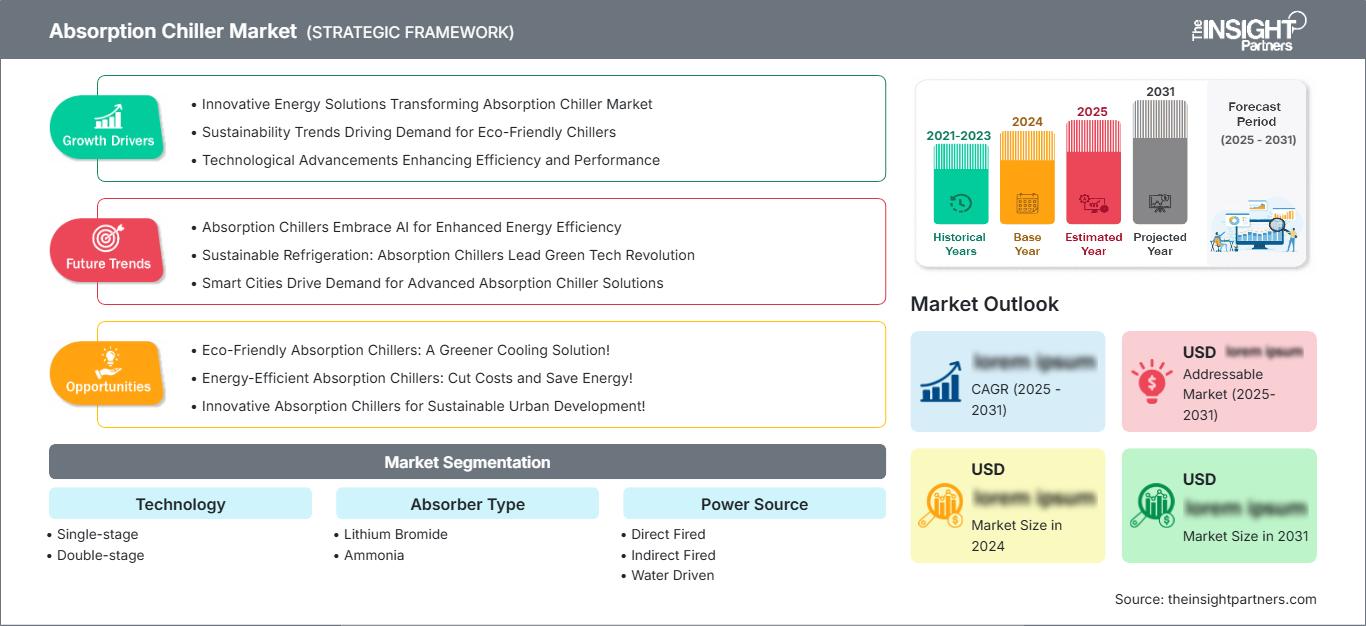
The Absorption Chiller Market is valued at US$ 3.03 Billion in 2025 and is projected to reach US$ 4.81 Billion by 2034, registering a CAGR of 5.25% from 2026 to 2034. The demand for absorption chillers is driven by the recovery of waste heat from industries, the development of district cooling, the need for low electricity use in cooling, and the increasing need to decarbonize large HVAC and process cooling applications without sacrificing chilled water reliability.
The Absorption Chiller Market in North America is projected to grow at a CAGR between 4.8%–5.4%. It will be driven by a combined heat and power application, access to gases and steam, concerns about grid peak load, and retrofitting, where recovered waste heat reduces dependence on electric compressors.
Absorption Chiller Market Assessment and Insights
- North America held 27%–31% share in 2025 and is growing at a CAGR of 4.8%–5.4% between 2026–2034, supported by CHP-linked campuses, hospitals, and industrial retrofits.
- The U.S. represented 80%–86% of North America in 2025 and is growing at a CAGR of 4.9%–5.5%, driven by steam loops, gas infrastructure, and institutional cooling redundancy.
- Europe accounted for 20%–25% share in 2025 and is growing at a CAGR of 4.6%–5.2%, led by Germany, the UK, France, Italy, and Spain through district energy and industrial efficiency projects.
- Asia Pacific held 38%–44% share in 2025 and is growing at a CAGR of 5.5%–6.2%, with China leading and Japan, South Korea, India, and Australia supporting industrial and commercial demand.
- Largest Segment: Lithium Bromide held 63%–68% of the Absorption Chiller market share in 2025 and is growing at a CAGR of 5.0%–5.6%, reflecting suitability for chilled-water HVAC and industrial cooling.
- High Growth Segment: Water Driven held 12%–16% market share in 2025 and is growing at a CAGR of 6.0%–6.8%, supported by waste heat and solar thermal use.
- Key companies analyzed in detail: Thermax Limited, Kirloskar Brothers Limited, Century Corporation, Carrier Global Corporation, Coolair, LG Electronics Inc., Trane Technologies plc, Johnson Controls International plc, Hitachi-Johnson Controls Air Conditioning, Inc., Yazaki Energy System Corporation, Broad Air Conditioning Co., Ltd., Shuangliang Eco-Energy Systems Co., Ltd., Daikin Industries, Ltd., Kawasaki Thermal Engineering Co., Ltd.
Source: The Insight Partners' analysis based on proprietary research, government publications, company annual reports, investor presentations, industry databases, and expert interviews.
The Absorption Chiller Market has moved from niche cooling substitution toward engineered energy optimization. The efficiency of heat exchangers is being improved by manufacturers along with corrosion protection, vacuum retention, and controls compatibility as end-users assess the life-cycle cost of energy use. The manufacturing environment favors manufacturers that provide application engineering, field service, and heat source options since project success depends on steam, exhaust gas, hot water, gas-fired heat or renewable thermal energy and not just capacity of the equipment.
The biggest forward movement is seen in Asia-Pacific, the Middle East, and the industrial beltways, where cooling demands, energy security, and efficiency standards converge. Investments are being made in hybrid plants, modular designs, and low-temperature hot water system technologies, which contribute to the Absorption Chiller Market Forecast. Thermal cooling can now be considered one of the levers to reduce peak electricity usage.
Absorption Chiller Market Report Scope
| Report Attribute | Details |
|---|---|
| Market size in 2025 | US$ 3.03 Billion |
| Market Size by 2034 | US$ 4.81 Billion |
| Global CAGR (2026 - 2034) | 5.25% |
| Historical Data | 2021-2024 |
| Forecast period | 2026-2034 |
Absorption Chiller Market Analysis
Demand in the Absorption Chiller Market is shaped by the economics of substituting thermal energy for electricity. Industrial plants, hospitals, airports, universities, district cooling networks, and commercial estates adopt absorption systems when steam, hot water, exhaust heat, or gas can provide dependable chilled water. The Absorption Chiller size also benefits from rising cooling intensity in facilities that cannot add unlimited electrical load.
The components of the system are generators, absorbers, condensers, evaporators, solution pumps, inhibitors, controls, cooling towers, heat exchangers, piping, commissioning, and maintenance. The supply dynamics of the system are engineering-based since the performance of the system is affected by the temperature of the heat source, load characteristics of cooling, water treatment, and capabilities of the user.
The competitive landscape is concentrated around companies able to combine equipment with project design. Thermax Limited, Johnson Controls International plc, Trane Technologies plc, Carrier Global Corporation, Hitachi-Johnson Controls Air Conditioning, Inc., Yazaki Energy System Corporation, LG Electronics Inc., Broad Air Conditioning Co., Ltd., and Shuangliang Eco-Energy Systems Co., Ltd. compete through efficiency, capacity range, service reach, and thermal-source adaptability.
Investment trends are towards networked controls, mini-modular units, hydrogen-compatible combustion technology, and systems that utilize low-quality heat. Positioning becomes increasingly reliant on demonstrating total cost of ownership, availability, emissions advantage, and compatibility with building automation. Absorption Chiller technology is more financially viable when suppliers provide feasibility studies, heat mapping, service agreements, and training, rather than treating chiller equipment as stand-alone products.
● REPORT CUSTOMIZATION
Tailor This Report To Align With Your Specific Business Requirements
This report can be customized to align precisely with your business objectives, scope, and target markets. Customization options include tailored segmentation, geography, competitive analysis, and strategic insights to support informed decision-making.
Customize This Report →WHAT YOU CAN ADJUST
- ● Segmentations
- ● Geography
- ● Competitive Analysis
- ● Language Preferences
Absorption Chiller Market: Strategic Insights
Regional Insights
North America Absorption Chiller
North America held 27%–31% share in 2025 and is forecast to grow at a 4.8%–5.4% CAGR, supported by hospitals, universities, industrial campuses, and district energy systems. Growth of Absorption Chillers in the region depends on CHP production, steam delivery, gas-fired central plants, and peak load management techniques.
Adoption remains but robust as buyers want to be assured about the availability of heat and the reliability of services. Johnson Controls International plc, Carrier Global Corporation, Trane Technologies plc, Yazaki Energy System Corporation, and Thermax Limited provide support for applications related to healthcare backup power, industrial cooling, energy centers, and building upgrades.
U.S. Absorption Chiller Market
The U.S. represented 80%–86% of North American demand in 2025 and is expected to grow at a 4.9%–5.5% CAGR. Installations are prevalent in hospitals, government installations, manufacturing establishments, universities, airports, and district heating plants, where gas distribution, steam distribution, or recovered heat can be used to make chilled water.
Corporate presence is strong, with YORK absorption chillers from Johnson Controls International plc, chiller product lines from Carrier Global Corporation and Trane Technologies plc, and water-fired chillers from Yazaki Energy System Corporation. These are applications such as hospital redundancy, CHP-based cooling, research into data centers' thermal management, and industrial process cooling, where energy diversity plays an important role.
Europe Absorption Chiller Market
Europe held 20%–25% share in 2025 and is growing at a 4.6%–5.2% CAGR. Germany leads because manufacturing plants, district heating assets, CHP systems, and industrial energy-efficiency programs create strong heat-recovery opportunities. Buyers emphasize refrigerant sustainability, corrosion control, and long service life.
The UK is driven by hospitals, universities, commercial estates, and energy centers where steam or hot-water systems can support absorption cooling. Retrofit demand is influenced by public-sector decarbonization, estate modernization, and rising interest in central plant optimization across healthcare and education facilities.
France, Italy, and Spain contribute through public buildings, airports, hotels, food processing, pharmaceuticals, and solar-assisted cooling. France emphasizes low-carbon infrastructure, Italy shows industrial and hospitality demand, and Spain benefits where high cooling loads coincide with solar thermal resources and district cooling feasibility.
APAC Absorption Chiller Market
Asia Pacific led with 38%–44% share in 2025 and is projected to grow at a 5.5%–6.2% CAGR. China is the leading country because industrial heat recovery, district cooling, manufacturing scale, and commercial construction create large addressable demand.
Japan and South Korea add technology depth through advanced HVAC engineering, compact designs, and building efficiency programs. India is gaining momentum in pharmaceuticals, textiles, chemicals, airports, hotels, and commercial complexes seeking reduced electrical demand.
Australia contributes through hospitals, universities, mining facilities, and commercial buildings evaluating resilience. Policy drivers across APAC include industrial efficiency, waste heat utilization, energy security, and lower electricity intensity in cooling-heavy economies.
Middle East & Africa Absorption Chiller Market
The Middle East & Africa market is growing at a 5.6%–6.4% CAGR. Saudi Arabia is the leading country due to district cooling, petrochemical facilities, airports, hotels, and mega-projects requiring large chilled-water infrastructure.
The UAE follows with high commercial cooling loads, hospitality assets, and smart-city developments. Gas availability, desalination-linked energy systems, and industrial waste heat support absorption technology where summer electricity peaks strain grid planning.
South Africa and the rest of MEA show selective demand in mining, food processing, hospitals, and public infrastructure. Adoption depends on water availability, service continuity, engineering capability, and stable fuel economics.
Segmentation Analysis
Technology
Technology is expected to grow at a 5.0%–5.8% CAGR between 2026–2034 as buyers balance efficiency, capital cost, heat-source quality, and operating hours. Single-stage units fit low-grade heat recovery and smaller systems, while double-stage equipment serves larger plants where higher coefficient of performance and continuous duty justify added complexity.
- Single-stage systems suit low-temperature heat sources, solar thermal loops, and smaller commercial installations where lower upfront cost and simpler operation matter more than maximum efficiency.
- Double-stage systems serve large commercial, industrial, and district cooling applications using steam or direct-fired input, supporting higher efficiency where cooling loads are stable.
Absorber Type
Absorber Type is projected to grow at a 4.9%–5.7% CAGR from 2026–2034. Lithium bromide dominates chilled-water applications above freezing because water acts as the refrigerant, while ammonia systems remain important for lower-temperature industrial refrigeration. Selection depends on target temperature, safety practices, system design, and maintenance capability.
- Lithium Bromide systems dominate comfort and process chilled-water demand because they fit hospitals, campuses, hotels, commercial buildings, and many industrial facilities operating above freezing.
- Ammonia systems address specialized refrigeration and lower-temperature process cooling in food processing, cold storage, chemicals, and industrial settings where water-based refrigerant cycles are unsuitable.
Power Source
Power Source is forecast to grow at a 5.1%–6.0% CAGR from 2026–2034 as customers use different thermal inputs to optimize cooling economics. Direct-fired systems provide independence where steam is unavailable, indirect-fired units leverage steam or exhaust heat, and water-driven systems address low-temperature hot-water, solar thermal, and recovered heat applications.
- Direct Fired chillers use natural gas or fuel oil for sites requiring independent thermal cooling capacity, especially commercial buildings, district plants, and industrial facilities.
- Indirect Fired systems use steam, exhaust heat, or hot water, making them central to CHP integration, process plants, and waste heat recovery projects.
- Water Driven units use low-temperature hot water from solar thermal, cogeneration, or recovered heat, widening the Absorption Chiller trends toward renewable thermal cooling.
Application
Application is expected to grow at a 5.0%–5.9% CAGR from 2026–2034. Industrial users lead because they often have continuous cooling loads and usable heat streams, while commercial facilities adopt systems for district cooling, hospitals, airports, and hotels. Residential use remains limited but relevant in centralized and solar-assisted communities.
- Industrial applications lead because factories, refineries, chemicals, pharmaceuticals, textiles, food processing, and power-linked facilities can convert waste heat or steam into reliable cooling.
- Commercial demand comes from hospitals, airports, hotels, malls, offices, campuses, and district cooling networks where centralized plants reduce electrical peak exposure.
- Residential adoption remains selective, serving high-end developments, district cooling communities, and solar-assisted systems where centralized thermal cooling can support multiple homes efficiently.
Opportunity Snapshot
| Application | Revenue Contribution | Trend Tag | Adoption Stage |
| Industrial | High | Waste Heat | Mature |
| Commercial | Medium | District Cooling | Scaling |
| Residential | Low | Solar Thermal | Emerging |
Absorption Chiller Market Growth Drivers and Impact Analysis
Waste heat recovery improves cooling economics
Industrial waste heat recovery is the strongest growth driver because many facilities reject usable thermal energy while purchasing electricity for cooling. Absorption systems convert steam, exhaust gas, jacket water, or hot water into chilled water, improving energy productivity in chemicals, steel, textiles, refining, power generation, pharmaceuticals, and food processing. The Absorption Chiller market impact is larger project scope, including heat exchangers, controls, cooling towers, pumps, piping, commissioning, and lifecycle service. Vendors with heat-source assessment and plant integration expertise can turn sustainability targets into funded retrofit projects.
Decarbonization pressure supports thermal cooling choices
Decarbonization is reshaping cooling investment as facilities reduce electricity intensity, manage refrigerant exposure, and improve energy resilience. Absorption chillers are attractive when they use recovered heat, renewable thermal energy, or efficient CHP output. Lithium bromide systems using water as refrigerant also support refrigerant-transition planning, although total benefit depends on heat source, water use, and part-load operation. The impact is visible in hospitals, campuses, public buildings, airports, and industrial plants demanding lifecycle analysis, automation integration, and measurable emissions reduction.
District cooling and campuses need resilient capacity
District cooling networks, hospitals, universities, airports, resorts, and industrial campuses require dependable chilled water over long operating hours. Absorption chillers diversify energy input, reduce electric chiller dependence, and integrate with central plants. In hot climates or grid-constrained regions, using gas, steam, hot water, or recovered heat creates operating flexibility that electric-only systems may not provide. This driver supports large infrastructure projects where design decisions lock in energy performance, maintenance obligations, and service contracts for decades, reinforcing the positive Absorption Chiller Market Forecast.
Absorption Chiller Market Future Trends
Hybrid cooling plants will become the preferred design model
Hybrid cooling plants combining absorption chillers with electric chillers, heat pumps, thermal storage, and advanced controls will become more common. Facility owners want systems that respond to energy prices, grid conditions, heat availability, and carbon intensity. Absorption units can operate when waste heat or gas economics are favorable, while electric chillers cover variable loads and redundancy. This trend shifts procurement toward plant optimization, analytics, and automation rather than individual equipment efficiency, creating opportunities for integrated controls and retrofit engineering, reflecting evolving Absorption Chiller Market Trends.
Compact modular systems will widen addressable applications
Compact modular absorption systems are likely to expand demand beyond large mechanical rooms and heavy custom projects. Smaller pre-engineered units reduce installation complexity, shorten commissioning, and make thermal cooling more accessible for agriculture, public buildings, light industry, commercial facilities, and solar thermal projects. Yazaki Energy System Corporation’s 2025 compact system launch illustrates how factory integration can reduce installation cost and footprint. Wider adoption will depend on simplified controls, remote diagnostics, financing clarity, and reliable local service.
Absorption Chiller Market Opportunities
Industrial retrofit projects using recovered thermal energy
Industrial retrofit projects offer attractive opportunities because many facilities already have rejected heat streams but lack integrated cooling recovery systems. Absorption chillers can be added to use exhaust, steam condensate, hot water, or process heat for chilled-water production. The best targets have steady cooling loads, predictable thermal output, high electricity tariffs, and sustainability goals. Suppliers should combine site audits, heat-source mapping, payback modeling, and maintenance planning to convert energy-efficiency intent into funded capital projects, supporting long-term Absorption Chiller Market Size expansion.
District cooling and infrastructure-led thermal networks
District cooling and infrastructure-led thermal networks represent high-value opportunities because absorption chillers can serve centralized plants with large, stable loads. Airports, mixed-use districts, hospitals, universities, industrial parks, and smart cities can use absorption units alongside electric chillers to optimize fuel mix and reduce electrical peaks. Suppliers should engage early with developers, utilities, EPC contractors, and public authorities. Feasibility support, lifecycle cost analysis, commissioning, and operator training can convert strategic infrastructure planning into long-term service revenue.
Recent Developments
- February 2026: Johnson Controls International plc launched thermal management reference design guides for gigawatt-scale AI data centers, with future guides expected to include air-cooled and absorption chiller solutions. The announcement signals rising relevance of advanced chiller architectures in high-density data center planning, where cooling redundancy, energy efficiency, and integrated design are central investment considerations.
- September 2025: Yazaki Energy System Corporation — launched what it described as the world’s smallest-class absorption chiller unit, integrating a hot-water-fired Aroace absorption chiller-heater with auxiliary equipment. The system uses 70°C–90°C hot water from waste heat or renewable thermal sources and targets agriculture, factories, public facilities, and commercial cooling applications.
- February 2025: Thermax Europe Ltd. reported installation and commissioning activity including a low-temperature 2 MW absorption chiller at a modern vegetable farm in the UK and an absorption chiller in Germany for comfort cooling. These projects highlight absorption technology’s role in agriculture, industrial heat recovery, and European low-carbon cooling applications.
Frequently Asked Questions

- Comprehensive Market Sizing and Forecast Analysis
- Detailed Segmentation Analysis
- In-Depth Market Dynamics Assessment
- Regional and Country-Level Insights
- Competitive Landscape and Company Benchmarking
- Strategic Business Intelligence
Recent Reports
Testimonials

The Insight Partners' SCADA System Market report is comprehensive, with valuable insights on current trends and future forecasts. The team was highly professional, responsive, and supportive throughout. We are very satisfied and highly recommend their services.
RAN KEDEM Partner, Reali Technologies LTDs
I requested a report on a very specific software market and the team produced the report in a few days. The information was very relevant and well presented. I then requested some changes and additions to the report. The team was again very responsive and I got the final report in less than a week.
JEAN-HERVE JENN Chairman, Future Analytica
We worked with The Insight Partners for an important market study and forecast. They gave us clear insights into opportunities and risks, which helped shape our plans. Their research was easy to use and based on solid data. It helped us make smart, confident decisions. We highly recommend them.
PIYUSH NAGPAL Sr. Vice President, High Beam Global
The Insight Partners delivered insightful, well-structured market research with strong domain expertise. Their team was professional and responsive throughout. The user-friendly website made accessing industry reports seamless. We highly recommend them for reliable, high-quality research services
YUKIHIKO ADACHI CEO, Deep Blue, LLC.
This is the first time I have purchased a market report from The Insight Partners.While I was unsure at first, I visited their web site and felt more comfortable to take the risk and purchase a market report.I am completely satisfied with the quality of the report and customer service. I had several questions and comments with the initial report, but after a couple of dialogs over email with their analyst I believe I have a report that I can use as input to our strategic planning process.Thank you so much for taking the extra time and making this a positive experience.I will definitely recommend your service to others and you will be my first call when we need further market data.
JOHN SUZUKI President and Chief Executive Officer, Board Director, BK Technologies
I wish to appreciate your support and the professionalism you displayed in the course of attending to my request for information regarding to infectious disease IVD market in Nigeria. I appreciate your patience, your guidance, and the fact that you were willing to offer a discount, which eventually made it possible for us to close a deal. I look forward to engaging The Insight Partners in the future, all thanks to the impression you have created in me as a result of this first encounter.
DR CHIJIOKE ONYIA MANAGING DIRECTOR, PineCrest Healthcare Ltd.Reason to Buy
- Informed Decision-Making
- Understanding Market Dynamics
- Competitive Analysis
- Identifying Emerging Markets
- Customer Insights
- Market Forecasts
- Risk Mitigation
- Boosting Operational Efficiency
- Strategic Planning
- Investment Justification
- Tracking Industry Innovations
- Aligning with Regulatory Trends





 Get Free Sample for