
Accelerometer and Gyroscope Market Demand, Trends & Forecast by 2034
Coverage: By Type (MEMS Accelerometer, Piezoelectric Accelerometer, MEMS Gyroscope, Fiber optic Gyroscope, Ring layer Gyroscope); Dimension (1 axis, 2 axis, 3 axis) , and Geography (North America, Europe, Asia Pacific, and South and Central America)
- Status : Data Released
- Report Code : TIPRE00020738
- Category : Electronics and Semiconductor
- No. of Pages : 150
- Available Report Formats :


- Last update date : July 16, 2026


2025 Market Size
US$ 4.14 Bn
Base year value
2034 Forecast
US$ 6.6 Bn
Projected by 2034
CAGR 2026-2034
5.31 %
Growth rate
Addressable Market
US$ 48.69 Bn
(2026-2034)
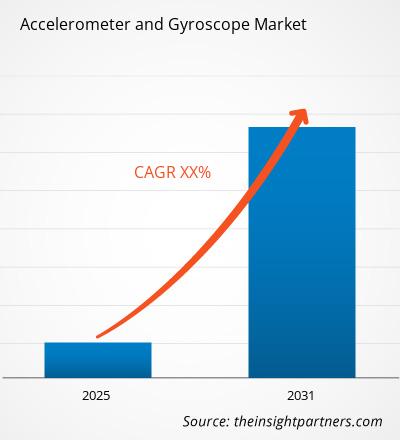
The Accelerometer and Gyroscope Market was valued at US$ 4.14 Billion in 2025 and is projected to reach US$ 6.6 Billion by 2034, registering a CAGR of 5.31% during 2026–2034. The market is driven by increasing demand for motion sensors in consumer electronics, automotive safety, aerospace navigation, industrial automation, and health care devices where acceleration, angular velocity, vibration, and orientation information are required for effective digital control.
North America will experience a CAGR of 5.0% to 5.6% between 2026 and 2034 due to growing demand for vehicle electronics, defense-related inertial measurement units, and health care wearables. The region’s growth will also be driven by innovative semiconductor design, aerospace spending, robotics investments, and the use of industrial condition monitoring systems that leverage miniature MEMS and gyroscopes.
Accelerometer and Gyroscope Market Assessment and Insights
- North America: 28–32% share in 2025, growing at a CAGR of 5.0–5.6% during 2026–2034, supported by defense navigation, automotive safety electronics, robotics, and healthcare wearables.
- US: 78–82% share of North America in 2025, growing at a CAGR of 5.1–5.7% during 2026–2034, led by aerospace, medical devices, and semiconductor design.
- Europe: 21–25% share in 2025, growing at a CAGR of 4.6–5.2% during 2026–2034, with Germany, France, the UK, Italy, and Spain leading automotive and industrial adoption.
- Asia Pacific: 36–40% share in 2025, growing at a CAGR of 5.7–6.4% during 2026–2034, led by China, Japan, South Korea, and India across electronics, EVs, and automation.
- Largest Segment: Consumer Electronics holds 39–43% market share in 2025, growing at a CAGR of 5.1–5.7% during 2026–2034 as smartphones, wearables, hearables, gaming, and AR devices expand motion sensing.
- High Growth Segment: Healthcare holds 9–12% market share in 2025, growing at a CAGR of 6.3–7.0% during 2026–2034 due to remote monitoring, rehabilitation, fall detection, and surgical navigation.
- Key companies analyzed in detail: Infineon Technologies AG; Northrop Grumman Corporation; NXP Semiconductors N.V.; Honeywell International Inc.; STMicroelectronics N.V.; Analog Devices, Inc.; TDK Corporation; Murata Manufacturing Co., Ltd.; ROHM Co., Ltd.; Robert Bosch GmbH.
Source: The Insight Partners' analysis based on proprietary research, government publications, company annual reports, investor presentations, industry databases, and expert interviews.
Motion sensing has changed from stand-alone electromechanical sensors to energy-efficient MEMS and inertial measurement units that are integrated into electronics platforms. Accelerometers and gyroscopes are used by consumer applications for orientation, stabilization, motion detection, and spatial interfaces, but automotive and aerospace applications need sensors with high levels of reliability, redundancy, and environment resilience. Manufacturing trends suggest that companies that can produce MEMS at the wafer level, integrate ASICs, and have the relevant calibration software and quality systems have an advantage.
The forward demand would depend on factors such as the localization of electronics, autonomous driving, military modernization, and decentralized healthcare delivery. The Asia-Pacific region continues to dominate in manufacturing capacity, while North America and Europe focus on mission-critical inertial capabilities. The Accelerometer and Gyroscope Market scope is expanding due to OEMs' use of sensor fusion, AI-enabled embedded systems, reduced drift, increased shock resistance, and motion data security.
Accelerometer and Gyroscope Market Report Scope
| Report Attribute | Details |
|---|---|
| Market size in 2025 | US$ 4.14 Billion |
| Market Size by 2034 | US$ 6.6 Billion |
| Global CAGR (2026 - 2034) | 5.31% |
| Historical Data | 2021-2024 |
| Forecast period | 2026-2034 |
Accelerometer and Gyroscope Market Analysis
Demand is driven by the need for mechanisms that require motion, tilting, vibration, and angular rate information. Demand from smartphones, wearable gadgets, hearing aids, drones, game controllers, camera stabilization, and AR systems calls for small-sized and low-power MEMS-based devices. Inertial information in automotive platforms is used for stability control, rollover detection, navigation, airbag deployment, ADAS assistance, and battery management in electric vehicles.
The ecosystem spans MEMS wafer fabrication, inertial sensing element design, ASICs, packaging, calibration, firmware, distribution, module integration, and OEM validation, contributing to sustained Accelerometer and Gyroscope Market Size expansion. The market size is characterized by high volume, customer acceptance, and a high price range for tactical, automotive, aerospace, and medical devices. Supply factors give an advantage to vendors who provide stable sensor performance, temperature compensation, software packages, and longevity.
The competitive landscape is split between MEMS semiconductor leaders and high-reliability inertial system specialists. STMicroelectronics N.V., Robert Bosch GmbH, TDK Corporation, Murata Manufacturing Co., Ltd., Analog Devices, Inc., Infineon Technologies AG, and NXP Semiconductors N.V. compete in compact motion sensing, while Honeywell International Inc. and Northrop Grumman Corporation address navigation-grade and defense applications. ROHM Co., Ltd. strengthens regional electronics supply.
Areas for investment include 6-axis IMUs, sensor fusion algorithms, artificial intelligence (AI)-enabled event detection, low-noise gyroscopes, high-g accelerometers, and robust inertial navigation. The study on the Accelerometer and Gyroscope Market reveals that positioning is based on application software, qualification levels, and small form factors rather than sensors themselves. Those suppliers with strong track records in automotive, consumer electronics, and critical-mission applications will maintain their Share.
● REPORT CUSTOMIZATION
Tailor This Report To Align With Your Specific Business Requirements
This report can be customized to align precisely with your business objectives, scope, and target markets. Customization options include tailored segmentation, geography, competitive analysis, and strategic insights to support informed decision-making.
Customize This Report →WHAT YOU CAN ADJUST
- ● Segmentations
- ● Geography
- ● Competitive Analysis
- ● Language Preferences
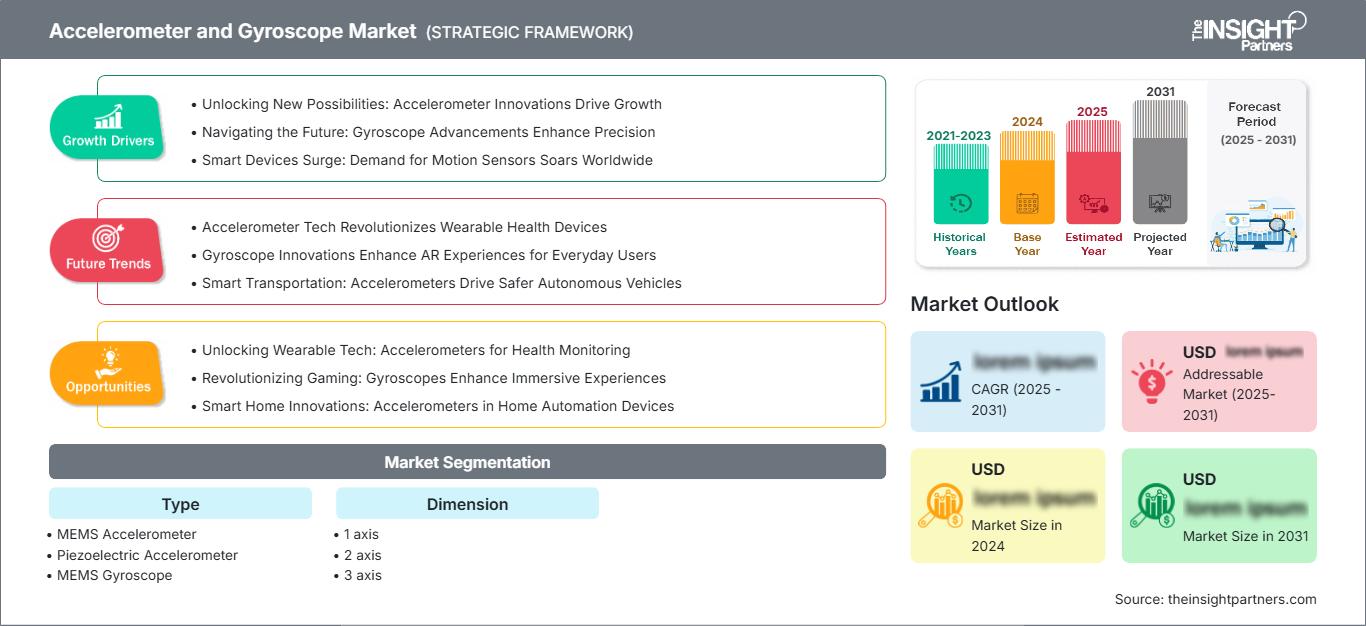
Accelerometer and Gyroscope Market: Strategic Insights
Regional Insights
North America Accelerometer and Gyroscope Market
North America accounts for 28–32% share in 2025 and is projected to grow at a CAGR of 5.0–5.6% during 2026–2034. This includes defense navigation, aerospace electronics, medical wearables, industrial robotics, and automotive safety. Requirements include low drift, shock resistance, cybersecurity-friendly firmware, and component provenance. Demand drivers are NASA/defense buying cycles, FAA-compliant avionics upgrades, hospital-standard remote patient monitoring, and factory automation. North America Accelerometer and Gyroscope Market players include Honeywell International Inc., Northrop Grumman Corporation, Analog Devices, Inc., NXP Semiconductors N.V., and Infineon Technologies AG.
U.S. Accelerometer and Gyroscope Market Market
The U.S. represents 78–82% of North American demand in 2025 and is expected to grow at a CAGR of 5.1–5.7% during 2026–2034. Demand is concentrated in defense inertial systems, medical devices, EV platforms, industrial automation, and semiconductor design. Northrop Grumman Corporation, Honeywell International Inc., Analog Devices, Inc., and NXP Semiconductors N.V. support advanced qualification and application engineering.
Trends in applications point to IMU use in GPS-denied navigation systems, fall detection devices, surgical devices, machine vibration analysis, and camera stabilization. U.S. Original Equipment. The Accelerometer and Gyroscope Market growth in the country also benefits from defense modernization and connected healthcare investments.
Europe Accelerometer and Gyroscope Market Market
Europe holds 21–25% share in 2025 and is forecast to grow at a CAGR of 4.6–5.2%. Germany leads regional demand because its automotive, robotics, industrial machinery, and automation ecosystem requires precise inertial feedback. Robert Bosch GmbH, Infineon Technologies AG, STMicroelectronics N.V., and Murata Manufacturing Co., Ltd. strengthen local supply and design activity.
UK contributes to the adoption of MEMS in aerospace, defense electronics, motorsports, medical technology, and robotics. Avionics, automotive suppliers, healthcare systems, and industrial controls help France contribute. Consumers focus on conformity, functional safety, and availability since any problem with the inertial sensors will impact operation.
Additional demands are generated from appliance manufacturing, automotive components, industrial automation, drones and aircrafts, and healthcare electronics industries in Italy and Spain. Vehicle safety policies, energy efficiency policies, quality healthcare systems policies, and aerospace policies in Europe have accuracy of the components as a key point. Some trends are sensor fusion, embedded diagnostics, and low-power motion processing.
APAC Accelerometer and Gyroscope Market Market
Asia Pacific accounts for 36–40% share in 2025 and is projected to grow at a CAGR of 5.7–6.4%. China leads regional demand through smartphones, EVs, drones, appliances, and automation.
Japan and South Korea will continue to be important for MEMS process knowledge, automotive electronics, robotics, and premium consumer devices. Regional qualification is provided by TDK Corporation, Murata Manufacturing Co., Ltd., ROHM Co., Ltd., and Robert Bosch GmbH.
The contributions of India and Australia come through localization of electronics, medical devices, mining automation, drones, and mobility initiatives. The policy factors involve incentives for semiconductors, EV production, smart factories, and healthcare accessibility. The region is key to the Accelerometer and Gyroscope Market growth.
Middle East & Africa Accelerometer and Gyroscope Market Market
The Middle East & Africa market is expected to grow at a CAGR of 4.0–4.7%. Saudi Arabia leads demand through aviation, defense localization, smart infrastructure, energy monitoring, and healthcare expansion.
Adoption of this technology is supported by the UAE in aviation, logistics, smart building, robotics, and high-end consumer electronics segments. The role of South Africa includes mining machinery, car assembly, industrial maintenance, and organized distribution channel.
The rest of MEA remains project-driven, and adoption depends on infrastructure investments, calibration, and distributor coverage. Opportunities for sensing of motion and vibration are in energy, water, aviation, health care, and security sectors.
Segmentation Analysis
Type
The type segment is expected to grow at a CAGR of 5.2–5.8% during 2026–2034. Accelerometers dominate high-volume motion and vibration sensing, while gyroscopes add angular-rate precision for stabilization, navigation, and immersive interfaces. Demand increasingly favors combined IMUs that reduce board area, simplify calibration, and support sensor fusion across consumer, automotive, aerospace, industrial, and healthcare platforms.
- Accelerometer: Positioned as the highest-volume device type, accelerometers support activity tracking, tilt sensing, vibration monitoring, crash detection, and equipment diagnostics where linear motion data is essential.
- Gyroscope: Gyroscopes are strategically important for angular-rate measurement in navigation, image stabilization, robotics, drones, AR systems, and aerospace platforms requiring precise orientation control.
Dimension
The dimension segment is projected to grow at a CAGR of 5.3–5.9% during 2026–2034. Three-axis devices are widely adopted because they capture full spatial motion and simplify software interpretation. One-axis and two-axis devices remain relevant for cost-sensitive, dedicated, or constrained applications where a narrower measurement plane is sufficient for control, safety, or monitoring.
- 1-Axis: Demand is concentrated in dedicated vibration, shock, tilt, and machinery monitoring applications where one directional measurement provides adequate control insight at lower system cost.
- 2-Axis: Two-axis devices serve portable electronics, industrial inclination monitoring, gaming accessories, and equipment positioning where planar motion data supports reliable functionality without full spatial sensing.
- 3-Axis: Three-axis devices hold the strongest position because smartphones, wearables, vehicles, drones, robotics, and medical devices require complete motion vectors for sensor fusion.
Industry Vertical
The industry vertical segment is expected to grow at a CAGR of 5.4–6.0% during 2026–2034. Consumer electronics remains the largest revenue contributor, while healthcare is the fastest-growing vertical. Automotive, aerospace and defense, and industrial applications require higher reliability, qualification depth, and ruggedized performance, creating a balanced mix of volume-driven and value-driven opportunities.
- Consumer Electronics: This vertical leads demand through smartphones, wearables, hearables, gaming devices, AR headsets, drones, and cameras where compact motion sensing improves interfaces and stabilization.
- Automotive: Adoption is tied to electronic stability control, airbag systems, navigation, rollover detection, EV battery monitoring, ADAS, and cabin sensing across combustion and electrified platforms.
- Aerospace & Defense: Demand centers on inertial navigation, guidance, avionics, UAVs, missile systems, and mission equipment where precision, durability, and operation in GPS-denied environments are critical.
- Industrial: Industrial users deploy accelerometers and gyroscopes for predictive maintenance, robotics, machine health, vibration diagnostics, warehouse automation, and safety monitoring across connected factories.
- Healthcare: Healthcare adoption is expanding in fall detection, rehabilitation tracking, surgical navigation, remote monitoring, prosthetics, and wearable diagnostics where motion data supports clinical decisions.
Opportunity Snapshot
| Industry Vertical | Revenue Contribution | Trend Tag | Adoption Stage |
| Consumer Electronics | High | Spatial UX | Mature |
| Automotive | High | Safety Control | Scaling |
| Aerospace & Defense | Medium | Assured Navigation | Scaling |
| Industrial | Medium | Machine Health | Scaling |
| Healthcare | Medium | Remote Mobility | Emerging |
Accelerometer and Gyroscope Market Growth Drivers and Impact Analysis
Rising Motion Sensing Content in Consumer Devices
Consumer electronics remains the largest adoption base as smartphones, wearables, hearables, gaming controllers, drones, cameras, and AR devices require motion data for orientation, stabilization, gesture control, activity tracking, and immersive interfaces. The impact is structural because MEMS accelerometers and gyroscopes are designed into product architectures rather than added as optional accessories. Suppliers benefit from recurring high-volume programs, while OEMs gain lower power consumption, smaller packages, and embedded software features that improve user experience and product differentiation.
Safety and Autonomy Requirements in Mobility Platforms
Vehicles, aircraft, drones, and autonomous mobile robots increasingly depend on inertial sensing to maintain orientation, detect impacts, stabilize motion, and support navigation when satellite signals are limited. Automotive demand is linked to electronic stability control, airbag deployment, rollover detection, ADAS functions, and EV battery safety. Aerospace and defense applications add value through higher precision and ruggedization. This driver strengthens evolving Accelerometer and Gyroscope Market Trends by connecting component demand to regulated safety, autonomy, and mission assurance requirements.
Industrial Monitoring and Healthcare Mobility Analytics
Factories, utilities, hospitals, and home-care providers are using motion data to improve uptime, safety, and patient outcomes. Accelerometers detect vibration signatures in motors, pumps, gearboxes, and compressors before failure, while gyroscopes support robotics and equipment stabilization. In healthcare, motion sensing enables fall detection, rehabilitation adherence, gait analysis, prosthetic control, and surgical tools. The market impact is broader addressable demand beyond consumer cycles, with buyers valuing reliability, analytics compatibility, and qualified component supply.
Accelerometer and Gyroscope Market Future Trends
AI-Enabled IMUs Shift Intelligence to the Sensor Edge
Future IMUs will increasingly combine accelerometers, gyroscopes, embedded microcontrollers, machine-learning cores, and event-detection firmware. This architecture reduces host processor workload, lowers latency, and enables always-on features in wearables, hearables, robotics, and safety devices. Bosch Sensortec has highlighted integrated MEMS, software, and AI as a direction for intelligent sensors, while STMicroelectronics and TDK Corporation are expanding AI-enabled motion platforms. The shift will make software ecosystems, reference designs, and algorithm validation critical differentiators, helping companies strengthen their Accelerometer and Gyroscope Market Share.
Precision Inertial Navigation Expands Beyond Defense
Navigation-grade gyroscopes and multi-axis inertial systems will move into more commercial domains as drones, autonomous vehicles, space systems, marine platforms, and industrial robots require resilient positioning. GPS disruption, underground operation, urban canyons, and harsh industrial environments create demand for inertial backup. Northrop Grumman Corporation’s hypersonic inertial measurement work illustrates the performance frontier, while automotive and robotics suppliers are translating similar resilience principles into scaled platforms. This trend raises the importance of drift control, calibration, and sensor fusion, reinforcing the positive Accelerometer and Gyroscope Market Forecast.
Accelerometer and Gyroscope Market Opportunities
Design-In Partnerships for Wearable Healthcare Platforms
The manufacturers of healthcare devices require motion sensors with compact form factors, power efficiency, proven algorithms, and long life cycles. The suppliers can add value through designing reference solutions for applications such as fall detection, gait analysis, rehabilitation programs, sleep detection, and diagnostics. This is an opportunity-oriented scenario since the delivery of healthcare services is now moving to remote locations, and motion sensing could be used to support adherence and risk management.
Localized Supply for EV, Robotics, and Industrial Automation
OEMs are revisiting the issue of sourcing resilience of the safety-critical electronics used in electric vehicles, robotics, industrial machinery, and automated warehouses. Accelerometer and gyroscope manufacturers have an opportunity to leverage regional assembly, application engineering, and second-source programs. The biggest opportunity arises when the qualification process is lengthy, and the cost of downtime is high. Vendors that combine local technical support with global quality systems can shorten validation, reduce supply risk, and deepen customer relationships across multiple motion-controlled platforms, supporting long-term Accelerometer and Gyroscope Market Size expansion.
Recent Developments
- June 2026: STMicroelectronics launched the ASM330LHHG1, a new six-axis inertial measurement unit (IMU) for automotive applications. The company said the product improves positioning accuracy by synchronizing outputs from its three-axis accelerometer and three-axis gyroscope at the same point in time. Both sensors are manufactured using microelectromechanical systems (MEMS) technology. The three-axis accelerometer measures acceleration in forward-backward, left-right and vertical directions, while the three-axis gyroscope measures rotational velocity across three axes.
- March 2026: VectorNav Technologies today announced 95G and 250G accelerometer and 4000°/sec gyroscope ranges across its Tactical Series inertial measurement unit (IMU) and inertial navigation system (INS) product line. The enhancement directly addresses urgent requirements from defense contractors and platform developers operating in high-G mission profiles.
- July 2024: Seiko Epson Corporation has developed and recently begun volume production of the new premium model for its lineup of inertial measurement units1 ("IMUs") equipped with high-performance six-axis sensors. The new model, the M-G570PR, offers high precision, low noise and an IP67 rating for protection against the intrusion of dust and water.
Frequently Asked Questions

- Comprehensive Market Sizing and Forecast Analysis
- Detailed Segmentation Analysis
- In-Depth Market Dynamics Assessment
- Regional and Country-Level Insights
- Competitive Landscape and Company Benchmarking
- Strategic Business Intelligence
Recent Reports
Testimonials

The Insight Partners' SCADA System Market report is comprehensive, with valuable insights on current trends and future forecasts. The team was highly professional, responsive, and supportive throughout. We are very satisfied and highly recommend their services.
RAN KEDEM Partner, Reali Technologies LTDs
I requested a report on a very specific software market and the team produced the report in a few days. The information was very relevant and well presented. I then requested some changes and additions to the report. The team was again very responsive and I got the final report in less than a week.
JEAN-HERVE JENN Chairman, Future Analytica
We worked with The Insight Partners for an important market study and forecast. They gave us clear insights into opportunities and risks, which helped shape our plans. Their research was easy to use and based on solid data. It helped us make smart, confident decisions. We highly recommend them.
PIYUSH NAGPAL Sr. Vice President, High Beam Global
The Insight Partners delivered insightful, well-structured market research with strong domain expertise. Their team was professional and responsive throughout. The user-friendly website made accessing industry reports seamless. We highly recommend them for reliable, high-quality research services
YUKIHIKO ADACHI CEO, Deep Blue, LLC.
This is the first time I have purchased a market report from The Insight Partners.While I was unsure at first, I visited their web site and felt more comfortable to take the risk and purchase a market report.I am completely satisfied with the quality of the report and customer service. I had several questions and comments with the initial report, but after a couple of dialogs over email with their analyst I believe I have a report that I can use as input to our strategic planning process.Thank you so much for taking the extra time and making this a positive experience.I will definitely recommend your service to others and you will be my first call when we need further market data.
JOHN SUZUKI President and Chief Executive Officer, Board Director, BK Technologies
I wish to appreciate your support and the professionalism you displayed in the course of attending to my request for information regarding to infectious disease IVD market in Nigeria. I appreciate your patience, your guidance, and the fact that you were willing to offer a discount, which eventually made it possible for us to close a deal. I look forward to engaging The Insight Partners in the future, all thanks to the impression you have created in me as a result of this first encounter.
DR CHIJIOKE ONYIA MANAGING DIRECTOR, PineCrest Healthcare Ltd.Reason to Buy
- Informed Decision-Making
- Understanding Market Dynamics
- Competitive Analysis
- Identifying Emerging Markets
- Customer Insights
- Market Forecasts
- Risk Mitigation
- Boosting Operational Efficiency
- Strategic Planning
- Investment Justification
- Tracking Industry Innovations
- Aligning with Regulatory Trends





 Get Free Sample for