
Access Control Market Segments and Growth by 2034
Coverage: By Offering (Hardware, Software, Services); Type (Discretionary Access Control (DAC), Attribute-based Access Control (ABAC), Mandatory Access Control (MAC), Role-Based Access Control (RBAC), Others); End User (Residential, Commercial, Industrial, Homeland Security), and Geography
- Status : Data Released
- Report Code : TIPTE100000401
- Category : Technology, Media and Telecommunications
- No. of Pages : 150
- Available Report Formats :


- Last update date : August 07, 2026


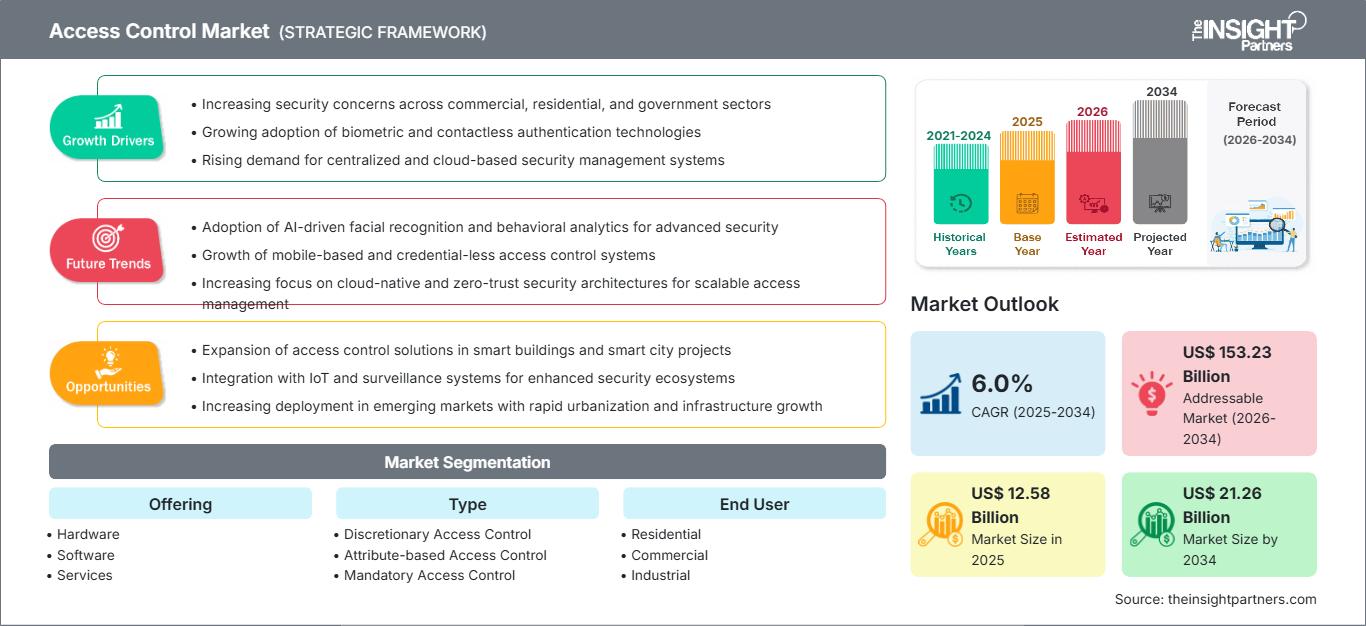
2025 Market Size
US$ 12.58 Bn
Base year value
2034 Forecast
US$ 21.26 Bn
Projected by 2034
CAGR 2026-2034
6.0 %
Growth rate
Addressable Market
US$ 153.23 Bn
(2026-2034)
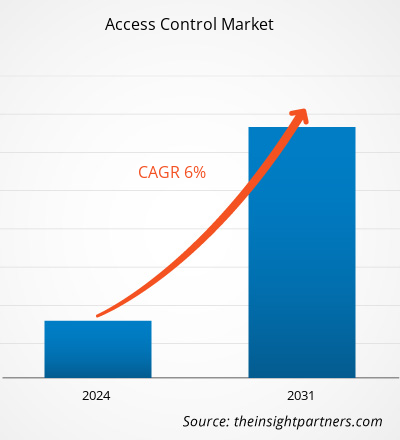
The access control market demand continues to strengthen across commercial buildings, industrial facilities, residential complexes, and government infrastructure as organizations prioritize secure identity verification and facility protection. The market was valued at US$ 21.26 Billion in 2025 and is projected to reach US$ 12.58 Billion by 2034, registering a CAGR of 6.0% during 2026–2034. Increasing integration of cloud-managed security platforms, biometric authentication technologies, and mobile credentials continues to reshape enterprise and institutional security architectures globally.
Across North America, spending on intelligent building infrastructure, critical infrastructure protection, and enterprise security modernization remains a key growth catalyst. The access control market size in the region is supported by increasing deployment of touchless authentication, centralized credential management, and AI-enabled monitoring solutions. Regional adoption is expected to advance at a CAGR of 5.5–6.5% through 2034, reinforced by ongoing investment in healthcare, education, transportation, and government facilities.
Access Control Market Assessment and Insights
- North America: Accounted for 34–38% share in 2025, supported by enterprise digitization, critical infrastructure upgrades, and advanced security technology adoption. Expected CAGR between 2026–2034: 5.5–6.5%.
- US: Represented 78–82% of North American demand in 2025, driven by strong commercial security expenditure, data center expansion, and government modernization programs. Expected CAGR between 2026–2034: 5.7–6.7%.
- Europe: Held 26–30% share in 2025, with Germany, the UK, and France serving as leading markets. Expected CAGR between 2026–2034: 5.2–6.2%.
- Asia Pacific: Captured 28–32% share in 2025, led by China, Japan, India, and South Korea. Infrastructure investment and smart-city deployment support CAGR of 6.8–7.8% during 2026–2034.
- Largest Segment: Hardware maintained 44–48% market share in 2025, driven by extensive installation of readers, controllers, locks, and biometric devices. CAGR between 2026–2034: 5.5–6.5%.
- High Growth Segment: Software represented 22–26% market share in 2025 and is projected to expand at 7.2–8.2% CAGR during 2026–2034, supported by cloud-based management and analytics adoption.
- Key companies analyzed in detail: Honeywell International Inc., dormakaba Holding AG, ASSA ABLOY AB, Johnson Controls International plc, Allegion plc, Nedap N.V., Identiv, Inc., Suprema Inc., Thales S.A., Robert Bosch GmbH.
Source: The Insight Partners' analysis based on proprietary research, government publications, company annual reports, investor presentations, industry databases, and expert interviews.
Enterprise security requirements have evolved beyond traditional card-based entry systems toward connected platforms integrating identity verification, visitor management, surveillance analytics, and cybersecurity controls. Organizations increasingly seek centralized management solutions capable of supporting multiple facilities while enhancing operational visibility. Cloud deployment, biometric authentication, and mobile credential technologies are influencing purchasing decisions across both public and private sectors. These shifts are encouraging providers to develop interoperable ecosystems that combine physical security with digital identity management capabilities.
Looking ahead, access control market expansion is expected to be supported by growing infrastructure investments across Asia Pacific, the Middle East, and selected African economies. Governments continue implementing stricter security standards for transportation networks, healthcare facilities, utilities, and public buildings. Regulatory emphasis on data security and critical infrastructure protection is likely to accelerate deployment of advanced authentication and credential management systems, creating sustained demand throughout the forecast period.
Access Control Market Report Scope
| Report Attribute | Details |
|---|---|
| Market size in 2025 | US$ 12.58 Billion |
| Market Size by 2034 | US$ 21.26 Billion |
| Global CAGR (2025 - 2034) | 6.0% |
| Historical Data | 2021-2024 |
| Forecast period | 2026-2034 |
Access Control Market Analysis
The access control market growth outlook remains favorable as businesses and institutions increase investment in physical security modernization and identity-centric protection strategies. Organizations are focusing on improving facility security while maintaining user convenience through mobile credentials, biometric verification, and cloud-managed access systems. The market ecosystem encompasses hardware manufacturers, software providers, identity specialists, system integrators, and managed security service providers working together to deliver comprehensive solutions. Increasing awareness of personnel safety and facility resilience further supports adoption across commercial, industrial, healthcare, and government sectors.
Demand patterns indicate a stronger preference for scalable architectures capable of integrating with surveillance systems, building automation platforms, and workforce management applications. Organizations are increasingly replacing standalone systems with interoperable environments that provide centralized administration, data visibility, and remote management capabilities. Such developments are supporting recurring software revenues and driving service-related opportunities.
The access control market analysis reveals a competitive environment shaped by technological innovation, platform integration, and strategic acquisitions. Honeywell International Inc. continues expanding intelligent building security capabilities, while ASSA ABLOY AB and Allegion plc focus on digital access ecosystems and credential technologies. Johnson Controls International plc and dormakaba Holding AG are strengthening cloud-connected security portfolios to address evolving enterprise requirements. Competitive positioning increasingly depends on lifecycle services, cybersecurity resilience, and ecosystem interoperability.
Investment priorities continue shifting toward AI-enabled authentication, identity orchestration, and software-driven security management. Suprema Inc. and Thales S.A. are enhancing biometric and digital identity offerings, while Identiv, Inc. and Nedap N.V. focus on credential management and enterprise security innovations. Market participants are emphasizing recurring revenue models and long-term customer engagement through subscription-based platforms and managed services rather than relying solely on hardware sales.
● REPORT CUSTOMIZATION
Tailor This Report To Align With Your Specific Business Requirements
This report can be customized to align precisely with your business objectives, scope, and target markets. Customization options include tailored segmentation, geography, competitive analysis, and strategic insights to support informed decision-making.
Customize This Report →WHAT YOU CAN ADJUST
- ● Segmentations
- ● Geography
- ● Competitive Analysis
- ● Language Preferences
Access Control Market: Strategic Insights
Regional Insights
North America Access Control Market
North America held a 34–38% access control market share in 2025, making it the largest regional contributor. Strong demand originates from commercial real estate, healthcare institutions, transportation infrastructure, educational campuses, and government facilities. Security modernization initiatives continue to drive replacement cycles for legacy systems, while organizations increasingly adopt cloud-managed architectures and biometric authentication solutions. The region is expected to register a CAGR of 5.5–6.5% during 2026–2034.
The presence of leading technology vendors and established system integration networks supports rapid implementation of advanced security solutions. Enterprise investment in digital workplace infrastructure, data centers, and smart building technologies further contributes to market expansion. Organizations are increasingly adopting unified platforms that combine physical access management, surveillance integration, visitor tracking, and identity governance capabilities. Continued cybersecurity concerns and critical infrastructure protection requirements are expected to sustain long-term demand across public and private sectors, reinforcing North America's leadership position during the forecast period.
U.S. Access Control Market
The United States accounted for 78–82% of North American demand in 2025 and is projected to expand at a CAGR of 5.7–6.7% through 2034. Demand remains concentrated across corporate campuses, healthcare facilities, industrial sites, data centers, educational institutions, and federal agencies. Increasing investment in critical infrastructure protection and workforce security management continues to support access technology adoption nationwide.
Major suppliers including Honeywell International Inc., Allegion plc, Johnson Controls International plc, and Identiv, Inc. maintain substantial operational presence across the country. Market demand increasingly favors software-centric platforms offering centralized administration, mobile credentials, biometric verification, and seamless integration with enterprise systems. The growing emphasis on cybersecurity, regulatory compliance, and operational resilience is encouraging organizations to replace traditional systems with more intelligent and scalable security frameworks capable of supporting distributed operations and hybrid work environments.
Europe Access Control Market
Europe represented 26–30% of global demand in 2025 and is expected to grow at a CAGR of 5.2–6.2% through 2034. Germany remains the leading national market due to strong adoption within manufacturing, transportation, healthcare, and commercial infrastructure. Increasing investment in industrial security and smart buildings continues to support technology deployment throughout the region.
The UK has a high demand for commercial building modernization, education, and public infrastructure projects. Germany offers opportunities for automation programs and enhanced corporate security needs. France, Italy, and Spain form a strong opportunity base, driven by transportation modernization, public digital services, hospitality development, and infrastructure modernization projects. Regulations for privacy protection, occupational safety, and critical infrastructure protection are further fueling the adoption of advanced authentication, credential management, and surveillance solutions.
APAC Access Control Market
Asia Pacific accounted for 28–32% of the access control market demand in 2025 and is projected to show the highest growth rate, with a 6.8–7.8% CAGR. China has been the leading regional market due to substantial investments in the development of transport, industry, and urban infrastructure.
India, Japan, South Korea, and Australia have been driving regional growth through smart city initiatives and investments in digital infrastructure. The fast pace of urban and industrial development will continue to create the potential for cloud-based and biometric access control systems.
Middle East & Africa Access Control Market
The Middle East and Africa access control market is forecast to grow at a CAGR of 6.3–7.3% through 2034. Saudi Arabia and the United Arab Emirates remain the leading growth centers due to large-scale smart-city developments, airport projects, and commercial real estate investment.
South Africa and the wider regional market continue to benefit from rising demand for industrial security, utility protection, and government facility modernization. Infrastructure expansion and energy-sector investment remain significant demand drivers across multiple countries.
Segmentation Analysis
Offering
Offering is expected to grow at a CAGR of 6.0%–7.0% from 2026 through 2034. The evolution of the access control market within this category is driven by the trend towards convergence of hardware for physical security, software intelligence, and life cycle services. Companies need a comprehensive approach to increase efficiency, simplify administration, and improve visibility across their dispersed locations. With the acceleration of digital transformation initiatives, software and services are becoming increasingly strategic while hardware remains foundational to system deployment.
- Hardware: Maintains the largest revenue contribution owing to extensive deployment of readers, controllers, biometric terminals, access cards, electronic locks, and authentication devices across commercial, industrial, and public infrastructure environments.
- Software: Growing adoption reflects increased demand for cloud administration, identity management, credential lifecycle control, mobile access provisioning, analytics integration, and centralized monitoring capabilities across multi-site organizations.
- Services: Includes consulting, implementation, system integration, maintenance, managed services, and technical support that enable organizations to optimize performance, security compliance, and long-term operational reliability.
Type
Type is forecast to grow at a CAGR of 5.8-6.8% in the access control industry up to 2034. Access control systems continue to evolve as companies seek an authorization framework that balances security, flexibility, regulatory requirements, and administrative efficiency. Various deployment scenarios call for different degrees of permissions control, hence the need for various authorization approaches. Enterprise digital transformation and identity governance initiatives are further encouraging adoption of sophisticated permission frameworks.
- Discretionary Access Control: Commonly adopted across commercial and educational environments where administrators require flexibility to modify access privileges based on operational requirements and changing organizational structures.
- Attribute-based Access Control: Increasingly utilized in dynamic environments where multiple contextual parameters such as location, device status, time, and user attributes influence authorization decisions.
- Mandatory Access Control: Frequently implemented within government, defense, intelligence, and highly regulated sectors where security policies dictate access rights and administrative discretion remains limited.
- Role-Based Access Control: Widely preferred because permissions can be assigned efficiently according to employee roles, organizational responsibilities, and departmental structures without excessive administrative burden.
End User
End User is expected to record a CAGR of 6.2–7.2% during the forecast period of the access control market. Demand continues expanding across residential, commercial, industrial, and homeland security environments as both public and private organizations increase investments in modern security infrastructure. The segment benefits from rising awareness of facility protection, personnel safety, regulatory compliance, and digital identity management.
- Residential: Growing interest in connected living environments supports adoption of smart locks, mobile-entry systems, cloud-managed credentials, and integrated home automation security solutions.
- Commercial: Represents the largest end-user category due to extensive deployment across office buildings, healthcare facilities, retail establishments, educational campuses, financial institutions, and hospitality properties.
- Industrial: Demand centers on workforce tracking, perimeter security, critical asset protection, contractor management, and operational safety requirements within manufacturing, utilities, logistics, and energy facilities.
- Homeland Security: Driven by border management, government infrastructure protection, defense facilities, emergency response operations, and national security modernization programs requiring advanced verification capabilities.
Opportunity Snapshot
| End User | Revenue Contribution | Trend Tag | Adoption Stage |
| Residential | Medium | Smart Locks | Scaling |
| Commercial | High | Mobile Credentials | Mature |
| Industrial | Medium | Workforce Tracking | Scaling |
| Homeland Security | High | Border Security | Mature |
Access Control Market Growth Drivers and Impact Analysis
Rising Demand for Integrated Physical Security Ecosystems
Unified security platform solutions that offer integrated access control, video surveillance, visitor management, identity management, and operations analysis capabilities are gaining increasing popularity among organizations. The non-integrated approach has its drawbacks as well, such as complicated administration and a lack of situational awareness. Integration of security systems helps reduce response time, streamline compliance reporting, and provide centralized administration of geographically dispersed facilities. The convergence of security systems is especially relevant to commercial businesses, healthcare systems, educational institutions, and transportation firms. There is huge potential in integrating different types of security data, which enables better decision-making, incident analysis, and risk management. The integration of security systems is an essential factor in platform innovation and industry development.
Growth of Biometric and Touchless Authentication Technologies
Advances in biometrics continue to revolutionize physical security systems infrastructure across the world. Facial recognition, fingerprint identification, iris scanning, and multi-biometric authentication systems continue to be deployed to enhance identity verification and minimize reliance on conventional identity proofs. Biometric technologies are preferred by enterprises due to the reduction of risks related to identity proof sharing, loss, duplication, and unauthorized access to sensitive information. Growth in demand continues in hospitals, government agencies, airports, data centers, and corporate environments where identity verification is critical. Increasing sophistication in algorithms, efficiency, and analysis speed, along with low hardware costs, will continue to provide new avenues for biometrics deployment.
Critical Infrastructure Protection and Regulatory Compliance
Organizations such as utilities, transportation companies, manufacturing companies, governmental organizations, and public infrastructure providers continue to increase their security investments due to evolving threats and regulations. The access management system is becoming a component of resilience and risk management programs intended to safeguard personnel, the facility, and operational continuity. The current access management systems can provide audit trails, real-time monitoring, credential management, and centralized incident handling. Regulations on critical infrastructure protection, information security, and workplace safety are prompting many companies to enhance their security infrastructure. Such regulatory requirements typically ensure the sustainability of the business opportunity.
Access Control Market Future Trends
Accelerating Migration Toward Cloud-Native Security Platforms
Cloud deployment models are forecast to fundamentally change how organizations acquire, operate, and scale physical security systems over the next decade. The access control market trends show an observable shift towards remotely managed solutions that enable centralized control, software upgrades, and credential management without requiring much on-premises hardware. Organizations running multiple locations will appreciate scalability and visibility capabilities, as well as reduced maintenance needs. Subscribed software solutions will definitely become more popular due to their predictability and flexibility.
Convergence of Physical Access and Digital Identity Management
The next generation of security plans will see greater alignment between facility access privileges and enterprise digital identity solutions. With this system, users such as employees, contractors, and guests will be able to use credentials valid for both physical locations and online resources. Mobile devices, digital wallets, and biometrics are likely to take over larger portions of access card usage. Organizations can enjoy better governance, greater compliance, and better end-user experiences. In the era of hybrid workplaces, convergence between physical and logical identity management systems will likely become a key aspect of next-generation security architecture.
Access Control Market Opportunities
Expansion Opportunities Across Smart Infrastructure Programs
Governments and private investors continue to allocate substantial resources to smart cities, transportation corridors, healthcare campuses, logistics hubs, and public infrastructure upgrades. These initiatives are becoming increasingly reliant on sophisticated access management systems capable of handling large communities, multiple buildings, and security environments. Companies that have scalable solutions and can operate on an open platform and a cloud-based administration system are well-positioned to secure long-term contracts during the development cycle for such infrastructure. The access control market forecast reveals substantial growth opportunities in the Asia-Pacific and Middle Eastern regions, where urban expansion is a key objective. Apart from the deployment of these systems, vendors may enjoy repeated opportunities from service maintenance, software subscriptions, and identity management.
Rising Revenue Potential in Software and Security Services
The shift from hardware- to software-based security solutions is presenting new profit opportunities for all companies in the market. The requirements for central management, predictive maintenance, cloud analytics, remote credential issuance, and managed security operations that boost efficiency and reduce complexity have led to the growing significance of subscription fees in vendors' business strategies. In other words, businesses that manage to integrate AI-powered analytics, cybersecurity, identity management, and lifecycle services will be able to deliver greater customer loyalty and more stable income. More companies are adopting hybrid work systems and distributed facilities, which is boosting the need for remotely managed software systems. The above-mentioned trends present investment opportunities for global and specialized technology companies.
Frequently Asked Questions

- Comprehensive Market Sizing and Forecast Analysis
- Detailed Segmentation Analysis
- In-Depth Market Dynamics Assessment
- Regional and Country-Level Insights
- Competitive Landscape and Company Benchmarking
- Strategic Business Intelligence
Recent Reports
Testimonials

The Insight Partners provided valuable market intelligence that supported our global go-to-market strategy. Their team was professional, responsive, and attentive to our feedback, providing thoughtful analysis and helpful methodological clarifications throughout the project.
Junmo Kim Chief Financial Officer (CFO), Enertech Co., Ltd.
The Insight Partners' SCADA System Market report is comprehensive, with valuable insights on current trends and future forecasts. The team was highly professional, responsive, and supportive throughout. We are very satisfied and highly recommend their services.
RAN KEDEM Partner, Reali Technologies LTDs
I requested a report on a very specific software market and the team produced the report in a few days. The information was very relevant and well presented. I then requested some changes and additions to the report. The team was again very responsive and I got the final report in less than a week.
JEAN-HERVE JENN Chairman, Future Analytica
We worked with The Insight Partners for an important market study and forecast. They gave us clear insights into opportunities and risks, which helped shape our plans. Their research was easy to use and based on solid data. It helped us make smart, confident decisions. We highly recommend them.
PIYUSH NAGPAL Sr. Vice President, High Beam Global
The Insight Partners delivered insightful, well-structured market research with strong domain expertise. Their team was professional and responsive throughout. The user-friendly website made accessing industry reports seamless. We highly recommend them for reliable, high-quality research services
YUKIHIKO ADACHI CEO, Deep Blue, LLC.
This is the first time I have purchased a market report from The Insight Partners.While I was unsure at first, I visited their web site and felt more comfortable to take the risk and purchase a market report.I am completely satisfied with the quality of the report and customer service. I had several questions and comments with the initial report, but after a couple of dialogs over email with their analyst I believe I have a report that I can use as input to our strategic planning process.Thank you so much for taking the extra time and making this a positive experience.I will definitely recommend your service to others and you will be my first call when we need further market data.
JOHN SUZUKI President and Chief Executive Officer, Board Director, BK Technologies
I wish to appreciate your support and the professionalism you displayed in the course of attending to my request for information regarding to infectious disease IVD market in Nigeria. I appreciate your patience, your guidance, and the fact that you were willing to offer a discount, which eventually made it possible for us to close a deal. I look forward to engaging The Insight Partners in the future, all thanks to the impression you have created in me as a result of this first encounter.
DR CHIJIOKE ONYIA MANAGING DIRECTOR, PineCrest Healthcare Ltd.Reason to Buy
- Informed Decision-Making
- Understanding Market Dynamics
- Competitive Analysis
- Identifying Emerging Markets
- Customer Insights
- Market Forecasts
- Risk Mitigation
- Boosting Operational Efficiency
- Strategic Planning
- Investment Justification
- Tracking Industry Innovations
- Aligning with Regulatory Trends






 Get Free Sample for