
Acoustic Camera Market Demand, Trends & Forecast by 2034
Coverage: By Array Type (2D, 3D); Measurement Type (Far Field, Near Field); Application (Noise Source Identification, Leakage Detection, Others); End User (Automotive, Aerospace, Electronics, Education and Research, Infrastructure, Energy and Power, Others) , and Geography (North America, Europe, Asia Pacific, and South and Central America)
- Status : Data Released
- Report Code : TIPRE00005942
- Category : Electronics and Semiconductor
- No. of Pages : 150
- Available Report Formats :


- Last update date : July 10, 2026


2025 Market Size
US$ 165.21 Bn
Base year value
2034 Forecast
US$ 213.14 Bn
Projected by 2034
CAGR 2026-2034
2.87 %
Growth rate
Addressable Market
US$ 1,717.44 Bn
(2026-2034)
The Acoustic Camera market is valued at US$ 165.21 Billion in 2025 and is projected to reach US$ 213.14 Billion by 2034; it is expected to register a CAGR of 2.87% from 2026 to 2034. The market is expanding as sound visualization becomes essential for noise source identification, leakage detection, product validation, and preventive maintenance across automotive, aerospace, electronics, infrastructure, energy, and research environments.
The North American market is estimated to grow at a CAGR of 2.6% to 3.1%, driven by the increasing adoption of acoustic imaging in manufacturing industries, power generation facilities, research laboratories, and infrastructure organizations for faster fault location. Increased demand for noise assessment of the vehicle components and cab as well as air, gas, steam, and electrical inspection further drives the Acoustic Camera Market deployment
Acoustic Camera Market Assessment and Insights
- North America: Share in 2025 is estimated at 34%–38%, with CAGR between 2026 – 2034 at 2.6%–3.1%, supported by automotive NVH, aerospace testing, leak surveys, industrial reliability, and strong laboratory infrastructure.
- US: Share in 2025 is estimated at 75%–82% of North America, with CAGR between 2026 – 2034 at 2.7%–3.2%, led by mobility, semiconductor, utilities, and research demand.
- Europe: Share in 2025 is estimated at 24%–29%, with CAGR between 2026 – 2034 at 2.4%–2.9%; Germany leads, followed by the UK, France, Italy, and Spain.
- Asia Pacific: Share in 2025 is estimated at 30%–35%, with CAGR between 2026 – 2034 at 3.2%–3.8%; China leads, supported by Japan, South Korea, India, and Australia.
- Largest Segment: Noise Source Identification holds 46%–52% market share in 2025 and a 2.6%–3.0% CAGR, reflecting established use in engineering, compliance, and quality validation.
- High Growth Segment: Leakage Detection holds 24%–29% of the Acoustic Camera market share in 2025 and a 3.4%–4.1% CAGR as energy audits and maintenance teams prioritize visible loss detection.
- Key companies analyzed in detail: Hottinger Brüel & Kjær A/S, CAE Software and Systems GmbH, gfai tech GmbH, Microflown Technologies B.V., Norsonic AS, Siemens Industry Software Inc., SINUS Messtechnik GmbH, SM Instruments Co., Ltd., Sorama B.V., Wibro-Akustyka Sp. z o.o., SONOTEC GmbH, and CRYSOUND Co., Ltd.
Source: The Insight Partners' analysis based on proprietary research, government publications, company annual reports, investor presentations, industry databases, and expert interviews.
The market has progressed from specialized beamforming devices used in laboratories to portable tools used in industry to convert sound fields into visual evidence. Changes have occurred in production processes owing to the incorporation of MEMS microphones, processor chips, thermal overlay, and reporting software, which simplify the device. The Acoustic Camera size is an indicator of its wider adoption, whereas acoustic imaging is now being acquired by reliability engineers, energy managers, universities, and product developers.
Future demand will be driven by the industrialization of Asia Pacific, energy efficiency initiatives in North America, and environmental noise regulation in Europe. The report from the European Environment Agency in 2025 noted that nearly one in five Europeans are at risk of hazardous transport noise, thereby adding credibility to the importance of acoustics in planning and remediation. Financial focus will be on robust equipment, artificial intelligence classification, cloud-based reports, and service-based deployments.
Acoustic Camera Market Report Scope
| Report Attribute | Details |
|---|---|
| Market size in 2025 | US$ 165.21 Billion |
| Market Size by 2034 | US$ 213.14 Billion |
| Global CAGR (2026 - 2034) | 2.87% |
| Historical Data | 2021-2024 |
| Forecast period | 2026-2034 |
Acoustic Camera Market Analysis
Demand in the Acoustic Camera Market is driven by the need to locate abnormal sound faster than manual inspection or conventional sound meters allow. Automotive teams use systems for electric vehicle sound quality, buzz, squeak, and rattle correction. Energy, utilities, and facilities teams use acoustic imaging to identify compressed-air, gas, vacuum, steam, and electrical discharge signals that are difficult to isolate in noisy plants.
The value chain is made up of microphone arrays, optical cameras, MEMS-based sensors, beamforming algorithms, calibration, embedded computing, visualization software, analytics, training, and inspection services. The market dynamics will benefit those suppliers who can offer solutions that simplify fieldwork without compromising on frequency range and localization capabilities. The results from an Acoustic Camera study reveal that purchasing is becoming more and more outcome driven.
The competitive landscape is specialized rather than fragmented. Hottinger Brüel & Kjær A/S, Siemens Industry Software Inc., gfai tech GmbH, Norsonic AS, and Microflown Technologies B.V. serve engineering and testing users, while SONOTEC GmbH, CRYSOUND Co., Ltd., SM Instruments Co., Ltd., and Sorama B.V. strengthen portable, industrial, and monitoring applications. Competitive positioning depends on array design, usability, software depth, and service coverage.
The investment trends center on handheld acoustic imagers, AI-based sound classification, leak-loss calculations, partial-discharge notifications, and maintenance system integration. The Acoustic Camera market share of the dominant brands depends on technological superiority; however, customers are now considering real-world usability aspects like time needed for training, robustness, battery capacity, reporting capabilities, and calibration on-site. The strategic success stories combine visualization with financial, safety, and reliability results.
● REPORT CUSTOMIZATION
Tailor This Report To Align With Your Specific Business Requirements
This report can be customized to align precisely with your business objectives, scope, and target markets. Customization options include tailored segmentation, geography, competitive analysis, and strategic insights to support informed decision-making.
Customize This Report →WHAT YOU CAN ADJUST
- ● Segmentations
- ● Geography
- ● Competitive Analysis
- ● Language Preferences
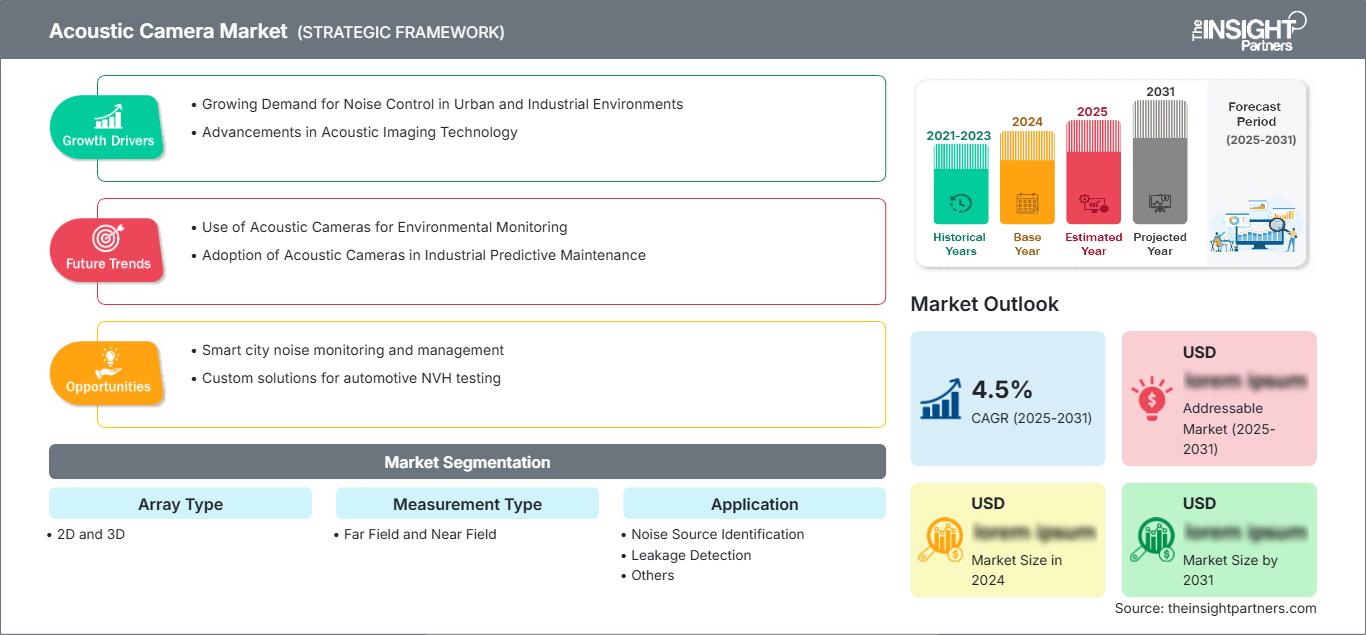
Acoustic Camera Market: Strategic Insights
Regional Insights
North America Acoustic Camera Market
North America holds a 34%–38% share in 2025 and is projected to grow at a 2.6%–3.1% CAGR. The demand is driven by applications in automotive NVH laboratories, aerospace certification, semiconductor manufacturing, power generation companies, and industry reliability initiatives. The Acoustic Camera Market will receive a boost from mature test environments, existing service providers, and customers' readiness to identify faults through visualization prior to repairs.
The factors leading to demand include electrified transport, workplace noise control, air-compression efficiency initiatives, and aging infrastructure that requires rapid diagnosis. The continued IEA interest in industry energy efficiency makes leakage reduction an operational necessity. In terms of regional consumers, durability and portability tend to be valued in mobile units, while high channel numbers tend to be valued in engineering applications.
U.S. Acoustic Camera Market
The U.S. accounts for 75%–82% of North America’s 2025 demand and is estimated to grow at a 2.7%–3.2% CAGR. Application trends are concentrated in electric vehicle acoustics, aerospace production, electronics cooling systems, power generation, HVAC commissioning, and university research. Noise source identification remains the leading use case, while leakage detection is expanding through maintenance and energy teams.
Company presence is evident from their testing laboratories, distributors, and industrial users who implement the systems provided by Hottinger Brüel & Kjær A/S, Siemens Industry Software Inc., SONOTEC GmbH, CRYSOUND Co., Ltd., and Norsonic AS. American consumers tend to evaluate accuracy and usability together, as acoustic diagnosis technologies transition from specialized measurements to routine field tests and warranty documentation.
Europe Acoustic Camera Market
Europe represents 24%–29% share in 2025 and is projected to expand at a 2.4%–2.9% CAGR, with Germany leading. The UK is a proponent of adoption of acoustic visualization in aerospace, utilities, railways, universities, and building services, where it can be used to detect mechanical, leak, and environmental noise. Public noise issues and effects on health increase the need for verifiable acoustic data.
Germany is the strongest economy in the area due to its expertise in automotive design, industrial machines, electronics, and engineering universities. The current trends in the Acoustic Camera market in Germany focus on repeatability, high frequencies, and engineering processes. Research facilities and established suppliers provide room for development of beamforming techniques, while machinery manufacturers and electric vehicle projects drive the demand for near-field and far-field solutions.
The contribution from France, Italy, and Spain comes from the aerospace, railway, manufacturing, energy, and urban infrastructure sectors. In France, there is strong interest in transportation and government noise-reduction programs; in Italy, there is demand for machinery and HVAC diagnostics; and in Spain, the added value comes from energy, airports, and city infrastructure. The European buyer cares about credibility, calibration, support, and appropriate reports.
APAC Acoustic Camera Market
APAC accounts for 30%–35% share in 2025 and grows at a 3.2%–3.8% CAGR. China leads because of industrial scale, EV manufacturing, electronics, power infrastructure, and smart-city programs. Acoustic Camera growth is tied to quality control, leak reduction, and faster localization of faults in dense manufacturing settings.
Premium usage is supported by Japan and South Korea in the auto, robotics, electronics, and precision manufacturing industries. India is building up demand as its factories upgrade their maintenance processes and expand HVAC, energy, and transportation infrastructure. Australia adds to the effort through mining, utilities, universities, and public infrastructure.
The factors that drive policy and industry initiatives are automation, energy savings, grid stability, and city noise control. The advanced countries tend to like high-end systems, whereas the developing countries are interested in portables with straightforward reporting capabilities. The speed of adoption will depend on training and distribution support.
Middle East & Africa Acoustic Camera Market
The Middle East & Africa market is estimated to grow at a 2.5%–3.0% CAGR. Saudi Arabia leads because oil and gas, petrochemicals, power, desalination, and infrastructure projects create acoustic inspection needs. The UAE adds airports, commercial buildings, district cooling, and smart facilities.
There is predominance of energy & infrastructure applications. Acoustic cameras are used to sense the presence of compressed air, gas, steam, vacuum, and electric discharge without shutting down the machines. Visual confirmation is highly preferred by operators because it enables prioritization of maintenance for noisy facilities such as refineries, utilities, cooling systems, and power plants.
The potential for South Africa and other MEA regions lies in mining, manufacturing, airports, education, and utilities. Budget constraints may hamper acquisition, but portability combined with training, calibration, and local servicing will turn infrastructure needs into repeatable inspection programs.
Segmentation Analysis
Array Type
Array type is projected to grow at a 2.8%–3.2% CAGR as buyers balance cost, field usability, and spatial accuracy. The Acoustic Camera scope differs by array geometry: 2D systems serve routine visualization and education, while 3D systems support complex environments where depth, overlapping sources, and multi-directional sound fields affect diagnosis.
- 2D: 2D acoustic cameras remain relevant for routine inspections, education, and cost-sensitive applications where operators need clear sound visualization without the complexity of advanced spatial mapping.
- 3D: 3D acoustic cameras support complex environments by improving depth perception, source localization, and analysis of overlapping sound fields in automotive, aerospace, infrastructure, and industrial testing.
Measurement Type
Measurement type is expected to grow at a 2.7%–3.1% CAGR as users select systems according to distance, asset size, and inspection setting. Far-field measurement supports vehicles, aircraft, buildings, and large equipment, while near-field measurement enables detailed component analysis, leak localization, and laboratory validation in constrained spaces.
- Far Field: Far-field measurement is used for vehicles, aircraft, industrial halls, public infrastructure, and large equipment where noise sources must be identified from a practical distance.
- Near Field: Near-field measurement supports component testing, leak localization, laboratory analysis, and confined inspections where close-range acoustic detail improves diagnosis and corrective action.
Application
Application demand is projected to grow at a 2.9%–3.4% CAGR, led by noise source identification and supported by leakage detection. Users adopt acoustic imaging when sound problems are intermittent, hidden, or costly to locate. The segment benefits from stronger reporting requirements and the need to connect acoustic evidence with corrective actions.
- Noise Source Identification: Noise source identification leads adoption as engineers use acoustic images to locate vibration, airflow, mechanical friction, and design-related sound problems faster.
- Leakage Detection: Leakage detection is scaling across compressed air, gas, steam, vacuum, and HVAC systems where visualized ultrasonic signals help reduce energy waste and safety risks.
End User
End user demand is forecast to grow at a 2.8%–3.3% CAGR as acoustic imaging becomes relevant to engineering, maintenance, infrastructure, and research budgets. Automotive and energy users contribute high revenue intensity, while electronics, aerospace, education, infrastructure, and power applications broaden the installed base across both premium and portable systems.
- Automotive: Automotive users apply acoustic cameras for electric vehicle sound quality, cabin refinement, component noise, production troubleshooting, and regulatory or brand-driven acoustic targets.
- Aerospace: Aerospace applications include engine testing, cabin acoustics, structural diagnostics, ground support equipment, and localization of abnormal sound in high-value, safety-sensitive environments.
- Electronics: Electronics manufacturers use acoustic cameras to diagnose fans, coils, drives, circuit noise, and product defects where compact components create difficult-to-isolate sound patterns.
- Education and Research: Education and research users value acoustic cameras for experiments, demonstrations, material studies, environmental acoustics, and training that converts invisible sound into visual evidence.
- Infrastructure: Infrastructure applications include bridges, rail assets, tunnels, buildings, airports, and public facilities where acoustic visualization supports maintenance, noise control, and asset monitoring.
- Energy and Power: Energy and power users deploy acoustic cameras for leakage detection, partial discharge inspection, turbine diagnostics, plant maintenance, and reliability programs across critical assets.
Opportunity Snapshot
| End User | Revenue Contribution | Trend Tag | Adoption Stage |
| Automotive | High | EV Acoustics | Mature |
| Aerospace | Medium | Cabin Noise | Scaling |
| Electronics | Medium | Miniaturization | Scaling |
| Education and Research | Low | Acoustic Labs | Emerging |
| Infrastructure | Medium | Asset Monitoring | Scaling |
| Energy and Power | High | Leak Reduction | Scaling |
Acoustic Camera Market Growth Drivers and Impact Analysis
Noise compliance and product refinement intensify acoustic testing
Noise control has become an engineering, health, and compliance problem that is quantifiable rather than simply a comfort problem. According to the 2025 report by the European Environment Agency, 92 million Europeans are exposed to road traffic noise above the END level of 55 dB, whereas transport noise leads to 73,000 deaths per year in Europe. This has increased the need for tools to detect precise sources rather than merely measure ambient levels. Acoustic cameras assist engineers in detecting airflow, vibration, friction, and sound from vehicles, machines, HVAC systems, aircraft cabins, and infrastructure designs.
Leakage detection links acoustic imaging to measurable savings
The scope for leakage detection increases because acoustic cameras use ultrasonic waves to detect leaks in compressed air, gases, steam, vacuum, and refrigerants, making them visible as maintenance issues. Industrial compressed air systems may result in significant energy waste due to undetected leaks, and there is a growing need for inspection devices that can operate even in noisy facilities without downtime. Leak loss calculation features, adjustable filters, and the ability to create report files enable maintenance staff to prioritize repairs based on their impact on operations. This driver is closely linked to energy efficiency investments, sustainability reports, and safety management initiatives.
Portable systems make acoustic diagnostics accessible to non-experts
Acoustic imaging portable equipment is increasing its range of users from specialized acousticians to maintenance technicians, facility managers, teachers, and field-service personnel. Previous models needed to be tested under controlled conditions with expert interpretation and justifiable capital costs. Modern portable equipment combines MEMS array, optical camera, touch screen, frequency filters, templates, and auto report generating that decrease training periods. The buying process is altered since acoustic imaging may be a routine procedure instead of a project-based one. The real-world market impact is wider deployment in mid-sized plants, commercial facilities, utilities, universities, and service contractors, supporting hardware sales, calibration, training, software upgrades, and repeat audit programs, reinforcing the positive Acoustic Camera Market Forecast.
Acoustic Camera Market Future Trends
AI-enabled sound classification will reshape inspection workflows
AI-enabled classification will shape the next phase of the Acoustic Camera Market by helping users move from visual detection to diagnosis support. The next generation of these systems is expected to categorize air leaks, gas leaks, partial discharges, bearing failures, turbulent airflow, and vibrations with confidence levels. This will streamline the interpretation process for non-expert personnel and ensure more consistent results across multi-site inspection procedures. The greatest benefit will arise when AI remains transparent, allows for manual checks, and learns from diverse field conditions. Such vendors will be able to enhance their reliability and energy workflows by using acoustic imaging techniques.
Acoustic data will integrate with maintenance and energy platforms
Acoustic data will increasingly connect with computerized maintenance management systems, energy dashboards, asset performance platforms, and digital inspection records. This is significant since while acoustic images alone may be valuable, combined recordings can provide information on location, seriousness, the state of repairs, and even pre- and post-validation. Future users would look for solutions that can export data, calculate leak losses, and run on cloud platforms, in line with Acoustic Camera Market Trends. In industries such as manufacturing and infrastructure, integration would enable better root cause analysis and maintenance planning. For the energy and power sectors, integration would tie inspection activities to cost savings.
Acoustic Camera Market Opportunities
Leak audit services for energy-intensive industrial facilities
Leak audit services present an actionable opportunity because many energy-intensive facilities recognize losses but lack a repeatable way to locate, document, and verify repairs. Acoustic Imaging can be offered alongside technician training, surveys, leak classifications, maintenance recommendations, and additional inspection visits. Potential clients might be industrial sites, utilities, refineries, district cooling systems, hospitals, airports, and corporate campuses. The offer is attractive as it frames the purchase of the product in terms of outcomes rather than features, thereby helping the Acoustic Camera Market Size grow in the coming years. The vendors can earn more money by introducing calibration, software, audits, and even company-wide efforts that help detect and fix any leaks.
Acoustic imaging for electric vehicle and HVAC sound engineering
Electric vehicles and advanced HVAC systems create a focused opportunity because quieter platforms make small noises more noticeable to customers and engineers. Acoustic cameras are capable of visualizing noise sources like inverter whining, fan imbalance, flow turbulence, compressor noise, panel vibrations, and cabin acoustics in various stages including design, validation, and troubleshooting. The funding must be directed towards automotive test facilities, component manufacturers, HVAC manufacturers, appliance manufacturers, and research institutions with application-specific package offerings. Such packages could comprise near-field and far-field systems, among other items. The opportunity is durable because acoustic testing repeats through prototyping, production quality, warranty analysis, and service improvement, supporting the long-term Acoustic Camera Market Forecast.
Recent Developments
- October 2025: CRYSOUND Co., Ltd. launched the CRY8500 Series SonoCam Pi Acoustic Camera during its Global New Product Launch in Hangzhou, alongside new data acquisition, calibration, and Bluetooth audio products. The event highlighted acoustic imaging, sound calibration, and testing technologies for global customers and partners.
- September 2025: FOTRIC unveiled the TD2 Acoustic Camera for smarter leak detection and everyday maintenance, positioning the compact device for industrial teams needing simplified acoustic imaging. The launch emphasized leak detection, portability, and maintenance usability for facilities seeking practical tools to identify compressed-air and gas leaks.
- June 2024: SONOTEC GmbH presented the SONASCREEN 2 Acoustic Camera with 176 microphones, frequency coverage up to 100 kHz, real-time acoustic photos and videos, leak loss display, partial discharge evaluation, and a 7-inch multi-touch interface designed for industrial maintenance, electrical inspection, compressed-air systems, and tightness testing.
Frequently Asked Questions

- Comprehensive Market Sizing and Forecast Analysis
- Detailed Segmentation Analysis
- In-Depth Market Dynamics Assessment
- Regional and Country-Level Insights
- Competitive Landscape and Company Benchmarking
- Strategic Business Intelligence
Recent Reports
Testimonials

The Insight Partners' SCADA System Market report is comprehensive, with valuable insights on current trends and future forecasts. The team was highly professional, responsive, and supportive throughout. We are very satisfied and highly recommend their services.
RAN KEDEM Partner, Reali Technologies LTDs
I requested a report on a very specific software market and the team produced the report in a few days. The information was very relevant and well presented. I then requested some changes and additions to the report. The team was again very responsive and I got the final report in less than a week.
JEAN-HERVE JENN Chairman, Future Analytica
We worked with The Insight Partners for an important market study and forecast. They gave us clear insights into opportunities and risks, which helped shape our plans. Their research was easy to use and based on solid data. It helped us make smart, confident decisions. We highly recommend them.
PIYUSH NAGPAL Sr. Vice President, High Beam Global
The Insight Partners delivered insightful, well-structured market research with strong domain expertise. Their team was professional and responsive throughout. The user-friendly website made accessing industry reports seamless. We highly recommend them for reliable, high-quality research services
YUKIHIKO ADACHI CEO, Deep Blue, LLC.
This is the first time I have purchased a market report from The Insight Partners.While I was unsure at first, I visited their web site and felt more comfortable to take the risk and purchase a market report.I am completely satisfied with the quality of the report and customer service. I had several questions and comments with the initial report, but after a couple of dialogs over email with their analyst I believe I have a report that I can use as input to our strategic planning process.Thank you so much for taking the extra time and making this a positive experience.I will definitely recommend your service to others and you will be my first call when we need further market data.
JOHN SUZUKI President and Chief Executive Officer, Board Director, BK Technologies
I wish to appreciate your support and the professionalism you displayed in the course of attending to my request for information regarding to infectious disease IVD market in Nigeria. I appreciate your patience, your guidance, and the fact that you were willing to offer a discount, which eventually made it possible for us to close a deal. I look forward to engaging The Insight Partners in the future, all thanks to the impression you have created in me as a result of this first encounter.
DR CHIJIOKE ONYIA MANAGING DIRECTOR, PineCrest Healthcare Ltd.Reason to Buy
- Informed Decision-Making
- Understanding Market Dynamics
- Competitive Analysis
- Identifying Emerging Markets
- Customer Insights
- Market Forecasts
- Risk Mitigation
- Boosting Operational Efficiency
- Strategic Planning
- Investment Justification
- Tracking Industry Innovations
- Aligning with Regulatory Trends





 Get Free Sample for