
Acoustic Wave Sensor Market Demand, Size & Forecast by 2034
Acoustic Wave Sensor Market Size and Forecasts (2021 - 2034), Global and Regional Share, Trends, and Growth Opportunity Analysis Report Coverage : By Type (Saw Sensors, Baw Sensors), Device (Resonators, Delay Lines), Sensing Parameter (Temperature, Pressure, Humidity, Chemical Vapor/Gas, Torque, Mass, Viscosity, Others), Vertical (Military, Automotive, Industrial, Healthcare, Food & Beverages, Environment, Others)
- Status : Data Released
- Report Code : TIPRE00039699
- Category : Electronics and Semiconductor
- No. of Pages : 150
- Available Report Formats :


- Last update date : July 16, 2026


2025 Market Size
US$ 1.77 Bn
Base year value
2034 Forecast
US$ 4.37 Bn
Projected by 2034
CAGR 2026-2034
10.57 %
Growth rate
Addressable Market
US$ 27.22 Bn
(2026-2034)
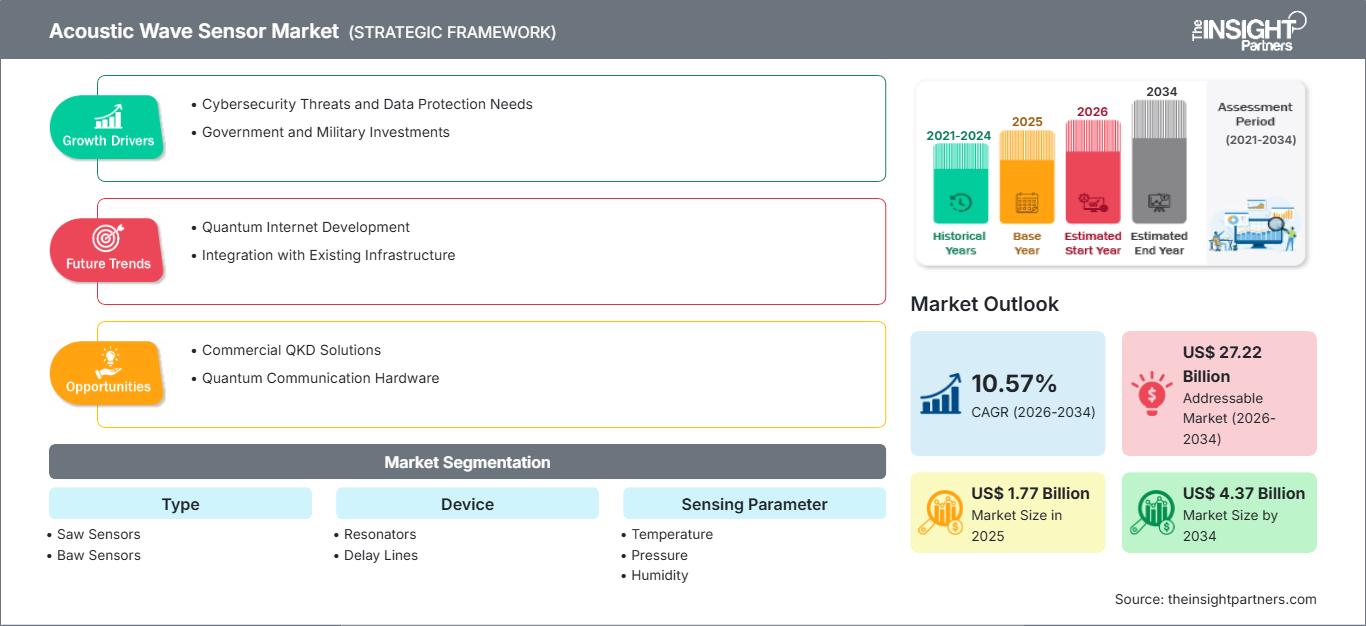
The Acoustic Wave Sensor Market was valued at USD 1.77 Billion in 2025 and is projected to reach USD 4.37 Billion by 2034, advancing at a CAGR of 10.57% from 2026 to 2034. The market will be driven by compact, passive, wireless, and sensitive sensor platforms in automotive safety applications, industrial monitoring, diagnostic testing in healthcare, environmental surveillance, food quality control, and military surveillance systems.
North America is forecasted to grow at a CAGR of 9.8%–10.8% driven by modernization of defense equipment, connectivity in vehicles, industrial automation, and sensor applications in medical and environmental systems. The region’s ability to undertake research and development, along with the use of MEMS technology and need for wireless sensors in severe environments, boosts commercialization chances.
Acoustic Wave Sensor Market Assessment and Insights
- North America: The region held an estimated 35%–40% share in 2025 and is growing at a CAGR range of 9.8%–10.8% during 2026–2034, supported by defense electronics, connected mobility, and industrial reliability programs.
- US: The country accounted for 72%–78% of North American demand in 2025 and is growing at a CAGR range of 10%–11% during 2026–2034, driven by defense, EV, and industrial IoT use cases.
- Europe: Europe held 25%–30% share in 2025 and is growing at a CAGR range of 9%–10% during 2026–2034, led by Germany, the UK, France, Italy, and Spain.
- Asia Pacific: APAC held 30%–35% share in 2025 and is growing at a CAGR range of 11%–12% during 2026–2034, led by China, Japan, South Korea, India, and Australia.
- Largest Segment: SAW Sensors represented 60%–65% market share in 2025 and is growing at a CAGR range of 10%–11% during 2026–2034, supported by compact wireless sensing adoption.
- High Growth Segment: BAW Sensors held 35%–40% market share in 2025 and is growing at a CAGR range of 11%–12% during 2026–2034, supported by miniaturized high-frequency sensing demand.
- Key companies analyzed in detail: Althen GmbH, NanoTemper Technologies GmbH, H. Heinz Meßwiderstände GmbH, Transense Technologies Plc, Pro-Micron GmbH & Co. KG, Vectron International Inc., Qualtre Inc., Senseor SAS, Sensor Technology Ltd., Hawk Measurement Systems
Source: The Insight Partners' analysis based on proprietary research, government publications, company annual reports, investor presentations, industry databases, and expert interviews.
The Acoustic Wave Sensor Market has transitioned from frequency control components to multi-functional sensors that can detect changes in temperature, pressure, gas, humidity, mass, torque, and viscosity with great accuracy. The increasing importance of SAW and BAW sensors is attributable to the fact that certain types of sensors can operate wirelessly, be packaged in smaller sizes, and have responses in rotating devices and inaccessible equipment where other sensors lack endurance.
The forward outlook is shaped by the factors of miniaturization, radio frequency integration, networked sensors with analysis capability, and increased demand from Asia-Pacific manufacturing belts, North American defense applications, and European industrial automation. The regulatory focus on worker safety, emissions monitoring, reliability testing for vehicles, and medical diagnostics is broadening the Acoustic Wave Sensors Market horizon. The players with proven packaging expertise, material science, and application-oriented engineering skills will have an edge over others.
Acoustic Wave Sensor Market Report Scope
| Report Attribute | Details |
|---|---|
| Market size in 2025 | US$ 1.77 Billion |
| Market Size by 2034 | US$ 4.37 Billion |
| Global CAGR (2026 - 2034) | 10.57% |
| Historical Data | 2021-2024 |
| Forecast period | 2026-2034 |
Acoustic Wave Sensor Market Analysis
Acoustic Wave Sensor Market dynamics have been shaped by the integration of MEMS manufacturing technologies, wireless sensing, and industrial digitalization. These devices transform surface or bulk waves into electronic signals and can be used for non-contact measurements in places where electronics would be too expensive or difficult to install. There is a growing need in areas where system reliability, process integrity, and operational information are crucial.
Supply chain participants include providers of piezoelectric materials, wafer processers, manufacturers of RF components, sensor designers, packaging providers, systems integrators, and original equipment manufacturers. Resonators and delay lines continue to be the main device types, but the sensors' sensing layers define the selectivity toward gases, vapors, humidity, and mass loading. This supply chain rewards those who provide good stability of frequency response, low drift, and packaging for field use.
The competition level is specialized with existing sensor manufacturing companies competing along with the RF device manufacturers and MEMS innovators. Althen GmbH and H. Heinz Meßwiderstände GmbH provide assistance to meet precise sensing requirements, whereas Transense Technologies Plc and Pro-Micron GmbH & Co KG are linked with wireless torque and industrial sensing applications. Vectron International Inc., Qualtre Inc., SENSeOR SAS, Sensor Technology Ltd. and Hawk Measurement Systems help add more players to the competitive landscape.
The investment focus will be on systems operating at high temperatures, coating chemistry, low-power receivers, RF front ends, and sensor networks capable of analytics. The strategic positioning will require relationships with the design-in of automotive, military, industrial, and health care customers. Companies that can simplify the calibration process, demonstrate long-term stability, and package acoustic wave devices for field use will likely be more valuable than those relying solely on component costs.
● REPORT CUSTOMIZATION
Tailor This Report To Align With Your Specific Business Requirements
This report can be customized to align precisely with your business objectives, scope, and target markets. Customization options include tailored segmentation, geography, competitive analysis, and strategic insights to support informed decision-making.
Customize This Report →WHAT YOU CAN ADJUST
- ● Segmentations
- ● Geography
- ● Competitive Analysis
- ● Language Preferences
Acoustic Wave Sensor Market: Strategic Insights
Regional Insights
North America Acoustic Wave Sensor Market
North America Acoustic Wave Sensor Market is projected to record a CAGR of about 9.8%–10.8%, underpinned by defense electronics, connected mobility, semiconductor R&D, and industrial reliability programs. The region benefits from early adoption of MEMS sensors, strong university-industry collaboration, and high demand for wireless sensing in aerospace, process automation, and critical infrastructure.
Drivers in structural category involve increased safety monitoring, use of predictive maintenance, and robustness of sensors required in rotating and sealed systems. Monitoring of the tire pressure of the automotive industry, gas sensing and equipment monitoring are some of the applications that continue to provide significant demand channels. The procurement decision is inclined towards reliability, compatibility with cyber security and engineering support.
U.S. Acoustic Wave Sensor Market
The U.S. Acoustic Wave Sensor Market is estimated to grow at a CAGR near 10%–11% and account for roughly 72%–78% of North American demand. Adoption is supported by defense procurement, EV and connected vehicle programs, industrial IoT deployment, and biomedical research that requires compact, sensitive, label-free sensing methods.
Company presence spans sensor integrators, RF component suppliers, and application developers serving automotive, aerospace, environmental, and healthcare users. Vectron International Inc. and Qualtre Inc. are relevant to the U.S. technology base, while demand is expanding in pressure sensing, gas monitoring, viscosity measurement, and wireless condition monitoring for assets where maintenance access is limited.
Europe Acoustic Wave Sensor Market
Europe Acoustic Wave Sensor Market holds an estimated 25%–30% global share and is expected to expand at a CAGR of approximately 9%–10%. Germany is the leading country, supported by automotive engineering, industrial automation, and advanced sensor manufacturing. Regional demand is reinforced by energy efficiency, process safety, and environmental compliance priorities.
The UK market is shaped by defense electronics, aerospace monitoring, and industrial asset management. Acoustic wave sensors are gaining relevance in wireless torque measurement, gas detection, and high-temperature monitoring. Transense Technologies Plc and Sensor Technology Ltd. reflect the country’s applied engineering base, especially where precision sensing is required in demanding environments.
Germany benefits from a strong industrial machinery and automotive supply chain, with Althen GmbH, H. Heinz Meßwiderstände GmbH, and Pro-Micron GmbH & Co KG supporting specialized sensing needs. France, Italy, and Spain are advancing through environmental monitoring, food processing quality control, and industrial modernization, although commercialization remains more application-specific than volume-led, contributing to long-term Acoustic Wave Sensor Market Size expansion.
APAC Acoustic Wave Sensor Market
APAC Acoustic Wave Sensor Market is expected to be the fastest-growing region, with a CAGR of around 11%–12% and an estimated 30%–35% global share. China is the leading country, supported by electronics manufacturing, EV production, industrial automation, and environmental monitoring needs. Regional policy support for smart factories and clean technology accelerates adoption.
Japan and South Korea contribute through precision electronics, RF components, automotive systems, and semiconductor-linked innovation. Acoustic wave sensors are relevant for miniaturized pressure, gas, and chemical vapor detection, particularly in high-reliability manufacturing settings. Their role in wireless monitoring aligns with factory automation and quality assurance programs across advanced production ecosystems.
India and Australia are emerging through infrastructure monitoring, mining automation, healthcare diagnostics, and environmental surveillance. India’s electronics manufacturing incentives and industrial digitization create demand for cost-effective sensing platforms, while Australia’s mining, water management, and energy sectors require rugged monitoring solutions. APAC growth is therefore both manufacturing-led and application-led.
Middle East & Africa Acoustic Wave Sensor Market
Middle East & Africa Acoustic Wave Sensor Market is projected to grow at a CAGR of roughly 8%–9%, led by Saudi Arabia. Demand is tied to oil and gas monitoring, water infrastructure, smart city projects, and industrial safety. Wireless and passive sensing features are attractive where assets operate in remote, hot, or hazardous environments.
Saudi Arabia and the UAE are investing in energy diversification, downstream processing, and infrastructure modernization, creating opportunities for pressure, temperature, gas, and corrosion-adjacent sensing. Acoustic wave devices can support predictive maintenance and environmental monitoring in refineries, pipelines, utilities, and transport networks where continuous measurement improves reliability and compliance.
South Africa and the rest of MEA show gradual adoption in mining, food processing, healthcare, and municipal infrastructure. Budget sensitivity encourages durable, low-maintenance solutions rather than complex sensor networks. Growth will depend on local integration capability, distributor partnerships, and demonstration of field durability under dust, heat, vibration, and inconsistent connectivity.
Segmentation Analysis
Type
Type is growing at a CAGR range of 10%–11% during 2026–2034, supported by adoption of SAW and BAW architectures across automotive, industrial, defense, healthcare, and environmental systems. The segment benefits from miniaturized piezoelectric platforms, wireless interrogation, rugged packaging, and demand for sensing methods that perform reliably where heat, vibration, contamination, or sealed operating conditions constrain conventional electronics.
- Saw Sensors: SAW sensors lead adoption because they support compact, cost-efficient, and wireless sensing formats for temperature, pressure, torque, and gas detection across automotive and industrial systems.
- Baw Sensors: BAW sensors are gaining importance in high-frequency, miniaturized, and precision applications where stronger signal stability, compact packaging, and advanced RF integration are required.
Device
Device is growing at a CAGR range of 9%–10% during 2026–2034 as resonators and delay lines remain central to acoustic wave measurement architectures. Adoption is shaped by the need for stable frequency response, low drift, compact integration, and wireless readout capability in rotating, sealed, high-temperature, or difficult-to-access equipment across industrial, automotive, and process monitoring applications.
- Resonators: Resonators are widely used where frequency shifts provide precise measurement of mass loading, temperature, pressure, or chemical interaction in compact sensing architectures.
- Delay Lines: Delay lines are preferred for wireless interrogation and time-delay-based measurement, supporting passive sensing in rotating, sealed, or difficult-to-access industrial environments.
Sensing Parameter
Sensing Parameter is growing at a CAGR range of 10%–11% during 2026–2034 as acoustic wave platforms address temperature, pressure, humidity, gas, torque, mass, and viscosity measurement requirements. Growth is supported by selective coatings, improved signal processing, and expanding use in predictive maintenance, emissions monitoring, laboratory analytics, food processing, and healthcare diagnostics where sensitivity and compactness are strategic advantages.
- Temperature: Temperature sensing benefits from acoustic wave stability in harsh settings, supporting industrial furnaces, engines, power systems, and process environments where wired sensors face reliability constraints.
- Pressure: Pressure measurement is important in tires, hydraulics, industrial equipment, and medical devices, where compact acoustic wave formats improve responsiveness and integration flexibility.
- Humidity: Humidity sensing uses surface interaction with sensitive coatings, enabling compact monitoring in food processing, environmental systems, electronics storage, and controlled manufacturing spaces.
- Chemical Vapor/Gas: Chemical vapor and gas sensing relies on selective coatings that alter acoustic wave behavior, supporting environmental surveillance, industrial safety, healthcare screening, and defense detection.
- Torque: Torque sensing is a high-value application for wireless SAW systems, especially in rotating shafts, drivetrain components, turbines, and industrial machinery requiring non-contact monitoring.
- Mass: Mass sensing supports biosensing, thin-film monitoring, and analytical applications where small surface changes produce measurable frequency shifts with high sensitivity.
- Viscosity: Viscosity measurement is relevant in process industries, food production, and fluid monitoring, where acoustic response helps track material consistency without intrusive sampling.
Vertical
Vertical is growing at a CAGR range of 10%–11% during 2026–2034 as military, automotive, industrial, healthcare, food and beverage, and environmental users adopt acoustic wave sensing for reliability, safety, and operational intelligence. The segment reflects strong Acoustic Wave Sensor Market growth because each vertical values compact, rugged, and high-sensitivity measurement differently, creating multiple application-specific demand pathways.
- Military: Military applications prioritize rugged, passive, and secure sensing for equipment health, chemical detection, environmental monitoring, and mission-critical systems operating under extreme conditions.
- Automotive: Automotive demand is driven by tire pressure monitoring, torque sensing, emissions systems, EV components, and safety features requiring compact, reliable, and wireless sensor integration.
- Industrial: Industrial users apply acoustic wave sensors for predictive maintenance, process control, pressure monitoring, viscosity tracking, and temperature measurement in harsh or inaccessible equipment.
- Healthcare: Healthcare adoption is emerging in biosensing, diagnostics, respiratory monitoring, and lab-on-chip platforms where high sensitivity and miniaturization can improve analytical performance.
- Food & Beverages: Food and beverage applications use acoustic wave sensing for humidity, viscosity, quality control, contamination screening, and process stability in regulated production environments.
- Environment: Environmental use cases include gas detection, humidity monitoring, pollution tracking, and field-deployable sensing networks that require durable, low-power, and responsive devices.
Opportunity Snapshot
| Vertical | Revenue Contribution | Trend Tag | Adoption Stage |
| Military | Medium | Threat Detection | Scaling |
| Automotive | High | Connected Safety | Mature |
| Industrial | High | Predictive Maintenance | Scaling |
| Healthcare | Medium | Biosensing | Emerging |
| Food & Beverages | Medium | Process Quality | Scaling |
| Environment | Medium | Gas Monitoring | Scaling |
Acoustic Wave Sensor Market Growth Drivers and Impact Analysis
Rising Need for Passive Wireless Monitoring in Harsh Environments
One of the strongest growth drivers for the Acoustic Wave Sensor Market is the requirement for reliable sensing in locations where batteries, wiring, and frequent maintenance are impractical. SAW-based devices can be interrogated wirelessly in selected configurations, enabling measurement on rotating shafts, sealed chambers, turbines, tires, high-temperature equipment, and remote industrial assets. This capability is particularly valuable where conventional electronics degrade under vibration, heat, contamination, or electromagnetic interference. The real-world impact is a shift from periodic manual inspection to continuous or near-continuous condition visibility. Industrial operators can detect early deviations in torque, pressure, temperature, or gas presence before failures escalate into downtime. Automotive and aerospace systems benefit from lighter sensing architectures and reduced cabling complexity. For suppliers, this driver expands addressable demand beyond component replacement into engineered monitoring solutions, reader systems, calibration services, and application-specific packaging.
Expansion of Automotive Safety and Electrified Mobility Platforms
Automotive applications are accelerating Acoustic Wave Sensor Market adoption as vehicles require more compact, durable, and responsive sensing for safety, efficiency, and performance management. Tire pressure monitoring remains a practical use case, but opportunities are broadening toward torque measurement, drivetrain monitoring, emissions-related sensing, thermal management, and EV component diagnostics. As electric and hybrid vehicles increase electronic complexity, automakers need sensors that can withstand temperature variation, vibration, and packaging constraints while providing dependable data. The market impact is visible in stronger demand for miniaturized devices that integrate with vehicle control architectures and wireless communication systems. Suppliers that can meet automotive qualification standards, ensure long-term stability, and support high-volume manufacturing are positioned to benefit, strengthening their Acoustic Wave Sensor Market Share. Acoustic wave platforms also support predictive maintenance models, enabling fleet operators to reduce unplanned repairs and improve operational safety across commercial mobility applications.
Growing Demand for Selective Gas and Chemical Vapor Detection
Chemical vapor and gas detection is becoming an important driver because acoustic wave devices can be functionalized with selective coatings that respond to target molecules through measurable frequency or phase changes. This creates opportunities in environmental monitoring, industrial safety, defense, food quality, and healthcare diagnostics. Facilities handling chemicals, fuels, or volatile compounds increasingly require compact sensors that can provide early warning without bulky instrumentation. The real-world impact is improved situational awareness in hazardous environments, reduced exposure risk for workers, and better compliance with emissions and safety requirements. In healthcare and laboratory settings, high-sensitivity mass loading principles support biosensing and diagnostic research. The opportunity also encourages collaboration between material science, coating chemistry, MEMS fabrication, and analytics developers, making differentiation dependent not only on sensor hardware but also on selectivity, drift control, and interpretation software, reinforcing the positive Acoustic Wave Sensor Market Forecast.
Acoustic Wave Sensor Market Future Trends
Integration of Acoustic Wave Sensors with Industrial IoT Networks
A defining future trend in the Acoustic Wave Sensor Market is the integration of sensor nodes with industrial IoT platforms, edge analytics, and asset performance management systems. Acoustic wave devices are well suited to condition monitoring because they can detect small changes in temperature, pressure, torque, gas concentration, or material loading while occupying minimal physical space. As factories, utilities, and transportation fleets digitize operations, the value of the sensor shifts from standalone measurement to actionable operational intelligence. Forward-looking demand will favor solutions that pair rugged sensing elements with reliable readers, wireless protocols, secure data handling, and cloud-compatible analytics. This trend will also create new revenue models involving monitoring subscriptions, predictive maintenance services, and application-specific dashboards, aligning with emerging Acoustic Wave Sensor Market Trends. Suppliers that build partnerships with automation vendors and industrial software providers can move closer to system-level decision-making rather than remaining isolated component vendors.
Advanced Functional Coatings for Selective and Multi-Parameter Sensing
Future innovation will increasingly depend on functional coatings and material engineering that allow acoustic wave sensors to detect specific gases, vapors, biomolecules, humidity levels, or mass changes with improved selectivity. The sensing layer determines how the acoustic path responds to target substances, making coating stability, reversibility, response time, and interference resistance critical performance factors. Forward-looking development is expected around nanostructured materials, polymer films, metal-organic frameworks, and biofunctional surfaces. This trend supports multi-parameter sensing platforms where temperature, humidity, gas, and pressure data can be interpreted together for richer context. It also expands the market into healthcare diagnostics, food safety, environmental surveillance, and defense detection. Companies that combine MEMS design with material science expertise will be better positioned to create differentiated products and reduce commoditization pressure in core SAW and BAW device categories, helping strengthen their Acoustic Wave Sensor Market Share.
Acoustic Wave Sensor Market Opportunities
Application-Specific Sensor Packages for Industrial Reliability Programs
Industrial reliability programs offer a strong opportunity because end users need sensors that are not only accurate but also packaged for specific mechanical, thermal, and chemical conditions. Acoustic wave sensors can support predictive maintenance in pumps, turbines, compressors, bearings, gearboxes, and process equipment, yet adoption depends on proving durability and ease of integration. Suppliers can create value by developing tailored packages, readers, calibration methods, and installation kits for defined use cases rather than selling generic devices. The investment opportunity lies in verticalized solutions for oil and gas, mining, manufacturing, food processing, and utilities, supporting the long-term Acoustic Wave Sensor Market Forecast. Companies such as Hawk Measurement Systems, Pro-Micron GmbH & Co KG, and Sensor Technology Ltd. can benefit from demand for rugged monitoring systems where field performance and technical support matter. Successful participants will focus on lifecycle savings, reduced downtime, and measurable maintenance outcomes.
Biosensing and Environmental Monitoring Platforms Using SAW and BAW
Biosensing and environmental monitoring represent attractive opportunities as acoustic wave devices can detect small mass changes and surface interactions without bulky optical systems. In healthcare, this supports research in diagnostic assays, biomolecular interaction analysis, respiratory monitoring, and compact lab platforms. In environmental applications, coated acoustic wave sensors can support detection of volatile compounds, humidity changes, pollutants, and hazardous gases. The investment logic is strongest where high sensitivity, miniaturization, and field deployability create advantages over conventional instruments. Nanotemper Technologies GmbH’s broader presence in molecular interaction analysis illustrates the relevance of high-sensitivity measurement ecosystems, while acoustic wave specialists can target portable and distributed sensing networks. Action-oriented strategies include partnering with coating developers, environmental agencies, medtech firms, and instrument makers to convert laboratory performance into validated, repeatable, and scalable monitoring products, supporting sustained Acoustic Wave Sensor Market Size expansion.
Recent Developments
- January 2026: On the opening day of CES 2026, Goertek unveiled a comprehensive suite of technological innovations designed to power the next generation of intelligent devices. The company is contributing to the evolution of human-machine interaction with new developments across three strategic domains: AI & Metaverse, Acoustics & Sensing, and the Smart Cockpit.
- June 2025: Qorvo (Nasdaq: QRVO), a leading global provider of connectivity and power solutions, introduced two advanced RF components tailored for the increasing demand for higher performance, tighter integration, and more compact radio designs in 5G massive MIMO (mMIMO) and fixed wireless access (FWA) deployments. It leverages Qorvo’s multi-generation bulk acoustic wave (BAW) technology, delivering superior insertion loss, power handling and enhanced thermal reliability.
- July 2025: Murata Manufacturing Co., Ltd. has announced the mass production and commercial shipment of the world’s first high-frequency filter using XBAR technology. Developed by combining Murata’s proprietary Surface Acoustic Wave (SAW) filter expertise with XBAR technology from Murata's subsidiary Resonant Inc., it enables the extraction of desired signals while achieving both low insertion loss and high attenuation.
Frequently Asked Questions

- Comprehensive Market Sizing and Forecast Analysis
- Detailed Segmentation Analysis
- In-Depth Market Dynamics Assessment
- Regional and Country-Level Insights
- Competitive Landscape and Company Benchmarking
- Strategic Business Intelligence
Recent Reports
Testimonials

The Insight Partners' SCADA System Market report is comprehensive, with valuable insights on current trends and future forecasts. The team was highly professional, responsive, and supportive throughout. We are very satisfied and highly recommend their services.
RAN KEDEM Partner, Reali Technologies LTDs
I requested a report on a very specific software market and the team produced the report in a few days. The information was very relevant and well presented. I then requested some changes and additions to the report. The team was again very responsive and I got the final report in less than a week.
JEAN-HERVE JENN Chairman, Future Analytica
We worked with The Insight Partners for an important market study and forecast. They gave us clear insights into opportunities and risks, which helped shape our plans. Their research was easy to use and based on solid data. It helped us make smart, confident decisions. We highly recommend them.
PIYUSH NAGPAL Sr. Vice President, High Beam Global
The Insight Partners delivered insightful, well-structured market research with strong domain expertise. Their team was professional and responsive throughout. The user-friendly website made accessing industry reports seamless. We highly recommend them for reliable, high-quality research services
YUKIHIKO ADACHI CEO, Deep Blue, LLC.
This is the first time I have purchased a market report from The Insight Partners.While I was unsure at first, I visited their web site and felt more comfortable to take the risk and purchase a market report.I am completely satisfied with the quality of the report and customer service. I had several questions and comments with the initial report, but after a couple of dialogs over email with their analyst I believe I have a report that I can use as input to our strategic planning process.Thank you so much for taking the extra time and making this a positive experience.I will definitely recommend your service to others and you will be my first call when we need further market data.
JOHN SUZUKI President and Chief Executive Officer, Board Director, BK Technologies
I wish to appreciate your support and the professionalism you displayed in the course of attending to my request for information regarding to infectious disease IVD market in Nigeria. I appreciate your patience, your guidance, and the fact that you were willing to offer a discount, which eventually made it possible for us to close a deal. I look forward to engaging The Insight Partners in the future, all thanks to the impression you have created in me as a result of this first encounter.
DR CHIJIOKE ONYIA MANAGING DIRECTOR, PineCrest Healthcare Ltd.Reason to Buy
- Informed Decision-Making
- Understanding Market Dynamics
- Competitive Analysis
- Identifying Emerging Markets
- Customer Insights
- Market Forecasts
- Risk Mitigation
- Boosting Operational Efficiency
- Strategic Planning
- Investment Justification
- Tracking Industry Innovations
- Aligning with Regulatory Trends





 Get Free Sample for