
Active Electronic Components Market Size, Share & Growth Opportunities by 2034
Coverage: by Product Type (Semiconductor Devices, Display Devices, Vacuum Tubes, Others); End User (Automotive, Consumer Electronics, Manufacturing, Aerospace and Defense, Healthcare, Others) , and Geography (North America, Europe, Asia Pacific, and South and Central America)
- Status : Data Released
- Report Code : TIPRE00008422
- Category : Electronics and Semiconductor
- No. of Pages : 150
- Available Report Formats :


- Last update date : July 09, 2026


2025 Market Size
US$ 380.41 Bn
Base year value
2034 Forecast
US$ 664.32 Bn
Projected by 2034
CAGR 2026-2034
6.39 %
Growth rate
Addressable Market
US$ 4,726.48 Bn
(2026-2034)
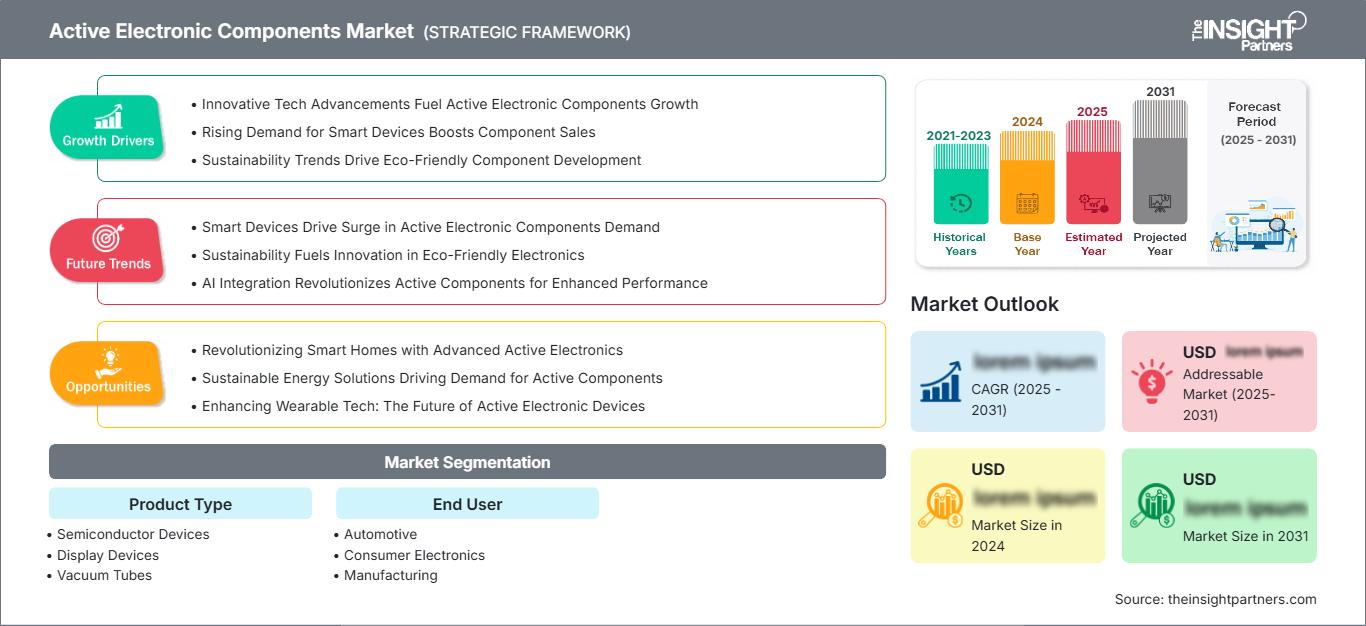
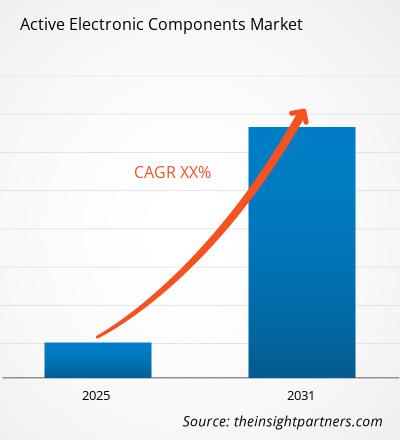
According to the report, the Global Active Electronic Components market was valued at US$ 380.41 Billion in 2025 and is anticipated to reach US$ 664.32 Billion by 2034 at a CAGR of 6.39% from 2026 to 2034. The above growth path can be attributed to constant demand in automotive, consumer electronics, and industrial segments due to technology developments in semiconductors and power management systems.
The North American region has potential for growth in terms of Compound Annual Growth Rate (CAGR), estimated to grow between 6.8% and 7.4% until 2034 owing to investments by the North American countries on semiconductor fabrication units and electric vehicles and hyperscale data centers.
Active Electronic Components Market Assessment and Insights
- North America: The region holds approximately 22–24% market share in 2025, supported by strong innovation ecosystems in the U.S. and growing electronics manufacturing capabilities. The Active Electronic Components market is growing at a CAGR range of 6.8–7.4% between 2026–2034, driven by data center expansion and EV adoption.
- US: The United States accounts for roughly 85–90% of North American Active Electronic Components market share in 2025, with a projected CAGR range of 7.0–7.6% between 2026–2034. Leading semiconductor manufacturers continue expanding domestic fabrication capacity.
- Europe: Europe maintains approximately 16–19% market share in 2025, with Germany, the UK, and France as leading contributors. Regional growth reflects a CAGR range of 5.5–6.2% between 2026–2034, driven by automotive electrification and industrial automation.
- Asia Pacific: The region dominates with 38–42% market share in 2025, led by China, Japan, South Korea, and India. Asia Pacific is growing at a CAGR range of 6.2–6.9% between 2026–2034, supported by extensive electronics manufacturing bases and rising domestic consumption.
- Largest Segment: Semiconductor Devices held the largest Active Electronic Components market share ranging from 56–60% in 2025, with a CAGR range of 6.1–6.7% between 2026–2034, driven by integration trends and miniaturization demands.
- High Growth Segment: Display Devices is the fastest-growing segment with a market share range of 14–18% in 2025, expanding at a CAGR range of 7.2–7.8% between 2026–2034, fueled by advanced display technologies and consumer electronics upgrades.
- Key companies analyzed in detail: Advanced Micro Devices, Inc., Analog Devices, Inc., Broadcom Inc., Intel Corporation, Maxim Integrated, Microchip Technology Inc., Renesas Electronics Corporation, Semiconductor Components Industries, LLC, STMicroelectronics NV, and Texas Instruments Incorporated.
Source: The Insight Partners' analysis based on proprietary research, government publications, company annual reports, investor presentations, industry databases, and expert interviews.
Markets have undergone extensive evolution over the last decade, with a shift towards highly integrated semiconductor technologies and complex power management systems. Manufacturing operations have shifted from producing discrete components to high-level system-on-a-chip products, which offer improved efficiency, lower energy consumption, and smaller size. The combination of artificial intelligence, 5G network technologies, and electric cars has changed the nature of component demand and pushed companies to continually develop in materials science and fabrication.
Looking forward, the developing geographies of Southeast Asia and Latin America present attractive investment opportunities for the industry, with governments focusing on building their digital infrastructure and localizing electronics production. Favorable regulatory winds, such as semiconductor sovereignty and sustainability regulations, will help create favorable conditions for the industry to grow. With investments in advanced packaging and next-generation semiconductor materials, the industry is set for strong growth through the Active Electronic Components Market Forecast., especially in active components.
Active Electronic Components Market Report Scope
| Report Attribute | Details |
|---|---|
| Market size in 2025 | US$ 380.41 Billion |
| Market Size by 2034 | US$ 664.32 Billion |
| Global CAGR (2026 - 2034) | 6.39% |
| Historical Data | 2021-2024 |
| Forecast period | 2026-2034 |
Active Electronic Components Market Analysis
Demand for active electronic components is driven by the widespread use of intelligent devices, the growth of Internet-of-Things ecosystems, and global shifts towards electrified modes of transport. The entire chain includes semiconductor design, wafer manufacturing, assembly, testing, and distribution of components, and requires specialized knowledge and significant investment. The supply situation continues to be affected by geopolitical factors, material availability, and manufacturing capacity limitations, resulting in the need to diversify production locations and build stock.
The ecosystem thrives on collaboration between the manufacturers of the components, OEMs, and research organizations to drive innovation in performance and reliability. The end-users' demand for products that support miniaturization, increased functionality, and energy efficiency drives the development agenda for many players in the industry. The combination of all these elements supports healthy demand trends within the industry.
The industry consists of existing multinational players producing semiconductors along with companies specializing in the supply of components. Companies like Intel Corporation, Texas Instruments Incorporated, and Broadcom Inc., being the key market participants, have large product lines covering analog, digital, and mixed-signal areas. The strategies used by these companies for further development include production capacity increase, technology collaborations, and acquisition of other firms.
The investment trends indicate an increased emphasis on advanced manufacturing capabilities, R&D in next-generation semiconductor technology, and vertical integration approaches. There is increased commitment of resources by firms towards developing proprietary manufacturing techniques, improved design automation systems, and application-specific solutions. The strategic orientation of the firms is increasingly focused on sustainability, resilient supply chains, and responsiveness to regional market conditions.
● REPORT CUSTOMIZATION
Tailor This Report To Align With Your Specific Business Requirements
This report can be customized to align precisely with your business objectives, scope, and target markets. Customization options include tailored segmentation, geography, competitive analysis, and strategic insights to support informed decision-making.
Customize This Report →WHAT YOU CAN ADJUST
- ● Segmentations
- ● Geography
- ● Competitive Analysis
- ● Language Preferences
Active Electronic Components Market: Strategic Insights
Regional Insights
North America Active Electronic Components
There are high expectations regarding the North America Active Electronic Components Market, which is expected to post a compounded annual growth rate of 6.8%–7.4% between 2026 and 2034. Some of the drivers fueling the growth of this market include the growing trend of investment in hyperscale data centers, increasing popularity of electric vehicles, and demand from aerospace and defense industries.
Further growth in applications for industrial automation, telecoms infrastructure, and healthcare equipment is expected to drive market growth. Major companies have continued to invest heavily in expanding manufacturing capability at home. These factors place North America at the forefront of market growth in the international active electronic components industry.
U.S. Active Electronic Components Market
The US is the major player in North America, with a market share of about 85%-90% of the total region in 2025. It is estimated that the US market will expand at a compound annual growth rate of 7.0% to 7.6% from 2026 to 2034, owing to considerable investments in semiconductor production, growth in data centers, and electric vehicles.
Company presence is robust, with companies such as Texas Instruments, Intel Corporation, and Analog Devices operating on a large scale across many states. The application trends include high demands from the automotive electronics industry, industrial products industry, consumer devices, and telecommunication. The government programs for developing domestic chip production capabilities, along with associations with technological giants, make the U.S. market more competitive in the global market of active electronic components.
Europe Active Electronic Components Market
The European region still holds its strong position within the international market for active electronic components with market shares of around 16% to 19% in 2025. The forecast growth rate of this market in Europe will be in the range of 5.5% to 6.2% at CAGR from 2026 to 2034.
The United Kingdom demonstrates continued growth in advanced semiconductor design, telecommunications equipment, and aerospace applications. The UK market benefits from highly developed research organizations, government efforts to develop technology, and collaboration with other European countries and the rest of the world on technology.
Germany remains the leader in Europe in automotive engineering, industrial machinery, and precision machining. High demand for power electronics, mixed-signal devices, and integrated circuits is helping Germany continue to expand the Active Electronic Components market.
The combined effort of these three nations results in a considerable contribution to market volume in areas that include consumer electronics, telecom infrastructure, and renewable energy systems. Aerospace and defense electronics is the key application focus in France, while Italy and Spain have been showing interest in automotive and industrial automation applications.
APAC Active Electronic Components Market
Asia Pacific dominates the global active electronic components market with approximately 38–42% share in 2025. The region is projected to grow at a CAGR range of 6.2–6.9% from 2026 to 2034, supported by extensive electronics manufacturing capabilities and rising domestic consumption.
China, Japan, South Korea, India, and Australia represent key markets, each contributing distinct strengths to regional dynamics. China leads in consumer electronics production and telecommunications equipment manufacturing. Japan and South Korea maintain advanced semiconductor fabrication capabilities and strong positions in automotive electronics.
The industrial and policy drivers involve governmental efforts towards semiconductor independence, heavy investments made in 5G networks, and the rapid adoption of electric vehicles. Vertically integrated supply chains, qualified manufacturing labor force, and friendly regulatory environment to foster technological innovations add to the strengths of the region. The mentioned attributes contribute to establishing Asia Pacific as the leading market for active electronic components throughout the forecast period.
Middle East & Africa Active Electronic Components Market
The Middle East and Africa region demonstrates emerging growth potential in active electronic components, with applications expanding across telecommunications infrastructure, smart city developments, and energy systems. Saudi Arabia and the UAE lead regional investments in digital transformation, data centers, and advanced manufacturing capabilities.
South Africa represents the most mature Active Electronic Components market within the region, supported by established industrial bases and growing consumer electronics adoption. Rest of MEA countries show gradual progress in infrastructure development and electronics manufacturing. The region is projected to expand at a CAGR range of 5.8–6.5% from 2026 to 2034.
Energy and infrastructure context includes substantial investments in renewable energy projects, smart grid deployments, and telecommunications network expansion. Government initiatives promoting economic diversification and technology adoption create favorable conditions for market growth. The UAE emerges as the leading country, driven by rapid development of data centers, intelligent building systems, and smart infrastructure projects that require advanced active electronic components.
Segmentation Analysis
Product Type
The Semiconductor Devices segment is projected to grow at a CAGR range of 6.1–6.7% from 2026 to 2034. This segment maintains dominant Active Electronic Components market positioning due to widespread applications across consumer electronics, automotive systems, telecommunications infrastructure, and industrial equipment. Advancements in integrated circuit design, power management technologies, and miniaturization continue to drive adoption.
- Transistors, diodes, and integrated circuits form the core of modern electronic systems, enabling signal processing, power regulation, and data management functions. The segment benefits from sustained R&D investments, fabrication capacity expansions, and strategic partnerships between manufacturers and end-user industries.
- Semiconductor Devices: Transistors, diodes, and integrated circuits dominate applications across automotive, telecommunications, and consumer electronics, enabling signal amplification, power control, and data processing functions essential to modern electronic systems.
- Display Devices: LCDs, LEDs, and OLEDs serve critical roles in smartphones, televisions, automotive dashboards, and medical monitors, with innovations in resolution, energy efficiency, and flexible form factors driving continued market expansion.
- Vacuum Tubes: Specialized applications in high-frequency amplification, radar systems, and aerospace electronics maintain niche demand, supported by unique reliability characteristics under extreme operating conditions and continued development in materials and design.
End User
The End User segment is projected to grow at a CAGR range of 6.0–6.6% from 2026 to 2034. Consumer Electronics, Automotive, and Manufacturing represent the largest application verticals, each experiencing distinct growth dynamics driven by technological adoption and industry transformation.
- Healthcare, Aerospace and Defense applications demonstrate steady expansion, supported by increasing demand for advanced medical devices, diagnostic equipment, and mission-critical electronics systems. The segment benefits from cross-industry trends toward automation, connectivity, and enhanced performance requirements.
- Automotive: Electric vehicles, advanced driver-assistance systems, and infotainment technologies drive robust demand for power electronics, sensors, and integrated circuits, with manufacturers prioritizing reliability, efficiency, and functional safety across next-generation vehicle platforms.
- Consumer Electronics: Smartphones, wearables, tablets, and smart home devices sustain high-volume consumption of active components, with continuous innovation in processing power, battery life, and connectivity features shaping component specifications and design roadmaps.
- Manufacturing: Industrial automation, robotics, and process control systems require high-reliability components for sensors, actuators, and control circuits, with Industry 4.0 initiatives and smart factory deployments accelerating adoption rates across global manufacturing facilities.
- Aerospace and Defense: Mission-critical applications in navigation, communication, radar, and surveillance systems demand high-performance active components with exceptional reliability, driving innovation in high-frequency transistors and specialized semiconductors.
- Healthcare: Medical imaging, diagnostic equipment, wearable monitors, and surgical devices increasingly rely on advanced active components for precision, miniaturization, and connectivity, supporting trends in telemedicine and personalized healthcare solutions.
Opportunity Snapshot
| Segment Name | Revenue Contribution | Trend Tag | Adoption Stage |
| Automotive | High | Electrification Push | Scaling |
| Consumer Electronics | High | AI Integration | Mature |
| Manufacturing | High | Smart Factory | Scaling |
| Aerospace and Defense | Medium | Autonomous Systems | Scaling |
| Healthcare | Medium | Remote Monitoring | Emerging |
Active Electronic Components Market Growth Drivers and Impact Analysis
Electric Vehicle Proliferation and Power Electronics Demand
The global transition toward electric mobility fundamentally reshapes automotive electronics architectures, creating unprecedented demand for power semiconductors, battery management integrated circuits, and high-voltage switching components. Electric vehicles require substantially more active electronic components compared to conventional internal combustion engine vehicles, with powertrains, charging systems, and thermal management all dependent on sophisticated semiconductor solutions.
Manufacturers are prioritizing silicon carbide and gallium nitride technologies to improve efficiency, reduce thermal losses, and enable faster charging capabilities. This driver extends beyond passenger vehicles to commercial transportation, two-wheelers, and off-road equipment, creating sustained growth opportunities across multiple vehicular segments. Component suppliers are responding with dedicated automotive-grade product lines, enhanced quality assurance processes, and long-term supply agreements with major automakers.
5G Infrastructure Deployment and Telecommunications Equipment Upgrades
The worldwide rollout of 5G networks necessitates substantial upgrades to base stations, radio access equipment, and backhaul infrastructure, all requiring advanced active electronic components for signal processing, amplification, and power management. Fifth-generation telecommunications standards demand higher frequency operation, greater bandwidth, and lower latency compared to previous generations, pushing component specifications toward enhanced performance and efficiency.
Radio frequency amplifiers, mixed-signal integrated circuits, and power management devices experience elevated demand as network operators expand coverage and capacity. Small cell deployments, massive MIMO antenna systems, and edge computing infrastructure further amplify component requirements. Telecommunications equipment manufacturers are partnering closely with semiconductor suppliers to develop purpose-built solutions addressing specific 5G challenges, including thermal management, linearity, and power efficiency in compact form factors.
Data Center Expansion and Hyperscale Computing Infrastructure
Hyperscale data centers and cloud computing facilities represent the fastest-growing end-user segment for active electronic components, driven by exponential growth in data traffic, artificial intelligence workloads, and enterprise digital transformation initiatives. Modern data centers require vast quantities of power management integrated circuits, high-speed transceivers, voltage regulators, and signal conditioning components to support server racks, storage arrays, and networking equipment.
The emergence of AI-optimized computing architectures intensifies demand for specialized components capable of handling massive parallel processing, high-bandwidth memory interfaces, and accelerated inferencing operations. Edge data center deployments further extend component requirements to distributed locations supporting low-latency applications. Component manufacturers are developing data center-specific product portfolios emphasizing energy efficiency, thermal performance, and reliability under continuous high-utilization conditions.
Active Electronic Components Market Future Trends
Advanced Packaging and Heterogeneous Integration
The industry is shifting toward sophisticated packaging techniques that enable multiple semiconductor dies, passive components, and interconnect structures to be integrated within single compact modules. Advanced packaging approaches, including system-in-package, chiplets, and 3D stacking, address limitations in traditional scaling while delivering enhanced performance, reduced power consumption, and smaller footprints.
This trend responds to physical constraints in transistor miniaturization and the growing demand for multifunctional electronics in space-constrained applications. Manufacturers are investing heavily in proprietary packaging technologies, forming strategic alliances with substrate suppliers and equipment vendors to establish differentiated capabilities. The shift toward heterogeneous integration enables system architects to combine logic, memory, analog, and RF functions more efficiently, unlocking new design possibilities for next-generation electronic products across consumer, automotive, and industrial segments.
Sustainable Manufacturing and Circular Economy Initiatives
Increasingly, environmental sustainability is shaping the design, production, and end-of-life disposal of active electronic components. This trend arises from pressures related to regulations, consumer demands, and companies' responsibilities to adopt green technologies, energy-efficient production, and recycling initiatives aimed at recovering valuable metals.
Carbon footprint measurement, renewable energy sources, and water preservation strategies are being adopted by manufacturers across their manufacturing plants. Designing products for recycling has become a key consideration when developing new products, with attention to material choice and ease of disassembly. There is a framework for the circular economy that includes component reuse, remanufacturing, and closed-loop supply chains. These initiatives not only address environmental concerns but also enhance supply chain resilience and reduce dependency on virgin raw material sources, reflecting evolving Active Electronic Components Market Trends.
Active Electronic Components Market Opportunities
Emerging Markets Electronics Manufacturing Localization
Several nations in Southeast Asia, Latin America, and Africa are developing policies that will attract investments in electronics manufacturing, thereby providing a chance for the component manufacturers to have their own production and distribution facilities within the region. Electronics manufacturing is viewed by governments as an important sector for economic growth and technological advancement.
This can be leveraged in the component manufacturing industry by establishing assembly plants, technical service centers, and distribution channels near end-user markets. Transportation costs are reduced, time is reduced, and responding to customer needs becomes much easier. Early entrants will enjoy an advantage from the relationships they have developed with local original equipment manufacturers and other institutions, supporting the long-term Active Electronic Components Market Forecast. These markets present particularly attractive opportunities in consumer electronics, automotive components, and industrial equipment segments experiencing rapid adoption rates.
Specialized Components for Renewable Energy and Smart Grid Systems
The move towards the production of renewable energy and smart power distribution in the world leads to a large amount of demand for specific electronic devices that have been tailored to perform effectively for the power-related functions. Solar power inverters, control units for wind turbines, batteries for energy storage, and smart grid systems all require efficient power semiconductors.
Component providers have opportunities for differentiation by developing products that offer increased efficiency, reliable operation under severe environmental conditions, and communication in line with new standards. These opportunities include the installation of microgrids, electric vehicle charging facilities, and systems for managing distributed energy resources. Collaboration with renewable energy providers and equipment manufacturers enables this. Government incentives, decarbonization mandates, and declining renewable energy costs support sustained investment in this opportunity space through the forecast period, supporting the long-term Active Electronic Components Market Size.
Recent Developments
- June 2026: AMD announced production ramp of next-generation AMD EPYC processor "Venice" on TSMC 2nm process technology, marking a significant advancement in data center computing performance and energy efficiency for enterprise AI workloads.
- May 2026: Analog Devices, Inc. — Analog Devices announced acquisition of Empower Semiconductor, expanding its next-generation high-density power portfolio for the AI era, strengthening capabilities in power management solutions for data centers and AI infrastructure.
- June 2025: Texas Instruments Incorporated — Texas Instruments announced plans to invest more than $60 billion across seven U.S. semiconductor fabs in Texas and Utah, the largest investment in foundational semiconductor manufacturing in U.S. history, supporting over 60,000 new U.S. jobs.
Frequently Asked Questions

- Comprehensive Market Sizing and Forecast Analysis
- Detailed Segmentation Analysis
- In-Depth Market Dynamics Assessment
- Regional and Country-Level Insights
- Competitive Landscape and Company Benchmarking
- Strategic Business Intelligence
Recent Reports
Testimonials

The Insight Partners' SCADA System Market report is comprehensive, with valuable insights on current trends and future forecasts. The team was highly professional, responsive, and supportive throughout. We are very satisfied and highly recommend their services.
RAN KEDEM Partner, Reali Technologies LTDs
I requested a report on a very specific software market and the team produced the report in a few days. The information was very relevant and well presented. I then requested some changes and additions to the report. The team was again very responsive and I got the final report in less than a week.
JEAN-HERVE JENN Chairman, Future Analytica
We worked with The Insight Partners for an important market study and forecast. They gave us clear insights into opportunities and risks, which helped shape our plans. Their research was easy to use and based on solid data. It helped us make smart, confident decisions. We highly recommend them.
PIYUSH NAGPAL Sr. Vice President, High Beam Global
The Insight Partners delivered insightful, well-structured market research with strong domain expertise. Their team was professional and responsive throughout. The user-friendly website made accessing industry reports seamless. We highly recommend them for reliable, high-quality research services
YUKIHIKO ADACHI CEO, Deep Blue, LLC.
This is the first time I have purchased a market report from The Insight Partners.While I was unsure at first, I visited their web site and felt more comfortable to take the risk and purchase a market report.I am completely satisfied with the quality of the report and customer service. I had several questions and comments with the initial report, but after a couple of dialogs over email with their analyst I believe I have a report that I can use as input to our strategic planning process.Thank you so much for taking the extra time and making this a positive experience.I will definitely recommend your service to others and you will be my first call when we need further market data.
JOHN SUZUKI President and Chief Executive Officer, Board Director, BK Technologies
I wish to appreciate your support and the professionalism you displayed in the course of attending to my request for information regarding to infectious disease IVD market in Nigeria. I appreciate your patience, your guidance, and the fact that you were willing to offer a discount, which eventually made it possible for us to close a deal. I look forward to engaging The Insight Partners in the future, all thanks to the impression you have created in me as a result of this first encounter.
DR CHIJIOKE ONYIA MANAGING DIRECTOR, PineCrest Healthcare Ltd.Reason to Buy
- Informed Decision-Making
- Understanding Market Dynamics
- Competitive Analysis
- Identifying Emerging Markets
- Customer Insights
- Market Forecasts
- Risk Mitigation
- Boosting Operational Efficiency
- Strategic Planning
- Investment Justification
- Tracking Industry Innovations
- Aligning with Regulatory Trends





 Get Free Sample for