
Advanced Metering Infrastructure Market Growth, Share & Trends by 2034
Coverage: By Device (Smart Meters, Communication Infrastructure, Home Area Networks (HANS), In-home Display Units); Solution (MDM, Meter Data Analytics, AMI Security Meter, Communication Infrastructure); Service (System Integration, Meter Deployment, Program Management and Consulting) , and Geography (North America, Europe, Asia Pacific, and South and Central America)
- Status : Data Released
- Report Code : TIPRE00004790
- Category : Electronics and Semiconductor
- No. of Pages : 150
- Available Report Formats :


- Last update date : July 09, 2026


2025 Market Size
US$ 26.31 Bn
Base year value
2034 Forecast
US$ 72.48 Bn
Projected by 2034
CAGR 2026-2034
11.92 %
Growth rate
Addressable Market
US$ 433.62 Bn
(2026-2034)
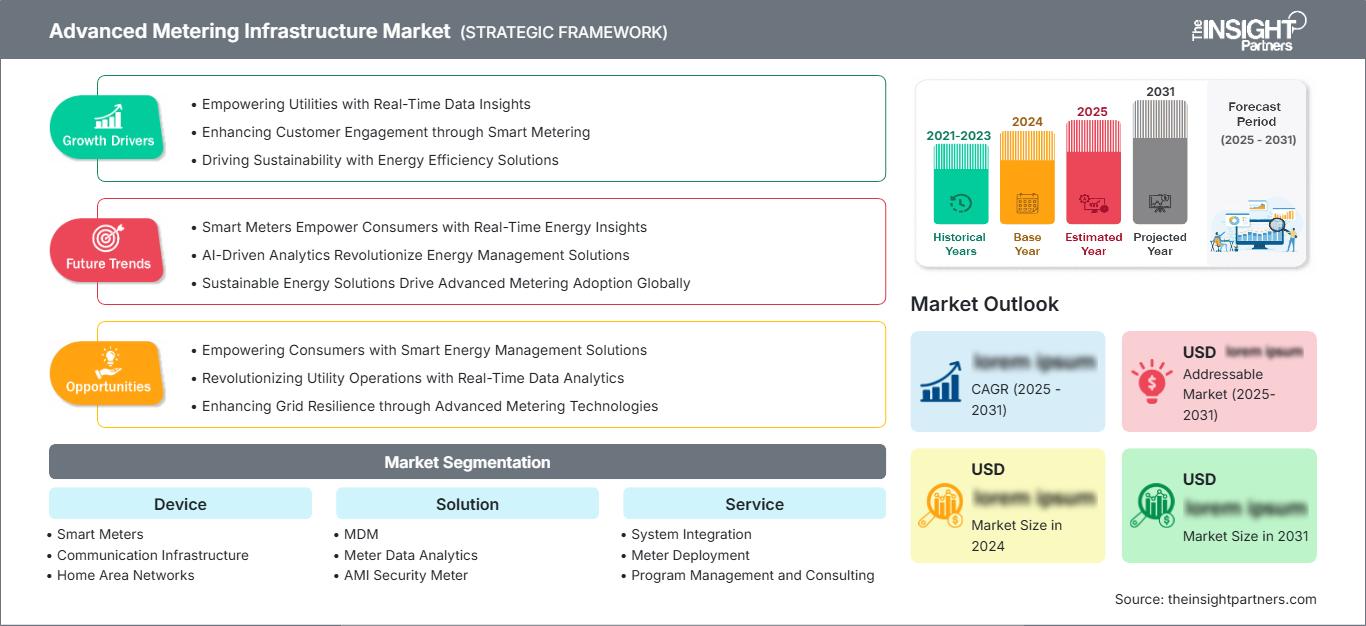
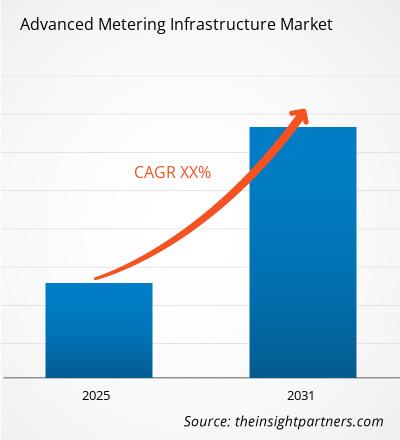
The Advanced Metering Infrastructure Market size is projected to grow from US$ 26.31 Billion in 2025 to US$ 72.48 Billion by 2034, registering a CAGR of 11.92% from 2026 to 2034. The market reflects utilities’ accelerating shift from periodic meter reading toward two-way digital networks that support billing accuracy, outage visibility, demand response, and distributed energy integration across power, water, and gas systems.
North America remains a mature but investment-intensive region, with expected CAGR in the 8.8–10.2% range through 2034. Replacement cycles, resilience spending, and second-wave smart meter deployments are driving the Advanced Metering Infrastructure Market growth. Utilities are prioritizing secure communications, grid-edge intelligence, and meter data platforms as distributed generation, electrification, and dynamic tariffs expand operational complexity.
Advanced Metering Infrastructure Market Assessment and Insights
- North America: The region accounted for 29–32% share in 2025 and is growing at a CAGR of 8.8–10.2% between 2026–2034, supported by second-wave deployments, resilience programs, and rising grid automation needs.
- US: The US represented 84–88% of North America in 2025 and is growing at a CAGR of 8.9–10.1% between 2026–2034, led by investor-owned utility modernization.
- Europe: Europe held 23–26% share in 2025 and is growing at a CAGR of 9.4–10.8% between 2026–2034, with the UK, Germany, France, Italy, and Spain advancing smart metering and flexibility programs.
- Asia Pacific: Asia Pacific captured 34–38% share in 2025 and is growing at a CAGR of 13.0–14.6% between 2026–2034, led by China, Japan, South Korea, India, and Australia.
- Largest Segment: Device held 47–51% market share in 2025 and is growing at a CAGR of 10.6–12.1% between 2026–2034, driven by smart meter and communication infrastructure spending.
- High Growth Segment: Solution held 28–32% market share in 2025 and is growing at a CAGR of 12.8–14.3% between 2026–2034, supported by analytics, MDM, and security adoption.
- Key companies analyzed in detail: Black & Veatch Holding Company, Eaton Corporation plc, Honeywell International Inc., GE Vernova Inc., International Business Machines Corporation, Itron, Inc., Landis+Gyr Group AG, Schneider Electric SE, Xylem Inc., Siemens AG, Sagemcom SAS, Kamstrup A/S.
Source: The Insight Partners' analysis based on proprietary research, government publications, company annual reports, investor presentations, industry databases, and expert interviews.
Utility metering has moved from electromechanical recording toward interoperable, sensor-rich infrastructure that links endpoints, communication networks, and enterprise software. The Advanced Metering Infrastructure Market analysis indicates that production dynamics are shifting from hardware-led procurement to integrated platform selection, where meters, firmware, cybersecurity, and analytics are evaluated together. Manufacturers are also redesigning devices for longer operating life, remote upgrades, and multi-utility compatibility as utilities reduce field visits and improve lifecycle economics.
Over the forecast period, emerging geographies will add volume while mature markets will add value through replacement and software monetization. Regulatory tailwinds tied to energy efficiency, loss reduction, renewable integration, and consumer data access are expected to expand the Advanced Metering Infrastructure Market scope. Investment is increasingly directed toward communication infrastructure, meter data analytics, and secure interoperability because distribution networks must manage electrification, rooftop solar, and more variable demand.
Advanced Metering Infrastructure Market Report Scope
| Report Attribute | Details |
|---|---|
| Market size in 2025 | US$ 26.31 Billion |
| Market Size by 2034 | US$ 72.48 Billion |
| Global CAGR (2026 - 2034) | 11.92% |
| Historical Data | 2021-2024 |
| Forecast period | 2026-2034 |
Advanced Metering Infrastructure Market Analysis
The demand is driven by utilities' requirements to have interval data, automated billing, outage detection, and efficiency. With the inclusion of electric vehicles, rooftop solar, energy storage, and dynamic loads into the electrical grid, the AMI technology becomes a necessary base component to achieve visibility of the grid edge. The environment includes the meter companies, networking companies, cloud computing providers, system integrators, security vendors, and IT departments of the utilities. On the supply side, vendors capable of providing interoperability and solid communications are preferred.
Hardware availability remains important, but procurement value is moving toward lifecycle services and software-enabled outcomes. Utilities increasingly assess the total cost of ownership, regulatory recoverability, security architecture, and analytics usability before large deployments. This reinforces demand for modular platforms that connect meter data management, outage management, customer information systems, and demand response programs, supporting growth in the Advanced Metering Infrastructure Market size.
The competitive landscape is concentrated around companies with large installed bases, utility references, and multi-region service networks. Itron, Inc., Landis+Gyr Group AG, Honeywell International Inc., Schneider Electric SE, Siemens AG, and Sagemcom SAS compete on endpoint performance, communication options, and integration depth, while Black & Veatch Holding Company and International Business Machines Corporation support program execution, data platforms, and consulting-led transformation. The Advanced Metering Infrastructure Market report highlights the importance of scalable deployments, interoperability, and digital grid integration in shaping competitive positioning across the industry.
Trends in investment highlight a significant shift toward security in data architecture as well as second-generation installations. These include GE Vernova Inc., Eaton Corporation plc, Xylem Inc., and Kamstrup A/S. Positioning is becoming more dependent on cybersecurity qualifications, cloud readiness, regulation knowledge, and the capability to generate actionable operational intelligence from metering data instead of billing data alone.
● REPORT CUSTOMIZATION
Tailor This Report To Align With Your Specific Business Requirements
This report can be customized to align precisely with your business objectives, scope, and target markets. Customization options include tailored segmentation, geography, competitive analysis, and strategic insights to support informed decision-making.
Customize This Report →WHAT YOU CAN ADJUST
- ● Segmentations
- ● Geography
- ● Competitive Analysis
- ● Language Preferences
Advanced Metering Infrastructure Market: Strategic Insights
Regional Insights
North America Advanced Metering Infrastructure Market
North America accounted for 29–32% share in 2025 and is projected to grow at a CAGR of 8.8–10.2% during 2026–2034. The region benefits from extensive installed AMI bases, regulatory acceptance of grid modernization investments, and a rising need for outage intelligence as storms, wildfires, and peak-load events stress distribution systems.
Second-wave replacements are reshaping procurement priorities. Utilities are moving beyond automated reads toward distributed intelligence, firmware management, and customer engagement. The Advanced Metering Infrastructure Market share in North America is supported by utility capital plans, federal grid resilience funding, and mature vendor ecosystems capable of executing multi-year deployment and integration programs.
U.S. Advanced Metering Infrastructure Market
The US represented 84–88% of North America in 2025 and is expected to grow at a CAGR of 8.9–10.1% through 2034. The market is shaped by large investor-owned utility programs, municipal modernization, and regulatory pressure to improve reliability metrics, billing transparency, and distributed energy visibility.
The presence of companies is high within the endpoint segment, consultancy, and software. This can be attributed to Itron, Inc., Landis+Gyr Group AG, Black & Veatch Holding Company, International Business Machines Corporation, Eaton Corporation plc, and GE Vernova Inc., which help in deployment and automation within the grids. The Advanced Metering Infrastructure Market forecast highlights the increasing implementation of outage localization, voltage management, time of use pricing, and customer portals.
Europe Advanced Metering Infrastructure Market
Europe held 23–26% share in 2025 and is projected to expand at a CAGR of 9.4–10.8% during 2026–2034. The UK remains a leading country by rollout scale and consumer energy data programs, although deployment complexity and replacement needs are influencing procurement schedules. Advanced Metering Infrastructure Market trends across Europe are being shaped by smart grid modernization, regulatory support for energy efficiency, and growing demand for real-time energy monitoring and data-driven utility operations.
Germany is speeding up after a traditionally conservative deployment process due to data protection and certification needs. The market in Germany has the potential to be realized through high consumption consumers, areas rich in renewables, and flexible grid technologies for which secure metering gateways could facilitate dynamic tariffs and distributed energy sources management.
France, Italy, and Spain have good examples of large-scale deployments and second-generation upgrades. Italy still plays an important role in regard to experience with deployments, whereas Spain has its full-scale smart meters deployment, allowing remote services to be performed.
APAC Advanced Metering Infrastructure Market
APAC accounted for 34–38% share in 2025 and is forecast to grow at a CAGR of 13.0–14.6% between 2026–2034. China is the leading country by deployment scale, supported by grid digitalization, urban electrification, and renewable integration needs.
Japan and South Korea value reliability, advanced power management systems, and demand-side management systems. Their systems have become progressively integrated with distributed energy, coordinated storage systems, and high-quality outage management.
India and Australia bring different growth factors. India’s efforts on distribution reform and loss reduction contribute to high installation volumes, while the high rooftop solar penetration of Australia makes interval data and dynamic pricing essential.
Middle East & Africa Advanced Metering Infrastructure Market
The Middle East & Africa is projected to grow at a CAGR of 10.2–11.8% during 2026–2034. Saudi Arabia is the leading country, supported by power sector digitalization, smart city investment, and utility modernization tied to energy efficiency objectives. The Advanced Metering Infrastructure Market is expected to benefit from these initiatives as utilities accelerate deployment of smart grid technologies and advanced energy management systems across the region.
The UAE is advancing AMI through smart city platforms, water and electricity integration, and customer-facing digital services. Deployment priorities focus on operational efficiency, accurate billing, and high service reliability.
South Africa and the Rest of MEA show demand linked to revenue protection, prepaid metering migration, and distribution loss reduction. The Advanced Metering Infrastructure Market is supported by these utility modernization efforts, although infrastructure constraints, financing models, and cybersecurity readiness will influence the pace of adoption.
Segmentation Analysis
Device
The Device segment is expected to grow at a CAGR of 10.6–12.1% from 2026 to 2034. Devices remain the largest spending category because endpoint replacement, communication modules, and in-premise equipment account for substantial deployment costs. Procurement decisions increasingly prioritize remote firmware upgrades, tamper detection, multi-communication compatibility, and longer asset life.
- Smart Meters dominate device demand as utilities replace legacy meters with two-way endpoints that support interval data, remote connection functions, outage signals, and accurate billing across residential and commercial customers.
- Communication Infrastructure is strategically important because AMI performance depends on reliable RF mesh, cellular, PLC, or hybrid networks capable of supporting dense meter fleets and utility-grade availability.
- Home Area Networks support customer-side energy management by linking meters with appliances, gateways, and demand response tools, though adoption varies with tariff design and consumer engagement maturity.
- In-home Display Units improve consumption visibility for households and small businesses, supporting behavioral efficiency and dynamic tariff awareness where regulators require direct customer feedback mechanisms.
Solution
The Solution segment is projected to grow at a CAGR of 12.8–14.3% from 2026 to 2034. Utilities are shifting value creation from meter installation to data utilization. The Advanced Metering Infrastructure Market is increasingly driven by solutions that clean, secure, analyze, and route interval data into billing, outage, demand response, and planning systems, making them central to AMI business cases.
- MDM platforms help in organizing large volumes of interval data, validating readings, and linking meter data with billing and customer systems, thus becoming an integral part of reliable utility operations.
- Meter Data Analytics helps utilities transform raw readings into useful data to be used in forecasting the load, detecting any theft, optimizing voltages, and managing outages and distributed energy.
- AMI Security Meter solutions solve the problems of encryption, authentication, firmware integrity, and anomaly detection to help utilities manage millions of devices exposed to cyber threats.
- Communication Infrastructure solutions help utilities in managing their network, routing data, and connecting devices to ensure high-quality service throughout their urban, suburban, and rural territories.
Service
The Service segment is expected to grow at a CAGR of 11.3–12.7% from 2026 to 2034. Services are expanding as utilities require program design, installation management, integration, workforce coordination, and post-deployment optimization. The Advanced Metering Infrastructure Market is increasingly supported by service providers, as execution capability is critical because delays can affect regulatory recovery, customer satisfaction, and operational benefit realization.
- The System Integration Services are those that integrate the AMI systems with billing systems, outage management systems, customer information systems, analytics, and enterprise systems, resulting in fewer data silos.
- The Meter Deployment services include installation in the field, testing of the devices, customer communications, and quality control, which are important in large-scale deployments that are time-bound and safety-conscious.
- The Program Management & Consulting Services include developing business cases, vendor selections, regulatory filing, change management, and benefits realization.
Opportunity Snapshot
| Segment Name | Revenue Contribution | Trend Tag | Adoption Stage |
| MDM | High | Data Hub | Mature |
| Meter Data Analytics | High | Grid Insights | Scaling |
| AMI Security Meter | Medium | Cyber Defense | Scaling |
| Communication Infrastructure | High | Network Edge | Mature |
Advanced Metering Infrastructure Market Growth Drivers and Impact Analysis
Grid Modernization and Reliability Investment
Utilities are making larger investments in AMI due to the requirement for fast fault detection, restoration, and visibility of the low-voltage situation in the distribution network. The IEA has highlighted that investments in smart grids will need to be doubled by 2030 if we are to stay on track with net-zero pathways. In other words, digital metering is crucial for the reliability of the network system. AMI eliminates reliance on manual reporting of outages, increases precision in dispatching the crew, and helps collect voltage information at the consumer level.
Distributed Energy and Electrification Complexity
Solar rooftop panels, EVs, heat pumps, and battery storage behind the meter are affecting load profiles and power flows. AMI provides utilities with interval-level consumption and export information required for tariff design, loading of transformers, and managing local congestion. In response to growing variability of peaks due to increasing electrification, traditional readings on a monthly basis are not enough for planning purposes. It broadens Advanced Metering Infrastructure Market trends towards analytics, communications robustness, and edge computing because utilities need to translate data from meters into action.
Revenue Protection and Operational Efficiency
AMI helps with revenue assurance through bill estimation, tamper detection, non-technical loss detection, and manual meter reading savings. In emerging markets, loss reduction could provide a significant boost to the utility’s cash flows and justify the investment in network upgrades. In mature markets, savings would be achieved through remote service orders, automation of move-ins and move-outs, and truck roll reductions. The opportunity for the Advanced Metering Infrastructure market is thus driven by both capital expenditure and recurring benefits through improved data accuracy, faster billing processes, and improved labor productivity.
Advanced Metering Infrastructure Market Future Trends
AI-Enabled Meter Data Operations
Future AMI solutions will increasingly leverage artificial intelligence in order to identify irregularities, predict local demand, and schedule field operations. Rather than considering their meters as mere passive receivers, utilities will be leveraging fast data streams in order to enable predictive asset management and automated anomaly resolution. This will increase the need for well-functioning data pipelines, explainable analytics, and secured cloud infrastructures. Providers that successfully incorporate domain-oriented algorithms with utility workflows will have an edge over their competitors, in light of the increasing regulatory requirements.
Interoperable Multi-Utility Networks
AMI networks are expected to support electricity, gas, and water endpoints on shared or coordinated platforms, especially in cities seeking integrated utility operations. Interoperability will become more important as municipalities and multi-service utilities look to lower communication costs and unify customer engagement. Standards-based device management, cybersecurity protocols, and modular application layers will shape procurement. This trend will also support the Advanced Metering Infrastructure share of software spending, as utilities require platforms that can manage diverse assets without vendor lock-in.
Advanced Metering Infrastructure Market Opportunities
Second-Generation Replacement Programs
Early AMI adopters are entering replacement cycles that create opportunities for upgraded meters, stronger security, and advanced analytics. These programs are attractive because utilities already understand AMI value, have established regulatory frameworks, and can justify upgrades through improved functionality rather than first-time automation. Suppliers can target modular retrofits, communications migration, and cloud-based meter data modernization. Successful bids will emphasize continuity, cybersecurity, low disruption, and measurable benefits such as faster outage response, improved voltage visibility, and customer data access.
Emerging Market Loss-Reduction Initiatives
Emerging markets present investment opportunities where utilities face high aggregate technical and commercial losses, manual billing inefficiencies, and limited grid visibility. AMI can improve revenue collection, support prepaid or flexible billing models, and create data for targeted network reinforcement. Public funding, development finance, and performance-linked contracts can reduce upfront affordability barriers. The Advanced Metering Infrastructure Market is expected to benefit as vendors and integrators that offer scalable deployment models, localized service capabilities, and proven loss-reduction analytics capture demand from governments prioritizing financially sustainable power distribution.
Recent Developments
- March 2025: Netmore Group, a global provider of Internet of Things (IoT) network solutions, has introduced its new Metering-as-a-Service (MaaS) offering for water and gas utilities. The service provides a cost-effective alternative to conventional capital-intensive Advanced Metering Infrastructure (AMI) deployments by removing the need for significant upfront investment. By shifting to a service-based model, MaaS helps utilities improve cash flow, reduce financial barriers, and accelerate the adoption of modern metering infrastructure.
- February 2025: HPL Electric & Power Ltd (HPL), a manufacturer of electric equipment and smart meters, has partnered with Wirepas, a global leader in IoT connectivity, to showcase a comprehensive end-to-end smart electricity metering solution designed to address India's demanding Advanced Metering Infrastructure (AMI) requirements for electricity.
- March 2026: Genus Power (NSE: GENUSPOWER) (BSE: 530343), India's provider of end-to-end energy measurement and advanced metering solutions, has surpassed the milestone of deploying more than 26 million smart meters worldwide, further strengthening its position as a trusted technology and execution partner for utilities across the globe.
Frequently Asked Questions

- Comprehensive Market Sizing and Forecast Analysis
- Detailed Segmentation Analysis
- In-Depth Market Dynamics Assessment
- Regional and Country-Level Insights
- Competitive Landscape and Company Benchmarking
- Strategic Business Intelligence
Recent Reports
Testimonials

The Insight Partners' SCADA System Market report is comprehensive, with valuable insights on current trends and future forecasts. The team was highly professional, responsive, and supportive throughout. We are very satisfied and highly recommend their services.
RAN KEDEM Partner, Reali Technologies LTDs
I requested a report on a very specific software market and the team produced the report in a few days. The information was very relevant and well presented. I then requested some changes and additions to the report. The team was again very responsive and I got the final report in less than a week.
JEAN-HERVE JENN Chairman, Future Analytica
We worked with The Insight Partners for an important market study and forecast. They gave us clear insights into opportunities and risks, which helped shape our plans. Their research was easy to use and based on solid data. It helped us make smart, confident decisions. We highly recommend them.
PIYUSH NAGPAL Sr. Vice President, High Beam Global
The Insight Partners delivered insightful, well-structured market research with strong domain expertise. Their team was professional and responsive throughout. The user-friendly website made accessing industry reports seamless. We highly recommend them for reliable, high-quality research services
YUKIHIKO ADACHI CEO, Deep Blue, LLC.
This is the first time I have purchased a market report from The Insight Partners.While I was unsure at first, I visited their web site and felt more comfortable to take the risk and purchase a market report.I am completely satisfied with the quality of the report and customer service. I had several questions and comments with the initial report, but after a couple of dialogs over email with their analyst I believe I have a report that I can use as input to our strategic planning process.Thank you so much for taking the extra time and making this a positive experience.I will definitely recommend your service to others and you will be my first call when we need further market data.
JOHN SUZUKI President and Chief Executive Officer, Board Director, BK Technologies
I wish to appreciate your support and the professionalism you displayed in the course of attending to my request for information regarding to infectious disease IVD market in Nigeria. I appreciate your patience, your guidance, and the fact that you were willing to offer a discount, which eventually made it possible for us to close a deal. I look forward to engaging The Insight Partners in the future, all thanks to the impression you have created in me as a result of this first encounter.
DR CHIJIOKE ONYIA MANAGING DIRECTOR, PineCrest Healthcare Ltd.Reason to Buy
- Informed Decision-Making
- Understanding Market Dynamics
- Competitive Analysis
- Identifying Emerging Markets
- Customer Insights
- Market Forecasts
- Risk Mitigation
- Boosting Operational Efficiency
- Strategic Planning
- Investment Justification
- Tracking Industry Innovations
- Aligning with Regulatory Trends





 Get Free Sample for