
Advanced Persistent Threat (APT) Protection Market Share, Growth & Demand by 2034
Coverage: By Component (Solution, Service); Deployment (Cloud-based, On-premises); Organization Size (Large Enterprise, SMEs); Vertical (BFSI, Construction and Engineering, Healthcare, Retail and E-commerce, Energy and Utilities, Media and Entertainment, Government and Defense, IT and Telecommunications, Other) , and Geography (North America, Europe, Asia Pacific, and South and Central America)
- Status : Data Released
- Report Code : TIPTE100000458
- Category : Technology, Media and Telecommunications
- No. of Pages : 150
- Available Report Formats :


- Last update date : August 05, 2026


2025 Market Size
US$ 9.18 Bn
Base year value
2034 Forecast
US$ 43.54 Bn
Projected by 2034
CAGR 2026-2034
18.88 %
Growth rate
Addressable Market
US$ 216.31 Bn
(2026-2034)
The Advanced persistent threat protection market was valued at US$ 9.18 Billion in 2025 and is projected to reach US$ 43.54 Billion by 2034, expanding at a CAGR of 18.88% during 2026–2034. The increasing complexity of attacks from nation-states, cyber campaigns for financial gains, and techniques like "long dwell" attacks is driving the adoption of advanced threat detection, behavioral analysis, threat intelligence integration, and automated response systems.
Across North America, cybersecurity modernization initiatives, increasing ransomware exposure, and stringent compliance obligations continue to strengthen spending on advanced threat defense frameworks. The advanced persistent threat protection market size in the region will be supported by strong investment in enterprise security and digital infrastructure development in the region. It is estimated that the regional demand for the market will grow at a CAGR of 17-19% between 2023 and 2034.
Advanced Persistent Threat (APT) Protection Market Assessment and Insights
- North America: Accounted for an estimated 36–40% share in 2025 and is expected to grow at a CAGR of 17–19% during 2026–2034. Strong cybersecurity spending, extensive cloud deployment, and growing regulatory scrutiny continue to support sustained adoption of advanced threat protection technologies.
- US: Represented approximately 72–76% of the North American market in 2025 and is projected to expand at a CAGR of 17–19% during 2026–2034, driven by federal cybersecurity programs, large enterprise demand, and increasing investments in AI-enabled security analytics.
- Europe: Held an estimated 25–29% share in 2025 and is expected to register a CAGR of 17–18.5% during 2026–2034. Germany, the UK, and France remain leading contributors due to strict data protection regulations and industrial cybersecurity requirements.
- Asia Pacific: Captured approximately 22–26% share in 2025 and is forecast to grow at a CAGR of 21–23% during 2026–2034. China, Japan, India, and South Korea are driving investment through digitalization programs and increasing cyber-risk exposure.
- Largest Segment: Solution generated an estimated 66–70% market share in 2025 and is projected to record a CAGR of 18–19% during 2026–2034, supported by demand for integrated threat intelligence, endpoint protection, and network monitoring platforms.
- High Growth Segment: Cloud-based Deployment accounted for approximately 53–57% market share in 2025 and is anticipated to grow at a CAGR of 21–23% during 2026–2034, reflecting accelerating cloud security adoption and distributed workforce protection requirements.
- Key companies analyzed in detail: Broadcom Inc., McAfee Corp., Kaspersky Lab, Fortinet, Inc., Trellix, Raytheon Technologies Corporation, Palo Alto Networks, Inc., VMware LLC, Microsoft Corporation, Cisco Systems, Inc.
Source: The Insight Partners' analysis based on proprietary research, government publications, company annual reports, investor presentations, industry databases, and expert interviews.
A paradigm shift has been observed in the cybersecurity domain due to the evolution from signature-based security systems to intelligence-based security architecture by enterprises. With an increased number of encrypted traffic flows, cloud native computing loads, and advanced intrusion threats, there has been a rising need for the implementation of continuous monitoring and automated threat correlation mechanisms. Market players within the advanced persistent threat protection domain have been adding new capabilities to their platforms through the use of artificial intelligence, machine learning, and security orchestration.
In terms of the future, market growth is predicted to be driven by higher spending on infrastructure protection and cybersecurity, cyber defense programs for sovereign states, and digital transformation strategies in developing countries. The regulatory landscape that includes cyber resiliency, incident reporting, and risk management is driving companies to upgrade their security protection technology. There is increasing attention being paid by security providers to small and medium enterprises that lack security protection through the delivery of solutions via the cloud.
Advanced Persistent Threat (APT) Protection Market Report Scope
| Report Attribute | Details |
|---|---|
| Market size in 2025 | US$ 9.18 Billion |
| Market Size by 2034 | US$ 43.54 Billion |
| Global CAGR (2026 - 2034) | 18.88% |
| Historical Data | 2021-2024 |
| Forecast period | 2026-2034 |
Advanced Persistent Threat (APT) Protection Market Analysis
A significant factor influencing advanced persistent threat protection market growth is due to the fact that there has been an emergence of sophisticated cyber threats targeting the critical business assets, intellectual property, and OT network environment. The attackers are utilizing techniques such as stealth attacks, credential abuse, supply chain attacks, and living-off-the-land tactics that are capable of bypassing traditional security systems. With the emergence of hybrid work environments and multi-cloud strategies, attack surfaces have become larger.
The security ecosystem is becoming increasingly interconnected, with organizations incorporating endpoint detection and response, security information and event management, network analytics, and threat intelligence tools into their infrastructure. The service providers, managed security operations center, and cloud security partners have an increasingly important role in facilitating the process. The need is especially prominent in BFSI, government, healthcare, and telecommunication segments.
The competitive structure of the market reflects a combination of established cybersecurity providers and specialized threat intelligence firms. Within the broader advanced persistent threat protection market analysis, vendors are differentiating offerings through AI-assisted threat hunting, cloud-native detection models, automated remediation workflows, and integrated security platforms. Broadcom Inc., Fortinet, Inc., Microsoft Corporation, Palo Alto Networks, Inc., and Cisco Systems, Inc. continue to strengthen market positioning through platform consolidation strategies and expanded security ecosystems.
Current investment trends are pointing towards security automation, threat intelligence enrichment, and managed detection services. Companies are seeking products that help them cut down on alert fatigue and make the process of incident handling more efficient due to the shortage of skills in their cybersecurity workforce. Strategic acquisitions, cloud integrations, and platform integrations are some key areas that will drive vendors’ product strategy. Security vendors able to provide visibility across hybrid environments will gain a greater portion of enterprises' cybersecurity spend.
● REPORT CUSTOMIZATION
Tailor This Report To Align With Your Specific Business Requirements
This report can be customized to align precisely with your business objectives, scope, and target markets. Customization options include tailored segmentation, geography, competitive analysis, and strategic insights to support informed decision-making.
Customize This Report →WHAT YOU CAN ADJUST
- ● Segmentations
- ● Geography
- ● Competitive Analysis
- ● Language Preferences
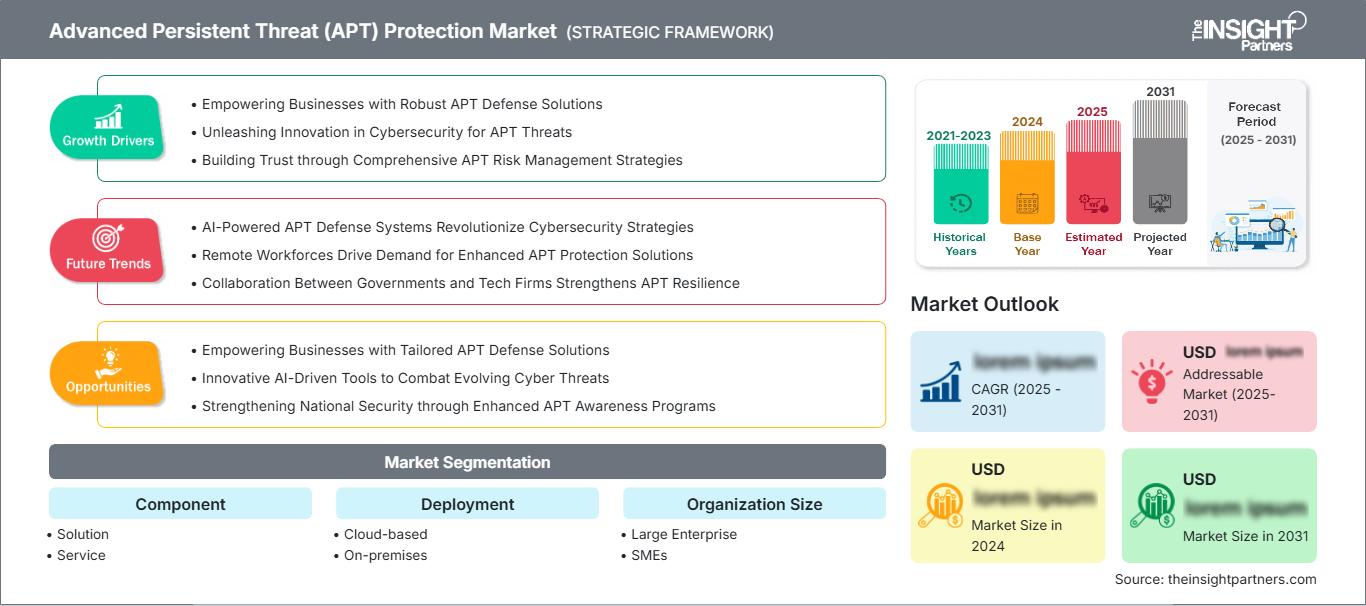
Advanced Persistent Threat (APT) Protection Market: Strategic Insights
Regional Insights
North America Advanced Persistent Threat Protection Market
North America maintained the largest regional position, accounting for approximately 36–40% of the advanced persistent threat protection market share in 2025. Growth is projected at a CAGR of 17–19% between 2026 and 2034, supported by extensive cybersecurity investments across government agencies, financial institutions, healthcare providers, and technology enterprises. More organizations are integrating threat intelligence, automated incident response, and cloud security solutions in order to keep up with changing threats and compliance requirements.
The regional demand is also fueled by high levels of cloud adoption, cybersecurity awareness, and deployment of zero-trust security solutions. There is an increased spending by critical infrastructure owners on threat detection and network visibility solutions. The presence of major cybersecurity solution providers and the development of cyber defense collaboration initiatives contribute to the continuous growth of the market in the region.
U.S. Advanced Persistent Threat Protection Market
The United States represented approximately 72–76% of the North American market in 2025 and is expected to register a CAGR of 17–19% through 2034. Large-scale digital transformation initiatives, increasing cloud migration, and heightened concern regarding state-sponsored cyber activity continue to strengthen investment in advanced threat protection technologies. Federal programs focused on cyber resilience further reinforce enterprise and public-sector spending.
The country is home to a number of top companies in the field of security, technology, and managed security services. This adoption rate is especially high among sectors such as the defense sector, BFSI, healthcare, telecommunication, and cloud services. Artificial intelligence and behavior analysis techniques are increasingly being adopted to enhance detection rates and reduce response time.
Europe Advanced Persistent Threat Protection Market
Europe accounted for an estimated 25–29% share in 2025 and is forecast to expand at a CAGR of 17–18.5% during 2026–2034. Germany remains the leading Advanced persistent threat protection market due to its extensive industrial base, Industry 4.0 initiatives, and growing focus on operational technology security. The demand for this market is bolstered by the rising worries about the protection of critical infrastructures and the cybersecurity resiliency of businesses.
The United Kingdom shows continued high adoption due to the strong presence of the financial services industry, growing digital infrastructure, and rising interest in cybersecurity resiliency. In addition, France, Italy, and Spain have been stepping up their cybersecurity efforts as well. Growth in the region is linked to the increasing compliance with cybersecurity directives, data protection regulations, and digital economy strategies.
APAC Advanced Persistent Threat Protection Market
Asia Pacific represented approximately 22–26% of the Advanced persistent threat protection market in 2025 and is expected to record the fastest expansion at a CAGR of 21–23% through 2034. China leads regional spending, while Japan and South Korea continue investing heavily in cyber defense modernization and protection of digital infrastructure assets.
India and Australia are becoming significant growth drivers owing to growing digitalization, cloud usage, and cybersecurity efforts by governments. The increasing awareness among enterprises, growing ecosystems of internet-connected devices, and increasing cyber risks make advanced threat protection solutions a popular choice in the region.
Middle East & Africa Advanced Persistent Threat Protection Market
The Middle East and Africa Advanced persistent threat protection market is projected to expand at a CAGR of 18–20% during 2026–2034. Saudi Arabia and the United Arab Emirates are driving demand through national digital transformation programs, smart city investments, and cybersecurity modernization initiatives across critical infrastructure sectors.
South Africa continues to be an important market in the region, whereas the wider MEA ecosystem sees improved connectivity and cloud adoption. The energy, utility, transportation, and government industries remain focused on threat visibility amid increasing cyber threats, along with modernizing infrastructure.
Segmentation Analysis
Component
The Component segment is projected to grow at a CAGR of 18–20% during 2026–2034. The segment remains fundamental to enterprise cybersecurity strategies as organizations seek comprehensive visibility across networks, endpoints, cloud workloads, and user identities. Increasing attack sophistication is encouraging investments in integrated prevention, detection, and response capabilities. The advanced persistent threat protection market scope continues to expand as businesses adopt unified security architectures that combine threat intelligence, analytics, and incident response functionality.
- Solution – This sub-segment represents the dominant market position due to widespread deployment of endpoint protection, threat intelligence, network monitoring, behavioral analytics, and automated response technologies used to identify sophisticated cyber intrusions.
- Service – Demand is supported by growing reliance on managed security services, consulting engagements, incident response assistance, and security operations support as organizations address internal cybersecurity skill shortages.
Deployment
The Deployment segment is anticipated to register a CAGR of 20–22% during 2026–2034. Organizations increasingly evaluate deployment strategies based on scalability, operational flexibility, compliance requirements, and security management efficiency. Growing cloud transformation initiatives are influencing purchasing decisions, while enterprises with strict regulatory requirements continue to maintain selected on-premises cybersecurity environments.
- Cloud-based – Enterprises favor cloud deployment for scalability, faster threat intelligence updates, centralized management capabilities, and efficient protection of distributed environments supporting hybrid work and multi-cloud operations.
- On-premises – This sub-segment maintains relevance among government agencies, critical infrastructure operators, and highly regulated industries requiring extensive control over security infrastructure and sensitive operational information.
Organization Size
The Organization Size segment is expected to expand at a CAGR of 18–19.5% during 2026–2034. Large-scale organizations traditionally account for significant cybersecurity spending; however, growing threat exposure is encouraging wider adoption among smaller enterprises. Cost-efficient subscription models and managed security offerings are improving accessibility across businesses with varying resource capabilities.
- Large Enterprise – Large organizations remain key adopters due to extensive digital ecosystems, larger attack surfaces, and elevated compliance obligations spanning multiple business functions and geographies.
- SMEs – Adoption is increasing as smaller businesses experience greater exposure to targeted cyberattacks and gain access to affordable cloud-delivered security services with advanced protection capabilities.
Vertical
The Vertical segment is projected to grow at a CAGR of 19–21% during 2026–2034. Industry demand patterns are shaped by variations in data sensitivity, regulatory obligations, operational continuity requirements, and cyber risk exposure. Organizations across critical sectors increasingly prioritize proactive detection and response capabilities to reduce financial and operational impacts associated with advanced cyber threats.
- BFSI – Financial institutions prioritize advanced threat protection to secure sensitive customer information, maintain transaction integrity, and address increasingly sophisticated fraud and cyber espionage attempts.
- Construction and Engineering – Digital project management platforms, connected infrastructure assets, and supply chain collaboration tools are increasing cybersecurity requirements throughout construction ecosystems.
- Healthcare – Healthcare providers are expanding cybersecurity investments to protect patient records, connected medical devices, and digitally integrated clinical environments from persistent threats.
- Retail and E-commerce – Retail organizations focus on protecting payment systems, customer databases, digital commerce platforms, and omnichannel operational environments from evolving cyber risks.
- Energy and Utilities – Operators prioritize security of industrial control systems, critical infrastructure assets, and operational technology environments supporting essential energy services.
- Media and Entertainment – Rising digital content distribution and intellectual property protection requirements are strengthening adoption of advanced threat defense solutions across media organizations.
- Government and Defense – High-value information assets, national security concerns, and increasing nation-state cyber activity continue to drive extensive deployment across government agencies.
- IT and Telecommunications – Telecommunications providers and technology companies require advanced monitoring capabilities to secure extensive networks, customer data, and cloud infrastructure environments.
Opportunity Snapshot
| Vertical | Revenue Contribution | Trend Tag | Adoption Stage |
|---|---|---|---|
| BFSI | High | Fraud Defense | Mature |
| Construction and Engineering | Low | Smart Projects | Emerging |
| Healthcare | High | Clinical Security | Scaling |
| Retail and E-commerce | Medium | Payment Shield | Scaling |
| Energy and Utilities | High | OT Security | Scaling |
| Media and Entertainment | Low | Content Defense | Emerging |
| Government and Defense | High | Cyber Sovereignty | Mature |
| IT and Telecommunications | High | Network Analytics | Mature |
Advanced Persistent Threat (APT) Protection Market Growth Drivers and Impact Analysis
Escalation of State-Sponsored and Targeted Cyber Campaigns
Growing geopolitical tensions and increasingly sophisticated cyber warfare tactics have significantly elevated the importance of advanced threat protection technologies. Nation-state actors are targeting defense organizations, critical infrastructure systems, technology companies, healthcare institutions, and government agencies to obtain strategic information and disrupt operations. Unlike conventional malware attacks, advanced persistent threats often remain undetected for extended periods while extracting sensitive information. Organizations are therefore investing in continuous monitoring, threat intelligence integration, and behavioral analytics capabilities to improve visibility and detection performance. This trend is encouraging enterprises to implement multilayer security architectures that support proactive threat hunting and rapid incident response, ultimately strengthening demand across both public-sector and private-sector markets.
Expansion of Cloud Computing and Hybrid Work Environments
The increasing transition toward cloud infrastructure, software-as-a-service platforms, and distributed workforce models is creating larger and more complex attack surfaces. Employees routinely access corporate systems from diverse locations and devices, increasing the need for centralized visibility and adaptive security controls. Traditional perimeter-focused approaches are no longer sufficient for securing hybrid environments. As organizations modernize digital infrastructure, demand grows for solutions capable of monitoring cloud workloads, user identities, endpoints, and network activity simultaneously. Security platforms that deliver unified threat detection and automated response capabilities are becoming essential components of modern cybersecurity strategies. The resulting transformation is accelerating investment in advanced persistent threat protection technologies across industries worldwide.
Strengthening Regulatory Requirements for Cyber Resilience
Governments and regulatory bodies are introducing more comprehensive cyber resilience frameworks to address increasing economic and operational risks associated with cyberattacks. Requirements related to breach disclosure, operational continuity, infrastructure security, and risk governance are influencing security investment priorities across many industries. Organizations are under growing pressure to demonstrate measurable cybersecurity readiness and threat response capabilities. Advanced threat protection solutions support compliance efforts by improving monitoring, reporting, and incident investigation processes. As regulatory oversight expands across sectors such as BFSI, healthcare, telecommunications, and energy, organizations are strengthening cybersecurity programs through greater adoption of intelligence-driven protection platforms capable of mitigating sophisticated and long-duration cyber intrusions.
Advanced Persistent Threat (APT) Protection Market Future Trends
AI-Driven Autonomous Threat Investigation
Artificial intelligence is expected to become a central capability within advanced threat protection platforms over the coming decade. Security teams increasingly face large volumes of alerts, making manual investigation difficult and resource intensive. Future platforms are likely to combine large language models, behavioral analytics, and automated response mechanisms to accelerate threat identification and remediation. The advanced persistent threat protection market trends indicate growing demand for autonomous security operations capable of correlating telemetry from endpoints, networks, cloud environments, and identity systems. Vendors are expected to enhance predictive detection models that identify suspicious behavior before significant compromise occurs. This evolution will support faster incident containment, reduced analyst workloads, and stronger cyber resilience across enterprises operating increasingly complex digital infrastructures.
Convergence of Cybersecurity Platforms and Zero-Trust Architectures
Organizations are moving toward consolidated cybersecurity environments that reduce operational complexity while improving visibility across digital assets. Future security strategies will increasingly integrate identity security, endpoint protection, cloud workload monitoring, network analytics, and threat intelligence within unified platforms. Demand for consistent policy enforcement and continuous verification is expected to strengthen adoption of zero-trust architectures. As hybrid work, cloud computing, and connected ecosystems continue expanding, enterprises are likely to prioritize solutions capable of protecting users and assets regardless of location. Vendors offering integrated protection frameworks and centralized security management capabilities are expected to benefit significantly as organizations seek improved efficiency, reduced tool fragmentation, and stronger protection against sophisticated intrusion campaigns.
Advanced Persistent Threat (APT) Protection Market Opportunities
Expansion of Managed Detection and Response Services
A significant opportunity exists for vendors and service providers delivering managed detection and response capabilities. Many organizations lack the internal expertise required to operate advanced cybersecurity technologies effectively. Rising cyber threats, increasing regulatory obligations, and shortages of skilled security professionals are encouraging businesses to outsource monitoring and incident response functions. The advanced persistent threat protection market Forecasts indicate strong potential for service-oriented business models that combine threat intelligence, expert analysis, and continuous monitoring. Providers capable of delivering scalable managed security offerings for mid-sized enterprises are positioned to capture incremental demand. Strategic investments in regional security operations centers and AI-enabled analytics platforms may further strengthen competitive differentiation and long-term revenue generation opportunities.
Protection of Operational Technology and Critical Infrastructure
Industrial digitalization is creating new opportunities across energy, utilities, manufacturing, transportation, and public infrastructure sectors. Operational technology environments historically relied on isolated systems, but increasing connectivity has exposed critical assets to sophisticated cyber threats. Organizations are therefore seeking specialized solutions capable of monitoring industrial protocols, identifying anomalous behavior, and supporting rapid incident response. Vendors that successfully bridge information technology and operational technology security requirements can address a growing Advanced persistent threat protection market need. Investments targeting infrastructure modernization, smart grid development, and industrial automation initiatives are expected to generate additional demand. As governments prioritize cyber resilience for essential services, advanced threat protection providers may benefit from substantial long-term deployment opportunities.
Frequently Asked Questions

- Comprehensive Market Sizing and Forecast Analysis
- Detailed Segmentation Analysis
- In-Depth Market Dynamics Assessment
- Regional and Country-Level Insights
- Competitive Landscape and Company Benchmarking
- Strategic Business Intelligence
Recent Reports
Testimonials

The Insight Partners provided valuable market intelligence that supported our global go-to-market strategy. Their team was professional, responsive, and attentive to our feedback, providing thoughtful analysis and helpful methodological clarifications throughout the project.
Junmo Kim Chief Financial Officer (CFO), Enertech Co., Ltd.
The Insight Partners' SCADA System Market report is comprehensive, with valuable insights on current trends and future forecasts. The team was highly professional, responsive, and supportive throughout. We are very satisfied and highly recommend their services.
RAN KEDEM Partner, Reali Technologies LTDs
I requested a report on a very specific software market and the team produced the report in a few days. The information was very relevant and well presented. I then requested some changes and additions to the report. The team was again very responsive and I got the final report in less than a week.
JEAN-HERVE JENN Chairman, Future Analytica
We worked with The Insight Partners for an important market study and forecast. They gave us clear insights into opportunities and risks, which helped shape our plans. Their research was easy to use and based on solid data. It helped us make smart, confident decisions. We highly recommend them.
PIYUSH NAGPAL Sr. Vice President, High Beam Global
The Insight Partners delivered insightful, well-structured market research with strong domain expertise. Their team was professional and responsive throughout. The user-friendly website made accessing industry reports seamless. We highly recommend them for reliable, high-quality research services
YUKIHIKO ADACHI CEO, Deep Blue, LLC.
This is the first time I have purchased a market report from The Insight Partners.While I was unsure at first, I visited their web site and felt more comfortable to take the risk and purchase a market report.I am completely satisfied with the quality of the report and customer service. I had several questions and comments with the initial report, but after a couple of dialogs over email with their analyst I believe I have a report that I can use as input to our strategic planning process.Thank you so much for taking the extra time and making this a positive experience.I will definitely recommend your service to others and you will be my first call when we need further market data.
JOHN SUZUKI President and Chief Executive Officer, Board Director, BK Technologies
I wish to appreciate your support and the professionalism you displayed in the course of attending to my request for information regarding to infectious disease IVD market in Nigeria. I appreciate your patience, your guidance, and the fact that you were willing to offer a discount, which eventually made it possible for us to close a deal. I look forward to engaging The Insight Partners in the future, all thanks to the impression you have created in me as a result of this first encounter.
DR CHIJIOKE ONYIA MANAGING DIRECTOR, PineCrest Healthcare Ltd.Reason to Buy
- Informed Decision-Making
- Understanding Market Dynamics
- Competitive Analysis
- Identifying Emerging Markets
- Customer Insights
- Market Forecasts
- Risk Mitigation
- Boosting Operational Efficiency
- Strategic Planning
- Investment Justification
- Tracking Industry Innovations
- Aligning with Regulatory Trends





 Get Free Sample for