
Advancement Camera Technologies Market Demand, Trends & Forecast by 2034
Advancement Camera Technologies Market Size and Forecasts (2021 - 2034), Global and Regional Share, Trends, and Growth Opportunity Analysis Report Coverage : By Type (Conventional, Digital), Vehicle Type (Passenger Cars, Commercial Vehicles), Application Type (Power Train, Body Electronics, Alternative Fuel Vehicles)
- Status : Data Released
- Report Code : TIPRE00039701
- Category : Electronics and Semiconductor
- No. of Pages : 150
- Available Report Formats :


- Last update date : July 13, 2026


2025 Market Size
US$ 8.94 Bn
Base year value
2034 Forecast
US$ 19.74 Bn
Projected by 2034
CAGR 2026-2034
9.19 %
Growth rate
Addressable Market
US$ 128.12 Bn
(2026-2034)
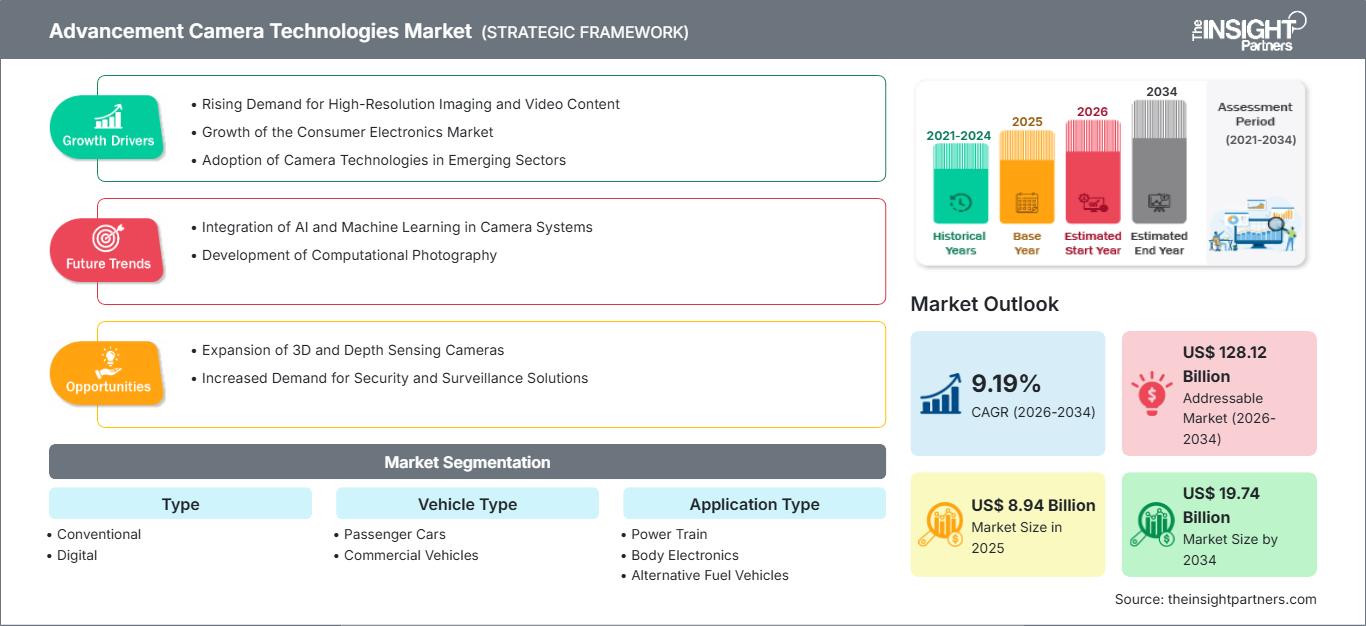
The Advancement Camera Technologies Market was valued at US$ 8.94 Billion in 2025 and is projected to reach US$ 19.74 Billion by 2034, registering a CAGR of 9.19% during 2026–2034. Advancement camera technologies integrate optical hardware, image sensors, digital processing, embedded software, and vehicle-level electronics to support visibility, safety, automation, and efficiency across mobility platforms.
North America is expected to grow at a CAGR range of 8.5–9.0% during 2026–2034, supported by advanced driver-assistance penetration, fleet safety investment, and rising use of camera-based monitoring in passenger and commercial vehicles. Federal safety priorities, insurance pressure, and OEM competition are accelerating multi-camera architectures for power train monitoring, body electronics, and alternative fuel vehicle platforms, according to the Advancement Camera Technologies Market Report.
Advancement Camera Technologies Market Assessment and Insights
- North America: 27–31% share in 2025 and CAGR between 2026–2034 of 8.5–9.0%; ADAS mandates, high-value light trucks, and fleet safety programs support sustained adoption.
- US: 78–82% of North America share in 2025 and CAGR between 2026–2034 of 8.6–9.1%; OEM electronics depth and commercial fleet upgrades make it the regional anchor.
- Europe: 21–25% share in 2025 and CAGR between 2026–2034 of 8.0–8.5%; Germany, France, the UK, Italy, and Spain lead through safety regulation and premium vehicle content.
- Asia Pacific: 34–38% share in 2025 and CAGR between 2026–2034 of 9.8–10.3%; China, Japan, South Korea, and India benefit from EV platforms, electronics scale, and cost-competitive camera modules.
- Largest Segment: Digital held 64–68% market share in 2025, CAGR range 9.6–10.1%, supported by image processing, sensor fusion, and software-defined vehicle architectures.
- High Growth Segment: Alternative Fuel Vehicles held 18–22% market share in 2025, CAGR range 10.8–11.3%, driven by EV thermal monitoring, battery safety, and platform-level electronics integration.
- Key companies analyzed in detail: Panasonic Holdings Corporation; Samsung Electronics Co., Ltd.; Ricoh Company, Ltd.; Huawei Technologies Co., Ltd.; Guangdong OPPO Mobile Telecommunications Corp., Ltd.; OM Digital Solutions Corporation; FUJIFILM Holdings Corporation; Vivo Mobile Communication Co., Ltd.; Canon Inc.; Sony Group Corporation; Continental AG; Valeo SE.
Source: The Insight Partners' analysis based on proprietary research, government publications, company annual reports, investor presentations, industry databases, and expert interviews.
The Advancement Camera Technologies Market Forecast indicates that advancement camera technologies have moved from basic rear-view visibility to distributed sensing systems that support driver assistance, in-cabin monitoring, surround view, and electronic control integration. Production dynamics are shifting toward CMOS sensors, high dynamic range imaging, LED flicker mitigation, heated lenses, software calibration, and compact modules. As vehicles become software-defined, camera hardware is increasingly designed around compute, cybersecurity, validation, and thermal packaging rather than standalone optics.
Forward demand will be shaped by emerging EV production hubs, safety regulations, fleet digitization, and investment in centralized vehicle computers. North America and Europe emphasize compliance and premium features, while Asia Pacific drives volume through scale manufacturing and local OEM innovation. The Advancement Camera Technologies Market analysis indicates rising supplier value where camera modules connect perception, monitoring, and electronics control across multiple vehicle domains.
Advancement Camera Technologies Market Report Scope
| Report Attribute | Details |
|---|---|
| Market size in 2025 | US$ 8.94 Billion |
| Market Size by 2034 | US$ 19.74 Billion |
| Global CAGR (2026 - 2034) | 9.19% |
| Historical Data | 2021-2024 |
| Forecast period | 2026-2034 |
Advancement Camera Technologies Market Analysis
Demand is led by vehicle safety, automated parking, lane assistance, surround-view visualization, driver monitoring, and camera-linked electronics diagnostics. Yole Group reported automotive camera module revenue near US$ 6 billion in 2024 and forecast US$ 8.7 billion by 2030, indicating that camera value is rising with module complexity, sensor resolution, and system integration. This supports Advancement Camera Technologies' size expansion beyond conventional visibility use cases.
The Advancement Camera Technologies Market size is supported by a broad ecosystem that includes image sensor suppliers, lens makers, module assemblers, tier-one integrators, software vendors, semiconductor foundries, OEM engineering teams, and validation laboratories. Supply dynamics depend on automotive-grade qualification, exposure to semiconductor cycles, regional assembly, and the ability to deliver reliable performance under rain, glare, vibration, heat, and low-light driving conditions.
The competition is built around the combination of imaging consumer knowledge, automotive electronics capability, and innovative smartphone-sized sensors. The vehicle integration of the competitive environment involves Panasonic Holdings Corporation and Continental AG. Samsung Electronics Co., Ltd., Sony Group Corporation, Canon Inc., and FUJIFILM Holdings Corporation provide sensors, optics, and imaging technologies. Huawei Technologies Co., Ltd., Vivo Mobile Communication Co., Ltd., and Guangdong OPPO Mobile Telecommunications Corp., Ltd. reinforce the importance of computational imaging.
Investment trends are focused on 8 megapixel automotive sensors, RGB-IR driver monitoring capabilities, global shutter technology, lens heating, small form factor, cybersecurity, and software calibration. Ricoh Company, Ltd., OM Digital Solutions Corporation, and Valeo SE stay relevant in cases where rugged optics, in-vehicle imaging, and ADAS integration coincide. Strategic positioning requires careful balancing of long automotive lifecycles with fast innovations in digital imaging.
● REPORT CUSTOMIZATION
Tailor This Report To Align With Your Specific Business Requirements
This report can be customized to align precisely with your business objectives, scope, and target markets. Customization options include tailored segmentation, geography, competitive analysis, and strategic insights to support informed decision-making.
Customize This Report →WHAT YOU CAN ADJUST
- ● Segmentations
- ● Geography
- ● Competitive Analysis
- ● Language Preferences
Advancement Camera Technologies Market: Strategic Insights
Regional Insights
North America Advancement Camera Technologies Market
Advancement Camera Technologies Market share reached 27–31% in North America in 2025, and the region is projected to grow at a CAGR of 8.5–9.0% during 2026–2034. In the region, there are high safety adoption levels, electronics contents in pickups and SUVs, as well as commercial fleets with camera-based driver assistance needs. The NHSTA's emphasis on avoiding crashes increases the adoption of cameras by automakers for perception. Suppliers' activities include surround view cameras, driver monitoring, cabin sensing, and trailer assist cameras. In addition, there is the use of high-definition cameras to eliminate blind spots and enhance parking automation and over-the-air updates of features. The growth of Advancement Camera Technologies in North America is thus based on software-defined vehicle strategies and the economics of fleets.
U.S. Advancement Camera Technologies Market
The U.S. represented 78–82% of North America's market share in 2025 and is expected to expand at a CAGR of 8.6–9.1% through 2034. Application trends are concentrated in ADAS, body electronics, driver monitoring, and commercial vehicle safety packages. Panasonic Holdings Corporation, Samsung Electronics Co., Ltd., Sony Group Corporation, Continental AG, and Valeo SE support component, module, and integration activities. Key Advancement Camera Technologies Market trends include the increasing adoption of AI-enabled vision systems, expansion of driver monitoring technologies, integration of high-resolution camera modules for autonomous driving functions, and growing demand for camera-based safety solutions across passenger and commercial vehicles.
OEMs use camera systems to differentiate electric SUVs, pickup trucks, delivery vans, and premium passenger cars. Fleet operators value evidence capture, lane awareness, cargo monitoring, and driver behavior analytics, while consumers increasingly expect surround view and automated parking. The U.S. market also benefits from semiconductor design depth and connected-vehicle software investment.
Europe Advancement Camera Technologies Market
Europe held 21–25% share in 2025 in the Advancement Camera Technologies Market and is forecast to grow at a CAGR of 8.0–8.5% during 2026–2034. Germany is leading because of the integration of the camera system into power train, chassis, and body electronics by premium OEMs. High engineering validation, supplier concentration, and the impact of Euro NCAP safety help in the dominance of cameras in perception for the launch of new vehicle platforms.
The UK facilitates adoption through the need for fleet safety, insurance telematics, and parking assistance in crowded urban conditions. France promotes the use of cameras through safety legislation, electric vehicle initiatives, and OEM platforms. Italy and Spain continue to be key manufacturers and replacement markets for small cars and urban driving conditions.
European consumers attach great significance to reliability, data protection, and functional safety. This puts suppliers with the capability in automotive-grade performance and software at an advantage. The Advancement Camera Technologies Market in Europe, therefore, emphasizes validated sensing, in-cabin monitoring, and integration with battery-electric and hybrid vehicle electronics.
APAC Advancement Camera Technologies Market
APAC accounted for 34–38% share in 2025 in the Advancement Camera Technologies Market and is expected to grow at a CAGR of 9.8–10.3% through 2034. China leads through EV scale, local ADAS adoption, and high camera counts on intelligent vehicles.
Japan and South Korea contribute sensor, optics, semiconductor, and OEM engineering depth. India expands through passenger car safety upgrades, two-wheeler adjacent imaging innovation, and local assembly incentives, while Australia supports premium SUV and fleet applications.
Industrial policy, export manufacturing, and battery-electric platforms make APAC the fastest-growing region. The Advancement Camera Technologies Market benefits from dense electronics supply chains and rapid consumer acceptance of camera-enabled vehicle features.
Middle East & Africa Advancement Camera Technologies Market
The Middle East & Africa is expected to experience a growth of 7.2-7.7% CAGR for 2026-2034. The country leading in the region is Saudi Arabia because of smart city mobility, premium car sales, logistics improvements, and infrastructure development.
The UAE drives the market through valuable cars, telematics for fleet, and mobility solutions for airports, ports, and tourism. South Africa drives the market through commercial trucks and mining trucks, and replacement demand due to security.
Diversification of energy sources, road safety campaigns, and logistics improvement drive the adoption of cameras, but affordability issues prevent complete market penetration. Rugged modules, thermal resistance, and after-sales services are extremely important in harsh conditions.
Segmentation Analysis
Type
The type segment of the Advancement Camera Technologies Market is projected to grow at a CAGR of 8.9–9.4% during 2026–2034. Digital systems dominate new vehicle platforms because they support high dynamic range, software correction, embedded diagnostics, and integration with ADAS controllers. Conventional systems retain value in cost-sensitive applications where basic visibility, durability, and straightforward replacement remain important.
- Conventional cameras serve price-sensitive vehicle trims and aftermarket replacement channels, where simple rear-view and basic monitoring functions remain adequate for safety compliance and entry-level convenience.
- Digital cameras hold a stronger strategic importance because they enable image processing, object detection, remote calibration, over-the-air software improvement, and integration with centralized vehicle computers.
Vehicle Type
The vehicle type segment is expected to grow at a CAGR of 9.0–9.5% during 2026–2034. Passenger cars remain the larger demand base due to high model volumes and consumer expectations for parking assistance, lane awareness, and cabin safety. Commercial vehicles show rising strategic relevance as fleets adopt cameras for driver monitoring, cargo visibility, route safety, and liability management.
- Passenger cars account for broad deployment because OEMs increasingly package surround view, driver monitoring, and body electronics cameras across mid-range, premium, hybrid, and electric platforms.
- Commercial vehicles use cameras to reduce blind spots, document incidents, support driver coaching, monitor cargo, and improve safety economics across logistics, construction, public transport, and delivery fleets.
Application Type
The application type segment is forecast to grow at a CAGR of 9.4–9.9% during 2026–2034. Body electronics form the adoption core through parking, mirrors, cabin sensing, and lighting-linked systems. Power train monitoring is emerging in thermal, vibration, and maintenance contexts, while alternative fuel vehicles create new demand around battery safety, thermal events, and platform-specific diagnostics.
- Power Train uses cameras for inspecting, observing through thermal imaging, diagnostics through vibrations, and maintenance, particularly for electrified systems that necessitate visibility of the enclosed system.
- Body Electronics continue to be strategically important because cameras help integrate parking, mirrors, driver monitoring, occupancy monitoring, access control, lighting, and cockpit functions within one electronic experience.
- Alternative Fuel Vehicles generate significant need for thermal sensing of batteries, visibility around the charging area, underbody inspection, and integrated sensing systems within electric and hydrogen-based vehicles.
Opportunity Snapshot
| Application Type | Revenue Contribution | Trend Tag | Adoption Stage |
| Power Train | Medium | Thermal Vision | Scaling |
| Body Electronics | High | Surround View | Mature |
| Alternative Fuel Vehicles | Medium | Battery Safety | Scaling |
Advancement Camera Technologies Market Growth Drivers and Impact Analysis
ADAS and Safety Regulation Raise Camera Content
Automobile manufacturers are integrating more cameras as safety assessment programs recognize the need for pedestrian detection, lane guidance, automated emergency braking, driver monitoring, and parking assistance capabilities. This can be seen in terms of increased numbers of cameras per car and increased implementation beyond high-end segments. These applications require high dynamic range, night vision, LED flicker reduction, and tuned software, adding to the value of the module. For camera suppliers, the focus of the competition will move from cost-effective modules to perception capability, functional safety, and durability of operation.
Software-Defined Vehicles Expand Imaging Roles
Vehicle architectures are evolving from individualized electronic control units to integrated computing, zonal control, and software-updatable features. Cameras are not simply for visibility anymore, but for the provision of data used in perception, customization of interiors, diagnostics, predictive maintenance, and UI purposes. This alters procurement in that OEMs consider latency, security, data throughput, power efficiency, and upgradability in addition to optical performance. The implications for the market include an increased demand for digital cameras and camera module design capabilities.
Electrification Creates New Monitoring Requirements
Electric vehicles and alternative fuel vehicles give rise to new imaging needs with regard to battery packs, charging port imaging, thermal events, underbody protection, and autonomous parking in close proximity to charging equipment. Camera technology helps provide the necessary imaging in order to help with visibility, obstacle detection, and monitoring of the vehicle because of the quiet operation, which impacts the driving experience. The implications range from consumer use of EVs all the way to electric buses and vans, which have operational uptime and diagnostic needs.
Advancement Camera Technologies Market Future Trends
High-Resolution Automotive Sensors Become Mainstream
Camera roadmap technologies are headed for sensors of increased resolution owing to demand for better object recognition capabilities, larger field of view, and greater ability to function with varying light conditions. Sensors with eight megapixel resolution, HDR+ capability, and LED flicker elimination technologies are likely to become increasingly popular for front, surround, and interior cameras. The technology trend is going to raise processing needs, thermal designs, and validation burdens. It will also put an extra emphasis on careful selection of image sensors since resolution should be considered alongside other factors such as power consumption, latency, and reliability.
In-Cabin Sensing Moves Beyond Compliance
Driver monitoring is evolving from being used for regulatory compliance purposes to becoming part of cabin intelligence. In the future, systems will be able to handle occupant identification, seatbelt reminder systems, alerting the driver about the presence of children, personalization, gestures, and even fatigue detection, all based on privacy-compliant architectures. RGB+IR cameras and global shuttering technology would probably play an increasing role due to the needs of the cabin, which is operating in darkness, daylight, and high-speed conditions. In the future, as cars turn into connected digital spaces, camera manufacturers could enter cockpit software ecosystems.
Advancement Camera Technologies Market Opportunities
Fleet Safety Platforms and Commercial Vehicles
Commercial fleets offer a high-priority opportunity because operators can translate camera investment into fewer incidents, better claims management, driver coaching, and improved asset visibility. Suppliers can package forward, side, rear, cabin, and cargo cameras with analytics dashboards, storage, and integration into fleet management systems. The opportunity is especially attractive in logistics, mining, public transport, construction, and last-mile delivery, where downtime and liability have measurable financial consequences. Vendors that provide rugged hardware, secure data handling, and aftermarket support can build recurring service relationships beyond one-time module sales.
EV Platform Integration and Battery Safety
Alternative fuel vehicles provide a chance for cameras to be designed to address battery security, charging, sensing the underbody, and reacting to thermal events. Car manufacturers and their tier one suppliers may integrate cameras with thermal detectors, parking systems, and diagnostic technologies to ensure more security and confidence in electric cars, hybrids, and hydrogen-based automobiles. This market opportunity will benefit most from efforts directed at developing small modules, heat resistance of equipment, software calibration, and data interface to link imaging with health monitoring of the vehicle.
Recent Developments
- November 2025: Canon announced an addition to the EOS R mirrorless system, the new full-frame EOS R6 MARK III camera and the RF45mm F1.2 STM, a new large aperture standard prime lens designed for professional filmmakers and photographers from across genres. Succeeding the EOS R6 Mark II, which was released in 2023, the EOS R6 MARK III features a higher 32.5-megapixel resolution and improved speed, performance, and reliability. It also incorporates powerful video capabilities that support professional workflows. As for the RF45mm F1.2 STM, it is Canon’s widest aperture non-professional lens in its RF lens lineup. A versatile and easy-to-use 45mm focal length on full-frame cameras, it broadens the accessibility of an f/1.2 lens to users. On APS-C cameras like the EOS R50, users can expect a portrait-friendly 72mm full-frame equivalent focal length.
- October 2025: Sony Semiconductor Solutions Corporation (Sony) announced the upcoming release of the IMX828, the industry’s first CMOS image sensor for automotive applications with a built-in MIPI A-PHY interface. There are multiple high-speed transmission interface standards for automotive applications. This product is the first in the industry to include the interface in the image sensor.
- March 2025: Samsung Electronics’ booth at Mobile World Congress 2025 captivated visitors with the recently released Galaxy S25 series and its advanced AI features. Through interactive zones and hands-on activities, attendees discovered how Galaxy AI is transforming mobile interactions with AI-powered tools that boost productivity, cutting-edge camera enhancements that capture the perfect shot, and more.
Frequently Asked Questions

- Comprehensive Market Sizing and Forecast Analysis
- Detailed Segmentation Analysis
- In-Depth Market Dynamics Assessment
- Regional and Country-Level Insights
- Competitive Landscape and Company Benchmarking
- Strategic Business Intelligence
Recent Reports
Testimonials

The Insight Partners' SCADA System Market report is comprehensive, with valuable insights on current trends and future forecasts. The team was highly professional, responsive, and supportive throughout. We are very satisfied and highly recommend their services.
RAN KEDEM Partner, Reali Technologies LTDs
I requested a report on a very specific software market and the team produced the report in a few days. The information was very relevant and well presented. I then requested some changes and additions to the report. The team was again very responsive and I got the final report in less than a week.
JEAN-HERVE JENN Chairman, Future Analytica
We worked with The Insight Partners for an important market study and forecast. They gave us clear insights into opportunities and risks, which helped shape our plans. Their research was easy to use and based on solid data. It helped us make smart, confident decisions. We highly recommend them.
PIYUSH NAGPAL Sr. Vice President, High Beam Global
The Insight Partners delivered insightful, well-structured market research with strong domain expertise. Their team was professional and responsive throughout. The user-friendly website made accessing industry reports seamless. We highly recommend them for reliable, high-quality research services
YUKIHIKO ADACHI CEO, Deep Blue, LLC.
This is the first time I have purchased a market report from The Insight Partners.While I was unsure at first, I visited their web site and felt more comfortable to take the risk and purchase a market report.I am completely satisfied with the quality of the report and customer service. I had several questions and comments with the initial report, but after a couple of dialogs over email with their analyst I believe I have a report that I can use as input to our strategic planning process.Thank you so much for taking the extra time and making this a positive experience.I will definitely recommend your service to others and you will be my first call when we need further market data.
JOHN SUZUKI President and Chief Executive Officer, Board Director, BK Technologies
I wish to appreciate your support and the professionalism you displayed in the course of attending to my request for information regarding to infectious disease IVD market in Nigeria. I appreciate your patience, your guidance, and the fact that you were willing to offer a discount, which eventually made it possible for us to close a deal. I look forward to engaging The Insight Partners in the future, all thanks to the impression you have created in me as a result of this first encounter.
DR CHIJIOKE ONYIA MANAGING DIRECTOR, PineCrest Healthcare Ltd.Reason to Buy
- Informed Decision-Making
- Understanding Market Dynamics
- Competitive Analysis
- Identifying Emerging Markets
- Customer Insights
- Market Forecasts
- Risk Mitigation
- Boosting Operational Efficiency
- Strategic Planning
- Investment Justification
- Tracking Industry Innovations
- Aligning with Regulatory Trends





 Get Free Sample for