
AI Adaptive Radio Market Demand, Share & Growth by 2034
Coverage: by Technology Type (Cognitive Radio System and Software Based Radio); Application (Geolocation & Networking, Navigation Planning, Spectrum Sensing & Access, and Authentication); Verticals (Military and Defense and Commercial Industry), and Geography (North America, Europe, Asia Pacific, and South and Central America)
- Status : Data Released
- Report Code : TIPAD00002069
- Category : Electronics and Semiconductor
- No. of Pages : 150
- Available Report Formats :


- Last update date : July 10, 2026


2025 Market Size
US$ 3.48 Bn
Base year value
2034 Forecast
US$ 17.08 Bn
Projected by 2034
CAGR 2026-2034
19.34 %
Growth rate
Addressable Market
US$ 83.96 Bn
(2026-2034)
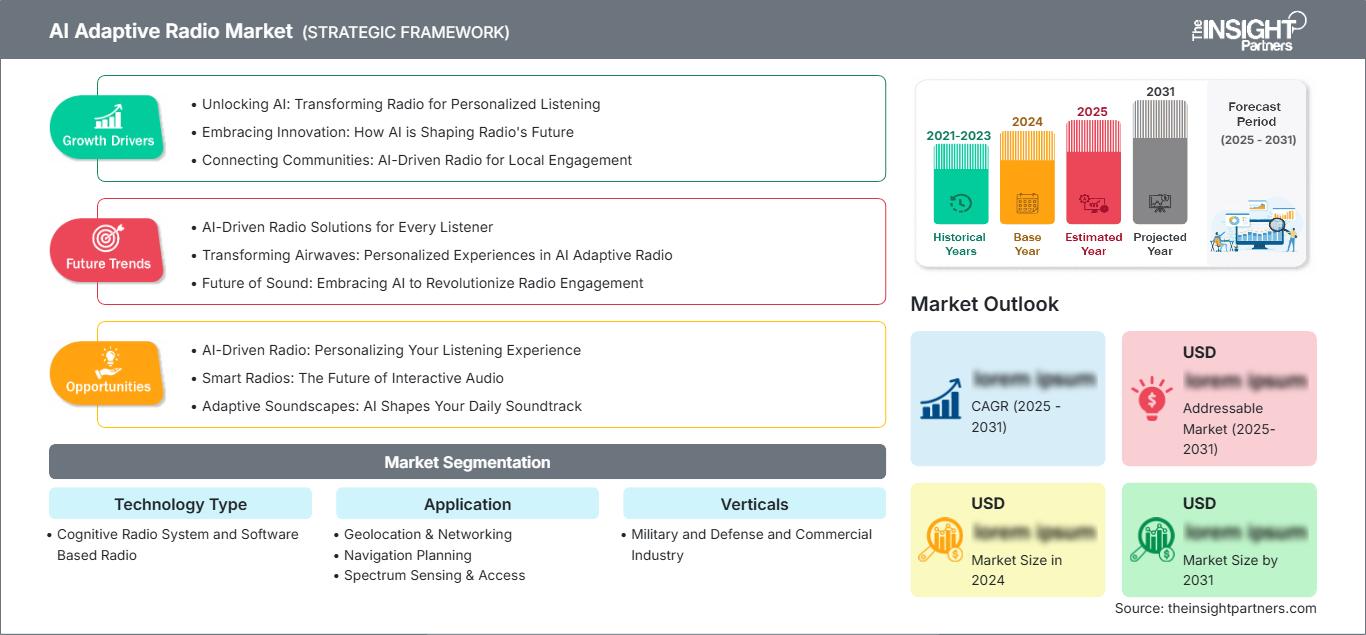
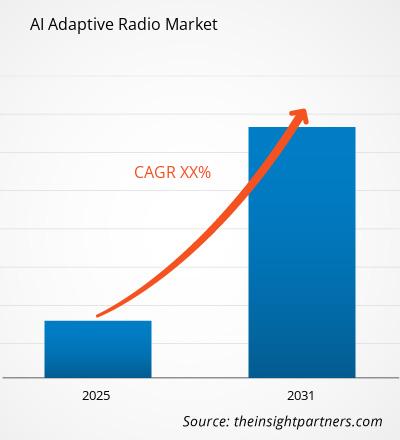
The AI Adaptive Radio Market is valued at US$ 3.48 Billion in 2025 and is projected to reach US$ 17.08 Billion by 2034, expanding at a CAGR of 19.34% during 2026–2034. The market is driven by intelligent spectrum optimization, AI-enabled signal processing, and dynamic frequency allocation capabilities across defense and commercial communication ecosystems. Increasing demand for resilient, interference-free communication in mission-critical environments is accelerating deployment. Integration of cognitive algorithms and software-defined architectures continues to redefine next-generation adaptive radio systems globally.
North America remains the dominant innovation hub for the AI Adaptive Radio Market, expected to expand at a CAGR of 18.5–20.2% through 2034. Growth is supported by advanced defense modernization programs and the rapid adoption of AI-driven spectrum intelligence systems. Strong presence of defense contractors and telecom innovators enhances ecosystem maturity. Rising investment in secure battlefield communication and autonomous network infrastructure further strengthens regional adoption across both military and enterprise-grade communication networks.
AI Adaptive Radio Market Assessment and Insights
- North America: Accounts for 38–42% share in 2025, growing at 18.5–20.2% CAGR (2026–2034). Strong defense communication modernization, AI spectrum allocation, and private 5G deployments drive dominance across military and commercial communication systems.
- US: Holds 30–33% share in 2025 within North America, growing at 18.8–20.5% CAGR. High R&D spending in defense AI radios and software-defined networks supports strong domestic expansion.
- Europe: Represents 22–25% share in 2025, expanding at 17.5–19.0% CAGR—growth led by UK, Germany, and France through NATO-aligned communication modernization and spectrum efficiency initiatives.
- Asia Pacific: Accounts for 25–28% share in 2025, growing at a 20.0–21.5% CAGR. China, India, Japan, and South Korea lead investments in secure military communications and smart infrastructure.
- Largest Segment: Cognitive Radio Systems hold 56–60% share in 2025, growing at 18.7–20.1% CAGR due to adaptive spectrum intelligence and defense communication adoption.
- High Growth Segment: Spectrum Sensing & Access applications hold 28–31% share in 2025, growing at 20.5–22.0% CAGR driven by AI-based interference detection and real-time allocation efficiency.
- Key companies analyzed: Thales Group, L3Harris Technologies, RTX Corporation (Raytheon), Northrop Grumman Corporation, Collins Aerospace, HPE Aruba Networks, Rockwell Collins legacy systems, Datron World Communications, FireEye (Trellix), Boston Micromachines Corporation.
Source: The Insight Partners' analysis based on proprietary research, government publications, company annual reports, investor presentations, industry databases, and expert interviews.
The AI Adaptive Radio Market size has evolved from conventional software-defined radio platforms into AI-embedded cognitive communication ecosystems. Initial radio architectures were more concerned with spectrum flexibility, while modern ones have machine learning incorporated in their design for automated frequency and interference management. Defense sectors and telecoms companies are moving toward incorporating layers of intelligent adaptability to tackle the congested spectrum environment. Radio virtualization through cloud technology and edge computing is changing the paradigms of deployment models in both tactical and commercial radio networks.
In the future, development will be propelled by factors like the convergence of satellites and terrestrial radio communications, 6G project development efforts, and defense digitalization projects. The governments of the US, China, and Europe are making investments in intelligent and secure communication systems using AI technologies. With regulatory push towards maximizing the use of the spectrum by organizations such as the FCC and the ITU, commercialization will be spurred.
AI Adaptive Radio Market Report Scope
| Report Attribute | Details |
|---|---|
| Market size in 2025 | US$ 3.48 Billion |
| Market Size by 2034 | US$ 17.08 Billion |
| Global CAGR (2026 - 2034) | 19.34% |
| Historical Data | 2021-2024 |
| Forecast period | 2026-2034 |
AI Adaptive Radio Market Analysis
AI Adaptive Radio Market share is strongly influenced by rising spectrum congestion, increasing defense communication complexity, and the expansion of IoT ecosystems. AI-powered adaptive radios enable real-time optimization of frequencies to lower latency and enhance reliability even in contested operating conditions. The ecosystem consists of semiconductor producers, defense contractors, and telecom companies. The supply chains are dependent upon modern RF technology and AI chipsets, with an increasing focus on edge AI processing devices. Software-based architecture allows for easy scaling across air, maritime, and ground platforms.
Increased competitive intensity results from the investment by existing defense contractors and telecom equipment makers in cognitive radios. For example, Thales Group and L3Harris Technologies are working on AI-powered battlefield communication solutions, while RTX Corporation and Northrop Grumman Corporation develop secure spectrum technologies. HPE Aruba Networks is developing enterprise-ready adaptive wireless technologies. The industry investment trends show great interest of venture capital investors in spectrum intelligence start-ups and defense AI integration, while strategic alliances prevail in product development cycles.
● REPORT CUSTOMIZATION
Tailor This Report To Align With Your Specific Business Requirements
This report can be customized to align precisely with your business objectives, scope, and target markets. Customization options include tailored segmentation, geography, competitive analysis, and strategic insights to support informed decision-making.
Customize This Report →WHAT YOU CAN ADJUST
- ● Segmentations
- ● Geography
- ● Competitive Analysis
- ● Language Preferences
AI Adaptive Radio Market: Strategic Insights
Regional Insights
North America AI Adaptive Radio Market
North America leads the AI Adaptive Radio Market due to strong defense modernization programs and advanced telecom infrastructure. The region accounts for 38–42% share in 2025 and is projected to grow steadily at 18.5–20.2% CAGR through 2034. The United States leads the way in demand generation, owing to investments made by the Federal Government in AI-supported communication systems. Canada also makes its contribution through cognitive research on spectrum management and improvements in emergency communication systems. The growing use of 5G and Private LTE networks further bolsters the uptake. Military demand is seen as the major source of growth in this ecosystem, especially when it comes to robust battlefield communication systems that are compatible with frequency optimization platforms using artificial intelligence.
There are excellent contributions made by the region in terms of defense companies and technology players. The use of cognitive algorithms in communication equipment further adds to their robustness. Expansion of autonomous defense systems and satellite communication networks further strengthens long-term demand for adaptive radio technologies across North America, according to the AI Adaptive Radio Market Report.
U.S. AI Adaptive Radio Market
The United States accounts for 30–33% share of the North America AI Adaptive Radio Market Forecast in 2025 and is projected to grow at a CAGR of 18.8–20.5%. The federal defense budgets and research and development investments made by DARPA are some of the forces encouraging the adoption of cognitive radios. The need for secure AI-enhanced communications in the U.S. military makes implementation on the airborne and naval vehicles a major success. Adaptive radios are increasingly being adopted by the commercial sector in the form of 5G and enterprise wireless systems.
Some of the technology companies contributing to innovation include L3Harris Technologies and RTX Corporation. The increasing pressure for efficient spectrum utilization in telecommunication network infrastructure and defense communications modernization is fueling the continued innovation process.
Europe AI Adaptive Radio Market
Europe has a share of 22-25% for 2025 with a CAGR growth rate of 17.5-19.0%. UK, Germany, and France are the key adopters via NATO defense communication enhancements. Europe is focused on secure spectrum utilization and cross-border compatibility. Regulatory structure via the European Telecommunications Standards Institute is promoting the standardized implementation of cognitive radio technology.
Defense Communication Resilience forms the key focus area for the UK, Germany concentrates on wireless integration for the industrial and automotive sectors. At the same time, France develops secure communications for the military sector. The progress of Italy and Spain comes from the gradual development of the public safety communication system.
APAC AI Adaptive Radio Market
The Asia Pacific region accounts for 25%-28% share in 2025 and will be growing at 20.0%-21.5% CAGR, being driven by China, India, Japan, South Korea, and Australia. China leads due to the massive defense modernization and 6G initiatives. India is upgrading its tactical communication systems through defense digitization initiatives. Japan and South Korea are working towards telecom and smart infrastructure integration.
Geopolitical factors driving the growth include increased government policies and emphasis on secure communication technologies. Australia is contributing through defense interoperability initiatives. APAC continues to be the leading region due to extensive telecom development and government-led spectrum optimization initiatives, with China leading the region.
Middle East & Africa AI Adaptive Radio Market
The Middle East & Africa has an 8–10% market share in 2025 and is forecasted to have a 17.0–18.5% CAGR. Smart defense and smart cities are driving the implementation of the product in this region. While South Africa is working on communication systems for public safety, other MEA countries are implementing adaptive radio systems for infrastructure improvement.
Digitization of the energy industry and investments in secure communication systems are driving forces. There is government funding in communication networks for oil & gas and logistics. UAE stands out among other MEA countries because of the quick implementation of AI-based defense communication solutions and smart infrastructure.
Segmentation Analysis
Technology Type (Cognitive Radio System and Software-Based Radio)
Cognitive Radio Systems and Software-Based Radio collectively form the backbone of the AI Adaptive Radio Market, enabling dynamic spectrum allocation and intelligent signal processing. The segment is projected to grow at a CAGR of 18.7–20.1% from 2026–2034. Rising demand for autonomous communication systems in defense and commercial applications is accelerating adoption. Integration of AI algorithms enhances spectrum efficiency and reduces interference, making these technologies central to emerging AI Adaptive Radio Market trends focused on autonomous spectrum management, real-time signal optimization, and resilient wireless communications.
- Cognitive Radio System: Dominates due to real-time spectrum awareness, supporting defense communication and mission-critical operations across dynamic environments.
- Software-Based Radio: Enables flexible deployment and upgrades through software updates, supporting cost efficiency and rapid scalability in commercial telecom networks.
Application (Geolocation & Networking, Navigation Planning, Spectrum Sensing & Access, Authentication)
Applications in the AI Adaptive Radio Market are expanding due to increasing demand for secure and adaptive communication frameworks across industries. Spectrum Sensing & Access leads innovation due to its role in real-time frequency optimization. Geolocation and navigation planning enhance operational accuracy in defense missions. Authentication ensures secure communication across sensitive networks. Networking applications support large-scale connectivity in enterprise systems. Growing integration of AI improves responsiveness, reduces latency, and enhances spectrum utilization efficiency across all application domains.
- Geolocation and Networking: Helps to ensure positioning and connectivity in defense and logistics missions that need real-time communication.
- Navigation Planning: Assists in mission planning by routing and adaptive communication in spectrum-aware networks.
- Spectrum Sensing and Access: Assists in sensing available frequencies for better efficiency and reduced interference.
- Authentication: Provides secure communication links with the use of AI authentication and encryption.
Verticals (Military and Defense and Commercial Industry)
The Military and Defense vertical dominates the AI Adaptive Radio Market due to rising demand for secure battlefield communication systems. The segment is projected to grow at 19.0–20.8% CAGR, driven by the modernization of tactical communication infrastructure. Commercial industries are increasingly adopting adaptive radios for enterprise networking and private 5G deployments. Integration of AI enhances operational reliability and spectrum efficiency across both verticals. Defense remains the primary growth contributor due to geopolitical tensions and modernization programs globally.
- Military and Defense: High adoption driven by secure, resilient communication requirements in contested environments and multi-domain operations.
- Commercial Industry: Expanding use in telecom, smart cities, and enterprise networks requiring adaptive, interference-free connectivity solutions.
Opportunity Snapshot
| End-User | Revenue Contribution | Trend Tag | Adoption Stage |
| Military and Defense | High | Secure Comms | Mature |
| Commercial Industry | Medium | Private 5G | Scaling |
AI Adaptive Radio Market Growth Drivers and Impact Analysis
AI-Driven Spectrum Optimization in Defense Networks
AI-based spectrum optimization technologies are changing the future of military communication devices through real-time frequency management and interference avoidance. In current military activities, uninterrupted connectivity in air, land, and maritime environments demands more use of adaptable radio communications. Algorithms learn the situation in the spectrum and optimize transmission parameters on the fly. Such technology decreases the risk of communication breakdowns in hostile environments and improves operational effectiveness. Defense organizations in America and Europe have made significant investments in radios with AI capabilities to enable safe communication on the battlefield.
Expansion of Software-Defined Communication Infrastructure
Software-defined radio infrastructure is enabling flexible and upgradable communication systems across the telecom and defense sectors. By decoupling hardware and software layers, organizations can rapidly deploy updates and enhance system capabilities without replacing physical components. This reduces lifecycle costs and improves scalability across large networks. Telecom operators are integrating adaptive radio technologies into private 5G and LTE systems. Defense organizations benefit from rapid configuration changes in dynamic mission environments. Cloud-native radio management further enhances remote control and optimization. The shift toward virtualization is creating new opportunities for AI integration, enabling smarter spectrum utilization and improved network resilience in congested communication environments globally.
Rising Demand for Secure Multi-Domain Communication Systems
The increasing need for secure communication across multi-domain operations is a major driver for the AI Adaptive Radio Market. Military and critical infrastructure operators require seamless connectivity across terrestrial, airborne, and satellite systems. AI-enabled adaptive radios ensure encrypted, interference-free communication across all domains. Rising cyber threats and electronic warfare risks have intensified demand for resilient communication frameworks. Governments are prioritizing investments in secure spectrum technologies to protect sensitive data transmission. Integration of authentication and encryption layers within adaptive radio systems strengthens defense against cyber intrusions. This trend is particularly strong in North America and Asia Pacific, where defense modernization programs are accelerating deployment.
AI Adaptive Radio Market Future Trends
Integration of AI with 6G and Satellite Convergence
The convergence of AI-enabled adaptive radios with 6G networks and satellite communication systems is expected to redefine global connectivity. AI algorithms will enable real-time coordination between terrestrial and non-terrestrial networks, improving coverage in remote and high-mobility environments. This integration supports ultra-low latency communication for defense, aerospace, and autonomous systems. Satellite-based adaptive radio systems will enhance global reach and redundancy. Governments and telecom operators are investing in hybrid network architectures to ensure a resilient communication infrastructure. The combination of AI and multi-orbit satellite systems will significantly improve spectrum utilization efficiency and enable seamless global interoperability across commercial and military applications.
Autonomous Cognitive Communication Ecosystems
Autonomous cognitive communication ecosystems represent the next evolution of adaptive radio technologies. These systems will self-optimize without human intervention by continuously learning from spectrum environments. AI-driven decision engines will manage frequency allocation, interference mitigation, and network routing in real time. This reduces operational complexity and enhances system reliability. Defense applications will benefit from fully autonomous battlefield communication networks, while commercial sectors will use self-managing wireless infrastructure. Edge computing integration will further enhance responsiveness. The shift toward autonomy will redefine network management paradigms, enabling highly resilient, scalable, and intelligent communication systems across global industries.
AI Adaptive Radio Market Opportunities
Defense Modernization and AI Communication Upgrades
Defense modernization programs worldwide present significant opportunities for AI Adaptive Radio Market expansion. Governments are investing heavily in upgrading legacy communication systems with AI-enabled adaptive radios to enhance battlefield awareness and operational resilience. These systems support secure, real-time communication across multi-domain operations. Increasing geopolitical tensions and modernization initiatives in NATO, Asia Pacific, and the Middle East are accelerating procurement cycles. Integration of AI improves spectrum efficiency and reduces vulnerability to electronic warfare. Defense contractors are collaborating with technology firms to develop next-generation adaptive communication platforms, creating long-term procurement and service-based revenue opportunities across global defense ecosystems.
Private 5G and Enterprise Wireless Expansion
The expansion of private 5G networks and enterprise wireless infrastructure offers strong growth potential for adaptive radio technologies. Enterprises require flexible, interference-resistant communication systems to support IoT, automation, and cloud-based operations. AI-enabled radios enhance network reliability and optimize spectrum usage in dense environments such as smart factories and urban infrastructure. Telecom operators are increasingly deploying software-defined adaptive radios to support customized enterprise solutions. This trend is particularly strong in manufacturing, logistics, and energy sectors. Rising digital transformation initiatives globally are expected to accelerate adoption, creating new commercial revenue streams for adaptive radio solution providers across enterprise communication ecosystems.
Recent Developments
- June 2026: Bittium and NestAI have announced a partnership to bring adaptive intelligence to tactical communications, with NestOS powering AI capabilities in two Bittium products. In the first phase of the collaboration, the AI capabilities will be integrated into the two products to enhance the performance and situational awareness of tactical systems.
- February 2026: Ericsson launched a new suite of radio, antenna, and AI RAN software solutions ahead of Mobile World Congress (MWC) 2026 in Barcelona. The new products will enable communications service providers (CSPs) to monetize AI devices with differentiated connectivity and launch new services. This new lineup includes new AI-ready radios and Ericsson Silicon featuring neural network accelerators that boost AI inference capabilities in Massive MIMO radios.
- June 2026: Ericsson has unveiled AI in RAN, as the vendor seeks to embed AI tools within its Radio Access Network (RAN) platforms. It will enable Ericsson to bring telco-grade AI models directly into basebands and radios to boost 5G networks without the need for new hardware.
Frequently Asked Questions

- Comprehensive Market Sizing and Forecast Analysis
- Detailed Segmentation Analysis
- In-Depth Market Dynamics Assessment
- Regional and Country-Level Insights
- Competitive Landscape and Company Benchmarking
- Strategic Business Intelligence
Recent Reports
Testimonials

The Insight Partners' SCADA System Market report is comprehensive, with valuable insights on current trends and future forecasts. The team was highly professional, responsive, and supportive throughout. We are very satisfied and highly recommend their services.
RAN KEDEM Partner, Reali Technologies LTDs
I requested a report on a very specific software market and the team produced the report in a few days. The information was very relevant and well presented. I then requested some changes and additions to the report. The team was again very responsive and I got the final report in less than a week.
JEAN-HERVE JENN Chairman, Future Analytica
We worked with The Insight Partners for an important market study and forecast. They gave us clear insights into opportunities and risks, which helped shape our plans. Their research was easy to use and based on solid data. It helped us make smart, confident decisions. We highly recommend them.
PIYUSH NAGPAL Sr. Vice President, High Beam Global
The Insight Partners delivered insightful, well-structured market research with strong domain expertise. Their team was professional and responsive throughout. The user-friendly website made accessing industry reports seamless. We highly recommend them for reliable, high-quality research services
YUKIHIKO ADACHI CEO, Deep Blue, LLC.
This is the first time I have purchased a market report from The Insight Partners.While I was unsure at first, I visited their web site and felt more comfortable to take the risk and purchase a market report.I am completely satisfied with the quality of the report and customer service. I had several questions and comments with the initial report, but after a couple of dialogs over email with their analyst I believe I have a report that I can use as input to our strategic planning process.Thank you so much for taking the extra time and making this a positive experience.I will definitely recommend your service to others and you will be my first call when we need further market data.
JOHN SUZUKI President and Chief Executive Officer, Board Director, BK Technologies
I wish to appreciate your support and the professionalism you displayed in the course of attending to my request for information regarding to infectious disease IVD market in Nigeria. I appreciate your patience, your guidance, and the fact that you were willing to offer a discount, which eventually made it possible for us to close a deal. I look forward to engaging The Insight Partners in the future, all thanks to the impression you have created in me as a result of this first encounter.
DR CHIJIOKE ONYIA MANAGING DIRECTOR, PineCrest Healthcare Ltd.Reason to Buy
- Informed Decision-Making
- Understanding Market Dynamics
- Competitive Analysis
- Identifying Emerging Markets
- Customer Insights
- Market Forecasts
- Risk Mitigation
- Boosting Operational Efficiency
- Strategic Planning
- Investment Justification
- Tracking Industry Innovations
- Aligning with Regulatory Trends





 Get Free Sample for