
Air and Gas Leak Detectors Market Size, Growth & Trends by 2034
Coverage: by Type (Portable Detectors, Fixed Detectors); Application (Oil and Gas, Chemical, Mining, Others) , and Geography (North America, Europe, Asia Pacific, and South and Central America)
- Status : Data Released
- Report Code : TIPRE00011806
- Category : Electronics and Semiconductor
- No. of Pages : 150
- Available Report Formats :


- Last update date : July 10, 2026


2025 Market Size
US$ 1.39 Bn
Base year value
2034 Forecast
US$ 2.39 Bn
Projected by 2034
CAGR 2026-2034
6.97 %
Growth rate
Addressable Market
US$ 17.79 Bn
(2026-2034)
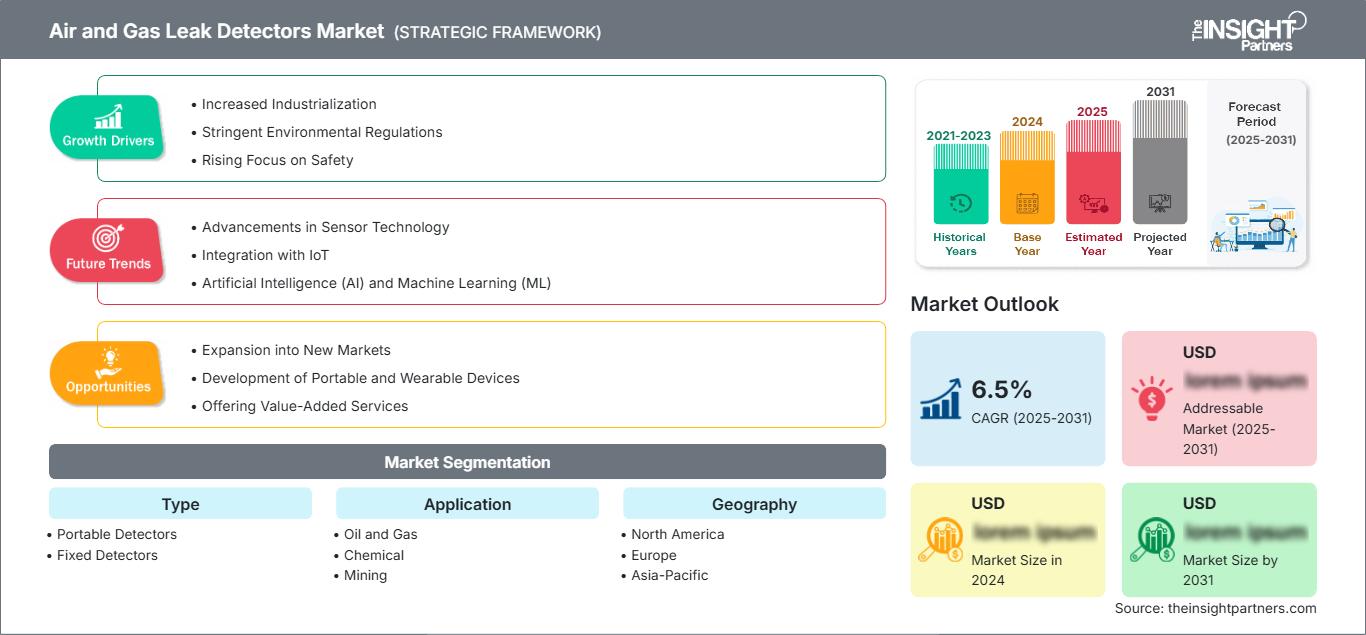
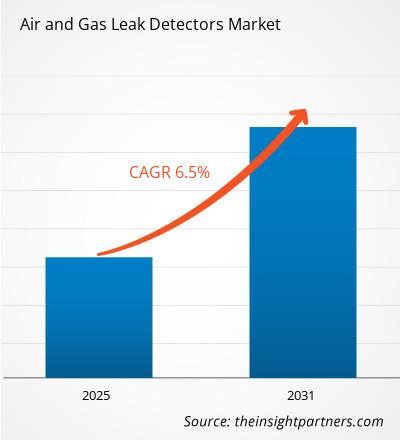
The Air and Gas Leak Detectors Market was valued at US$ 1.39 Billion in 2025 and is projected to reach US$ 2.39 Billion by 2034; it is expected to register a CAGR of 6,.97% from 2026 to 2034. The market demand is supported by safety compliance, combustible gas monitoring, and industrial leak-control programs across oil and gas, chemical, and mining facilities.
North America is expected to grow at a 6.1%–6.8% CAGR, supported by refinery modernization, LNG infrastructure, and stricter worker-exposure monitoring. U.S. facilities rely on portable detectors for confined-space entry and fixed systems for process areas, while Canadian mining and energy sites are increasingly adopting connected gas monitoring. OSHA guidance on direct-reading monitors reinforces calibration, alarm testing, and documented maintenance for hazardous atmospheres. The Air and Gas Leak Detectors Market share in the region is supported by ongoing industrial safety investments, regulatory compliance requirements, and the adoption of advanced monitoring technologies.
Air and Gas Leak Detectors Market Assessment and Insights
- North America: The region held 29%–33% share in 2025 and is growing at a 6.1%–6.8% CAGR between 2026–2034, driven by refinery safety upgrades, LNG terminals, and mining compliance programs.
- US: The U.S. represented 78%–84% of North America in 2025 and is growing at a 6.2%–6.9% CAGR between 2026–2034, led by oil, gas, and chemical plants.
- Europe: Europe held 24%–28% share in 2025 and is growing at a 5.8%–6.5% CAGR between 2026–2034, led by Germany, the UK, France, Italy, and Spain.
- Asia Pacific: Asia Pacific held 28%–32% share in 2025 and is growing at a 7.4%–8.1% CAGR between 2026–2034, led by China, India, Japan, South Korea, and Australia.
- Largest Segment: Fixed Detectors held 56%–62% market share in 2025 and are growing at a 6.4%–7.1% CAGR between 2026–2034 due to continuous monitoring needs.
- High Growth Segment: Chemical held 22%–27% market share in 2025 and is growing at a 7.2%–8.0% CAGR between 2026–2034, supported by VOC and toxic gas controls.
- Key companies analyzed in detail: ABB Ltd, Drägerwerk AG & Co. KGaA, Emerson Electric Co., Honeywell International Inc., Johnson Controls International plc, MSA Safety Incorporated, Schneider Electric SE, SDT International n.v. s.a., Siemens Aktiengesellschaft, Yokogawa Electric Corporation.
Source: The Insight Partners' analysis based on proprietary research, government publications, company annual reports, investor presentations, industry databases, and expert interviews.
The Air and Gas Leak Detectors Market size is evolving as the industry shifts from stand-alone alarms to connected safety systems that combine electrochemical, infrared, ultrasonic, catalytic bead, and photoionization sensing. Production dynamics increasingly emphasize rugged housings, lower sensor drift, wireless communication, and calibration traceability. Fixed systems are embedded into distributed control environments, while portable detectors support maintenance, confined-space entry, and emergency response. This evolution reflects tighter industrial safety expectations and the need to reduce downtime from undetected leaks.
Forward demand will be strongest in industrial clusters where combustible gases, volatile organic compounds, ammonia, hydrogen sulfide, and oxygen-deficiency risks intersect with regulatory audits. The Air and Gas Leak Detectors Market report highlights how operators are increasingly integrating sensor data with maintenance platforms and emergency shutdown logic. Emerging geographies in Asia Pacific and the Middle East are investing in refining, petrochemicals, LNG, and mining assets, creating long-cycle replacement and retrofit opportunities.
Air and Gas Leak Detectors Market Report Scope
| Report Attribute | Details |
|---|---|
| Market size in 2025 | US$ 1.39 Billion |
| Market Size by 2034 | US$ 2.39 Billion |
| Global CAGR (2026 - 2034) | 6.97% |
| Historical Data | 2021-2024 |
| Forecast period | 2026-2034 |
Air and Gas Leak Detectors Market Analysis
Demand is anchored in worker safety, asset protection, and environmental compliance across hazardous industrial sites. OSHA identifies direct-reading portable monitors as critical tools for detecting toxic, oxygen-deficient, and combustible atmospheres, while EPA leak detection and repair guidance targets volatile organic compound emissions from valves, pumps, and connectors. These requirements support the Air and Gas Leak Detectors Market forecast, indicating continued growth in routine inspection, shutdown maintenance, and continuous process monitoring.
The value chain consists of sensor element providers, enclosure manufacturers, transmitter suppliers, calibration gas suppliers, software developers, system installation firms, and maintenance service providers. Favorable supply conditions are for those who can provide calibrated and application-ready instruments for sour gas, flammable hydrocarbons, chlorine, ammonia, and solvents. The study conducted by Air and Gas Leak Detectors reveals that accuracy, response time, battery life, diagnostics, and integration capability with safety systems are the focus of purchasers.
The competitive landscape is moderately consolidated, with global safety and automation suppliers competing through product breadth, installed base, and service networks. Honeywell International Inc., MSA Safety Incorporated, Drägerwerk AG & Co. KGaA, Emerson Electric Co., and ABB Ltd are prominent across portable and fixed systems. Siemens Aktiengesellschaft, Yokogawa Electric Corporation, Schneider Electric SE, Johnson Controls International plc, and SDT International n.v. s.a. strengthen adjacent automation, facility safety, and acoustic detection capabilities. Air and Gas Leak Detectors Market trends are increasingly focused on connected monitoring, wireless sensing, predictive maintenance, real-time analytics, and integration with industrial safety and automation platforms.
Investment trends favor wireless fixed detectors, open-path infrared systems, predictive calibration, and cloud-enabled fleet management for portable devices. Strategic positioning is shifting toward lifecycle services because detector reliability depends on sensor replacement, bump testing, calibration records, and training. The Air and Gas Leak Detectors Market is therefore shaped not only by hardware procurement but by recurring service contracts and compliance documentation.
● REPORT CUSTOMIZATION
Tailor This Report To Align With Your Specific Business Requirements
This report can be customized to align precisely with your business objectives, scope, and target markets. Customization options include tailored segmentation, geography, competitive analysis, and strategic insights to support informed decision-making.
Customize This Report →WHAT YOU CAN ADJUST
- ● Segmentations
- ● Geography
- ● Competitive Analysis
- ● Language Preferences
Air and Gas Leak Detectors Market: Strategic Insights
Regional Insights
North America Air and Gas Leak Detectors
North America held 29%–33% share in 2025 and is growing at a 6.1%–6.8% CAGR between 2026–2034. The Air and Gas Leak Detectors Market benefits from refinery modernization, shale gas processing, LNG export terminals, and mining safety programs that require continuous fixed monitoring and portable worker protection.
Demand is reinforced by OSHA confined-space requirements, EPA leak detection and repair practices, and insurance pressure to document alarm readiness. U.S. and Canadian operators are deploying wireless sensors in remote wellheads, compressor stations, chemical storage zones, and underground mines where wiring costs or access constraints are high.
U.S. Air and Gas Leak Detectors Market
The United States made up for 78% - 84% of the continent in 2025, while growth between 2026 - 2034 is pegged at 6.2% - 6.9% CAGR. The oil and gas, chemical processing, mining support services, and utilities need detectors of hydrogen sulfide, methane, carbon monoxide, chlorine, ammonia, and oxygen deficiency.
Strong presence is observed in fixed gas detection, portable monitoring, and safety platform solutions. Honeywell International Inc., Emerson Electric Co., MSA Safety Incorporated, ABB Ltd, and Drägerwerk AG & Co. KGaA offer solutions to refineries, petrochemical, mid-stream, and confined space applications. Demand for Air and Gas Leak Detectors will be driven by calibration data, fleet management, and audit maintenance practices.
Europe Air and Gas Leak Detectors Market
The market in Europe had 24% to 28% share in 2025 and is projected to grow at a CAGR of 5.8% to 6.5% during 2026 to 2034. Germany is the market leader due to chemical parks, refineries' upgrades, hydrogen pilot projects' facilities, and machinery standards encouraging certified gas monitoring in process and maintenance environments.
The United Kingdom still holds importance due to offshore energy, terminals, and industrial retrofits, where the demand is driven by portable multi-gas detectors and fixed combustible gas detectors. France is boosted by its petrochemicals, LNG terminals, and industrial gases, while Italy and Spain boost demand due to refining, chemicals, and mining-related process industry. The Air and Gas Leak Detectors Market continues to benefit from all these industrial applications.
The European customers focus on the ATEX certification, maintenance documentation, and compatibility with plant automation systems. The Air and Gas Leak Detectors market size in Europe depends on replacement cycles, high labor-safety requirements, and modernization of existing gas detector facilities.
APAC Air and Gas Leak Detectors Market
The Asia Pacific region captured 28%-32% market share in 2025 and will grow at a 7.4%-8.1% CAGR during 2026-2034. The China region dominates due to applications such as petrochemicals, coal mining safety, gas transmission, and industrial park monitoring. The industry drives the Air and Gas Leak Detectors market since companies keep making investments in solutions that ensure their staff's safety, monitor emissions, and manage process risks.
The Japanese and South Korean markets focus on detectors with high reliability for chemicals, hydrogen, and advanced manufacturing. In India, the expansion of refineries, city gas, fertilizers, and mining sectors is forecasted. Australia uses gas detection in mining, LNG, and remote industrial processes.
Government policy regarding safety at the workplace, air quality monitoring, and prevention of industrial incidents stimulates the adoption of connected sensors. Tendencies in the APAC Air and Gas Leak Detectors market include portable rugged units, wireless fixed installations, and localized maintenance services.
Middle East & Africa Air and Gas Leak Detectors Market
The Middle East & Africa is growing at a 6.6%–7.3% CAGR between 2026–2034. Saudi Arabia is the leading country, supported by refining, petrochemicals, gas processing, and major industrial infrastructure programs requiring combustible and toxic gas monitoring. The Air and Gas Leak Detectors Market is benefiting from these investments as operators strengthen safety systems, regulatory compliance, and continuous monitoring capabilities across critical industrial facilities. The UAE adds demand from LNG, ports, district cooling, and industrial zones, while South Africa requires detectors for mining, chemicals, and energy facilities. The rest of MEA adoption is linked to oil production, storage terminals, and power projects.
Regional growth depends on certified equipment, harsh-environment durability, and maintenance availability. Fixed detectors dominate process sites, while portable instruments support turnaround, confined-space, and emergency-response work.
Segmentation Analysis
Type
The Type segment is growing at a 6.3%–7.0% CAGR between 2026–2034. Fixed Detectors dominate continuous area monitoring in refineries, chemical plants, mines, compressor stations, and storage areas. At the same time, Portable Detectors remain essential for worker exposure checks, maintenance routes, and confined-space entry. Adoption depends on alarm reliability, gas specificity, sensor life, calibration frequency, and compatibility with plant control systems.
- Portable Detectors: Portable devices are used by people who do testing, work in confined spaces, respond to emergencies, and perform maintenance where mobility means that the testing needs to be portable or hand-held with rapid alarms and calibrations.
- Fixed Detectors: Fixed devices continuously monitor areas such as process units, storage tanks, mines, compressor stations, and areas dealing with chemicals.
Application
The Application segment is growing at a 6.6%–7.4% CAGR between 2026–2034. Oil and gas remain the largest demand base because flammable hydrocarbons and hydrogen sulfide hazards require layered detection. Chemical applications are expanding quickly as plants monitor chlorine, ammonia, solvents, and VOCs, while Mining relies on portable and fixed systems for methane, carbon monoxide, oxygen deficiency, and ventilation control.
- Oil and Gas: Oil and gas sites employ sensors in drilling, gathering, refining, liquefied natural gas (LNG), and storage operations where detection of methane, hydrogen sulfide, and other combustible vapors helps prevent explosions or exposures.
- Chemical: Gas detection is needed in chemical plants for toxins, corrosives, and flammables, and the accuracy of the detection system, location of alarms, and integration of ventilation or shutdown functions are essential.
- Mining: Mining requirements include methane, carbon monoxide, oxygen deficiency, and ventilation detection, while portable devices help protect employees, and stationary detectors aid underground and processing plant safety.
Opportunity Snapshot
| Application | Revenue Contribution | Trend Tag | Adoption Stage |
| Oil and Gas | High | Methane Control | Mature |
| Chemical | Medium | VOC Monitoring | Scaling |
| Mining | Medium | Mine Ventilation | Scaling |
Air and Gas Leak Detectors Market Growth Drivers and Impact Analysis
Stricter Industrial Safety and Exposure Monitoring
Regulatory requirements are the main drivers since hazardous environments may lead to explosions, poisoning, oxygen displacement, and downtime. According to OSHA guidelines, the use of direct-reading monitoring devices should be tested and calibrated. Additionally, confined space and hazardous waste regulations call for monitoring either prior to entering or during entry. The influence of the Air and Gas Leak Detectors market can be seen through repeat purchases of portable multi-gas monitors, bump test stations, calibration gases, and even fixed monitoring systems linked to alarm panels. Companies that cannot provide maintenance information are at risk of undergoing an audit, insurance problems, and operational issues. Therefore, customers are being drawn to digital monitoring systems.
Expansion of Oil, Gas, LNG, and Petrochemical Assets
Larger quantities of energy and chemicals will ensure the ongoing use of detectors due to the fast growth in gas leaks that can happen from the storage tanks, compression stations, processing facilities, and loading facilities. LNG facilities, refining facilities, handling of hydrogen, and expansion of petrochemical plants will necessitate flammability, toxicity, and oxygen detection over vast regions. In terms of market effect, there is going to be higher demand for fixed point detectors, open path infrared detectors, wireless transmitters, and alarm systems in the control room.
Digitalization of Plant Safety and Maintenance Workflows
Changes in procurement practices are happening due to the desire of operators for the leak detection information that will help with predictive maintenance, investigations of incidents, and reporting on compliance issues. Wireless gas detectors help to minimize costs associated with wiring in distant or temporary areas, whereas wireless portable fleets monitor calibration information, assign users, and record alarms. From the perspective of the industry, the change means moving from buying just devices to creating a whole ecosystem of safety involving sensors, gateways, software, and services.
Air and Gas Leak Detectors Market Future Trends
Wireless Fixed Detection and Predictive Calibration
One of the future trends will be moving from wired fixed detectors to wireless and hybrid systems that reduce costs in brownfield projects. The predictive calibration methods will consider the drift of sensors, their exposure to the environment, and alarms, and schedule maintenance before reliability decreases. That will enhance availability and eliminate the need for extra trips to the field, particularly to distant well pads, tank farms, and mine ventilation points. With the increasing longevity of batteries, mesh communications, and intrinsically safe designs, wireless fixed detection is going to become an affordable upgrade for companies unable to invest in the complete replacement of the cabling infrastructure.
Multi-Gas, Hydrogen, and Low-Emission Industrial Monitoring
Future procurement will place greater emphasis on instruments that detect multiple gases while addressing new fuels and lower-emission industrial processes. Hydrogen production, ammonia logistics, carbon capture facilities, and battery-material plants create gas profiles that differ from conventional hydrocarbon sites. Buyers will need sensors with better selectivity, faster response, and lower false-alarm rates in complex atmospheres. This trend will expand the Air and Gas Leak Detectors Market beyond traditional combustible gas alarms and encourage vendors to develop application-specific sensor packs, analytics, and certification support for evolving industrial hazards.
Air and Gas Leak Detectors Market Opportunities
Retrofit Programs for Brownfield Industrial Plants
Brownfield refineries, chemical plants, mines, and terminals offer a practical investment opportunity because many sites still operate mixed detector fleets with inconsistent calibration records. Suppliers can target retrofit programs that replace aging transmitters, standardize portable devices, and integrate alarm data into existing control systems. The strongest opportunities involve phased deployment, training, and service contracts that minimize shutdown disruption. Vendors that quantify lower maintenance time, improved audit readiness, and fewer nuisance alarms can justify upgrades even where capital budgets are constrained. The Air and Gas Leak Detectors Market is expected to benefit from these retrofit and modernization initiatives across industrial facilities.
Connected Portable Detector Fleet Management
Connected portable detector fleet management is an attractive opportunity because industrial employers must prove instruments are assigned, calibrated, bump-tested, and used correctly. Software platforms can reduce manual logs, flag overdue maintenance, and provide alarm records for incident review. Service providers can bundle devices, docking stations, calibration gas, training, and analytics under subscription or managed-service models. This opportunity is especially relevant for contractors, mining operators, and multi-site energy companies that need consistent worker protection across locations while controlling inventory loss and compliance gaps. The Air and Gas Leak Detectors Market is expected to benefit from these trends as organizations increasingly adopt connected safety management solutions.
Recent Developments
- May 2025: Honeywell introduced a new Hydrogen Leak Detector (HLD) sensor designed to identify microscopic hydrogen leaks in real time. Using Thermal Conductivity Detection technology, the sensor can detect leaks as small as 50 parts per million, helping prevent fire and explosion risks. The solution is designed for industrial equipment, power generators, and hydrogen-powered vehicles, with a maintenance-free operating life of up to 10 years. The launch supports the growing global hydrogen economy by enhancing safety and operational reliability.
- June 2025: ANYbotics unveiled a new Gas Leak and Presence Detection solution for its autonomous ANYmal inspection robot. The system combines modular gas detectors with a 360° acoustic imaging payload to accurately locate gas leaks, measure concentrations, and quantify potential losses. Designed for industries such as oil & gas, energy, mining and petrochemicals, the solution improves worker safety by reducing exposure to hazardous environments. It also enables predictive maintenance, lowers emissions, and helps companies cut operational costs through continuous autonomous monitoring.
- June 2026: INFICON introduced the LDS Arnova, a new industrial leak-testing instrument that uses either low-cost argon gas or ambient air instead of helium. The system delivers leak-detection performance comparable to helium-based technologies while significantly reducing operating costs and supply-chain risks associated with helium shortages. Built on the proven LDS3000 platform, it can detect leaks as small as 1×10⁻⁶ mbar·l/s with argon and 1×10⁻³ mbar·l/s with air. The solution offers faster testing, improved measurement stability, fewer false readings, and easier integration into existing production lines, making it suitable for automotive, HVAC, battery, and industrial manufacturing applications.
Frequently Asked Questions

- Comprehensive Market Sizing and Forecast Analysis
- Detailed Segmentation Analysis
- In-Depth Market Dynamics Assessment
- Regional and Country-Level Insights
- Competitive Landscape and Company Benchmarking
- Strategic Business Intelligence
Recent Reports
Testimonials

The Insight Partners' SCADA System Market report is comprehensive, with valuable insights on current trends and future forecasts. The team was highly professional, responsive, and supportive throughout. We are very satisfied and highly recommend their services.
RAN KEDEM Partner, Reali Technologies LTDs
I requested a report on a very specific software market and the team produced the report in a few days. The information was very relevant and well presented. I then requested some changes and additions to the report. The team was again very responsive and I got the final report in less than a week.
JEAN-HERVE JENN Chairman, Future Analytica
We worked with The Insight Partners for an important market study and forecast. They gave us clear insights into opportunities and risks, which helped shape our plans. Their research was easy to use and based on solid data. It helped us make smart, confident decisions. We highly recommend them.
PIYUSH NAGPAL Sr. Vice President, High Beam Global
The Insight Partners delivered insightful, well-structured market research with strong domain expertise. Their team was professional and responsive throughout. The user-friendly website made accessing industry reports seamless. We highly recommend them for reliable, high-quality research services
YUKIHIKO ADACHI CEO, Deep Blue, LLC.
This is the first time I have purchased a market report from The Insight Partners.While I was unsure at first, I visited their web site and felt more comfortable to take the risk and purchase a market report.I am completely satisfied with the quality of the report and customer service. I had several questions and comments with the initial report, but after a couple of dialogs over email with their analyst I believe I have a report that I can use as input to our strategic planning process.Thank you so much for taking the extra time and making this a positive experience.I will definitely recommend your service to others and you will be my first call when we need further market data.
JOHN SUZUKI President and Chief Executive Officer, Board Director, BK Technologies
I wish to appreciate your support and the professionalism you displayed in the course of attending to my request for information regarding to infectious disease IVD market in Nigeria. I appreciate your patience, your guidance, and the fact that you were willing to offer a discount, which eventually made it possible for us to close a deal. I look forward to engaging The Insight Partners in the future, all thanks to the impression you have created in me as a result of this first encounter.
DR CHIJIOKE ONYIA MANAGING DIRECTOR, PineCrest Healthcare Ltd.Reason to Buy
- Informed Decision-Making
- Understanding Market Dynamics
- Competitive Analysis
- Identifying Emerging Markets
- Customer Insights
- Market Forecasts
- Risk Mitigation
- Boosting Operational Efficiency
- Strategic Planning
- Investment Justification
- Tracking Industry Innovations
- Aligning with Regulatory Trends





 Get Free Sample for