
Air Compressor Filter and Compressed Air Dryer Market Trends, Size & Forecast by 2034
Coverage: by Product (Compressed Air Dryers, Compressed Air Filters); Application (Condensed Water Removal, Oil Removal, Particulate Removal, Others); Industry (Automotive, Oil and Gas, Chemicals, Power Generation, Electronics, Others) , and Geography (North America, Europe, Asia Pacific, and South and Central America)
- Status : Data Released
- Report Code : TIPRE00009298
- Category : Electronics and Semiconductor
- No. of Pages : 150
- Available Report Formats :


- Last update date : July 15, 2026


2025 Market Size
US$ 6.67 Bn
Base year value
2034 Forecast
US$ 11.78 Bn
Projected by 2034
CAGR 2026-2034
6.52 %
Growth rate
Addressable Market
US$ 83.42 Bn
(2026-2034)
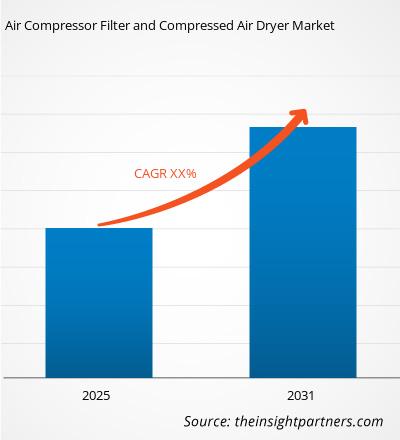
The Air Compressor Filter and Compressed Air Dryer Market size was valued at US$ 6.67 Billion in 2025 and is projected to reach US$ 11.78 Billion by 2034, registering a CAGR of 6.52% from 2026 to 2034. Demand is shaped by contamination control, moisture removal, and compressed air reliability across automotive, oil and gas, chemicals, power generation, and electronics facilities.
North America is expected to grow at a CAGR range of 5.8–6.4% during 2026–2034, supported by brownfield factory modernization and higher verification of ISO 8573 air purity classes. U.S. semiconductor, battery, food processing, and petrochemical plants are prioritizing dew point stability, oil carryover reduction, and lower pressure drop, making lifecycle service contracts and digitally monitored air treatment packages central to replacement demand. The Air Compressor Filter and Compressed Air Dryer Market report highlights these trends as key drivers supporting equipment upgrades and long-term service opportunities across the region.
Air Compressor Filter and Compressed Air Dryer Market Assessment and Insights
- North America: The region accounted for 31–34% share in 2025 and is projected to grow at a 5.8–6.4% CAGR between 2026–2034, led by U.S. factory automation, energy audits, and replacement of legacy dryers.
- US: The U.S. represented 72–75% of North America in 2025 and is expected to expand at a 5.9–6.5% CAGR between 2026–2034, driven by electronics, refining, and automotive applications.
- Europe: Europe held 24–27% share in 2025 and is forecast to grow at a 5.1–5.8% CAGR between 2026–2034, with Germany, the UK, France, Italy, and Spain leading upgrades.
- Asia Pacific: Asia Pacific captured 30–33% share in 2025 and should grow at a 7.0–7.8% CAGR between 2026–2034, led by China, India, Japan, and South Korea manufacturing expansion.
- Largest Segment: Compressed air dryers held 56–59% market share in 2025 and are projected to grow at a 6.2–6.8% CAGR between 2026–2034 due to moisture-sensitive production.
- High Growth Segment: Electronics industry applications held 13–16% market share in 2025 and are expected to grow at a 7.4–8.2% CAGR between 2026–2034 as cleanroom air standards tighten.
- Key companies analyzed in detail: Atlas Copco AB, BOGE KOMPRESSOREN Otto Boge GmbH and Co. KG, Donaldson Company, Inc., Ingersoll Rand Inc., KAESER KOMPRESSOREN SE, MANN+HUMMEL International GmbH and Co. KG, Parker-Hannifin Corporation, SPX FLOW, Inc., Sullair, LLC, Sullivan-Palatek, Inc.
Source: The Insight Partners' analysis based on proprietary research, government publications, company annual reports, investor presentations, industry databases, and expert interviews.
Markets have shifted from simple line protection to engineered air treatment systems incorporating refrigeration, desiccant drying, coalescing filtration, oil vapor absorption, condensate removal, and sensor-based monitoring technologies. Market dynamics have become more complex through the influence of modularity in skid design, low global warming refrigerants, standardized cartridges, and after-market service considerations. The industrial buyer is evaluating pressure drop, dew point stability, oil aerosol removal, and total cost of ownership rather than simply price per unit.
Future demand growth will come from where there is convergence between industrial policy, reshoring, and export-based manufacturing activities. India, Mexico, Southeast Asia, and Gulf industrial regions are investing in their compressed air infrastructure with electronics, chemicals, automotive parts, and energy-related applications. Pressure on issues related to contamination of the product, condensate management, and energy efficiency will drive market adoption of validated filter trains and dryer technologies.
Air Compressor Filter and Compressed Air Dryer Market Report Scope
| Report Attribute | Details |
|---|---|
| Market size in 2025 | US$ 6.67 Billion |
| Market Size by 2034 | US$ 11.78 Billion |
| Global CAGR (2026 - 2034) | 6.52% |
| Historical Data | 2021-2024 |
| Forecast period | 2026-2034 |
Air Compressor Filter and Compressed Air Dryer Market Analysis
Demand is anchored in the need to remove water, oil, and particulates before compressed air reaches pneumatic tools, process valves, conveying lines, analytical instruments, or clean manufacturing zones. The Air Compressor Filter and Compressed Air Dryer Market analysis shows that moisture control is no longer a maintenance-only decision because corrosion, microbial growth, and oil carryover can affect product yield, safety documentation, and equipment uptime.
The market includes compressor OEMs, filter media companies, drying equipment producers, distributors, service firms, condensate treatment firms, and engineers from manufacturing plants. The supply conditions continue to be linked to the aluminum housing, valves, desiccants, heat exchangers, refrigeration equipment, and control systems. The buyers are increasingly opting for packaged offerings since integration ensures less pressure drop and avoids liability issues.
The competitive landscape is concentrated around global compressor technology groups and specialist filtration companies. Atlas Copco AB, Ingersoll Rand Inc., KAESER KOMPRESSOREN SE, Parker-Hannifin Corporation, Donaldson Company, Inc., and MANN+HUMMEL International GmbH and Co. KG compete through efficiency claims, replacement cartridges, rental support, service reach, and validated air quality documentation for regulated users. The Air Compressor Filter and Compressed Air Dryer Market forecast indicates that demand will increasingly favor energy-efficient systems, predictive maintenance capabilities, and advanced air-treatment solutions that help industrial users meet air quality, reliability, and operating cost objectives.
Investments are being made in the area of digitized diagnostic tools, low-loss filtering media, refrigerant dryers with variable speeds, and desiccants that minimize the use of purge air. BOGE KOMPRESSOREN Otto Boge GmbH & Co. KG, SPX FLOW, Inc., Sullair, LLC, and Sullivan-Palatek, Inc. build their positioning through focusing on reliability at the plant level, whereas distributors help through retrofits with big compressor footprints in the region.
● REPORT CUSTOMIZATION
Tailor This Report To Align With Your Specific Business Requirements
This report can be customized to align precisely with your business objectives, scope, and target markets. Customization options include tailored segmentation, geography, competitive analysis, and strategic insights to support informed decision-making.
Customize This Report →WHAT YOU CAN ADJUST
- ● Segmentations
- ● Geography
- ● Competitive Analysis
- ● Language Preferences
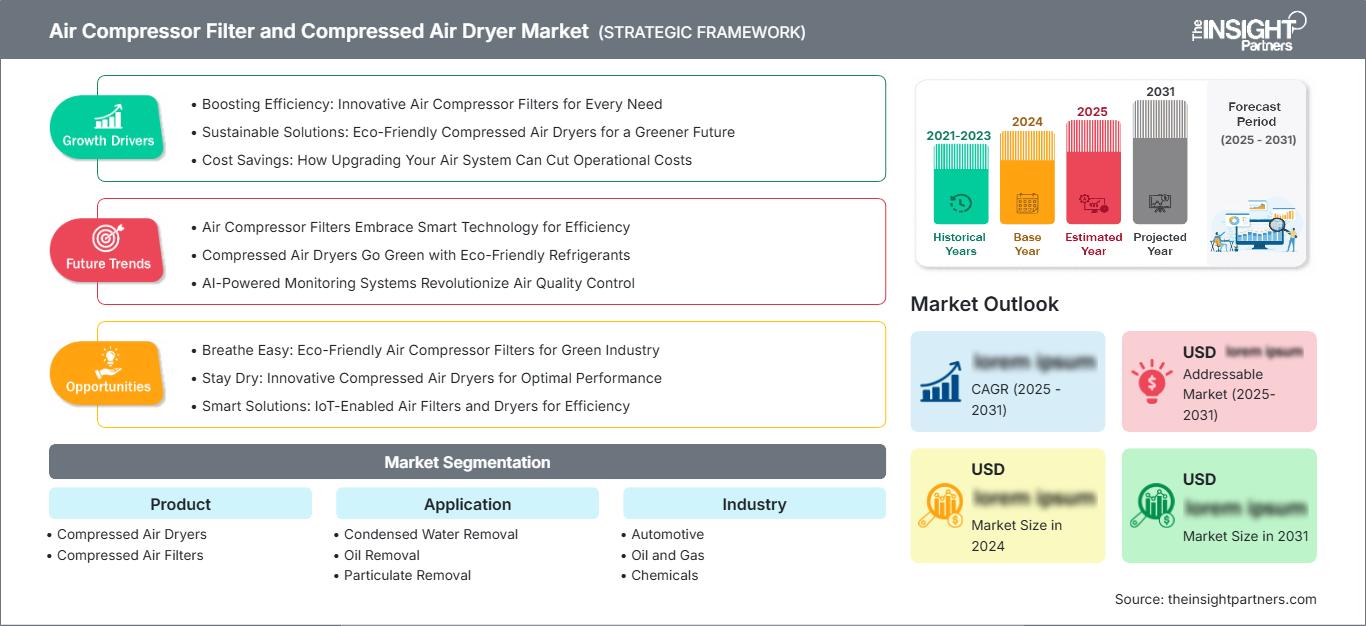
Air Compressor Filter and Compressed Air Dryer Market: Strategic Insights
Regional Insights
North America Air Compressor Filter and Compressed Air Dryer Market
North America accounted for 31–34% share in 2025 and is expected to grow at a 5.8–6.4% CAGR through 2034. Replacement demand is strong because many plants are upgrading aging refrigerated dryers, adding high-efficiency coalescing filters, and documenting compressed air quality for food, electronics, and life-science-adjacent operations.
Energy management is another structural driver because compressed air systems are costly utilities, and lower-pressure drop filtration helps reduce compressor load. Automotive reshoring, battery plants, oil and gas midstream activity, and petrochemical maintenance cycles support recurring purchases. The Air Compressor Filter and Compressed Air Dryer Market share in the region remains service-led, with distributors influencing specification and retrofit timing.
U.S. Air Compressor Filter and Compressed Air Dryer Market
The U.S. constitutes 72-75% of North America in 2025 and is forecasted to grow at a CAGR of 5.9%-6.5% for the period of 2026-2034. Semiconductor production, EV manufacturing, refineries, aircraft, and food packaging factories have a requirement for constant dew points and no oil carryover, hence requiring multi-stage filtration & drying equipment.
Atlas Copco AB, Ingersoll Rand Inc., Parker-Hannifin Corporation, Donaldson Company, Inc., Sullair, LLC, and Sullivan-Palatek, Inc. have a significant presence in the U.S. market via OEMs, distributors, and after-sales services. Trending applications include particulate filtration in the electronics sector, oil filtration in food contact utilities, and condensate management in humid regions.
Europe Air Compressor Filter and Compressed Air Dryer Market
Market share in Europe was 24-27% in 2025 and forecast to grow at a CAGR of 5.1-5.8% till 2034. Germany is a major player as there is a demand for air purification, dew point management, and filtration technology compatible with energy conservation initiatives of plants in industries like automotive suppliers, machinery, chemicals, and electronics.
In the UK market, there is growth because of pharmaceutical packaging, food processing, aerospace maintenance, and water infrastructure facilities that depend on dry instrument air. Investment in retrofit is affected by energy costs, documentation requirements, and favorability towards machinery that keeps air purity without causing pressure drop and unexpected stoppage.
France, Italy, and Spain add demand through chemicals, wine and beverage processing, packaging machinery, automotive components, and power generation maintenance. KAESER KOMPRESSOREN SE, BOGE KOMPRESSOREN Otto Boge GmbH and Co. KG, Atlas Copco AB, and Parker-Hannifin Corporation benefit from established European distribution and service networks. The Air Compressor Filter and Compressed Air Dryer Market continues to benefit from strong regional industrial activity and extensive aftermarket service support.
APAC Air Compressor Filter and Compressed Air Dryer Market
APAC captured 30–33% share in 2025 and is forecast to grow at a 7.0–7.8% CAGR through 2034. China remains the leading country because electronics, automotive, chemicals, and industrial machinery output require large installed compressed air networks.
Japan and South Korea emphasize precision manufacturing, semiconductor packaging, and factory automation, where dew point stability and particulate control directly affect process reliability. Premium dryers and validated filters gain traction as operators target low downtime.
India and Australia add demand through industrial corridors, mining, food processing, LNG infrastructure, and power assets. Policy support for manufacturing localization and industrial energy efficiency expands the Air Compressor Filter and Compressed Air Dryer Market growth outlook.
Middle East & Africa Air Compressor Filter and Compressed Air Dryer Market
In the Middle East and Africa, growth is anticipated to be at 5.6%-6.3% CAGR from 2026-2034. Saudi Arabia leads the market with downstream chemicals, electricity generation, water systems, and industrial diversification initiatives that require instrument air.
The United Arab Emirates generates growth from district cooling, manufacturing plants, aviation services, and logistics-oriented packaging facilities. In the case of coastal areas, drying equipment plays a crucial role, while oils have to be removed in order to preserve pneumatic controls.
The rest of South Africa and the rest of MEA depend on compressed air treatment for mining, food and beverages, cement, and other maintenance-intensive industries. Growth is modest but consistent due to infrastructure upgradation and energy sector initiatives.
Segmentation Analysis
Product
The product segment is expected to grow at a 6.1–6.8% CAGR during 2026–2034. Demand is shaped by integrated air preparation packages that combine dryers and filters to achieve defined purity targets. The Air Compressor Filter and Compressed Air Dryer Market trends favor low-pressure-drop housings, energy-efficient refrigeration cycles, desiccant regeneration control, and filter cartridges designed for predictable maintenance intervals.
- Compressed Air Dryers: The above category forms the biggest part of the market, owing to the prevention of corrosion, icing, biological contamination, and equipment malfunctions due to moisture levels.
- Compressed Air Filters: These will remain strategically important for filtering oils, vapors, and particulates, particularly when compressed air comes into contact with packaging material, electronic parts, paints, and controls.
Application
The application segment is projected to expand at a 6.3–7.0% CAGR during 2026–2034. Condensed water removal remains the baseline need, but oil and particulate removal are gaining strategic weight as factories improve product quality controls. The Air Compressor Filter and Compressed Air Dryer Market scope increasingly includes point-of-use treatment where centralized systems cannot guarantee final air purity.
- Condensed Water Removal: The need is universal in humid environments and heavy-duty operations due to the corrosive action of condensate on pipes, tools, valves, and more frequent maintenance.
- Oil Removal: Oil removal becomes imperative when there are compressors, lubrication, or aerosols that would impact surface coating, food contact utilities, analytical equipment, or process chemistry downstream.
- Particulate Removal: Particulate removal is essential for precise pneumatic systems, electronics assembly, packaging, and instrumentation to minimize dust, rust, scale, and filterable particulates on-site.
Industry
The industry segment is forecast to grow at a 6.4–7.1% CAGR during 2026–2034. Automotive and oil and gas provide stable installed-base demand, while electronics deliver the fastest adoption because contamination tolerance is low. Chemicals and power generation rely on dry, clean instrument air to protect controls, actuators, analyzers, and maintenance-critical pneumatic equipment. The Air Compressor Filter and Compressed Air Dryer Market is supported by these industries as they increasingly prioritize air quality, equipment reliability, and operational efficiency.
- Automobiles: The demand depends on paint booths, assembly, robots, and component manufacturing, where water or oil contamination can impact the quality of coating and the operation of pneumatic tools.
- Oil & Gas: Refineries, LPG facilities, pipes, and petrochemical production need dry instrument air to ensure proper operation of valves, analyzers, control cabinets, and pneumatic safety systems.
- Chemicals: Air processing systems help chemical industries protect catalysts, conveying systems, control valves, and packaging processes from contamination by moisture, particulates, and oil.
- Power Generation: Power plants require reliable instrument air for actuators, ash handling, turbine support systems, and maintenance tools; reliability and condensate management are the key considerations for purchase decisions.
- Electronics: Electronics plants need particulate and oil separation as compressed air may come into contact with wafers, printed circuit boards, clean room tools, and automated machinery.
Opportunity Snapshot
| Industry | Revenue Contribution | Trend Tag | Adoption Stage |
| Automotive | High | Paint Quality | Mature |
| Oil and Gas | High | Instrument Air | Mature |
| Chemicals | Medium | Process Purity | Scaling |
| Power Generation | Medium | Plant Reliability | Mature |
| Electronics | High | Cleanroom Air | Scaling |
Air Compressor Filter and Compressed Air Dryer Market Growth Drivers and Impact Analysis
Stricter Air Quality Verification Across Regulated Production
Industrial users are moving from assumed air cleanliness to documented verification because ISO 8573 classifications define contaminant limits for particles, water, and oil. This shift increases demand for dryers, coalescing filters, activated carbon filters, and point-of-use monitoring. Food packaging, electronics, automotive painting, chemicals, and medical device-adjacent production cannot tolerate inconsistent air quality. As audits become more evidence-based, buyers are replacing underspecified filters and installing dedicated treatment at critical use points. The practical impact is higher aftermarket cartridge demand, more service contracts, and a stronger preference for suppliers that can support testing, documentation, and lifecycle performance. The Air Compressor Filter and Compressed Air Dryer Market is benefiting from this transition toward verified air quality and compliance-driven compressed air management.
Energy Efficiency Pressure in Compressed Air Systems
Compressed air is an energy-intensive plant utility, so inefficient filtration and drying create measurable operating cost penalties through pressure drop, purge air loss, and over-compression. Facilities are evaluating dryers and filters as part of broader energy management rather than isolated maintenance purchases. Low-loss filter media, variable-speed refrigerated dryers, heat-of-compression dryers, and intelligent drain systems reduce waste while maintaining required dew points. This driver directly supports premium equipment adoption because payback can be framed through lower compressor power, fewer failures, and reduced rejected production. It also strengthens the Air Compressor Filter and Compressed Air Dryer Market size case for retrofits.
Manufacturing Expansion in Moisture-Sensitive Industries
Electronics, battery components, automotive parts, specialty chemicals, and packaged foods are expanding in regions where compressed air quality has direct implications for yield and uptime. New factories are more likely to specify complete air treatment packages during design, while older plants add filtration and dryers during capacity upgrades. Moisture-sensitive pneumatic equipment and clean production areas need consistent dew point control, oil removal, and particulate capture. The impact is strongest in APAC and North America, where industrial policy and private investment are increasing installed compressor capacity. This creates both first-fit equipment demand and recurring service revenue for the Air Compressor Filter and Compressed Air Dryer Market.
Air Compressor Filter and Compressed Air Dryer Market Future Trends
Sensor-Enabled Air Treatment and Predictive Maintenance
Future systems will increasingly integrate dew point sensors, differential pressure monitoring, oil vapor indicators, and connected controllers that help operators move from scheduled maintenance to condition-based service. This trend matters because filter saturation, drain failure, or dryer underperformance can remain hidden until production quality is affected. Digital visibility allows service providers to recommend cartridge changes, desiccant regeneration checks, or dryer tuning before air quality deteriorates. Over time, equipment suppliers can differentiate through dashboards, remote diagnostics, and guaranteed-performance contracts. The Air Compressor Filter and Compressed Air Dryer Market trends will therefore include software-enabled aftermarket models, not only hardware replacement.
Low-Carbon Refrigeration and Smarter Desiccant Regeneration
Both refrigerated and desiccant dryers will be redesigned to achieve lower lifecycle greenhouse gas emissions, lower purge losses, and load matching improvements. The factors such as the change in refrigerants, heat recovery capabilities, and speed control of the equipment could affect purchasing decisions in countries implementing tighter energy and climate policies. Desiccant air dryers will develop through more intelligent regeneration, which will ensure that there is no unnecessary loss of compressed air while achieving low dew points. This would be especially important for industries such as electronics, chemicals, and oil and gas, as production cannot be interrupted.
Air Compressor Filter and Compressed Air Dryer Market Opportunities
Retrofit Packages for Installed Compressor Bases
A large installed base of compressors provides an operational opportunity for retrofit kits, which will enhance dryers, filters, drains, and monitoring systems without upgrading the entire compressed air system. There is currently a lot of older equipment that was designed to handle utility air, but not the current air purity requirements. This creates an opportunity for the supplier to sell bundles such as audit services, pressure drop, dew point test, condensate analysis, and phased equipment replacement. These will reduce the capital barriers for customers to start by focusing on the most important production lines. This will increase revenues from cartridges, service calls, and monitoring subscriptions.
Localized Manufacturing and Service in High-Growth APAC Markets
The APAC region’s growth is a chance for manufacturers to have localized facilities for assembly, stock, and services that will be located close to electronics, automotive, chemical, and food processing industries. Indian, Chinese, South Korean, Japanese, and Southeast Asian buyers prefer timely parts delivery since failures of the compressed air system could impact the entire production line. Localized services will help equipment manufacturers modify their equipment according to such factors as humidity, dust, power supply, and the level of maintenance skills of local personnel. Collaborations with compressor distributors and engineering companies will increase the influence on the specification process.
Recent Developments
- January 2026: Tsunami Compressed Air Solutions has announced the launch of its new High Temperature Regenerative Dryer, a drying system designed to address humidity challenges in mobile compressed air applications where high ambient temperatures and confined equipment spaces are common. The High Temperature Regenerative Dryer combines a wall-mounted aftercooler with Tsunami’s Pure 5, Pure 7 or Pure 10 regenerative desiccant dryers to create a single, integrated solution.
- January 2025: Trident Pneumatics Pvt. Ltd. (“Trident”), a manufacturer of compressed air treatment and on-site gas generation based in India, has become part of Atlas Copco Group. The company specializes in compressed air treatment and on-site gas generation and offers a comprehensive product range consisting of compressed air dryers, filters, condensate drains, and on-site gas generators.
- January 2025: V.O.L. Industries, a Canadian provider of compressed air dryers and filters for the general industry, has become part of the Atlas Copco Group. The company has become part of the division Air and Gas Applications within the Compressor Technique Business Area.
Frequently Asked Questions

- Comprehensive Market Sizing and Forecast Analysis
- Detailed Segmentation Analysis
- In-Depth Market Dynamics Assessment
- Regional and Country-Level Insights
- Competitive Landscape and Company Benchmarking
- Strategic Business Intelligence
Recent Reports
Testimonials

The Insight Partners provided valuable market intelligence that supported our global go-to-market strategy. Their team was professional, responsive, and attentive to our feedback, providing thoughtful analysis and helpful methodological clarifications throughout the project.
Junmo Kim Chief Financial Officer (CFO), Enertech Co., Ltd.
The Insight Partners' SCADA System Market report is comprehensive, with valuable insights on current trends and future forecasts. The team was highly professional, responsive, and supportive throughout. We are very satisfied and highly recommend their services.
RAN KEDEM Partner, Reali Technologies LTDs
I requested a report on a very specific software market and the team produced the report in a few days. The information was very relevant and well presented. I then requested some changes and additions to the report. The team was again very responsive and I got the final report in less than a week.
JEAN-HERVE JENN Chairman, Future Analytica
We worked with The Insight Partners for an important market study and forecast. They gave us clear insights into opportunities and risks, which helped shape our plans. Their research was easy to use and based on solid data. It helped us make smart, confident decisions. We highly recommend them.
PIYUSH NAGPAL Sr. Vice President, High Beam Global
The Insight Partners delivered insightful, well-structured market research with strong domain expertise. Their team was professional and responsive throughout. The user-friendly website made accessing industry reports seamless. We highly recommend them for reliable, high-quality research services
YUKIHIKO ADACHI CEO, Deep Blue, LLC.
This is the first time I have purchased a market report from The Insight Partners.While I was unsure at first, I visited their web site and felt more comfortable to take the risk and purchase a market report.I am completely satisfied with the quality of the report and customer service. I had several questions and comments with the initial report, but after a couple of dialogs over email with their analyst I believe I have a report that I can use as input to our strategic planning process.Thank you so much for taking the extra time and making this a positive experience.I will definitely recommend your service to others and you will be my first call when we need further market data.
JOHN SUZUKI President and Chief Executive Officer, Board Director, BK Technologies
I wish to appreciate your support and the professionalism you displayed in the course of attending to my request for information regarding to infectious disease IVD market in Nigeria. I appreciate your patience, your guidance, and the fact that you were willing to offer a discount, which eventually made it possible for us to close a deal. I look forward to engaging The Insight Partners in the future, all thanks to the impression you have created in me as a result of this first encounter.
DR CHIJIOKE ONYIA MANAGING DIRECTOR, PineCrest Healthcare Ltd.Reason to Buy
- Informed Decision-Making
- Understanding Market Dynamics
- Competitive Analysis
- Identifying Emerging Markets
- Customer Insights
- Market Forecasts
- Risk Mitigation
- Boosting Operational Efficiency
- Strategic Planning
- Investment Justification
- Tracking Industry Innovations
- Aligning with Regulatory Trends





 Get Free Sample for