
Air Handling Units Market Growth, Share & Trends by 2034
Coverage: By Type (Packaged Air Handling Units, Modular Air Handling Units, Custom Air Handling Units, Rooftop Mounted Air Handling Units, Others); Capacity (Below 5000 m3/h, 5001-15000 m3/h, 15001-30000 m3/h, 30001-50000 m3/h, Above 50001 m3/h); Application (Commercial, Residential) , and Geography (North America, Europe, Asia Pacific, and South and Central America)
- Status : Data Released
- Report Code : TIPRE00017191
- Category : Electronics and Semiconductor
- No. of Pages : 150
- Available Report Formats :


- Last update date : July 15, 2026


2025 Market Size
US$ 14.06 Bn
Base year value
2034 Forecast
US$ 21.22 Bn
Projected by 2034
CAGR 2026-2034
4.68 %
Growth rate
Addressable Market
US$ 160.17 Bn
(2026-2034)
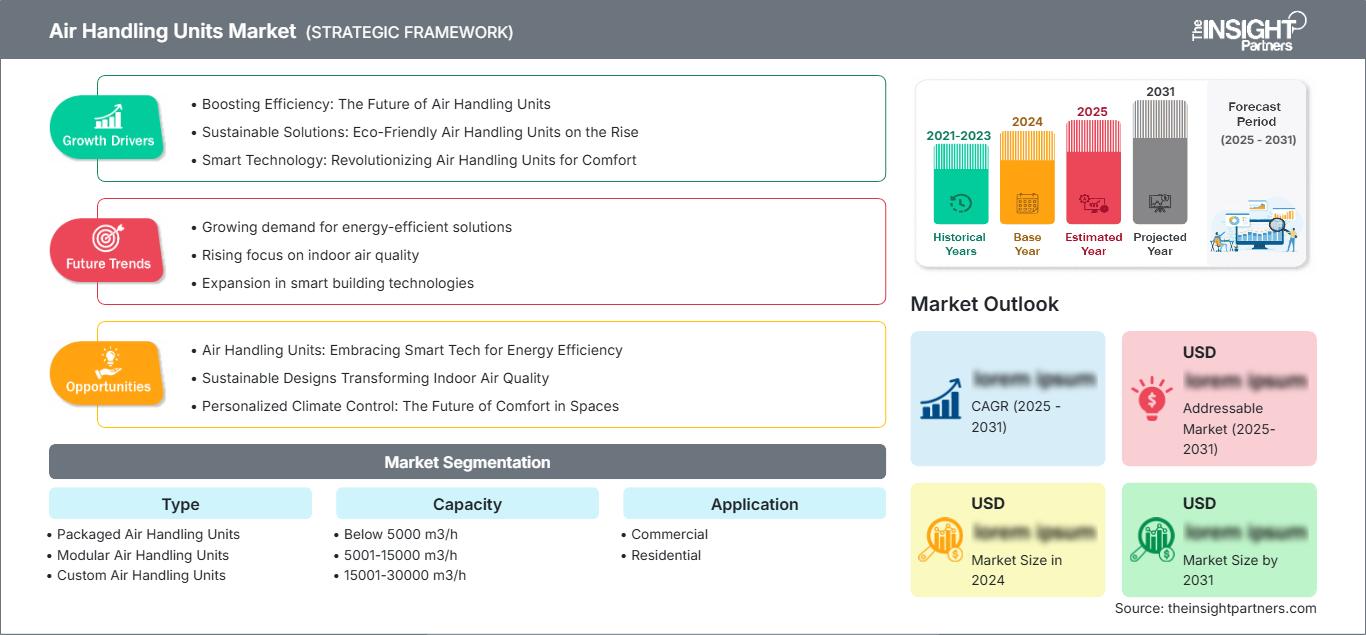
The Air Handling Units Market was valued at US$ 14.06 Billion in 2025 and is projected to reach US$ 21.22 Billion by 2034, advancing at a CAGR of 4.68% from 2026 to 2034. The market demand is being influenced by HVAC renovation due to energy efficiency, increased air quality requirements, improvements in the commercial building sector, and the usage of modular, packaged, rooftop-mounted, and customized air handling units.
North America holds high potential for growth. The Air Handling Units Market size will be driven by the need for replacement in hospitals, office buildings, educational facilities, and institutional properties. The regional growth rate of 4.2% – 4.8% will continue until 2034 due to ventilation resilience, decarbonization projects, and intelligent HVAC systems which minimize fan energy consumption.
Air Handling Units Market Assessment and Insights
- North America held an estimated 26%–31% share in 2025 and is projected to grow at a CAGR of 4.2%–4.8% between 2026–2034, supported by retrofit-heavy demand across healthcare, education, offices, and institutional assets.
- US represented 78%–84% of North America in 2025 and is expected to grow at a CAGR of 4.3%–4.9% between 2026–2034, led by commercial replacement and healthcare ventilation upgrades.
- Europe accounted for an estimated 24%–29% share in 2025 and is forecast to grow at a CAGR of 4.1%–4.7% between 2026–2034, with Germany, the UK, France, Italy, and Spain leading efficiency-led replacement.
- Asia Pacific held an estimated 34%–40% share in 2025 and is projected to grow at a CAGR of 5.2%–5.9% between 2026–2034, supported by China, India, Japan, South Korea, and Australia.
- Largest Segment Modular Air Handling Units held an estimated market share of 31%–36% in 2025 and are expected to grow at a CAGR of 4.8%–5.4% between 2026–2034.
- High Growth Segment Rooftop Mounted Air Handling Units held an estimated market share of 16%–20% in 2025 and are expected to grow at a CAGR of 5.0%–5.7% between 2026–2034.
- Key companies analyzed in detail: Carrier Global Corporation, Daikin Industries, Ltd., Euroclima AG / SPA, Johnson Controls International plc, Lennox International Inc., Sabiana SpA, Systemair AB, Trane Inc., Trox GmbH, and WOLF Anlagen-Technik GmbH & Co. KG.
Source: The Insight Partners' analysis based on proprietary research, government publications, company annual reports, investor presentations, industry databases, and expert interviews.
Air Handling Units Market has evolved from basic ventilation equipment into engineered air-management platforms that integrate filtration, energy recovery, variable-speed fans, low-leakage casings, and digital control compatibility. The production process is being redesigned towards modules, prefabricated components, customized coil sets, and application-specific hygiene solutions. This is due to the increasing importance placed on operational expenses, indoor air quality, and decarbonization of the economy, with HVAC equipment playing an increasingly visible role in the long-term asset performance strategy.
Future demand will be driven by emerging Asian construction, infrastructure projects in the Gulf area, hospital capacity expansions, airport renovations, and ventilation performance regulations. The buyers are going to prefer those suppliers that have engineering capabilities, quick deliveries, smart diagnostics, and lifetime service. Retrofitting activities in mature economies, as well as new commercial buildings in developing economies, will balance the demand among package, modular, customized, and roof-mounted HVAC equipment.
Air Handling Units Market Report Scope
| Report Attribute | Details |
|---|---|
| Market size in 2025 | US$ 14.06 Billion |
| Market Size by 2034 | US$ 21.22 Billion |
| Global CAGR (2026 - 2034) | 4.68% |
| Historical Data | 2021-2024 |
| Forecast period | 2026-2034 |
Air Handling Units Market Analysis
The demand for these products stems from the need to transport, treat, cool, heat, humidify, dehumidify, and recycle the energy within the air in commercial establishments under increasingly strict energy and ventilation requirements. The growth of the Air Handling Units Market can be attributed to the need to replace units within offices, hospitals, hospitality establishments, airports, schools, and industrial ancillary facilities.
The ecosystem includes casing fabricators, fan and motor makers, filter manufacturers, heat exchanger specialists, controls manufacturers, consultants, contractors, facility operators, and service providers. The supply chain dynamics place a premium on vendors capable of customizing the airflow, filtration grade, coil type, acoustics, heat recovery, and control systems. Hence, engineering support, lifetime service, and commissioning become as crucial as manufacturing capabilities for HVAC equipment.
The key players in this industry include diverse HVAC companies and specialized air technology manufacturers. Carrier Global Corporation, Daikin Industries, Ltd., Johnson Controls International plc, Lennox International Inc., Trane Technologies plc, and Systemair AB leverage their product portfolio strength and installed base for enterprise sales. On the other hand, TROX GmbH, WOLF GmbH, Swegon Group AB, and Munters Group AB are formidable in engineered, hygienic, and climate control settings.
Investment priorities include low-leakage casings, electronically commutated fans, high-efficiency heat recovery, low-pressure-drop filtration, plug-and-play controls, and compact modular platforms for refurbishment. Air Handling Units Market analysis is increasingly tied to measurable energy savings, indoor air quality performance, and reduced installation disruption. Strategic positioning depends on helping customers navigate decarbonization, refrigerant transition, and total cost of ownership.
● REPORT CUSTOMIZATION
Tailor This Report To Align With Your Specific Business Requirements
This report can be customized to align precisely with your business objectives, scope, and target markets. Customization options include tailored segmentation, geography, competitive analysis, and strategic insights to support informed decision-making.
Customize This Report →WHAT YOU CAN ADJUST
- ● Segmentations
- ● Geography
- ● Competitive Analysis
- ● Language Preferences
Air Handling Units Market: Strategic Insights
Regional Insights
North America Air Handling Units
North America Air Handling Units Market holds an estimated 26%–31% share in 2025 and is projected to grow at 4.2%–4.8%. Replacement demand is highest in healthcare facilities, educational institutions, offices, hotels, and other types of buildings, where outdated equipment will not be able to satisfy current requirements for filtration, controls, or energy efficiency. EPA says that people spend almost 90 percent of their time inside; hence, this adds commercial rationale for ventilation renovation.
Structure-related factors are performance requirements of buildings, transition to electric heat, compliance with energy codes, and facility improvements that lower HVAC operating costs. Insights provided in the Air Handling Units Market report show that regional demand is fueled by strong service infrastructure and high number of existing installations. Carrier Global Corporation, Johnson Controls International plc, Trane Technologies plc, Lennox International Inc., and Daikin Industries, Ltd. are among the companies profiting from their HVAC portfolio and controls.
U.S. Air Handling Units Market
The U.S. represents 78%–84% of North American demand and is expected to expand at 4.3%–4.9%. Commercial, healthcare, life sciences, educational, aviation, hospitality, and critical mission sites provide the basis for replacement and new installations. Modular and customized products find favor where considerations of flow rates, filtration needs, sound attenuation, humidity levels, and space in the mechanical room necessitate engineering.
The technology focus is on IAQ, heat recovery systems, monitoring capability, and integration with building automation. Geographic presence of the industry is extensive through such firms as Carrier Global Corporation, Trane Technologies plc, Johnson Controls International plc, Lennox International Inc., and Daikin Industries, Ltd. Purchasers are now more often considering project viability in terms of lifecycle efficiency, servicing, reliable commissioning, and heat pump-based decarbonization efforts.
Europe Air Handling Units Market
Europe accounts for 24%–29% of global demand and is projected to grow at 4.1%–4.7%. Germany is the dominant market due to the presence of high-performance air handlers in industries, health care facilities, public institutions, and HVAC technology. The consumers in Germany are interested in certified performance, heat recovery, minimized casing leakage, hygienic design, and certification related to energy efficiency.
The UK is favored with office refurbishment projects, education renovation projects, health care facility projects, and ventilation resilience projects. Consumers in the United Kingdom are looking for modular units due to space constraints during retrofits, roof-mounted units for commercial buildings, and controlled units where controls enable better monitoring without mechanical modifications.
France, Italy, and Spain contribute demand via hospitality applications, retail, public buildings, manufacturing, and climate adaptation projects. France focuses on low-carbon building systems, Italy mandates flexibility of the project-engineered units, and Spain is boosted by the tourism-related commercial buildings. Systemair AB, TROX GmbH, WOLF GmbH, Swegon Group AB, and Munters Group AB still have relevance in such cases.
APAC Air Handling Units Market
APAC is the largest and fastest-growing regional market, with 34%–40% share and 5.2%–5.9% CAGR. China takes the lead on demand based on commercial building construction, hospitals, transportation infrastructure, electronics manufacturing plants, and industrial buildings that need central ventilation and air conditioning.
Japan and South Korea prioritize the use of small, efficient, and quiet HVAC equipment in office buildings, healthcare institutions, clean manufacturing plants, and other non-residential buildings. Engineering standards ensure the replacement cycle, and high energy costs will favor the replacement of old equipment with low fan-energy models.
India and Australia contribute via urbanization, airport developments, hospital constructions, premium office buildings, logistics centers, and green building requirements. Regional manufacturing and distribution networks are becoming better at providing modular and rooftop HVAC solutions.
Middle East & Africa Air Handling Units Market
The Middle East & Africa Air Handling Units Market is projected to grow at 4.6%–5.3%, with Saudi Arabia leading demand. High-capacity air handling units are needed for applications that demand cooling, dust control, filtration, and dependability.
There is considerable investment in smart cities and infrastructural initiatives in Saudi Arabia and the United Arab Emirates, where energy use in HVAC is a critical operational parameter. Variable speed fans, heat recovery, and reliable controls are increasingly important specifications.
There is some selective demand in South Africa and the other countries in the Middle East and Africa region in the form of building refurbishment, hospital construction, mining-related facilities, and public infrastructure works.
Segmentation Analysis
Type
The Type segment is projected to grow at 4.6%–5.2% during 2026–2034. The Air Handling Units Market scope is shaped by project complexity, space constraints, energy recovery needs, hygiene requirements, and installation speed. Modular systems hold the strongest position because they balance customization with manageable delivery, while packaged, custom, and rooftop-mounted units address standardized, specialized, and space-limited applications.
- Packaged Air Handling Units provide solutions to commercial projects that demand quick installation, compact design, consistent performance, and reduced engineering requirements in office buildings, retail establishments, educational institutions, health centers, and small-scale institutions.
- Modular Air Handling Units command popularity due to their sectioned design, allowing flexibility of sizing, easy transportation, customizability of components, and adaptability to retrofits in hospitals, airports, hotels, offices, and large commercial buildings.
- Custom Air Handling Units are chosen in cases where complex projects require specialized considerations concerning air flow rate, hygiene, filtration, noise control, humidity, housing, and heat recovery.
- Rooftop-mounted air handling units facilitate the process of accommodating such units in space-constrained buildings owing to their outdoor placement and serving retail outlets, warehouses, offices, and low-rise commercial buildings.
The capacity segment is forecast to grow at 4.5%–5.1% during 2026–2034. Selection depends on airflow load, building size, occupancy pattern, duct pressure, filtration class, and available plant space. Mid-range units serve broad commercial demand, while high-capacity systems are strategically important in airports, hospitals, industrial halls, laboratories, and large mixed-use developments.
- Below 5000 m3/h units cater to smaller commercial spaces, luxury residences, clinics, and retrofit applications where silence, ease of installation, effective ventilation, and maintenance are paramount.
- 5001-15000 m3/h units are designed for mid-size offices, educational institutions, retail shops, and hotels that require a balance between air movement, filters, efficiency, and equipment size suited for regular plant rooms.
- 15001-30000 m3/h units cater to bigger commercial spaces, hospitals, hotels, and other public buildings where the stability of air distribution, heat recovery, and control integration come to play.
- 30001-50000 m3/h units are used in airports, industrial halls, malls, labs, and large institutions that need a higher volume of air flow, robust casing, superior filters, and proper servicing access.
- Above 50001 m3/h units are used in mega construction sites, manufacturing units, transit sites, and large-scale healthcare facilities where custom engineering, redundancy, lifecycle servicing, and commissioning services matter.
Application
The application segment is expected to grow at 4.4%–5.0% during 2026–2034. Commercial buildings dominate because they require centralized air treatment, filtration, humidity control, and energy management across large occupied areas. Residential demand remains narrower but is scaling in premium developments, large homes, and apartments seeking improved comfort and controlled ventilation.
- Commercial applications dominate because offices, hospitals, hotels, malls, airports, schools, laboratories, and industrial support buildings require reliable air treatment, energy efficiency, filtration, and centralized ventilation control.
- Residential adoption is concentrated in premium apartments, large homes, and high-end developments using centralized ventilation to improve comfort, air quality, humidity control, and HVAC efficiency.
Opportunity Snapshot
| Application | Revenue Contribution | Trend Tag | Adoption Stage |
| Commercial | High | IAQ Upgrades | Mature |
| Residential | Medium | Premium Ventilation | Scaling |
Air Handling Units Market Growth Drivers and Impact Analysis
Indoor Air Quality Becomes a Board-Level Building Priority
Indoor air quality is one of the key motivators as owners have come to consider ventilation as a matter of health, productivity, occupancy, and compliance. Air handlers are used for delivering fresh air, filtering air, humidification, heating/cooling, and diluting contaminants. The WHO guidelines on ventilation and the EPA’s indoor air messaging add weight to the economic motivation for investments in classrooms, workplaces, hotels, hospitals, and public buildings. This market effect is evident from increased use of modular and custom-made systems, which will allow for improved filter capacity, pressure monitoring, energy recovery, and connectivity.
Energy Efficiency Pressure Reshapes HVAC Procurement
The pressure for energy efficiency is driving changes in procurement since the building industry makes up about 30 percent of global energy use, says the IEA. Air-handling units affect fan energy, heat recovery, coil efficiency, air delivery, and part load efficiency. Purchasers now evaluate the total cost of ownership rather than initial cost, generating a need for electronically commutated fans, variable frequency drives, energy-efficient heat exchangers, low-resistance filters, and optimized controls. The market effect is a move towards engineered equipment that uses less electricity without sacrificing comfort or ventilation. Suppliers who convert performance information into financial benefits may gain specification clout.
Retrofit and Modular Construction Expand Addressable Demand
Retrofits generate increased demand since a large number of building owners need their facilities to undergo ventilation improvement without causing structural disturbance. Modular air handlers are particularly significant when it comes to moving the equipment through the current doors, elevators, servicing passages, or limited plant room. Packaged and rooftop systems are equally valuable when fast installation in projects where any delays will cause lost income is required. This makes an impact on greater demand for flexible platforms, prefabricated units, smaller sizes, and user-friendly solutions. Manufacturers offering selection programs, quick submittal processes, sectional design, and commissioning assistance are well-positioned to benefit from this trend.
Air Handling Units Market Future Trends
Connected Air Handling Units Move Toward Predictive Operation
The trend of connected air handling units is shifting from the provision of optional controls to predictive operating platforms. Such sensors and integration with building management systems have the capacity to check the flow of air, pressure drop of filters, performance of fans, coil temperatures, humidity, consumption of energy, and faults. The Air Handling Units Market trends will hinge on the security of data, interoperability, quality of analytics, and facility personnel’s capability to apply insights gained.
Low-Carbon HVAC Integration Shapes Product Design
Integration of HVAC systems with a low carbon footprint is emerging as a key product trend in the wake of the transition of building HVAC from fossil fuel-based heating to electrified HVAC, heat pumps, and more efficient hydronic systems. There needs to be efficient functioning of air handling units with changing water temperatures, loads and energy recovery systems. Optimized coils, low fan energy, high efficiency casings, and controls that can integrate ventilation with heating and cooling systems would be key features of future AHUs.
Air Handling Units Market Opportunities
High-Performance Retrofits in Commercial Buildings
There is potential for commercial retrofits since there are many existing inefficient systems that utilize poorly performing fans, old coils, lack filtration capability, and poor integration capabilities with controls. Replacement would be feasible for owners aiming to cut down costs while enjoying improved indoor air quality if suppliers highlight benefits such as long-term cost effectiveness, simpler maintenance procedures, and better occupant comfort. Air Handling Units Market Projections indicate higher retrofit installations by vendors who will conduct an audit of the building, implement replacement programs, provide financing, and engage in performance-based services.
Healthcare and Data-Intensive Facilities Need Specialized AHUs
The healthcare and data-related sectors offer scope for customized systems due to the greater demands placed by these industries on reliability, filtration, humidity control, backup and precise temperature control. Hygiene, access, filtration upgradeability, and efficient air flow/heat management are essential in hospitals, whereas in data centers, reliable air flow and heat management are essential. The areas of focus will be customized systems, high-capacity modular platforms, rust-proof casing, sophisticated controls, and servicing options. Competitors can set themselves apart through application engineering, factory testing, spares provision, and interface with chillers/heat pumps.
Recent Developments
- February 2026: Daikin Industries, Ltd. launched Vertical DX air handling units for VRV and ERA systems, targeting large indoor spaces such as sports halls, logistics warehouses, distribution centers, and multipurpose halls. The plug-and-play floor-standing unit supports decentralized ventilation, flexible installation, and energy-efficient operation in retrofit and commercial applications.
- July 2025: AL-KO Air Technology, part of Trane Technologies plc, announced combined AL-KO AT4 Complete air handling units with Trane heat pump solutions following ISH 2025, including vertical airflow configurations, efficient fan drives, integrated controls, and compact designs for space-limited applications. The development supports decarbonized commercial and industrial ventilation projects.
- March 2025: Trane Technologies plc showcased high-performance heating, cooling, and ventilation solutions with AL-KO Airtech at ISH 2025, including air handling unit technologies for data centers, manufacturing processes, commercial offices, and hospitals. The exhibit highlighted modular AHU design, hygiene performance, energy recovery, and combined Trane-AL-KO capabilities for European commercial HVAC projects.
Frequently Asked Questions

- Comprehensive Market Sizing and Forecast Analysis
- Detailed Segmentation Analysis
- In-Depth Market Dynamics Assessment
- Regional and Country-Level Insights
- Competitive Landscape and Company Benchmarking
- Strategic Business Intelligence
Recent Reports
Testimonials

The Insight Partners' SCADA System Market report is comprehensive, with valuable insights on current trends and future forecasts. The team was highly professional, responsive, and supportive throughout. We are very satisfied and highly recommend their services.
RAN KEDEM Partner, Reali Technologies LTDs
I requested a report on a very specific software market and the team produced the report in a few days. The information was very relevant and well presented. I then requested some changes and additions to the report. The team was again very responsive and I got the final report in less than a week.
JEAN-HERVE JENN Chairman, Future Analytica
We worked with The Insight Partners for an important market study and forecast. They gave us clear insights into opportunities and risks, which helped shape our plans. Their research was easy to use and based on solid data. It helped us make smart, confident decisions. We highly recommend them.
PIYUSH NAGPAL Sr. Vice President, High Beam Global
The Insight Partners delivered insightful, well-structured market research with strong domain expertise. Their team was professional and responsive throughout. The user-friendly website made accessing industry reports seamless. We highly recommend them for reliable, high-quality research services
YUKIHIKO ADACHI CEO, Deep Blue, LLC.
This is the first time I have purchased a market report from The Insight Partners.While I was unsure at first, I visited their web site and felt more comfortable to take the risk and purchase a market report.I am completely satisfied with the quality of the report and customer service. I had several questions and comments with the initial report, but after a couple of dialogs over email with their analyst I believe I have a report that I can use as input to our strategic planning process.Thank you so much for taking the extra time and making this a positive experience.I will definitely recommend your service to others and you will be my first call when we need further market data.
JOHN SUZUKI President and Chief Executive Officer, Board Director, BK Technologies
I wish to appreciate your support and the professionalism you displayed in the course of attending to my request for information regarding to infectious disease IVD market in Nigeria. I appreciate your patience, your guidance, and the fact that you were willing to offer a discount, which eventually made it possible for us to close a deal. I look forward to engaging The Insight Partners in the future, all thanks to the impression you have created in me as a result of this first encounter.
DR CHIJIOKE ONYIA MANAGING DIRECTOR, PineCrest Healthcare Ltd.Reason to Buy
- Informed Decision-Making
- Understanding Market Dynamics
- Competitive Analysis
- Identifying Emerging Markets
- Customer Insights
- Market Forecasts
- Risk Mitigation
- Boosting Operational Efficiency
- Strategic Planning
- Investment Justification
- Tracking Industry Innovations
- Aligning with Regulatory Trends





 Get Free Sample for