
Air Particle Tracking Solution Market Trends, Size & Forecast by 2034
Coverage: by Product (Indoor, Fixed, Outdoor, Wearable); Sampling (Continuous, Passive, Stack); Pollutant (Gas, VOC (Volatile Organic Compound), Particulate matter, Biological); End-user (Government, Industrial, Commercial, Household) , and Geography (North America, Europe, Asia Pacific, and South and Central America)
- Status : Data Released
- Report Code : TIPRE00005010
- Category : Electronics and Semiconductor
- No. of Pages : 150
- Available Report Formats :


- Last update date : July 15, 2026


2025 Market Size
US$ 718.24 Mn
Base year value
2034 Forecast
US$ 1,435.0 Mn
Projected by 2034
CAGR 2026-2034
7.99 %
Growth rate
Addressable Market
US$ 9,681.65 Mn
(2026-2034)
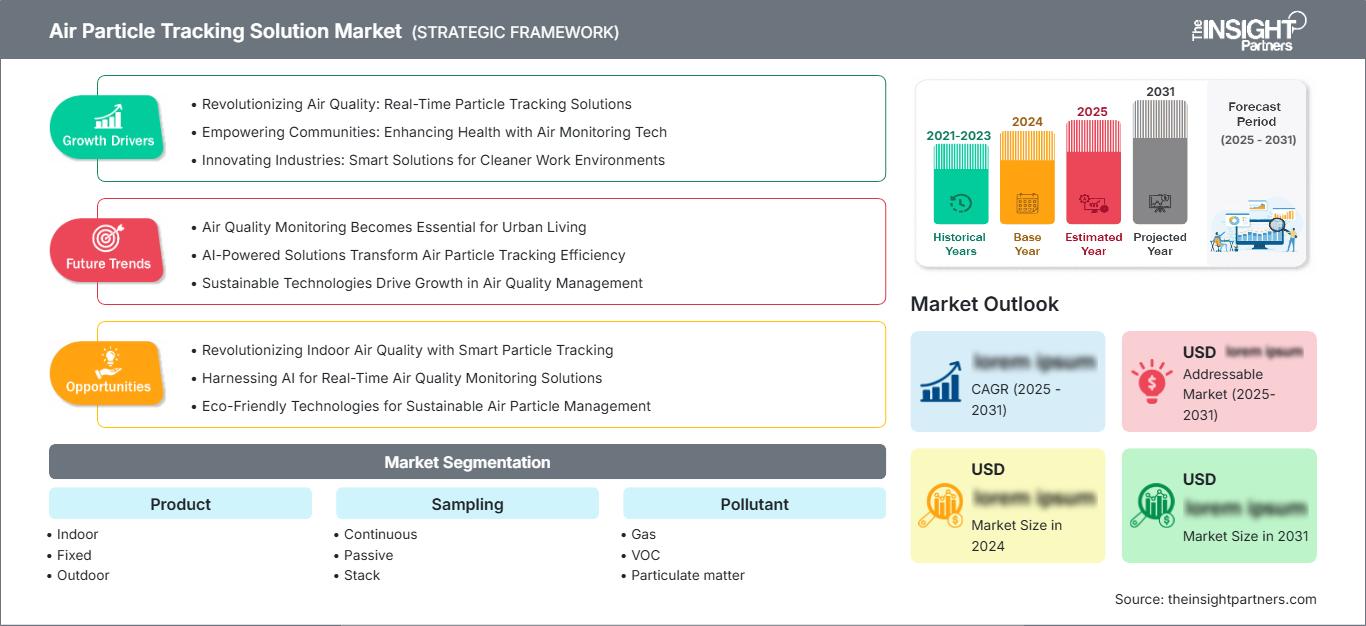
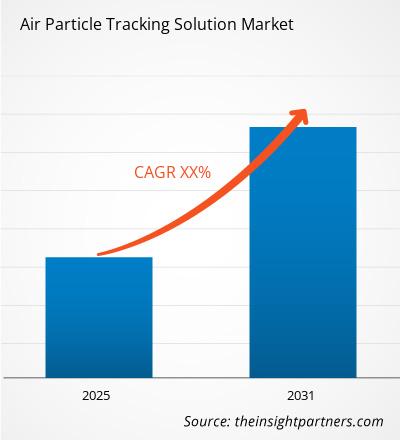
The global Air Particle Tracking Solution market was valued at US$ 718.24 million in 2025 and is expected to reach US$ 1435 million by 2034; it is estimated to record a CAGR of 7.99% during 2026-2034.
Air Particle Tracking Solution Market Assessment and Insights
- North America accounted for 33–36% share in 2025 and is expected to grow at an 8.4–9.1% CAGR between 2026–2034, supported by regulatory modernization, industrial hygiene monitoring, and commercial IAQ investments.
- US represented 74–78% of North America in 2025 and is projected to expand at an 8.2–8.8% CAGR between 2026–2034, led by EPA-linked monitoring upgrades.
- Europe held 24–27% share in 2025 and is forecast to grow at a 7.8–8.5% CAGR between 2026–2034, with Germany, the UK, and France leading demand.
- Asia Pacific captured 26–29% share in 2025 and is anticipated to post a 10.1–10.9% CAGR between 2026–2034, driven by China, India, Japan, and South Korea.
- Largest Segment Continuous sampling held 42–46% market share in 2025 and is expected to grow at an 8.8–9.4% CAGR during 2026–2034.
- High-Growth Segment Wearable products held 8–11% market share in 2025 and are projected to grow at an 11.2–12.4% CAGR during 2026–2034.
- Key companies analyzed in detail: 3M Company, Aeroqual Limited, Beckman Coulter, Inc., Ecotech Pty Ltd, Honeywell International Inc., Particle Measuring Systems, Inc., Pegasor Oy, Siemens AG, Thermo Fisher Scientific Inc., TSI Incorporated.
Source: The Insight Partners' analysis based on proprietary research, government publications, company annual reports, investor presentations, industry databases, and expert interviews.
The evolution of technology is changing the dynamics of the Air Particle Tracking Solution market as fixed reference stations, optical counters, beta attenuation monitors, and sensor nodes join together on platforms. Production will move towards modular products that can be configured with pollutant heads, reduced maintenance, and quality assurance through software.
During the forecast period, adoption will increase in new urban belts, energy infrastructure projects, hospitals, and high-value manufacturing hubs. Investments will focus on durable outdoor nodes, stack monitoring for continuous emissions, and platforms that facilitate regulatory compliance dashboards. Regulatory push towards higher particulate concentration limits and occupational exposure limits will accelerate adoption. At the same time, the APAC and Middle East regions will see investments through infrastructural development and air quality initiatives.
Air Particle Tracking Solution Market Report Scope
| Report Attribute | Details |
|---|---|
| Market size in 2025 | US$ 718.24 Million |
| Market Size by 2034 | US$ 1,435.0 Million |
| Global CAGR (2026 - 2034) | 7.99% |
| Historical Data | 2021-2024 |
| Forecast period | 2026-2034 |
Air Particle Tracking Solution Market Analysis
Demand drivers for the Air Particle Tracking Solution Market growth are based on three specific needs: the need for ongoing proof of compliance, the need for quicker pollution management, and less risk of exposure within occupied or managed environments. Government bodies are ramping up their monitoring of PM2.5 and ozone, while industry users are linking up their monitors to EHS systems and alarms.
The environment consists of sensor manufacturers, reference instruments providers, cloud analytics providers, calibration labs, distributors, environmental consultants, and facility managers. The supply landscape is becoming more favorable as standardization of optical sensors and communication hardware is advancing; however, the defensibility of the data remains dependent on calibration, proper enclosure design, and validation of specific pollutants.
The competitive positioning in the Air Particle Tracking Solution Market depends on the extent of coverage of pollutants, service network, and regulatory trustworthiness. While Thermo Fisher Scientific Inc. and TSI Incorporated offer robust reference-grade particulate measurement solutions, companies like Aeroqual Limited and Ecotech Pty Ltd cater to field-based networks of monitors. Honeywell International Inc., Siemens AG, and 3M Company enhance the adjacent markets of buildings and industry, security, and automation, respectively.
The investment trend involves hybrid strategies that include both fixed monitoring stations and portable exposure systems. Particle Measuring Systems, Inc., Beckman Coulter, Inc., and Pegasor Oy leverage their strengths in contamination detection, laboratory, and combustion particles, respectively. The strategic buyers are concerned about uptime, traceability, and scalability, which makes life-cycle management as much a criterion for purchase as the sensor cost itself.
● REPORT CUSTOMIZATION
Tailor This Report To Align With Your Specific Business Requirements
This report can be customized to align precisely with your business objectives, scope, and target markets. Customization options include tailored segmentation, geography, competitive analysis, and strategic insights to support informed decision-making.
Customize This Report →WHAT YOU CAN ADJUST
- ● Segmentations
- ● Geography
- ● Competitive Analysis
- ● Language Preferences
Air Particle Tracking Solution Market: Strategic Insights
Regional Insights
North America Air Particle Tracking Solution Market
North America accounted for 33–36% share in 2025 and is projected to grow at an 8.4–9.1% CAGR during 2026–2034. Air Particle Tracking Solution Market size in the region will be driven by government/state monitoring systems, industrial cleanup initiatives, cleanroom validation, and commercial building requirements for scientifically-based indoor air quality information.
Regulatory traction is crucial, especially following changes to PM2.5 standards that made detailed monitoring more relevant than ever before. Moreover, industries are installing perimeter or continuous monitoring systems in order to control community exposure levels, protect employees from potential hazards, and meet regulatory requirements. The vendors with certified devices, cloud analytics, and calibration solutions have a good opportunity to benefit from replacement cycles in utilities, healthcare, construction, and manufacturing industries.
U.S. Air Particle Tracking Solution Market
The US represented 74–78% of North America in 2025 and is expected to expand at an 8.2–8.8% CAGR through 2034. Demands include EPA modernization of monitoring, semiconductor cleanroom technology, pharmaceutical manufacturing, wildfire smokes, and occupational hygiene, where repeatable exposures to particles and gases are required.
Company presence is extensive, including such companies as 3M Company, Thermo Fisher Scientific Inc., TSI Incorporated, Honeywell International Inc., Beckman Coulter, Inc., and Particle Measuring Systems, Inc. Applications are shifting from standalone measurements to networked dashboards for schools, hospitals, factories, transport corridors, and building sites.
Europe Air Particle Tracking Solution Market
Europe held 24–27% share in 2025 and is forecast to grow at a 7.8–8.5% CAGR during 2026–2034. Germany drives the growth via industrial automation, automotive testing, and green manufacturing, whereas the UK focuses on air quality monitoring in urban areas, construction dust monitoring, and occupational exposure monitoring in densely populated cities.
The market is driven by France, Italy, and Spain due to increased usage of the Air Particle Tracking Solutions Market for public health monitoring, transport corridors, and industrial compliance. European Union air quality policy and city programs in different nations within the union have made a shift towards purchasing continuous air particle monitoring equipment.
APAC Air Particle Tracking Solution Market
Asia Pacific accounted for 26–29% share in 2025 and is projected to grow at a 10.1–10.9% CAGR, making it the fastest regional opportunity. The biggest player is China, with its backing from manufacturing volume, urban air pollution controls, and industrial emissions monitoring programs for both heavy industries and electronics clusters.
Japan and South Korea focus on highly precise measurement for semiconductors, health care, and intelligent buildings, India on developing government and industrial measurement programs under clean air initiatives, and Australia on additional needs arising from mining, construction, and wildfires.
Middle East & Africa Air Particle Tracking Solution Market
The Middle East & Africa is expected to grow at an 8.7–9.6% CAGR during 2026–2034. Saudi Arabia leads the way due to its industries, energy resources, building of giga-projects, and environmental permitting. Demand in the UAE comes from the smart infrastructure and indoor air quality projects.
South Africa will help in the implementation of mining, utilities, and urban air quality monitoring, while the remaining MEA regions will follow the project-oriented approach. Severe weather conditions will create a need for sturdy enclosures, tolerance to dust, and remote diagnostics capabilities.
Segmentation Analysis
Product
The Product segment is projected to grow at an 8.8–9.6% CAGR during 2026–2034. The Air Particle Tracking Solution Market scope spans fixed stations, indoor monitors, outdoor systems, and wearables, with buyers selecting products based on data accuracy, deployment environment, connectivity, and maintenance burden. Product differentiation increasingly depends on calibration stability, enclosure reliability, and software integration.
- The indoor solutions have applications in offices, hospitals, schools, laboratories, and homes where performance of the ventilation, exposure of people, and energy efficiency depend on the real-time data of particulates and gases in the air.
- The fixed instruments are crucial for regulatory networks, industrial fence lines, and cleanrooms due to their reliability and long-term compliance requirements of such locations.
- The outdoor solutions have applications in ambient pollution, construction dust, fire smoke, and urban corridors, where the durability, weather protection, and remote diagnosis features become buying criteria.
- Wearables have become increasingly important due to applications in personal exposure assessment, work safety, and field studies in places with significant changes in pollution at small locations.
Sampling
The Sampling segment is projected to grow at an 8.9–9.5% CAGR during 2026–2034. Continuous monitoring dominates because regulators and operators increasingly require time-resolved data, automated alarms, and defensible trend histories. Passive and stack sampling retain importance where cost, pollutant type, or source-specific compliance requirements shape monitoring design.
- Continuous sampling is applicable in procurement for compliance, alerting, cleanroom testing, and industrial EHS due to its ability to transform the monitoring process from periodic data gathering to operational control in real-time.
- Passive sampling still holds its ground in cases where long-term exposure assessment is required, power consumption is not an issue, and average pollution levels are sufficient for making decisions.
- Stack sampling is useful in the verification of emissions from utilities, cement factories, chemicals production facilities, and energy generation plants.
Pollutant
The Pollutant segment is projected to grow at an 8.7–9.4% CAGR during 2026–2034. Particulate matter remains the most visible demand driver because of health impacts and regulatory thresholds, while gas, VOC, and biological monitoring expand the use case into industrial hygiene, building management, and infection-control adjacent applications.
- Gas monitoring helps in compliance and safety programs for CO, NO2, SO2, ozone, and CO2, especially in industrial sites, transportation routes, and commercial buildings.
- Detection of VOCs is essential for remediation, production activities, the oil and gas industry, and indoor air quality when there is a need to detect any solvent, fuel, or chemical exposure rapidly.
- Particulate matter still constitutes the principal class of pollutants since PM2.5, PM10, ultrafine particles, dust, and smoke have a direct effect on regulation compliance and risk communication related to health.
- Biological monitoring has become relevant in healthcare institutions, laboratories, and buildings with high occupancy rates, where biological air pollutants can be detected.
End-user
The End-user segment is projected to grow at a 9.0–9.8% CAGR during 2026–2034. Government demand is shaped by ambient networks and public reporting, while industrial and commercial buyers use monitoring for compliance, safety, productivity, and reputation protection. Household adoption remains smaller but expands as consumer-grade devices improve accuracy.
- The government requires data-driven solutions that are defensible from a public perspective; regulatory compliance, planning, and emergency notification drive purchases of devices, calibration, and management systems.
- Industries install their monitoring systems in manufacturing, mining, energy production, pharmaceuticals, semiconductors, and remediation sites in order to control worker exposure, regulatory compliance issues, and process contamination problems.
- Office buildings, retail spaces, hospitals, schools, and hotels are commercial examples of customers that use monitoring systems due to the need for air quality visibility.
- Domestic purchases depend on health considerations, fire hazards, allergies, and integration with smart home technology; however, consumers remain cost-conscious.
Opportunity Snapshot
| Segment Name | Revenue Contribution | Trend Tag | Adoption Stage |
| Government | High | Public Networks | Mature |
| Industrial | High | Fence Monitoring | Scaling |
| Commercial | Medium | Smart Buildings | Scaling |
| Household | Low | Home Sensors | Emerging |
Air Particle Tracking Solution Market Growth Drivers and Impact Analysis
Stricter Particle Exposure Standards
With the regulator reducing tolerance to particulates due to epidemiology proving a link between PM2.5 and ultra-fine particulates and cardiovascular and pulmonary diseases, there is an increased need for monitoring solutions that are continuous, calibrated, and auditable in ambient air, schools, hospitals, construction sites, and factories. The market implications are real: purchasers have to provide evidence of compliance with time-stamping as opposed to sampling. With regulations tightening, the cycle speeds up, and those able to deliver credible data will be able to hold their price.
Industrial Digitization of EHS Workflows
Environmental, Health & Safety (EHS) data from industrial operations is being integrated into digital processes that tie sensor readings to alarms, dashboards, compliance records, and maintenance activities. The integration adds value to air particle monitoring as the data can be used to make decisions in real time. The adoption is most prevalent when the presence of particulates, such as dust, VOCs, combustion particles, and clean room contamination, has an impact on safety, production, or permit compliance. Vendors that offer open software, remote diagnosis, and calibration can generate recurring revenues.
Rising Indoor Air Quality Accountability
Pressure is mounting on owners, employers, schools, and healthcare providers to demonstrate indoor environmental quality. Air monitoring helps to tune up the ventilation system, install filters, minimize infections, and communicate with occupants. Commercially, the importance cannot be understated because air monitoring systems can be incorporated into HVAC control, building management, and energy efficiency systems. Unlike an audit, which can only happen once, a monitor offers trends and warnings that make it easier to spend money on air handling.
Air Particle Tracking Solution Market Future Trends
Hybrid Reference and Sensor Networks
Air Particle Tracking Solution Market Trends will see the shift towards hybrid systems that combine reference-quality measuring devices with cost-effective distributed sensing nodes. The approach enables organizations to keep their anchor points based on high-quality measurement systems and increase the number of locations where the measurement takes place – neighborhoods, campuses, industrial plants, and transportation routes. In the future, emphasis will be placed on calibration, data fusion, and anomaly detection in order to avoid false positives. Such an approach looks appealing due to its combination of scientific rigor and budget considerations.
Personal Exposure Intelligence
Wearable and mobile sensing technologies will develop from simple alerts to become exposure intelligence technologies that are combined with geographical locations, activities, and buildings. While businesses will have the ability to optimize operations based on aggregated information, researchers will be able to create maps of the variability in exposure at the street or task level. Personal monitoring technology is going to require accurate readings, as well as measures to ensure privacy and accuracy.
Air Particle Tracking Solution Market Opportunities
Compliance-as-a-Service Platforms
Vendors can convert hardware sales into recurring revenue by offering monitoring, calibration, reporting, and audit support as managed services. This opportunity is strongest for construction, remediation, commercial real estate, and mid-sized industrial sites that need defensible data but lack specialist staff. Air Particle Tracking Solution Market Forecasts indicate buyers will reward providers that reduce compliance complexity while maintaining measurement credibility. Bundled services can include instrument leasing, remote diagnostics, automated reports, and escalation protocols, creating stickier customer relationships.
Clean Manufacturing Expansion
The growth of semiconductor, pharmaceutical, biotechnology, and medical device manufacturing facilities offers substantial opportunities for advanced particle measurement technology. These types of manufacturing processes need to be protected from contamination through classification and environmental controls. This type of equipment can offer services during the design process of the facility, validation procedures, and ongoing operation of the facility. The best opportunity for growth will be where governments are encouraging local manufacturing and businesses are developing reliable supply chains close to their customers.
Recent Developments
- March 2026: TSI Incorporated launched the OmniCount™ Portable Water-based Condensation Particle Counter (PWCPC) Model 3001, a compact single-channel instrument designed for accurate ultrafine particle measurements in research, environmental monitoring, and field studies.
- December 2025: IIT Kanpur and BMC introduced plans for MANAS (Mumbai Air Network for Advanced Sciences), an AI-enabled independent AQI monitoring platform for Mumbai. The system will use a network of low-cost sensors to provide hyperlocal air quality data, identify pollution sources, and help authorities take targeted mitigation actions.
- April 2025: AQI India launched a mobile app to help users track air pollution levels, providing easier access to air quality information and pollution monitoring updates.
Frequently Asked Questions

- Comprehensive Market Sizing and Forecast Analysis
- Detailed Segmentation Analysis
- In-Depth Market Dynamics Assessment
- Regional and Country-Level Insights
- Competitive Landscape and Company Benchmarking
- Strategic Business Intelligence
Recent Reports
Testimonials

The Insight Partners' SCADA System Market report is comprehensive, with valuable insights on current trends and future forecasts. The team was highly professional, responsive, and supportive throughout. We are very satisfied and highly recommend their services.
RAN KEDEM Partner, Reali Technologies LTDs
I requested a report on a very specific software market and the team produced the report in a few days. The information was very relevant and well presented. I then requested some changes and additions to the report. The team was again very responsive and I got the final report in less than a week.
JEAN-HERVE JENN Chairman, Future Analytica
We worked with The Insight Partners for an important market study and forecast. They gave us clear insights into opportunities and risks, which helped shape our plans. Their research was easy to use and based on solid data. It helped us make smart, confident decisions. We highly recommend them.
PIYUSH NAGPAL Sr. Vice President, High Beam Global
The Insight Partners delivered insightful, well-structured market research with strong domain expertise. Their team was professional and responsive throughout. The user-friendly website made accessing industry reports seamless. We highly recommend them for reliable, high-quality research services
YUKIHIKO ADACHI CEO, Deep Blue, LLC.
This is the first time I have purchased a market report from The Insight Partners.While I was unsure at first, I visited their web site and felt more comfortable to take the risk and purchase a market report.I am completely satisfied with the quality of the report and customer service. I had several questions and comments with the initial report, but after a couple of dialogs over email with their analyst I believe I have a report that I can use as input to our strategic planning process.Thank you so much for taking the extra time and making this a positive experience.I will definitely recommend your service to others and you will be my first call when we need further market data.
JOHN SUZUKI President and Chief Executive Officer, Board Director, BK Technologies
I wish to appreciate your support and the professionalism you displayed in the course of attending to my request for information regarding to infectious disease IVD market in Nigeria. I appreciate your patience, your guidance, and the fact that you were willing to offer a discount, which eventually made it possible for us to close a deal. I look forward to engaging The Insight Partners in the future, all thanks to the impression you have created in me as a result of this first encounter.
DR CHIJIOKE ONYIA MANAGING DIRECTOR, PineCrest Healthcare Ltd.Reason to Buy
- Informed Decision-Making
- Understanding Market Dynamics
- Competitive Analysis
- Identifying Emerging Markets
- Customer Insights
- Market Forecasts
- Risk Mitigation
- Boosting Operational Efficiency
- Strategic Planning
- Investment Justification
- Tracking Industry Innovations
- Aligning with Regulatory Trends





 Get Free Sample for