
Alarm Monitoring Market Growth, Share & Trends by 2034
Coverage: By Component (Hardware, Software, Services); Input Signal (Discrete, Analog, Protocol); Connectivity (Wired, Wireless); Application (Vehicle Alarm Monitoring, Building Alarm Monitoring, Equipment Monitoring, Environmental Monitoring) , and Geography (North America, Europe, Asia Pacific, and South and Central America)
- Status : Data Released
- Report Code : TIPRE00007265
- Category : Electronics and Semiconductor
- No. of Pages : 150
- Available Report Formats :


- Last update date : July 17, 2026


2025 Market Size
US$ 50.96 Bn
Base year value
2034 Forecast
US$ 73.96 Bn
Projected by 2034
CAGR 2026-2034
4.22 %
Growth rate
Addressable Market
US$ 567.15 Bn
(2026-2034)
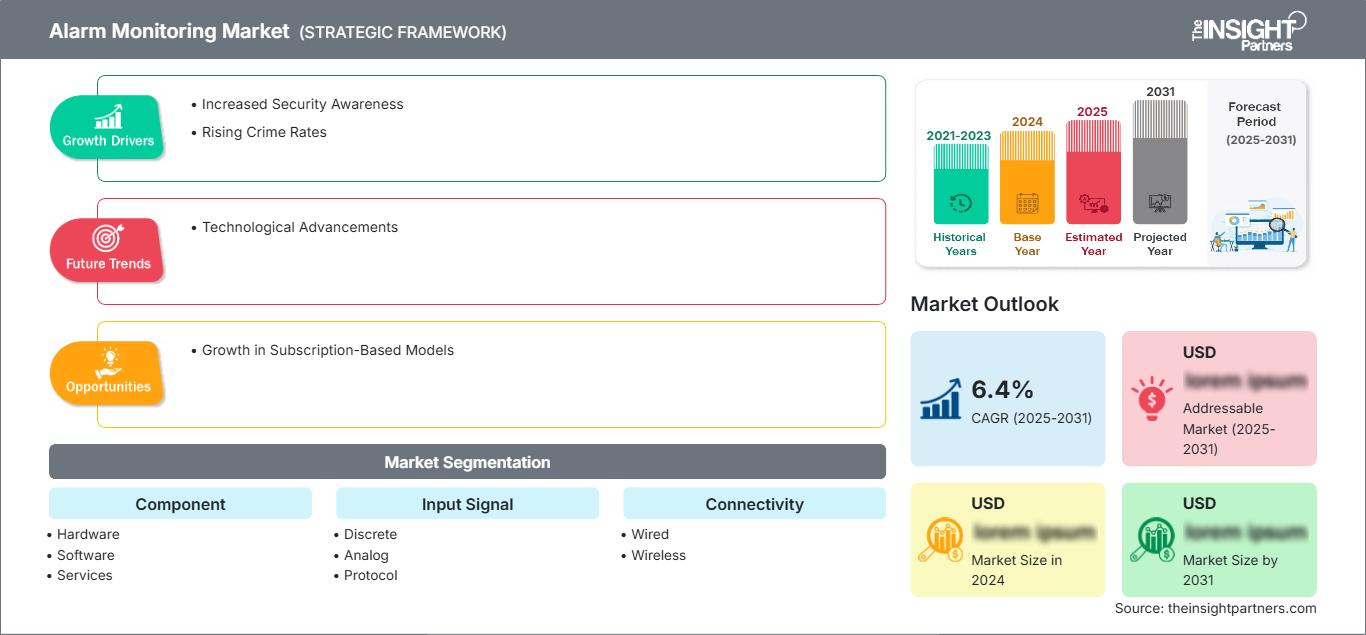
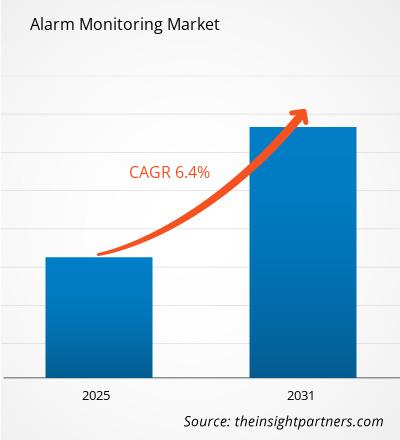
The Alarm Monitoring Market is witnessing steady expansion, reaching a market size of US$ 50.96 Billion in 2025 and projected to attain US$ 73.96 Billion by 2034, registering a CAGR of 4.22% during 2026–2034. The market growth is driven by increased security needs, technological connectivity, and automation through monitoring systems in residential, commercial, industrial, transport, and critical infrastructure sectors.
Alarm Monitoring Market Size is affected by security environment prevailing in North America, which includes factors such as use of smart buildings, regulations, and need for replacement of existing monitoring systems. Growth rate of the market in North America is estimated to be 3.8-4.6% CAGR during 2026-2034.
Alarm Monitoring Market Assessment and Insights
- North America: The region maintains a significant position with an estimated share in 2025 of 34–38% and is projected to expand at a CAGR of 3.8–4.6% during 2026–2034. Demand is supported by established security service providers, commercial infrastructure upgrades, and connected surveillance integration.
- US: The country represents a major contributor within North America, accounting for an estimated share in 2025 of 75–80% of the regional market and growing at a CAGR of 3.9–4.7% during 2026–2034 due to residential security adoption and enterprise monitoring requirements.
- Europe: The region holds an estimated share in 2025 of 26–30% and is expected to grow at a CAGR of 4.0–4.8% during 2026–2034. Germany, the UK, France, Italy, and Spain are key markets driven by safety regulations, industrial automation, and smart infrastructure initiatives.
- Asia Pacific: The region accounts for an estimated share in 2025 of 22–26% and is anticipated to record a CAGR of 5.0–5.8% during 2026–2034. China, Japan, South Korea, and India are driving adoption through urban development, industrial security needs, and digital transformation programs.
- Largest Segment: Services represent the leading segment with an estimated market share of 42–46% in 2025 and a CAGR of 4.3–5.0% during 2026–2034, supported by recurring monitoring contracts and managed security demand.
- High-Growth Segment: Software is projected as a high-growth segment with an estimated market share of 24–28% in 2025 and a CAGR of 5.2–6.0% during 2026–2034, driven by cloud platforms and analytics-enabled monitoring.
- Key companies analyzed in detail: ADT Inc., Bosch Security Systems GmbH, Brinks Home Security, Chubb Fire and Security Group (UTC), Honeywell International Inc., Johnson Controls International PLC, Schneider Electric SE, Securitas Sverige AB, Vector Security, Vivint, Inc.
Source: The Insight Partners' analysis based on proprietary research, government publications, company annual reports, investor presentations, industry databases, and expert interviews.
The alarm monitoring market has shifted from traditional alarm panels and telecommunication systems to integrated solutions that combine sensors, wireless technology, cloud-based monitoring, and analysis tools. Technology advancements have brought about changes in how solutions are deployed through remote monitoring, improved coordination of responses, and centralized security management. The market environment encompasses hardware vendors, software companies, monitoring solution providers, network providers, and end-users who require scalable security solutions. Alarm Monitoring Market Share is affected by the increasing uptake of cloud-based monitoring solutions and intelligent security solutions.
In the coming years, growth in the future would be aided by increased spending in intelligent infrastructure, safety upgrades in the industry, and attention to emergency preparedness regulations. Emerging economies are upgrading their security framework, while developed countries are upgrading their existing system. Collaboration with the likes of artificial intelligence, edge computing, and IoT technologies will bring new prospects for suppliers of interoperable monitoring solutions.
Alarm Monitoring Market Report Scope
| Report Attribute | Details |
|---|---|
| Market size in 2025 | US$ 50.96 Billion |
| Market Size by 2034 | US$ 73.96 Billion |
| Global CAGR (2026 - 2034) | 4.22% |
| Historical Data | 2021-2024 |
| Forecast period | 2026-2034 |
Alarm Monitoring Market Analysis
The Alarm Monitoring Market Forecast is being influenced by rising security concerns across commercial facilities, residential properties, transportation assets, and industrial locations. The demand for services will be driven by increased use of interconnected devices, higher requirements for real-time notifications, and the evolution from stand-alone alarm systems to integrated security systems. Companies look for solutions that provide monitoring, analytics, and automation functionalities.
The value chain consists of hardware producers, software developers, communication network providers, system integrators, and monitoring services providers. The supply dynamics are shifting towards increased involvement of vendors in wireless technology, cloud technology, and security issues. Availability of hardware, innovations in components, and improved connectivity allow the development and usage of systems in various environments.
The alarm monitoring market indicates a competitive environment where established security companies and technology providers are strengthening their positions through platform development, partnerships, and service expansion. Alarm Monitoring Market Trends are reflected in the strategies of ADT Inc., Brinks Home Security, Vivint, Inc., and Vector Security, which continue focusing on managed security offerings, while technology firms, including Honeywell International Inc., Bosch Security Systems GmbH, Johnson Controls International PLC, and Schneider Electric SE, emphasize integrated building and industrial solutions.
The current trend is the investment made in software capacity, remote surveillance systems, and analytics. Strategic positioning can be achieved via cloud deployment, improvements in interoperability, and enterprise applications. Securitas Sverige AB and Chubb Fire and Security Group (UTC) add value in their security services expertise.
● REPORT CUSTOMIZATION
Tailor This Report To Align With Your Specific Business Requirements
This report can be customized to align precisely with your business objectives, scope, and target markets. Customization options include tailored segmentation, geography, competitive analysis, and strategic insights to support informed decision-making.
Customize This Report →WHAT YOU CAN ADJUST
- ● Segmentations
- ● Geography
- ● Competitive Analysis
- ● Language Preferences
Alarm Monitoring Market: Strategic Insights
Regional Insights
North America Alarm Monitoring Market
North America Alarm Monitoring Market maintains a leading position due to established security infrastructure, high adoption of managed monitoring services, and continuous modernization of commercial facilities. The region accounted for an estimated 34–38% share in 2025 and is projected to expand at a CAGR of 3.8–4.6% during 2026–2034. USA and Canada are considered to be advanced markets with high demand for products from residential security, health care facilities, banks, and government offices.
The ecosystem in this region is driven by a developed communication system, more deployment of smart buildings, and a focus on safety through regulations. Businesses are implementing cloud-based monitoring, mobile alerts, and artificial intelligence-driven analytics to increase efficiency. The installation of old alarm systems, as well as more subscription-based security services, will keep up the demand going forward. North America continues to be the dominant market due to technology advancement and established monitoring companies.
U.S. Alarm Monitoring Market
The U.S. Alarm Monitoring Market represents approximately 75–80% of the North American share in 2025 and is expected to register a CAGR of 3.9–4.7% during 2026–2034. The entire nation reaps the advantage of the broad penetration of security alarm systems, commercial surveillance systems, and professional monitoring systems. Enterprises, big or small, as well as individual households, are embracing connected alarm systems.
Large firms have robust business operations due to extensive network infrastructure and advanced technology. Application in vehicle security, buildings, industry, and environmental security has continued to grow. Market dynamics are being driven by insurance needs, urban security plans, and the desire to manage remotely.
Europe Alarm Monitoring Market
Europe Alarm Monitoring Market accounted for an estimated 26–30% share in 2025 and is projected to grow at a CAGR of 4.0–4.8% during 2026–2034. Advantages of the region include stringent safety laws, enhanced security infrastructure, and increasing use of intelligent security systems. One of the leading countries in this region is Germany because of the automation of industries, factories, and the security infrastructure of buildings.
Advantages of the UK market are commercial security needs, monitoring services in residences, and service-based security systems. The country of Germany continues to enjoy the advantage of industrial applications, whereas France, Italy, and Spain have been growing thanks to smart cities initiatives, retail security needs, and infrastructural modernization. European countries are using more and more integrated monitoring solutions, which include alarm systems, access control systems, and cameras.
APAC Alarm Monitoring Market
APAC Alarm Monitoring Market represents an estimated 22–26% share in 2025 and is forecast to grow at a CAGR of 5.0–5.8% during 2026–2034. The position of China is still maintained because of the quick growth in urban areas, industries, and infrastructure projects. Japan and South Korea have contributions via their technological adaptation and effective facilities management.
India and Australia are seeing more demand for such services owing to commercial properties, transport facilities, and industrial sites. The government policies of digital infrastructure and safety are playing roles in the same. Growth is expected in terms of industrial automation, construction activities, and connectivity networks in the region.
Middle East & Africa Alarm Monitoring Market
The Middle East & Africa Alarm Monitoring Market is growing owing to infrastructure developments, energy security needs, and commercial facility constructions. The market in the region is anticipated to grow at a CAGR of 4.2–5.0% from 2026 to 2034, wherein Saudi Arabia and UAE are significant countries because of extensive infrastructural developments and security upgradation projects.
Commercial security needs in South Africa, and energy facilities and transportation development initiatives in the Rest of MEA region are contributing to the growth of the market. Growing concern about asset security for oil and gas infrastructures, logistics centers, and public facilities is fostering the adoption of advanced monitoring solutions.
Segmentation Analysis
Component
The Components Segment consists of Hardware, Software, and Services. It is estimated that the growth rate of this segment would be between 4.0% and 4.8% per annum during 2026-2034 due to increasing needs of integrated solution providers that combine hardware, software, and monitoring. Hardware continues to be important for the implementation of the systems, whereas software and services gain more significance due to recurring models.
- Hardware constitutes the core part of security systems that include sensors, alarm panels, and communication hardware. Consistent demand for such products is attributed to the need for replacements, expansion, and transition from traditional systems to smart devices.
- Software provides functionalities like centralized management, analysis, automation, and remote control. More and more customers are resorting to cloud technology and intelligent monitoring solutions, which contribute to increasing the importance of software in security systems.
- Services offer high market shares because of professional monitoring, maintenance, and management services. Subscription-based services are becoming increasingly popular.
Input Signal
Input Signal Segment comprises Discrete, Analog, and Protocol. It is predicted to witness a CAGR of 3.9% to 4.7% from 2026 to 2034 because of the growing need for flexibility in integrating alarms under varying conditions of operation. This is because businesses nowadays are demanding solutions that can process multiple signals effectively.
- Discrete signals are still in use in traditional alarm systems, where there is a need to change the status. They offer reliability and cost-effectiveness.
- Analog signals have significance in the case where there is a need for continuous monitoring of parameters. This can be seen in industrial settings and special application areas.
- Protocol-based signals are becoming increasingly significant in security systems that are interconnected. These signals allow for interoperability among different devices and software platforms.
Connectivity
Connectivity comprises Wired Solutions and Wireless Solutions. The segment is projected to grow at a CAGR of 4.5–5.3% from 2026 to 2034 due to the need for reliability, ease of installation, and scalability of the monitoring system among end users. Adoption of wireless technology is growing owing to easy installation.
- Wired connectivity allows reliable communication in large buildings, industrial settings, and areas that require consistent performance over a long period of time.
- Wireless connectivity ensures quick installation and remote management, along with its capability to work with smart gadgets. Increasing use of the Internet of Things and advanced communication systems is helping in its implementation.
Application
The Application category includes Vehicle Alarm Monitoring, Building Alarm Monitoring, Equipment Monitoring, and Environmental Monitoring. This category is anticipated to expand at a CAGR of 4.2%-5.0% for the period from 2026 to 2034. The Alarm Monitoring Market is growing in its scope as companies implement monitoring systems in different settings that need safety, security, and visibility.
- Vehicle Alarm Monitoring is used in transportation security because it prevents thefts, incorporates tracking, and meets fleet security needs. It is increasingly adopted by logistics companies and owners of commercial vehicles.
- Building Alarm Monitoring is still a major application because of the need for residential, commercial, and institutional security. Integration into smart buildings is making the adoption of these monitoring systems more prevalent.
- Equipment Monitoring helps in protecting industrial assets because it detects problems with the equipment. Industrial manufacturers and infrastructure companies are increasingly relying on monitoring systems.
- Environmental Monitoring is used to detect environmental threats such as temperature variations, fire threats, and environmental hazards. These systems are adopted in healthcare, industrial, and storage facilities for preventive security.
Opportunity Snapshot
| Application | Revenue Contribution (High/Medium/Low) | Trend Tag | Adoption Stage |
| Vehicle Alarm Monitoring | Medium | Fleet Security | Scaling |
| Building Alarm Monitoring | High | Smart Buildings | Mature |
| Equipment Monitoring | Medium | Industrial Safety | Scaling |
| Environmental Monitoring | Medium | Hazard Detection | Emerging |
Alarm Monitoring Market Growth Drivers and Impact Analysis
Expansion of Smart Building Security Infrastructure
The rise in smart building technology use is shaping the need for integrated monitoring solutions that include alarm, access control, sensor, and management systems. There is an increasing adoption of intelligent security infrastructure by commercial property managers in order to enhance occupant safety, visibility of operations, and adherence to safety requirements. Cloud-based platforms help monitor multiple facilities without any manual involvement. With the increase in urbanization and connectivity of buildings, monitoring solutions are becoming an integral part of facility management. The emergence of this trend is offering opportunities to technology companies for developing integrated solutions that include automation, analytics, and remote monitoring functionalities.
Increasing Industrial Asset Protection Requirements
Monitoring systems have been used more frequently by industry players as a means of protecting key machines, production processes, and operations. The need for effective monitoring in manufacturing plants, energy plants, and logistics facilities exists since such systems help to reduce downtime and increase the efficiency of dealing with problems. Modern monitoring systems allow organizations to identify possible problems at an early stage. The growth in industrial automation and connectivity in the industry makes it necessary to have systems that can process information from different sources. This trend is forcing vendors to produce products that are better in terms of compatibility, analytics, and remote control.
Growth of Subscription-Based Security Services
The growing tendency towards managed security options is impacting the way in which customers behave when making purchases. The services offered by security monitoring providers give constant protection and system maintenance without the need for managing complicated security systems on behalf of the customers. This type of solution is especially suitable for small enterprises and individual consumers who want to gain access to state-of-the-art features at affordable prices. Security providers have been developing various tools in order to offer their services, such as mobile apps and cloud services. In addition, a subscription-based approach makes businesses interested in developing relations with their customers.
Alarm Monitoring Market Future Trends
Artificial Intelligence Enabled Security Monitoring
The use of artificial intelligence is anticipated to revolutionize the monitoring systems through the enhancement of the accuracy of the threat detection system, reduction of false alarms, and conducting predictive analysis. In the future, systems will probably integrate sensor data, video analysis, and behavioral patterns in order to make better decisions. The use of AI-powered technology will be helpful in the process of decision-making by detecting abnormal behavior. As organizations deal with complicated security challenges, intelligent automation will play a significant role. It is probable that vendors will develop systems that integrate automation with human control.
Greater Adoption of Cloud Connected Platforms
Monitoring systems based in the cloud will likely grow in popularity due to their flexibility and scalability, along with ease of access from remote locations. They enable the user to control several locations via centralized systems and lower reliance on conventional infrastructure. Future installations will focus more on the integration with IoT devices, mobile applications, and enterprise systems. The use of the cloud platform could facilitate fast software updates, better data handling, and increased operational efficiency. With the development of the connectivity infrastructure worldwide, cloud-based monitoring solutions will be more widespread in different applications.
Alarm Monitoring Market Opportunities
Expansion Across Emerging Infrastructure Markets
The emerging economies offer chances because of their rapid urbanization, development of infrastructure, and emphasis on security. Nations that are developing smart cities, building transport infrastructure, industrial plants, and business districts need scalable monitoring solutions. Companies could exploit this chance by developing cost-efficient solutions tailored to regional needs and network availability. Cooperation with regional integration companies and infrastructure developers could help with the implementation of such solutions. The development of digital infrastructure in underdeveloped nations provides an opportunity for providers of flexible platforms that can be used for different purposes. Awareness about the importance of safety and asset protection is likely to boost implementation.
Integration With Enterprise Risk Management Platforms
The integration of monitoring systems into a wider enterprise risk management system offers a chance for technology vendors. Companies need a comprehensive platform that is capable of integrating security alarms, operations information, and incident management systems. These connected systems could increase visibility within facilities and enhance the efficiency of the process. The companies that create interoperable software frameworks could have a competitive edge by meeting enterprise needs other than providing security alarms. The synergy among the security vendors, software firms, and infrastructure technology companies could boost innovations.
Recent Developments
- June 2026: Alarm Detection Systems (ADS), a 58-year leader in electronic security and life safety solutions, announced the launch of its ADS SEEKER Remote Video Monitoring platform, a next-generation, AI-powered solution designed to make security smarter, faster, and more responsive in real time. SEEKER builds on the security systems many businesses already have in place, enhancing cameras and infrastructure with intelligent analytics and live, human-interaction monitoring. By combining AI technology with highly trained video analysts, the SEEKER platform detects, verifies, and responds to potential threats before they escalate, helping stop incidents in real time.
- May 2026: SeQent, a leading provider of industrial alarm notification and plant-floor communication software, and Velotic, a leading independent industrial software company, announced the renewal and expansion of their longstanding partnership to power real-time alarm and event notification across Proficy Software, the former manufacturing software business of GE Vernova. The partnership currently supports Proficy's CIMPLICITY HMI/SCADA, with capabilities extending to iFIX in 2026, bringing real-time alarm and event notification to a significantly broader base of Velotic users.
- December 2025: Alarm.com and Everon LLC, a leading security integrator and premier provider of commercial security, video, fire, and life safety solutions, announced a strategic partnership to deliver a unified console for Everon customers to manage integrated intrusion protection, access control, remote video monitoring, and business management solutions. The partnership reflects the growing demand for integrated commercial security platforms that can easily connect with existing infrastructure while delivering remote management capabilities. The Alarm.com partnership with Everon will enable a scalable solution that meets the sophisticated requirements of commercial customers across diverse business environments, from small businesses to multi-location enterprises.
Frequently Asked Questions

- Comprehensive Market Sizing and Forecast Analysis
- Detailed Segmentation Analysis
- In-Depth Market Dynamics Assessment
- Regional and Country-Level Insights
- Competitive Landscape and Company Benchmarking
- Strategic Business Intelligence
Recent Reports
Testimonials

The Insight Partners provided valuable market intelligence that supported our global go-to-market strategy. Their team was professional, responsive, and attentive to our feedback, providing thoughtful analysis and helpful methodological clarifications throughout the project.
Junmo Kim Chief Financial Officer (CFO), Enertech Co., Ltd.
The Insight Partners' SCADA System Market report is comprehensive, with valuable insights on current trends and future forecasts. The team was highly professional, responsive, and supportive throughout. We are very satisfied and highly recommend their services.
RAN KEDEM Partner, Reali Technologies LTDs
I requested a report on a very specific software market and the team produced the report in a few days. The information was very relevant and well presented. I then requested some changes and additions to the report. The team was again very responsive and I got the final report in less than a week.
JEAN-HERVE JENN Chairman, Future Analytica
We worked with The Insight Partners for an important market study and forecast. They gave us clear insights into opportunities and risks, which helped shape our plans. Their research was easy to use and based on solid data. It helped us make smart, confident decisions. We highly recommend them.
PIYUSH NAGPAL Sr. Vice President, High Beam Global
The Insight Partners delivered insightful, well-structured market research with strong domain expertise. Their team was professional and responsive throughout. The user-friendly website made accessing industry reports seamless. We highly recommend them for reliable, high-quality research services
YUKIHIKO ADACHI CEO, Deep Blue, LLC.
This is the first time I have purchased a market report from The Insight Partners.While I was unsure at first, I visited their web site and felt more comfortable to take the risk and purchase a market report.I am completely satisfied with the quality of the report and customer service. I had several questions and comments with the initial report, but after a couple of dialogs over email with their analyst I believe I have a report that I can use as input to our strategic planning process.Thank you so much for taking the extra time and making this a positive experience.I will definitely recommend your service to others and you will be my first call when we need further market data.
JOHN SUZUKI President and Chief Executive Officer, Board Director, BK Technologies
I wish to appreciate your support and the professionalism you displayed in the course of attending to my request for information regarding to infectious disease IVD market in Nigeria. I appreciate your patience, your guidance, and the fact that you were willing to offer a discount, which eventually made it possible for us to close a deal. I look forward to engaging The Insight Partners in the future, all thanks to the impression you have created in me as a result of this first encounter.
DR CHIJIOKE ONYIA MANAGING DIRECTOR, PineCrest Healthcare Ltd.Reason to Buy
- Informed Decision-Making
- Understanding Market Dynamics
- Competitive Analysis
- Identifying Emerging Markets
- Customer Insights
- Market Forecasts
- Risk Mitigation
- Boosting Operational Efficiency
- Strategic Planning
- Investment Justification
- Tracking Industry Innovations
- Aligning with Regulatory Trends





 Get Free Sample for