
All-Flash Array Market Growth, Trends & Forecast by 2034
Coverage: by Flash Media (Custom Flash Modules, Solid-State Drives); Storage Architecture/ Access Pattern (File, Object, Block); Industry Vertical (Enterprise, BFSI, Healthcare, Media and Entertainment, Retail, Government, Cloud, Telecom) , and Geography (North America, Europe, Asia Pacific, and South and Central America)
- Status : Data Released
- Report Code : TIPRE00004365
- Category : Electronics and Semiconductor
- No. of Pages : 150
- Available Report Formats :


- Last update date : July 15, 2026


2025 Market Size
US$ 22.35 Bn
Base year value
2034 Forecast
US$ 38.13 Bn
Projected by 2034
CAGR 2026-2034
6.11 %
Growth rate
Addressable Market
US$ 273.77 Bn
(2026-2034)
The global All-Flash Array market was valued at US$ 22.35 billion in 2025 and is expected to reach US$ 38.13 billion by 2034; it is estimated to record a CAGR of 6.11% during 2026-2034.
All-Flash Array Market Assessment and Insights
- North America held 36–38% share in 2025 and is expected to grow at 6.4–6.8% CAGR between 2026–2034, led by AI infrastructure, enterprise refreshes, and mature cloud adoption.
- US represented 78–82% of North America in 2025 and is projected to grow at 6.3–6.7% CAGR between 2026–2034, supported by hyperscale and BFSI deployments.
- Europe accounted for 25–27% share in 2025 and may expand at 6.0–6.4% CAGR between 2026–2034, with Germany, the UK, and France leading regulated modernization.
- Asia Pacific captured 23–25% share in 2025 and is likely to grow at 7.5–8.0% CAGR between 2026–2034, driven by China, Japan, India, and South Korea.
- Largest Segment Block storage held 44–46% market share in 2025 and is expected to grow at 6.5–6.9% CAGR between 2026–2034.
- High Growth Segment Custom flash modules held 28–30% market share in 2025 and may grow at 7.4–7.9% CAGR between 2026–2034.
- Key companies analyzed in detail: Dell Inc., Hewlett Packard Enterprise Development LP, Hitachi, Ltd., Huawei Technologies Co., Ltd., International Business Machines Corporation, Kaminario, Micron Technology, Inc., NetApp, Inc., Pure Storage, Inc., Western Digital Corporation.
Source: The Insight Partners' analysis based on proprietary research, government publications, company annual reports, investor presentations, industry databases, and expert interviews.
Enterprise storage has shifted from performance optimization initiatives to platform modernization initiatives due to latency-critical databases, virtual desktop systems, analytics engines, and AI pipelines becoming more common for mixed disk farms. The All-Flash Array Market Growth represents such a change due to the need for consistent throughputs, low power consumption, and greater capacity within racks. NVMe capabilities, data reduction, cyber-resilient snapshots, and lifecycle automation are being touted by manufacturers as they balance the availability of NAND Flash memory, innovations in controllers, and their responsibilities towards enterprises.
Future adoption will expand beyond early enterprise adopters as mid-sized cloud services providers, national digital infrastructure plans, and regulated industries adopt faster storage layers. Investments are anticipated in line with workload optimization, sovereign cloud development, healthcare digitization, and banking resiliency needs. Energy savings regulations will also help drive the All-Flash Array Market since flash arrays take up less physical space and require less cooling than traditional disk estates.
All-Flash Array Market Report Scope
| Report Attribute | Details |
|---|---|
| Market size in 2025 | US$ 22.35 Billion |
| Market Size by 2034 | US$ 38.13 Billion |
| Global CAGR (2026 - 2034) | 6.11% |
| Historical Data | 2021-2024 |
| Forecast period | 2026-2034 |
All-Flash Array Market Analysis
The market sees its highest demand in places where there is a need for low latency, fast recovery, and high input/output operations. Trading platforms, EHRs, live streams, and AI inference clusters have come to see the value in flash arrays as not just high-end storage but also critical production infrastructure. As per the All-Flash Array Market Report, vendors compete in software-defined services, compression performance, replication capabilities, and hybrid cloud mobility, along with hardware performance.
The ecosystem includes NAND flash makers, controller makers, array vendors, cloud providers, channels, and managed service providers. Supply-side dynamics continue to be linked to SSD prices, the enterprise qualification process, and firmware development. Total Cost of Ownership is reduced in the All-Flash Array Market when considering power consumption, size of space required, administration costs, and application consolidation in addition to purchase cost.
Competition is focused and technologically differentiated. Competitors include Dell Inc., NetApp, Inc., Pure Storage, Inc., Hewlett Packard Enterprise Development LP, and Huawei Technologies Co., Ltd., competing for enterprise and cloud business. In addition, Hitachi, Ltd., International Business Machines Corporation, Micron Technology, Inc., Western Digital Corporation, and Kaminario provide products that target specific performance, media, and platform categories. Installed base migration and subscription model considerations will impact the All-Flash Array Market share.
Future investment trends are cyber recovery, artificial intelligence data pipelines, unified block-file-object platforms, and storage consumption as a service. Companies that have built-in observability and automated tuning capabilities will be able to protect their margins from hardware commoditization. Purchasing groups will value predictable service levels, density, and life cycle flexibility, and as such, strategic positioning will be software and support-driven, not just controller performance.
● REPORT CUSTOMIZATION
Tailor This Report To Align With Your Specific Business Requirements
This report can be customized to align precisely with your business objectives, scope, and target markets. Customization options include tailored segmentation, geography, competitive analysis, and strategic insights to support informed decision-making.
Customize This Report →WHAT YOU CAN ADJUST
- ● Segmentations
- ● Geography
- ● Competitive Analysis
- ● Language Preferences
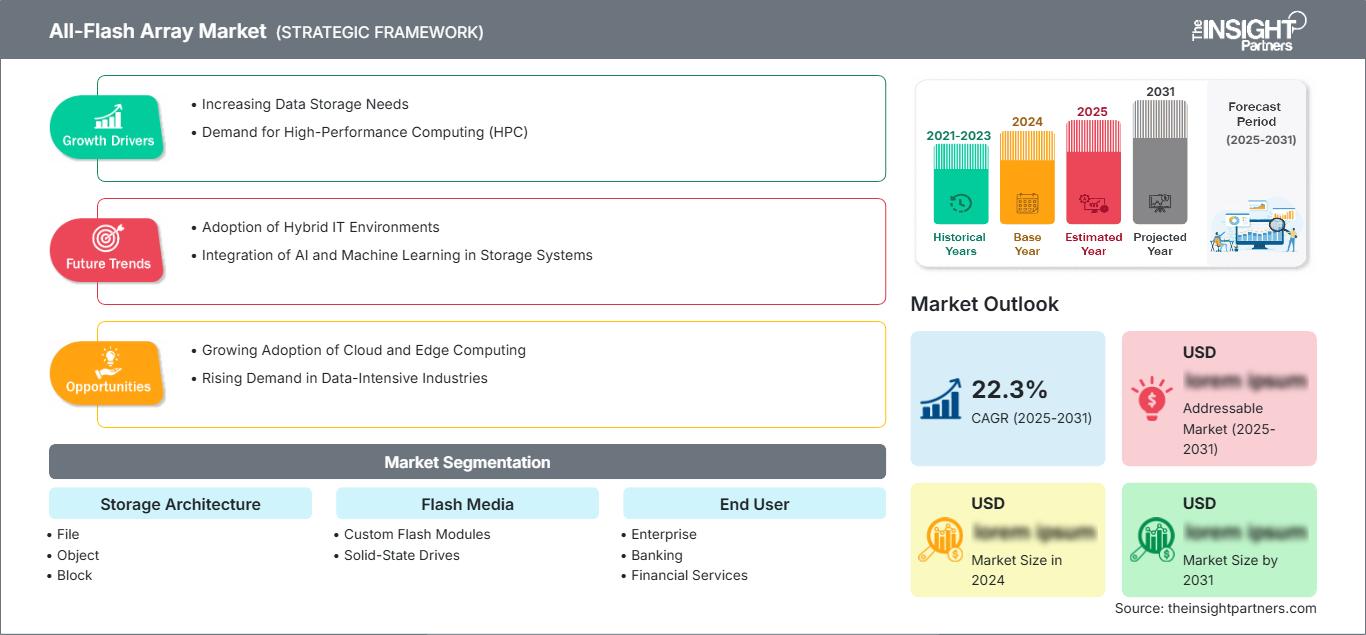
All-Flash Array Market: Strategic Insights
Regional Insights
North America All-Flash Array Market
North America held 36–38% share in 2025 and is expected to expand at 6.4–6.8% CAGR through 2034. Enterprise refresh cycles, AI-ready private cloud, and regulated data loads enable disk and hybrid arrays to be phased out. The United States dominates demand, but Canada gains steam from its financial services and public cloud regions.
Hyperscale and colocation deployments help procurement at the regional level since the operators require dense, energy-efficient, and low-latency environments. North American All-Flash Array Market share is also enabled by channel financing, storage-as-a-service subscriptions, and excellent field engineering support from the vendors in healthcare, banking, government, and media loads.
U.S. All-Flash Array Market
The US represented 78–82% of North America in 2025 and is projected to grow at 6.3–6.7% CAGR between 2026–2034. The demand comes from the hyperscale cloud, large enterprise data centers, BFSI, healthcare, and military-related modernization projects that require quick recovery, encryption, and workload isolation.
Vendor footprint remains considerable, with Dell Inc., Pure Storage, Inc., NetApp, Inc., International Business Machines Corporation, Hewlett Packard Enterprise Development LP, and Western Digital Corporation having a sales, service, engineering, or ecosystem presence. Applications of interest include artificial intelligence inference storage, electronic documents, high-frequency analytics, and media production pipelines with deterministic performance.
Europe All-Flash Array Market
Europe accounted for 25–27% share in 2025 and is forecast to grow at 6.0–6.4% CAGR through 2034. Germany continues to dominate due to industrial automation, SAP landscapes of businesses, and investments in data sovereignty. The UK is contributing with its financial sector, cloud services, and digital government efforts.
France, Italy, and Spain are adding stable modernization demands because of banks, retailers, and healthcare networks working on consolidation under heightened requirements for resilience and privacy. Buyers in regions assess energy efficiency, local presence, and compliance preparedness collectively. It plays into the hands of providers who offer service-level agreements along with cybersecurity and hybrid clouds.
APAC All-Flash Array Market
APAC held 23–25% share in 2025 and is expected to grow at 7.5–8.0% CAGR between 2026–2034. China leads, backed by cloud infrastructure, digital government, and enterprise modernization in its own nation. Japan and South Korea contribute via manufacturing and financials.
Data localization, BFSI digitization, and cloud region availability enable India and Australia to scale. Industrial automation, AI workloads, and national data center policies spur flash storage uptake amid increasing limitations on space, energy, and continuity.
Middle East & Africa All-Flash Array Market
The Middle East & Africa is projected to grow at 6.6–7.1% CAGR from 2026–2034. Demand from Saudi Arabia will be driven by smart city, cloud, and government data solutions, whereas the UAE will drive the demand with its expansion of enterprise storage related to financial services, airlines, and digital services.
Demand from South Africa will be driven by banking, telecommunications, and managed services. Demand from the rest of MEA will come from energy firms, infrastructure projects, and data centers where flash improves response time and saves space.
Segmentation Analysis
Storage Architecture
The storage architecture segment is expected to grow at 6.3–6.8% CAGR during 2026–2034 as enterprises align workload performance with file, object, and block access patterns. The All-Flash Array Market scope is expanding as organizations consolidate databases, analytics, virtual machines, and unstructured data into unified platforms without sacrificing governance or recoverability.
- File storage enables better productivity in distributed teams through media, healthcare imaging, engineering documents, and collaboration use cases due to shared access, metadata capabilities, and faster access.
- Object storage is becoming increasingly significant for AI data lakes, backups, and cloud native archives with the need for scalability, policy automation, and cost-effective retention capabilities.
- Block storage still constitutes the biggest storage architecture at 44–46% market share in 2025 due to the need for low-latency and recovery performance for databases, virtualization, ERP, and transactions.
Flash media is projected to grow at 6.8–7.2% CAGR during 2026–2034 as vendors optimize capacity density, endurance, and controller integration. Procurement decisions increasingly compare standard SSD economics with proprietary modules that improve performance, serviceability, and data reduction. Media strategy is becoming central to lifecycle cost, rack density, and workload consolidation.
- Custom Flash Modules held 28–30% market share in 2025 and may grow at 7.4–7.9% CAGR between 2026–2034, supported by optimized endurance and density.
- Solid-State Drives remain widely adopted because standardized form factors, supply availability, and familiar procurement models fit broad enterprise refresh programs and hybrid-cloud storage designs.
End User
The end-user segment is forecast to grow at 6.7–7.1% CAGR from 2026–2034 as flash adoption expands across regulated, cloud, and data-intensive sectors. Buyers increasingly link storage to business continuity, analytics velocity, customer experience, and compliance readiness. Sector-specific workload requirements are shaping product selection, service levels, and deployment models.
- Enterprise buyers need consolidation, virtualization, ERP acceleration, and easier management, which makes flash arrays an important layer for production workloads and private clouds modernization.
- BFSI buyers require low-latency, quick recovery, fraud analysis, and robust transaction processing, which makes performance consistency and cyber-recovery key aspects in their purchases.
- The healthcare industry is driven by electronic health records, image storage, genomics, and clinical analytics, where high availability and data protection become critical aspects.
- Media & Entertainment companies leverage flash arrays for their editing, rendering, delivery, and archival workloads as the demand for high-resolution formats drives higher bandwidth needs.
- Retail customers utilize flash arrays to facilitate their omnichannel transactions, stock analysis, personalization platforms and POS systems that need fast and reliable data access.
- The Government sector relies on flash arrays based on considerations such as sovereignty, security, digital services for citizens and resiliency. Procurement is often linked to modernization projects with lengthy support life-cycles.
- Cloud vendors leverage dense flash arrays for storage, databases, AI applications, and tenant isolation capabilities.
Opportunity Snapshot
| Segment Name | Revenue Contribution | Trend Tag | Adoption Stage |
| Enterprise | High | Private Cloud | Mature |
| Banking, Financial Services, Insurance | High | Cyber Recovery | Mature |
| Healthcare | Medium | Imaging Data | Scaling |
| Media and Entertainment | Medium | 4K Workflow | Scaling |
| Retail | Medium | Omnichannel Data | Scaling |
| Government | Medium | Sovereign Cloud | Scaling |
| Cloud | High | AI Storage | Mature |
| Others | Low | Edge Sites | Emerging |
All-Flash Array Market Growth Drivers and Impact Analysis
AI and Analytics Workloads Raise Storage Performance Requirements
For applications like AI inferencing, real-time analysis, and high-throughput data preparation, storage solutions are needed that can provide constant latency regardless of the combination of read and write workloads. The use of all-flash arrays can enable enterprises to minimize the bottleneck of data movement from compute clusters to data stores, particularly for cases where the application depends on fresh operational data. According to IDC, the revenue of all-flash arrays increased by 17.6% year-over-year in the third quarter of 2025, whereas hybrid flash and disk arrays' revenues decreased, clearly demonstrating a shift towards flash arrays based on workloads.
Enterprise Modernization Favors Dense and Energy-Efficient Arrays
There is a need for data center managers to scale up the workload capacity without scaling up the amount of power consumed, cooling required, and floor space. Flash array technology offers greater capacity density compared to disk-based technology and allows consolidation of various application layers onto a single platform. It is critical to note that the International Energy Agency had noted the increased demand for electricity in data centers, networks, and artificial intelligence infrastructure. Purchase decisions are increasingly being made on the basis of the total cost of ownership, which involves the use of energy, rack density, management, and availability risks.
Cyber Resilience Becomes a Core Storage Buying Criterion
Ransomware, insider threats, and regulatory compliance pressure are driving changes in enterprise requirements for storage infrastructure. Consumers are looking for solutions where immutable backups, fast recovery, anomaly detection, encryption, and air gap recovery are built into primary storage systems. In financial services, government, healthcare, and cloud environments, recovery times are viewed as an operational risk management metric at the executive level rather than an IT capability. This trend is creating increased interest in storage arrays that balance performance and data protection orchestration capabilities.
All-Flash Array Market Future Trends
Unified Data Platforms Across Block, File, and Object
All-Flash Array Market trends point toward platforms that combine block, file, and object services under common policy, security, and observability layers. Fewer silos are needed in organizations as AI, analytics, virtualization, and application modernization rely on common datasets. Arrays that will be used in the future will offer automated tiering, common metadata, API-based provisioning, and common recovery capabilities regardless of where the deployment occurs. This trend should lead to easier operations and governance in a hybrid environment. Those companies that can provide an array of common services without impacting performance will have an advantage in serving their customers.
Consumption-Based Storage Expands Beyond Hyperscale Buyers
Storage subscription and grow-as-you-pay models will definitely find their way further into the mid-market and regulatory enterprise. Customers seek capacity flexibility, lifecycle ease, and service-level predictability without disruptive refresh cycles. Such a development would compel vendors to bundle up hardware, software, maintenance, and telemetry in outcomes-based packages. The adoption of such a model would require transparency, location control of data, and exit options. With storage being linked with application performance promises, business models will tend to favor those suppliers who align capacity with growth and risks.
All-Flash Array Market Opportunities
AI-Ready Storage Refresh in Regulated Enterprises
Regulated enterprises need infrastructure that supports AI experimentation while preserving auditability, privacy, and recovery discipline. Banks, insurers, hospitals, and public agencies can invest in flash platforms that keep sensitive datasets close to governed applications and reduce latency for model inference. The All-Flash Array Market Forecasts indicate opportunity for vendors offering validated reference architectures, secure snapshots, encryption, and policy-driven data mobility. Actionable investment areas include partner-led proofs-of-concept, workload assessment services, and migration tooling that quantifies performance, energy, and resilience gains before large-scale rollout.
Emerging Data-Center Regions Need Dense Primary Storage
As new cloud and colocation centers develop in India, the Gulf, South East Asia, and even some parts of Africa, they are expanding their capacity in the face of restrictions regarding power, cooling, and land. Flash arrays provide an excellent means of ensuring greater workload density as well as ensuring sovereignty of data, financial transformation, and citizen services. Vendors can reach such markets using channels, financing, and partnerships that will ensure compliance with relevant standards. This will require a balance between high performance and lifecycle cost management, especially for regional service providers.
Recent Developments
- April 2026: Lenovo completed the acquisition of Infinidat, bringing the high-end enterprise storage company into Lenovo’s Infrastructure Solutions Group. The acquisition strengthens Lenovo’s enterprise storage portfolio with Infinidat’s advanced storage platforms, supporting AI, analytics, and mission-critical workloads.
- May 2026: Dell Technologies introduced Dell PowerStore Elite, a next-generation storage platform designed for storage modernization and AI-ready data centers. The solution delivers up to 3x performance improvements, higher storage density, non-disruptive upgrades, AI-driven automation, and improved data reduction capabilities for enterprise workloads.
- September 2025: Pure Storage enhanced its FlashArray portfolio with new systems focused on higher performance and storage density, targeting demanding enterprise workloads including AI, analytics, and cloud-scale applications.
Frequently Asked Questions

- Comprehensive Market Sizing and Forecast Analysis
- Detailed Segmentation Analysis
- In-Depth Market Dynamics Assessment
- Regional and Country-Level Insights
- Competitive Landscape and Company Benchmarking
- Strategic Business Intelligence
Recent Reports
Testimonials

The Insight Partners provided valuable market intelligence that supported our global go-to-market strategy. Their team was professional, responsive, and attentive to our feedback, providing thoughtful analysis and helpful methodological clarifications throughout the project.
Junmo Kim Chief Financial Officer (CFO), Enertech Co., Ltd.
The Insight Partners' SCADA System Market report is comprehensive, with valuable insights on current trends and future forecasts. The team was highly professional, responsive, and supportive throughout. We are very satisfied and highly recommend their services.
RAN KEDEM Partner, Reali Technologies LTDs
I requested a report on a very specific software market and the team produced the report in a few days. The information was very relevant and well presented. I then requested some changes and additions to the report. The team was again very responsive and I got the final report in less than a week.
JEAN-HERVE JENN Chairman, Future Analytica
We worked with The Insight Partners for an important market study and forecast. They gave us clear insights into opportunities and risks, which helped shape our plans. Their research was easy to use and based on solid data. It helped us make smart, confident decisions. We highly recommend them.
PIYUSH NAGPAL Sr. Vice President, High Beam Global
The Insight Partners delivered insightful, well-structured market research with strong domain expertise. Their team was professional and responsive throughout. The user-friendly website made accessing industry reports seamless. We highly recommend them for reliable, high-quality research services
YUKIHIKO ADACHI CEO, Deep Blue, LLC.
This is the first time I have purchased a market report from The Insight Partners.While I was unsure at first, I visited their web site and felt more comfortable to take the risk and purchase a market report.I am completely satisfied with the quality of the report and customer service. I had several questions and comments with the initial report, but after a couple of dialogs over email with their analyst I believe I have a report that I can use as input to our strategic planning process.Thank you so much for taking the extra time and making this a positive experience.I will definitely recommend your service to others and you will be my first call when we need further market data.
JOHN SUZUKI President and Chief Executive Officer, Board Director, BK Technologies
I wish to appreciate your support and the professionalism you displayed in the course of attending to my request for information regarding to infectious disease IVD market in Nigeria. I appreciate your patience, your guidance, and the fact that you were willing to offer a discount, which eventually made it possible for us to close a deal. I look forward to engaging The Insight Partners in the future, all thanks to the impression you have created in me as a result of this first encounter.
DR CHIJIOKE ONYIA MANAGING DIRECTOR, PineCrest Healthcare Ltd.Reason to Buy
- Informed Decision-Making
- Understanding Market Dynamics
- Competitive Analysis
- Identifying Emerging Markets
- Customer Insights
- Market Forecasts
- Risk Mitigation
- Boosting Operational Efficiency
- Strategic Planning
- Investment Justification
- Tracking Industry Innovations
- Aligning with Regulatory Trends





 Get Free Sample for