
Ammonium Ion Selective Electrodes Market Trends, Size & Growth by 2034
Coverage: By Type (Liquid Membrane, PVC Membrane); Application (Industrial Use, Laboratory Use, Others) , and Geography (North America, Europe, Asia Pacific, and South and Central America)
- Status : Data Released
- Report Code : TIPRE00017894
- Category : Electronics and Semiconductor
- No. of Pages : 150
- Available Report Formats :


- Last update date : August 25, 2026


2025 Market Size
US$ 209.64 Mn
Base year value
2034 Forecast
US$ 381.77 Mn
Projected by 2034
CAGR 2026-2034
6.89 %
Growth rate
Addressable Market
US$ 2,671.83 Mn
(2026-2034)
The Ammonium Ion Selective Electrodes Market size was recorded at US$ 209.64 million in 2025 and is forecast to grow to reach US$ 381.77 million by 2034, growing at a CAGR of 6.89% through 2026 to 2034. The Market includes electrode systems that are utilized to estimate the concentration of ammonium ions in aqueous solution samples within both the industry and laboratories. This is driven by water quality monitoring, wastewater treatment, analysis, process control, and the advancement of membrane electrodes.
North America continues to be a significant market region owing to the presence of matured wastewater infrastructure, strict discharge monitoring procedures, and adoption of electrochemical instruments in laboratories. The market dynamics include growth due to rising need for fast field testing and process control for efficient operations.
Ammonium Ion Selective Electrodes Market Assessment and Insights
- North America: North America is estimated to account for 31–35% Ammonium Ion Selective Electrodes Market share in 2025 and expand at a 6.5–7.1% CAGR between 2026–2034, supported by mature laboratory infrastructure, wastewater monitoring, and industrial process-control requirements.
- US: The US represents approximately 76–80% of North America’s 2025 market, with growth of 6.4–7.0% CAGR between 2026–2034, reflecting established analytical laboratories and wastewater compliance programs.
- Europe: Europe is estimated at 27–30% share in 2025, growing at 6.7–7.2% CAGR between 2026–2034, with Germany, the UK, France, Italy, and Spain supporting demand through environmental monitoring and wastewater modernization.
- Asia Pacific: Asia Pacific is estimated at 24–28% share in 2025, advancing at 7.2–7.8% CAGR between 2026–2034, led by China, Japan, South Korea, India, and Australia as industrial water monitoring expands.
- Largest Segment: PVC Membrane is estimated to hold 58–62% market share in 2025, with a 6.9–7.4% CAGR during 2026–2034, supported by established membrane manufacturing and broad laboratory applicability.
- High Growth Segment: Laboratory Use is estimated at 57–61% market share in 2025, with a 7.2–7.6% CAGR during 2026–2034, driven by analytical testing, education, environmental laboratories, and quality-control workflows.
- Key companies analyzed in detail: Bante Instruments, Boston Scientific Corporation, Compumedics Limited, CONMED Corporation, GENERAL ELECTRIC, Hach, HORIBA, Natus Medical Incorporated, VectraCor, Vernier.
Source: The Insight Partners' analysis based on proprietary research, government publications, company annual reports, investor presentations, industry databases, and expert interviews.
According to the Ammonium Ion Selective Electrodes Market forecast, the market has moved from traditional ion selective membranes to combination electrodes, solid state, digitization, and portable analysis technology. Key differentiators in the market include membrane longevity, ease of calibration, interference reduction, temperature compensation, service cycles, and connectivity to connected metering devices. Hach, HORIBA, and Vernier illustrate the ways in which ammonium ion detection is now incorporating wider analytical solutions, but PVC membrane technology remains critical due to its known electrochemical behavior and economic viability of the replacement process. Specifications by Vernier, for instance, highlight concentration detection throughout a wide range of aqueous solutions and connectivity with digital interfaces.
The Ammonium Ion Selective Electrodes Market report indicates that in the future, the market will be well-placed to gain from investments in wastewater facility modernization, decentralized analysis, industrial water recycling, and connected laboratory processes. Europe will provide an excellent catalyst to growth based on its revised Urban Wastewater Treatment Directive that went into effect in January 2025. Asia Pacific will represent additional demand driven by increasing industrial capacity and infrastructure, as well as increased measurement requirements.
Ammonium Ion Selective Electrodes Market Report Scope
| Report Attribute | Details |
|---|---|
| Market size in 2025 | US$ 209.64 Million |
| Market Size by 2034 | US$ 381.77 Million |
| Global CAGR (2026 - 2034) | 6.89% |
| Historical Data | 2021-2024 |
| Forecast period | 2026-2034 |
Ammonium Ion Selective Electrodes Market Analysis
The basis of the demand is a need to measure amounts of ammonium in wastewater, environment, industrial liquids, and laboratory solutions without significant sample preparation. The value chain consists of materials for ion-selective membrane, reference system, electrode body, calibration solutions, meter, software, distributors, and technical service. Therefore, manufacturers should compete not only in performance of electrodes but also in their surroundings, with periodic demand for replacement membranes, standards, connectors, and compatible instruments.
The supply is affected by properties of the polymer membrane, stability of reference electrodes, availability of components, need for calibration, and the degree of integration between probes and meters. Robustness and maintenance costs are the priorities for industries, while laboratories pay more attention to repeatability, flexible calibration, and analytical range. Hach integrates ammonium measuring into the process of water quality control, while Vernier integrates ammonium probes into digital educational platforms.
Market competition in Ammonium Ion Selective Electrodes is characterized by differentiation and not concentration on any particular design of the products. Competitors such as Hach and HORIBA can be recognized to occupy niches in monitoring of water quality whereas Bante Instruments and Vernier target portable and laboratory oriented applications. Competitors like Boston Scientific Corporation, Compumedics Limited, CONMED Corporation, GENERAL ELECTRIC, Natus Medical Incorporated, and VectraCor are kept in the competitive set despite the fact that they are involved in different fields from that of ammonium ion selective electrodes.
Increasing investment goes into development of digital measurement, process automation, sensors longevity and less maintenance of the instruments. HORIBA produces HC-200N which is an analyzer combining measurement of ammonia and nitrate in wastewater process control reflecting shift towards multiparameter monitoring rather than measuring concentrations of the compounds. Similarly, Hach is concentrating on less maintenance and consumption of reagents in ammonia analyzer range.
● REPORT CUSTOMIZATION
Tailor This Report To Align With Your Specific Business Requirements
This report can be customized to align precisely with your business objectives, scope, and target markets. Customization options include tailored segmentation, geography, competitive analysis, and strategic insights to support informed decision-making.
Customize This Report →WHAT YOU CAN ADJUST
- ● Segmentations
- ● Geography
- ● Competitive Analysis
- ● Language Preferences
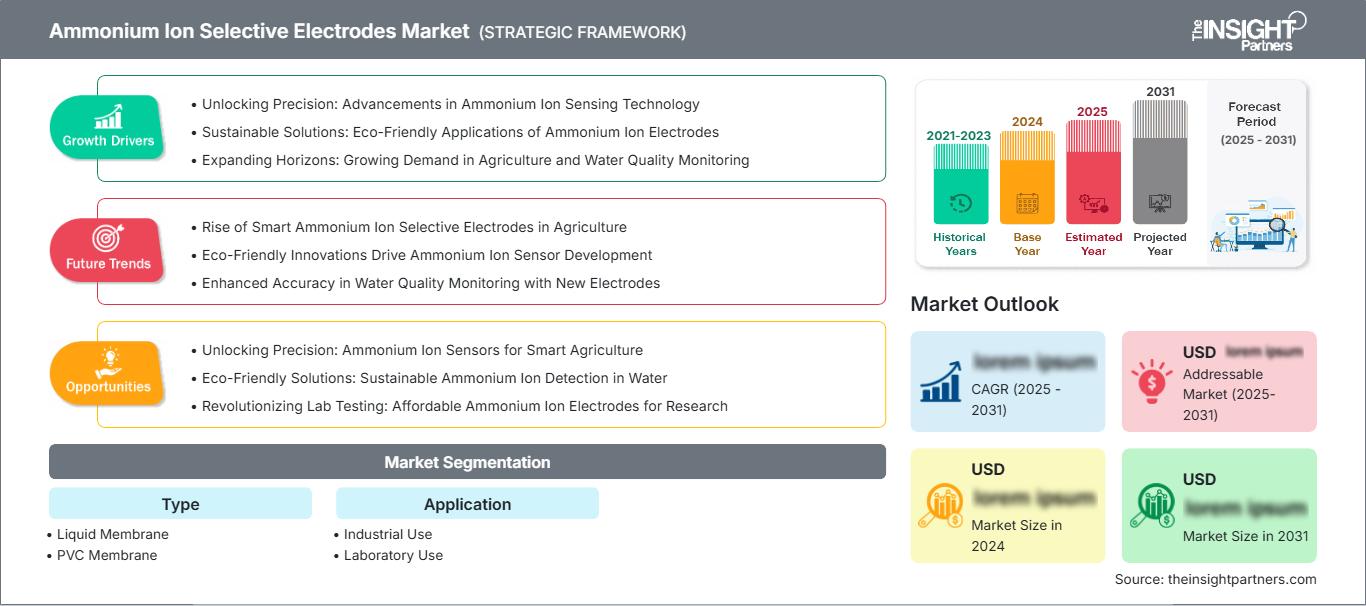
Ammonium Ion Selective Electrodes Market: Strategic Insights
Regional Insights
North America Ammonium Ion Selective Electrodes Market
North America is expected to account for 31-35% of the worldwide Ammonium Ion Selective Electrodes Market in 2025, registering a regional CAGR of 6.5-7.1% until 2034. The region enjoys well-developed infrastructure for wastewater management, numerous analytical laboratories, and environmental monitoring procedures. The growing need for precise nitrogen measuring equipment among industrial establishments to track treatment efficiency and discharges is an important driver for the market. The US is the largest market on a national level, whereas Canada and Mexico contribute due to municipal treatment, environmental laboratories, food industry, and industrial water applications.
The purchasing preferences of the region are moving towards electrodes that are easy to calibrate, have longer periods between recalibrations, possess digital connection abilities and compatibility with multiparameter meters. The market is favored by the presence of analytical equipment vendors and distributers as well. Regulatory monitoring is one of the structural aspects of the Ammonium Ion Selective Electrodes Market since some regulations imply limitations on ammonia-nitrogen concentrations that require regular measurements.
U.S. Ammonium Ion Selective Electrodes Market
North America’s US market is estimated to account for 76-80% of the total market in 2025 and is anticipated to grow with 6.4-7.0% CAGR up until 2034. Demand in the US will be driven by the municipal wastewater sector, industrial wastewater treatment, environment testing labs, educational institutions, and quality control labs. Growing applications are seen in areas that require fast measurement of concentrations where the operator does not want to depend on central analytical test alone. Availability of Hach and Vernier in the market will help in sales of the products.
Also, demand for the product in the US will be driven by the requirement of documentation of the wastewater treatment performance and treatment process involving nitrogen. Portable and bench analyzers will be used in laboratories whereas process analyzers will be required for continuous measurement. The market has potential for growth from decentralized testing because small size electrodes can facilitate sampling in different plants. Digital interfaces, standard calibration procedure, and disposable sensors will affect purchase decisions.
Europe Ammonium Ion Selective Electrodes Market
The Europe market is projected to command a 27-30% share in 2025 and grow at a CAGR of 6.7-7.2% during 2025-2034. In the European region, Germany is expected to lead, followed by the UK, France, Italy, and Spain. The updated European wastewater strategy increases the demand for nutrient removal and monitoring, offering a positive structural framework for analytical instruments.
Germany is one of the countries that provides a strong combination of advanced water treatment processes, laboratories, and engineering services, driving the demand for reliable electrochemical instruments. The UK continues to have a strong presence of laboratories and utility tests, while in France, demand arises due to investments in municipal wastewater and environmental monitoring activities. Italy and Spain provide demand because of industrial water, food processing, agricultural monitoring, and municipal wastewater upgrading.
APAC Ammonium Ion Selective Electrodes Market
It is estimated that the APAC market will take up 24–28% share in 2025 and is forecast to be growing at a 7.2–7.8% CAGR from 2025 to 2034. China ranks first, followed by Japan, South Korea, India, and Australia. Development of industries, investments in wastewater treatment, regulations, and programs for water recycling are key factors driving demand. Japan brings its advanced analytical solutions, while China and India drive growth through scale, as well as industrial and municipal wastewater treatment.
Continuous monitoring and decentralization of measurements are also trends in the region. The semiconductor, chemical, pharmaceutical, food production, and power plants are seeking for better monitoring of process water and wastewater treatment. It is demonstrated by Horiba’s solution in the area of water-quality instruments, where ammonia and nitrate measurements have been integrated into water treatment solutions. This type of solution helps to combine nitrogen measurements with aeration and chemical dosage, thus increasing the value of sensing equipment.
Middle East & Africa Ammonium Ion Selective Electrodes Market
Middle East & Africa is expected to record a moderate growth trajectory, with a projected 5.8–6.6% CAGR through 2034. Saudi Arabia and the UAE lead regional investment, while South Africa remains important for municipal, mining, industrial, and laboratory applications. Water scarcity encourages treatment efficiency and reuse, increasing the strategic importance of reliable water-quality measurement.
Saudi Arabia and the UAE are investing in desalination, wastewater reuse, industrial infrastructure, and resource-efficient water management. South Africa contributes demand through mining, municipal treatment, and environmental laboratories. The Rest of MEA remains more fragmented, with procurement shaped by infrastructure availability and technical-service capacity. Growth is therefore expected to favor suppliers able to provide durable products, straightforward calibration, regional distribution, and service support in challenging operating environments.
Segmentation Analysis
Type
Type determines membrane chemistry, selectivity, mechanical construction, maintenance requirements, and compatibility with measurement systems. PVC membranes remain widely applicable because they provide established ion-selective behavior and flexible product configurations. Liquid membrane systems continue to serve applications requiring established analytical performance and controlled laboratory conditions. The Type segment is expected to develop at a 6.7–7.3% CAGR during 2026–2034 as manufacturers focus on stability, usability, and lifecycle performance.
- Liquid Membrane: Liquid membrane electrodes remain important where controlled laboratory conditions, established response characteristics, and analytical flexibility are prioritized. Their strategic value is strongest in applications requiring specialized membrane chemistry and controlled measurement procedures.
- PVC Membrane: PVC membrane electrodes support broad adoption through established manufacturing practices, replaceable configurations, and compatibility with portable and benchtop instrumentation. Demand is reinforced by laboratory testing and routine aqueous-sample analysis.
Application
Application shapes purchasing priorities because industrial users typically require durability, process compatibility, and reduced maintenance, whereas laboratory users emphasize repeatability, calibration control, and measurement flexibility. Laboratory Use is expected to expand at a 7.2–7.6% CAGR during 2026–2034, supported by environmental testing, research, education, and quality-control activities.
- Industrial Use: Industrial users value robust electrode construction, stable readings, simplified maintenance, and integration with process meters. Wastewater, chemical processing, food production, and utility applications create recurring requirements for dependable ammonium concentration measurements.
- Laboratory Use: Laboratory users require reproducible measurements, controlled calibration, broad sample compatibility, and convenient data handling. Environmental laboratories, academic institutions, research facilities, and quality-control departments provide diverse demand across routine and specialized testing.
Opportunity Snapshot
| Application | Revenue Contribution (High/Medium/Low) | Trend Tag (MAX 2 words) | Adoption Stage (Emerging/Scaling/Mature) |
| Industrial Use | Medium | Process Monitoring | Scaling |
| Laboratory Use | High | Digital Testing | Mature |
Ammonium Ion Selective Electrodes Market Growth Drivers and Impact Analysis
Stricter Nutrient Monitoring Requirements
Nitrogen pollution has become a focal point in terms of regulation, and this trend is raising the monetary value of measurement systems that can give timely ammonium data. The amended European framework on wastewater management has raised the bar regarding nutrient removal, whereas worldwide efforts related to SDG 6 keep stressing the importance of better wastewater treatment and monitoring of water quality. UN Water pointed out that only 27% of industrial wastewater is treated properly in reporting countries which represent 8% of the world’s population, indicating the scope of monitoring problems. This kind of market environment allows for growing demands from wastewater treatment plant operators who require timely biological process and discharge monitoring.
Expansion of Water Reuse and Treatment Optimization
Water scarcity and industrial resource-efficiency objectives are encouraging operators to improve treatment performance and increase reuse. Ammonium concentration is an important process indicator because biological nitrogen removal depends on controlled conversion between nitrogen species. Thus, real-time or fast measurements can help decision-making related to aeration, chemical additions, and stage efficiency in the treatment process. This direction is represented by the HORIBA's HC-200N, which integrates measurements of ammonia and nitrates for control of the wastewater process, whose goal is stated as optimization of aeration and chemical addition. Commercially, this Ammonium Ion Selective Electrodes Market trend means moving away from independent laboratory tests to monitoring solutions. Manufacturers who combine electrodes with multiparameter instruments, automated maintenance, diagnostics, and digital logging can cover more of the plant budget and generate better repeat business.
Growth of Decentralized Analytical Testing
Testing of environmental parameters is becoming increasingly decentralized as it is conducted in various treatment plants, industries, field labs, universities, and quality control labs. The advantage of decentralization in testing lies in the reduction in the delay between sample collection and action on the results, especially when there are many samples or samples are scattered over wide areas. The architecture of the product, which includes the development of combination electrodes, wireless interface capability, and modular sensors, reduces the barriers to adoption. For instance, Vernier has ammonium electrodes with digital communication capability and concentration range for aqueous analysis. They are available in Vernier's Go Direct series that allows wireless or USB connectivity. This driver helps expand the pool of potential customers beyond centralized labs.
Ammonium Ion Selective Electrodes Market Future Trends
Connected Electrodes and Automated Data Workflows
The next stage of development will emphasize connectivity between electrodes, meters, laboratory software, and plant information systems. Wireless communication can reduce manual transcription and allow concentration measurements to move directly into digital records. Future products are likely to incorporate automated calibration prompts, stability checks, temperature compensation, electrode-health diagnostics, and cloud-compatible data export. These capabilities will be especially relevant where laboratories manage large sample volumes or treatment facilities require continuous documentation. Vernier’s expansion of remote data logging across selected Go Direct sensors illustrates the broader movement toward connected measurement workflows. For ammonium sensing, connectivity can increase the value of each measurement by linking concentration data with sampling time, location, operator identity, and process conditions, supporting more consistent analytical decisions.
Multi-Parameter Nitrogen Monitoring
Future systems are expected to move beyond isolated ammonium measurement toward coordinated monitoring of ammonia, ammonium, nitrate, pH, temperature, and related water-quality parameters. This shift reflects the operational reality of biological wastewater treatment, where nitrogen species change through nitrification and denitrification. Combined sensing can help operators understand process transitions rather than interpreting one concentration value in isolation. HORIBA’s introduction of an ammonia and nitrate nitrogen meter demonstrates this product direction, particularly for facilities seeking to optimize aeration and reduce operating costs. The trend should encourage investment in durable sensing assemblies, automated cleaning, diagnostic algorithms, and software capable of presenting multiple parameters within one workflow. Suppliers that develop integrated architectures can improve instrument utility and strengthen differentiation.
Ammonium Ion Selective Electrodes Market Opportunities
Industrial Wastewater Monitoring Expansion
Industrial wastewater represents an attractive opportunity because treatment requirements vary substantially across chemical, food, pharmaceutical, semiconductor, mining, and utility operations. Suppliers can develop application-specific electrode configurations for difficult matrices, high ionic strength samples, temperature variation, and frequent cleaning cycles. Opportunity is strongest where customers need quicker decisions than centralized laboratory testing can provide. Product bundles combining electrodes, meters, calibration standards, sample-conditioning accessories, and service contracts can address the full measurement workflow. Emerging industrial projects in Asia, the Middle East, and other water-stressed regions can create additional demand as operators prioritize reuse and tighter process control. Strategic partnerships with engineering contractors and treatment-system integrators could provide access to new installations while reducing customer acquisition costs. Local service capabilities would further improve adoption in markets where technical support is a purchasing criterion.
Laboratory Digitization and Portable Testing
Laboratory digitization creates an opportunity to reposition ammonium measurement as part of an integrated analytical workflow rather than an isolated electrode purchase. Suppliers can differentiate through wireless communication, instrument compatibility, automated calibration records, electronic quality-control documentation, and software interfaces. Portable systems also provide opportunities in environmental field testing, education, agricultural research, and decentralized water analysis. Vernier’s Go Direct ammonium product demonstrates how wireless connectivity can be incorporated into electrode measurement, while Hach and HORIBA illustrate opportunities for professional water-quality applications. Vendors can further expand revenue by supplying replacement modules, standards, membrane components, and service programs. Such recurring elements can improve customer retention while giving laboratories a predictable pathway for upgrading from conventional bench testing to digitally connected measurement.
Recent Developments
- April 2026: Amogy Inc. signed a joint venture agreement with GS Engineering & Construction to develop ammonia-based distributed power generation. The partnership combines Amogy’s ammonia-cracking technology with GS E&C’s EPC capabilities, building on a project in Pohang, South Korea, targeting up to 40 MW of ammonia-based power generation at the Yeongilman Industrial Complex. The initiative supports the commercialization of carbon-free distributed power solutions for industrial applications.
- March 2026: Reliance Industries Limited signed a US$3 billion green ammonia supply agreement with Samsung C&T Corporation. Under the 15-year agreement, Reliance will supply green ammonia beginning in the second half of fiscal year 2029. The deal supports expansion of Reliance’s new energy platform and aligns with India’s National Green Hydrogen Mission, which targets 5 million tonnes of green hydrogen production by 2030.
- April 2026: Amogy Inc. expanded its ammonia-to-power strategy through a joint venture with South Korean EPC company GS Engineering & Construction. The collaboration is intended to commercialize scalable distributed power systems using ammonia cracking to produce hydrogen for electricity generation, with the Pohang project serving as an initial platform for subsequent commercialization and international expansion.
Frequently Asked Questions

- Comprehensive Market Sizing and Forecast Analysis
- Detailed Segmentation Analysis
- In-Depth Market Dynamics Assessment
- Regional and Country-Level Insights
- Competitive Landscape and Company Benchmarking
- Strategic Business Intelligence
Recent Reports
Testimonials

The Insight Partners provided valuable market intelligence that supported our global go-to-market strategy. Their team was professional, responsive, and attentive to our feedback, providing thoughtful analysis and helpful methodological clarifications throughout the project.
Junmo Kim Chief Financial Officer (CFO), Enertech Co., Ltd.
The Insight Partners' SCADA System Market report is comprehensive, with valuable insights on current trends and future forecasts. The team was highly professional, responsive, and supportive throughout. We are very satisfied and highly recommend their services.
RAN KEDEM Partner, Reali Technologies LTDs
I requested a report on a very specific software market and the team produced the report in a few days. The information was very relevant and well presented. I then requested some changes and additions to the report. The team was again very responsive and I got the final report in less than a week.
JEAN-HERVE JENN Chairman, Future Analytica
We worked with The Insight Partners for an important market study and forecast. They gave us clear insights into opportunities and risks, which helped shape our plans. Their research was easy to use and based on solid data. It helped us make smart, confident decisions. We highly recommend them.
PIYUSH NAGPAL Sr. Vice President, High Beam Global
The Insight Partners delivered insightful, well-structured market research with strong domain expertise. Their team was professional and responsive throughout. The user-friendly website made accessing industry reports seamless. We highly recommend them for reliable, high-quality research services
YUKIHIKO ADACHI CEO, Deep Blue, LLC.
This is the first time I have purchased a market report from The Insight Partners.While I was unsure at first, I visited their web site and felt more comfortable to take the risk and purchase a market report.I am completely satisfied with the quality of the report and customer service. I had several questions and comments with the initial report, but after a couple of dialogs over email with their analyst I believe I have a report that I can use as input to our strategic planning process.Thank you so much for taking the extra time and making this a positive experience.I will definitely recommend your service to others and you will be my first call when we need further market data.
JOHN SUZUKI President and Chief Executive Officer, Board Director, BK Technologies
I wish to appreciate your support and the professionalism you displayed in the course of attending to my request for information regarding to infectious disease IVD market in Nigeria. I appreciate your patience, your guidance, and the fact that you were willing to offer a discount, which eventually made it possible for us to close a deal. I look forward to engaging The Insight Partners in the future, all thanks to the impression you have created in me as a result of this first encounter.
DR CHIJIOKE ONYIA MANAGING DIRECTOR, PineCrest Healthcare Ltd.Reason to Buy
- Informed Decision-Making
- Understanding Market Dynamics
- Competitive Analysis
- Identifying Emerging Markets
- Customer Insights
- Market Forecasts
- Risk Mitigation
- Boosting Operational Efficiency
- Strategic Planning
- Investment Justification
- Tracking Industry Innovations
- Aligning with Regulatory Trends





 Get Free Sample for