
Antibody Drug Conjugate Drug Market Growth, Share & Trends by 2034
Coverage: By Product (Adcertis, Kadcyla); Technology (ImmunoGen technology, Seattle Genetics technology, Immunomedics technology); End User (Hospitals, Specialized Cancer Centers, Academic Research Institutes, Biotechnology Companies, Biopharmaceutical Companies, Others) , and Geography (North America, Europe, Asia Pacific, and South and Central America)
- Status : Data Released
- Report Code : TIPRE00016840
- Category : Life Sciences
- No. of Pages : 150
- Available Report Formats :


- Last update date : August 24, 2026


2025 Market Size
US$ 14.57 Bn
Base year value
2034 Forecast
US$ 33.59 Bn
Projected by 2034
CAGR 2026-2034
9.72 %
Growth rate
Addressable Market
US$ 214.54 Bn
(2026-2034)
The antibody drug conjugate drug market is entering a period of sustained expansion, reaching US$ 14.57 Billion in 2025 and projected to attain US$ 33.59 Billion by 2034, representing a CAGR of 9.72% during 2026–2034. Expansion is supported by broader clinical adoption of targeted oncology therapies, increasing availability of approved antibody-drug conjugates, and continued investment in antibody engineering, linker chemistry, payload selection, and manufacturing capabilities.
North America remains structurally attractive because of its concentration of oncology research, biologics manufacturing, specialist cancer centers, and regulatory expertise. The antibody drug conjugate drug market size is supported by clinical trial density, reimbursement infrastructure, and commercial uptake of targeted therapies. A modeled regional CAGR of 9.0–9.8% through 2034 is supported by pipeline maturation and expansion into additional solid-tumor indications.
Antibody Drug Conjugate Drug Market Assessment and Insights
- North America: North America is expected to represent a 38–42% share in 2025, growing at a 9.0–9.8% CAGR between 2026–2034, supported by established oncology infrastructure, ADC clinical development, specialist treatment centers, and strong biopharmaceutical investment.
- US: The US is expected to account for 82–86% of North America's 2025 share, with a 9.1–9.9% CAGR during 2026–2034, reflecting regulatory approvals, oncology innovation, and extensive commercial adoption.
- Europe: Europe is projected to hold a 25–29% share in 2025 and expand at a 8.6–9.4% CAGR during 2026–2034, led by Germany, the UK, France, Italy, and Spain through specialist oncology networks and biopharmaceutical research.
- Asia Pacific: Asia Pacific is estimated at a 21–25% share in 2025, advancing at a 10.0–11.0% CAGR during 2026–2034, with China, Japan, South Korea, and Australia benefiting from expanding oncology pipelines and manufacturing.
- Largest Segment: The Kadcyla product segment is modeled at a 24–28% market share in 2025, with a 7.5–8.5% CAGR during 2026–2034, supported by established HER2-positive breast cancer use.
- High Growth Segment: The Specialized Cancer Centers segment is modeled at a 29–33% market share in 2025, with a 10.2–11.0% CAGR during 2026–2034, reflecting concentrated ADC administration and multidisciplinary oncology care.
- Key companies analyzed in detail: Genentech USA, Inc.; Seagen Inc., a Pfizer company; F. Hoffmann-La Roche Ltd.; Takeda Pharmaceuticals; Pfizer Inc.; AbbVie Inc.; Gilead Sciences, Inc.; ImmunoGen Inc.; Lonza; Creative Biolabs.
Source: The Insight Partners' analysis based on proprietary research, government publications, company annual reports, investor presentations, industry databases, and expert interviews.
The process of product development has moved from traditional cytotoxic payload combinations to include engineered antibodies, ratio optimization for drugs to antibodies, cleavable and non-cleavable linkers, and differentiated payload mechanisms. This has caused manufacturing to move into a more specialized area, involving the manufacture of antibodies, working with highly potent payloads, conjugation, analytics, and aseptic fill and finish. This trend has increased the importance of specialized development and manufacturing partners.
In the future, there is expected to be growth in geographical areas because of the rise in ADC development in China, Japan, South Korea, and certain markets in Europe. There will also be clear development pathways in place for ADCs because of regulatory experience with new conjugates. Investment will go towards different payload classes, solid-tumor targets, and combinations of ADCs with immuno-oncology treatments.
Antibody Drug Conjugate Drug Market Report Scope
| Report Attribute | Details |
|---|---|
| Market size in 2025 | US$ 14.57 Billion |
| Market Size by 2034 | US$ 33.59 Billion |
| Global CAGR (2026 - 2034) | 9.72% |
| Historical Data | 2021-2024 |
| Forecast period | 2026-2034 |
Antibody Drug Conjugate Drug Market Analysis
The antibody drug conjugate drug market development is driven by the combination of precision medicine in oncology and targeted cytotoxic delivery. The supply chain starts from target identification and selection of antibodies, then linker and payload design, conjugation, characterization, development, regulatory and manufacturing stages. On the demand side, more emphasis is put on the population defined by biomarkers, therapy line extension, and clinical proof of survival benefit.
Supply-side dynamics will still remain challenging due to the fact that ADC production involves both biologics and potent small molecule manufacturing. This is why contract development and manufacturing companies play an important role for payload production, linkers chemistry, conjugation, analytical testing and fill-finish services. It is important to think about capacity in order to be ready for the fast scale-up of late stage products in case of their approval.
The antibody drug conjugate drug market report suggests a competition pattern with existing oncology product platforms and technology companies. Genentech USA, Inc. and F. Hoffmann-La Roche Ltd. have existing expertise in HER2 targeting, whereas Seagen has been adding ADCs to the product portfolio of Pfizer Inc. Takeda Pharmaceuticals has unique oncology assets, while AbbVie Inc. has developed more extensive ADC capabilities in targeted oncology. Gilead Sciences, Inc. remains strategically significant by the Immunomedics portfolio.
Technology differentiation becomes a key factor for investments. ImmunoGen Inc. brings existing experience in ADC development, Lonza develops ADCs and manufactures them, and Creative Biolabs is an advanced research company that offers R&D services in ADCs. Competitive positions now rely upon the choice of targets, novel payloads, stability of linkers, therapeutic index, manufacturing scalability, and generation of combination data.
● REPORT CUSTOMIZATION
Tailor This Report To Align With Your Specific Business Requirements
This report can be customized to align precisely with your business objectives, scope, and target markets. Customization options include tailored segmentation, geography, competitive analysis, and strategic insights to support informed decision-making.
Customize This Report →WHAT YOU CAN ADJUST
- ● Segmentations
- ● Geography
- ● Competitive Analysis
- ● Language Preferences
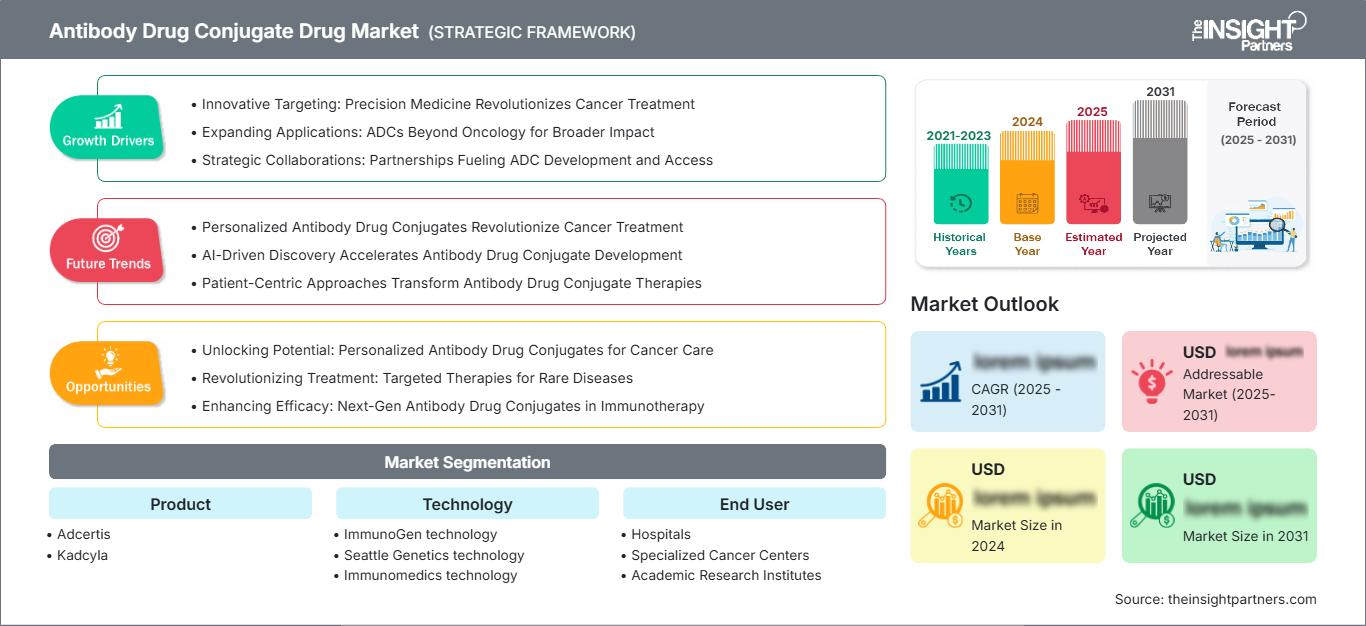
Antibody Drug Conjugate Drug Market: Strategic Insights
Regional Insights
North America antibody drug conjugate drug market
The region of North America is forecast to be represented at a 38%–42% of the antibody drug conjugate drug market share in 2025, with a CAGR of 9.0%–9.8% up until 2034. The US dominates the regional sector owing to the prevalence of oncology research clusters, biologics production facilities, cancer treatment centers and a developed regulation process. Canada adds its value by way of oncology research and specialized clinical facilities despite a less commercialized market.
This region has a number of positive factors, including the widespread use of ADCs in breast cancers, hematological malignancies, urothelial cancer and new indications in solid tumors. Specialty hospitals start using ADC therapy within multidisciplinary cancer care, while large pharma companies continue to develop new generation payloads and combinations. Venture activity and licenses further help in the technology transfer from biotech companies to pharmaceutical corporations.
U.S. antibody drug conjugate drug Market
The US represents 82–86% of North America's 2025 share and is projected to expand at a 9.1–9.9% CAGR. Its leadership reflects rapid regulatory decisions, extensive clinical trial infrastructure, and broad availability of specialized oncology services. Major companies including Genentech USA, Inc., Pfizer Inc., Takeda Pharmaceuticals, and AbbVie Inc. maintain significant oncology development or commercial capabilities.
The application patterns are now shifting from those targeting the well-known HER2 biomarker to those such as TROP2 and BCMA. The FDA activities show how the field has expanded in terms of therapy, which includes the approval of datopotamab deruxtecan in January 2025 for the treatment of patients who have undergone therapy for HR-positive, HER2-negative metastatic breast cancer.
Europe antibody drug conjugate drug Market
The region represents a 25-29% share in 2025 with a CAGR of 8.6-9.4%, positioning Europe as the second biggest regional market. The biggest national market is Germany, fueled by specialized cancer hospitals and robust pharmaceutical industry infrastructure. The UK is significant in clinical trials and HTA processes.
Germany is known to have a robust oncology treatment facility, along with a highly developed pharmaceutical industry and academia. The UK has specialized cancer research facilities and expertise in conducting clinical trials; however, the reimbursement policy could affect the uptake time. Other countries, such as France, Italy, and Spain, would be additional sources of demand owing to their oncology care system and increased usage of targeted therapies.
APAC antibody drug conjugate drug Market
The APAC region is forecasted to contribute 21–25% in 2025 and grow at a CAGR of 10.0–11.0%. The major contributors in the region include China, followed by Japan and South Korea. Meanwhile, India and Australia contribute to regional growth in their ways.
Specifically, China is important because of the growth of domestic investment in biopharma and ADCs. Japan relies on its pharmaceutical industry. South Korea is growing its biologics manufacturing. India is growing its oncology patients as well as its manufacturing capabilities, while Australia brings clinical research. Growth is driven by the policy supporting biotech and localization of manufacturing, as well as better access to cancer therapies.
Middle East & Africa antibody drug conjugate drug Market
Middle East and Africa antibody drug conjugate drug market represent a smaller but expanding opportunity, with Saudi Arabia and the UAE leading Gulf activity and South Africa serving as an important African oncology market. Regional growth is supported by healthcare infrastructure investment, specialist hospitals, and increasing oncology service capacity.
The Kingdom of Saudi Arabia is benefiting from health care transformation programs as well as from the development of tertiary care facilities, while the United Arab Emirates has been increasing its strength in specialized cancer care services. South Africa continues to be a clinical referral hub in the region. In RoMEA, affordability and availability of specialists restricts access to target oncology products.
Segmentation Analysis
Product
The Product segment is expected to expand at a 8.2–9.0% CAGR during 2026–2034. Product performance is influenced by established commercial franchises, label expansion, clinical durability, and physician familiarity. Adcertis and Kadcyla provide important reference points for evaluating mature ADC commercialization, while newer products are increasingly competing through differentiated targets, payloads, and treatment combinations.
- Adcertis: Adcertis, commercially associated with brentuximab vedotin, maintains strategic relevance in hematologic oncology. Its established clinical positioning demonstrates how validated antigen targeting can support durable ADC utilization across defined treatment pathways.
- Kadcyla: Kadcyla represents a mature HER2-directed ADC franchise with extensive clinical experience. Its strategic importance derives from established physician familiarity, treatment sequencing, and continued relevance within HER2-positive breast cancer management.
Technology
The Technology segment is modeled to grow at a 9.4–10.2% CAGR during 2026–2034. Technology differentiation increasingly centers on payload potency, linker behavior, conjugation precision, therapeutic index, and manufacturability. Established technology platforms remain commercially relevant while newer approaches seek to improve tumor penetration, bystander effects, resistance management, and tolerability.
- ImmunoGen technology: ImmunoGen technology is strategically associated with payload and linker innovation. Its historical contribution demonstrates the importance of combining potent cytotoxic agents with controlled intracellular release to achieve targeted therapeutic activity.
- Seattle Genetics technology: Seattle Genetics technology is associated with targeted conjugation and validated oncology development. Its influence remains visible through ADC approaches using defined antibody targeting, linker chemistry, and potent cytotoxic payload delivery.
- Immunomedics technology: Immunomedics technology is linked with TROP2-directed ADC development and illustrates the commercial potential of expanding target classes beyond traditional HER2 and hematologic applications into major solid-tumor populations.
End User
The End User segment in the antibody drug conjugate drug market is projected to grow at a 9.6–10.5% CAGR during 2026–2034. Utilization is increasingly concentrated in facilities capable of biomarker testing, infusion management, toxicity monitoring, and multidisciplinary cancer care. Specialized institutions are positioned to adopt complex ADC regimens more rapidly because they combine oncology expertise with clinical trial participation and advanced supportive services.
- Hospitals: Hospitals remain essential delivery points because they provide infusion facilities, oncology pharmacy services, laboratory monitoring, and multidisciplinary management required for complex targeted cancer treatments.
- Specialized Cancer Centers: Specialized Cancer Centers are strategically important because concentrated oncology expertise enables biomarker-led treatment selection, adverse-event management, clinical trial participation, and rapid adoption of newly approved ADC regimens.
- Academic Research Institutes: Academic Research Institutes contribute through investigator-led trials, translational research, biomarker discovery, and early evaluation of novel ADC combinations, supporting evidence generation before wider commercial adoption.
- Biotechnology Companies: Biotechnology Companies increasingly use specialized platforms to discover targets, engineer antibodies, and develop differentiated payloads, creating partnership opportunities with larger pharmaceutical organizations possessing regulatory and commercial infrastructure.
- Biopharmaceutical Companies: Biopharmaceutical Companies remain major commercialization and investment drivers because they combine clinical development resources, manufacturing scale, regulatory capabilities, and global market access.
Opportunity Snapshot
| End User | Revenue Contribution (High/Medium/Low) | Trend Tag | Adoption Stage |
|---|---|---|---|
| Hospitals | High | Infusion Networks | Mature |
| Specialized Cancer Centers | High | Precision Oncology | Scaling |
| Academic Research Institutes | Medium | Translational Trials | Scaling |
| Biotechnology Companies | Medium | Payload Innovation | Scaling |
| Biopharmaceutical Companies | High | Portfolio Expansion | Mature |
Antibody Drug Conjugate Drug Market Growth Drivers and Impact Analysis
Expansion of ADC use across solid tumors
The addressable opportunity is expanding as developers move beyond established hematologic and HER2-driven indications into TROP2, HER3, B7-H3, tissue-factor, and other tumor-associated targets. This diversification changes commercial potential because solid tumors represent substantially broader patient populations than many rare hematologic indications. The impact extends across clinical development, companion diagnostics, manufacturing, and oncology treatment infrastructure. New indications also create opportunities for earlier lines of therapy, maintenance strategies, and combination regimens. For manufacturers, broader indications can improve plant utilization and justify investment in dedicated conjugation capacity. For providers, the expansion increases the need for toxicity-management protocols and biomarker testing. Consequently, target diversification is becoming a central determinant of long-term product lifecycle value.
Increasing investment in differentiated payload and linker platforms
Investment is shifting toward ADC architectures designed to overcome limitations associated with payload resistance, narrow therapeutic windows, heterogeneous antigen expression, and insufficient tumor penetration. Novel topoisomerase inhibitors, microtubule inhibitors, DNA-damaging agents, and emerging payload classes are being evaluated alongside improved linker technologies. The commercial effect is significant because successful differentiation can protect products from direct competition even when they address the same antigen. Development organizations are therefore allocating greater resources to platform technologies rather than individual molecules alone. This approach can create multiple clinical candidates from one underlying technology and improve the return on research infrastructure. It also increases demand for specialized analytical characterization and high-potency manufacturing services capable of supporting increasingly complex conjugation processes.
Greater integration of biomarkers into treatment selection
Biomarker-driven oncology is increasingly influencing ADC development because target expression, tumor heterogeneity, prior treatment exposure, and resistance mechanisms can affect therapeutic response. More sophisticated patient-selection strategies can improve trial design and support differentiated positioning where broad antigen expression alone is insufficient. The commercial impact extends to pathology laboratories, diagnostic developers, clinical data platforms, and pharmaceutical companies designing companion or complementary testing strategies. Better patient segmentation can also reduce unnecessary treatment exposure and support clearer evidence for reimbursement discussions. As ADCs enter earlier treatment lines, healthcare systems will increasingly evaluate treatment value through measurable clinical outcomes rather than product novelty alone. This trend favors companies able to connect drug development with translational diagnostics and real-world evidence generation.
Antibody Drug Conjugate Drug Market Future Trends
Next-generation payload classes will reshape ADC differentiation
The antibody drug conjugate drug market trends are moving toward payload diversity as developers seek mechanisms that remain active against tumors resistant to conventional cytotoxic classes. N-myristoyltransferase inhibitors, novel DNA-damaging agents, immune-modulating payloads, and other differentiated mechanisms could broaden the technological base. Future development is likely to emphasize payloads that maintain potency while reducing systemic exposure and improving therapeutic windows. Companies may increasingly build modular platforms in which a single payload can be paired with multiple antibodies and targets. This architecture could accelerate candidate generation and increase the strategic value of technology licensing. Manufacturing organizations will also need flexible containment and conjugation systems capable of handling diverse payload chemistries while maintaining reproducibility across clinical and commercial scales.
ADC combinations will increasingly integrate with immuno-oncology
Combination development is expected to become a major avenue for improving response depth and overcoming acquired resistance. ADCs may increasingly be paired with checkpoint inhibitors, targeted therapies, endocrine agents, or other biologics where complementary mechanisms can produce stronger tumor control. Future trials are likely to become more biomarker-defined, using tumor phenotype, prior treatment history, and resistance signatures to identify patients most likely to benefit. Commercial strategy will also shift toward sequencing rather than evaluating each ADC as an isolated product. Developers with established oncology franchises may have an advantage because they can conduct combination studies using internally controlled treatment backbones. The resulting market could therefore favor companies that integrate ADC development with broader oncology platforms, diagnostics, clinical data, and lifecycle-management capabilities.
Antibody Drug Conjugate Drug Market Opportunities
Build regional ADC manufacturing and development capacity
The antibody drug conjugate drug market Forecasts indicate meaningful opportunities for manufacturers that establish regional capabilities for antibody production, payload synthesis, conjugation, analytical testing, and sterile filling. Asia Pacific is particularly attractive because China, Japan, South Korea, India, and Australia combine expanding oncology demand with growing biopharmaceutical infrastructure. Regional manufacturing can reduce supply-chain complexity, improve responsiveness to clinical programs, and support localization requirements. Contract manufacturers can capture demand by developing flexible ADC suites rather than conventional biologics capacity alone. Investment priorities should include high-potency containment, conjugation process control, analytical comparability, and scalable fill-finish operations. Companies entering this segment can also build strategic relationships with emerging biotechnology sponsors that require specialized manufacturing before they possess internal commercial-scale facilities.
Develop platform partnerships around emerging tumor targets
Target discovery remains a substantial opportunity because many tumor-associated antigens have not yet produced commercially mature ADC franchises. Companies can create value by combining antibody engineering, target validation, payload technology, and translational biomarker expertise rather than pursuing isolated assets. Partnership models can reduce development risk by allowing smaller biotechnology companies to contribute discovery capabilities while larger organizations provide clinical, regulatory, manufacturing, and commercialization resources. Priority areas include heterogeneous solid tumors, resistant disease settings, and targets with differentiated expression profiles. Strategic investors should evaluate platform flexibility, intellectual-property breadth, payload compatibility, and manufacturability alongside clinical evidence. Such criteria can distinguish scalable technologies from single-asset opportunities and improve portfolio resilience as competitive intensity increases.
Recent Developments
- July 2026: Novartis AG agreed to acquire Myricx Bio for US$1.1 billion upfront plus up to US$400 million in potential milestone payments. The transaction adds an N-myristoyltransferase inhibitor ADC payload platform and two lead ADC assets, broadening Novartis' oncology pipeline and targeting potential resistance to established payload classes.
- June 2026: Pfizer Inc. reported Phase 3 results for sigvotatug vedotin, an investigational integrin beta-6-directed ADC, in previously treated metastatic non-squamous NSCLC. The overall study did not achieve statistically significant overall-survival improvement, while a prespecified earlier-line subgroup showed a stronger efficacy trend, providing important evidence for ADC development strategy.
- January 2025: Daiichi Sankyo Company, Limited received US approval for Datroway, a TROP2-directed DXd ADC, for previously treated HR-positive, HER2-negative metastatic breast cancer. The approval was based on TROPION-Breast01, where Datroway reduced the risk of disease progression or death by 37% versus chemotherapy.
Frequently Asked Questions

- Comprehensive Market Sizing and Forecast Analysis
- Detailed Segmentation Analysis
- In-Depth Market Dynamics Assessment
- Regional and Country-Level Insights
- Competitive Landscape and Company Benchmarking
- Strategic Business Intelligence
Recent Reports
Testimonials

The Insight Partners' SCADA System Market report is comprehensive, with valuable insights on current trends and future forecasts. The team was highly professional, responsive, and supportive throughout. We are very satisfied and highly recommend their services.
RAN KEDEM Partner, Reali Technologies LTDs
I requested a report on a very specific software market and the team produced the report in a few days. The information was very relevant and well presented. I then requested some changes and additions to the report. The team was again very responsive and I got the final report in less than a week.
JEAN-HERVE JENN Chairman, Future Analytica
We worked with The Insight Partners for an important market study and forecast. They gave us clear insights into opportunities and risks, which helped shape our plans. Their research was easy to use and based on solid data. It helped us make smart, confident decisions. We highly recommend them.
PIYUSH NAGPAL Sr. Vice President, High Beam Global
The Insight Partners delivered insightful, well-structured market research with strong domain expertise. Their team was professional and responsive throughout. The user-friendly website made accessing industry reports seamless. We highly recommend them for reliable, high-quality research services
YUKIHIKO ADACHI CEO, Deep Blue, LLC.
This is the first time I have purchased a market report from The Insight Partners.While I was unsure at first, I visited their web site and felt more comfortable to take the risk and purchase a market report.I am completely satisfied with the quality of the report and customer service. I had several questions and comments with the initial report, but after a couple of dialogs over email with their analyst I believe I have a report that I can use as input to our strategic planning process.Thank you so much for taking the extra time and making this a positive experience.I will definitely recommend your service to others and you will be my first call when we need further market data.
JOHN SUZUKI President and Chief Executive Officer, Board Director, BK Technologies
I wish to appreciate your support and the professionalism you displayed in the course of attending to my request for information regarding to infectious disease IVD market in Nigeria. I appreciate your patience, your guidance, and the fact that you were willing to offer a discount, which eventually made it possible for us to close a deal. I look forward to engaging The Insight Partners in the future, all thanks to the impression you have created in me as a result of this first encounter.
DR CHIJIOKE ONYIA MANAGING DIRECTOR, PineCrest Healthcare Ltd.Reason to Buy
- Informed Decision-Making
- Understanding Market Dynamics
- Competitive Analysis
- Identifying Emerging Markets
- Customer Insights
- Market Forecasts
- Risk Mitigation
- Boosting Operational Efficiency
- Strategic Planning
- Investment Justification
- Tracking Industry Innovations
- Aligning with Regulatory Trends





 Get Free Sample for