
Antibody Therapy Market Size, Growth & Trends by 2034
Coverage: By Type [Monoclonal Antibody, (Oncology, Autoimmune Disease, Infectious Disease, Others), Antibody Drug Conjugates], and End User (Hospitals, Specialty Centers, Others) and Geography (North America, Europe, Asia Pacific, Middle East & Africa, and South & Central America)
- Status : Data Released
- Report Code : TIPRE00031447
- Category : Life Sciences
- No. of Pages : 150
- Available Report Formats :


- Last update date : August 24, 2026


2025 Market Size
US$ 330.07 Bn
Base year value
2034 Forecast
US$ 965.51 Bn
Projected by 2034
CAGR 2026-2034
12.67 %
Growth rate
Addressable Market
US$ 5,653.20 Bn
(2026-2034)
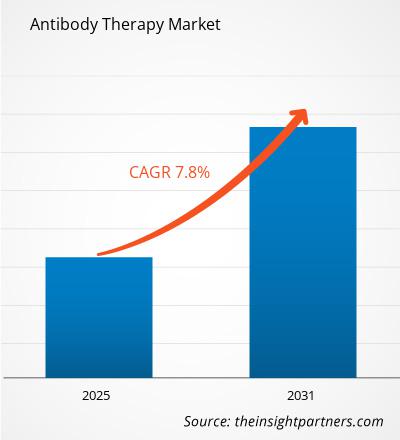
The antibody therapy market is evolving from the widespread range of existing monoclonal antibody treatments to more advanced and precise biologics. The market is worth US$ 330.07 Billion in 2025 and forecasted to grow up to US$ 965.51 Billion by 2034 with a CAGR of 12.67% from 2026 to 2034. Developments in oncology, immunology, hematology, and other treatment fields are boosting demand for antibody-based treatment approaches.
North America will retain its strategic importance owing to the ability to develop biologics, extensive clinical trials infrastructure, high rates of targeted drug adoption, and considerable spending on pharmaceutical R&D. The CAGR of the antibody therapy market size in North America will be estimated at 11.5–13.0% from 2026 to 2034.
Antibody Therapy Market Assessment and Insights
- North America: North America is expected to account for a 38–42% share in 2025, growing at a 11.5–13.0% CAGR between 2026–2034, supported by established biologics manufacturing, clinical trial infrastructure, and strong oncology demand.
- US: The US is estimated to represent 82–86% of North America's 2025 value, with a 11.7–13.2% CAGR during 2026–2034, reflecting extensive therapeutic antibody adoption and pipeline activity.
- Europe: Europe is projected to hold a 25–29% share in 2025 and grow at a 10.8–12.3% CAGR through 2034, led by Germany, the UK, France, Italy, and Spain.
- Asia Pacific: Asia Pacific is estimated at a 20–24% share in 2025, expanding at a 13.5–15.0% CAGR, with China, Japan, South Korea, and India benefiting from expanding biologics capabilities.
- Largest Segment: Monoclonal Antibody is estimated to hold a 91–94% market share in 2025 and expand at a 11.8–13.0% CAGR during 2026–2034, supported by broad clinical use.
- High Growth Segment: Antibody Drug Conjugates are estimated at a 6–9% market share in 2025 and projected to grow at a 15.5–17.5% CAGR through 2034, driven by oncology innovation.
- Key companies analyzed in detail: Merck & Co., Inc.; Eli Lilly and Company; Seagen Inc.; Novartis AG; Takeda Pharmaceutical Company Limited; Bristol-Myers Squibb Company; Johnson & Johnson; AstraZeneca PLC; Regeneron Pharmaceuticals, Inc.; Roche Holding AG.
Source: The Insight Partners' analysis based on proprietary research, government publications, company annual reports, investor presentations, industry databases, and expert interviews.
The antibody therapy market has developed from traditional murine and chimeric antibodies to humanized, human antibodies, bispecific, and antibody drug conjugates. Production processes have been advancing towards high yielding mammalian cell culture, intensified process technologies, advanced purification, and characterization. The changes result in increased consistency while allowing more complex modes of action. Oncology is one of the major routes for commercialization, whereas immunology and hematology expand the therapeutic range.
According to the antibody therapy market report, there will be an increase in investments into precise antibody design, delivery systems, and combinations. The emerging markets become increasingly important because of growing domestic production of biologics and better biosimilar policies leading to affordable price levels. The regulatory agencies also pay much attention to comparability, immunogenicity testing, manufacturing consistency, and patient selection.
Antibody Therapy Market Report Scope
| Report Attribute | Details |
|---|---|
| Market size in 2025 | US$ 330.07 Billion |
| Market Size by 2034 | US$ 965.51 Billion |
| Global CAGR (2026 - 2034) | 12.67% |
| Historical Data | 2021-2024 |
| Forecast period | 2026-2034 |
Antibody Therapy Market Analysis
Antibody drugs are driven by the importance of highly selective biological action, especially in oncology, autoimmunity, and hematology. Antibody therapeutics are now dependent upon the development of validated targets into unique products that demonstrate long-term efficacy, safety, and scalable manufacturing. This industry ecosystem includes discovery platforms, antibody development, cell line development, clinical development, commercial manufacturing, distribution, hospitals, and specialty centers.
The supply of the antibodies is constrained by their complex manufacturing process and controlled biological production. Upstream cell culture, downstream purification, formulation, fill-finish, and cold chain logistics become several quality and cost control points. According to WHO, monoclonal antibodies are an important type of biological medicines, and in its 2025 report on the clinical research, there were 2,066 monoclonal antibody studies carried out in 2014–2023.
Competition is being driven by differences in target validation, antibody format, clinical data, manufacturing, and lifecycle management. Portfolio strength and commercial sustainability will thus be considered for the analysis of the antibody therapy market apart from the number of products. Merck & Co., Inc. and Bristol-Myers Squibb Company hold significant oncology antibody portfolios whereas AstraZeneca PLC, Novartis AG, and Regeneron Pharmaceuticals, Inc. hold differentiated positions in the areas of oncology, immunology, and specialty diseases.
Competitors like Eli Lilly and Company, Takeda Pharmaceutical Company Limited, Johnson & Johnson, Seagen Inc., and Roche Holding AG continue to compete with their advanced targeted biologics, ADCs, and strong development capabilities. Investors are now focusing on platforms that can manufacture various antibody formats from common technologies. Partnerships, licenses, acquisitions, and co-development deals still matter because they lower discovery risks and speed up validation of targets and engineering know-how.
● REPORT CUSTOMIZATION
Tailor This Report To Align With Your Specific Business Requirements
This report can be customized to align precisely with your business objectives, scope, and target markets. Customization options include tailored segmentation, geography, competitive analysis, and strategic insights to support informed decision-making.
Customize This Report →WHAT YOU CAN ADJUST
- ● Segmentations
- ● Geography
- ● Competitive Analysis
- ● Language Preferences
Antibody Therapy Market: Strategic Insights

Regional Insights
North America antibody therapy market
North America is estimated to represent a 38–42% share in 2025 and grow at an 11.5–13.0% CAGR through 2034. The US dominates regional demand because of advanced oncology treatment infrastructure, high biologic utilization, extensive clinical research, and strong pharmaceutical investment. Canada contributes through specialized oncology centers and expanding biologics access.
The region also benefits from integrated biopharmaceutical manufacturing, academic research, and regulatory expertise. The US FDA's evolving approach to development methodologies is increasing attention on human-relevant testing and efficient clinical translation. Demand is particularly strong for monoclonal antibodies and ADCs used in oncology, while immunology applications provide an additional recurring revenue base. The antibody therapy market share is therefore supported by both established products and continued pipeline expansion.
U.S. antibody therapy Market
The US represents an estimated 82–86% share of North America in 2025 and is projected to expand at an 11.7–13.2% CAGR through 2034. High treatment adoption, reimbursement capacity, specialist infrastructure, and a large clinical trial ecosystem underpin regional leadership. Merck & Co., Inc., Eli Lilly and Company, Bristol-Myers Squibb Company, Johnson & Johnson, AstraZeneca PLC, and Regeneron Pharmaceuticals, Inc. maintain significant development or commercialization activities.
Application trends increasingly favor biomarker-defined oncology treatment, antibody combinations, and ADCs. FDA approvals continue to demonstrate expansion of antibody mechanisms across cancer subtypes. In 2025, the agency approved datopotamab deruxtecan, a Trop-2-directed antibody and topoisomerase inhibitor conjugate, for previously treated HR-positive, HER2-negative metastatic breast cancer. Such developments reinforce the importance of targeted patient selection and companion diagnostics.
Europe antibody therapy Market
It is expected that Europe will have an approximate market share of 25–29% in 2025 and a compound annual growth rate (CAGR) between 10.8–12.3% from 2025 to 2034. Germany is likely to be the dominant national market owing to specialized hospitals, biopharmaceutical production, and reimbursement infrastructure, followed by the UK, due to translation research and oncology specialists.
Germany is helped by the existence of major facilities for biopharmaceutical production and clinical research, whereas the UK makes use of academic research combined with specialized treatment facilities and national purchasing of healthcare systems. France has large utilization of biologics in the hospital setting, mainly for oncology and autoimmune diseases. Italy and Spain are increasing the usage of biologics through the development of their specialty treatment facilities and increased biological products.
APAC antibody therapy Market
APAC is estimated to hold a 20–24% share in 2025 and expand at a 13.5–15.0% CAGR through 2034, making it the fastest-growing major region. China is expected to lead, supported by domestic biologics investment, clinical development, and manufacturing expansion.
Japan and South Korea offer established biologics eco-systems, whereas India is building its local manufacturing facilities and biosimilars platform. Australia plays its role by offering R&D and healthcare specialty. Policies and incentives for local manufacturing and growing cancer diagnoses are boosting demand in the region. Antibody-based therapy market in APAC is also benefiting from increased access to biological drugs and treatment centers.
Middle East & Africa antibody therapy Market
Middle East & Africa constitutes a lower share of global demand but presents rising prospects due to investments in healthcare infrastructure. The market is expected to experience a CAGR of 9.5 – 11.0% up to 2034, with Saudi Arabia driving demand and the UAE and South Africa following suit.
Both Saudi Arabia and the UAE will be developing specialized hospitals, cancer centers, and advanced pharmaceutical infrastructure. South Africa offers a strong platform in sub-Saharan Africa, whereas other markets depend on the importation of biologics. Healthcare infrastructure investments in the Middle East and Gulf countries will be funded by energy revenues, allowing for the development of highly specialized biologics.
Segmentation Analysis
Type
Type remains the primary structural division, with Monoclonal Antibody and Antibody Drug Conjugates representing the complete segmentation provided. The segment is projected to expand at a 12.0–13.5% CAGR during 2026–2034. Monoclonal antibodies retain broad therapeutic applicability, while ADCs introduce targeted cytotoxic delivery and increasingly sophisticated oncology applications. Product differentiation is consequently shifting toward target specificity, payload selection, linker stability, and therapeutic index.
- Monoclonal Antibody: Monoclonal antibodies maintain the dominant position because of extensive approvals, established manufacturing platforms, and applications across oncology, immunology, hematology, and infectious diseases. Their mature commercial base supports recurring treatment demand.
- Antibody Drug Conjugates: Antibody drug conjugates combine antigen recognition with targeted payload delivery, increasing strategic relevance in oncology. Demand is supported by advances in linker chemistry, payload potency, biomarker selection, and clinical validation.
End User
End User is segmented into Hospitals and Specialty Centers, with the segment expected to grow at a 12.1–13.4% CAGR during 2026–2034. Administration requirements, treatment complexity, specialist monitoring, and reimbursement structures determine where therapies are delivered. Hospitals retain a broad installed base, while specialty centers are gaining importance for oncology and other treatments requiring dedicated multidisciplinary expertise and infusion infrastructure.
- Hospitals: Hospitals represent a major treatment setting because they provide multidisciplinary care, pharmacy infrastructure, emergency support, laboratory monitoring, and access to complex infusion-based therapies requiring integrated clinical management.
- Specialty Centers: Specialty centers are increasingly important for oncology and hematology therapies, offering disease-specific expertise, streamlined infusion pathways, biomarker testing, and patient monitoring tailored to advanced antibody-based treatment protocols.
Opportunity Snapshot
| Segment Name | Revenue Contribution (High/Medium/Low) | Trend Tag | Adoption Stage |
|---|---|---|---|
| Hospitals | High | Infusion Care | Mature |
| Specialty Centers | Medium | Precision Oncology | Scaling |
Antibody Therapy Market Growth Drivers and Impact Analysis
Expansion of Targeted Oncology Treatment
Cancer continues to be an important driver for antibody development since such treatments could selectively recognize tumor antigens while facilitating differentiated treatment methods. The US FDA has approved a number of antibody-based and ADC products during 2025, which is yet another proof that there is ongoing translation of target-specific approaches into clinics. In December 2025, the FDA approved trastuzumab deruxtecan and pertuzumab for HER2-positive metastatic breast cancer, along with their companion diagnostics, which proves the trend of therapeutic and diagnostic ecosystems’ co-development. However, the impact on the market goes beyond particular products since proven targets trigger further development of additional indications, combination studies, biomarker studies, and manufacturing capacity. Oncology presents great opportunities for creating franchise programs based on validated mechanisms for developers.
Increasing Clinical Validation of Advanced Antibody Formats
The antibody therapy Market trends indicate that the development pipeline is moving beyond conventional monoclonal antibodies toward ADCs, multispecific antibodies, and engineered formats capable of improving target engagement or therapeutic delivery. WHO notes that advances in recombinant biotechnology and protein chemistry have expanded interest in antibody fragments, single-domain antibodies, and multispecific antibodies. This evolution changes competitive requirements because companies increasingly need integrated capabilities spanning molecular engineering, pharmacology, analytics, and manufacturing. Advanced formats can also create opportunities for differentiated intellectual property and lifecycle management. For established manufacturers, platform technologies can support multiple programs using shared development infrastructure. For emerging developers, specialized antibody engineering can provide an entry point into licensing or co-development arrangements without requiring complete commercial manufacturing capabilities.
Broader Access to Biological Medicines and Biosimilars
Healthcare systems are increasingly balancing the clinical value of biological medicines against affordability requirements. WHO reported that its Essential Medicines List contained 81 biologic therapies as of 2023, representing more than 15% of listed essential medicines, while biosimilars of trastuzumab and rituximab have supported broader access in several countries. Although biosimilars can increase competitive pressure on originator products, they can simultaneously expand the overall treated population. This creates a two-sided market effect: established products may experience price erosion, while improved affordability can increase treatment volumes. Manufacturers therefore need differentiated formulations, delivery approaches, indications, and lifecycle strategies to protect value while maintaining access across cost-sensitive healthcare systems.
Antibody Therapy Market Future Trends
Convergence of Antibody Therapy With Personalized Medicine
The next phase of antibody development will increasingly connect treatment selection with molecular profiling, companion diagnostics, and longitudinal patient data. Biomarker-defined populations can improve clinical response rates while reducing exposure to therapies that are unlikely to benefit specific patients. This approach will encourage developers to design therapeutic and diagnostic strategies together rather than treating diagnostics as a downstream requirement. Antibody products may also increasingly incorporate patient-selection algorithms into clinical development, particularly in oncology. Over time, specialty treatment centers could become important nodes for integrated testing, treatment administration, and outcome monitoring. The commercial consequence will be a shift from product-centric competition toward treatment-pathway differentiation, where evidence generation, diagnostic compatibility, and measurable patient outcomes influence adoption.
Next-Generation Payload and Combination Strategies
ADC innovation is expected to move toward more precise payload selection, improved linker stability, optimized drug-to-antibody ratios, and combinations with immunotherapies or other targeted agents. These developments could expand therapeutic windows and create additional opportunities in tumors where conventional treatment approaches provide limited benefit. Combination strategies may also support sequential or perioperative use, broadening the settings in which antibody-based therapies are administered. The competitive landscape will consequently depend on both the antibody component and the performance of associated payload and delivery technologies. Developers with integrated chemistry, biology, clinical, and manufacturing capabilities should be better positioned to manage these increasingly complex products, while smaller companies may pursue partnerships to access specialized technology.
Antibody Therapy Market Opportunities
Regional Manufacturing and Technology Localization
Expanding biologics manufacturing in Asia Pacific creates opportunities for companies to establish regional production, technology-transfer arrangements, and specialized development partnerships. China, India, South Korea, and selected Southeast Asian markets are increasing biopharmaceutical capabilities while seeking greater supply-chain resilience. Localization can reduce dependence on imported products and shorten distribution pathways, particularly where healthcare systems prioritize domestic production. Companies can pursue modular strategies combining regional fill-finish, local clinical development, and centralized high-value manufacturing. Partnerships with domestic pharmaceutical companies may further accelerate market entry. For investors, the opportunity extends beyond manufacturing capacity to process development, analytical testing, cold-chain services, and regulatory support, creating an ecosystem around antibody commercialization rather than relying solely on product sales.
Lifecycle Expansion Through New Indications and Delivery Models
Existing antibody assets offer substantial opportunities for lifecycle management through additional indications, combination regimens, dosing optimization, and alternative administration routes. Developers can use established safety and pharmacology knowledge to explore adjacent patient populations while potentially reducing the time and cost associated with entirely new discovery programs. Subcutaneous formulations, extended dosing intervals, and more convenient treatment settings can improve patient experience and reduce pressure on infusion infrastructure. The antibody therapy market Forecasts therefore increasingly depend on the ability to extract additional value from validated molecules rather than relying exclusively on new molecular entities. Strategic portfolio teams can prioritize indications where unmet need, biomarker clarity, competitive intensity, and reimbursement conditions provide the strongest commercial rationale.
Recent Developments
- July 2026: Merck & Co., Inc. announced Phase 3 KEYNOTE-C93 results showing that KEYTRUDA significantly improved progression-free survival versus platinum doublet chemotherapy in previously untreated patients with dMMR advanced or recurrent endometrial cancer. The development strengthens the evidence base for PD-1 blockade as a monotherapy strategy in a biomarker-defined population.
- June 2026: Merck & Co., Inc. received US FDA approval for KEYTRUDA and KEYTRUDA QLEX in combination with Trodelvy for first-line treatment of PD-L1-positive advanced triple-negative breast cancer. The decision represents an important antibody plus ADC combination strategy and expands the clinical use of targeted immuno-oncology regimens.
- July 2025: Regeneron Pharmaceuticals, Inc. received US FDA accelerated approval for linvoseltamab, a BCMA-directed CD3 T-cell engager, for adults with relapsed or refractory multiple myeloma after at least four prior lines of therapy. The approval illustrates continued expansion of engineered antibody mechanisms into heavily pretreated hematologic cancers.
Frequently Asked Questions

- Comprehensive Market Sizing and Forecast Analysis
- Detailed Segmentation Analysis
- In-Depth Market Dynamics Assessment
- Regional and Country-Level Insights
- Competitive Landscape and Company Benchmarking
- Strategic Business Intelligence
Recent Reports
Testimonials

The Insight Partners' SCADA System Market report is comprehensive, with valuable insights on current trends and future forecasts. The team was highly professional, responsive, and supportive throughout. We are very satisfied and highly recommend their services.
RAN KEDEM Partner, Reali Technologies LTDs
I requested a report on a very specific software market and the team produced the report in a few days. The information was very relevant and well presented. I then requested some changes and additions to the report. The team was again very responsive and I got the final report in less than a week.
JEAN-HERVE JENN Chairman, Future Analytica
We worked with The Insight Partners for an important market study and forecast. They gave us clear insights into opportunities and risks, which helped shape our plans. Their research was easy to use and based on solid data. It helped us make smart, confident decisions. We highly recommend them.
PIYUSH NAGPAL Sr. Vice President, High Beam Global
The Insight Partners delivered insightful, well-structured market research with strong domain expertise. Their team was professional and responsive throughout. The user-friendly website made accessing industry reports seamless. We highly recommend them for reliable, high-quality research services
YUKIHIKO ADACHI CEO, Deep Blue, LLC.
This is the first time I have purchased a market report from The Insight Partners.While I was unsure at first, I visited their web site and felt more comfortable to take the risk and purchase a market report.I am completely satisfied with the quality of the report and customer service. I had several questions and comments with the initial report, but after a couple of dialogs over email with their analyst I believe I have a report that I can use as input to our strategic planning process.Thank you so much for taking the extra time and making this a positive experience.I will definitely recommend your service to others and you will be my first call when we need further market data.
JOHN SUZUKI President and Chief Executive Officer, Board Director, BK Technologies
I wish to appreciate your support and the professionalism you displayed in the course of attending to my request for information regarding to infectious disease IVD market in Nigeria. I appreciate your patience, your guidance, and the fact that you were willing to offer a discount, which eventually made it possible for us to close a deal. I look forward to engaging The Insight Partners in the future, all thanks to the impression you have created in me as a result of this first encounter.
DR CHIJIOKE ONYIA MANAGING DIRECTOR, PineCrest Healthcare Ltd.Reason to Buy
- Informed Decision-Making
- Understanding Market Dynamics
- Competitive Analysis
- Identifying Emerging Markets
- Customer Insights
- Market Forecasts
- Risk Mitigation
- Boosting Operational Efficiency
- Strategic Planning
- Investment Justification
- Tracking Industry Innovations
- Aligning with Regulatory Trends





 Get Free Sample for