
Antisense and RNAi Therapeutics Market Share, Size & Demand by 2034
Coverage: By Type (RNA Interference, Antisense RNA); Route of Administration (Pulmonary Delivery, Intravenous Injections, Intra-Dermal, Intraperitoneal, Topical, Others); Application (Infectious Diseases, Cardiovascular Diseases, Cancer, Neurological Disorders, Others.) , and Geography (North America, Europe, Asia Pacific, and South and Central America)
- Status : Data Released
- Report Code : TIPRE00023784
- Category : Life Sciences
- No. of Pages : 150
- Available Report Formats :


- Last update date : August 26, 2026


2025 Market Size
US$ 5.7 Bn
Base year value
2034 Forecast
US$ 22.1 Bn
Projected by 2034
CAGR 2026-2034
16.25 %
Growth rate
Addressable Market
US$ 117.33 Bn
(2026-2034)
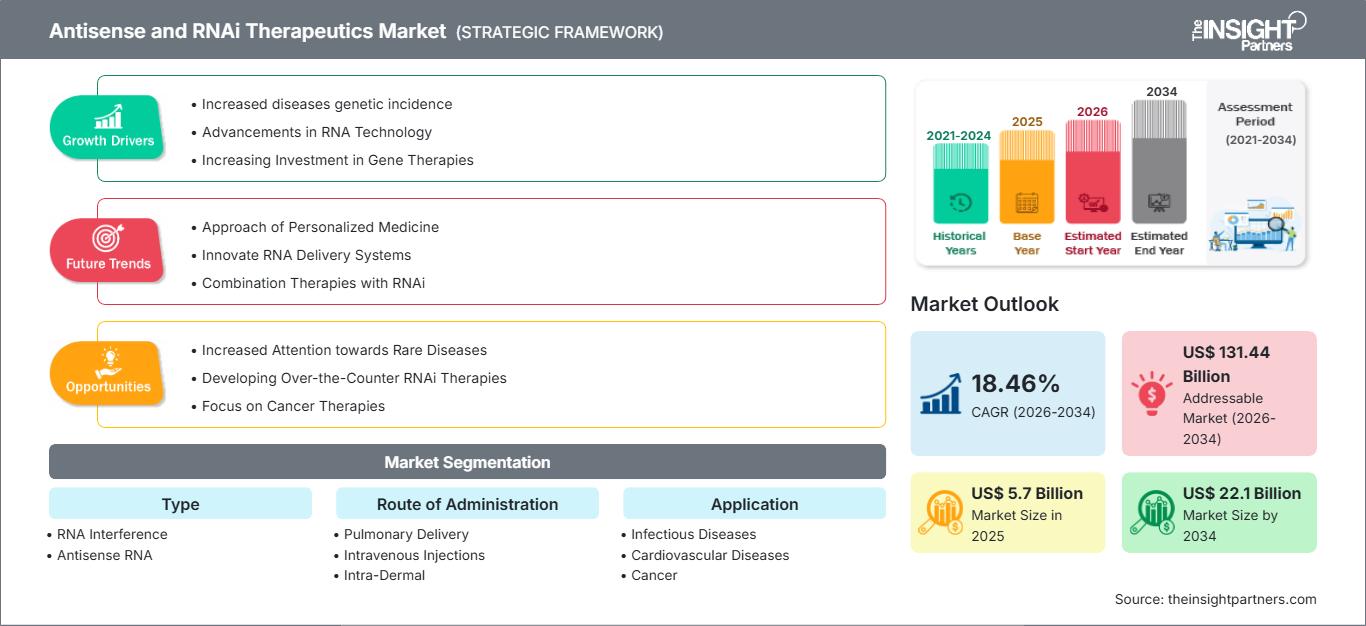
The Antisense and RNAi Therapeutics market was valued at US$ 5.7 billion in 2025 and is expected to reach US$ 22.1 billion by 2034; it is estimated to record a CAGR of 16.25% during 2026-2034.
Antisense and RNAi Therapeutics Market Assessment and Insights
- North America: North America is estimated to hold a 42–46% antisense and rnai therapeutics Market share in 2025 and expand at a 15.5–17.5% CAGR between 2026–2034, supported by established RNA drug developers, advanced clinical infrastructure, and strong biotechnology investment.
- US: The US represents approximately 36–40% of the global market in 2025 and is projected to grow at a 15.5–17.5% CAGR during 2026–2034, reflecting strong commercialization and pipeline depth.
- Europe: Europe accounts for an estimated 25–29% share in 2025 and is expected to grow at a 16.0–18.0% CAGR between 2026–2034, with Germany, the UK, France, Switzerland, and Italy supporting clinical development and specialty drug adoption.
- Asia Pacific: Asia Pacific is estimated at 19–23% share in 2025 and is expected to register a 20.0–22.0% CAGR between 2026–2034, led by China, Japan, South Korea, and India through expanding biopharmaceutical manufacturing and clinical research.
- Largest Segment: RNA Interference is estimated to represent 55–60% market share in 2025, with a 19.0–21.0% CAGR during 2026–2034, supported by multiple commercialized products and durable silencing.
- High Growth Segment: Neurological Disorders is estimated to represent 14–18% market share in 2025 and grow at a 22.0–24.0% CAGR during 2026–2034, driven by expanding CNS-targeted pipelines.
- Key companies analyzed in detail: Alnylam Pharmaceuticals, Inc.; Benitec Biopharma Ltd.; Quark Pharmaceuticals, Inc.; Ionis Pharmaceuticals, Inc.; Astellas Pharma Inc.; Marina Biotech, Inc.; Sanofi; Dicerna Pharmaceuticals, Inc.; Tekmira Pharmaceuticals Corporation; Merck & Co., Inc.
Source: The Insight Partners' analysis based on proprietary research, government publications, company annual reports, investor presentations, industry databases, and expert interviews.
The commercialization trend within this industry has been driven by advances in oligonucleotide chemistry, conjugation, and delivery technology. Conjugated GalNAc has increased the efficacy of RNA interference against liver targets through subcutaneous delivery and long-term gene silencing, while chemical modifications in antisense oligonucleotides have made such nucleotides more stable and less toxic. Therefore, manufacturing processes have become more focused on specialized oligonucleotide synthesis, purification, conjugation, sterile filling, and analysis than small molecule manufacturing.
In terms of future trends, the market will focus more on extrahepatic delivery, especially for neurological and pulmonary conditions. Funding will be increasingly channeled towards blood-brain barrier crossing, tissue targeting, extended dosing intervals, and combinations. Past experience gained from approved RNA drugs will also help decrease the risks of developing these products. Up-and-coming Asian markets will be more significant due to developing capabilities for clinical trials and manufacturing of biotechnology drugs.
Antisense and RNAi Therapeutics Market Report Scope
| Report Attribute | Details |
|---|---|
| Market size in 2025 | US$ 5.7 Billion |
| Market Size by 2034 | US$ 22.1 Billion |
| Global CAGR (2026 - 2034) | 16.25% |
| Historical Data | 2021-2024 |
| Forecast period | 2026-2034 |
Antisense and RNAi Therapeutics Market Analysis
The antisense and RNAi therapeutics market forecast indicates that the market is driven by the potential of modulating disease biology upstream of protein translation. The highest demand exists in cases when traditional therapies fail to effectively tackle genetically validated targets, including rare diseases, inherited metabolic disorders, and certain neurologic diseases. The value chain includes target discovery, sequence discovery, oligonucleotide synthesis, conjugation or formulation, preclinical validation, clinical development, approval, and specialty marketing.
Another advantage of RNA-based therapeutics is the relative differentiation of the manufacturing environment. Specific vendors offer phosphoramidites, modified nucleotides, conjugation reagents, lipid components, purification technologies, and analytical services. Scale-up of manufacturing is increasingly needed in case of longer oligonucleotides and conjugates due to advanced purification required. Thus, there are opportunities for contract development and manufacturing organizations specializing in nucleic acid manufacturing.
Competitive rivalry is focused around firms that have proprietary RNA chemistry, delivery technology, validated targets, or existing commercial structures. Alnylam Pharmaceuticals Inc. has established a top-notch RNA interference franchise, whereas Ionis Pharmaceuticals Inc. has built extensive experience with antisense technologies for both neurological and cardiometabolic applications. Partnerships, platform investment and development strategy have been contributed by Astellas Pharma Inc., Sanofi and Merck & Co. Inc.
The antisense and rnai therapeutics market trends indicate that competitive landscape now increasingly focuses on platform economics over individual assets. The total revenue for Alnylam in 2025 was US$3.714 billion, whereas its net product revenues amounted to approximately US$2.987 billion, highlighting the commercial potential of RNA interference products. Ionis Pharmaceuticals Inc. also had multiple commercial stage assets along with advanced neurological programs entering 2026. Small firms, like Benitec Biopharma Ltd. and Quark Pharmaceuticals Inc., still hold strategic relevance with differentiated gene-silencing capabilities and licensing programs.
● REPORT CUSTOMIZATION
Tailor This Report To Align With Your Specific Business Requirements
This report can be customized to align precisely with your business objectives, scope, and target markets. Customization options include tailored segmentation, geography, competitive analysis, and strategic insights to support informed decision-making.
Customize This Report →WHAT YOU CAN ADJUST
- ● Segmentations
- ● Geography
- ● Competitive Analysis
- ● Language Preferences
Antisense and RNAi Therapeutics Market: Strategic Insights
Regional Insights
North America antisense and rnai therapeutics market
North America is projected to retain its dominance, holding 42–46% market share in 2025 and having CAGR of 15.5–17.5% up to 2034. The US holds its dominance due to the presence of oligonucleotide developers, specialized centers conducting clinical trials, ample venture capital investments, and the availability of regulation of advanced therapies. Canada participates in the development of drugs through academia and biotechnology collaborations, though its commercial market is relatively small.
Its structural strength is evident at all stages – from drug discovery through clinical trials, manufacturing to commercialization. The demand for such drugs is driven by chronic neurological, cardiovascular, metabolic, and rare diseases which require long-term therapy. The subcutaneous application is broadening the applicability of RNA drugs beyond hospitals. In addition, technology suppliers, specialized CDMOs, and pharmaceutical companies make the transition to commercialization easier.
U.S. antisense and rnai therapeutics Market
The US accounts for 36 to 40% of the total global market and 82 to 88% of the North America revenue in 2025 and exhibits a 15.5 to 17.5% CAGR through 2034. Key players are operating both commercially and clinically in the region, which include Alnylam Pharmaceuticals, Inc., Ionis Pharmaceuticals, Inc., Merck & Co., Inc., and Sanofi. Reimbursement structures and networks of prescribers specializing in these diseases favor the market.
Applications have evolved from rare liver diseases into cardiovascular, metabolic, infectious, and neurological diseases. Regulatory familiarity with oligonucleotide-based drugs is increasing due to the cumulative experience of the FDA in this regard, while orphan and breakthrough drug approvals might help reduce development times for diseases with high unmet needs. It is critical to continue investments into CNS delivery since applications in neurological diseases can substantially increase the target patient population.
Europe antisense and rnai therapeutics Market
Europe is estimated to represent a 25–29% share in 2025, expanding at a 16.0–18.0% CAGR through 2034. The UK and Germany remain leading markets because of advanced research infrastructure, specialist hospitals, and strong pharmaceutical development capabilities. European demand is additionally supported by centralized regulatory processes and increasing attention to rare-disease treatment access.
The UK maintains a strong translational research base linking universities, biotechnology companies, and pharmaceutical developers. Germany combines large healthcare expenditure with established specialty-care infrastructure and strong pharmaceutical manufacturing. France, Italy, and Spain provide additional demand through public healthcare systems and increasing availability of advanced therapies. Switzerland also contributes disproportionately to research, licensing, and pharmaceutical innovation despite its smaller population. Germany is expected to remain the leading continental European market.
APAC antisense and rnai therapeutics Market
APAC is estimated to hold a 19–23% share in 2025 and expand at a 20.0–22.0% CAGR, making it the fastest-growing major region. China leads regional development, followed by Japan and South Korea. India and Australia provide additional clinical, manufacturing, and research capacity.
China benefits from biotechnology investment, expanding clinical-trial infrastructure, and government support for innovative medicines. Japan has strong experience in specialty pharmaceuticals and RNA research, while South Korea is strengthening biomanufacturing. India offers cost-efficient development and manufacturing capabilities, and Australia provides a strong clinical research ecosystem. Increasing localization of drug development and improving regulatory pathways should support regional adoption.
Middle East & Africa antisense and rnai therapeutics Market
Middle East and Africa remains an emerging market, with Saudi Arabia and the UAE leading specialty pharmaceutical adoption and South Africa providing the region's strongest research and clinical infrastructure. Growth is expected to exceed conventional specialty-drug expansion as healthcare modernization improves access to advanced therapies.
Saudi Arabia's healthcare transformation programs and the UAE's investment in specialized medical infrastructure support adoption of innovative medicines. South Africa remains important for clinical research and regional distribution, while the rest of MEA depends more heavily on imported specialty products. Greater healthcare investment, centralized procurement, and improving diagnostic infrastructure should support gradual expansion.
Segmentation Analysis
Drug Class
Drug Class is expected to expand at a 17.5–19.5% CAGR during 2026–2034. RNA interference currently has stronger commercial momentum because several approved products validate durable gene silencing, while antisense remains important for targets requiring transcript modulation. Advances in sequence chemistry, conjugation, and tissue targeting are improving both modalities and broadening their therapeutic applications.
- RNA Interference: RNA interference remains the dominant modality, supported by validated silencing mechanisms, subcutaneous delivery, and commercial products targeting hepatic proteins. Its strategic importance is increasing as developers extend programs into cardiovascular and neurological diseases.
- Antisense RNA: Antisense RNA remains strategically important where selective transcript reduction or splice modulation is required. Its broad target flexibility supports applications across neurological, metabolic, rare genetic, and inflammatory diseases.
Route of Administration
Route of Administration is projected to grow at a 18.0–20.0% CAGR during 2026–2034. Delivery remains a central determinant of commercial success because tissue distribution, dosing frequency, tolerability, and patient convenience influence product differentiation. Subcutaneous and systemic approaches are increasingly complemented by specialized administration strategies for extrahepatic targets.
- Pulmonary Delivery: Pulmonary delivery provides direct access to respiratory tissues and may reduce systemic exposure. Its strategic importance is rising for lung-specific gene targets and diseases where local RNA modulation could improve therapeutic concentration.
- Intravenous Injections: Intravenous administration remains useful for products requiring systemic distribution, particularly during clinical development. However, development priorities increasingly favor less burdensome administration when comparable exposure can be achieved.
- Intra-Dermal: Intra-dermal administration offers localized tissue exposure and potential applications in dermatological and immunological conditions. Its strategic role depends on advances in formulation, tissue penetration, and reproducible administration.
- Intraperitoneal: Intraperitoneal delivery remains a specialized approach for selected disease models and targeted applications. Commercial use is constrained by administration complexity, limiting its broader adoption compared with systemic or subcutaneous routes.
- Topical: Topical delivery can provide localized exposure while reducing systemic treatment burden. Development interest is focused on diseases involving accessible tissues where local RNA modulation can generate measurable therapeutic effects.
- Others: Other administration approaches encompass emerging delivery concepts designed to overcome tissue-specific barriers. Their strategic value depends on demonstrating reproducible biodistribution, manageable manufacturing requirements, and clinically meaningful improvements over established routes.
Application
Application is forecast to grow at a 20.0–22.0% CAGR during 2026–2034, with neurological disorders emerging as a particularly attractive expansion area. Commercial maturity remains highest in selected rare and cardiometabolic indications, while oncology and infectious diseases offer larger potential populations but require stronger evidence of durable clinical benefit.
- Infectious Diseases: RNA-targeted approaches can silence pathogen-associated genes or host factors, creating opportunities for diseases where conventional resistance or persistent infection limits treatment effectiveness.
- Cardiovascular Diseases: Cardiovascular applications benefit from targets that can be modulated through durable gene silencing. Infrequent dosing could improve long-term adherence for chronic risk-management populations.
- Cancer: Cancer remains a high-potential application because RNA medicines can address difficult molecular targets. Development priorities include tumor-selective delivery, combination therapy, and overcoming heterogeneous disease biology.
- Neurological Disorders: Neurological disorders represent an expanding opportunity as developers improve CNS delivery and demonstrate biomarker-linked target engagement. Long-lasting transcript reduction may be valuable for chronic neurodegenerative conditions.
- Others: Other applications include metabolic, genetic, inflammatory, and ophthalmic conditions where RNA modulation can address targets that remain difficult for conventional pharmacological approaches.
Opportunity Snapshot
| Segment Name | Revenue Contribution | Trend Tag | Adoption Stage |
|---|---|---|---|
| Infectious Diseases | Medium | Viral Silencing | Emerging |
| Cardiovascular Diseases | High | Gene Silencing | Scaling |
| Cancer | Medium | Targeted RNA | Emerging |
| Neurological Disorders | Medium | CNS Silencing | Scaling |
| Others | Low | Rare Targets | Emerging |
Antisense and RNAi Therapeutics Market Growth Drivers and Impact Analysis
Expansion of Durable Gene-Silencing Medicines
The increasing clinical validation of durable gene silencing is changing the commercial economics of RNA medicines. Traditional chronic therapies often require daily or weekly administration, whereas optimized RNA interference products can maintain target suppression for substantially longer periods. This creates differentiation around dosing frequency, adherence, and treatment convenience rather than only pharmacological potency. Commercial success in transthyretin-mediated amyloidosis, hyperoxaluria, and hemophilia demonstrates that RNA-based mechanisms can translate into repeatable specialty-care models. The effect extends across the ecosystem because successful products increase physician familiarity, encourage payer assessment of value based on reduced treatment burden, and strengthen investor confidence in platform technologies. As more targets achieve validated clinical proof of concept, developers can reuse chemistry and delivery capabilities across multiple programs.
Growth of Neurological RNA Drug Development
Neurological disease represents a major expansion opportunity for the antisense and rnai therapeutics market because many pathogenic proteins remain difficult to modulate using conventional small molecules. Antisense and RNA interference approaches can theoretically reduce production of disease-associated proteins at the messenger RNA level, creating opportunities in Huntington disease, Alzheimer disease, amyotrophic lateral sclerosis, tauopathies, and genetic neurological disorders. Improvements in intrathecal administration, conjugation, and CNS-targeted delivery are increasing the feasibility of these programs. The market impact is significant because neurological indications generally involve large patient populations and long treatment durations. Successful clinical translation could therefore shift the commercial mix from primarily rare hepatic diseases toward broader chronic neurological applications, increasing the strategic value of companies possessing validated CNS delivery technologies and biomarker-driven development capabilities.
Increasing Pharmaceutical Partnerships and Platform Licensing
Large pharmaceutical companies are increasingly using partnerships to access RNA-targeting platforms without building every capability internally. These arrangements can combine specialized sequence design and delivery technologies from biotechnology companies with the regulatory, manufacturing, and commercial resources of larger organizations. The model reduces development risk while allowing platform owners to monetize proprietary chemistry, delivery systems, and target libraries across multiple programs. Strategic activity is particularly relevant where technologies can move beyond liver-directed applications into neurological, pulmonary, or oncology targets. Partnership economics are also changing as clinical validation improves: companies with demonstrated human target engagement can negotiate stronger milestone structures and broader development rights. This creates a favorable environment for platform consolidation, licensing, and co-development transactions.
Antisense and RNAi Therapeutics Market Future Trends
AI-Enabled RNA Sequence and Delivery Optimization
AI-enabled design is expected to become increasingly important in selecting RNA sequences, predicting off-target effects, optimizing chemical modifications, and prioritizing delivery strategies. Future platforms will likely integrate genomic datasets, structural information, clinical biomarkers, and historical oligonucleotide performance into unified design workflows. This could shorten early discovery cycles and reduce the number of experimentally tested candidates required before clinical nomination. Alnylam's June 2026 collaboration with Inceptive, valued at up to US$2 billion including milestone-based consideration, illustrates the growing strategic interest in combining RNA expertise with foundation-model capabilities. Over time, AI may become a competitive differentiator not merely for discovery speed, but for improving sequence precision, manufacturability, and probability of clinical success.
Expansion Beyond Liver-Directed RNA Medicines
The next phase of innovation is likely to focus on tissues that have historically been difficult to reach with oligonucleotide therapeutics. Liver-directed delivery has provided the strongest commercial foundation, but neurological, pulmonary, muscular, and tumor tissues represent much larger areas for platform expansion. Researchers are therefore prioritizing receptor-mediated uptake, novel conjugates, nanoparticles, local administration, and improved intracellular trafficking. The successful development of CNS programs could materially change the industry's revenue composition because neurological diseases frequently require prolonged treatment. Advances will also encourage new partnerships between biotechnology companies with delivery platforms and pharmaceutical companies with disease-specific clinical expertise. The competitive advantage will increasingly depend on tissue-specific delivery rather than sequence design alone.
Antisense and RNAi Therapeutics Market Opportunities
Regional Manufacturing and Licensing Expansion
Emerging pharmaceutical markets offer an opportunity to establish regional manufacturing, licensing, and commercialization partnerships for RNA-targeted medicines. China, India, South Korea, and selected Middle Eastern markets are developing capabilities in biotechnology manufacturing and specialty pharmaceutical distribution. Companies entering these markets can use local partnerships to reduce regulatory complexity, expand patient access, and create regional supply resilience. The opportunity is particularly relevant for products requiring specialized cold-chain logistics, high-value clinical support, and disease-specific diagnostics. Local formulation or fill-finish capabilities may become increasingly attractive as volumes rise. Strategic investors should prioritize markets where regulatory frameworks for advanced therapies are becoming more predictable and where government healthcare programs are increasing access to innovative medicines.
RNA Therapeutics for Underserved Genetic Diseases
Rare genetic diseases with clearly defined molecular targets represent an attractive investment area because antisense and RNA interference technologies can potentially address pathogenic mechanisms that lack conventional drug targets. Developers can prioritize conditions with established biomarkers, identifiable patient populations, and natural-history datasets that facilitate clinical development. Partnerships with patient foundations, genomic-testing providers, and specialist hospitals can improve trial recruitment while supporting disease identification. The commercial opportunity extends beyond initial approvals because platform technologies may be adapted to genetically related conditions. Investors should therefore assess the scalability of the underlying delivery and chemistry platform rather than valuing individual candidates independently. Programs demonstrating repeatable target engagement can provide stronger long-term strategic value.
Recent Developments
- July 2026: Ionis Pharmaceuticals, Inc. reported expanded Phase 2 CELIA data for diranersen at AAIC 2026. The investigational antisense therapy demonstrated robust reductions in tau biomarkers and signals of slowed cognitive decline in early Alzheimer disease. Ionis stated that partner Biogen plans to advance the program into confirmatory Phase 3 development, strengthening the role of RNA-targeted approaches in neurodegenerative disease.
- June 2026: Alnylam Pharmaceuticals, Inc. announced a strategic collaboration with Inceptive Nucleics to accelerate RNA interference therapeutic discovery using artificial intelligence and foundation models. The agreement is valued at up to US$2 billion, including US$30 million in upfront consideration and additional milestone-linked payments, emphasizing AI's increasing role in RNA drug design.
- December 2025: Sanofi announced approval of Qfitlia in China for hemophilia A and B. The small-interfering RNA therapy uses Alnylam's ESC-GalNAc technology and can provide prophylaxis with as few as six injections annually. The approval expanded commercial access to an RNAi therapy in China and strengthened Sanofi's rare hematology portfolio.
Frequently Asked Questions

- Comprehensive Market Sizing and Forecast Analysis
- Detailed Segmentation Analysis
- In-Depth Market Dynamics Assessment
- Regional and Country-Level Insights
- Competitive Landscape and Company Benchmarking
- Strategic Business Intelligence
Recent Reports
Testimonials

The Insight Partners provided valuable market intelligence that supported our global go-to-market strategy. Their team was professional, responsive, and attentive to our feedback, providing thoughtful analysis and helpful methodological clarifications throughout the project.
Junmo Kim Chief Financial Officer (CFO), Enertech Co., Ltd.
The Insight Partners' SCADA System Market report is comprehensive, with valuable insights on current trends and future forecasts. The team was highly professional, responsive, and supportive throughout. We are very satisfied and highly recommend their services.
RAN KEDEM Partner, Reali Technologies LTDs
I requested a report on a very specific software market and the team produced the report in a few days. The information was very relevant and well presented. I then requested some changes and additions to the report. The team was again very responsive and I got the final report in less than a week.
JEAN-HERVE JENN Chairman, Future Analytica
We worked with The Insight Partners for an important market study and forecast. They gave us clear insights into opportunities and risks, which helped shape our plans. Their research was easy to use and based on solid data. It helped us make smart, confident decisions. We highly recommend them.
PIYUSH NAGPAL Sr. Vice President, High Beam Global
The Insight Partners delivered insightful, well-structured market research with strong domain expertise. Their team was professional and responsive throughout. The user-friendly website made accessing industry reports seamless. We highly recommend them for reliable, high-quality research services
YUKIHIKO ADACHI CEO, Deep Blue, LLC.
This is the first time I have purchased a market report from The Insight Partners.While I was unsure at first, I visited their web site and felt more comfortable to take the risk and purchase a market report.I am completely satisfied with the quality of the report and customer service. I had several questions and comments with the initial report, but after a couple of dialogs over email with their analyst I believe I have a report that I can use as input to our strategic planning process.Thank you so much for taking the extra time and making this a positive experience.I will definitely recommend your service to others and you will be my first call when we need further market data.
JOHN SUZUKI President and Chief Executive Officer, Board Director, BK Technologies
I wish to appreciate your support and the professionalism you displayed in the course of attending to my request for information regarding to infectious disease IVD market in Nigeria. I appreciate your patience, your guidance, and the fact that you were willing to offer a discount, which eventually made it possible for us to close a deal. I look forward to engaging The Insight Partners in the future, all thanks to the impression you have created in me as a result of this first encounter.
DR CHIJIOKE ONYIA MANAGING DIRECTOR, PineCrest Healthcare Ltd.Reason to Buy
- Informed Decision-Making
- Understanding Market Dynamics
- Competitive Analysis
- Identifying Emerging Markets
- Customer Insights
- Market Forecasts
- Risk Mitigation
- Boosting Operational Efficiency
- Strategic Planning
- Investment Justification
- Tracking Industry Innovations
- Aligning with Regulatory Trends





 Get Free Sample for