
Appendicitis Market Trends, Demand & Growth by 2034
Coverage: By Type (Acute Appendicitis, Chronic Appendicitis); Treatment (Appendectomy Surgery, Medicines, Others); End User (Hospitals, Specialized Clinics, Ambulatory Surgical Centers) , and Geography (North America, Europe, Asia Pacific, and South and Central America)
- Status : Data Released
- Report Code : TIPRE00008536
- Category : Life Sciences
- No. of Pages : 150
- Available Report Formats :


- Last update date : August 26, 2026


2025 Market Size
US$ 9.14 Bn
Base year value
2034 Forecast
US$ 13.38 Bn
Projected by 2034
CAGR 2026-2034
4.32 %
Growth rate
Addressable Market
US$ 102.24 Bn
(2026-2034)
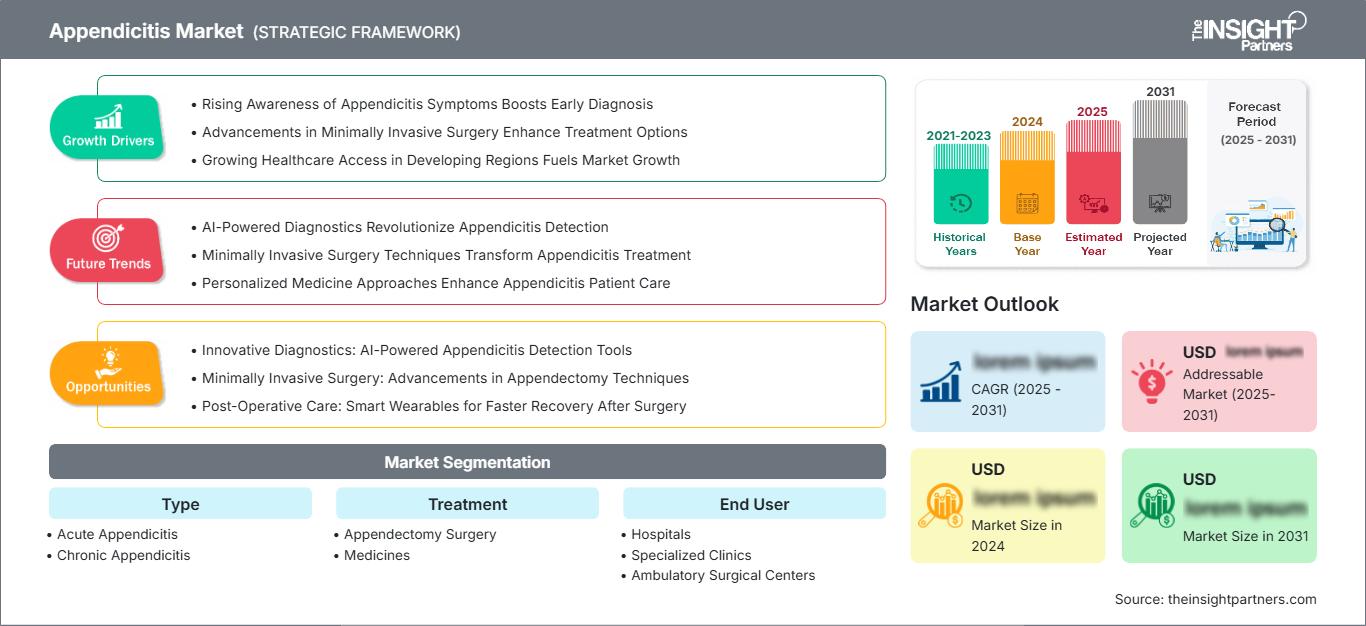
The appendicitis market is valued at US$ 9.14 Billion in 2025 and is projected to reach US$ 13.38 Billion by 2034, registering a CAGR of 4.32% during 2026–2034. The market encompasses diagnosis-driven treatment decisions, appendectomy procedures, pharmacological management, and healthcare delivery across hospitals, specialized clinics, and ambulatory surgical centers. Demand is shaped by acute disease burden, surgical capacity, antibiotic stewardship, minimally invasive techniques, and improving access to emergency abdominal care.
North America is expected to remain a high-value regional market, with an estimated 4.4–5.0% CAGR through 2034. Established emergency-care infrastructure, broad availability of laparoscopic appendectomy, and continued preference for evidence-based antibiotic protocols support demand. The appendicitis market size in the region is also influenced by outpatient surgical pathways, increasing use of ambulatory facilities for selected uncomplicated cases, and sustained investment in operating-room technologies and perioperative care.
Appendicitis Market Assessment and Insights
- North America: North America is estimated to represent a 34–38% share in 2025, supported by advanced emergency-care infrastructure, high procedural capacity, and established laparoscopic practice. The region is expected to grow at a 4.4–5.0% CAGR between 2026–2034 as outpatient pathways expand.
- US: The US accounts for approximately 27–31% share of the global market and 78–82% of North American revenue in 2025. Growth is projected at a 4.5–5.1% CAGR during 2026–2034, supported by surgical capacity and ambulatory care.
- Europe: Europe is estimated to hold a 27–31% share in 2025 and expand at a 4.0–4.7% CAGR through 2034. Germany, the UK, France, Italy, and Spain remain important markets because of mature hospital systems and established minimally invasive surgery.
- Asia Pacific: Asia Pacific is estimated at a 22–26% share in 2025, with China, Japan, India, South Korea, and Australia driving regional demand. The region is expected to record a 4.8–5.5% CAGR between 2026–2034 as surgical access improves.
- Largest Segment: Treatment is the largest segment, with a 70–75% market share in 2025 and a 4.2–4.7% CAGR during 2026–2034, reflecting the revenue concentration in appendectomy procedures.
- High Growth Segment: Ambulatory Surgical Centers represent the fastest-growing end-user segment, with a 7–11% market share in 2025 and a 5.2–6.0% CAGR during 2026–2034.
- Key companies analyzed in detail: Pfizer, Inc., CooperSurgical Inc., Teva Pharmaceutical Industries Ltd., GSK plc, Astellas Pharma Inc., Aurobindo Pharma Limited, Sanofi, Merck & Co., Inc., Blacksmith Surgical Inc., and Desco Medical India.
Source: The Insight Partners' analysis based on proprietary research, government publications, company annual reports, investor presentations, industry databases, and expert interviews.
Technological advances have led to increased use of laparoscopic appendectomy, standard perioperative management protocols, imaging, and selective non-operative management of uncomplicated cases. Dynamics of manufacturing involve generic antibiotics, anesthesia, and surgery-related consumables, laparoscopic devices, closure devices, and hospital equipment. Increasing competition among suppliers will involve the ability to supply reliable and compatible products at reasonable procurement costs while complying with regulations, and not by product segments alone.
Future growth will depend most upon regions where emergency surgical facilities and imaging are growing. India, China, Southeast Asia, Latin America, and some Middle Eastern markets provide such opportunities, since hospitals are adding operating room capacity and coverage for procedures. Increased regulations on antimicrobial stewardship may further foster judicious use of antibiotics, while keeping surgery as a definitive procedure for complicated cases.
Appendicitis Market Report Scope
| Report Attribute | Details |
|---|---|
| Market size in 2025 | US$ 9.14 Billion |
| Market Size by 2034 | US$ 13.38 Billion |
| Global CAGR (2026 - 2034) | 4.32% |
| Historical Data | 2021-2024 |
| Forecast period | 2026-2034 |
Appendicitis Market Analysis
The appendicitis market growth is primarily connected with the continuing incidence of acute appendicitis and the need for rapid treatment following emergency presentation. The value chain starts with diagnosis through imaging and laboratory tests, followed by surgery or drug therapy, anesthesia, disposables, monitoring, and discharge management. The hospital is still an essential part because a perforation, abscess, or systemic infection may need immediate surgical treatment, while uncomplicated cases tend to favor treatment protocol-based decisions.
Supply chains have significantly different characteristics in developed and developing countries. Generics producers of antibiotics are competing in terms of availability, regulatory status, and price, while surgery suppliers are competing in terms of laparoscopic instruments, stapling, retrieval, access, and closure devices. Procurement agencies have shifted their attention from pricing single devices to total procedure costs. Thus, standardization of surgical trays, reusable technology platforms, and distributors with secure logistics during emergencies is preferred.
Competitive positioning across the appendicitis market analysis reflects two distinct ecosystems. Pfizer, Inc., Teva Pharmaceutical Industries Ltd., Aurobindo Pharma Limited, Sanofi, and Merck & Co., Inc. participate primarily through pharmaceutical portfolios and manufacturing capabilities, while CooperSurgical Inc., Blacksmith Surgical Inc., and Desco Medical India are more closely connected with procedural and surgical equipment opportunities. Astellas Pharma Inc. and GSK plc broaden the pharmaceutical competitive landscape.
The investment strategies now have an increased inclination toward scalable manufacturing, generic drugs, minimal surgery equipment and technologies that shorten procedure times or utilize less hospital resources. Since the treatment of appendicitis involves the use of pharmaceuticals, devices and perioperative services, companies having strong ties with hospitals will have a distinct advantage. This makes the competitive environment highly fragmented with strategic differentiations made on a broad portfolio, price, regulatory and distribution strengths as well as clinical workflows.
● REPORT CUSTOMIZATION
Tailor This Report To Align With Your Specific Business Requirements
This report can be customized to align precisely with your business objectives, scope, and target markets. Customization options include tailored segmentation, geography, competitive analysis, and strategic insights to support informed decision-making.
Customize This Report →WHAT YOU CAN ADJUST
- ● Segmentations
- ● Geography
- ● Competitive Analysis
- ● Language Preferences
Appendicitis Market: Strategic Insights
Regional Insights
North America appendicitis market
North America is estimated to account for 34–38% of the global appendicitis market share in 2025 and is projected to expand at a 4.4–5.0% CAGR through 2034. The region benefits from extensive emergency departments, advanced diagnostic imaging, high laparoscopic penetration, and strong access to trained surgical personnel. Clinical pathways increasingly distinguish uncomplicated from complicated disease, supporting more selective antibiotic use alongside surgery.
The US represents the dominant regional contributor, while Canada provides a smaller but structurally mature market. Hospital consolidation and ambulatory-care expansion are influencing procurement decisions, particularly for standardized laparoscopic instruments and perioperative consumables. North American providers also have greater capacity to implement evidence-based protocols, digital scheduling, and rapid diagnostic workflows, supporting consistent treatment volumes.
U.S. appendicitis Market
The US contributes approximately 78–82% of the North American appendicitis market revenue in 2025 and is expected to grow at a 4.5–5.1% CAGR through 2034. Its position reflects a large emergency-care network, extensive hospital capacity, widespread laparoscopic appendectomy, and established availability of generic medicines. Major pharmaceutical suppliers maintain extensive distribution relationships, while surgical suppliers address hospital and ambulatory procedural demand.
Application trends increasingly favor differentiated pathways for uncomplicated cases, including antibiotic-first management for selected patients and outpatient or short-stay surgery when clinically appropriate. The resulting demand mix benefits both medicines and procedural products. Rising labor and facility costs also encourage providers to prioritize efficient surgical sets, predictable device performance, and shorter postoperative stays. These factors support continued investment in procedural standardization and hospital supply-chain resilience.
Europe appendicitis Market
Europe is estimated to hold a 27–31% share of the appendicitis market in 2025 and grow at a 4.0–4.7% CAGR through 2034. Germany is the leading national market, followed by the UK, France, Italy, and Spain. Mature public healthcare systems, established laparoscopic practice, and strong clinical protocols support stable procedural demand.
The UK and Germany represent major demand centers because of broad hospital coverage and standardized emergency pathways. France, Italy, and Spain also maintain substantial treatment capacity, with adoption increasingly influenced by hospital efficiency, minimally invasive procedures, and antibiotic stewardship. Differences in reimbursement structures and public procurement create pricing variation across countries, but regional demand remains supported by established surgical infrastructure and relatively consistent access to emergency abdominal care.
APAC appendicitis Market
APAC is estimated to represent 22–26% of global revenue in 2025 and is expected to expand at a 4.8–5.5% CAGR. China is the leading regional market, followed by Japan, South Korea, India, and Australia. Expanding hospital capacity and improving emergency-care access underpin demand.
China and India provide the strongest expansion opportunities because of population scale and healthcare infrastructure investment. Japan and South Korea contribute mature procedural capabilities, while Australia benefits from established emergency and surgical systems. Industrial development of generic medicines and locally manufactured surgical supplies can improve affordability, while public healthcare initiatives support wider access to diagnosis and definitive treatment.
Middle East & Africa appendicitis Market
The Middle East and Africa are projected to grow at a 4.2–5.0% CAGR, with Saudi Arabia leading regional demand, followed by the UAE and South Africa. Hospital modernization, specialist-care investment, and emergency infrastructure development support procedural capacity, particularly in major urban centers.
Saudi Arabia and the UAE are strengthening advanced hospital networks, while South Africa remains an important access point for sophisticated surgical care in sub-Saharan Africa. The rest of MEA markets remain constrained by uneven specialist availability, financing, and rural access. Investments in healthcare infrastructure, medical supply distribution, and workforce development should gradually improve treatment accessibility and support demand for standardized appendectomy equipment and medicines.
Segmentation Analysis
Type
The Type segment is expected to register a 4.0–4.5% CAGR during 2026–2034. Acute disease accounts for most treatment activity because it commonly requires rapid evaluation and definitive intervention. Chronic appendicitis represents a smaller clinical category, with demand influenced by recurrent symptoms, diagnostic uncertainty, and selective surgical decisions.
- Neuroendocrine Tumors: Not applicable to this segmentation. Acute and chronic inflammatory disease classifications drive the relevant treatment pathway, while neuroendocrine tumors belong to appendiceal oncology rather than standard appendicitis management.
- Carcinomas: Not applicable to routine appendicitis segmentation. Appendiceal carcinomas are oncology conditions requiring distinct diagnostic and therapeutic pathways and therefore, should not be incorporated into this inflammatory disease market.
Treatment
Treatment is the largest segment and is projected to grow at a 4.2–4.7% CAGR through 2034. Appendectomy remains the definitive approach for many patients, while medicines support antibiotic-first management in selected uncomplicated cases, perioperative infection control, and postoperative care.
- Appendectomy Surgery: Represents the principal procedural pathway, supported by laparoscopic adoption, established emergency protocols, and the need for definitive treatment in complicated or recurrent disease.
- Medicines: Include antibiotics and supportive therapies used before or after surgery and, in selected uncomplicated cases, as an alternative initial management approach under clinical supervision.
End User
The End User segment is projected to expand at a 4.3–4.9% CAGR. Hospitals remain dominant because they provide emergency diagnostics, surgery, anesthesia, intensive monitoring, and postoperative care. Specialized clinics and ambulatory surgical centers gain importance as selected uncomplicated cases move toward shorter treatment pathways.
- Hospitals: Remain the primary treatment setting because they can manage complicated appendicitis, perforation, abscess, emergency surgery, imaging, anesthesia, and postoperative complications.
- Specialized Clinics: Provide focused surgical consultation and selected treatment services, particularly where referral networks and diagnostic infrastructure support rapid assessment.
- Ambulatory Surgical Centers: Are increasingly relevant for appropriately selected uncomplicated cases because shorter stays, focused workflows, and lower facility intensity can improve procedural efficiency.
Opportunity Snapshot
| Segment Name | Revenue Contribution | Trend Tag | Adoption Stage |
| Hospitals | High | Emergency Surgery | Mature |
| Specialized Clinics | Medium | Specialist Referral | Scaling |
| Ambulatory Surgical Centers | Low | Same-Day Surgery | Scaling |
Appendicitis Market Growth Drivers and Impact Analysis
Rising Emergency Surgical Capacity in Emerging Healthcare Systems
The growth of infrastructure, especially with regard to emergency facilities and surgical equipment in emerging markets, will lead to an increase in the number of patients receiving their treatment in the clinically recommended timeframe. The construction of hospitals, the development of expertise in specialists, and diagnostic imaging are very relevant, since appendicitis needs quick distinction from other cases of abdominal pain. It has an effect not only on the quantity but also on such factors as the possibility to perform laparoscopic surgeries, provide anesthetics, monitoring after the surgery, and antibiotics. The reduction of geographical gaps in the treatment of appendicitis in India, China, Southeast Asia and Middle Eastern countries will be possible because of the investments in public and private health sectors.
Greater Adoption of Minimally Invasive Appendectomy
The laparoscopic appendectomy is still having an effect on the equipment needs market because it allows smaller incisions, procedural structure in the operating room, and potentially shortened recovery time for the right candidates. Increased availability of laparoscopic systems leads to ongoing needs for access devices, retrieval devices, closure devices, energy sources, and consumables. The issue has particular relevance for those hospitals looking to increase operating room efficiency while dealing with staffing and infrastructure cost considerations. The manufacturers can capitalize on that issue by designing their instruments around procedures and creating portfolios of products as opposed to single devices. In resource-poor markets, however, the main limitation will be capital and surgeon training issues, so reusable devices and affordable instruments will matter most.
Antibiotic Stewardship and Selective Nonoperative Management
The presence of evidence-based support for an antibiotic-first strategy for select cases of uncomplicated appendicitis is shaping providers' views on pathways to treatment. While this does not render surgery unnecessary, it leads to differentiation in the group of patients that should receive medical treatment versus those that need urgent intervention. From the commercial standpoint, this is leading to increased differentiation in the demand side for drugs, diagnostics, follow-up care, and surgical capabilities. Generic manufacturers and distributors of generic products may have an opportunity to take part in the drug delivery side of things, while providers must be able to monitor patients to ensure proper treatment and non-recurrence. Policies of antimicrobial stewardship add additional importance to this aspect of treatment. Eventually, it may become possible to encourage hospitals to incorporate imaging studies, laboratory tests, and clinical scoring into their decision pathways.
Appendicitis Market Future Trends
Protocol-Based Personalized Treatment Pathways
The appendicitis market trends are moving toward more individualized treatment pathways that combine imaging findings, clinical severity, patient preference, recurrence risk, and institutional protocols. During the next decade, hospitals are likely to formalize decision algorithms that distinguish uncomplicated inflammation from perforation, abscess, or generalized infection. This new approach could assist in achieving consistency in the selection of patients for antibiotic therapy or surgery, and structured follow-up can detect either recurrence or failure of treatment. This new approach will not diminish the role of the surgeon’s judgment in any way; rather, it will assist in bringing consistency among emergency departments with respect to treatment. In response to such a change in the market, suppliers can adjust by assisting in integrating diagnostics, perioperative information collection, and procedures in a standardized manner.
Expansion of Short-Stay and Ambulatory Surgical Pathways
Ambulatory care and short-stay care approaches will probably be more prevalent as institutions get better at choosing suitable patients and perioperative procedures. Anesthesia management, laparoscopic procedure skills, post-procedure pain relief, infection control, and follow-up care are examples of areas where improvements can facilitate the care of carefully chosen patients using fewer facilities' resources. It is especially applicable in healthcare systems that are under financial pressure to reduce hospitalization costs while retaining their capacity for emergencies. ASCs will be able to take up more suitable cases if there are well-developed emergency referral networks, imaging capability, and transportation arrangements. Equipment manufacturers will have an incentive to design smaller laparoscopy units and sets of tools. In the long run, a payment system that encourages appropriate use of resources will further encourage moving in the direction of same-day or next-day discharges.
Appendicitis Market Opportunities
Localized Surgical Supply Manufacturing in Emerging Markets
Appendicitis market Forecasts indicate an opportunity for manufacturers to localize production of laparoscopic instruments, surgical consumables, and selected generic medicines in high-volume emerging markets. Local manufacturing will be helpful for reducing dependency on imports, decreasing the replenishment cycle time, and making the procurement more affordable with the help of the right quality systems. India is a pertinent case because of its developed pharmaceutical manufacturing industry and evolving medical devices industry. The same can be said about China and certain Southeast Asian countries. Products to be considered are those having regular procedure use, low regulatory burden, and being compatible with existing surgical systems. Collaboration with hospitals and distribution partners will give visibility into demand and at the same time lower the risk of entering the market.
Integrated Procurement Platforms for Emergency Appendicitis Care
A second opportunity involves procurement systems that package medicines, surgical tools, disposables, and perioperative supplies based on the standard appendectomy procedure process flow. Many hospitals are looking for predictable expenses and streamlined purchasing processes, especially for their emergency departments with varying levels of procedure frequency. Procurement systems can package procedure-specific kits consisting of access, retrieval, closure devices, and disposables, as well as pharmaceutical agreements where it makes commercial sense. In addition to improving inventory management and decreasing the chance of missing crucial supplies during emergencies, technology-based procurement platforms could also keep track of utilization, reordering information, substitutions, and supplier performance. Firms entering this market should focus on integration capabilities within hospital procurement systems and clear cost per procedure measures.
Recent Developments
- July 2026: CooperSurgical Inc. announced support for Saving Mothers to advance global women’s health and raise awareness, reflecting continued engagement in healthcare access and clinical infrastructure. Its broader portfolio includes surgical products relevant to operating-room workflows, reinforcing the company’s role in procedural healthcare supply.
- June 2026: Aurobindo Pharma Limited announced US FTC approval for Aurobindo Pharma USA to acquire Lannett Company LLC. The transaction strengthens the company’s US pharmaceutical platform and expands its commercial infrastructure, relevant to the broader generic-medicine supply environment supporting hospital-based acute-care treatment.
- February 2026: Sanofi India announced expansion of its Hyderabad Global Capability Center to strengthen capabilities and innovation. The development reflects continued investment in India-based healthcare operations and supports the broader pharmaceutical ecosystem serving hospitals and specialty-care providers.
Frequently Asked Questions

- Comprehensive Market Sizing and Forecast Analysis
- Detailed Segmentation Analysis
- In-Depth Market Dynamics Assessment
- Regional and Country-Level Insights
- Competitive Landscape and Company Benchmarking
- Strategic Business Intelligence
Recent Reports
Testimonials

The Insight Partners' SCADA System Market report is comprehensive, with valuable insights on current trends and future forecasts. The team was highly professional, responsive, and supportive throughout. We are very satisfied and highly recommend their services.
RAN KEDEM Partner, Reali Technologies LTDs
I requested a report on a very specific software market and the team produced the report in a few days. The information was very relevant and well presented. I then requested some changes and additions to the report. The team was again very responsive and I got the final report in less than a week.
JEAN-HERVE JENN Chairman, Future Analytica
We worked with The Insight Partners for an important market study and forecast. They gave us clear insights into opportunities and risks, which helped shape our plans. Their research was easy to use and based on solid data. It helped us make smart, confident decisions. We highly recommend them.
PIYUSH NAGPAL Sr. Vice President, High Beam Global
The Insight Partners delivered insightful, well-structured market research with strong domain expertise. Their team was professional and responsive throughout. The user-friendly website made accessing industry reports seamless. We highly recommend them for reliable, high-quality research services
YUKIHIKO ADACHI CEO, Deep Blue, LLC.
This is the first time I have purchased a market report from The Insight Partners.While I was unsure at first, I visited their web site and felt more comfortable to take the risk and purchase a market report.I am completely satisfied with the quality of the report and customer service. I had several questions and comments with the initial report, but after a couple of dialogs over email with their analyst I believe I have a report that I can use as input to our strategic planning process.Thank you so much for taking the extra time and making this a positive experience.I will definitely recommend your service to others and you will be my first call when we need further market data.
JOHN SUZUKI President and Chief Executive Officer, Board Director, BK Technologies
I wish to appreciate your support and the professionalism you displayed in the course of attending to my request for information regarding to infectious disease IVD market in Nigeria. I appreciate your patience, your guidance, and the fact that you were willing to offer a discount, which eventually made it possible for us to close a deal. I look forward to engaging The Insight Partners in the future, all thanks to the impression you have created in me as a result of this first encounter.
DR CHIJIOKE ONYIA MANAGING DIRECTOR, PineCrest Healthcare Ltd.Reason to Buy
- Informed Decision-Making
- Understanding Market Dynamics
- Competitive Analysis
- Identifying Emerging Markets
- Customer Insights
- Market Forecasts
- Risk Mitigation
- Boosting Operational Efficiency
- Strategic Planning
- Investment Justification
- Tracking Industry Innovations
- Aligning with Regulatory Trends





 Get Free Sample for