
Application Management Services Market Share, Demand & Growth by 2034
Coverage: By Service Type (Application Modernization, Application Security, Application Portfolio Assessment, Application Managed Services, Others); Organization Size (Small and Medium Size Organization, Large Size Organization); End-user (BFSI, IT and Telecom, Retail and E-commerce, Energy and Utilities, Healthcare, Manufacturing, Others) , and Geography (North America, Europe, Asia Pacific, and South and Central America)
- Status : Data Released
- Report Code : TIPRE00010152
- Category : Technology, Media and Telecommunications
- No. of Pages : 150
- Available Report Formats :


- Last update date : August 26, 2026


2025 Market Size
US$ 349.17 Bn
Base year value
2034 Forecast
US$ 596.11 Bn
Projected by 2034
CAGR 2026-2034
6.12 %
Growth rate
Addressable Market
US$ 4,279.19 Bn
(2026-2034)
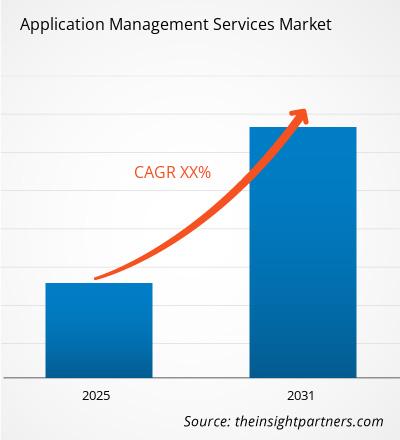
The application management services market was valued at US$ 349.17 Billion in 2025 and is projected to reach US$ 596.11 Billion by 2034; it is expected to register a CAGR of 6.12% during 2026–2034. Enterprise demand is shifting from reactive application support toward integrated lifecycle services covering modernization, managed operations, security hardening, and portfolio rationalization across hybrid, cloud-native, and legacy environments.
Across North America, the application management services market size is supported by mature cloud adoption, high enterprise software intensity, and regulated industries that require resilient application estates. The region is estimated to expand at a 5.6–6.1% CAGR during 2026–2034, driven by modernization backlogs in banking, healthcare, public services, and telecom, alongside migration from labor-led support models to automation-led managed service contracts.
Application Management Services Market Assessment and Insights
- North America accounted for 37–40% share in 2025 and is growing at a 5.6–6.1% CAGR between 2026–2034, supported by cloud-native modernization, cybersecurity mandates, platform engineering adoption, and mature outsourcing across BFSI, healthcare, retail, and telecommunications.
- US represented 78–82% of North America share in 2025 and is growing at a 5.5–6.0% CAGR between 2026–2034, led by large enterprise renewals, AI-enabled operations, and regulated workload modernization.
- Europe held 24–27% share in 2025 and is growing at a 5.1–5.7% CAGR between 2026–2034, with the UK, Germany, France, Italy, and Spain leading due to cloud sovereignty, banking transformation, and public sector digitization.
- Asia Pacific captured 23–26% share in 2025 and is growing at a 7.0–7.8% CAGR between 2026–2034, led by China, India, Japan, South Korea, and Australia as enterprises scale cloud, ERP modernization, and digital commerce.
- Largest Segment: Service Type led by Application Managed Services, with 42–46% market share in 2025 and a 5.5–6.1% CAGR during 2026–2034, reflecting recurring support demand and platform operations outsourcing.
- High Growth Segment: End-user led by Healthcare, with 10–13% market share in 2025 and a 7.4–8.2% CAGR during 2026–2034, supported by electronic health records, cybersecurity controls, interoperability, and cloud migration.
- Key companies analyzed in detail: Accenture plc, Atos SE, Capgemini SE, Cognizant Technology Solutions Corporation, Deloitte Touche Tohmatsu Limited, Fujitsu Limited, International Business Machines Corporation, Infosys Limited, Tata Consultancy Services Limited, Wipro Limited.
Source: The Insight Partners' analysis based on proprietary research, government publications, company annual reports, investor presentations, industry databases, and expert interviews.
Application services have evolved from a ticketed maintenance model to an engineering operating model where observability, DevSecOps, cloud FinOps, and continuous modernization are integrated. The delivery centers of providers leverage AI co-pilots, accelerators, and site reliability engineering to decrease incident occurrences and improve release cycles. On the other hand, production landscapes have evolved due to the rationalization of redundant applications, sunset of unsupportable platforms, and packaging of application management services together with security, infrastructure, and cloud management services.
The next era will be defined by emerging digital economies, regulation on workload transfer, and technology procurement with operational resilience considerations. Digital public infrastructure investments are growing in governments. Enterprises in healthcare, energy, and financial services industries face stringent continuity requirements and cybersecurity considerations. Therefore, service providers are developing sovereign cloud alliances, industry platforms, and outcome-oriented delivery models with a focus on tying application availability to business performance.
Application Management Services Market Report Scope
| Report Attribute | Details |
|---|---|
| Market size in 2025 | US$ 349.17 Billion |
| Market Size by 2034 | US$ 596.11 Billion |
| Global CAGR (2026 - 2034) | 6.12% |
| Historical Data | 2021-2024 |
| Forecast period | 2026-2034 |
Application Management Services Market Analysis
Demand is expanding as enterprises confront aging core systems, fragmented SaaS estates, and rising cyber exposure. The application management services market growth pattern reflects the need to operate business-critical software while modernizing it without service disruption. Consumers tend to favor suppliers that can effectively integrate portfolio management, modernization, security, testing, and running of services into one coherent lifecycle model.
The value chain comprises hyperscalers, software solution suppliers, security platforms, automation solutions, global systems integrators, and offshore delivery centers. The supply dynamics benefit suppliers having reusability capabilities, skilled cloud professionals, and knowledge about specific domain applications. The pricing dynamics have started moving towards managed capacity, outcome-based, and consumption-based solutions instead of pure full-time equivalents.
Competitive intensity remains high because large providers are converging around AI-enabled delivery, cloud modernization, and platform operations. The application management services market analysis shows Accenture plc, International Business Machines Corporation, Capgemini SE, Infosys Limited, and Tata Consultancy Services Limited positioning AMS as part of broader digital core transformation rather than a standalone maintenance service.
Cognizant Technology Solutions Corporation and Wipro Limited are emphasizing industry-specific managed services, while Deloitte Touche Tohmatsu Limited integrates advisory, risk, cyber, and transformation capabilities. Atos SE and Fujitsu Limited remain relevant in infrastructure-heavy estates and public sector environments. Investment is moving into agentic support tools, automated code remediation, and integrated governance dashboards.
● REPORT CUSTOMIZATION
Tailor This Report To Align With Your Specific Business Requirements
This report can be customized to align precisely with your business objectives, scope, and target markets. Customization options include tailored segmentation, geography, competitive analysis, and strategic insights to support informed decision-making.
Customize This Report →WHAT YOU CAN ADJUST
- ● Segmentations
- ● Geography
- ● Competitive Analysis
- ● Language Preferences
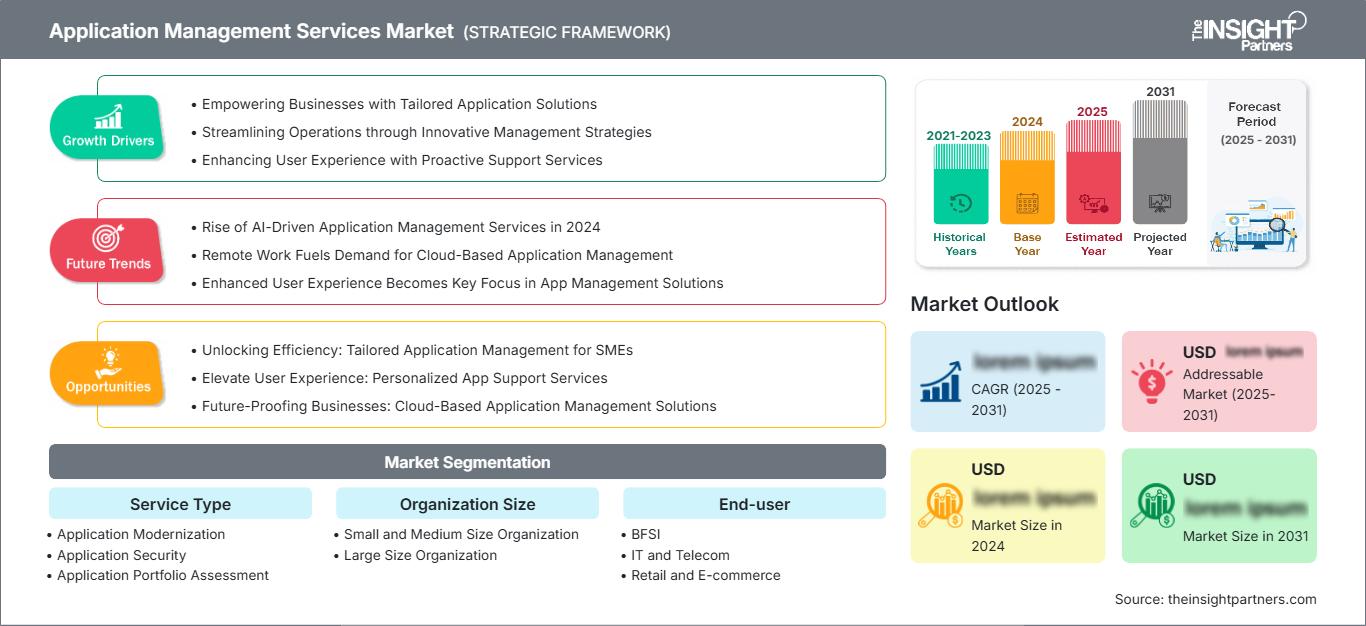
Application Management Services Market: Strategic Insights
Regional Insights
North America application management services market
North America accounted for 37–40% share in 2025 and is projected to grow at a 5.6–6.1% CAGR during 2026–2034. The region benefits from high enterprise cloud penetration, large installed bases of ERP and CRM platforms, and heavy spending on application resilience across banking, insurance, healthcare, and retail. The application management services market share is strongest where enterprises need audited support, cyber controls, and modernization roadmaps.
Demand is also shaped by talent scarcity in cloud engineering and security operations. Enterprises are consolidating vendors to reduce complexity, improve service accountability, and shift from infrastructure uptime metrics to application experience metrics. AI-assisted incident triage, automated testing, and portfolio rationalization are becoming standard contract components.
U.S. application management services Market
The U.S. represented 78–82% of North America application management services market share in 2025 and is forecast to expand at a 5.5–6.0% CAGR during 2026–2034. Growth is seen in banking, health care, telecom, retail and manufacturing, which have mission-critical applications that need constant monitoring and compliance and modernization needs. Enterprises are increasingly favoring resilient cloud operations, secure APIs and fast delivery of digital products.
Providers are abundant, and Accenture plc, International Business Machines Corporation, Cognizant Technology Solutions Corporation, Deloitte Touche Tohmatsu Limited, Infosys Limited, Tata Consultancy Services Limited and Wipro Limited provide consulting and delivery to major US clients using onshore, nearshore and global service models. Application trends include DevSecOps services, refactoring legacy applications, mainframe integration and cloud cost management.
Europe application management services Market
Europe held 24–27% share of the application management services market in 2025 and is expected to register a 5.1–5.7% CAGR during 2026–2034. The UK remains the leading country because financial institutions, retailers, utilities, and public agencies continue to modernize core applications while maintaining strict resilience requirements. Demand is reinforced by cloud sovereignty expectations and heightened cybersecurity governance across regulated sectors.
Germany follows with strong manufacturing, automotive, industrial software, and SAP-centric environments. Enterprises are using managed services to stabilize complex application landscapes, connect operational technology with enterprise systems, and migrate workloads under data protection controls. France, Italy, and Spain contribute through public sector digitization, telecom modernization, banking cloud programs, and retail platform upgrades.
APAC application management services Market
APAC captured 23–26% share in 2025 and is projected to grow at a 7.0–7.8% CAGR during 2026–2034. China is the leading country by enterprise scale, while India shows strong growth due to digital public infrastructure, cloud-first enterprises, and domestic IT services maturity.
Japan, South Korea, and Australia add demand through manufacturing modernization, telecom transformation, and financial services compliance. Policy support for digital government, cybersecurity, and industrial automation is increasing enterprise reliance on managed application operations and modernization partners.
Middle East & Africa application management services Market
The Middle East & Africa application management services market is expected to grow at a 6.5–7.2% CAGR during 2026–2034. Saudi Arabia leads due to smart city programs, energy diversification, cloud regions, and public sector digital platforms. The UAE follows with banking, aviation, logistics, and government modernization.
South Africa contributes through financial services and telecom application outsourcing, while the Rest of MEA shows selective adoption in energy, utilities, and public infrastructure. Regional buyers prioritize cybersecurity, Arabic-enabled digital services, and reliable support for cloud-hosted enterprise applications.
Segmentation Analysis
Service Type
Service Type is expected to grow at a 5.8–6.4% CAGR during 2026–2034. The application management services market scope is broadening as enterprises combine modernization, security, assessment, and managed operations within multiyear transformation programs. Demand is strongest where CIOs need lower run costs, faster releases, better application visibility, and reduced technical debt without interrupting customer-facing platforms.
- Application Modernization supports migration from monolithic and legacy architectures toward cloud-native, API-based, containerized, and microservices environments, helping enterprises improve scalability, release speed, and integration flexibility.
- Application Security is strategically important as organizations embed vulnerability management, secure coding, identity controls, compliance monitoring, and DevSecOps into application lifecycles to reduce breach exposure.
- Application Portfolio Assessment helps enterprises classify applications by business value, cost, risk, redundancy, and modernization readiness, enabling informed decisions on retention, retirement, replacement, or refactoring.
- Application Managed Services remains the largest service area because enterprises need continuous monitoring, incident management, change support, performance optimization, and service governance for mission-critical platforms.
Organization Size
Organization Size is projected to grow at a 5.9–6.5% CAGR during 2026–2034. Large enterprises dominate outsourcing value because they operate complex application estates across regions, business units, and regulatory environments. Small and medium-sized organizations are increasing adoption through cloud-based managed service bundles that reduce internal technical staffing requirements.
- Small and Medium Size Organization demand is rising as cloud applications, cybersecurity obligations, and digital commerce platforms require external support models that remain affordable, scalable, and operationally predictable.
- Large Size Organization accounts for the strongest spending intensity because distributed application portfolios require governance, automation, compliance assurance, multilingual support, and integration with enterprise transformation programs.
End-user
End-user demand is expected to grow at a 6.1–6.8% CAGR during 2026–2034. BFSI, IT and telecom, healthcare, retail, energy, and manufacturing are using managed services to protect uptime, modernize customer platforms, and integrate analytics into operational workflows. The most attractive opportunities sit where application downtime directly affects revenue, compliance, safety, or service continuity.
- BFSI leads adoption because banks and insurers depend on resilient core systems, digital channels, payment platforms, regulatory reporting, fraud controls, and secure modernization of legacy estates.
- IT and Telecom use managed application services to operate billing, customer experience, network orchestration, service assurance, and cloud platforms while accelerating 5G-enabled digital service launches.
- Retail and E-commerce demand is tied to omnichannel platforms, inventory visibility, payments, personalization engines, and peak-season uptime, making application performance a revenue-critical capability.
- Energy and Utilities requires managed support for asset management, grid operations, customer billing, field service, and compliance platforms as digital infrastructure becomes more operationally connected.
- Healthcare is the high-growth end-user as hospitals, payers, and life sciences companies modernize records, interoperability platforms, cybersecurity controls, patient engagement tools, and analytics systems.
- Manufacturing relies on application management to connect ERP, product lifecycle management, supply chain systems, industrial IoT, and plant-level applications across distributed production networks.
Opportunity Snapshot
| End-user | Revenue Contribution | Trend Tag | Adoption Stage |
| BFSI | High | Core Banking | Mature |
| IT and Telecom | High | Network Cloud | Mature |
| Retail and E-commerce | Medium | Omnichannel Ops | Scaling |
| Energy and Utilities | Medium | Grid Apps | Scaling |
| Healthcare | Medium | Clinical Cloud | Scaling |
| Manufacturing | High | Smart Factory | Scaling |
Application Management Services Market Growth Drivers and Impact Analysis
Cloud Complexity and Hybrid Application Estates
The emergence of hybrid and multicloud environments has produced a situation where today’s applications are more difficult to monitor, secure, and optimize compared to their predecessors. Businesses operate with a combination of packaged software, custom apps, SaaS connections, APIs, data platforms, and legacy systems at the same time. There has been an increased need for vendors that are capable of managing dependencies, avoiding outages, and planning proper sequencing of the migration process. The bottom line is the transition of businesses from limited maintenance arrangements to comprehensive operating models that incorporate app observability, cloud budgeting, service reliability engineering, and automation of incident management.
Security, Compliance, and Operational Resilience Pressure
Cybersecurity and regulatory considerations are turning application management into a risk control function instead of just a technology expense for a business. Banks, healthcare organizations, utility companies, and governmental agencies require services that cover vulnerability remediation, compliance attestation, secure software releases, identity management, and change management for auditing. This driver becomes highly significant if applications deal with sensitive information and/or critical infrastructure. Market consequences come from increased demand for DevSecOps services, managed application security and application resilience testing. Service providers who have cyber expertise and industry compliance knowledge will have better market positioning due to the increased importance of risk, continuity, and governance in application management.
AI-enabled Automation in Managed Operations
Operations with AI are redefining the economics of service provision through the automation of ticket categorization, root cause analysis, code review assistance, testing, and knowledge lookup. Service providers can leverage this to save on costs, respond more quickly, and shift away from routine support activities into proactive improvement initiatives. The effects of automation in the marketplace are evident in contract reconfiguration, where businesses seek to make productivity gains, cut down on repeated problems, and achieve higher-quality releases. Automation can help small businesses that previously couldn’t afford managed services due to budget constraints.
Application Management Services Market Future Trends
Agentic AI for Application Operations
The next phase of application management services market trends will be shaped by agentic AI that can recommend remediation steps, generate test cases, summarize incidents, and coordinate tasks across IT service management tools. These systems will not fully replace engineers, but they will reshape support workflows by reducing routine diagnostics and improving knowledge reuse. Providers are expected to package AI agents into managed operations platforms with governance, audit trails, and domain-specific rules. Adoption will be strongest in large enterprises with mature observability data, standardized processes, and sufficient confidence in automated recommendations.
Outcome-based and Experience-led Contracts
Future contracts will tend more towards tying provider compensation to business-oriented metrics, including application availability, deployment speed, user experience, incidents reduced, and cloud cost efficiency. The market will move away from input-based staffing models to one of joint responsibility for service quality. Experience-based agreements will become relevant in situations where digital channels have an impact on customer retention or revenue generation. Providers that can track their business value and not just availability will be the ones to stand out.
Application Management Services Market Opportunities
Modernization of Regulated Core Platforms
Regulated sectors offer high-value opportunities because many firms still depend on aging applications that cannot be retired quickly. Banks, insurers, hospitals, utilities, and government agencies need structured modernization programs that reduce risk while keeping essential services available. The application management services market Forecasts indicate that providers can capture demand by combining portfolio assessment, security remediation, cloud migration, and managed run services. Investment should focus on reusable compliance frameworks, migration factories, and domain-specific accelerators. Vendors able to modernize without service disruption will be better positioned for long-duration transformation contracts.
Mid-market Managed Service Bundles
There is a growing opportunity in small to medium enterprises due to the decreasing costs associated with delivering managed services via cloud computing technologies. The vast majority of these companies do not have an in-house capability for cybersecurity, applications integration, performance monitoring, and release management, but are increasingly dependent upon digital systems for their sales, financial, operational, and customer services activities. Providers can leverage this opportunity via modular packages of services, automated monitoring, standardized security procedures, and industry-specific templates. The greatest opportunity will be found among healthcare firms, regional banks, e-commerce firms, and manufacturing companies.
Frequently Asked Questions

- Comprehensive Market Sizing and Forecast Analysis
- Detailed Segmentation Analysis
- In-Depth Market Dynamics Assessment
- Regional and Country-Level Insights
- Competitive Landscape and Company Benchmarking
- Strategic Business Intelligence
Recent Reports
Testimonials

The Insight Partners provided valuable market intelligence that supported our global go-to-market strategy. Their team was professional, responsive, and attentive to our feedback, providing thoughtful analysis and helpful methodological clarifications throughout the project.
Junmo Kim Chief Financial Officer (CFO), Enertech Co., Ltd.
The Insight Partners' SCADA System Market report is comprehensive, with valuable insights on current trends and future forecasts. The team was highly professional, responsive, and supportive throughout. We are very satisfied and highly recommend their services.
RAN KEDEM Partner, Reali Technologies LTDs
I requested a report on a very specific software market and the team produced the report in a few days. The information was very relevant and well presented. I then requested some changes and additions to the report. The team was again very responsive and I got the final report in less than a week.
JEAN-HERVE JENN Chairman, Future Analytica
We worked with The Insight Partners for an important market study and forecast. They gave us clear insights into opportunities and risks, which helped shape our plans. Their research was easy to use and based on solid data. It helped us make smart, confident decisions. We highly recommend them.
PIYUSH NAGPAL Sr. Vice President, High Beam Global
The Insight Partners delivered insightful, well-structured market research with strong domain expertise. Their team was professional and responsive throughout. The user-friendly website made accessing industry reports seamless. We highly recommend them for reliable, high-quality research services
YUKIHIKO ADACHI CEO, Deep Blue, LLC.
This is the first time I have purchased a market report from The Insight Partners.While I was unsure at first, I visited their web site and felt more comfortable to take the risk and purchase a market report.I am completely satisfied with the quality of the report and customer service. I had several questions and comments with the initial report, but after a couple of dialogs over email with their analyst I believe I have a report that I can use as input to our strategic planning process.Thank you so much for taking the extra time and making this a positive experience.I will definitely recommend your service to others and you will be my first call when we need further market data.
JOHN SUZUKI President and Chief Executive Officer, Board Director, BK Technologies
I wish to appreciate your support and the professionalism you displayed in the course of attending to my request for information regarding to infectious disease IVD market in Nigeria. I appreciate your patience, your guidance, and the fact that you were willing to offer a discount, which eventually made it possible for us to close a deal. I look forward to engaging The Insight Partners in the future, all thanks to the impression you have created in me as a result of this first encounter.
DR CHIJIOKE ONYIA MANAGING DIRECTOR, PineCrest Healthcare Ltd.Reason to Buy
- Informed Decision-Making
- Understanding Market Dynamics
- Competitive Analysis
- Identifying Emerging Markets
- Customer Insights
- Market Forecasts
- Risk Mitigation
- Boosting Operational Efficiency
- Strategic Planning
- Investment Justification
- Tracking Industry Innovations
- Aligning with Regulatory Trends





 Get Free Sample for