
Automated Infrastructure Management Solutions Market Size, Growth & Trends by 2034
Coverage: By Application (Incident Management, Device Discovery, and Asset Management), End-user (IT and Telecom, BFSI, Data Centers, Energy and Utilities, Government, Manufacturing, and Others), and Geography
- Status : Data Released
- Report Code : TIPRE00010647
- Category : Technology, Media and Telecommunications
- No. of Pages : 150
- Available Report Formats :


- Last update date : August 19, 2026


2025 Market Size
US$ 5.32 Bn
Base year value
2034 Forecast
US$ 17.53 Bn
Projected by 2034
CAGR 2026-2034
14.17 %
Growth rate
Addressable Market
US$ 98.41 Bn
(2026-2034)
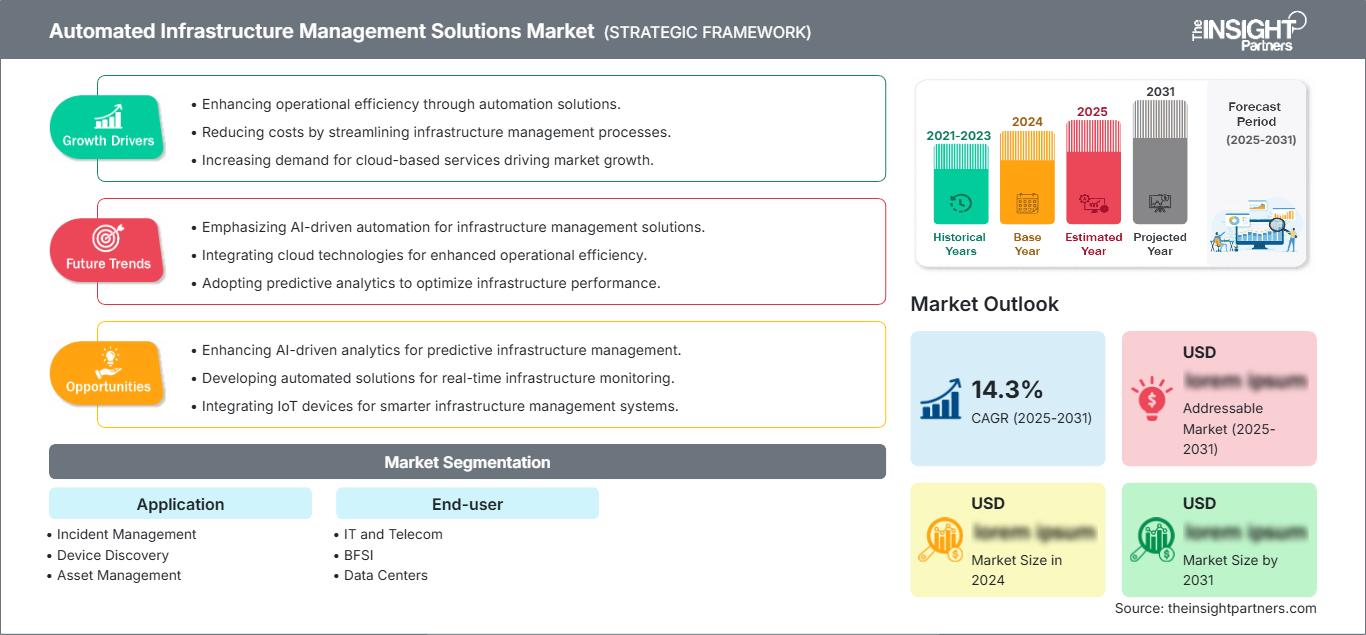
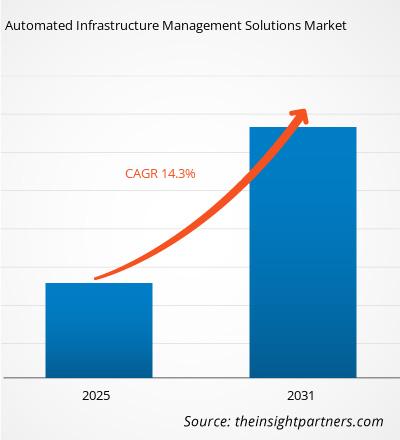
The automated infrastructure management solutions market is projected to grow from US$ 5.32 Billion in 2025 to US$ 17.53 Billion by 2034, registering a CAGR of 14.17% during 2026–2034. Demand is being shaped by enterprises that need automated visibility across networks, data centers, hybrid IT estates, and physical infrastructure, while reducing downtime, manual errors, and fragmented asset records.
North America is expected to remain a major revenue contributor as hyperscale capacity, cloud modernization, AI workload density, and regulatory expectations increase the need for automated infrastructure management solutions market size expansion. Regional adoption is supported by data center vacancy constraints, rising power-density requirements, and enterprise demand for platforms that connect asset discovery, incident response, and lifecycle planning.
Automated Infrastructure Management Solutions Market Assessment and Insights
- North America: Estimated at 34–38% share in 2025, growing at a CAGR range of 13.5–15.5% during 2026–2034, supported by hyperscale data centers, AI workloads, and infrastructure modernization.
- U.S.: Estimated at 72–78% of North America share in 2025, growing at 13.8–15.8% CAGR, led by cloud, colocation, telecom, and enterprise IT automation investments.
- Europe: Estimated at 24–28% share in 2025, growing at 12.5–14.5% CAGR, with the UK, Germany, France, Netherlands, and Nordics leading resilient infrastructure adoption.
- Asia Pacific: Estimated at 25–29% share in 2025, growing at 15.0–17.0% CAGR, supported by China, Japan, India, South Korea, Singapore, and Australia.
- Largest Segment: Asset Management held an estimated 40–44% market share in 2025 and is expected to grow at 13.8–15.2% CAGR due to asset visibility requirements.
- High Growth Segment: Device Discovery held an estimated 27–31% share in 2025 and is expected to grow at 15.5–17.5% CAGR as distributed infrastructure complexity increases.
- Key companies analyzed in detail: Broadcom Inc., Cisco Systems, Inc., CommScope Holding Company, Inc., CSS Corp Private Limited, Fujitsu Limited, Hewlett Packard Enterprise Development LP, IBM Corporation, Ivanti, Inc., Microsoft Corporation, The Siemon Company, SAP SE, Flexera Software LLC, ManageEngine, LogicMonitor, Inc., ScienceLogic, Inc., HashiCorp, Inc., CloudBolt Software, Inc., Dynatrace LLC, and Splunk LLC.
Source: The Insight Partners' analysis based on proprietary research, government publications, company annual reports, investor presentations, industry databases, and expert interviews.
The market development process has evolved beyond physical layer monitoring and now includes integrated infrastructure intelligence. Former implementations included cabling documentation, port-level visibility, and data center asset management. The current generation includes automated discovery, topology mapping, incident correlation, policy workflow, and service management integration. This is causing changes in the purchase decision process from single monitoring solutions to unified operation platform solutions that can ensure uptime, compliance, capacity management, and automation within hybrid enterprise environments.
Future demand is predicted to rise due to the standardized market growth approach to AI-based operations, edge sites, low-latency facilities, and strict energy management. Companies' investments will be shifted from infrastructure monitoring systems to proactive maintenance, workload-driven capacity management, and automation. Future markets will benefit because of the rising importance of data sovereignty, the digitization of industries, and telecoms infrastructure modernization.
Automated Infrastructure Management Solutions Market Report Scope
| Report Attribute | Details |
|---|---|
| Market size in 2025 | US$ 5.32 Billion |
| Market Size by 2034 | US$ 17.53 Billion |
| Global CAGR (2026 - 2034) | 14.17% |
| Historical Data | 2021-2024 |
| Forecast period | 2026-2034 |
Automated Infrastructure Management Solutions Market Analysis
Demand is driven by the following factors: infrastructure complexity, economics of uptime, and connecting IT with facility insights. Enterprises are provisioning cloud connectivity, network equipment, power systems, distributed applications, and compliance documentation in various settings. In the market analysis, it was found that buyers prefer tools that minimize the need for manual reconciliations, speed up response to incidents, and provide a trustworthy source of asset truth.
The supply factors include the following: software-based differentiation, system integrations, and partnerships within data center, telecommunication, and enterprise IT communities. Vendors are introducing AI analytics capabilities, workflow automations, APIs, and cybersecurity-aware monitoring capabilities into their platforms to stay relevant. Hardware-centric AIM vendors continue serving structured cabling and physical infrastructure needs, whereas software players expand their footprint through cloud monitoring and service management integrations.
Competitors include major technology vendors and specialist infrastructure vendors. The competitors of the company include Cisco Systems, Inc., IBM Corporation, Microsoft Corporation, Hewlett Packard Enterprise Development LP, Broadcom Inc., and Fujitsu Limited. They compete using enterprise platforms, cloud integrations, and the level of network automation. The companies that help improve the physical layer visibility include CommScope Holding Company, Inc., The Siemon Company, and related specialists. The companies that provide monitoring, observability, and operational intelligence include Dynatrace LLC, Splunk LLC, LogicMonitor, Inc., ScienceLogic, Inc., Flexera Software LLC, and ManageEngine.
Investment trends reveal that buyers want the solutions that allow correlating the infrastructure health with business services. The buyers need fast deployment, flexibility in licensing, integration with IT service management, and better analytics for resilience. The vendors that provide asset precision, predictive analysis, and workflows are likely to meet the needs of data centers, telecommunication providers, BFSI, utilities, government organizations, and manufacturers.
● REPORT CUSTOMIZATION
Tailor This Report To Align With Your Specific Business Requirements
This report can be customized to align precisely with your business objectives, scope, and target markets. Customization options include tailored segmentation, geography, competitive analysis, and strategic insights to support informed decision-making.
Customize This Report →WHAT YOU CAN ADJUST
- ● Segmentations
- ● Geography
- ● Competitive Analysis
- ● Language Preferences
Automated Infrastructure Management Solutions Market: Strategic Insights
Regional Insights
North America automated infrastructure management solutions market
North America is estimated to account for 34–38% share in 2025 and grow at 13.5–15.5% CAGR during 2026–2034. Data center construction, hyperscale preleasing, AI workload intensity, and constrained availability are increasing the need for infrastructure automation, capacity visibility, and predictive operations.
The automated infrastructure management solutions market share in the region is reinforced by mature cloud ecosystems, strong colocation demand, and enterprise modernization budgets. Organizations are adopting AIM platforms to reduce downtime, improve asset traceability, manage energy-sensitive infrastructure, and align IT operations with business continuity expectations.
U.S. automated infrastructure management solutions Market
The U.S. is estimated to represent 72–78% of North America's share in 2025 and grow at 13.8–15.8% CAGR during 2026–2034. Adoption is concentrated in hyperscale cloud, telecom networks, BFSI infrastructure, federal modernization programs, and large enterprise campuses requiring accurate asset intelligence.
Company presence is broad, with Cisco Systems, Inc., IBM Corporation, Microsoft Corporation, Hewlett Packard Enterprise Development LP, Dynatrace LLC, Splunk LLC, and LogicMonitor, Inc. supporting automation-led operations. Application demand is strongest in asset management, incident management, and device discovery across hybrid IT environments.
Europe automated infrastructure management solutions Market
Europe is estimated at 24–28% share in 2025 and is expected to grow at 12.5–14.5% CAGR during 2026–2034. Growth is shaped by data sovereignty, regulated industries, resilient network operations, and sustainability reporting across the UK, Germany, France, Italy, Spain, the Netherlands, and Nordic markets.
Germany and the UK are leading adopters due to advanced manufacturing, financial services, cloud regions, and telecom modernization. France, Italy, and Spain provide steady demand through government digitization and enterprise infrastructure upgrades. Buyers emphasize compliance, energy visibility, and integrated operational control.
APAC automated infrastructure management solutions Market
APAC is estimated to hold 25–29% share in 2025 and grow at 15.0–17.0% CAGR during 2026–2034. China, Japan, South Korea, India, Singapore, and Australia are expanding cloud regions, telecom capacity, industrial digitization, and smart infrastructure programs.
China and India are expected to drive volume growth, while Japan, South Korea, Singapore, and Australia emphasize resilient operations and regulated infrastructure quality. Industrial automation, 5G, edge computing, and data center investment are strengthening platform demand.
Middle East & Africa automated infrastructure management solutions Market
The Middle East & Africa is expected to grow at 12.0–14.0% CAGR during 2026–2034. Saudi Arabia, the UAE, and South Africa are leading adoption through data center projects, smart city infrastructure, energy sector digitization, and government transformation initiatives.
Regional buyers value automated visibility because infrastructure is becoming more distributed and mission-critical. Telecom expansion, oil and gas digitalization, and national cloud strategies support demand for incident management, asset management, and device discovery platforms.
Segmentation Analysis
Application
The Application segment is expected to grow at 14.0–16.0% CAGR during 2026–2034. The Automated Infrastructure Management Solutions Market Report highlights that the market scope across applications is expanding as enterprises shift from manual inventory and disconnected monitoring toward automated workflows. Incident management supports resilience, device discovery improves infrastructure accuracy, and asset management enables lifecycle control across data centers, telecom networks, and enterprise facilities.
- Incident Management: Demand is rising as organizations need faster detection, correlation, escalation, and remediation of infrastructure faults that can affect network availability and critical digital services.
- Device Discovery: This sub-segment is gaining strategic relevance as hybrid infrastructure, edge nodes, cloud-linked assets, and connected devices create continuous change across enterprise environments.
- Asset Management: Asset management remains the largest application area because operators need accurate records, lifecycle planning, capacity visibility, and compliance-ready infrastructure documentation.
End-user
The End-user segment is expected to grow at 13.5–15.5% CAGR during 2026–2034. Adoption differs by infrastructure intensity, regulatory pressure, and uptime requirements. IT and telecom lead early deployment, while BFSI, data centers, energy and utilities, government, and manufacturing increasingly use AIM platforms to control risk, improve utilization, and support digital operations.
- IT and Telecom: Operators use AIM tools to manage dense networks, reduce configuration errors, support service assurance, and improve visibility across hybrid and distributed infrastructure.
- BFSI: Financial institutions prioritize infrastructure resilience, auditability, incident response, and asset traceability because outages and compliance failures can carry material business risk.
- Data Centers: Data centers require automated visibility across racks, ports, power, cooling, and connected assets to improve capacity utilization and reduce operational downtime.
- Energy and Utilities: Utilities adopt AIM platforms to support grid digitalization, operational continuity, remote site visibility, and secure management of critical infrastructure assets.
- Government: Public agencies use automation to modernize legacy infrastructure, standardize asset records, strengthen cybersecurity oversight, and improve continuity for citizen services.
- Manufacturing: Manufacturers rely on AIM solutions to connect production networks, operational technology assets, maintenance workflows, and plant-level infrastructure resilience.
Opportunity Snapshot
| End-user | Revenue Contribution | Trend Tag | Adoption Stage |
| IT and Telecom | High | Network Automation | Mature |
| BFSI | Medium | Resilience Control | Scaling |
| Data Centers | High | Capacity Visibility | Scaling |
| Energy and Utilities | Medium | Grid Monitoring | Scaling |
| Government | Medium | Legacy Modernization | Emerging |
| Manufacturing | Medium | Plant Connectivity | Scaling |
Automated Infrastructure Management Solutions Market Growth Drivers and Impact Analysis
Rising Infrastructure Complexity Across Hybrid IT Estates
Organizations are running on-premises data centers, cloud regions, colocation centers, branch offices, industrial environments, and edge deployments. All of these create challenges around incomplete asset management, delayed incident response, and poor capacity planning. AIM solutions solve all of these challenges through automated discovery, dependency management, and linking infrastructure change to operational processes. The outcome is improved continuity of service, less manual labor, and improved accountability.
Data Center Expansion and AI Workload Density
AI workloads, cloud services, power limitations, and low vacancy rates in the main market areas have put more pressure on data centers. In such a scenario, it becomes essential for them to have an infrastructure visibility capability so that they get the right insight about where the assets are located, how well they are being utilized, their connectivity status, and their impact on any faults.
Operational Resilience and Compliance Requirements
Sectors like BFSI, government, energy, utilities, and telecom need better evidence of their infrastructure control. The manual nature of record-keeping and the use of separate tools lead to audit loopholes, response-time inefficiencies, and service assurance discrepancies. The use of AIM systems improves the resilience of organizations by ensuring proper infrastructure inventory, automated alerts, compliance support, and change management. With infrastructure becoming increasingly important for revenue and safety, automation is gradually turning into a risk-control necessity.
Automated Infrastructure Management Solutions Market Future Trends
AI-Native Infrastructure Operations
Automated infrastructure management solutions market trends are moving toward AI-native operations that can identify abnormal behavior, predict failure patterns, and recommend remediation actions before service disruption occurs. Future platforms will increasingly correlate asset intelligence with logs, events, configuration changes, energy usage, and business-service impact. This will help infrastructure teams move from dashboard monitoring to decision support. Vendors that provide explainable recommendations, integration flexibility, and measurable downtime reduction will gain stronger enterprise relevance.
Edge Infrastructure and Distributed Asset Control
Edge computing, 5G, industrial automation, and regional AI inference are creating infrastructure footprints outside traditional centralized facilities. This trend will increase demand for AIM platforms that support remote discovery, automated configuration visibility, and lifecycle control across smaller distributed sites. Operators will need consistent asset data, security context, and incident workflows across hundreds or thousands of locations. Scalable cloud-based AIM deployment models are expected to benefit from this transition.
Automated Infrastructure Management Solutions Market Opportunities
Integrated Data Center and IT Operations Platforms
Automated infrastructure management solutions market Forecasts indicate a strong opportunity for vendors that connect AIM, DCIM, observability, IT service management, and cybersecurity workflows. Many organizations still operate separate tools for physical assets, application health, network monitoring, and incident tickets. Integrated platforms can reduce operational silos and improve decision speed. Vendors should prioritize open APIs, prebuilt connectors, deployment templates, and analytics that show measurable gains in uptime, utilization, and operational efficiency.
Automation for Regulated and Asset-Intensive Sectors
High-value opportunities exist in BFSI, utilities, government, telecom, and manufacturing because these sectors manage critical infrastructure with strict uptime, security, and audit requirements. AIM providers can tailor solutions around compliance reporting, change governance, operational technology visibility, and disaster recovery readiness. Vertical-specific packages can shorten buying cycles by aligning features with sector risks. This approach also supports premium pricing where infrastructure failures have significant financial, safety, or service continuity consequences.
Frequently Asked Questions

- Comprehensive Market Sizing and Forecast Analysis
- Detailed Segmentation Analysis
- In-Depth Market Dynamics Assessment
- Regional and Country-Level Insights
- Competitive Landscape and Company Benchmarking
- Strategic Business Intelligence
Recent Reports
Testimonials

The Insight Partners' SCADA System Market report is comprehensive, with valuable insights on current trends and future forecasts. The team was highly professional, responsive, and supportive throughout. We are very satisfied and highly recommend their services.
RAN KEDEM Partner, Reali Technologies LTDs
I requested a report on a very specific software market and the team produced the report in a few days. The information was very relevant and well presented. I then requested some changes and additions to the report. The team was again very responsive and I got the final report in less than a week.
JEAN-HERVE JENN Chairman, Future Analytica
We worked with The Insight Partners for an important market study and forecast. They gave us clear insights into opportunities and risks, which helped shape our plans. Their research was easy to use and based on solid data. It helped us make smart, confident decisions. We highly recommend them.
PIYUSH NAGPAL Sr. Vice President, High Beam Global
The Insight Partners delivered insightful, well-structured market research with strong domain expertise. Their team was professional and responsive throughout. The user-friendly website made accessing industry reports seamless. We highly recommend them for reliable, high-quality research services
YUKIHIKO ADACHI CEO, Deep Blue, LLC.
This is the first time I have purchased a market report from The Insight Partners.While I was unsure at first, I visited their web site and felt more comfortable to take the risk and purchase a market report.I am completely satisfied with the quality of the report and customer service. I had several questions and comments with the initial report, but after a couple of dialogs over email with their analyst I believe I have a report that I can use as input to our strategic planning process.Thank you so much for taking the extra time and making this a positive experience.I will definitely recommend your service to others and you will be my first call when we need further market data.
JOHN SUZUKI President and Chief Executive Officer, Board Director, BK Technologies
I wish to appreciate your support and the professionalism you displayed in the course of attending to my request for information regarding to infectious disease IVD market in Nigeria. I appreciate your patience, your guidance, and the fact that you were willing to offer a discount, which eventually made it possible for us to close a deal. I look forward to engaging The Insight Partners in the future, all thanks to the impression you have created in me as a result of this first encounter.
DR CHIJIOKE ONYIA MANAGING DIRECTOR, PineCrest Healthcare Ltd.Reason to Buy
- Informed Decision-Making
- Understanding Market Dynamics
- Competitive Analysis
- Identifying Emerging Markets
- Customer Insights
- Market Forecasts
- Risk Mitigation
- Boosting Operational Efficiency
- Strategic Planning
- Investment Justification
- Tracking Industry Innovations
- Aligning with Regulatory Trends





 Get Free Sample for