
Application Processor Market Demand, Size & Forecast by 2034
Coverage: by Device Type (Mobile Phones, PC Tablets, Smart Wearables, Automotive ADAS and Infotainment Systems); Core Type (Octa-core, Hexa-core, Quad-core, Dual-core, Single-core); Industry Vertical (Consumer Electronics, Automotive, Others) , and Geography (North America, Europe, Asia Pacific, and South and Central America)
- Status : Data Released
- Report Code : TIPRE00010754
- Category : Electronics and Semiconductor
- No. of Pages : 150
- Available Report Formats :


- Last update date : July 15, 2026


2025 Market Size
US$ 34.35 Bn
Base year value
2034 Forecast
US$ 63.08 Bn
Projected by 2034
CAGR 2026-2034
6.99 %
Growth rate
Addressable Market
US$ 440.02 Bn
(2026-2034)
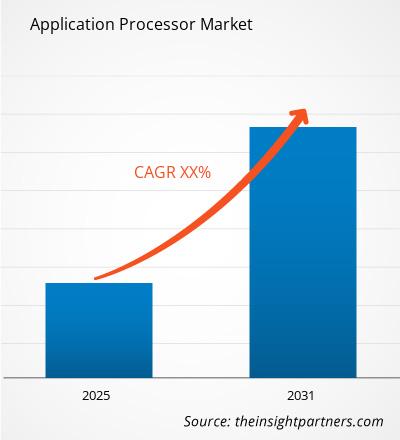
The Application Processor Market is projected to grow from US$ 34.35 Billion in 2025 to US$ 63.08 Billion by 2034, registering a CAGR of 6.99% during 2026–2034. Expansion is supported by rising demand for high-performance mobile computing, AI-enabled edge devices, smart wearables, PC tablets, and automotive ADAS and infotainment systems that require efficient multi-core processing, graphics acceleration, and secure connectivity.
North America is expected to advance at a CAGR range of 6.2–6.8% between 2026 and 2034, driven by premium smartphone refresh cycles, AI PCs, software-defined vehicles, and strong semiconductor design ecosystems. Application Processor Market size is reinforced by automotive digital cockpit programs, edge-AI workloads, and OEM partnerships that integrate application processors into connected mobility, infotainment, and safety-focused computing platforms.
Application Processor Market Assessment and Insights
- North America held 28–31% share in 2025 and is expected to grow at a CAGR range of 6.2–6.8% during 2026–2034, supported by AI PCs, premium devices, and automotive cockpit computing.
- The US represented 78–82% of North America in 2025 and is projected to grow at a CAGR range of 6.3–6.9%, reflecting strong semiconductor design, automotive software, and device ecosystems.
- Europe accounted for 18–21% share in 2025 and is forecast to grow at a CAGR range of 5.8–6.4%, with Germany, the UK, and France leading automotive and industrial adoption.
- Asia Pacific captured 43–47% share in 2025 and is expected to grow at a CAGR range of 7.4–8.1%, led by China, South Korea, Japan, India, and Taiwan-linked manufacturing scale.
- Largest Segment: Mobile Phones held 58–62% market share in 2025 and is expected to grow at a CAGR range of 6.4–7.0%, reflecting premium smartphone and AI handset demand.
- High Growth Segment: Automotive ADAS and Infotainment Systems held 9–12% market share in 2025 and is expected to grow at a CAGR range of 9.2–10.4%, driven by centralized vehicle compute.
- Key companies analyzed in detail: Apple Inc., Huawei Technologies Co., Ltd., MediaTek Inc., NVIDIA Corporation, NXP Semiconductors N.V., Qualcomm Incorporated, Samsung Electronics Co., Ltd., Texas Instruments Incorporated, UNISOC Communications Inc., Xiaomi Corporation.
Source: The Insight Partners' analysis based on proprietary research, government publications, company annual reports, investor presentations, industry databases, and expert interviews.
Application processors have evolved from smartphone-centric SoCs into heterogeneous computing platforms combining CPUs, GPUs, neural processors, image processors, modems, and secure enclaves. The Application Processor Market forecast indicates that foundry migration to advanced nodes, chiplet exploration, and stronger software stacks are reshaping production economics. Device makers increasingly balance performance per watt, AI acceleration, thermal limits, and supply assurance, making processor roadmaps central to product differentiation.
Over the forecast period, emerging geographies will contribute more demand through affordable 5G smartphones, localized electronics assembly, and connected vehicle programs. Regulatory support for vehicle safety, data privacy, and domestic semiconductor capacity will influence sourcing decisions. The Application Processor Market report highlights that growth remains strongest where OEMs align processor selection with AI features, battery efficiency, multimedia quality, and long software-support cycles.
Application Processor Market Report Scope
| Report Attribute | Details |
|---|---|
| Market size in 2025 | US$ 34.35 Billion |
| Market Size by 2034 | US$ 63.08 Billion |
| Global CAGR (2026 - 2034) | 6.99% |
| Historical Data | 2021-2024 |
| Forecast period | 2026-2034 |
Application Processor Market Analysis
Demand is anchored in smartphones, tablets, wearables, and vehicles requiring real-time graphics, AI inference, imaging, and connectivity. The Application Processor Market size expansion reflects higher silicon value per device as OEMs integrate larger NPUs, advanced camera pipelines, and modem-ready architectures. ADAS and Infotainment in automotive applications create longer qualification cycles but increased design stability.
The value chain includes IP suppliers, EDA suppliers, foundries, subcontracted assembly, OS suppliers, module suppliers, and OEMs. The supply chain remains dependent on advanced node capability, availability of packaging, and geopolitical sources. Semiconductor suppliers who can source from foundries and refine reference designs see higher attach rates.
The competition is focused on companies that possess expertise in architecture, software, and customer design. Qualcomm Incorporated and MediaTek Inc. compete in the market for Android smartphones and car cockpits, while Apple Inc. and Samsung Electronics Co., Ltd. focus on silicon vertical integration. The players NVIDIA Corporation and NXP Semiconductors N.V. develop their competitive position in vehicles and edge-AI through computing in domains.
The investment trend is shifting towards accelerators for AI, advanced packaging, automotive-grade technology, and software development tools. Texas Instruments Incorporated, UNISOC Communications Inc., Huawei Technologies Co., Ltd., and Xiaomi Corporation expand their competitive positions through embedded computing, domestic ecosystem, and device optimization. Application Processor Market trends increasingly reward vendors that combine silicon performance with lifecycle software support.
● REPORT CUSTOMIZATION
Tailor This Report To Align With Your Specific Business Requirements
This report can be customized to align precisely with your business objectives, scope, and target markets. Customization options include tailored segmentation, geography, competitive analysis, and strategic insights to support informed decision-making.
Customize This Report →WHAT YOU CAN ADJUST
- ● Segmentations
- ● Geography
- ● Competitive Analysis
- ● Language Preferences
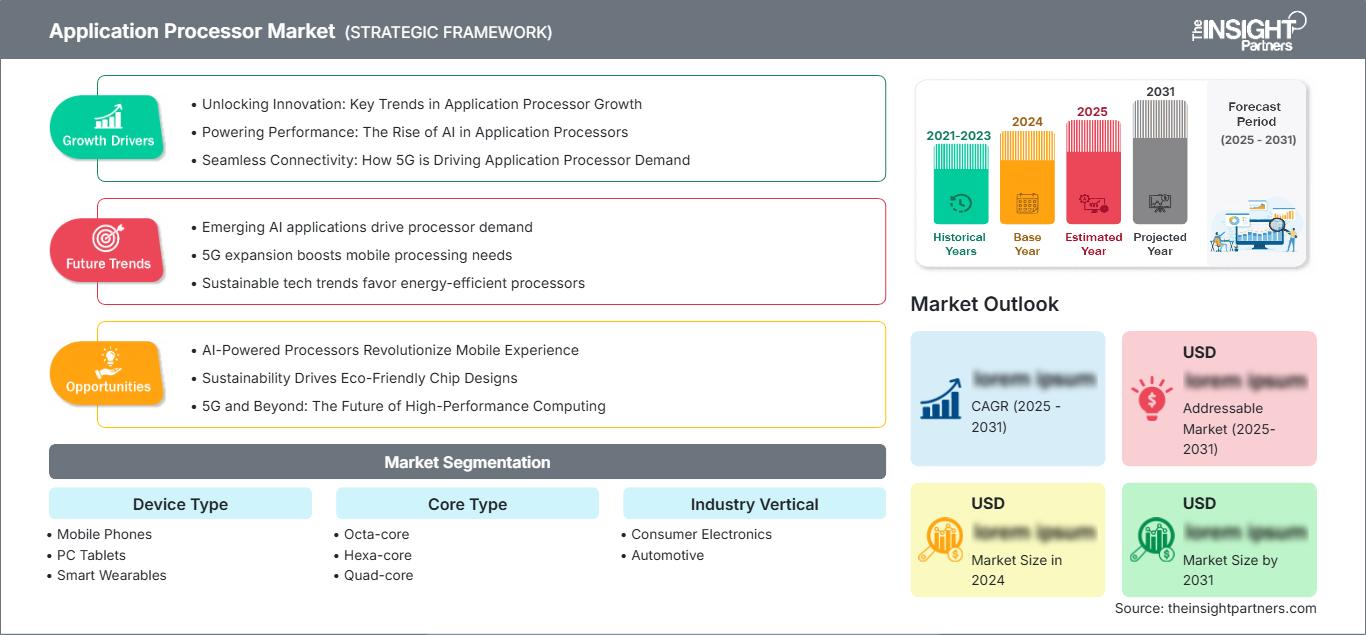
Application Processor Market: Strategic Insights
Regional Insights
North America Application Processor Market
North America held 28–31% share in 2025 and is expected to grow at a CAGR range of 6.2–6.8%. The region benefits from premium consumer electronics adoption, AI-enabled PC demand, connected vehicle programs, and strong processor design centers. Semiconductor policy support and cloud-to-edge AI development improve commercialization pathways.
Automotive demand is particularly relevant as infotainment, ADAS, and digital cockpit platforms converge. The Application Processor Market share in North America is supported by automaker partnerships, Tier-1 validation programs, and software-defined vehicle investment. High replacement value in smartphones and tablets sustains a stable baseline demand.
U.S. Application Processor Market
The US represented 78–82% of North America in 2025 and is expected to grow at a CAGR range of 6.3–6.9%. The presence of strong companies such as Apple Inc., Qualcomm Incorporated, NVIDIA Corporation, and Texas Instruments Incorporated is a good indication of design leadership in mobile, PC, automotive, and embedded computing workloads.
Applications focus on AI assistants, image processing, on-device privacy, in-car personalization, and low-latency infotainment. Automotive manufacturers and technology providers are embedding processors in cockpit displays, driver monitoring, and ADAS domain controllers, thus making the USA a critical design and demand center.
Europe Application Processor Market
Europe accounted for 18–21% share in 2025 and is forecast to grow at a CAGR range of 5.8–6.4%. Germany continues to be the market leader due to the requirement of automotive-grade processors from premium car makers, Tier-1 car suppliers, and industrial electronics manufacturers for digital cockpit architecture, safety, and electrified cars.
The UK market has a strong influence from connected mobility, AI software engineering, and the adoption of premium consumer devices. The demand from the market is not as manufacturing-driven as that from Germany. Still, it has advantages from design services, automotive software testing, and enterprise tablets used in healthcare, logistics, and finance.
France, Italy and Spain are key contributors in terms of automotive electronics, telecom retail, and digitalization of industry. France focuses on safety systems and aerospace-related electronics, Italy helps in embedded and vehicle-related electronics, whereas Spain has an edge in automotive assembly and the consumer electronics replacement cycle.
APAC Application Processor Market
APAC captured 43–47% share in 2025 and is expected to grow at a CAGR range of 7.4–8.1%. China ranks number one because of smartphone size, semiconductor efforts in China, EV manufacturing, and connected cockpits.
Japan and South Korea add value because of their luxury phones, displays, automotive electronics, and memory ecosystems. India provides volume growth in terms of local electronics manufacture, 5G implementation, and cheap phones, driving up application processor needs.
Australia stays small but contributes with its tablets, wearables, and fleet connectivity solutions. Industrial policies from APAC encourage more local assembly, while EV and smart mobility initiatives push for application processor adoption in infotainment and driver assistance systems.
Middle East & Africa Application Processor Market
The Middle East & Africa are expected to grow at a CAGR range of 5.4–6.1%, with the UAE leading technology adoption through smart city infrastructure, premium device uptake, and connected mobility programs.
The Saudi government stimulates the need for demand using technology in the government sector, the advancement of automotive retail, and infrastructure projects. Digitization of the energy sector creates a need for tablets, rugged devices, and edge computing solutions that require efficient processing.
In South Africa and the rest of MEA, growth is driven by the adoption of smartphones, telematics, and public communication programs. Growth is uneven, but processor demand is growing due to 4G and 5G expansion.
Segmentation Analysis
Device Type
The Device Type segment is expected to grow at a CAGR range of 6.7–7.3% during 2026–2034. Demand is driven by smartphones, tablets, wearables, and vehicles that require integrated compute, graphics, AI, and connectivity. The Application Processor Market scope is widening as device makers use processor capability to differentiate cameras, battery life, gaming, cockpit displays, and secure user experiences.
- Mobile Phones continue to lead the sub-segments due to higher-end smartphones incorporating powerful NPU, camera processors, and multi-core architecture support for gaming, AI assistants, and high-definition cameras.
- PC Tablets become relevant due to the hybrid nature of working and learning and AI productivity use cases, with processor choice being dictated by considerations such as battery life, graphics support, application compatibility, and corporate security.
- Smart Wearables need small and energy-efficient processors that can support sensor fusion, health monitoring, voice interaction, and continuous connectivity while extending battery life.
- Automotive ADAS and Infotainment Systems become strategically significant due to the convergence of cockpit management, navigation, driver monitoring, and safety into powerful and high-performance SoCs qualified for long automotive lifecycles.
Core Type
The Core Type segment is expected to grow at a CAGR range of 6.5–7.1% during 2026–2034. Multi-core architectures dominate because they distribute workloads across performance and efficiency cores, enabling thermal control and longer battery life. Octa-core and hexa-core designs are favored in smartphones and tablets, while simpler configurations remain relevant for cost-sensitive or embedded devices.
- Octa-core processors dominate premium and mainstream products by integrating performance and efficiency cores to enable multitasking, gaming, artificial intelligence imaging, and power management on both mobile and tablet products.
- Hexa-core processors cater to balanced performance classes where manufacturers seek a compromise between costs, thermal characteristics, power consumption, and media quality without sacrificing application responsiveness.
- Quad-core processors have their place in entry-level products, industrial tablets, and embedded products where performance predictability, reduced power consumption, and cost management matter more than performance itself.
- Dual-core processors are aimed at simple connected products and legacy applications, providing sufficient control processing power, simpler software development, and lower bill of materials.
- Single-core processors target specific embedded solutions where extremely low cost, low power consumption, and firmware execution are more valuable than graphical capabilities and AI.
Industry Vertical
The Industry Vertical segment is expected to grow at a CAGR range of 6.8–7.5% during 2026–2034. Consumer electronics remains the revenue anchor, while automotive generates faster silicon value growth through safety, infotainment, and software-defined vehicle requirements. Vendors increasingly tailor processors for vertical-specific reliability, multimedia, AI inference, and security expectations.
- Consumer Electronics dominates unit demand as smartphones, tablets, wearables, and connected devices require processors that improve user experience, battery performance, camera quality, and local AI functionality.
- Automotive is becoming a higher-value vertical as ADAS, digital cockpit, telematics, and in-cabin intelligence require reliable processors with long lifecycle support and automotive-grade validation.
Opportunity Snapshot
| Segment Name | Revenue Contribution | Trend Tag | Adoption Stage |
| Consumer Electronics | High | On-device AI | Mature |
| Automotive | Medium | Smart Cockpit | Scaling |
Application Processor Market Growth Drivers and Impact Analysis
Rising Edge AI Workloads in Consumer Devices
AI processing on device increases processor complexity since modern smartphones, tablets, and wearables need to perform language processing, computer vision, translation, health diagnostics, and other machine learning tasks on-device. As a result, the focus shifts from plain performance of the CPU to performance of integrated NPUs, bandwidth, and secure execution. Market effects include a higher average selling price for advanced SoC processors, accelerated upgrades of premium devices, and better positioning of OEMs offering AI functions that work independently of cloud services.
Software-Defined Vehicle Architectures
The automobile’s platforms are shifting from distributed control units to centralized computing for applications like cockpit, navigation, driver monitoring, connectivity, and assisted driving. The application processor helps due to the need of car manufacturers for high graphics capability, inference capabilities, virtualization capabilities, functional safety features, and software maintenance. This has a greater effect on increasing the value of design win, revenue visibility, and stronger relationships with suppliers despite longer qualification periods.
Advanced Manufacturing and Packaging Roadmaps
Higher densities of transistors, reduced power usage, and better integration of CPU/GPU/modem/AI functionality are possible using advanced nodes and package technology. Foundry capacity availability enables vendors to bring out their differentiated processor products sooner and remain performance leaders. The effects are not limited to premium smartphones; higher efficiency allows tablets, wearables, and automotive modules to operate within thermal constraints, enabling better software experience and prolonged product life cycle.
Application Processor Market Future Trends
Heterogeneous AI Compute Becomes Standard
Next-gen CPUs will not be judged on the number of cores alone but rather on how well they coordinate between CPUs, GPUs, NPUs, ISPs, and memory. Device vendors will need to provide software that allows automatic placement of tasks across accelerators. This will put emphasis on benchmark transparency, model optimizations, and developer communities when selecting processors for devices where generative AI and privacy-aware workloads will become a norm.
Automotive Cockpit and ADAS Compute Converge
Automobiles will see their platforms using a few, yet powerful processors to combine functionalities such as entertainment, driver monitoring, navigation, digital clusters, and certain ADAS features. This trend will decrease the need for wiring, allow for over-the-air updating, but also increase the need for isolation from a safety perspective, cybersecurity, and temperature robustness. The winners here will be suppliers who can provide evidence of virtualization, safety, and AI acceleration capabilities.
Application Processor Market Opportunities
Localized Smartphone and Tablet Ecosystems
Emerging market regions offer opportunities to processor suppliers to make their reference platforms compatible with local pricing, language models, payment methods, and repairs. Cooperation with regional OEMs will help shorten the time to market and certification from operators. The best opportunity would be mid-range 5G smartphones and educational/business tablets that need high performance, a long-lasting battery, and AI features at no extra cost.
Automotive-Grade AI Processor Platforms
The automotive customer base requires processors that provide AI acceleration capabilities, graphics support, connectivity features, safety certifications, and sustained availability. Vendors stand to gain significant traction by providing scalable solutions for lower, mid-tier, and premium vehicles in order to minimize OEM software fragmentation. Reference software development, cybersecurity efforts, and sensor fusion partnerships can enable a design win to become a multiple-year revenue stream, especially when it comes to EV producers and legacy automakers.
Recent Developments
- March 2026: NXP Semiconductors expanded its i.MX series with the introduction of the i.MX 93W applications processor. The i.MX 93W integrates a dedicated Neural Processing Unit (NPU) and a secure tri-radio wireless subsystem into a single package. It supports physical AI applications that require local machine learning and low-latency connectivity to enable autonomous decision-making in industrial and consumer edge devices.
- April 2026: NXP meets these demands with the i.MX 95 applications processor. As the highest performance microprocessing unit (MPU) in the i.MX applications processor portfolio, the i.MX 95 system on a chip (SoC) is designed for edge platforms where intense compute, advanced AI workloads and long-term software scalability are indispensable.
- March 2026: At Embedded World 2026, Intel launched the Intel Core processor Series 2 with P-cores, an industrial-ready platform engineered for mission-critical edge applications. Intel also announced its latest Edge AI suite for Health & Life Sciences, providing validated reference pipelines and benchmarking tools for AI-powered patient monitoring solutions.
Frequently Asked Questions

- Comprehensive Market Sizing and Forecast Analysis
- Detailed Segmentation Analysis
- In-Depth Market Dynamics Assessment
- Regional and Country-Level Insights
- Competitive Landscape and Company Benchmarking
- Strategic Business Intelligence
Recent Reports
Testimonials

The Insight Partners' SCADA System Market report is comprehensive, with valuable insights on current trends and future forecasts. The team was highly professional, responsive, and supportive throughout. We are very satisfied and highly recommend their services.
RAN KEDEM Partner, Reali Technologies LTDs
I requested a report on a very specific software market and the team produced the report in a few days. The information was very relevant and well presented. I then requested some changes and additions to the report. The team was again very responsive and I got the final report in less than a week.
JEAN-HERVE JENN Chairman, Future Analytica
We worked with The Insight Partners for an important market study and forecast. They gave us clear insights into opportunities and risks, which helped shape our plans. Their research was easy to use and based on solid data. It helped us make smart, confident decisions. We highly recommend them.
PIYUSH NAGPAL Sr. Vice President, High Beam Global
The Insight Partners delivered insightful, well-structured market research with strong domain expertise. Their team was professional and responsive throughout. The user-friendly website made accessing industry reports seamless. We highly recommend them for reliable, high-quality research services
YUKIHIKO ADACHI CEO, Deep Blue, LLC.
This is the first time I have purchased a market report from The Insight Partners.While I was unsure at first, I visited their web site and felt more comfortable to take the risk and purchase a market report.I am completely satisfied with the quality of the report and customer service. I had several questions and comments with the initial report, but after a couple of dialogs over email with their analyst I believe I have a report that I can use as input to our strategic planning process.Thank you so much for taking the extra time and making this a positive experience.I will definitely recommend your service to others and you will be my first call when we need further market data.
JOHN SUZUKI President and Chief Executive Officer, Board Director, BK Technologies
I wish to appreciate your support and the professionalism you displayed in the course of attending to my request for information regarding to infectious disease IVD market in Nigeria. I appreciate your patience, your guidance, and the fact that you were willing to offer a discount, which eventually made it possible for us to close a deal. I look forward to engaging The Insight Partners in the future, all thanks to the impression you have created in me as a result of this first encounter.
DR CHIJIOKE ONYIA MANAGING DIRECTOR, PineCrest Healthcare Ltd.Reason to Buy
- Informed Decision-Making
- Understanding Market Dynamics
- Competitive Analysis
- Identifying Emerging Markets
- Customer Insights
- Market Forecasts
- Risk Mitigation
- Boosting Operational Efficiency
- Strategic Planning
- Investment Justification
- Tracking Industry Innovations
- Aligning with Regulatory Trends





 Get Free Sample for