
AR Navigation Market Share, Demand & Growth by 2034
AR Navigation Market Size and Forecasts (2021 - 2034), Global and Regional Share, Trends, and Growth Opportunity Analysis Report Coverage : By Offering (HMD, HUD, AR Navigation Software), Application (Real-Time Location Data Management, Routing and Navigation, Asset Tracking, Reverse Geocoding)
- Status : Data Released
- Report Code : TIPRE00039726
- Category : Electronics and Semiconductor
- No. of Pages : 150
- Available Report Formats :


- Last update date : August 10, 2026


2025 Market Size
US$ 1.72 Bn
Base year value
2034 Forecast
US$ 34.53 Bn
Projected by 2034
CAGR 2026-2034
39.56 %
Growth rate
Addressable Market
US$ 115.80 Bn
(2026-2034)
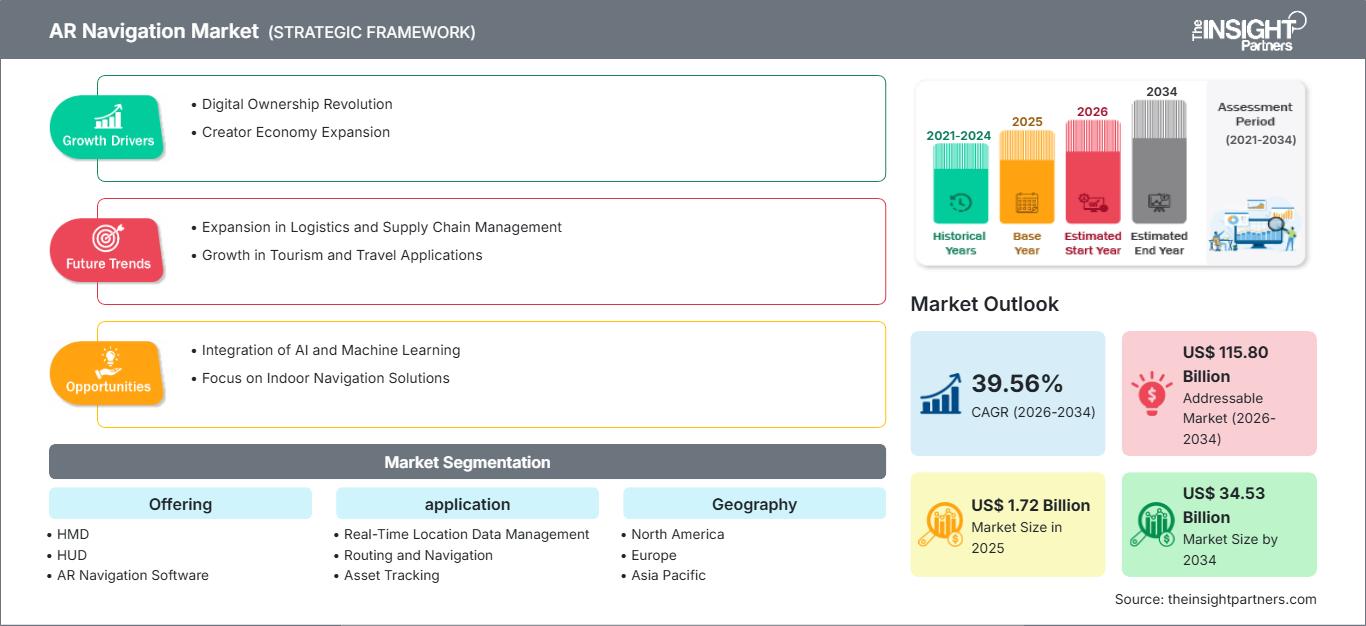
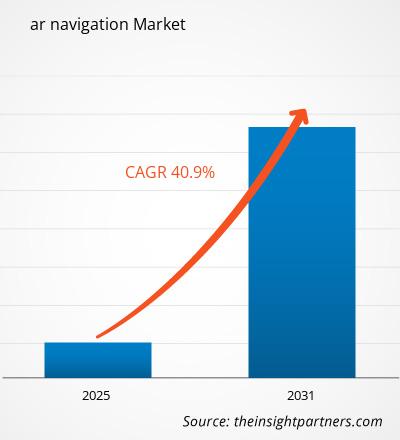
The AR Navigation Market was valued at US$ 1.72 Billion in 2025 and is projected to reach US$ 34.53 Billion by 2034, registering a CAGR of 39.56% during 2026–2034. The market encompasses augmented reality-based navigation solutions that overlay digital guidance, directional cues, and contextual information onto real-world environments across automotive, marine, aviation, logistics, and consumer applications. These systems integrate computer vision, sensor fusion, GPS, and inertial measurement units to deliver intuitive, hands-free navigation experiences that enhance situational awareness and reduce cognitive load for users.
North America AR Navigation Market size is expected to expand at a CAGR of 35.2–36.8% during 2026–2034, supported by automotive head-up display adoption, smart infrastructure investments, and consumer demand for immersive navigation experiences. Demand is reinforced by connected vehicle ecosystems, 5G network deployment, and technology partnerships between automotive OEMs, software developers, and mapping service providers across transportation and logistics sectors.
AR Navigation Market Assessment and Insights
- North America held 31–34% share in 2025 and is growing at a CAGR of 35.2–36.8% during 2026–2034, led by automotive HUD adoption, smart city projects, and logistics sector modernization across the US and Canada.
- US represented 82–85% of North American revenue in 2025 and is growing at a CAGR of 35.5–37.0% during 2026–2034.
- Europe accounted for 24–27% share in 2025 and is growing at a CAGR of 33.8–35.2% during 2026–2034, led by Germany, the UK, France, Italy, and Spain.
- Asia Pacific held 32–35% share in 2025 and is growing at a CAGR of 38.5–40.0% during 2026–2034, led by China, India, Japan, South Korea, and Australia.
- Largest Segment HMD held 48–52% market share in 2025 and is growing at a CAGR of 38.2–39.8% during 2026–2034.
- High Growth Segment AR Navigation Software represented 27–30% market share in 2025 and is growing at a CAGR of 40.5–42.0% during 2026–2034.
- Key companies analyzed in detail: Google LLC; Apple Inc.; Furuno Electric Co. Ltd.; Microsoft Corporation; Wiser Marine Technologies Ltd.; Arway Corp.; Mapbox; Treedis; Wayray AG; Viewar GmbH; Neusoft Corporation; Bosch Mobility Solutions; Continental AG.
Source: The Insight Partners' analysis based on proprietary research, government publications, company annual reports, investor presentations, industry databases, and expert interviews.
Navigation systems have moved from simple point-to-point guidance systems to immersive augmented reality platforms, which include head-mounted devices, head-up displays, and computer algorithms with spatial mapping, object detection, and real-time computing. The production process now highlights such aspects as lightweight optics, low-latency rendering, strong tracking, and integration of systems with car telematics and mobile ecosystem. Market demand for AR Navigation System is influenced by system integrators that integrate AR systems with fleet management systems, autonomous vehicles, and mobile applications in the realm of urban and industrial logistics.
Future investments will go to Asia Pacific, Europe, and North America technological centers, where the need for 5G technologies, smart cities, and electric cars implies high demand for advanced navigation interfaces that provide improved user experience and higher performance. Integration with standards for automobile safety systems and aviation navigation systems provides regulatory support for products certification and deployment. Buyers look for bundled solutions, which include not only hardware and software but also cloud services with constant updates and diagnostics.
AR Navigation Market Report Scope
| Report Attribute | Details |
|---|---|
| Market size in 2025 | US$ 1.72 Billion |
| Market Size by 2034 | US$ 34.53 Billion |
| Global CAGR (2026 - 2034) | 39.56% |
| Historical Data | 2021-2024 |
| Forecast period | 2026-2034 |
AR Navigation Market Analysis
The growth of the market is fueled by the need to provide users with better navigation, integrating heads up display technology in cars, logistics optimization, and advancements in computer vision technology. The value chain consists of optical elements, sensors, processing units, software platforms, providers of map data, system integrators, and service providers in the after market. Dynamics of supply depend on availability of components, software development cycle, and decision making at the platform level. Market analysis shows that the HMD and software platforms are preferred when there is a need for an immersive experience and data integration.
The driving force behind competition comes from technology firms and specialized AR solution vendors. Google LLC, Apple Inc., Microsoft Corporation, Mapbox, Wayray AG, Continental AG, Bosch Mobility Solutions, Neusoft Corporation, Furuno Electric Co. Ltd., and Wiser Marine Technologies Ltd. compete based on their ability to innovate, ecosystem development, user interface development, and user network size. Current investment trends are software-defined technologies, cloud computing, and integration within an automotive operating system. Google LLC and Apple Inc. sustain their market leadership position through complete mobile and mapping ecosystems, whereas Mapbox and Wayray AG enjoy the benefits of developer tools and hardware partnerships.
● REPORT CUSTOMIZATION
Tailor This Report To Align With Your Specific Business Requirements
This report can be customized to align precisely with your business objectives, scope, and target markets. Customization options include tailored segmentation, geography, competitive analysis, and strategic insights to support informed decision-making.
Customize This Report →WHAT YOU CAN ADJUST
- ● Segmentations
- ● Geography
- ● Competitive Analysis
- ● Language Preferences
AR Navigation Market: Strategic Insights
Regional Insights
North America AR Navigation Market
North America held 31-34% of the AR Navigation Market share in 2025 and is expected to witness growth at a CAGR of 35.2%-36.8% during 2026-2034. The demand will be driven by HUDs usage in automobiles, development of smart infrastructures, logistics industry updates, and electronics advancements. The government communications and transport regulatory bodies play an important role in deciding on the radiofrequency and safety issues, along with insurance companies favoring solutions that increase drivers' awareness. Google LLC, Apple Inc., Microsoft Corporation, Mapbox, Wayray AG, and Continental AG drive the installed base in the US and Canada.
U.S. AR Navigation Market
The United States accounted for 82-85% of North American sales in 2025, and is projected to experience a growth rate of CAGR between 35.5-37.0% during 2026-2034. The usage of AR will be in applications like automotive HUD, logistics/delivery services, consumer navigation apps, and aviation applications. Market players are supported by Google LLC, Apple Inc., Microsoft Corp, Mapbox, Wayray AG, and Continental AG. Buyers look for features like integration of real-time data, visuals, and software ecosystem as well as analytics for better engagement, navigation, and confidence while navigating unknown places.
Europe AR Navigation Market
The Europe region has held a share of 24–27% in 2025 and will grow with a CAGR of 33.8–35.2% between 2026 and 2034. Germany leads via its automotive production, mobility innovation, and navigation systems. The United Kingdom drives the region via urban mobility, logistics, and transport infrastructure. The France, Italy, and Spain regions provide additional demands via connected car initiatives, tourist applications, and transport hubs respectively. European Union policies for digital single market initiatives, automotive safety norms, and mobility investments provide advantages to the players with approval documentation. Google LLC, Apple Inc., Microsoft Corporation, Continental AG, Bosch Mobility Solutions, and Wayray AG still stand out.
APAC AR Navigation Market
The Asia-Pacific region has a market share of 32%-35% in 2025 and is estimated to witness a CAGR of 38.5%-40.0% from 2026 to 2034. The leadership of China comes from the development of the mobile ecosystem, connected car initiatives, and consumer electronics, whereas India develops through urban mobility, logistics, and digital transformation efforts. High-precision AR navigation systems are a priority in Japan and South Korea to serve automotive, robotics, and consumer electronics. Australia develops mining, logistics, and defense applications to contribute to the growth. The government encourages the deployment of digital infrastructure and navigation systems due to their high value.
Middle East & Africa AR Navigation Market
The Middle East & Africa market is expected to expand with a CAGR of 34.5-36.0% from 2026 to 2034. In this market, Saudi Arabia dominates with initiatives such as smart cities, technology programs, and infrastructure improvements, and the UAE includes tourism, logistics, and high-end commercial applications. South Africa and Rest of MEA utilize logistics, mining, and urban developments. Investments in connectivity and digital transformation increase the need for cutting-edge navigational solutions. In order for suppliers to be successful, they must integrate certified devices, local maps, training, and local service partners into their portfolio.
Segmentation Analysis
Offering
Offering is projected to grow at a CAGR of 39.2–40.8% during 2026–2034. AR Navigation Market scope covers HMD, HUD, and AR Navigation Software. Selection depends on application context, user requirements, integration complexity, and cost considerations. HMD leads through immersive experiences and hands-free operation across automotive, logistics, and consumer segments, delivering contextual information directly in the user's field of view.
- HMD devices serve automotive, logistics, and consumer applications where hands-free operation and immersive guidance are essential. These systems overlay digital content onto the physical world, enhancing situational awareness.
- HUD systems project navigation data onto windshields or visors, enabling drivers to access guidance without diverting attention from the road, supporting safer driving and improved decision-making.
- AR Navigation Software platforms process location data, sensor inputs, and mapping information to generate contextual overlays, integrate with hardware, and deliver seamless user experiences across devices.
Application
Application is forecast to grow at a CAGR of 39.8–41.2% during 2026–2034. Real-Time Location Data Management, Routing and Navigation, Asset Tracking, and Reverse Geocoding are becoming more strategic as enterprises and consumers standardize navigation processes, location intelligence, and system integration. Application sophistication rises when organizations combine location data with analytics, predictive modeling, and operational workflows.
- Real-Time Location Data Management processes GPS signals, sensor inputs, and network data to provide accurate positioning information, enabling dynamic navigation adjustments and precise asset tracking.
- Routing and Navigation generates optimized paths, turn-by-turn directions, and alternative route suggestions, improving travel efficiency and reducing journey time across automotive and logistics applications.
- Asset Tracking monitors vehicles, equipment, and shipments using location data and AR interfaces, delivering fleet visibility, operational intelligence, and enhanced supply chain management.
- Reverse Geocoding converts coordinates into human-readable addresses, supporting location-based services, logistics planning, and situational awareness across navigation applications.
Opportunity Snapshot
| Application | Revenue Contribution | Trend Tag | Adoption Stage |
|---|---|---|---|
| Real-Time Location Data Management | High | Real-Time Tracking | Mature |
| Routing and Navigation | High | Smart Routing | Scaling |
| Asset Tracking | Medium | Fleet Visibility | Scaling |
| Reverse Geocoding | Low | Address Intelligence | Emerging |
AR Navigation Market Growth Drivers and Impact Analysis
Automotive HUD Adoption Accelerates AR Navigation Deployment
Automotive manufacturers are integrating head-up display systems that project navigation data, speed, and safety alerts onto windshields, reducing driver distraction and improving situational awareness. As HUD technology becomes more affordable and AR capabilities mature, adoption across entry-level and premium vehicle segments is accelerating. Automakers increasingly view AR navigation as a differentiator in connected vehicle ecosystems, driving demand for certified hardware and software. The practical impact is higher spending on optical components, rendering engines, and testing programs that ensure seamless integration across vehicle platforms and driving conditions.
5G Connectivity and Smart Infrastructure Enable Real-Time AR Experiences
Deployment of 5G networks and smart city infrastructure is enabling low-latency, high-bandwidth data transmission essential for real-time AR navigation experiences. With network speeds increasing and latency decreasing, AR navigation systems can process mapping data, sensor inputs, and location information faster than ever. Urban planners and mobility operators increasingly incorporate AR solutions into transportation infrastructure. This driver benefits suppliers that combine hardware, software, and cloud services, enabling connected navigation capabilities that support safer and more efficient mobility.
Consumer Demand for Immersive Navigation Experiences Drives Market Growth
Consumers are increasingly seeking intuitive, engaging navigation experiences that reduce cognitive load and enhance spatial awareness. AR navigation addresses this demand by overlaying visual cues onto real environments, making directions more accessible and reducing map-reading effort. Mobile applications and aftermarket solutions are expanding AR navigation accessibility, with consumer adoption rising across urban mobility and tourism applications. The market impact is a premium for user-friendly interfaces, accurate location intelligence, and personalized navigation experiences that improve user satisfaction and engagement.
AR Navigation Market Future Trends
AI-Powered Localization and Scene Understanding Reshape Navigation Platforms
AR Navigation Market trends point toward AI-assisted localization algorithms that enhance scene understanding, object recognition, and contextual awareness. The next product cycle will combine computer vision, machine learning, and spatial mapping capabilities to deliver more accurate positioning and richer navigation overlays. This shift matters because users increasingly measure AR value by accuracy and contextual relevance as well as basic guidance. Vendors with strong AI capabilities, mapping datasets, and user experience expertise will be better positioned as navigation systems become part of broader digital mobility platforms.
Cloud-Native AR Navigation Architectures Enable Scalable Deployments
Developers are increasingly favoring cloud-native AR navigation architectures that enable real-time data processing, map updates, and content delivery across devices. Cloud-based rendering reduces hardware requirements while ensuring consistent performance across platforms. Future procurement will scrutinize cloud integration, data privacy, and update mechanisms. Suppliers that can document scalability and security will gain credibility with enterprise and consumer segments seeking reliable navigation solutions.
AR Navigation Market Opportunities
Enterprise Logistics and Fleet Optimization Solutions
AR Navigation Market Forecasts support investment in navigation solutions for logistics, delivery, and fleet management operations. Operators need route optimization, real-time tracking, and driver guidance to improve efficiency and reduce operational costs. Service providers can create recurring revenue by combining AR interfaces, fleet management platforms, and analytics dashboards. The opportunity is strongest where enterprises already use basic GPS navigation but lack advanced AR capabilities for driver training and operational visibility.
Emerging Mobility Ecosystems in Urban Transportation Networks
New mobility platforms, ride-sharing services, and connected vehicle ecosystems create demand for AR navigation solutions that enhance passenger and driver experiences. Many urban transportation projects need seamless navigation interfaces but cannot justify custom development. Vendors can win by offering developer-friendly SDKs, mapping integration, and scalable deployment models. This opportunity rewards companies that translate navigation expertise into practical solutions for mobility providers, transportation authorities, and consumer platforms.
Recent Developments
- October 2025: MediView XR, Inc., a pioneer in augmented reality (AR) surgical navigation, guidance, and image fusion, announced the close of its $24 million Series A funding round. The round was led by GE HealthCare with investment from Cleveland Clinic, Mayo Clinic, Edge Ventures, the investment arm of Emplify Health, and JobsOhio Growth Capital Fund. The investor syndicate underscores strong confidence from some of the world’s most influential healthcare and technology leaders.
- July 2025: Nextech3D.ai (OTCQX:NEXCF)(CSE:NTAR)(FSE:1SS) an AI-first technology company that produces photorealistic 3D models and immersive spatial experiences for e-commerce, retail, and event applications, is pleased to announce that its spatial computing spin-out, ARway Corp. (OTCQB:ARWYF)(CSE:ARWY)(FSE:E65), has launched Interactive Map Navigation. This new feature enables seamless, point-to-point wayfinding across web, mobile, and touchscreen kiosks, combining traditional 2D navigation with cutting-edge AR guidance in a unified platform. The company believes significant revenue opportunity exists from existing and new customers for the Industrys-First Hybrid Navigation.
- April 2025: Mapbox, a global leader in location technology, and Hyundai AutoEver, a software affiliate of Hyundai Motor Group, are unveiling their next-generation in-car technologies at CES 2025. Together, they are showcasing an integrated AI voice-driven and ADAS-enabled 3D navigation experience, powered by Mapbox 3D Live Navigation and MapGPT, running on Hyundai Mobis' advanced cockpit domain controller.
Frequently Asked Questions

- Comprehensive Market Sizing and Forecast Analysis
- Detailed Segmentation Analysis
- In-Depth Market Dynamics Assessment
- Regional and Country-Level Insights
- Competitive Landscape and Company Benchmarking
- Strategic Business Intelligence
Recent Reports
Testimonials

The Insight Partners provided valuable market intelligence that supported our global go-to-market strategy. Their team was professional, responsive, and attentive to our feedback, providing thoughtful analysis and helpful methodological clarifications throughout the project.
Junmo Kim Chief Financial Officer (CFO), Enertech Co., Ltd.
The Insight Partners' SCADA System Market report is comprehensive, with valuable insights on current trends and future forecasts. The team was highly professional, responsive, and supportive throughout. We are very satisfied and highly recommend their services.
RAN KEDEM Partner, Reali Technologies LTDs
I requested a report on a very specific software market and the team produced the report in a few days. The information was very relevant and well presented. I then requested some changes and additions to the report. The team was again very responsive and I got the final report in less than a week.
JEAN-HERVE JENN Chairman, Future Analytica
We worked with The Insight Partners for an important market study and forecast. They gave us clear insights into opportunities and risks, which helped shape our plans. Their research was easy to use and based on solid data. It helped us make smart, confident decisions. We highly recommend them.
PIYUSH NAGPAL Sr. Vice President, High Beam Global
The Insight Partners delivered insightful, well-structured market research with strong domain expertise. Their team was professional and responsive throughout. The user-friendly website made accessing industry reports seamless. We highly recommend them for reliable, high-quality research services
YUKIHIKO ADACHI CEO, Deep Blue, LLC.
This is the first time I have purchased a market report from The Insight Partners.While I was unsure at first, I visited their web site and felt more comfortable to take the risk and purchase a market report.I am completely satisfied with the quality of the report and customer service. I had several questions and comments with the initial report, but after a couple of dialogs over email with their analyst I believe I have a report that I can use as input to our strategic planning process.Thank you so much for taking the extra time and making this a positive experience.I will definitely recommend your service to others and you will be my first call when we need further market data.
JOHN SUZUKI President and Chief Executive Officer, Board Director, BK Technologies
I wish to appreciate your support and the professionalism you displayed in the course of attending to my request for information regarding to infectious disease IVD market in Nigeria. I appreciate your patience, your guidance, and the fact that you were willing to offer a discount, which eventually made it possible for us to close a deal. I look forward to engaging The Insight Partners in the future, all thanks to the impression you have created in me as a result of this first encounter.
DR CHIJIOKE ONYIA MANAGING DIRECTOR, PineCrest Healthcare Ltd.Reason to Buy
- Informed Decision-Making
- Understanding Market Dynamics
- Competitive Analysis
- Identifying Emerging Markets
- Customer Insights
- Market Forecasts
- Risk Mitigation
- Boosting Operational Efficiency
- Strategic Planning
- Investment Justification
- Tracking Industry Innovations
- Aligning with Regulatory Trends





 Get Free Sample for