
Arc-based Plasma Lighting Market Trends, Demand & Growth by 2034
Arc-based Plasma Lighting Market Size and Forecasts (2021 - 2034), Global and Regional Share, Trends, and Growth Opportunity Analysis Report Coverage : By Light Source (Xenon Arc Lamps, Metal Halide Lamps, Deuterium Lamps, Krypton Arc Lamps, Mercury Vapor Lamps), Wattage Type (Below 500 W, 501 to 1500 W, Above 1500 W), Application (Entertainment & Projection, Searchlight & Spotlight, Solar Simulation & Enviornmental Testing, Spectroscopy, Medical ighting, Microscopic Lighting, UV, Others)
- Status : Data Released
- Report Code : TIPRE00039728
- Category : Electronics and Semiconductor
- No. of Pages : 150
- Available Report Formats :


- Last update date : July 20, 2026


2025 Market Size
US$ 3.12 Bn
Base year value
2034 Forecast
US$ 5.18 Bn
Projected by 2034
CAGR 2026-2034
5.78 %
Growth rate
Addressable Market
US$ 37.58 Bn
(2026-2034)
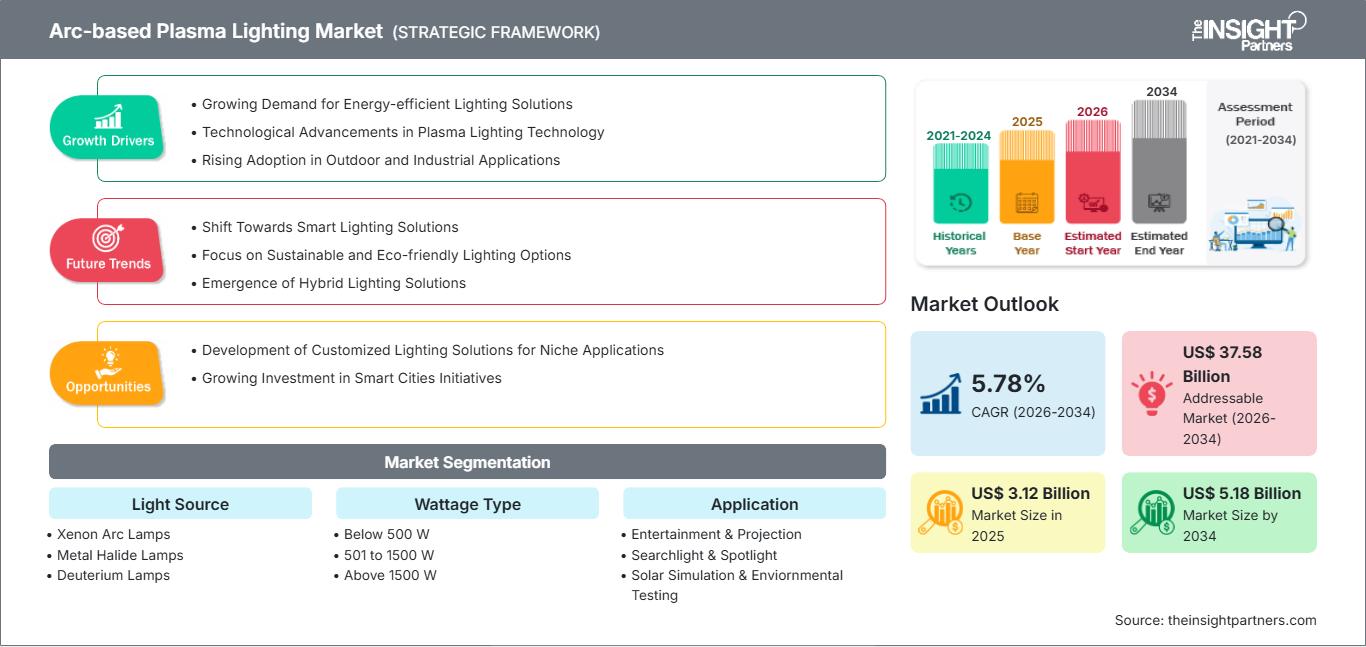
The Arc-based Plasma Lighting Market was valued at US$ 3.12 Billion in 2025 and is projected to reach US$ 5.18 Billion by 2034, registering a CAGR of 5.78% during 2026–2034. Demand is anchored in high-intensity light output, stable spectra, and long service life across projection, medical imaging, microscopy, spectroscopy, UV exposure, and solar simulation applications.
Across North America, the Arc-based Plasma Lighting Market size is supported by aerospace testing, defense searchlights, medical equipment manufacturing, and cinema projection replacements. The region is expected to grow at a CAGR range of 5.2–5.6% through 2034, with procurement increasingly tied to lamp reliability, calibrated optical performance, and compliance-driven replacement cycles in regulated laboratories.
Arc-based Plasma Lighting Market Assessment and Insights
- North America accounted for 31–33% share in 2025 and is growing at a CAGR range of 5.2–5.6% during 2026–2034, supported by medical imaging, aerospace simulation, and premium projection infrastructure.
- US represented 76–79% of North America in 2025 and is growing at a CAGR range of 5.1–5.5% during 2026–2034 through defense, laboratory, and OEM medical demand.
- Europe held 24–26% share in 2025 and is growing at a CAGR range of 4.9–5.3% during 2026–2034, led by Germany, the UK, France, Italy, and Spain.
- Asia Pacific captured 30–32% share in 2025 and is growing at a CAGR range of 6.2–6.7% during 2026–2034, driven by China, Japan, South Korea, India, and Australia.
- Largest Segment Xenon Arc Lamps held 44–47% market share in 2025 and is growing at a CAGR range of 5.4–5.8% during 2026–2034 due to broad-spectrum output.
- High Growth Segment Solar Simulation and Environmental Testing held 12–14% market share in 2025 and is growing at a CAGR range of 6.7–7.3% during 2026–2034.
- Key companies analyzed in detail: USHIO INC., ams-OSRAM AG, Excelitas Technologies Corp., Signify N.V., Hamamatsu Photonics K.K., LEDVANCE GmbH, Advanced Specialty Lighting, Inc., Amglo Kemlite Laboratories, Inc., Superior Quartz Products, Inc., and Newport Corporation.
Source: The Insight Partners' analysis based on proprietary research, government publications, company annual reports, investor presentations, industry databases, and expert interviews.
Technological evolution is steering away from the conventional lighting system and is focusing on developing application-based optical systems that will need features such as stable arcs, spectrum intensities, and precise beam geometrical controls and not only energy efficiency. Specialization remains in the process of manufacture and Japan, Europe, and the United States have continued to excel in producing xenon, deuterium, mercury vapor, and krypton lamps.
During the forecast period, the rise of new laboratories, semiconductor test centers, and solar equipment validation centers will see usage expand beyond traditional theaters and healthcare applications. Restrictions on the handling of mercury will impact the product range, but there will be continued replacement needs in applications that cannot be replaced by LED technology when it comes to producing required levels of radiance and UV light intensity.
Arc-based Plasma Lighting Market Report Scope
| Report Attribute | Details |
|---|---|
| Market size in 2025 | US$ 3.12 Billion |
| Market Size by 2034 | US$ 5.18 Billion |
| Global CAGR (2026 - 2034) | 5.78% |
| Historical Data | 2021-2024 |
| Forecast period | 2026-2034 |
Arc-based Plasma Lighting Market Analysis
Growth of the Arc-based Plasma Lighting market would depend upon requirements for brightness, spectral continuity, and beam focusing, which are not always possible with solid-state lighting systems. High-pressure xenon is still significant in the field of cinema, endoscopy, microscopy, and solar simulation; deuterium is used in ultraviolet spectroscopy. Value chain factors include quartz manufacturing, rare gas filling, electrode manufacturing, ceramic reflectors, and power supply.
Factors influencing the supply side of the industry include knowledge required for specialized manufacturing, safety certification, and few high-stability lamp manufacturers. The business model of repeat revenue generation comes from replacements, particularly for the use of equipment with validated light intensity. End-users are now looking at the overall cost of ownership in terms of hours of operation.
Positioning in Arc-based Plasma Lighting Market is based on the factors such as product dependability, family of lamps offered, and installation assistance besides pricing. USHIO INC. increased their specialty lamps due to the deal with ams-OSRAM AG on their industrial and entertainment lamps whereas Excelitas Technologies Corp. is focused on developing small xenon short-arc lights for medical applications. Hamamatsu Photonics K.K. continues to dominate analytical light sources.
The investments in future can be expected towards engineered products, low mercury options, and OEMs modules. The Signify N.V. and LEDVANCE GmbH will continue being leaders in general lighting but companies like Advanced Specialty Lighting, Inc., Amglo Kemlite Laboratories, Inc., Superior Quartz Products, Inc., and Newport Corporation will compete due to custom lamps, quartz assemblies, and photonics system compatibility.
● REPORT CUSTOMIZATION
Tailor This Report To Align With Your Specific Business Requirements
This report can be customized to align precisely with your business objectives, scope, and target markets. Customization options include tailored segmentation, geography, competitive analysis, and strategic insights to support informed decision-making.
Customize This Report →WHAT YOU CAN ADJUST
- ● Segmentations
- ● Geography
- ● Competitive Analysis
- ● Language Preferences
Arc-based Plasma Lighting Market: Strategic Insights
Regional Insights
North America Arc-based Plasma Lighting Market
North America accounted for 31–33% Arc-based Plasma Lighting Market share in 2025 and is projected to grow at a CAGR range of 5.2–5.6% during 2026–2034. Demand is concentrated in the US and Canada, where aerospace test chambers, photonics laboratories, medical device OEMs, and cinema service networks require stable, high-radiance sources for calibrated operating environments.
High replacement discipline comes to play here due to the fact that there is always a document tracking of lamp hourage and validated light output by various hospitals, laboratories, and defense contractors. There is also an aviation testing associated with the FAA, space qualification work by NASA, and other biomedical imaging processes that increase the need for solar simulator, Xenon lamp, and deuterium source.
U.S. Arc-based Plasma Lighting Market
The US accounted for 76-79% of North America in 2025 and is forecast to have a CAGR of 5.1-5.5% from 2026 to 2034. Demand drivers are endoscopy, microscopy, analytical instruments, military spotlights, semiconductors, and environmental analysis. OEM qualification cycles lead to sticky supplier relationships due to optical modification or recertification with the change in lamp type.
A wide array of players operate in this segment including Excelitas Technologies Corp., Newport Corporation, Superior Quartz Products, Inc., and USHIO America with clients in the healthcare, research and industrial sectors. Usage patterns are moving toward higher-power xenon modules for surgery, small deuterium lamps for chromatography and robust lamps for surveillance/searchlight use.
Europe Arc-based Plasma Lighting Market
Europe’s market share was at 24-26% in 2025 and expected to grow at CAGR of 4.9-5.3% during 2026-2034, mainly driven by Germany. UK drives demand for lamps from university optics labs, aerospace testing, and entertainment facilities. Germany provides strong industrial photonics sector, automotive environmental testing and equipment manufacturing, hence providing consistent use of xenon, metal halide, and UV lamps.
France, Italy, and Spain also help drive the demand via medical technologies, film maintenance industry, research centers, and specialized manufacturing. European Union regulations on mercury have increased the need for proper documentation but did not reduce demand for the products, which still remained needed for ultraviolet light or high-intensity discharge applications. European customers prefer certified manufacturers with replacement availability and lower risks.
APAC Arc-based Plasma Lighting Market
Asia-Pacific had 30–32% market share in 2025 and will experience growth in the CAGR range of 6.2–6.7% in 2026–2034. The leading driver behind the Asia-Pacific market would be demand generated by China due to electronics manufacturing, testing of solar equipment, cinema lighting, and UV applications in industries. Japan and South Korea would have photonics capabilities, while India and Australia would generate demand through labs, health care facilities, and defense lighting initiatives.
The policy orientation toward localized production of semiconductors, renewable energy testing, and medical devices makes the region a bright prospect in the future. Japan continues to play an important role in the supply chain since firms like USHIO INC. and Hamamatsu Photonics K.K. possess strong capabilities in discharge lamps and analytical light sources.
Middle East & Africa Arc-based Plasma Lighting Market
The Middle East and Africa region will see growth between the 2026 and 2034 period at a rate of 4.8-5.2%, led by Saudi Arabia. In the UAE, entertainment sites, airports, and other high-profile infrastructure drive demand, while South Africa drives the rest of MEA demand via mining, laboratory testing, and medical institutions. Demand in the RoMEA region is driven primarily by projects and replacement.
There are selective opportunities in searchlights, projection technology, and environmental testing from energy diversification, tourism investments, and safety infrastructure. Extreme conditions increase the importance of durable lamps, closed optical devices, and good service support. Since purchases are tied to major construction projects, distributors and service support training are more advantageous than only catalog products.
Segmentation Analysis
Light Source
Light Source is expected to grow at a CAGR range of 5.5–5.9% during 2026–2034. The Arc-based Plasma Lighting Market scope within this segment is defined by spectral requirements, lamp life, ignition stability, and compatibility with OEM optical assemblies. Buyers select light sources by wavelength, luminance, thermal behavior, and qualification history.
- Xenon Arc Lamps dominate high-radiance applications because daylight-like output, compact arc geometry, and strong color rendering support projection, endoscopy, microscopy, searchlights, and solar simulation.
- Metal Halide Lamps retain demand in entertainment, projection, and broad-area industrial lighting where brightness, cost efficiency, and established fixture compatibility remain important purchasing factors.
- Deuterium Lamps are strategically important for ultraviolet spectroscopy, chromatography detectors, and laboratory instruments requiring stable UV output, low noise, and repeatable analytical measurements.
- Krypton Arc Lamps serve specialist optical systems where distinct spectral lines, high brightness, and narrow application fit support usage in research, signaling, and calibrated illumination.
- Mercury Vapor Lamps remain relevant in UV curing, microscopy, and legacy analytical instruments, although handling rules and substitution pressure encourage documented replacement management.
Wattage Type
Wattage Type is projected to grow at a CAGR range of 5.4–5.8% during 2026–2034. Demand reflects the trade-off between compact optical design, cooling needs, power consumption, and beam intensity. Lower wattage lamps support instruments and medical devices, while high-power categories serve projection, searchlights, and simulation systems.
- Below 500 W supports compact medical, microscopy, spectroscopy, and portable systems where controlled heat, long life, and stable output are preferred over maximum radiant power.
- 501 to 1500 W addresses balanced performance needs in projection, laboratory simulation, and industrial inspection, combining strong brightness with manageable cooling and fixture costs.
- Above 1500 W serves large-format projection, searchlights, environmental testing, and aerospace simulation where extreme intensity, rugged electrodes, and robust power supplies are essential.
Application
Application is forecast to expand at a CAGR range of 5.7–6.1% during 2026–2034. Adoption is strongest where arc sources solve precision illumination problems that LEDs do not fully address. Growth is linked to calibrated testing, high color rendering, ultraviolet exposure, clinical visualization, and mission-critical beam projection across industrial and scientific environments.
- Entertainment & Projection remains a core demand pool because cinema, events, and large-format projection value brightness, color fidelity, established lamp housings, and reliable replacement availability.
- Searchlight & Spotlight demand is supported by defense, maritime, aviation, venue, and emergency operations where long throw, intense beam focus, and durability matter.
- Solar Simulation & Enviornmental Testing is strategically important as photovoltaic, aerospace, automotive, and materials laboratories require stable irradiance and repeatable exposure profiles.
- Spectroscopy relies on deuterium and xenon sources for ultraviolet and visible analysis, supporting chromatography, material identification, environmental testing, and research instrumentation.
- Medical ighting benefits from compact xenon modules used in endoscopy, surgical visualization, diagnostics, and microscopy where color accuracy and high localized brightness are critical.
- Microscopic Lighting uses controlled arc illumination for fluorescence, transmitted light, inspection, and imaging systems requiring stable output and compatibility with precision optical paths.
- UV applications include curing, exposure, disinfection-adjacent equipment, inspection, and analytical workflows where wavelength intensity and exposure consistency drive purchasing decisions.
Opportunity Snapshot
| Application | Revenue Contribution | Trend Tag | Adoption Stage |
| Entertainment & Projection | High | Cinema Retrofit | Mature |
| Searchlight & Spotlight | Medium | Defense Beam | Scaling |
| Solar Simulation & Enviornmental Testing | Medium | PV Testing | Scaling |
| Spectroscopy | Medium | UV Analysis | Mature |
| Medical ighting | High | Surgical Imaging | Mature |
| Microscopic Lighting | Medium | Fluorescence Imaging | Scaling |
| UV | Medium | Precision Curing | Scaling |
Arc-based Plasma Lighting Market Growth Drivers and Impact Analysis
Precision Testing Demand in Photovoltaics and Aerospace
Solar module qualification, testing of satellite materials, automotive weathering and aerospace component validation need a reproducible light exposure system which mimics challenging operating conditions. The arc lamp source is best suited in case where the lab demands high irradiance, UV presence and controlled spectral power distribution to perform accelerated aging and performance testing. The effect on the market would be maximum in cases where a complete set-up of lamps, filters, cooling system and calibrated sensor exists together as a package. With increased renewable energy application and increased space hardware testing, lamp replacement depends on compliance cycle rather than budget cycle.
Medical Visualization and Laboratory Instrument Replacement
Hospitals, diagnostic laboratories, and research institutes continue using arc lamps in endoscopy, surgical visualization, microscopy, and spectroscopy because high localized brightness and predictable spectra remain essential. Even where LED alternatives expand, many validated devices depend on specific lamp geometries, color temperature, and power supplies. Replacement cycles therefore provide recurring revenue, especially when downtime affects surgical schedules or analytical throughput. Suppliers that offer longer warranties, stable output over life, and drop-in compatibility gain purchasing preference. The impact is a resilient aftermarket that cushions cyclical weakness in new equipment sales and rewards consistent manufacturing quality.
Specialty Projection and Searchlight Reliability Requirements
Large venues, premium cinemas, defense users, maritime operators, and emergency services require high-intensity beams that remain visible across distance and adverse conditions. Arc-based sources continue to serve these niches because they deliver point-like radiance and proven optics compatibility. The commercial effect is not mass adoption, but durable demand in installed bases where fixture replacement would be costly. Service networks, inventory assurance, and lamp safety training influence supplier selection as much as lamp price. This driver favors companies with regional distribution, certified replacements, and experience supporting mission-critical illumination assets over long operating periods.
Arc-based Plasma Lighting Market Future Trends
Integrated Lamp Modules with Sensor Feedback
Arc-based Plasma Lighting Market trends point toward packaged modules that combine lamps, reflectors, ignition electronics, cooling, and optical monitoring. Future systems will increasingly measure output drift and adjust operating parameters before quality failures occur. This shift helps laboratories and medical users manage preventive maintenance with evidence rather than fixed replacement assumptions. For suppliers, module-level design raises margins and deepens OEM dependence because customers buy validated performance rather than a standalone consumable. The trend also supports remote diagnostics in equipment fleets, enabling service providers to forecast lamp inventories and reduce unplanned downtime.
Low-Mercury and Compliance-Oriented Product Migration
Regulatory scrutiny around mercury-containing lamps will accelerate migration toward lower-mercury designs, alternative chemistries, and better end-of-life handling programs. The transition will not remove all legacy products quickly because validated analytical, UV, and microscopy instruments often require exact lamp properties. Instead, buyers will seek documented compliance, recycling support, and clear substitution pathways. Suppliers that maintain technical equivalence while reducing environmental burden can defend specialized demand. Over time, procurement teams will treat environmental documentation, safety data, and disposal partnerships as standard selection criteria alongside brightness, lifetime, and spectral stability.
Arc-based Plasma Lighting Market Opportunities
OEM Partnerships for Validated Medical and Analytical Platforms
OEM partnerships offer one of the clearest paths for Arc-based Plasma Lighting Market Forecasts because instrument manufacturers prefer qualified components that reduce redesign risk. Lamp suppliers can create value by co-developing housings, power supplies, thermal paths, and calibration documentation for endoscopy, chromatography, microscopy, and inspection systems. Once approved, these components may remain embedded across product generations, supporting stable replacement revenue. Companies should prioritize engineering support, regulatory documentation, and regional service agreements rather than transactional sales. This approach can improve customer retention and reduce exposure to commodity pricing pressures in mature lamp categories.
Aftermarket Service Networks in Emerging Testing Hubs
Emerging testing hubs in Asia Pacific, the Middle East, and selected African economies need reliable lamp supply, calibration support, and safe replacement procedures. Distributors can move beyond resale by offering preventive maintenance kits, training, inventory planning, and service documentation for laboratories, cinemas, and industrial facilities. The opportunity is attractive because many users operate imported equipment with limited local support. Suppliers that certify regional partners and maintain fast-moving lamp inventories can capture recurring revenue while reducing downtime for customers. This model also strengthens brand preference where procurement decisions are relationship-driven.
Recent Developments
- July 2025: Longevity Health Holdings announced a definitive merger agreement with THPlasma in an all-stock transaction valued at $59 million, with an additional $20 million earnout tied to future performance. As part of the deal, the company also terminated its previously announced acquisition of 20/20 BioLabs to focus on THPlasma's rapidly growing plasma-based regenerative medicine business. The combined company aims to expand its network of treatment centers, strengthen manufacturing capabilities, and accelerate commercialization of plasma-derived therapies, while continuing to trade on Nasdaq under the ticker XAGE.
- June 2026: Hyundai Motor and Kia introduced Plasma Care UVC, the world's first in-vehicle sanitization technology that combines plasma and Far-UVC light to disinfect cabin air and surfaces while passengers remain inside the vehicle. Unlike conventional UV sterilization systems that require an empty cabin, the new technology is designed to continuously reduce bacteria, viruses, and odor-causing microorganisms during operation. The companies see the innovation as particularly valuable for autonomous vehicles, ride-hailing fleets, school buses, and other shared mobility services, although the system is still in the research and development stage and has not yet been approved for commercial production.
- June 2026: Fusion energy startup Realta Fusion announced a major technical milestone by becoming the first commercial fusion company to directly convert the kinetic energy of plasma into electricity using Direct Energy Conversion (DEC). Traditional fusion concepts rely on converting heat into electricity through steam turbines, which results in energy losses. Realta's demonstration bypasses this intermediate step by extracting electricity directly from charged plasma particles, potentially improving the overall efficiency and economics of future fusion power plants. The achievement represents an important step toward commercial fusion energy by simplifying power generation and reducing system complexity.
Frequently Asked Questions

- Comprehensive Market Sizing and Forecast Analysis
- Detailed Segmentation Analysis
- In-Depth Market Dynamics Assessment
- Regional and Country-Level Insights
- Competitive Landscape and Company Benchmarking
- Strategic Business Intelligence
Recent Reports
Testimonials

The Insight Partners' SCADA System Market report is comprehensive, with valuable insights on current trends and future forecasts. The team was highly professional, responsive, and supportive throughout. We are very satisfied and highly recommend their services.
RAN KEDEM Partner, Reali Technologies LTDs
I requested a report on a very specific software market and the team produced the report in a few days. The information was very relevant and well presented. I then requested some changes and additions to the report. The team was again very responsive and I got the final report in less than a week.
JEAN-HERVE JENN Chairman, Future Analytica
We worked with The Insight Partners for an important market study and forecast. They gave us clear insights into opportunities and risks, which helped shape our plans. Their research was easy to use and based on solid data. It helped us make smart, confident decisions. We highly recommend them.
PIYUSH NAGPAL Sr. Vice President, High Beam Global
The Insight Partners delivered insightful, well-structured market research with strong domain expertise. Their team was professional and responsive throughout. The user-friendly website made accessing industry reports seamless. We highly recommend them for reliable, high-quality research services
YUKIHIKO ADACHI CEO, Deep Blue, LLC.
This is the first time I have purchased a market report from The Insight Partners.While I was unsure at first, I visited their web site and felt more comfortable to take the risk and purchase a market report.I am completely satisfied with the quality of the report and customer service. I had several questions and comments with the initial report, but after a couple of dialogs over email with their analyst I believe I have a report that I can use as input to our strategic planning process.Thank you so much for taking the extra time and making this a positive experience.I will definitely recommend your service to others and you will be my first call when we need further market data.
JOHN SUZUKI President and Chief Executive Officer, Board Director, BK Technologies
I wish to appreciate your support and the professionalism you displayed in the course of attending to my request for information regarding to infectious disease IVD market in Nigeria. I appreciate your patience, your guidance, and the fact that you were willing to offer a discount, which eventually made it possible for us to close a deal. I look forward to engaging The Insight Partners in the future, all thanks to the impression you have created in me as a result of this first encounter.
DR CHIJIOKE ONYIA MANAGING DIRECTOR, PineCrest Healthcare Ltd.Reason to Buy
- Informed Decision-Making
- Understanding Market Dynamics
- Competitive Analysis
- Identifying Emerging Markets
- Customer Insights
- Market Forecasts
- Risk Mitigation
- Boosting Operational Efficiency
- Strategic Planning
- Investment Justification
- Tracking Industry Innovations
- Aligning with Regulatory Trends





 Get Free Sample for