
Artificial Intelligence (AI) Edge Computing Market Share, Growth & Forecast by 2034
Coverage: By Offering (Hardware, Solutions, Services); End-User (Manufacturing , Healthcare, Transportation, Government, Media and Entertainment, Energy and Utilities, Telecom and IT, Retail, Others) , and Geography (North America, Europe, Asia Pacific, and South and Central America)
- Status : Data Released
- Report Code : TIPRE00003106
- Category : Electronics and Semiconductor
- No. of Pages : 150
- Available Report Formats :


- Last update date : July 28, 2026


2025 Market Size
US$ 24.97 Bn
Base year value
2034 Forecast
US$ 134.96 Bn
Projected by 2034
CAGR 2026-2034
20.62 %
Growth rate
Addressable Market
US$ 643.38 Bn
(2026-2034)
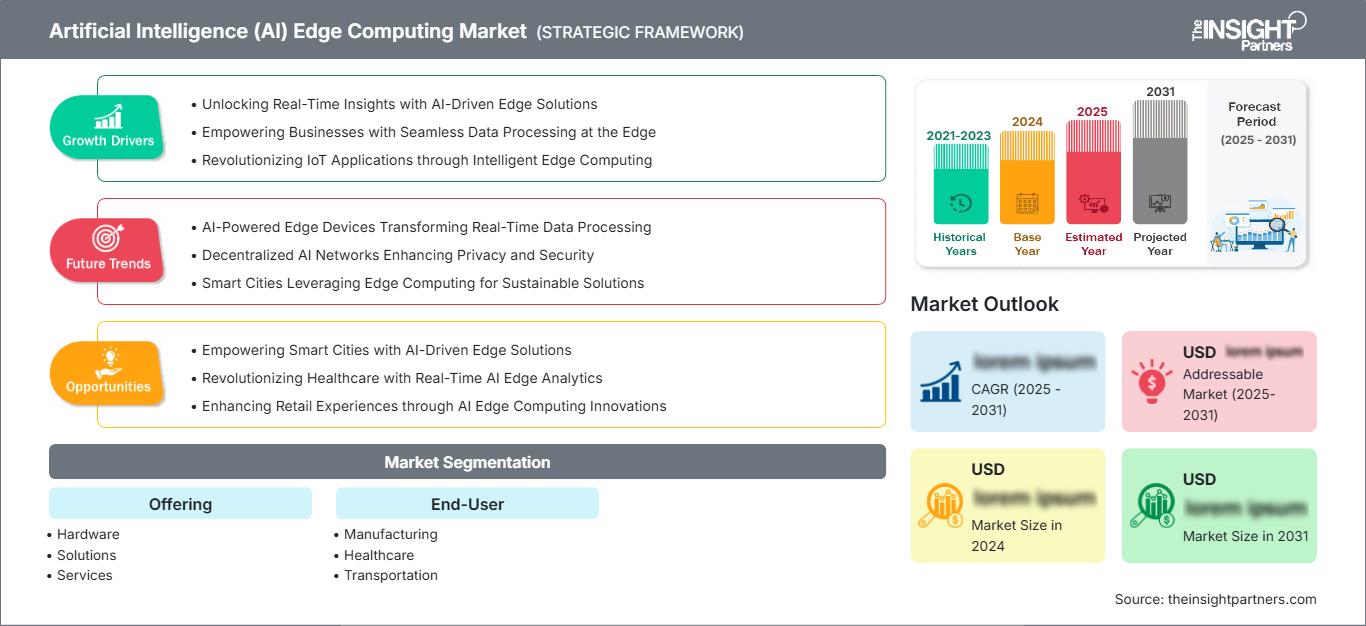
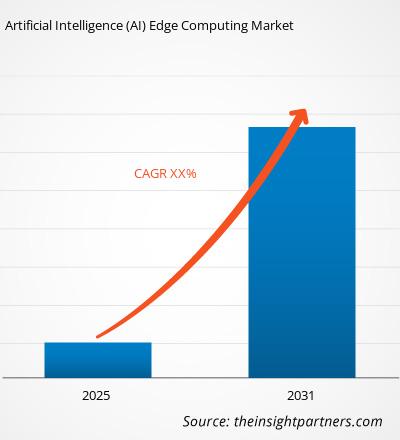
The Artificial Intelligence Edge Computing Market was valued at US$ 24.97 Billion in 2025 and is projected to reach US$ 134.96 Billion by 2034, registering a CAGR of 20.62% during 2026–2034. Demand is rising as enterprises shift AI inference closer to devices, machines, users, and distributed data sources to reduce latency, limit bandwidth use, improve operational resilience, and support decision-making in time-sensitive industrial and commercial environments.
Across North America, the Artificial Intelligence Edge Computing Market size is supported by cloud-to-edge modernization, private 5G activity, industrial automation, and healthcare digitization. The region is estimated to expand at a CAGR of 19–21% from 2026 to 2034, helped by dense enterprise networks, AI-ready infrastructure spending, and demand for secure local processing across factories, hospitals, stores, logistics hubs, and energy assets.
Artificial Intelligence (AI) Edge Computing Market Assessment and Insights
- North America accounted for 35–38% share in 2025 and is growing at a CAGR of 19–21% between 2026–2034, supported by private edge deployments, regulated data workloads, and enterprise AI infrastructure refresh cycles.
- US represented 80–84% of North America in 2025 and is growing at a CAGR of 19–21%, driven by hyperscaler, telecom, healthcare, retail, and manufacturing use cases.
- Europe held 24–27% share in 2025 and is growing at a CAGR of 18–20% between 2026–2034, with Germany, the UK, France, Italy, and Spain leading industrial, data-sovereign, and smart infrastructure adoption.
- Asia Pacific captured 27–30% share in 2025 and is growing at a CAGR of 22–24% between 2026–2034, led by China, Japan, South Korea, India, and Australia across manufacturing, telecom, logistics, and smart city programs.
- Largest Segment Hardware held 44–48% of the Artificial Intelligence Edge Computing market in 2025 and is growing at a CAGR of 19–21% during 2026–2034 as AI accelerators, rugged gateways, and edge servers scale.
- High Growth Segment Solutions held 31–35% market share in 2025 and is growing at a CAGR of 23–25% during 2026–2034 through orchestration, analytics, security, and model management demand.
- Key companies analyzed in detail: Cisco Systems, Inc., ClearBlade, Inc., FogHorn Systems, Inc., Hewlett Packard Enterprise Company, Huawei Technologies Co., Ltd., International Business Machines Corporation, Nokia Corporation, Rigado, Inc., Saguna Networks Ltd., Vapor IO, Inc.
Source: The Insight Partners' analysis based on proprietary research, government publications, company annual reports, investor presentations, industry databases, and expert interviews.
Adoption of technology has been evolving from isolated edge gateways to AI-enabled distributed compute fabrics. Companies such as manufacturers, telecom firms, retailers, and healthcare providers are now demanding local inference capabilities for processing sensor data, video data, machine data, and operational data without the need to route each workload to the central cloud-based platform. This is due to the fact that companies have to change their production environment as it involves coordination between the compact hardware, orchestration layer, security mechanism, and lifecycle services at multiple locations.
Emerging countries are anticipated to provide additional impetus to AI at the Edge as a Service over the forecast period as there will be expansion of 5G footprint, digitalization of industries, and AI strategies in different countries. In addition, regulatory considerations pertaining to privacy, data localization, and continuity of critical infrastructure are also driving AI execution closer to the operations.
Artificial Intelligence (AI) Edge Computing Market Report Scope
| Report Attribute | Details |
|---|---|
| Market size in 2025 | US$ 24.97 Billion |
| Market Size by 2034 | US$ 134.96 Billion |
| Global CAGR (2026 - 2034) | 20.62% |
| Historical Data | 2021-2024 |
| Forecast period | 2026-2034 |
Artificial Intelligence (AI) Edge Computing Market Analysis
The Artificial Intelligence Edge Computing Market growth is anchored in latency-sensitive analytics, rising connected device volumes, and the cost of moving high-frequency data to centralized environments. Inference at the edge is crucial for industrial vision inspection, predictive maintenance, automated checkout, video intelligence, remote care, and energy asset monitoring. It reduces backhaul traffic as well as ensures that organizations have operational continuity even during cloud connectivity gaps.
The ecosystem includes semiconductor producers, hardware manufacturers, network providers, platform vendors, cloud services providers, telcos, and managed services companies. Supply dynamics depend on availability of GPUs, NPUs, rugged servers, secure gateways, and container orchestration software. Integrated offerings that provide compute power, storage, connectivity, monitoring, and cybersecurity features have become increasingly popular among customers as distributed AI environments are hard to manage on-site.
The Artificial Intelligence Edge Computing Market analysis provides insights into competitive landscape shifting from product-based differentiation towards converged infrastructure and vertical solutions. Cisco Systems, Inc., Hewlett Packard Enterprise Company, International Business Machines Corporation, Huawei Technologies Co., Ltd., and Nokia Corporation focus on providing enterprise-level platforms. ClearBlade, Inc., FogHorn Systems, Inc., Rigado, Inc., Saguna Networks Ltd., and Vapor IO, Inc. offer specialized edge orchestration, industrial intelligence, wireless edge, and micro data centers solutions.
Trends in investments include decentralization of artificial intelligence, private wireless connectivity, security in inference, and hybrid governance of the edge-cloud environment. Competitive advantage has shifted from having proprietary software to positioning via partner ecosystems, available hardware, repeatable templates for implementation, and managed services throughout the lifecycle. Organizations with capabilities in low latency, compliance, device management, and efficient computing will be more successful in multisite enterprise deployments in multiple industries.
● REPORT CUSTOMIZATION
Tailor This Report To Align With Your Specific Business Requirements
This report can be customized to align precisely with your business objectives, scope, and target markets. Customization options include tailored segmentation, geography, competitive analysis, and strategic insights to support informed decision-making.
Customize This Report →WHAT YOU CAN ADJUST
- ● Segmentations
- ● Geography
- ● Competitive Analysis
- ● Language Preferences
Artificial Intelligence (AI) Edge Computing Market: Strategic Insights
Regional Insights
North America Artificial Intelligence Edge Computing Market
North America represented 35–38% of global demand in 2025 and is expected to grow at a CAGR of 19–21% through 2034. The Artificial Intelligence Edge Computing Market share in the region reflects strong enterprise AI budgets, hyperscale cloud partnerships, advanced telecom infrastructure, and broad adoption of private edge environments in factories, hospitals, stores, campuses, and logistics nodes.
Structural drivers include data-residency needs, rising machine vision deployments, and operational resilience requirements. The International Energy Agency reported that data centre electricity demand rose 17% in 2025, strengthening interest in workload placement that reduces unnecessary centralized processing. Edge AI also aligns with healthcare and transport digitization, where real-time decisions, privacy controls, and low-latency analytics carry operational value.
U.S. Artificial Intelligence Edge Computing Market
The U.S. accounted for 80–84% of North America Artificial Intelligence Edge Computing market in 2025 and is projected to grow at a CAGR of 19–21% from 2026 to 2034. The demand for the technology is mainly seen in industrial automation, retail analytics, healthcare connectivity, public safety, and telecom edge facilities where local inference reduces decision cycles and decreases the risk of cloud transfer.
Vendor participation is assured through Cisco Systems, Inc., Hewlett Packard Enterprise Company, International Business Machines Corporation, ClearBlade, Inc., Vapor IO, Inc., among others, all from the domestic ecosystem. Application usage includes AI-ready branch networks, distributed observability, automated store management, smart grid monitoring, and vision-based quality assurance. The enterprise end-user seeks a secure platform that can be managed centrally in hundreds of edge sites.
Europe Artificial Intelligence Edge Computing Market
Europe held 24–27% share in 2025 and is forecast to grow at a CAGR of 18–20% during 2026–2034. Germany is the market leader owing to the huge demand for edge AI due to industrial automation, automotive, robotics, and machine vision. The manufacturing companies employ edge computing locally in order to ensure security for their data and increase efficiency and energy savings.
The UK will gain from financial services, health care innovations, retail analytics, and transportation innovations. France, Italy, and Spain are developing smart infrastructures, utilities, defense and logistics applications in line with the European Union data governance requirements. The World Health Organization highlighted the growing influence of AI in the European health care system.
APAC Artificial Intelligence Edge Computing Market
APAC captured 27–30% share in 2025 and is expected to grow at a CAGR of 22–24% from 2026 to 2034. China excels in electronics manufacturing, telecommunications buildout, smart city initiatives, and artificial intelligence in industry applications. Japan and South Korea also include robotics, automotive, and semiconductor-led deployments in their requirements.
India and Australia are deploying edge artificial intelligence in telecommunications, logistics, energy, mining, and public services. Government policies in terms of digital infrastructure investments, manufacturing, and AI adoption help improve the pipeline in this region. Enterprises prefer small and power-efficient computing hardware due to high site density and varying connectivity situations.
Middle East & Africa Artificial Intelligence Edge Computing Market
Middle East & Africa is projected to grow at a CAGR of 21–23% during 2026–2034, with Saudi Arabia leading regional adoption. Low-latency analytics and edge computing are being demanded by energy, petrochemicals, smart cities, ports, and national digital infrastructure initiatives.
The UAE emphasizes the smart government, airports, logistics, and AI-powered urban infrastructure while South Africa uses edge intelligence for mining, utilities, security, and telecom networks. The rest of MEA countries are selective in their adoption of the technology.
Segmentation Analysis
Offering
Offering is forecast to grow at a CAGR of 20–22% from 2026 to 2034 as enterprises combine devices, platforms, integration services, and lifecycle support. The Artificial Intelligence Edge Computing Market scope across offerings is widening because buyers need compute acceleration, workload orchestration, cybersecurity, model deployment, and remote management to operate distributed AI reliably.
- Hardware leads adoption through AI accelerators, rugged edge servers, gateways, cameras, and embedded modules that support local inference, machine vision, sensor fusion, and deterministic industrial decision-making.
- Solutions are gaining strategic importance as enterprises seek orchestration, analytics, model monitoring, security, and device management platforms that reduce deployment fragmentation across multiple facilities and network environments.
- Services support consulting, integration, maintenance, and managed operations, helping organizations convert pilots into scaled production programs while addressing cybersecurity, interoperability, and lifecycle governance requirements.
End-User
End-User is projected to grow at a CAGR of 21–23% during 2026–2034 as vertical adoption broadens from early industrial and telecom deployments to healthcare, media, retail, transportation, utilities, and government applications. Demand varies by latency need, data sensitivity, site density, and operational automation maturity.
- Manufacturing remains a primary adopter because vision inspection, robotics, predictive maintenance, and digital twins require local processing that protects production data and supports fast control-loop decisions.
- Healthcare uses edge AI for imaging workflows, remote monitoring, patient flow, and connected devices, where privacy, resilience, and response time are essential to clinical and administrative performance.
- Transportation applies edge intelligence in traffic systems, airports, fleets, rail, ports, and logistics yards to improve routing, safety monitoring, asset utilization, and disruption response.
- Government demand centers on public safety, smart infrastructure, defense, citizen services, and sovereign data needs, creating preference for secure, locally governed AI processing.
- Media and Entertainment adoption is linked to live production, venue analytics, immersive experiences, content delivery optimization, and low-latency processing for distributed audiences and creative workflows.
- Energy and Utilities deploy edge AI for grid monitoring, substations, renewable assets, pipelines, and predictive maintenance, especially where remote operations and reliability carry high economic impact.
- Telecom and IT integrate AI edge nodes with 5G, private networks, enterprise services, and distributed cloud infrastructure, supporting network automation and latency-sensitive applications.
- Retail uses edge AI for checkout automation, loss prevention, inventory visibility, store operations, customer flow analytics, and localized personalization without excessive centralized data transfer.
Opportunity Snapshot
| End-User | Revenue Contribution | Trend Tag | Adoption Stage |
| Manufacturing | High | Vision AI | Scaling |
| Healthcare | Medium | Clinical Edge | Scaling |
| Transportation | Medium | Fleet Intelligence | Scaling |
| Government | Medium | Sovereign AI | Emerging |
| Media and Entertainment | Low | Live Edge | Emerging |
| Energy and Utilities | Medium | Grid Analytics | Scaling |
| Telecom and IT | High | 5G MEC | Mature |
| Retail | Medium | Smart Store | Scaling |
Artificial Intelligence (AI) Edge Computing Market Growth Drivers and Impact Analysis
Rising Need for Real-Time Industrial Decisions
Connected machinery is being utilized at factories, warehouses, ports, and utility companies which produce high velocity operational data. Transmitting each individual video frame, vibrational signal, and control action to remote cloud servers leads to higher latencies, increased cost of bandwidth, and risk of connection disruptions. Edge AI facilitates inference locally and results in reduced downtimes, increased speed in rejecting faulty products, and optimal use of assets. With industrial facilities transitioning from analytics-based to automated operations, the need for reliable equipment, deterministic networking, robust software, and support services that can operate 24/7 in harsh environments becomes evident.
Enterprise Data Governance and Sovereignty Requirements
In regulated sectors, there is a need for AI solutions that can operate on sensitive data closer to where the data is collected. For instance, health care providers, government entities, banks, and critical infrastructures have requirements for privacy, auditability, and residency that prevent centralized processing for certain use cases. Edge computing helps move selected data to the cloud while ensuring raw data remains on-premises for analytics, notifications, or anonymization. These capabilities improve compliance and security, as well as changing buying criteria in favor of encryption, identity, observability, and policy enforcement capabilities besides precision and inference speed.
Expansion of 5G, Private Networks, and Edge Infrastructure
The emergence of 5G, WiFi 6, private wireless networks, and micro data centers is establishing the connection infrastructure required for low-latency AI processing. Telecom companies and IT companies alike are treating edge locations as a platform for offering enterprise applications and not merely as a means for providing network connectivity. Some possible applications that would benefit from this technology include connected cars, automated facilities, remote diagnosis, immersive media, and distributed cybersecurity. With increasing coverage, businesses will be able to run inference closer to their customers and assets without having to construct data centers at each of their facilities.
Artificial Intelligence (AI) Edge Computing Market Future Trends
Agentic AI Workloads Move Toward Distributed Sites
Artificial Intelligence Edge Computing Market trends will come to reflect the transition of agentic AI from its centralized experimental environment to one which includes branch, factory, healthcare, retail, and infrastructure operations. Agentic AI systems demand constant context, rapid responsiveness, and access to local data. Performing the workloads at or near to the user and device locations decreases latency and promotes safe interactions between people and machines. Any platform of the future will need policy-driven autonomy, local storage, model constraints, and distant oversight capabilities. Companies providing computing, networking, storage, security, and orchestration capabilities in an edge-computing-friendly form are likely to succeed.
Energy-Aware Edge AI Architecture Becomes a Buying Criterion
The efficiency of energy will be a factor when it comes to architectural considerations as more distributed sites have to host more AI loads. Organizations will consider inference efficiency in terms of watts, consolidation of devices, load balancing, thermal consideration, and use of renewables in the micro-infrastructure. The International Energy Agency has pointed out how fast the demand for electricity in data centers for AI has been growing. Edge computing can help avoid unnecessary data transfers, but bad deployment could make things worse at the site level in terms of power.
Artificial Intelligence (AI) Edge Computing Market Opportunities
Verticalized Edge AI Platforms for Regulated Industries
Artificial Intelligence Edge Computing Market Forecasts indicate strong opportunity for vendors that package industry-specific infrastructure, models, workflows, and compliance controls. Healthcare, utilities, government, and transportation buyers often lack resources to assemble edge AI stacks from fragmented components. Solutions that include validated hardware, secure connectivity, model governance, audit logs, and integration templates can shorten procurement and deployment cycles. Investment should focus on repeatable reference architectures, partner-certified applications, and managed services that reduce operational risk. Providers able to demonstrate compliance readiness and measurable operational outcomes will be positioned to convert pilots into long-term platform contracts.
Managed Edge Operations for Multisite Enterprises
Large retailers, manufacturers, logistics companies, and telecom operators may operate hundreds or thousands of distributed edge locations, each requiring updates, monitoring, security patches, and model performance checks. This creates an opportunity for managed edge operations that combine fleet observability, automated provisioning, remote troubleshooting, and service-level accountability. Vendors can capture recurring revenue by offering operations centers, policy automation, and standardized deployment bundles. The strongest propositions will help enterprises manage complexity without building large internal edge engineering teams, while maintaining uptime, cyber hygiene, and consistent inference quality across varied environments.
Recent Developments
- July 2026: Supermicro introduced validated Kubernetes Edge AI Appliances in collaboration with Red Hat and Everpure, combining Red Hat OpenShift, Portworx by Everpure, and Supermicro edge servers into a pre-integrated solution that simplifies deployment, management, and scaling of AI inference workloads across distributed edge environments while providing enterprise-grade storage, resilience, and data protection.
- July 2026: OpenAI launched its GPT-5.6 family of AI models after a brief delay requested by the U.S. government over national security and cybersecurity concerns. The rollout began with trusted partners before expanding publicly, following additional safety testing and consultations with federal officials. The new models offer stronger reasoning, coding, biology, and cybersecurity capabilities while introducing enhanced safeguards.
- July 2026: ASUS, Intel, and Bahwan Projects & Telecoms launched an AI Lab at Oman's Ministry of Education in Al Dhahirah Governorate to advance AI education under Oman Vision 2040. The facility is equipped with ASUS AI-ready PCs, Chromebooks, all-in-one systems, and Intel Core Ultra-powered devices, providing students, educators, and researchers with hands-on AI learning, research, and innovation capabilities while supporting hybrid and sustainable education.
Frequently Asked Questions

- Comprehensive Market Sizing and Forecast Analysis
- Detailed Segmentation Analysis
- In-Depth Market Dynamics Assessment
- Regional and Country-Level Insights
- Competitive Landscape and Company Benchmarking
- Strategic Business Intelligence
Recent Reports
Testimonials

The Insight Partners' SCADA System Market report is comprehensive, with valuable insights on current trends and future forecasts. The team was highly professional, responsive, and supportive throughout. We are very satisfied and highly recommend their services.
RAN KEDEM Partner, Reali Technologies LTDs
I requested a report on a very specific software market and the team produced the report in a few days. The information was very relevant and well presented. I then requested some changes and additions to the report. The team was again very responsive and I got the final report in less than a week.
JEAN-HERVE JENN Chairman, Future Analytica
We worked with The Insight Partners for an important market study and forecast. They gave us clear insights into opportunities and risks, which helped shape our plans. Their research was easy to use and based on solid data. It helped us make smart, confident decisions. We highly recommend them.
PIYUSH NAGPAL Sr. Vice President, High Beam Global
The Insight Partners delivered insightful, well-structured market research with strong domain expertise. Their team was professional and responsive throughout. The user-friendly website made accessing industry reports seamless. We highly recommend them for reliable, high-quality research services
YUKIHIKO ADACHI CEO, Deep Blue, LLC.
This is the first time I have purchased a market report from The Insight Partners.While I was unsure at first, I visited their web site and felt more comfortable to take the risk and purchase a market report.I am completely satisfied with the quality of the report and customer service. I had several questions and comments with the initial report, but after a couple of dialogs over email with their analyst I believe I have a report that I can use as input to our strategic planning process.Thank you so much for taking the extra time and making this a positive experience.I will definitely recommend your service to others and you will be my first call when we need further market data.
JOHN SUZUKI President and Chief Executive Officer, Board Director, BK Technologies
I wish to appreciate your support and the professionalism you displayed in the course of attending to my request for information regarding to infectious disease IVD market in Nigeria. I appreciate your patience, your guidance, and the fact that you were willing to offer a discount, which eventually made it possible for us to close a deal. I look forward to engaging The Insight Partners in the future, all thanks to the impression you have created in me as a result of this first encounter.
DR CHIJIOKE ONYIA MANAGING DIRECTOR, PineCrest Healthcare Ltd.Reason to Buy
- Informed Decision-Making
- Understanding Market Dynamics
- Competitive Analysis
- Identifying Emerging Markets
- Customer Insights
- Market Forecasts
- Risk Mitigation
- Boosting Operational Efficiency
- Strategic Planning
- Investment Justification
- Tracking Industry Innovations
- Aligning with Regulatory Trends





 Get Free Sample for