
AS-Interface Market Size, Share & Demand by 2034
Coverage: by Component (AS-I Gateway/Master, AS-I Slaves, AS-Interface Power Supply, AS-I Cables); Application (Material Handling, Drive Control, Building Automation, Others); End-User Industry (Food and Beverages, Chemicals, Paper, Oil and Gas, Water and Wastewater Treatment, Automotive, Metal and Mining, Others) , and Geography (North America, Europe, Asia Pacific, and South and Central America)
- Status : Data Released
- Report Code : TIPRE00011347
- Category : Electronics and Semiconductor
- No. of Pages : 150
- Available Report Formats :


- Last update date : August 26, 2026


2025 Market Size
US$ 890.50 Mn
Base year value
2034 Forecast
US$ 1,368.85 Mn
Projected by 2034
CAGR 2026-2034
4.89 %
Growth rate
Addressable Market
US$ 10,252.77 Mn
(2026-2034)
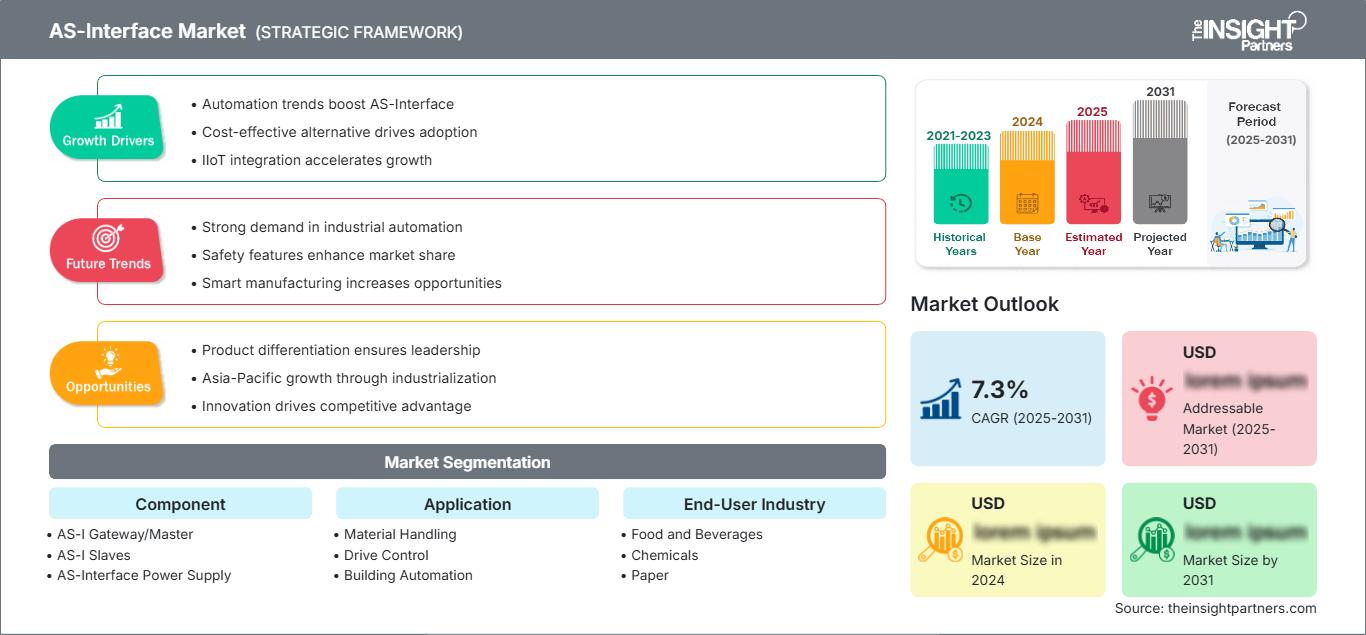
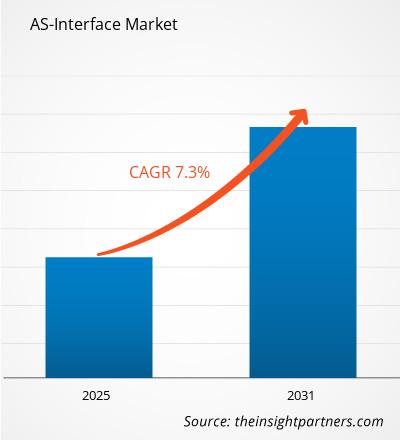
The AS-Interface Market Size will reach US$ 890.50 Million in 2025 and will achieve a size of US$ 1,368.85 Million by 2034, registering a CAGR of 4.89% in the period 2026–2034. The factors driving the demand include factory automation, lower field level networking, safety, cabling simplicity, and communications of sensors, actuators, drives, and gateways to programmable controllers in discrete and process industries.
North America represents a significant AS-Interface market share due to the developed industrial landscape in the region and early acceptance of automation technologies. The market in the region is expected to experience a CAGR of 3.5 to 4.5% during the forecast period, due to modernization of the existing manufacturing facilities and use of smart sensors/actuators in automotive and material handling industries.
AS-Interface Market Assessment and Insights
- North America captured approximately 32–36% of the global market in 2025, driven by strong automotive and material handling sectors. The region is expected to grow at a CAGR of 3.5–4.5% during 2026–2034, supported by continuous factory automation investments and industrial IoT deployment.
- US represented roughly 75–80% of the North American market in 2025. The country is forecast to expand at a CAGR of 3.8–4.5% through 2034, propelled by automotive manufacturing retrofits and food and beverage automation.
- Europe accounted for approximately 33–37% of the global market in 2025, led by Germany, the UK, and France. The region is projected to grow at a CAGR of 4.0–5.0%, underpinned by strong manufacturing bases and EU regulatory mandates for energy-efficient industrial operations.
- Asia Pacific represented roughly 22–26% of the global market in 2025, led by China, Japan, and India. The region is expected to register the fastest growth at a CAGR of 5.5–6.5%, driven by rapid industrialization, manufacturing capacity expansion, and government-backed Industry 4.0 initiatives.
- Largest Segment: AS-I Gateway/Master captured over 40–45% of the AS-Interface market in 2025. This segment is projected to grow at a CAGR of 4.0–5.0% through 2034, driven by the central role of gateways in managing communication between field devices and higher-level control systems .
- High Growth Segment: The AS-I Slaves segment is projected to achieve a CAGR of 5.5–6.5% during 2026–2034, driven by the increasing integration of intelligent sensors and actuators in automated production environments and rising demand for modular, scalable automation architectures .
- Key companies analyzed in detail: ABB Ltd., Baumer Electric AG, Bihl+Wiedemann GmbH, Emerson Electric Co., IFM Electronic GmbH, Pepperl+Fuchs GmbH, Phoenix Contact GmbH and Co. KG, Schneider Electric SE, Siemens AG, and Valmet Corporation.
Source: The Insight Partners' analysis based on proprietary research, government publications, company annual reports, investor presentations, industry databases, and expert interviews.
The market has come a long way from being just a niche fieldbus offering to becoming an industrial networking standard because of its inherent features that make wiring easy for discrete sensors and actuators. The success of early adoption in automotive industry proved the dependability and economic efficiency of the system, thereby leading to widespread acceptance in material handling, packaging and process industries. These have been supplemented by technological improvements such as increased speed of data transfer, enhanced diagnostic abilities and ability to interface seamlessly with higher levels of fieldbus and industrial Ethernet networks.
The AS-Interface market forecast indicates that in the coming years, the market is going to experience steady growth owing to the industrial modernization efforts of developing countries and the cost-effective upgrades of already existing facilities in developed nations. Smart manufacturing investments and regulation-friendly energy efficiency and safety laws are expected to provide impetus to the growth of the market. The fact that this technology helps in interfacing legacy sensors with modern control systems makes it well placed in the context of industrial digitalization efforts.
AS-Interface Market Report Scope
| Report Attribute | Details |
|---|---|
| Market size in 2025 | US$ 890.50 Million |
| Market Size by 2034 | US$ 1,368.85 Million |
| Global CAGR (2026 - 2034) | 4.89% |
| Historical Data | 2021-2024 |
| Forecast period | 2026-2034 |
AS-Interface Market Analysis
The need for AS-Interface arises due to changes within the manufacturing industry towards an automated, data-driven production process. Automotive, food and beverages, and logistics industries all depend on AS-Interface technology to provide connectivity to thousands of sensors, actuators, and safety components to the programmable logic controllers and distributed control systems. The capability to transmit both power and data using a two-wire cable greatly simplifies the installation process and lowers the cost of cabling materials, which becomes important in cases where there are thousands of input/output points.
The supply chain includes component suppliers, system integrators, and end-users, with system integrators being the most important in providing a custom-built automation architecture. The supply chain dynamics include a concentrated supply base for the main AS-Interface components such as the gateway and ICs.
The AS-Interface market trends indicates that the competitive environment involves a combination of industrial automation giants with specialized firms producing AS-Interface components. The companies include Siemens AG, Pepperl+Fuchs GmbH, and ABB Ltd., which use their large automation range to deliver a solution that combines AS-Interface into a wider product line. The specialists, Bihl+Wiedemann GmbH and IFM Electronic GmbH, compete through expertise and innovative application-oriented development of diagnostic capabilities and safety features. Emerson Electric Co. and Schneider Electric SE have included AS-Interface functionality as a part of wider process and hybrid automation solutions.
The investment trends point at the development of AS-Interface products with improved cybersecurity, diagnostics, and deterministic communication in time-sensitive networks. Strategic positioning involves delivery of modular and scalable solutions for easy integration with edge and cloud-based computing systems.
● REPORT CUSTOMIZATION
Tailor This Report To Align With Your Specific Business Requirements
This report can be customized to align precisely with your business objectives, scope, and target markets. Customization options include tailored segmentation, geography, competitive analysis, and strategic insights to support informed decision-making.
Customize This Report →WHAT YOU CAN ADJUST
- ● Segmentations
- ● Geography
- ● Competitive Analysis
- ● Language Preferences
AS-Interface Market: Strategic Insights
Regional Insights
North America AS-Interface Market
The North American AS-Interface market accounted for an estimated 32–36% share of global revenue in 2025. The United States represents the dominant national market, accounting for approximately 75–80% of regional demand, driven by extensive automotive manufacturing clusters in the Midwest, which utilize AS-Interface for body shop assembly lines and material handling systems. The region also benefits from a robust food and beverage processing sector that increasingly adopts the technology for hygienic and wash-down applications requiring reliable sensor communication. Key drivers include the need to modernize aging industrial infrastructure without disrupting operations, a scenario where AS-Interface's retrofit advantages and time savings of up to 50% over traditional wiring methods prove compelling. The market is further supported by the presence of major automation providers and a well-established network of system integrators with deep AS-Interface deployment expertise. The region's automotive sector remains the primary adopter, though growth in logistics and warehouse automation is gaining momentum.
U.S. AS-Interface Market
The U.S. AS-Interface market is estimated to grow at a CAGR of 3.8–4.5% from 2026 to 2034, reflecting steady industrial demand and technology replacement cycles. The U.S. accounted for over 80% of the North American market in 2025, with automotive OEMs and tier suppliers representing the largest end-user cohort. Major manufacturing hubs in Michigan, Ohio, and Indiana continue to deploy AS-Interface for both new production lines and brownfield retrofits, driven by the technology's ability to reduce installation time and simplify troubleshooting. The U.S. market also benefits from proactive engagement by the AS-Interface North America organization, which promotes standardization and provides technical support to end users and integrators. Key application trends include increasing adoption in packaging automation and pharmaceutical manufacturing, where stringent traceability and validation requirements align with AS-Interface's diagnostic capabilities.
Europe AS-Interface Market
Europe captured roughly 33–37% of the global AS-Interface market in 2025, with Germany emerging as the regional leader due to its strong automotive and mechanical engineering sectors. Germany accounts for a substantial share of European demand, driven by the presence of major automakers and a robust supplier network. The UK market is characterized by mature adoption in food and beverage processing and pharmaceuticals, while France and Italy show strong demand in material handling and packaging applications. Spain continues to invest in automation across its automotive and logistics sectors. European growth is further supported by regulatory initiatives such as the EU Green Deal, which promotes digitalization and energy efficiency in industrial processes. The region's CAGR is estimated at 4.0–5.0% through 2034, with Germany maintaining its leadership position.
APAC AS-Interface Market
The Asia Pacific AS-Interface market represented approximately 22–26% of global revenue in 2025 and is projected to register the highest regional CAGR of 5.5–6.5% during 2026–2034. China leads the region, driven by large-scale manufacturing expansions and government-backed Industry 4.0 initiatives. Japan and South Korea show strong adoption in automotive and electronics manufacturing, leveraging AS-Interface for precise and reliable sensor communication in high-volume production. India presents significant growth opportunities as industrial automation accelerates, supported by government programs promoting domestic manufacturing and digitalization. Australia's mining and resources sector increasingly adopts AS-Interface for process automation and safety applications. The region's rapid industrialization, coupled with investments in smart factory technologies, underpins robust demand growth.
Middle East & Africa AS-Interface Market
The Middle East & Africa is estimated to expand at a CAGR of 3.0–4.0% through 2034, driven by infrastructure development and modernization across the energy and industrial sectors. Saudi Arabia's Vision 2030 program is stimulating investments in industrial automation, while the UAE's focus on smart cities and manufacturing diversification creates new demand. South Africa remains a key market, with mining and metal processing as primary adopters of AS-Interface solutions for equipment monitoring and control. The region is also witnessing gradual uptake in water and wastewater treatment applications, supported by population growth and urban development. The market remains smaller compared to other regions but offers consistent growth opportunities.
Segmentation Analysis
Component
The component segment of the AS-Interface market is categorized into AS-I Gateway/Master, AS-I Slaves, AS-Interface Power Supply, and AS-I Cables. This segment is expected to exhibit a CAGR of 4.2–5.2% from 2026 to 2034.
- AS-I Gateway/Master: These devices manage communication between AS-Interface networks and higher-level fieldbuses or industrial Ethernet protocols. They captured over 40–45% of the market in 2025, driven by their critical role as network interfaces and the expanding installed base of AS-Interface systems.
- AS-I Slaves: Slaves include sensors, actuators, and I/O modules that connect to the AS-Interface network. This sub-segment is expected to grow at the fastest pace within the component category, driven by increasing sensorization and the proliferation of intelligent devices.
- AS-Interface Power Supply: These units supply power to AS-Interface networks while maintaining data communication integrity. Demand is closely tied to new system installations and expansions of existing networks.
- AS-I Cables: Yellow flat cables are the standard medium for AS-Interface networks, providing both power and data transmission. The market for cables is driven by new installations and the need for reliable, standardized cabling solutions.
Application
The application segment includes Material Handling, Drive Control, Building Automation, and Others. This segment is expected to witness a CAGR of 4.5–5.5% from 2026 to 2034.
- Material Handling: This is the largest application segment, capturing over 30–35% of the market in 2025. AS-Interface is widely used in conveyors, automated storage and retrieval systems, and sorting equipment due to its simplicity and reliability.
- Drive Control: AS-Interface is used for controlling and monitoring motor drives and variable frequency drives. Demand is driven by the need for decentralized control and reduced wiring in motor control centers.
- Building Automation: This application includes heating, ventilation, air conditioning, and lighting control. AS-Interface offers cost-effective and flexible solutions for connecting sensors and actuators in commercial and industrial buildings.
End-User Industry
The end-user segment comprises Food and Beverages, Chemicals, Paper, Oil and Gas, Water and Wastewater Treatment, Automotive, Metal and Mining, and Others. This segment is projected to register a CAGR of 4.6–5.6% during 2026–2034.
- Automotive: The automotive industry is a leading end-user, accounting for approximately 30–40% of the market in 2025. AS-Interface is extensively used in body shop welding lines, assembly lines, and paint shops .
- Food and Beverages: This sector relies on AS-Interface for hygienic and wash-down applications. Demand is driven by stringent food safety regulations and the need for reliable sensor communication.
- Water and Wastewater Treatment: AS-Interface is used for monitoring and controlling pumps, valves, and sensors in treatment plants. Growth is supported by infrastructure investments and environmental regulations.
- Metal and Mining: This industry uses AS-Interface for heavy-duty applications, including conveyor systems, crushers, and processing equipment, benefiting from the technology's robustness and reliability.
Opportunity Snapshot
| End-User Industry | Revenue Contribution | Trend Tag | Adoption Stage |
|---|---|---|---|
| Food and Beverages | Medium | Hygiene Automation | Scaling |
| Chemicals | Medium | Process Safety | Mature |
| Paper | Low | Mill Modernization | Emerging |
| Oil and Gas | Medium | Remote Monitoring | Scaling |
| Water and Wastewater Treatment | High | Infrastructure Upgrade | Scaling |
| Automotive | High | Smart Factory | Mature |
| Metal and Mining | Medium | Mine Automation | Scaling |
AS-Interface Market Growth Drivers and Impact Analysis
Increasing Adoption of Industry 4.0 and Smart Manufacturing
The global push toward Industry 4.0, characterized by the integration of cyber-physical systems, IoT, and cloud computing in manufacturing, is a primary driver. AS-Interface's ability to connect a vast array of field devices, including intelligent sensors and actuators, to higher-level control and data analytics platforms positions it as a foundational technology for smart factories. The technology's inherent diagnostic capabilities provide granular device-level data that is critical for predictive maintenance and operational optimization. As manufacturers increasingly seek to enhance production efficiency, reduce downtime, and improve product quality, the demand for robust, reliable, and easily deployable sensor communication networks like AS-Interface continues to grow. Industry data indicates that investments in industrial digitalization are rising across geographies, supporting sustained market expansion.
Cost-Effective Modernization of Legacy Industrial Infrastructure
A significant portion of the global installed base of industrial equipment relies on traditional point-to-point wiring, which is expensive to maintain and limits scalability. AS-Interface provides a cost-effective pathway for modernizing these legacy systems, enabling plant operators to upgrade to intelligent, networked control without a complete system overhaul. The two-wire system significantly reduces cabling, labor, and installation costs, with estimates suggesting savings of up to 40% compared to traditional wiring. This economic advantage is particularly compelling in brownfield applications where production interruptions must be minimized. The technology also simplifies system expansion, allowing incremental additions to the network as operational needs evolve. As plant managers face pressure to improve productivity and asset utilization, AS-Interface's retrofit value proposition remains a powerful demand driver.
Regulatory Mandates for Energy Efficiency and Safety
Stringent regulatory frameworks aimed at improving industrial energy efficiency and ensuring worker safety are propelling adoption of AS-Interface solutions. In Europe, the EU Green Deal and related directives incentivize investments in automation and digitalization to reduce carbon emissions and energy consumption . AS-Interface contributes to these goals by enabling precise control, monitoring, and optimization of motors, drives, and other energy-consuming equipment. The technology also supports advanced safety functions such as AS-Interface Safety at Work (ASi-SAFE), which allows safety devices to be integrated on the same network as standard I/O, simplifying safety system design and reducing wiring. This dual benefit of energy optimization and safety compliance resonates strongly with end users, particularly in the automotive and food and beverage sectors.
AS-Interface Market Future Trends
Integration with Industrial Internet of Things (IIoT) and Edge Computing
The convergence of AS-Interface with IIoT and edge computing architectures represents a significant future trend. As manufacturers pursue real-time data analytics and condition monitoring, AS-Interface gateways are increasingly designed to transmit diagnostic and operational data directly to cloud platforms or on-premise edge devices. This enables predictive maintenance, remote troubleshooting, and performance optimization on a scale previously unattainable. The trend toward "smart" AS-Interface components with embedded intelligence and advanced self-diagnostics will further enhance the ability to extract actionable insights from field-level data. This evolution will be particularly impactful in industries such as automotive and packaging, where high-speed production and stringent quality requirements demand immediate anomaly detection and corrective actions.
Expansion of Wireless and Hybrid AS-Interface Solutions
While AS-Interface is traditionally a wired networking technology, there is a growing trend toward wireless and hybrid solutions that combine wired infrastructure with wireless extensions. This is driven by applications involving mobile equipment, rotating machinery, or areas where physical wiring is challenging or hazardous. Developments in wireless AS-Interface allow sensors and actuators on moving parts to communicate with the network, extending the technology's applicability in material handling, logistics, and process industries. Hybrid approaches, where wireless segments feed into the main wired AS-Interface network, offer a flexible solution for brownfield upgrades and new installations. This trend will open up new application segments and enhance the technology's appeal in industries requiring flexible and reconfigurable production setups.
AS-Interface Market Opportunities
Expansion in Emerging Manufacturing Hubs in Asia and Latin America
Rapid industrialization and manufacturing capacity expansion in emerging economies, particularly in Asia and Latin America, present substantial growth opportunities for the AS-Interface market. Countries such as India, Vietnam, Mexico, and Brazil are witnessing significant investments in automotive, electronics, and consumer goods manufacturing, all of which are key end-user industries for AS-Interface. As these regions build new factories and upgrade existing facilities, the demand for efficient, cost-effective automation solutions is surging. Government initiatives promoting domestic manufacturing, such as India's "Make in India" and Mexico's manufacturing sector growth, are expected to accelerate adoption of industrial networking technologies. Companies that establish strong local presence and partnerships can capture significant market share in these high-growth regions.
Growing Demand in Water and Wastewater Treatment Infrastructure
Global investments in water and wastewater treatment infrastructure, driven by urbanization, environmental regulations, and climate resilience, present a growing market opportunity for AS-Interface. The technology is well-suited for monitoring and controlling pumps, valves, flow meters, and level sensors in water treatment plants, offering reliable communication in harsh and often remote environments. AS-Interface's ability to reduce wiring complexity and simplify maintenance aligns with the operational needs of utilities seeking to optimize plant performance and minimize downtime. With the World Bank and other international bodies funding large-scale water projects across Asia and Africa, the demand for automation solutions in this sector is poised to rise, creating new avenues for AS-Interface providers.
Recent Developments
- June 2026: ABB launches first Extension Pack for flagship DCS with web-based operations. The first Extension Pack (xP0) features a web browser-based Operations Client, which allows operators and automation teams to securely access, monitor, analyze and control industrial processes via HTML5 web technology
- March 2025: Schneider Electric, a global leader in digital transformation for energy management and automation, announced the launch of Modicon Edge I/O NTS — the future-ready Input/Output (I/O) system for data aggregation –at ProMat 2025 in Chicago.
- February 2023: Delta announces the launch of its R2-EC0902D0 32 digital input/output remote module. Featuring 32 integrated relays on the output, supporting 2 A at 30 VDC/ 250 VAC per channel, and 32 24 VDC digital inputs, the unit greatly simplifies the implementation of digital I/O on EtherCAT networks. The high level of integration reduces system costs by eliminating the need for a separate coupler, digital input/output modules, and external relays.
Frequently Asked Questions

- Comprehensive Market Sizing and Forecast Analysis
- Detailed Segmentation Analysis
- In-Depth Market Dynamics Assessment
- Regional and Country-Level Insights
- Competitive Landscape and Company Benchmarking
- Strategic Business Intelligence
Recent Reports
Testimonials

The Insight Partners provided valuable market intelligence that supported our global go-to-market strategy. Their team was professional, responsive, and attentive to our feedback, providing thoughtful analysis and helpful methodological clarifications throughout the project.
Junmo Kim Chief Financial Officer (CFO), Enertech Co., Ltd.
The Insight Partners' SCADA System Market report is comprehensive, with valuable insights on current trends and future forecasts. The team was highly professional, responsive, and supportive throughout. We are very satisfied and highly recommend their services.
RAN KEDEM Partner, Reali Technologies LTDs
I requested a report on a very specific software market and the team produced the report in a few days. The information was very relevant and well presented. I then requested some changes and additions to the report. The team was again very responsive and I got the final report in less than a week.
JEAN-HERVE JENN Chairman, Future Analytica
We worked with The Insight Partners for an important market study and forecast. They gave us clear insights into opportunities and risks, which helped shape our plans. Their research was easy to use and based on solid data. It helped us make smart, confident decisions. We highly recommend them.
PIYUSH NAGPAL Sr. Vice President, High Beam Global
The Insight Partners delivered insightful, well-structured market research with strong domain expertise. Their team was professional and responsive throughout. The user-friendly website made accessing industry reports seamless. We highly recommend them for reliable, high-quality research services
YUKIHIKO ADACHI CEO, Deep Blue, LLC.
This is the first time I have purchased a market report from The Insight Partners.While I was unsure at first, I visited their web site and felt more comfortable to take the risk and purchase a market report.I am completely satisfied with the quality of the report and customer service. I had several questions and comments with the initial report, but after a couple of dialogs over email with their analyst I believe I have a report that I can use as input to our strategic planning process.Thank you so much for taking the extra time and making this a positive experience.I will definitely recommend your service to others and you will be my first call when we need further market data.
JOHN SUZUKI President and Chief Executive Officer, Board Director, BK Technologies
I wish to appreciate your support and the professionalism you displayed in the course of attending to my request for information regarding to infectious disease IVD market in Nigeria. I appreciate your patience, your guidance, and the fact that you were willing to offer a discount, which eventually made it possible for us to close a deal. I look forward to engaging The Insight Partners in the future, all thanks to the impression you have created in me as a result of this first encounter.
DR CHIJIOKE ONYIA MANAGING DIRECTOR, PineCrest Healthcare Ltd.Reason to Buy
- Informed Decision-Making
- Understanding Market Dynamics
- Competitive Analysis
- Identifying Emerging Markets
- Customer Insights
- Market Forecasts
- Risk Mitigation
- Boosting Operational Efficiency
- Strategic Planning
- Investment Justification
- Tracking Industry Innovations
- Aligning with Regulatory Trends





 Get Free Sample for