
Aspherical Lens Market Trends, Size & Forecast by 2034
Aspherical Lens Market Size and Forecasts (2021 - 2034), Global and Regional Share, Trends, and Growth Opportunity Analysis Report Coverage : By The report is segmented into Type (Glass Aspherical lens, Plastic Aspherical lens), Offering (Double Aspherical lens and Single Aspherical lens), Manufacturing Technology (Molding, Polishing & Grinding), Application (Consumer Electronics, Digital Cameras, Automotive, Ophthalmic, Fiber Optics & Photonics, and Others)
- Status : Data Released
- Report Code : TIPRE00039730
- Category : Electronics and Semiconductor
- No. of Pages : 150
- Available Report Formats :


- Last update date : July 15, 2026


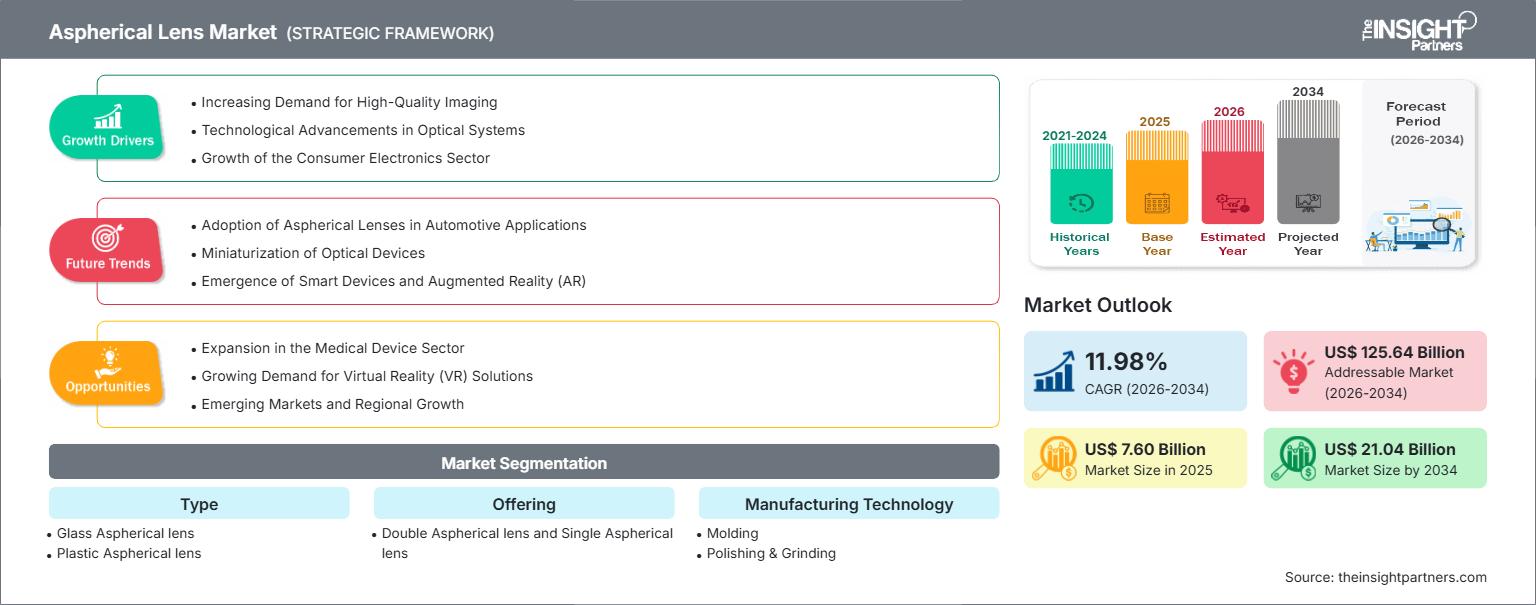
2025 Market Size
US$ 7.60 Bn
Base year value
2034 Forecast
US$ 21.04 Bn
Projected by 2034
CAGR 2026-2034
11.98 %
Growth rate
Addressable Market
US$ 125.64 Bn
(2026-2034)
The Aspherical Lens Market was valued at US$ 7.60 Billion in 2025 and is projected to reach US$ 21.04 Billion by 2034, growing at a CAGR of 11.98% during 2026–2034. As spherical lenses evolve into thin forms and expand their field of view while reducing optical aberrations and improving image quality, there will be an increase in the Aspherical Lens Market as well.
North America is a technologically developed region in terms of demand, and the Aspherical Lens Market size will be driven by automotive vision systems, premium glasses, defense optics, high-resolution imaging, and optical communication devices. The region is projected to register a CAGR in the 10.8–11.4% range between 2026 and 2034. Growth drivers include ADAS penetration in cars, medical imaging spending, and the local supply chain for precision optics.
Aspherical Lens Market Assessment and Insights
Aspherical Lens Market Assessment and Insights
- North America: The region holds 23–27% share in 2025 and grows at a CAGR range of 10.8–11.4% during 2026–2034, supported by automotive imaging, defense optics, premium ophthalmic demand, and photonics laboratories.
- US: The country represents 78–82% of North America in 2025 and grows at a CAGR range of 10.9–11.5% during 2026–2034, led by automotive, medical imaging, and optical instrumentation.
- Europe: The region accounts for 20–24% share in 2025 and grows at a CAGR range of 10.1–10.7% during 2026–2034, with Germany, the UK, France, Italy, and Spain leading precision optics adoption.
- Asia Pacific: The region holds 42–46% share in 2025 and grows at a CAGR range of 12.7–13.3% during 2026–2034, led by China, Japan, South Korea, India, and Taiwan.
- Largest Segment: Glass Aspherical lens holds 57–61% market share in 2025 and grows at a CAGR range of 11.2–11.8% during 2026–2034 due to durability and optical stability.
- High Growth Segment: Automotive holds 14–18% market share in 2025 and grows at a CAGR range of 13.4–14.0% during 2026–2034 as ADAS, LiDAR, and camera modules scale.
- Key companies analyzed in detail: Nikon Corporation; Canon Inc.; Panasonic Holdings Corporation; HOYA Corporation; AGC Inc.; SCHOTT AG; Carl Zeiss AG; Tokai Optical Co., Ltd.; SEIKO Optical Products Co., Ltd.; Calin Technology Co., Ltd.; Asia Optical Co., Inc.; Sunny Optical Technology (Group) Company Limited.
Source: The Insight Partners' analysis based on proprietary research, government publications, company annual reports, investor presentations, industry databases, and expert interviews.
Design for the optical system has evolved from being spherical to smaller multi-lens designs using molded glass, precise plastics, coatings, and the needs of computational imaging. Trends in manufacturing have moved to glass molding for consistency, polymer optics made through injection molding for volume manufacturing, and polishing/grinding for particular tolerances. This is positive for the Aspherical Lens Market as firms reduce the number of lenses used, avoid spherical aberration, and make thin modules.
Future growth is likely to arise from localization in the electronics sector, vehicle safety regulation, myopia treatment, photonics packaging, and the rising density of cameras on connected devices. New regions to be served by the company will get investments in lens processing, coating, and module assembly owing to the need for reliable supply chain operations close to manufacturing locations. Headwinds from regulation linked to vehicle safety, vision care, and medical imaging will make the use of well-designed aspheric optics necessary.
Aspherical Lens Market Report Scope
| Report Attribute | Details |
|---|---|
| Market size in 2025 | US$ 7.60 Billion |
| Market Size by 2034 | US$ 21.04 Billion |
| Global CAGR (2026 - 2034) | 11.98% |
| Historical Data | 2021-2024 |
| Forecast period | 2026-2034 |
Aspherical Lens Market Analysis
The Aspherical Lens Market is witnessing growth due to a trend in smaller optical systems requiring greater resolutions, wider fields of view, and improved low-light imaging. Aspheric lenses are used in smartphones' camera modules, car cameras, AR devices, ophthalmic instruments, and fiber optics due to their lower levels of aberration and fewer components involved. There is a growth in demand due to an increase in the manufacturing of vehicles equipped with driver assistance systems.
The value chain consists of optical glass suppliers, resin suppliers, mold makers, precise grinding, coating suppliers, module assembly, camera original equipment manufacturers, lens labs, and Tier 1 automotive parts suppliers. Factors affecting supply chain management include yield management, thermal stability, mold lifespan, surface finish, coating adherence, and metrology capabilities. Suppliers who are able to integrate design software, tooling, materials, and inspection are able to qualify customers faster.
In the case of the Aspherical Lens Market analysis, it is seen that the market competition is based on the processes of manufacturing, materials used, modules, and applications engineering, rather than just on lens manufacturing. The company Nikon Corporation and Canon Inc. hold their strengths in the field of imaging optics, whereas companies like HOYA Corporation, AGC Inc., SCHOTT AG, and Carl Zeiss AG have strengths in high-performance glass, ophthalmic, and industrial optics.
Investments are being made in areas such as precision glass molding, wafer-level optics, high-index materials, and automated surface inspection. Companies like Tokai Optical Co., Ltd., SEIKO Optical Products Co., Ltd., and Calin Technology Co., Ltd. offer specialized services for ophthalmic and molded optics applications where customization and quality coatings are key. Positioning will be important to secure design-ins with camera, ADAS, eyewear, photonics, and medical imaging customers prior to mass production.
● REPORT CUSTOMIZATION
Tailor This Report To Align With Your Specific Business Requirements
This report can be customized to align precisely with your business objectives, scope, and target markets. Customization options include tailored segmentation, geography, competitive analysis, and strategic insights to support informed decision-making.
Customize This Report →WHAT YOU CAN ADJUST
- ● Segmentations
- ● Geography
- ● Competitive Analysis
- ● Language Preferences
Aspherical Lens Market: Strategic Insights
Regional Insights
North America Aspherical Lens Market
North America accounts for 23–27% share in 2025 and is projected to grow at a CAGR range of 10.8–11.4% during 2026–2034. The Aspherical Lens Market share is supported by advanced driver assistance, medical imaging, machine vision, aerospace optics, defense imaging, and premium eyewear. Regional buyers value supplier qualification, documentation, coating reliability, and consistent optical performance across production lots.
Growth is enhanced through automotive safety systems, industrial automation, research in photonics, and advancements in optical communications. The US drives demand, whereas Canada provides through its involvement in medical technology, research optics, and automobiles. Traceability, local design, and reliable supply are important to procurement in areas such as defense, health care, and optical assemblies.
U.S. Aspherical Lens Market
The U.S. represents 78–82% of North America in 2025 and is expected to grow at a CAGR range of 10.9–11.5% during 2026–2034. The major demand segments in this market are automotive imaging, ophthalmic lenses, defense sensors, endoscopy, machine vision, and fiber-optic equipment. The company’s operations are facilitated by global suppliers, regional distributors, and application engineering groups for camera, medical, and instrument manufacturers.
The application trends involve multi-camera automobiles, portable diagnostic equipment, high-definition surveillance, augmented reality prototypes, and prescription glasses with sharper edges. Plastics are used to reduce weight, while moldable glass maintains the optical performance in vibration, temperature, humidity, and an extended service environment.
Europe Aspherical Lens Market
Europe holds 20–24% share in 2025 and is forecast to grow at a CAGR range of 10.1–10.7% during 2026–2034. Germany excels in automotive optics, industrial imaging, precision machinery, and medical technology. The United Kingdom promotes photonics research, defense imaging, and specialty optics, and suppliers will be supported by excellent universities and highly sophisticated manufacturing centers.
France, Italy, and Spain provide additional demand through eyewear production, health care imaging, vehicle electronics, and industrial imaging. European procurement processes will be influenced by road safety standards, sustainable business practices, optical quality certification, and reliability throughout the lifetime of use. Suppliers of high-index glass, sophisticated coatings, precise polishing, and specific applications design solutions will be ready to serve OEM exporters.
APAC Aspherical Lens Market
The Asia Pacific region contributes around 42%-46% share in 2025 and is expected to register CAGR at the rate of 12.7%-13.3% from 2026-2034. China leads the market owing to electronics assembly, smartphone camera module, electric vehicles' supply chain and optical components manufacturing.
Japan and South Korea focus on precision optics, cameras, display technologies and metrology associated with semiconductors, whereas India benefits because of electronics manufacturing and the eyewear industry. Photonics and imaging, along with research applications, are driving factors for Taiwan and Australia. Policies supporting local manufacturing and vehicle safety content increase the use of aspheric optics.
Middle East & Africa Aspherical Lens Market
MEA will witness growth in terms of a CAGR range of 9.4-10.0% during the forecast period 2026-2034. The main contributor to this market region will be Saudi Arabia, due to growth in smart cities, healthcare, security, and mobility applications, increasing the need for imaging hardware and optical devices.
The demand from UAE will come from the segments of surveillance, logistics, healthcare, and consumer electronics, and South Africa’s contribution will come from segments like ophthalmic care, mining inspection, and industrial imaging. Demand in rest of MEA will remain project-based and will be driven by distribution availability.
Segmentation Analysis
Type
CAGR forecast for Type is expected to be in the range of 11.6-12.2% from 2026-2034. The scope of the Aspherical Lens Market, based on type, includes material robustness, weight, refractive index, heat resistance, tooling expenses, and manufacturing quantity. Aspheric lenses made from glass can be used in stringent automotive, cameras, and instrumentation applications, whereas lenses made of plastics serve the mass market.
- Glass Aspherical lens: The glass aspherical lenses have the most dominant market position owing to their ability to offer thermal stability, scratch resistance, refractive behavior, and longevity in camera modules, ADAS, medical imaging, and industrial optics.
- Plastic Aspherical lens: Plastic aspherical lenses facilitate mass production of light-weight and affordable assemblies especially in the smartphone, sensors, display, and consumer electronics markets.
Offering
The growth rate in terms of Compound Annual Growth Rate (CAGR) is projected to be between 11.1% and 11.7% over 2026-2034. Demand is driven by optical configuration, level of correction required, and thickness of the lens. Single aspherical lenses are usually found in those cases that involve just one optimized surface to minimize aberrations.
- Aspherical Doublet: Double aspherical elements enhance the optical correction in smaller assemblies, aiding wide angle cameras, sophisticated ophthalmic devices, and imaging equipment requiring excellent edge correction.
- Aspherical Single lens: These single aspherical lenses continue to be popular due to the reduction of spherical aberrations and a smaller number of elements required.
Manufacturing Technology
The Manufacturing Technology segment is expected to experience growth with a CAGR of 11.4-12.0% for the forecast period 2026-2034. The molding process can be used when a large number of pieces need to be produced, such as in the case of smaller lenses; however, polishing and grinding processes cannot be ignored for intricate shapes and tough material.
- Molding: It is a vital process in the manufacture of scalable products because it ensures repeatability, reduces costs, and makes possible automation of inspection in the consumer electronics and automotive sectors.
- Finishing & Grinding: These processes continue to be essential for precision optics, prototypes, specialty glass, and industrial lenses.
Application
The CAGR for the applications is forecast to be between 12.0% and 12.6%. The consumer electronics sector will retain its position as the biggest user, while automotive will be the fastest growing as cars continue to incorporate many sensors and cameras. Other areas where demand is resilient include ophthalmic applications, fiber optics and photonics, and digital cameras.
- Consumer Electronics: Consumer electronics make use of aspheric optics in smartphones, wearables, displays, projection, and compact sensing technologies, where design thinness and enhanced image sharpness contribute towards differentiating their devices.
- Digital Camera: Digital cameras make use of aspherical lenses that help reduce distortion, enhance wide-angle optics, and enable lightweight interchangeable lenses in professional/enthusiast imaging systems.
- Automotive: Growing automotive applications include the requirement for compact lenses in ADAS, LiDAR, driver monitoring, digital mirror, and headlamps applications, requiring performance stability under challenging conditions.
- Ophthalmic: Ophthalmic lenses make use of a thinner profile, enhanced peripheral vision, and aesthetic properties in order to enable premium prescription eyewear, progressive lenses, and myopia management solutions.
- Fiber Optics & Photonics: Fiber optics/photonics applications require miniature lenses for coupling, collimation, sensing, lasers, and optical communication applications requiring precision alignment and low optical losses.
Opportunity Snapshot
| Application | Revenue Contribution | Trend Tag | Adoption Stage |
| Consumer Electronics | High | Multi-Camera | Mature |
| Digital Cameras | Medium | Creator Optics | Mature |
| Automotive | High | ADAS Vision | Scaling |
| Ophthalmic | Medium | Myopia Control | Scaling |
| Fiber Optics & Photonics | Medium | Photonic Coupling | Emerging |
Aspherical Lens Market Growth Drivers and Impact Analysis
Higher Optical Content in Connected Consumer Devices
Consumer electronics OEMs are packing in more cameras, sensors, and optics capabilities while maintaining thin form factors. Aspheric lenses are key players in enabling aberration correction and reducing lens stack height, thus becoming crucial components for phones, tablets, wearables, action cameras, and mini projectors. Market effects include increased requirements for molded plastic and glass optics capable of handling tight tolerances in yields, coatings, and assembly. Tooling and testing companies able to handle high volumes, perform automatic inspections, and deliver rapid design iterations have a chance of obtaining recurring business from camera module suppliers. This driver also drives innovation in materials as device manufacturers seek better low-light performance and edge acuity without changing module thickness.
Vehicle Vision Systems Requiring Rugged Compact Optics
There are front, rear, surround view, driver monitoring, LiDAR, and headlamp optical solutions being introduced by automotive platforms, all of which demand lenses that are capable of performing during vibrations, high temperatures, low temperatures, and humidity. There are benefits of having an aspherical lens because this will allow reduced distortion and improved light management, making it possible to build smaller modules for advanced driver-assistance system and intelligent lighting. It is significant because there is a growing trend among government agencies to promote the use of such driver assistance and visibility technology. The process of qualifying lenses for automotive applications increases barriers to entry as manufacturers must prove repeatability and longevity.
Premium Ophthalmic and Medical Imaging Demand
Improved comfort and image quality and miniaturized vision aids and medical imaging systems create demand for optics that provide improved comfort, image quality, and portability. Aspheric ophthalmic lenses could decrease the size and minimize distortions, whereas miniature optical systems can be utilized in endoscopic examinations. Commercially, the development of value-added optics becomes more significant than commoditized optics. An aging population, increased prevalence of myopia, and developments in digital healthcare fuel the growth of the market. Optical design, biocompatibility, fabrication precision, and clinical channel are necessary in order to provide both high-end eyewear and medical imaging systems.
Aspherical Lens Market Future Trends
Hybrid Glass-Plastic Optical Architectures
Aspherical Lens Market trends will increasingly include hybrid optical architectures that combine molded glass elements with engineered plastic lenses. This design method will enable engineers to optimize heat tolerance, weight, cost, and performance of imaging systems. Car, augmented reality, smartphone, and medical device manufacturers will be expected to utilize hybrid designs where no single material can satisfy their needs. Future competitiveness will revolve around material compatibility, coating layers, joining techniques, and metrology automation. Companies with cross-material design knowledge will reduce risks for OEMs and increase the market size by addressing the demand for sensor systems outside the imaging module realm.
Metrology-Led Manufacturing and AI-Assisted Design
In the future, production processes will depend even more on advanced metrology, machine vision inspection, and AI-enhanced optics design to increase yield and decrease time required for qualification. The verification of aspheric surfaces is complicated, so the ability to measure surface geometry, roughness, coating problems, and misalignment will give companies an edge. Producers will apply production line data to optimize tooling, forecast mold wear, and minimize losses. The most benefit will be derived from sectors in which even small variations of optical surfaces will impact sensors, including ADAS cameras, photonics components, high-end eyewear, and miniature imaging devices.
Aspherical Lens Market Opportunities
ADAS and LiDAR Module Design-Ins
Design-ins for automotive modules present a practical business opportunity since lens manufacturers will have access to a lengthy production cycle when qualified by the Tier 1 integrators. Aspherical Lens Market Forecasts give reasons for investing in robust glass lenses, anti-reflection coatings, and assembly of lenses optimized for wide-angle cameras, LiDAR receivers, and smart lighting systems. Lens providers should focus on engineering help, environmental testing, and geographic capability close to vehicle electronics hubs. Collaboration with camera module manufacturers could enhance specifications prior to making vehicle platform sourcing decisions.
Localized Ophthalmic Lens Processing and Digital Retail Channels
Value can be added by ophthalmic lens suppliers by integrating aspheric designs of lenses along with quick local manufacturing of these lenses, coating, and online order management systems. Premium lenses that enhance aesthetics, improve peripheral vision, and offer enhanced comfort become increasingly important for elderly clients, high-index prescriptions, and young kids who need myopia control. Optometrist education and investments into automated laboratories, regional stock programs, and an online portal management system for practitioners must be made by companies. There is an additional aspect to the business beyond selling lenses since the quality of service plays a key role in customer retention.
Recent Developments
- March 2025: Raymax announced its new partner, Asphericon, a leader in creating aspheric lenses, optics, and aspheric systems to bring visions to life in manufacturing, industrial technology, and engineering, laser applications, semiconductors, metrology, life sciences, automotive, aerospace, and others relying on high-quality optics.
- June 2026: ZEISS Medical Technology announced the early clinical implantations of the ZEISS AT LUCIA toric 721P intraocular lens (IOL), designed to treat cataracts while simultaneously correcting astigmatism. ZEISS is currently conducting an early-access clinical trial with a select group of highly experienced surgeons from six countries across Europe (Czech Republic, Germany, Italy, Spain, Sweden and UK). Surgeons who have begun implanting the new lens have already reported positive early impressions.
- March 2026: Johnson & Johnson announced U.S. Food and Drug Administration (FDA) approval of TECNIS PureSee IOL, an extended depth of focus (EDOF) intraocular lens (IOL) intended for use in cataract surgery.1 TECNIS PureSee IOL delivers clarity of vision for patients, with 97% of them reporting no very bothersome visual disturbances.1 TECNIS PureSee IOL will be available for patients in the U.S.
Frequently Asked Questions

- Comprehensive Market Sizing and Forecast Analysis
- Detailed Segmentation Analysis
- In-Depth Market Dynamics Assessment
- Regional and Country-Level Insights
- Competitive Landscape and Company Benchmarking
- Strategic Business Intelligence
Recent Reports
Testimonials

The Insight Partners provided valuable market intelligence that supported our global go-to-market strategy. Their team was professional, responsive, and attentive to our feedback, providing thoughtful analysis and helpful methodological clarifications throughout the project.
Junmo Kim Chief Financial Officer (CFO), Enertech Co., Ltd.
The Insight Partners' SCADA System Market report is comprehensive, with valuable insights on current trends and future forecasts. The team was highly professional, responsive, and supportive throughout. We are very satisfied and highly recommend their services.
RAN KEDEM Partner, Reali Technologies LTDs
I requested a report on a very specific software market and the team produced the report in a few days. The information was very relevant and well presented. I then requested some changes and additions to the report. The team was again very responsive and I got the final report in less than a week.
JEAN-HERVE JENN Chairman, Future Analytica
We worked with The Insight Partners for an important market study and forecast. They gave us clear insights into opportunities and risks, which helped shape our plans. Their research was easy to use and based on solid data. It helped us make smart, confident decisions. We highly recommend them.
PIYUSH NAGPAL Sr. Vice President, High Beam Global
The Insight Partners delivered insightful, well-structured market research with strong domain expertise. Their team was professional and responsive throughout. The user-friendly website made accessing industry reports seamless. We highly recommend them for reliable, high-quality research services
YUKIHIKO ADACHI CEO, Deep Blue, LLC.
This is the first time I have purchased a market report from The Insight Partners.While I was unsure at first, I visited their web site and felt more comfortable to take the risk and purchase a market report.I am completely satisfied with the quality of the report and customer service. I had several questions and comments with the initial report, but after a couple of dialogs over email with their analyst I believe I have a report that I can use as input to our strategic planning process.Thank you so much for taking the extra time and making this a positive experience.I will definitely recommend your service to others and you will be my first call when we need further market data.
JOHN SUZUKI President and Chief Executive Officer, Board Director, BK Technologies
I wish to appreciate your support and the professionalism you displayed in the course of attending to my request for information regarding to infectious disease IVD market in Nigeria. I appreciate your patience, your guidance, and the fact that you were willing to offer a discount, which eventually made it possible for us to close a deal. I look forward to engaging The Insight Partners in the future, all thanks to the impression you have created in me as a result of this first encounter.
DR CHIJIOKE ONYIA MANAGING DIRECTOR, PineCrest Healthcare Ltd.Reason to Buy
- Informed Decision-Making
- Understanding Market Dynamics
- Competitive Analysis
- Identifying Emerging Markets
- Customer Insights
- Market Forecasts
- Risk Mitigation
- Boosting Operational Efficiency
- Strategic Planning
- Investment Justification
- Tracking Industry Innovations
- Aligning with Regulatory Trends





 Get Free Sample for