
Attention Deficit Hyperactivity Disorder Market Trends, Size & Forecast by 2034
Coverage: by Drug ( Amphetamine, Methylphenidate, Lisdexamfetamine, Dexmethylphenidate, Atomoxetine, Guanfacine, Clonidine, Bupropion ); Drug Type ( Stimulant, Non-stimulant ); Demographic ( Adult (Aged 18 and above), Children ); Distribution Channel ( Retail Pharmacy, Hospital Pharmacy ), and Geography (North America, Europe, Asia Pacific, and South and Central America)
- Status : Data Released
- Report Code : TIPRE00011775
- Category : Life Sciences
- No. of Pages : 150
- Available Report Formats :


- Last update date : September 15, 2026


2025 Market Size
US$ 38.96 Bn
Base year value
2034 Forecast
US$ 51.64 Bn
Projected by 2034
CAGR 2026-2034
3.18 %
Growth rate
Addressable Market
US$ 411.39 Bn
(2026-2034)
The global Attention Deficit Hyperactivity Disorder market was valued at US$ 38.96 billion in 2025 and is expected to reach US$ 51.64 billion by 2034; it is estimated to record a CAGR of 3.18% during 2026-2034.
Attention Deficit Hyperactivity Disorder Market Assessment and Insights
- North America: North America represented approximately 41–45% share in 2025 and is expected to grow at a CAGR of 3.8–4.3% between 2026–2034, supported by established diagnosis, specialist care, reimbursement, and broad availability of branded and generic therapies.
- US: The US accounted for approximately 88–91% of North American revenue in 2025 and is projected to grow at 3.8–4.3% CAGR between 2026–2034, led by high diagnosis and treatment penetration.
- Europe: Europe held approximately 27–31% share in 2025 and is projected to grow at 3.4–3.9% CAGR through 2034. Germany, the UK, France, Italy, and Spain remain important markets, with treatment access and adult diagnosis supporting expansion.
- Asia Pacific: Asia Pacific represented approximately 20–24% share in 2025 and is expected to register 4.8–5.4% CAGR between 2026–2034. China, Japan, South Korea, India, and Australia provide the principal demand base as diagnosis and specialist capacity improve.
- Largest Segment: Stimulants held approximately 72–76% market share in 2025 and are expected to expand at a 3.2–3.7% CAGR between 2026–2034, maintaining dominance through established clinical use.
- High Growth Segment: Non-stimulants represented approximately 24–28% share in 2025 and are projected to grow at 4.8–5.5% CAGR through 2034, supported by tolerability and treatment personalization.
- Key companies analyzed in detail: Eli Lilly and Company, Johnson & Johnson Services, LLC, Lupin Limited, Mallinckrodt Pharmaceuticals, Aytu BioPharma, Inc., Pfizer Inc., Purdue Pharma L.P., Takeda Pharmaceutical Company Limited, Supernus Pharmaceuticals, Inc., and Tris Pharma, Inc.
Source: The Insight Partners' analysis based on proprietary research, government publications, company annual reports, investor presentations, industry databases, and expert interviews.
The ADHD market has progressed beyond standard immediate-release stimulants in favor of differentiation through improved formulations in terms of duration, adherence, ease of use, and tolerability. The new extended-release delivery forms, liquid formulations, chewables, and alternative means of delivery are repositioning their offerings. Manufacturing focuses more on compliance with controlled substance regulations, formulation reliability, production redundancy, and dependable distribution, since any interruption impacts continuity for patients and pharmacies alike.
The opportunity within the attention deficit hyperactivity disorder market during the forecasted period includes adult treatment, non-stimulant therapies, emerging Asia markets, and new formulations through better drug-delivery technology. Regulatory considerations include the safety of children, appropriate handling of controlled substances, and evidence-based prescribing. Increasing investment in therapies with the ability to address duration, adherence issues, and non-responders to standard stimulant therapy is occurring.
Attention Deficit Hyperactivity Disorder Market Report Scope
| Report Attribute | Details |
|---|---|
| Market size in 2025 | US$ 38.96 Billion |
| Market Size by 2034 | US$ 51.64 Billion |
| Global CAGR (2026 - 2034) | 3.18% |
| Historical Data | 2021-2024 |
| Forecast period | 2026-2034 |
Attention Deficit Hyperactivity Disorder Market Analysis
The attention deficit hyperactivity disorder market growth drivers include increasing diagnoses and rising awareness of the disorder as well as the ability to recognize the symptoms that remain consistent throughout the individual's life from adolescence to adulthood. According to the CDC, 12.0% of individuals between ages 3–17 have been diagnosed with ADHD in the United States during 2024. The need for treatment, apart from prevalence, hinges on diagnosis capabilities, physician confidence, persistence with medications, and accessibility to pharmacies and specialists.
The supply chain includes producers of active pharmaceutical ingredients, stimulant drugs manufacturers, product developers, regulatory bodies, wholesalers, retail pharmacies, hospital pharmacies, prescribers, and consumers. Availability is especially sensitive to manufacturing abilities and regulations of stimulants. Entry of generics makes treatment more affordable but reduces the prices for branded products. Differentiation via release technologies is a good strategy to preserve the value.
The attention deficit hyperactivity disorder market report depicts a fragmented competitive landscape made up of the originators, generic drug manufacturers, specialty pharmaceuticals, and formulation companies. Positioning of Johnson & Johnson Services, LLC is evident from its Concerta and methylphenidate drugs. The expertise of Eli Lilly and Company lies in the manufacture of atomoxetine drugs. Whereas the product range of Pfizer Inc., Lupin Limited, Mallinckrodt Pharmaceuticals, and Purdue Pharma L.P. is more diverse in the conventional pharma approaches.
Competition positioning has now become dependent upon formulation technology in addition to the molecule availability. The portfolio of Takeda Pharmaceutical Company Limited remains strategically relevant owing to its historical association with Shire ADHD products. Supernus Pharmaceuticals, Inc. and Tris Pharma, Inc. focus on their formulation technologies, while Aytu BioPharma, Inc. remains engaged with the ADHD product line acquisitions. The investment focus has now shifted toward long-duration, liquid formulation, mechanism, children-friendly, and discontinuation prevention technologies.
● REPORT CUSTOMIZATION
Tailor This Report To Align With Your Specific Business Requirements
This report can be customized to align precisely with your business objectives, scope, and target markets. Customization options include tailored segmentation, geography, competitive analysis, and strategic insights to support informed decision-making.
Customize This Report →WHAT YOU CAN ADJUST
- ● Segmentations
- ● Geography
- ● Competitive Analysis
- ● Language Preferences
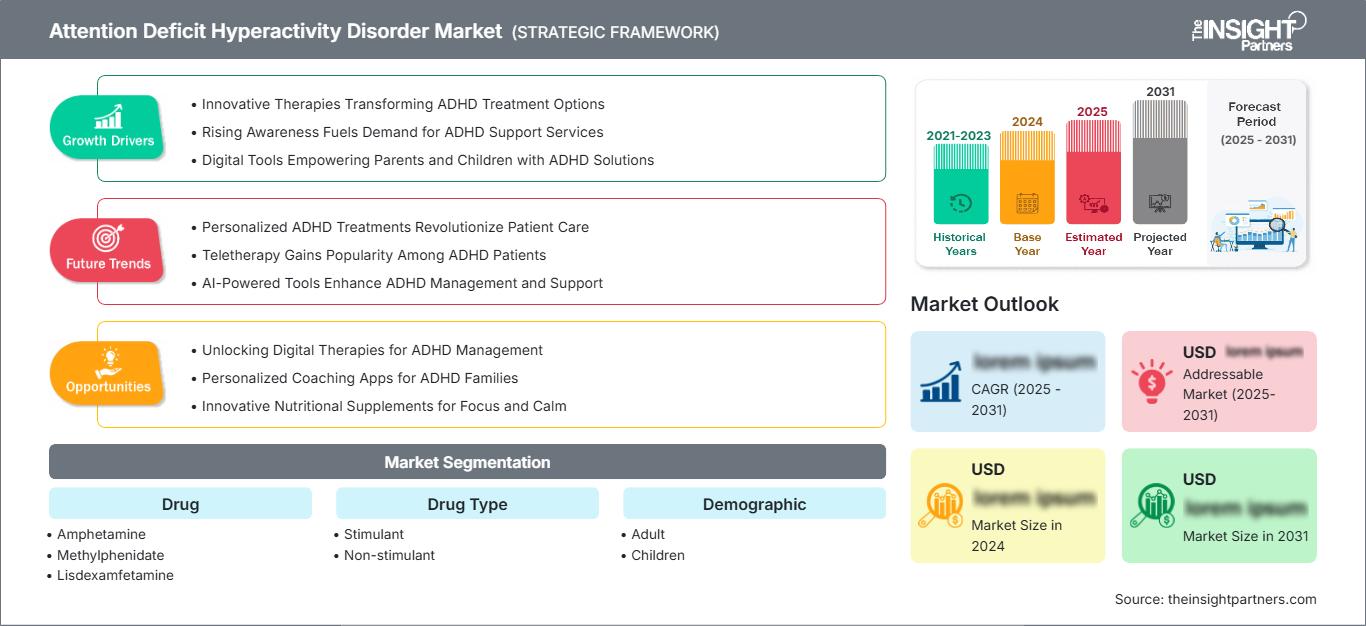
Attention Deficit Hyperactivity Disorder Market: Strategic Insights
Regional Insights
North America attention deficit hyperactivity disorder market
North America represents approximately 41-45% market share in 2025 and is expected to grow at a CAGR of 3.8-4.3% up to 2034. North America is dominated by the United States in terms of consumption due to the reasons mentioned previously: prevalence of diagnoses, established specialists, widespread medication and mature reimbursement.
The structural demand is underpinned by adult diagnosis, treatment needs, and further development of the extended-release formulations. Regulatory pressure is high due to the classification of stimulants as controlled substances, thus the strict compliance policy needs to be observed. Generic access is provided, while branded medications compete due to duration, convenience, and dose specificities.
U.S. attention deficit hyperactivity disorder Market
The US represented approximately 88–91% of North American revenue in 2025 and is expected to expand at a 3.8–4.3% CAGR. CDC data indicate that 12.0% of children aged 3–17 had ever received an ADHD diagnosis in 2024, reinforcing the country's large treated population.
Johnson & Johnson Services, LLC provides Concerta exposure, while Pfizer Inc., Lupin Limited, Mallinckrodt Pharmaceuticals, Purdue Pharma L.P., and Aytu BioPharma, Inc. operate in their respective product areas. Application trends have been observed involving the usage of the drug in adults, prolonged duration treatment, and the use of non-stimulants due to stimulant intolerance, abuse issues, and unresponsiveness.
Europe attention deficit hyperactivity disorder Market
Europe had approximately 27-31% of the share in 2025, and is expected to grow at 3.4-3.9% CAGR up till 2034. UK and Germany are considered dominant markets, as they have well-defined guidelines for clinical indications, and specialist services respectively. France, Italy and Spain are other sources of demand; however, access to treatments and prescribing varies from one nation to another.
While the UK has standard clinical guidelines for indication, Germany has specialist services with an established system for the distribution of pharmaceuticals. France and Italy have been steadily developing recognition of adult ADHD cases, which creates demand for treatment. In Spain, there are more pediatric and adolescent cases along with awareness in adults.
APAC attention deficit hyperactivity disorder Market
The APAC region was estimated to have held a share of about 20%-24% in 2025 and expected to grow at CAGR of 4.8-5.4% up to 2034, being the fastest growing region among all others. Japan and Australia boast relatively mature treatment paths, whereas China, South Korea, and India are regions with plenty of growth potential.
China dominates the market in the region and this is attributed to the better diagnostic capability of the market as well as better capabilities among the specialists. Japan and South Korea are nations that have an advanced healthcare system infrastructure while India provides opportunities for growth based on awareness and more specialist availability in urban areas.
Middle East & Africa attention deficit hyperactivity disorder Market
Middle East and Africa is expected to grow at approximately 3.2–4.0% CAGR through 2034. Saudi Arabia and the UAE represent leading Gulf markets because of relatively developed healthcare infrastructure, while South Africa provides an important sub-Saharan treatment base. Rest-of-MEA markets remain constrained by specialist availability and affordability.
Infrastructure developments in the healthcare sector, private hospital growth, and virtual consultation technologies have been contributing to increasing accessibility in certain nations. Gulf nations are benefiting from their ability to spend on healthcare and the modernization of the sector. However, substance regulation, inconsistent diagnosis, inadequate specialist density, and varying payments still affect adoption rates. Growth in the region requires improvement in diagnostics and drug delivery in smaller cities.
Segmentation Analysis
Drug
The drug segment is expected to expand at a 3.4–3.9% CAGR during 2026–2034. The attention deficit hyperactivity disorder market share is broad because clinicians select among multiple mechanisms and formulations according to age, symptom profile, duration requirements, tolerability, comorbidities, and previous treatment response. Established stimulants remain foundational, while non-stimulant options support individualized treatment strategies.
- Amphetamine: Amphetamine-based therapies remain strategically important because of established efficacy, multiple formulations, and broad clinician familiarity. Extended-release products support once-daily treatment and sustained symptom control across school and working hours.
- Methylphenidate: Methylphenidate remains a core treatment option across pediatric and adult populations. Immediate-release and modified-release formats provide dosing flexibility, enabling clinicians to balance rapid onset with longer daily coverage.
- Lisdexamfetamine: Lisdexamfetamine provides a differentiated prodrug approach with established use in ADHD. Generic competition is increasing accessibility while encouraging branded manufacturers to emphasize formulation, adherence, and patient experience.
- Dexmethylphenidate: Dexmethylphenidate addresses patients requiring methylphenidate-based therapy with differentiated pharmacological characteristics. Extended-release delivery remains strategically relevant where consistent daily symptom coverage is prioritized.
- Atomoxetine: Atomoxetine is an established non-stimulant option, particularly relevant when stimulant therapy is poorly tolerated or insufficient. Its positioning supports treatment diversification and broader management of patients with specific clinical considerations.
- Guanfacine: Guanfacine provides a non-stimulant alternative with particular relevance in pediatric treatment. Its clinical role supports combination strategies and patients for whom stimulant-based approaches present limitations.
- Clonidine: Clonidine offers another non-stimulant option, with extended-release formulations improving convenience. Its role is strengthened by differentiated liquid delivery and adjunctive use alongside stimulant therapy.
- Bupropion: Bupropion is used selectively and is not a primary FDA-approved ADHD therapy. Its strategic relevance comes from clinical situations where coexisting conditions may influence treatment selection.
Drug Type
The drug type segment is expected to register a 3.3–3.8% CAGR through 2034. Stimulants remain the dominant category because of rapid symptom response and extensive clinical experience. Non-stimulants provide important alternatives where response, tolerability, misuse risk, or individualized treatment considerations reduce suitability of stimulant therapy.
- Stimulant: Stimulants constitute the established treatment foundation and benefit from extensive clinical evidence. Their principal strategic challenge is balancing efficacy and duration with controlled-substance requirements, misuse concerns, and supply continuity.
- Non-stimulant: Non-stimulants expand therapeutic choice through alternative mechanisms and differentiated safety considerations. Their importance is increasing as clinicians seek options for inadequate stimulant response, intolerance, or specific patient circumstances.
Demographic
The demographic segment is projected to grow at a 3.5–4.0% CAGR during 2026–2034. Pediatric treatment remains fundamental, while adult diagnosis is increasingly recognized as an important source of incremental demand. NICE recommends stimulant treatment for appropriate adults and pediatric patients, with non-stimulants considered in defined circumstances.
- Adult: Adult treatment is gaining strategic importance as persistent symptoms receive greater recognition. Diagnosis creates demand for long-duration formulations, flexible dosing, and therapies compatible with professional responsibilities and adherence requirements.
- Children: Children represent a foundational treatment population, with medication decisions strongly influenced by safety, school-day duration, growth, tolerability, and caregiver preferences. Pediatric formulation usability remains commercially important.
Distribution Channel
The distribution channel segment is expected to grow at a 3.2–3.7% CAGR through 2034. Retail pharmacy remains the principal dispensing environment because ADHD therapies are predominantly outpatient prescriptions. Hospital pharmacies retain relevance for specialist initiation, institutional care, and selected complex treatment pathways.
- Retail Pharmacy: Retail pharmacies remain strategically central because recurring outpatient prescriptions require convenient and reliable fulfillment. Availability, generic substitution, controlled-substance procedures, and inventory continuity strongly influence channel performance.
- Hospital Pharmacy: Hospital pharmacies support specialist prescribing and initiation, particularly where diagnostic evaluation and multidisciplinary care occur. Their role is more concentrated than retail dispensing but remains important for complex patients.
Opportunity Snapshot
| Distribution Channel | Revenue Contribution | Trend Tag | Adoption Stage |
|---|---|---|---|
| Retail Pharmacy | High | Pharmacy Access | Mature |
| Hospital Pharmacy | Medium | Specialist Dispensing | Scaling |
Attention Deficit Hyperactivity Disorder Market Growth Drivers and Impact Analysis
Increasing diagnosis across pediatric and adult populations
Greater recognition of ADHD symptoms is expanding the addressable treatment population beyond traditional pediatric settings. CDC data show that 12.0% of US children aged 3–17 had ever been diagnosed in 2024, while growing clinical attention to adult ADHD is extending treatment pathways. The commercial impact is strongest where diagnosis converts into sustained pharmacological management. Pharmaceutical companies can therefore capture incremental demand through formulations tailored to different age groups, dosing schedules, and tolerability profiles. Expansion is also supported by improved specialist awareness and broader use of standardized assessment frameworks. However, increased diagnosis does not translate automatically into medicine revenue, because access, reimbursement, prescribing preferences, and treatment persistence determine the proportion of diagnosed patients receiving pharmacotherapy.
Expansion of differentiated drug delivery and non-stimulant options
Product differentiation is becoming increasingly important as established stimulant molecules face generic competition and prescribers seek more individualized treatment. Extended-release tablets, chewable formulations, liquid delivery, and alternative pharmacological mechanisms can address adherence, swallowing difficulties, duration gaps, and tolerability concerns. FDA approval of multiple generic lisdexamfetamine products has demonstrated the competitive pressure created by loss of exclusivity, while newer delivery technologies create opportunities for manufacturers to defend value through patient convenience. Non-stimulants also broaden the treatment pool by providing alternatives when stimulant therapy is unsuitable. The resulting competitive environment encourages companies to invest in formulation engineering, pharmacokinetic optimization, lifecycle management, and differentiated patient-support programs rather than relying solely on molecule-level differentiation.
Regulatory focus on controlled-substance safety and pediatric risk management
Regulatory requirements materially shape product development, manufacturing, distribution, and prescribing practices. FDA actions addressing prescription stimulant labeling and pediatric safety demonstrate increasing emphasis on risk management, particularly for younger children. In 2025, FDA required expanded labeling for extended-release stimulants concerning weight loss and adverse reactions in patients younger than six years. Such measures can affect product positioning, clinical monitoring, physician education, and evidence requirements. Controlled-substance rules also increase operational complexity for manufacturers, wholesalers, and pharmacies. Companies capable of maintaining reliable supply while meeting stringent quality, scheduling, packaging, and pharmacovigilance requirements can strengthen commercial resilience. Regulatory developments therefore influence both the cost structure and strategic attractiveness of ADHD pharmaceutical portfolios.
Attention Deficit Hyperactivity Disorder Market Future Trends
Precision duration and next-generation release profiles
Future attention deficit hyperactivity disorder market trends are expected to emphasize precision control of medication release across the full active day. Developers are increasingly targeting predictable onset, reduced afternoon symptom rebound, and fewer dosing events through advanced formulation technologies. Once-daily products may become more differentiated when they deliver distinct release phases rather than simply extending exposure. This approach can support adherence among school-aged children and working adults while reducing the practical burden of midday dosing. Formulation platforms that allow controlled release without materially increasing adverse-event exposure could gain strategic value. Regulatory submissions will increasingly need to demonstrate not only symptom efficacy, but also meaningful benefits in duration, usability, pharmacokinetic consistency, and patient experience.
Broader mechanism diversity beyond conventional stimulants
Future attention deficit hyperactivity disorder market trends will also reflect greater mechanism diversity as developers seek alternatives to established stimulant pathways. The 2026 FDA approval of centanafadine, a norepinephrine, dopamine, and serotonin reuptake inhibitor, illustrates movement toward differentiated pharmacology. Such products could broaden prescribing choices for patients who do not respond adequately to conventional therapies or experience tolerability limitations. The competitive effect may be strongest if new mechanisms combine efficacy with convenient dosing and favorable safety characteristics. Over time, treatment selection could become more phenotype-driven, incorporating age, comorbidities, previous medication response, duration needs, and risk considerations. This transition would create opportunities for specialty companies with focused clinical development strategies.
Attention Deficit Hyperactivity Disorder Market Opportunities
Expand differentiated pediatric formulations
The attention deficit hyperactivity disorder market Forecasts indicate an opportunity for companies to develop pediatric formulations addressing swallowing difficulty, dosing flexibility, and caregiver convenience. Liquid, chewable, orally disintegrating, and simplified once-daily products can target practical barriers that conventional tablets do not fully resolve. Developers should prioritize formulations with predictable pharmacokinetics and clear usability advantages while maintaining strong pediatric safety evidence. Partnerships with specialty manufacturers can accelerate formulation development and commercial scale-up without requiring fully integrated production infrastructure. Opportunities are particularly relevant in markets where specialist diagnosis is increasing but adherence remains constrained by formulation burden. Companies can also pursue lifecycle extensions around established active ingredients, using differentiated delivery as a route to preserve value after generic competition emerges.
Build regional access platforms in emerging markets
Emerging markets offer an opportunity to combine pharmaceutical commercialization with diagnostic and specialist-access expansion. The attention deficit hyperactivity disorder market Forecast can support strategic planning around countries where awareness is improving but treatment availability remains uneven. Companies can prioritize local distributors, specialist education, digital referral networks, and pharmacy partnerships alongside regulatory submissions. India, China, South Korea, and selected Middle Eastern markets provide different access models requiring localized pricing and channel strategies. Generic manufacturers can compete through affordability and supply reliability, while specialty companies can position differentiated formulations around unmet convenience needs. Investment decisions should evaluate diagnosis rates, reimbursement, controlled-substance regulations, local manufacturing requirements, and specialist density rather than relying solely on population size.
Recent Developments
- August 2026: Cingulate Inc. reported progress on chemistry, manufacturing, and controls activities for CTx-1301 after receiving an FDA Complete Response Letter focused primarily on manufacturing-related information. The company stated that it was preparing a response and NDA resubmission while continuing commercialization planning for its precision timed-release dexmethylphenidate candidate.
- July 2026: Otsuka Pharmaceutical Co., Ltd. received FDA approval for SIMTRIYO, or centanafadine, for ADHD in adults and pediatric patients aged six years and older meeting the specified weight requirement. The product introduces a norepinephrine, dopamine, and serotonin reuptake mechanism and is expected to become commercially available following controlled-substance scheduling.
- November 2024: Lupin Limited received US FDA approval for extended-release mixed amphetamine salts capsules, enabling commercialization of a generic equivalent to Adderall XR. The product covers multiple strengths and is indicated for ADHD in adults and pediatric patients aged six years and older, reinforcing generic competition in established stimulant therapy.
Frequently Asked Questions

- Comprehensive Market Sizing and Forecast Analysis
- Detailed Segmentation Analysis
- In-Depth Market Dynamics Assessment
- Regional and Country-Level Insights
- Competitive Landscape and Company Benchmarking
- Strategic Business Intelligence
Recent Reports
Testimonials

The Insight Partners' SCADA System Market report is comprehensive, with valuable insights on current trends and future forecasts. The team was highly professional, responsive, and supportive throughout. We are very satisfied and highly recommend their services.
RAN KEDEM Partner, Reali Technologies LTDs
I requested a report on a very specific software market and the team produced the report in a few days. The information was very relevant and well presented. I then requested some changes and additions to the report. The team was again very responsive and I got the final report in less than a week.
JEAN-HERVE JENN Chairman, Future Analytica
We worked with The Insight Partners for an important market study and forecast. They gave us clear insights into opportunities and risks, which helped shape our plans. Their research was easy to use and based on solid data. It helped us make smart, confident decisions. We highly recommend them.
PIYUSH NAGPAL Sr. Vice President, High Beam Global
The Insight Partners delivered insightful, well-structured market research with strong domain expertise. Their team was professional and responsive throughout. The user-friendly website made accessing industry reports seamless. We highly recommend them for reliable, high-quality research services
YUKIHIKO ADACHI CEO, Deep Blue, LLC.
This is the first time I have purchased a market report from The Insight Partners.While I was unsure at first, I visited their web site and felt more comfortable to take the risk and purchase a market report.I am completely satisfied with the quality of the report and customer service. I had several questions and comments with the initial report, but after a couple of dialogs over email with their analyst I believe I have a report that I can use as input to our strategic planning process.Thank you so much for taking the extra time and making this a positive experience.I will definitely recommend your service to others and you will be my first call when we need further market data.
JOHN SUZUKI President and Chief Executive Officer, Board Director, BK Technologies
I wish to appreciate your support and the professionalism you displayed in the course of attending to my request for information regarding to infectious disease IVD market in Nigeria. I appreciate your patience, your guidance, and the fact that you were willing to offer a discount, which eventually made it possible for us to close a deal. I look forward to engaging The Insight Partners in the future, all thanks to the impression you have created in me as a result of this first encounter.
DR CHIJIOKE ONYIA MANAGING DIRECTOR, PineCrest Healthcare Ltd.Reason to Buy
- Informed Decision-Making
- Understanding Market Dynamics
- Competitive Analysis
- Identifying Emerging Markets
- Customer Insights
- Market Forecasts
- Risk Mitigation
- Boosting Operational Efficiency
- Strategic Planning
- Investment Justification
- Tracking Industry Innovations
- Aligning with Regulatory Trends





 Get Free Sample for