
Audio Codec Market Share, Growth & Demand by 2034
Coverage: by Component (Hardware, Software); Application (Desktop and Laptop, Mobile Phone and Tablet, Music and Media Device and Home Theater, Television and Gaming Console, Automotive Infotainment, Other) , and Geography (North America, Europe, Asia Pacific, and South and Central America)
- Status : Data Released
- Report Code : TIPRE00012039
- Category : Electronics and Semiconductor
- No. of Pages : 150
- Available Report Formats :


- Last update date : July 17, 2026


2025 Market Size
US$ 7.85 Bn
Base year value
2034 Forecast
US$ 13.22 Bn
Projected by 2034
CAGR 2026-2034
5.96 %
Growth rate
Addressable Market
US$ 95.43 Bn
(2026-2034)
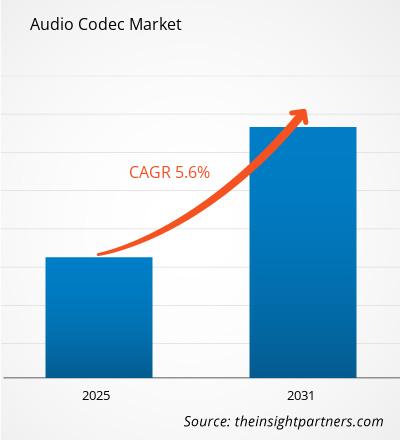
The Audio Codec Market is projected to grow from US$ 7.85 Billion in 2025 to US$ 13.22 Billion by 2034, registering a CAGR of 5.96% during 2026–2034. Demand is expanding as connected devices, wireless audio systems, in-vehicle infotainment, and immersive entertainment platforms require compact, low-power, high-fidelity encoding and decoding technologies across hardware and software architectures.
North America remains a high-value adoption base, supported by premium smartphones, PCs, streaming services, gaming ecosystems, and automotive infotainment upgrades. The Audio Codec Market size in the region is expected to advance at an estimated 5.4–5.9% CAGR, driven by semiconductor design leadership, strong software codec integration, and rising demand for spatial audio, voice interfaces, and low-latency wireless playback.
Audio Codec Market Assessment and Insights
- North America accounted for 28–31% share in 2025 and is projected to grow at a CAGR of 5.4–5.9% between 2026–2034, supported by premium devices, streaming platforms, and automotive audio upgrades.
- US represented 78–82% of North America in 2025 and is expected to expand at a CAGR of 5.5–6.0% during 2026–2034.
- Europe held 20–23% share in 2025 and is forecast to grow at a CAGR of 5.1–5.6% between 2026–2034, led by Germany, the UK, France, Italy, and Spain.
- Asia Pacific captured 34–38% share in 2025 and is projected to grow at a CAGR of 6.4–6.9% between 2026–2034, led by China, Japan, South Korea, India, and Taiwan.
- Largest Segment Hardware held 58–62% market share in 2025 and is expected to grow at a CAGR of 5.2–5.7% during 2026–2034.
- High Growth Segment Software held 38–42% market share in 2025 and is expected to grow at a CAGR of 6.5–7.1% during 2026–2034.
- Key companies analyzed in detail: Analog Devices, Inc., Cirrus Logic, Inc., Dolby Laboratories, Inc., DSP Group, Inc., Technicolor SA, Maxim Integrated Products, Inc., Qualcomm Incorporated, Realtek Semiconductor Corp., STMicroelectronics N.V., Texas Instruments Incorporated.
Source: The Insight Partners' analysis based on proprietary research, government publications, company annual reports, investor presentations, industry databases, and expert interviews.
The evolution of the products involves moving from simple stereo conversion to an audio subsystem with features like digital signal processing, codec IP, voice capture, noise suppression and power management. Hardware providers are developing new mixed signal solutions for smartphones, laptops, games consoles and automotive head units, whereas the software development involves increasing upgradability and compatibility of formats. The production factors include foundry capacity, shrinking and demand for low latency wireless audio.
Over the forecast period, growth will become more dependent on investments in manufacturing in Asia Pacific, chip design in North America and automotive electronics in Europe. The interests of regulators in the areas of safety and accessibility of the connected vehicles, as well as energy efficiency in electronics provide opportunities for implementation of the codecs in voice-enabled interfaces.
Audio Codec Market Report Scope
| Report Attribute | Details |
|---|---|
| Market size in 2025 | US$ 7.85 Billion |
| Market Size by 2034 | US$ 13.22 Billion |
| Global CAGR (2026 - 2034) | 5.96% |
| Historical Data | 2021-2024 |
| Forecast period | 2026-2034 |
Audio Codec Market Analysis
Growth in the Audio Codec Market is spurred by increasing need for greater audio resolution, voice-first technologies, Bluetooth LE Audio, and reduced power usage in battery-powered devices. Current smartphones, laptops, tablets, gaming consoles, smart TVs, and vehicles demand codecs that offer the ability to optimize fidelity, latency, heat dissipation, and bandwidth usage without additional Bill of Material costs.
Markets parties consist of semiconductor companies, IP companies, devices producers, software platforms, streaming companies, tier automotive suppliers, and standards organization. The semiconductor hardware supply would depend on the experience in mixed signal design and silicon wafers, and software codecs on licensing, interoperability, security patches, and platform certification.
The Audio Codec Market research shows that the market landscape is moderately concentrated, where companies like Analog Devices, Cirrus Logic, Qualcomm, Realtek Semiconductor, STMicroelectronics, and Texas Instruments compete using factors such as integration, power efficiency, sound quality, and platform partnership. The market players that impact codecs ecosystem are Dolby Laboratories and Technicolor with their immersive audio technologies and content workflow.
Investments are being made into artificial intelligence-enabled noise reduction, multi-microphone capturing, spatial rendering, and automotive qualification. Qualcomm Incorporated puts codecs into a larger picture of its mobile and connectivity platforms, while Cirrus Logic and Analog Devices focus on precise audio conversion capabilities. Realtek Semiconductor Corp. is crucial for the PC and consumer electronics industry, and STMicroelectronics N.V. – for embedded and automotive markets.
● REPORT CUSTOMIZATION
Tailor This Report To Align With Your Specific Business Requirements
This report can be customized to align precisely with your business objectives, scope, and target markets. Customization options include tailored segmentation, geography, competitive analysis, and strategic insights to support informed decision-making.
Customize This Report →WHAT YOU CAN ADJUST
- ● Segmentations
- ● Geography
- ● Competitive Analysis
- ● Language Preferences
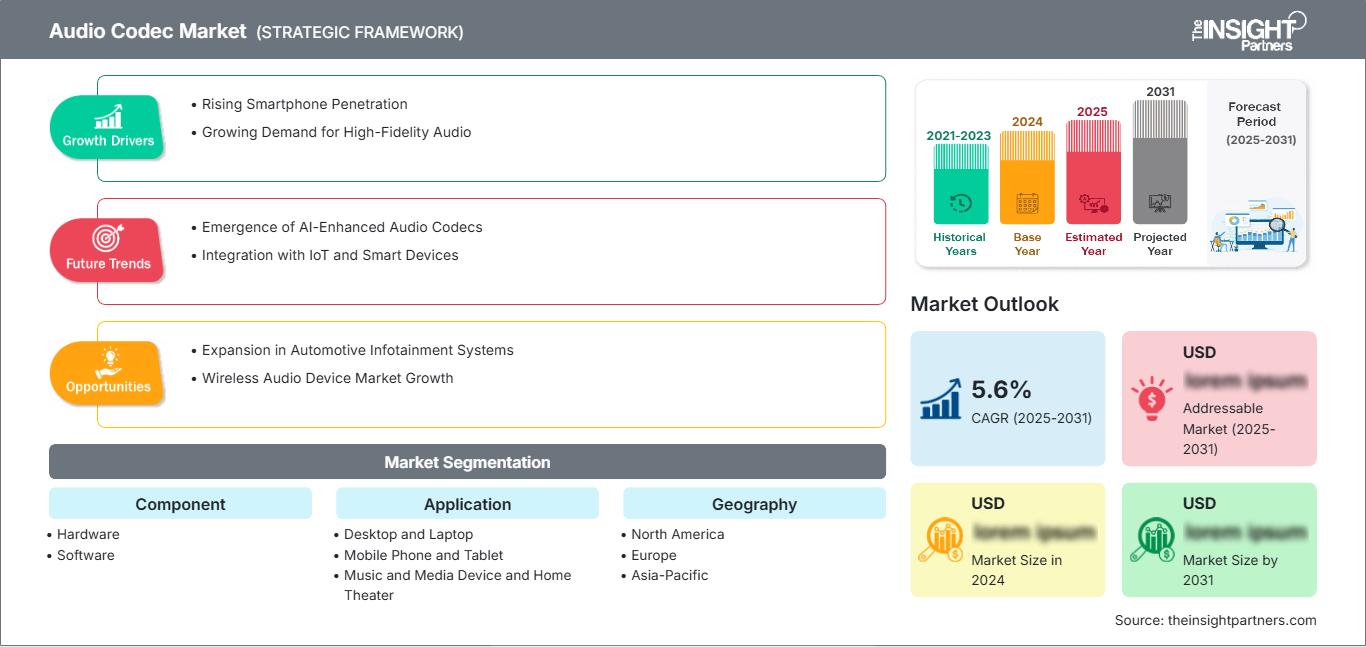
Audio Codec Market: Strategic Insights
Regional Insights
North America Audio Codec Market
North America held 28–31% share in 2025 and is projected to grow at a CAGR of 5.4–5.9% through 2034. The region benefits from high-value demand across premium smartphones, laptops, gaming platforms, streaming devices, professional audio equipment, and connected vehicles, where low-latency processing and voice clarity are core purchasing factors.
The Audio Codec Market share in North America is supported by semiconductor design centers, platform-level integration, and early adoption of spatial audio and AI-enhanced speech capture. Automotive infotainment and over-the-air software updates are expanding codec requirements beyond consumer devices into cabin monitoring, hands-free calling, navigation prompts, and personalized entertainment environments.
U.S. Audio Codec Market
In 2025, the share of the U.S. in North America was 78-82%, and the growth rate during 2026-2034 is estimated at a CAGR of 5.5-6.0%. The demand in the region arises due to the usage of the technology in smartphones, PCs, smart speakers, streaming devices, video games consoles, and automotive infotainment for high-quality speech, audio immersion, and stable Wi-Fi.
The presence of companies in the country is considerable because Analog Devices, Inc., Cirrus Logic, Inc., Dolby Laboratories, Inc., Qualcomm Incorporated, Maxim Integrated Products, Inc., and Texas Instruments Incorporated operate or were established in the USA. Current applications include software-upgradeable products, voice-assisted devices, conferencing audio equipment, premium earbuds, and gaming headphones.
Europe Audio Codec Market
In 2025, Europe held a share of 20-23% and is predicted to register a CAGR of 5.1-5.6% up to 2034. Germany dominates regional consumption since automobile electronics, high-end automobiles, and industry-specific sound systems need skilled products along with minimal electromagnetic interferences and voice processing for the increasing software-based cabin interiors.
The UK drives the market demand for codecs via media productions, streaming, gaming, and professional sound system ecosystem. France, Italy, and Spain drive market demand via consumer electronic devices, auto supply chain, broadcasting technology, and the growing popularity of smart homes. Growth drivers include the demands for energy-efficient products, accessibility solutions, premium sound, and audio needs in connected mobility.
APAC Audio Codec Market
APAC has had a 34–38% market share in 2025 and is expected to register a CAGR of 6.4–6.9% from 2026 to 2034, making it the leading region. The Chinese dominance in the region comes through electronics manufacturing, smartphone manufacturing, assembling of smart TVs, and implementation of wireless audio technologies in the devices.
Other contributors in this region include Japan and South Korea with consumer electronics, games, automobiles, and displays; whereas India and Australia have contributions through the mobile phones and connected homes. The policy backing of semiconductor localization, 5G devices, and electric mobility further supports codec opportunities in the region.
Middle East & Africa Audio Codec Market
CAGR Growth of Middle East & Africa Market is predicted to reach 5.8-6.3% between 2026-2034. Adoption by Saudi Arabia and the UAE is driven by smart city initiatives, entertainment facilities, luxury cars, hospitality sector projects, and consumer electronics devices with advanced audio processing requirements and multi-language capabilities.
MEA countries such as South Africa contribute further market growth through media consumption on mobile devices, education technologies, public places, and broadcasting upgrades. Growth in investments in energy and infrastructure is driving installation of connected displays, control room applications, and in-vehicle installations, providing specific codec opportunities.
Segmentation Analysis
Component
The Component segment is expected to grow at a CAGR of 5.8–6.3% during 2026–2034. The Audio Codec Market scope across components spans integrated codec chips, DSP-enabled hardware, software libraries, firmware, and platform-specific processing stacks. Demand is shaped by power budgets, device size, acoustic performance, updateability, and compatibility with evolving wireless and immersive audio standards.
- Hardware remains the largest component because smartphones, PCs, televisions, and vehicles need compact mixed-signal chips that deliver low noise, low power consumption, and dependable audio conversion.
- Software is scaling faster as OEMs use firmware updates, operating system integration, and cloud-linked features to add formats, improve latency, and extend device life cycles.
Application
The Application segment is expected to grow at a CAGR of 5.9–6.4% during 2026–2034. Demand is broadening from mobile and PC platforms into home theaters, gaming consoles, connected vehicles, and professional media devices. Each application has distinct requirements for latency, channel count, voice pickup, compression efficiency, and interoperability across operating systems and wireless protocols.
- Desktop and Laptop adoption is supported by hybrid work, conferencing, gaming, and creator workflows that require clearer microphones, better speakers, and software-tuned acoustic processing in compact systems.
- Mobile Phone and Tablet remains strategically important because high shipment volumes, earbuds pairing, spatial audio, and voice assistants make codec efficiency central to battery life and user experience.
- Music and Media Device and Home Theater demand reflects streaming subscriptions, soundbars, smart speakers, and premium playback devices that require multi-channel decoding, immersive formats, and consistent wireless audio performance.
- Television and Gaming Console adoption is shaped by low-latency gaming, surround sound, cloud streaming, and living-room entertainment systems where audio synchronization directly affects user engagement.
- Automotive Infotainment is becoming more strategic as electric vehicles, voice control, navigation prompts, and cabin personalization require robust codecs qualified for thermal, vibration, and lifecycle demands.
Opportunity Snapshot
| Application | Revenue Contribution | Trend Tag | Adoption Stage |
| Desktop and Laptop | Medium | AI Conferencing | Mature |
| Mobile Phone and Tablet | High | Spatial Audio | Mature |
| Music and Media Device and Home Theater | Medium | Immersive Playback | Scaling |
| Television and Gaming Console | Medium | Low Latency | Scaling |
| Automotive Infotainment | High | Cabin Audio | Scaling |
| Other | Low | Embedded Voice | Emerging |
Audio Codec Market Growth Drivers and Impact Analysis
Wireless Audio and Voice Interface Expansion
With wireless earbuds, smart speakers, tablets, and laptops becoming dependent on low-latency codecs with minimal loss of sound quality despite operating in restricted power conditions, the introduction of Bluetooth LE Audio and LC3 technology is revolutionizing design considerations for OEMs due to their demand for efficient encoding/decoding, multi-streaming, and synchronization across devices. The effect is more prominent in the mobile and consumer electronics segments, as the performance of codecs affects battery life, call quality, gaming experience, and the overall value of the products.
Automotive Cockpit Digitization
In terms of automotive industry, audio paths are being replaced by infotainment, voice command, navigation, active noise management and customized cabin zones. In electric vehicles, there is an additional requirement for the generation of artificial sounds, alerts and quality entertainment systems, due to their quiet interiors, which highlight any defects in sound performance. There is thus the need for codecs with special characteristics, suitable for automotive applications. Business implications of this are increased content per car, stronger cooperation between semiconductors manufacturers and their tier partners, as well as the desire for software defined audio solutions.
Streaming, Gaming, and Immersive Media Consumption
Streaming services, cloud gaming, home theaters, and creator devices are raising expectations for compressed audio that remains clear, synchronized, and spatially accurate. Low-latency codecs are essential when audio must align with video, gameplay, or real-time communication. Multi-channel and object-based formats also require efficient decoding in televisions, consoles, soundbars, and headsets. The market impact is a shift toward higher-value codec implementations, broader licensing ecosystems, and differentiation through acoustic software that enhances playback across device categories without requiring major hardware redesigns.
Audio Codec Market Future Trends
AI-Native Acoustic Processing
Audio Codec Market trends will increasingly center on AI-native acoustic processing that adapts to environments, speaker position, background noise, and user intent in real time. Future codec stacks are likely to combine compression, beamforming, echo cancellation, and speech enhancement inside coordinated hardware-software pipelines. This will matter for conferencing, vehicles, wearable devices, accessibility tools, and smart home systems where clarity is more valuable than raw loudness. Vendors able to validate AI processing under strict power and privacy constraints will be better positioned for premium design wins.
Software-Defined Codec Platforms
Codec platforms are expected to become more software-defined as device makers seek format flexibility, security patches, and feature upgrades without changing silicon. This trend will encourage modular firmware, certified codec libraries, and operating system-level audio services that can support new streaming formats, low-latency modes, and regional compliance requirements. The shift does not eliminate hardware demand, but it changes value capture toward suppliers that provide reference designs, developer tools, and lifecycle support. It also enables differentiated audio experiences across similar hardware platforms.
Audio Codec Market Opportunities
Automotive Infotainment Design Wins
Automotive infotainment offers one of the strongest Audio Codec Market Forecasts because each vehicle platform can require multiple audio paths for entertainment, voice, safety alerts, and cabin monitoring. Suppliers can target tier-one system integrators with qualified codecs, development kits, and software packages that reduce validation time. Investment should focus on long-lifecycle support, functional reliability, and compatibility with centralized vehicle compute architectures. Companies that help OEMs deliver premium audio, multilingual voice control, and over-the-air improvements can capture higher content value per vehicle.
Emerging Market Smart Device Localization
Emerging markets create opportunities for localized codec configurations in smartphones, tablets, smart TVs, education devices, and public communication systems. Manufacturers need cost-effective solutions that support regional languages, noisy environments, compressed streaming, and variable network quality. Semiconductor and software vendors can differentiate through reference designs optimized for mid-range devices, multilingual speech enhancement, and power-efficient playback. The opportunity is especially relevant in India, Southeast Asia, the Middle East, and Africa, where mobile-first media consumption and digital infrastructure investment are expanding the addressable base.
Recent Developments
- July 2026: NVIDIA introduced AudEx (Nemotron-Labs-AudEx-30B-A3B), a unified audio-text large language model capable of understanding, reasoning over, and generating both speech and general audio while maintaining the strong text reasoning abilities of its underlying Nemotron backbone. Unlike many multimodal models that sacrifice text performance when adding audio capabilities, AudEx delivers state-of-the-art performance across speech recognition, translation, text-to-speech, speech-to-speech generation, and general audio understanding with minimal regression in text intelligence. NVIDIA has also released the model checkpoints to support open research and accelerate the development of next-generation AI voice and audio applications.
- June 2026: Google quietly added native LHDC v5 (Low Latency High-Definition Audio Codec) support in Android 17, giving Pixel devices and future Android smartphones access to higher-quality wireless audio when paired with compatible Bluetooth headphones and earbuds. Previously, many Pixel users were limited to codecs such as AAC or LDAC, but the new support enables 24-bit/96 kHz high-resolution audio streaming with lower latency. The update strengthens Android's audio ecosystem and improves compatibility with premium audio products from brands such as OnePlus, Nothing, OPPO, and Xiaomi.
- February 2026: The Alliance for Open Media (AOMedia), the organization behind the AV1 video codec, announced development of the Open Audio Codec (OAC), an open-source successor to the widely used Opus codec. Built on the existing Opus framework, OAC aims to provide a modern, royalty-free audio standard with better support for future multimedia applications, including immersive audio, streaming, and real-time communications. Although the project is still in its early experimental stage, it represents a significant industry effort to establish the next generation of open audio compression technology.
Frequently Asked Questions

- Comprehensive Market Sizing and Forecast Analysis
- Detailed Segmentation Analysis
- In-Depth Market Dynamics Assessment
- Regional and Country-Level Insights
- Competitive Landscape and Company Benchmarking
- Strategic Business Intelligence
Recent Reports
Testimonials

The Insight Partners' SCADA System Market report is comprehensive, with valuable insights on current trends and future forecasts. The team was highly professional, responsive, and supportive throughout. We are very satisfied and highly recommend their services.
RAN KEDEM Partner, Reali Technologies LTDs
I requested a report on a very specific software market and the team produced the report in a few days. The information was very relevant and well presented. I then requested some changes and additions to the report. The team was again very responsive and I got the final report in less than a week.
JEAN-HERVE JENN Chairman, Future Analytica
We worked with The Insight Partners for an important market study and forecast. They gave us clear insights into opportunities and risks, which helped shape our plans. Their research was easy to use and based on solid data. It helped us make smart, confident decisions. We highly recommend them.
PIYUSH NAGPAL Sr. Vice President, High Beam Global
The Insight Partners delivered insightful, well-structured market research with strong domain expertise. Their team was professional and responsive throughout. The user-friendly website made accessing industry reports seamless. We highly recommend them for reliable, high-quality research services
YUKIHIKO ADACHI CEO, Deep Blue, LLC.
This is the first time I have purchased a market report from The Insight Partners.While I was unsure at first, I visited their web site and felt more comfortable to take the risk and purchase a market report.I am completely satisfied with the quality of the report and customer service. I had several questions and comments with the initial report, but after a couple of dialogs over email with their analyst I believe I have a report that I can use as input to our strategic planning process.Thank you so much for taking the extra time and making this a positive experience.I will definitely recommend your service to others and you will be my first call when we need further market data.
JOHN SUZUKI President and Chief Executive Officer, Board Director, BK Technologies
I wish to appreciate your support and the professionalism you displayed in the course of attending to my request for information regarding to infectious disease IVD market in Nigeria. I appreciate your patience, your guidance, and the fact that you were willing to offer a discount, which eventually made it possible for us to close a deal. I look forward to engaging The Insight Partners in the future, all thanks to the impression you have created in me as a result of this first encounter.
DR CHIJIOKE ONYIA MANAGING DIRECTOR, PineCrest Healthcare Ltd.Reason to Buy
- Informed Decision-Making
- Understanding Market Dynamics
- Competitive Analysis
- Identifying Emerging Markets
- Customer Insights
- Market Forecasts
- Risk Mitigation
- Boosting Operational Efficiency
- Strategic Planning
- Investment Justification
- Tracking Industry Innovations
- Aligning with Regulatory Trends





 Get Free Sample for