
Audio DSP Market Trends, Size & Forecast by 2034
Coverage: By Type (Discrete, Integrated); End-User Industry (Consumer Electronics, Automotive, Aerospace, Entertainment, Others) , and Geography (North America, Europe, Asia Pacific, and South and Central America)
- Status : Data Released
- Report Code : TIPRE00019860
- Category : Electronics and Semiconductor
- No. of Pages : 150
- Available Report Formats :


- Last update date : July 17, 2026


2025 Market Size
US$ 18.75 Bn
Base year value
2034 Forecast
US$ 38.68 Bn
Projected by 2034
CAGR 2026-2034
8.38 %
Growth rate
Addressable Market
US$ 257.82 Bn
(2026-2034)
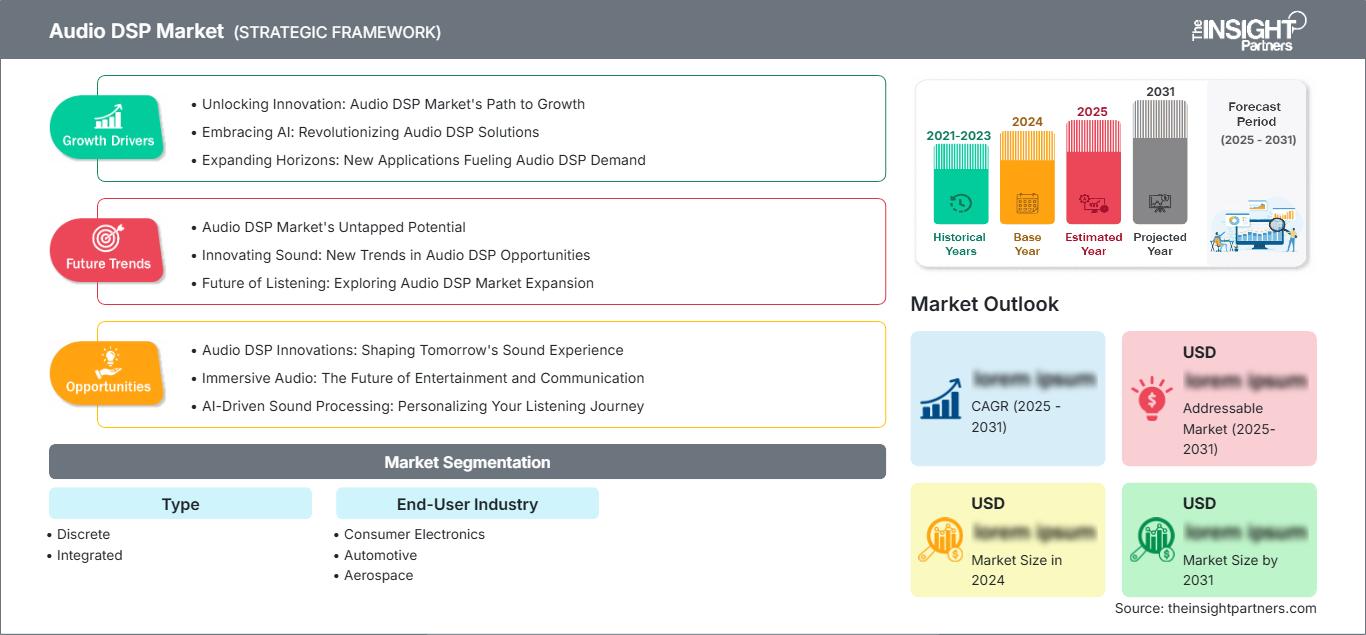
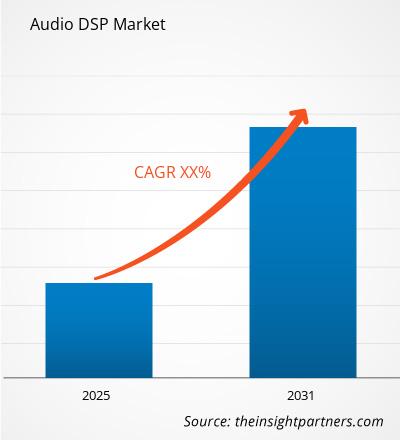
The Audio DSP Market size is valued at US$ 18.75 Billion in 2025 and is projected to reach US$ 38.68 Billion by 2034, advancing at a CAGR of 8.38% during 2026–2034. Audio DSP Market indicates the increasing requirements for devices designed to process sound signals using techniques like processing, enhancing, compression, filtering, and optimization of such signals within consumer electronics, vehicles, aerospace communication systems, and entertainment solutions.
North American Audio DSP Market Size is driven by high-end car audio devices, connected headphones, smart speakers, professional sound devices, and defense communication systems. It is expected to grow at a CAGR between 7.6% and 8.4% from 2026 to 2034 owing to OEMs' use of spatial audio, noise cancellation, low latency voice control, and AI.
Audio DSP Market Assessment and Insights
- North America holds 30–34% of the Audio DSP Market share in 2025 and is growing at a CAGR range of 7.6–8.4% during 2026–2034, led by premium automotive audio, connected devices, and aerospace communication systems.
- US accounts for 74–78% of North American revenue in 2025 and grows at 7.5–8.3% CAGR, supported by semiconductor design, vehicle infotainment, and defense audio systems.
- Europe represents 22–26% share in 2025 and grows at 7.1–7.9% CAGR, with Germany, the UK, France, Italy, and Spain leading automotive and professional audio adoption.
- Asia Pacific captures 34–38% share in 2025 and expands at 8.9–9.7% CAGR, led by China, Japan, South Korea, India, and Taiwan through electronics manufacturing and connected-device scale.
- Largest Segment is Integrated, holding 60–64% market share in 2025 and growing at 8.6–9.4% CAGR because compact SoCs reduce power, board space, and design complexity.
- High Growth Segment is Automotive, with 18–22% market share in 2025 and 9.0–9.8% CAGR, driven by immersive cabins, electric vehicles, and voice-enabled infotainment.
- Key companies analyzed in detail: Texas Instruments Incorporated, Intel Corporation, NXP Semiconductors N.V., Broadcom Inc., Analog Devices, Inc., Renesas Electronics Corporation, Advanced Micro Devices, Inc., Toshiba Corporation, LSI Corporation, and CEVA, Inc.
Source: The Insight Partners' analysis based on proprietary research, government publications, company annual reports, investor presentations, industry databases, and expert interviews.
DSP for audio processing has evolved from audio processors into SoC, codec-based architectures, and AI-enabled processors for embedded applications. Current production trends focus on energy efficiency, more channels, deterministic latency, and safe upgrade of software. The semiconductor industry is moving towards reference designs, automotive-grade components, and software tools that will enable OEMs to cut down their development cycles and keep the acoustic quality for headphones, loudspeakers, cars, aircrafts, and pro-audio environments.
Future demand will get boosted by the need for spatial audio, beamforming microphone arrays, edge AI assistants, active noise reduction, and adaptive equalization. New geographies will increase electronics manufacturing capacity, and safety and connectivity needs will raise DSP content in automotive and aviation applications. Investments will be made in integrated solutions combining audio, radar, AI acceleration, and secure networking to enable multiple performance levels using less semiconductors.
Audio DSP Market Report Scope
| Report Attribute | Details |
|---|---|
| Market size in 2025 | US$ 18.75 Billion |
| Market Size by 2034 | US$ 38.68 Billion |
| Global CAGR (2026 - 2034) | 8.38% |
| Historical Data | 2021-2024 |
| Forecast period | 2026-2034 |
Audio DSP Market Analysis
The Audio DSP Market development is driven by growing shipments of wireless earbuds, smart speakers, laptops, TVs, gaming headsets, and infotainment units in cars. The demand is further stimulated by customers' desire for enhanced voice capture capabilities, individualized sound zones, energy-efficient reproduction, and noise cancellation features. Another structural factor driving the market is electrification of cars, which makes acoustic tuning, audible alerts, and noise cancellation more significant.
The value chain consists of EDA providers, foundries, IP suppliers, semiconductor manufacturers, codec providers, acoustic algorithm experts, module providers, OEMs, and after-sales software engineers. The supply factors include wafer availability, embedded memory availability, mixed-signal integration, automotive certification, and developer communities. The buyers tend to favor solutions that incorporate audio DSP core, ARM-based processor, audio network, security hardware block, and reference software.
The Audio DSP Market report competitive environment includes semiconductor companies that strike the right balance of performance, power, safety, and software capability. Texas Instruments Incorporated is leading in the development of audio SoCs for the automotive sector. Analog Devices, Inc. offers SHARC and A2B audio platforms. NXP Semiconductors N.V. provides solutions for automotive and embedded processing. The CEVA, Inc. is offering DSP IP licensing for edge-connections.
Broadcom Inc., Renesas Electronics Corporation, Advanced Micro Devices, Inc., Intel Corporation, Toshiba Corporation, and LSI Corporation add strength to processing portfolio.
Current investment trends include scalable IP blocks, automotive-qualified processors, support for audio over Ethernet, AI-enabled voice front end processing, and software upgradable capabilities. Positioning strategies require reference designs, partnerships, lifecycle availability, and algorithms for acoustic processing. Those companies who alleviate bill-of-material pressure while providing high-end capabilities will have a chance to secure their design-in wins in vehicles, wearable, entertainment systems, aerospace headsets, and connected devices.
● REPORT CUSTOMIZATION
Tailor This Report To Align With Your Specific Business Requirements
This report can be customized to align precisely with your business objectives, scope, and target markets. Customization options include tailored segmentation, geography, competitive analysis, and strategic insights to support informed decision-making.
Customize This Report →WHAT YOU CAN ADJUST
- ● Segmentations
- ● Geography
- ● Competitive Analysis
- ● Language Preferences
Audio DSP Market: Strategic Insights
Regional Insights
North America Audio DSP Market
North America holds an estimated 30–34% Audio DSP Market share in 2025 and is projected to grow at a CAGR range of 7.6–8.4% during 2026–2034. Demand is based on applications like luxury cars, gaming audio, studio audio, aerospace communications, and enterprise conference audio that need low latency and processing reliability.
The region benefits from availability of semiconductor design capability, software defined vehicles efforts, and adoption of wireless personal audio. The aerospace and defense segment prefers tough signal processing, beamforming, and speech recognition in noise environment. The OEM segment and Tier I suppliers use spatial audio, road noise reduction, and alert synthesis techniques, which drive demand for audio processors.
U.S. Audio DSP Market Market
The U.S. accounts for 74–78% of North American revenue in 2025 and grows at a CAGR range of 7.5–8.3% through 2034. The market is dominated by automotive infotainment, premium headphones, smart speakers, conferencing systems, avionics communications, and professional entertainment hardware products where real-time audio processing enhances the user experience.
Texas Instruments Incorporated, Analog Devices, Inc., Broadcom Inc., Intel Corporation, Advanced Micro Devices, Inc., and CEVA, Inc. have a strong presence in the processor development, audio networking, intellectual property licensing, and embedded systems. The application trends are spatial audio rendering, in-vehicle voice commands, gaming latency optimization, adaptive hearing assistance, and professional mixing environments that require deterministic signal path.
Europe Audio DSP Market Market
Europe represents 22–26% share in 2025 and grows at a CAGR range of 7.1–7.9%. Demand from Germany is generated through automotive audio, infotainment electronics, and acoustic testing for industry, whereas the UK focuses on professional audio, broadcasting, gaming, and aerospace communications applications that rely on signal processing.
The main contribution by France, Italy, and Spain comes in consumer electronic connectivity, audio system installations in venues, automotive electronic products, and communication enhancements in defense. Consumers in Europe consider functionality safety, cyber security, acoustics, and long life spans for parts to be significant. The companies offering regional design services include NXP Semiconductors N.V., Analog Devices, Inc., Renesas Electronics Corporation, and Intel Corporation.
APAC Audio DSP Market Market
Asia Pacific captures 34–38% share in 2025 and records a CAGR range of 8.9–9.7% during 2026–2034. China dominates through electronics assembly and EVs, and Japan, South Korea, India, and Taiwan create additional demand through headphones, cell phones, TVs, automotive audio, and semiconductor assembly.
The policies that drive these efforts range from domestic chip development, smart manufacturing, 5G mobile devices, and vehicle electrification. APAC producers and international players utilize APAC production networks for mass production of integrated processors. The buyers look for low power, small footprint, multi-language speech processing, and efficient platforms.
Middle East & Africa Audio DSP Market Market
Middle East and Africa grows at a CAGR range of 6.5–7.3%, with the UAE and Saudi Arabia leading through smart infrastructure, entertainment venues, luxury vehicles, aviation, and defense communication upgrades. South Africa and Rest of MEA add demand through consumer electronics, broadcast, and public-address systems.
The demand for high reliability audio processing is driven by applications in energy, tourism, airport infrastructure, and others. Cost sensitive procurement makes DSPs popular especially when they simplify board design and lower cost of installation. The involvement of distributors, warranties, and integrators impacts choices.
Segmentation Analysis
Type
Type segmentation includes Discrete and Integrated, with the main segment growing at a CAGR range of 8.2–9.0% during 2026–2034. The Audio DSP Market forecast is shifting toward integrated devices because OEMs need smaller boards, lower power consumption, and simpler qualification. Discrete processors remain important where high accuracy, upgrade flexibility, and specialized acoustic tuning justify dedicated hardware.
- Discrete DSPs serve premium audio, studio equipment, aerospace communication, and high-performance automotive systems where dedicated processing, algorithm flexibility, and thermal headroom outweigh integration savings.
- Integrated DSPs lead adoption because combining processing, memory, interfaces, and security in one package reduces bill of materials, power draw, and design time for volume products.
End-User Industry
End-User Industry segmentation includes Consumer Electronics, Automotive, Aerospace, and Entertainment, with the main segment growing at a CAGR range of 8.4–9.2% during 2026–2034. Demand varies by product cycle, safety requirements, acoustic performance, and software update needs. Consumer electronics provide scale, automotive adds durable content growth, aerospace requires reliability, and entertainment prioritizes low-latency sound fidelity.
- Consumer Electronics remains the largest demand base as headphones, speakers, laptops, televisions, phones, wearables, and smart-home devices require efficient audio enhancement, beamforming, and always-on voice processing.
- Automotive is the high-growth end-user as electric vehicles, premium cabins, active noise cancellation, spatial audio, alert synthesis, and voice assistants lift DSP content per vehicle.
- Aerospace uses audio DSPs in cockpit communication, passenger announcements, headsets, avionics interfaces, and defense systems where clarity, reliability, and noise suppression are mission-critical.
- Entertainment adoption covers cinemas, gaming platforms, professional mixing, live venues, streaming equipment, and immersive audio systems that need deterministic latency and consistent acoustic quality.
Opportunity Snapshot
| End-User Industry | Revenue Contribution | Trend Tag | Adoption Stage |
| Consumer Electronics | High | Voice AI | Mature |
| Automotive | High | Spatial Cabin | Scaling |
| Aerospace | Medium | Noise Clarity | Scaling |
| Entertainment | Medium | Immersive Mix | Scaling |
Audio DSP Market Growth Drivers and Impact Analysis
Connected Consumer Devices Raising Audio Processing Intensity
There is an increasing need for enhancement on the fly as opposed to mere playback in wireless earbuds, smart speakers, laptops, televisions, gaming consoles, and wearable devices. DSP technology allows beam forming, echo cancellation, codec control, hearing optimization, and wake word detection using low power consumption. This driver can be seen in more processors per unit and increasing demand for platforms that include audio, artificial intelligence, memory, and connectivity. A processor supplier that can offer pre-validated algorithms and development kits can assist the original equipment manufacturer in reducing time to market.
Automotive Cabins Becoming Software-Defined Sound Environments
The interior of vehicles is now moving towards an evolution from fixed audio systems to software-defined audio experience solutions. Since electric vehicles have little engine noise, the quality of road noise, alerts, and entertainment becomes more apparent to the occupants inside the vehicle. DSPs enable technologies like active noise cancellation, spatial rendering, personalized zones, hands-free voice commands, and warning sound synthesis needed for both safety and comfort reasons. The Audio DSP Market trends will be positively impacted since car manufacturers are utilizing scalable processors on their entry-level, mid-level, and luxury cars.
Professional and Aerospace Systems Requiring Clearer Communication
Professional environments such as those of entertainment, aviation, defense, and enterprises demand high-quality audio performance amid challenging acoustical environments. Digital signal processing is tasked with eliminating background noise, speech equalization, channel management, and low latency in real-time. It has implications that go beyond just sales of devices, since buyers need certification, reliability, software updates, and longevity. This becomes a market driver that opens up the market for high-end discrete and integrated solutions with guaranteed deterministic performance. Vendors who are able to guarantee latency, temperature stability, security, and electromagnetic compliance gain an edge in these markets.
Audio DSP Market Future Trends
AI-Native Audio Processing at the Edge
The Audio DSP Market trends include AI-enabled processing that takes into consideration the context, user preference, and acoustics of the environment at the edge itself. Systems in the future would integrate neural noise cancellation, speaker recognition, equalization, and wake-word models without having to rely totally on the cloud. This is important for applications like those in vehicles, homes, offices, and aircraft where there are latency issues and privacy concerns. This means that processors need to have emphasis on AI capabilities, secure memory, and software stacks that will allow OEMs to upgrade their models through the lifecycle of the products.
Audio Networking Converging With Vehicle and Venue Architectures
Audio networks will join larger software-defined systems for vehicles, planes, and venues. Instead of standalone audio boards, the coming systems will connect sound, control, diagnostic, and update data over digital networks that offer predictable performance. Such a move will allow greater use of speakers, microphones, sensors, and zone controllers while simplifying wiring. Digital signal processing chip suppliers will have to distinguish themselves based on network integration, latency handling, synchronization, and cybersecurity as much as pure processing speed. The direction is toward audio platforms that offer connectivity over Ethernet, security and diagnostics along with processing.
Audio DSP Market Opportunities
Automotive Audio Platforms for Electric and Connected Vehicles
That is because Automotive offers an investment opportunity as audio processing is becoming an integral part of the car experience, safety, and uniqueness. Audio DSP Market Forecast can offer design wins for electric vehicles, luxury vehicles, and software platforms whereby noise cancellation, spatial sound, voice command, and alerts generation require common processing elements. The focus of the suppliers in this market should be on the development of processors qualified for automotive and scalable software libraries. In addition, cooperation with Tier 1 automotive audio systems suppliers should be considered. The most significant market potential will come from multi-price point vehicles with low redesign.
Low-Power Integrated DSPs for High-Volume Consumer Devices
High-volume consumer products provide an opening for DSPs which improve audio performance without growing the battery, adding heat, or raising the board cost. Earbuds, wearables, speakers, gaming peripherals, and conferencing products require small silicon solutions that can perform functions such as noise cancellation, beamforming, codec offload, and artificial intelligence-based wake-word recognition. The key to capturing value is through reference platforms, firmware packages, and ecosystems with partners who manufacture microphones, codecs, and wireless interfaces. Key areas of investment include low-power consumption, acoustical modeling, and quick customization capabilities.
Recent Developments
- April 2026: Analog Devices, Inc. launched A²B 2.0 for next-generation in-vehicle audio, highlighting higher bandwidth, deterministic low-latency operation, and expanded channel support for software-defined vehicle architectures. The release strengthens the company’s position in automotive audio networking and supports more complex speaker, microphone, and diagnostic configurations.
- February 2025: CEVA, Inc. introduced Ceva-XC21 and Ceva-XC23 communication DSPs for advanced 5G and 6G-ready applications, adding AI support, scalable architecture, and improved performance efficiency. Although aimed at baseband workloads, the programmable DSP roadmap reinforces CEVA’s relevance in smart edge devices that connect, sense, and process signal data efficiently.
- January 2025: Texas Instruments Incorporated introduced automotive audio processors including AM275x-Q1 MCUs and AM62D-Q1 processors with C7x DSP technology at CES 2025. The devices target premium audio features, spatial sound, active noise cancellation, sound synthesis, and advanced vehicle networking while helping automakers lower system complexity and cost.
Frequently Asked Questions

- Comprehensive Market Sizing and Forecast Analysis
- Detailed Segmentation Analysis
- In-Depth Market Dynamics Assessment
- Regional and Country-Level Insights
- Competitive Landscape and Company Benchmarking
- Strategic Business Intelligence
Recent Reports
Testimonials

The Insight Partners provided valuable market intelligence that supported our global go-to-market strategy. Their team was professional, responsive, and attentive to our feedback, providing thoughtful analysis and helpful methodological clarifications throughout the project.
Junmo Kim Chief Financial Officer (CFO), Enertech Co., Ltd.
The Insight Partners' SCADA System Market report is comprehensive, with valuable insights on current trends and future forecasts. The team was highly professional, responsive, and supportive throughout. We are very satisfied and highly recommend their services.
RAN KEDEM Partner, Reali Technologies LTDs
I requested a report on a very specific software market and the team produced the report in a few days. The information was very relevant and well presented. I then requested some changes and additions to the report. The team was again very responsive and I got the final report in less than a week.
JEAN-HERVE JENN Chairman, Future Analytica
We worked with The Insight Partners for an important market study and forecast. They gave us clear insights into opportunities and risks, which helped shape our plans. Their research was easy to use and based on solid data. It helped us make smart, confident decisions. We highly recommend them.
PIYUSH NAGPAL Sr. Vice President, High Beam Global
The Insight Partners delivered insightful, well-structured market research with strong domain expertise. Their team was professional and responsive throughout. The user-friendly website made accessing industry reports seamless. We highly recommend them for reliable, high-quality research services
YUKIHIKO ADACHI CEO, Deep Blue, LLC.
This is the first time I have purchased a market report from The Insight Partners.While I was unsure at first, I visited their web site and felt more comfortable to take the risk and purchase a market report.I am completely satisfied with the quality of the report and customer service. I had several questions and comments with the initial report, but after a couple of dialogs over email with their analyst I believe I have a report that I can use as input to our strategic planning process.Thank you so much for taking the extra time and making this a positive experience.I will definitely recommend your service to others and you will be my first call when we need further market data.
JOHN SUZUKI President and Chief Executive Officer, Board Director, BK Technologies
I wish to appreciate your support and the professionalism you displayed in the course of attending to my request for information regarding to infectious disease IVD market in Nigeria. I appreciate your patience, your guidance, and the fact that you were willing to offer a discount, which eventually made it possible for us to close a deal. I look forward to engaging The Insight Partners in the future, all thanks to the impression you have created in me as a result of this first encounter.
DR CHIJIOKE ONYIA MANAGING DIRECTOR, PineCrest Healthcare Ltd.Reason to Buy
- Informed Decision-Making
- Understanding Market Dynamics
- Competitive Analysis
- Identifying Emerging Markets
- Customer Insights
- Market Forecasts
- Risk Mitigation
- Boosting Operational Efficiency
- Strategic Planning
- Investment Justification
- Tracking Industry Innovations
- Aligning with Regulatory Trends





 Get Free Sample for