
Audio Interfaces Market Growth, Trends & Forecast by 2034
Coverage: By Component (Hardware, Software, Services); Type (USB, MIDI, Firewire, Thunderbolt, Others); Application (Professional, Amateurs) , and Geography (North America, Europe, Asia Pacific, and South and Central America)
- Status : Data Released
- Report Code : TIPTE100000495
- Category : Electronics and Semiconductor
- No. of Pages : 150
- Available Report Formats :


- Last update date : August 10, 2026


2025 Market Size
US$ 203.28 Mn
Base year value
2034 Forecast
US$ 373.70 Mn
Projected by 2034
CAGR 2026-2034
7.00 %
Growth rate
Addressable Market
US$ 2,605.33 Mn
(2026-2034)
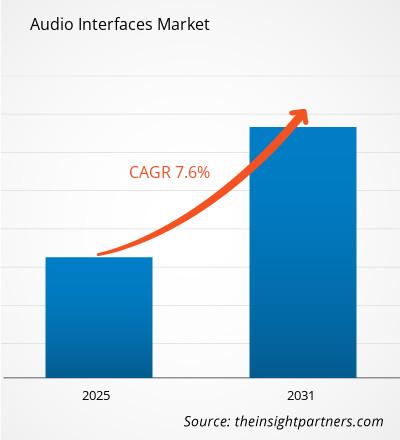
The Audio Interfaces Market in 2025 was US$ 203.28 Million and is forecast to hit US$ 373.70 Million in 2034, marking a CAGR of 7.00% during the forecast period from 2026 to 2034. The market includes a number of hardware devices, software solutions, and services which facilitate analog-to-digital and digital-to-analog audio conversion for recording, mixing, and playback in professional recording studios, home production environments, broadcast centers, and even live performances. They connect microphones, musical instruments, and audio playback devices with computers and smartphones for low-latency and high-quality audio processing.
The North America Audio Interfaces Market Size is forecast to grow at a CAGR of 6.2 – 6.9% in 2026 to 2034 driven by an increasing number of content creators, growth of podcasting ecosystem, and modernization of professional recording studios. Growth will be fueled by the popularity of home studios, growing consumption of music on streaming services, and cooperation between interfaces makers and digital audio workstations developers.
Audio Interfaces Market Assessment and Insights
- North America held 33–36% share in 2025 and is growing at a CAGR of 6.2–6.9% during 2026–2034, led by content creator growth, podcasting expansion, and studio upgrades across the US and Canada.
- US represented 80–83% of North American revenue in 2025 and is growing at a CAGR of 6.3–7.1% during 2026–2034.
- Europe accounted for 25–28% share in 2025 and is growing at a CAGR of 5.8–6.5% during 2026–2034, led by Germany, the UK, France, Italy, and Spain.
- Asia Pacific held 27–30% share in 2025 and is growing at a CAGR of 7.5–8.3% during 2026–2034, led by China, India, Japan, South Korea, and Australia.
- Largest Segment Hardware held 65–68% market share in 2025 and is growing at a CAGR of 6.5–7.2% during 2026–2034.
- High Growth Segment Software represented 18–21% market share in 2025 and is growing at a CAGR of 8.0–8.7% during 2026–2034.
- Key companies analyzed in detail: Behringer; Universal Audio; LOUD Technologies Inc.; Focusrite Audio Engineering Plc.; IK Multimedia; M-Audio; Steinberg Media Technologies GmbH; PreSonus Audio Electronics, Inc.; Roland Corporation; Zoom Corporation; Apogee Electronics; RME Audio.
Source: The Insight Partners' analysis based on proprietary research, government publications, company annual reports, investor presentations, industry databases, and expert interviews.
Audio production has transitioned from traditional hardware-based signal chain technologies into more hybrid systems, incorporating a combination of analog front-ends, digital converters, and software-based processing technologies. The production trends include an increased focus on high-resolution sampling, low-latency monitoring capabilities, advanced driver development and integration capabilities with popular digital audio workstations. The Audio Interface Market is also being driven by the need for system integration to match interface requirements with the recording process, live stream setup, and broadcasting technology.
Investments are moving towards Asia Pacific, North America, and Europe, where there are requirements for high-quality audio capture with improved user experience and operational efficiencies due to content creator economies, music streaming websites, and remote collaboration tools. Conformance with USB, Thunderbolt, and MIDI standard is helping with product certification and inter-device compatibility. The customers are increasingly opting for integrated systems comprising hardware, software, and cloud offerings, which also ensure continuous driver and firmware updates, technical support without interfering with the production process.
Audio Interfaces Market Report Scope
| Report Attribute | Details |
|---|---|
| Market size in 2025 | US$ 203.28 Million |
| Market Size by 2034 | US$ 373.70 Million |
| Global CAGR (2026 - 2034) | 7.00% |
| Historical Data | 2021-2024 |
| Forecast period | 2026-2034 |
Audio Interfaces Market Analysis
Market Growth Drivers is attributed to rising activity related to content generation, growth in number of podcasts, use of home studios, and need for professional recordings. The value chain consists of chip suppliers, converters, circuit board assemblers, software vendors, interface producers, distributors, and retailers. Factors affecting the supply chain include availability of semiconductors, software development, and channel-driven procurement. Audio Interfaces Market report shows that hardware-based interfaces become popular due to their low latency, high-quality preamplifier performance, and various connections.
The competition among these firms is led by the audio technology experts and consumer electronics companies. Competition in audio quality, connectivity capability, integration in ecosystems, and user network is seen in companies like Focusrite Audio Engineering Plc., Universal Audio, Behringer, PreSonus Audio Electronics, Inc., Roland Corporation, Steinberg Media Technologies GmbH, M-Audio, IK Multimedia, Zoom Corporation, and LOUD Technologies Inc. The investment in the industry has been going towards high-quality audio, integrated digital signal processing, and connectivity with USB-C and Thunderbolt along with integration to streaming platforms. Universal Audio and Focusrite Audio Engineering Plc. lead the competition with their superior portfolio of products and software ecosystems, whereas Behringer and M-Audio excel due to their pricing policy and performance level.
● REPORT CUSTOMIZATION
Tailor This Report To Align With Your Specific Business Requirements
This report can be customized to align precisely with your business objectives, scope, and target markets. Customization options include tailored segmentation, geography, competitive analysis, and strategic insights to support informed decision-making.
Customize This Report →WHAT YOU CAN ADJUST
- ● Segmentations
- ● Geography
- ● Competitive Analysis
- ● Language Preferences
Audio Interfaces Market: Strategic Insights
Regional Insights
North America Audio Interfaces Market
North America held a share of 33-36% of Audio Interfaces Market in 2025, and North America is expected to expand at a CAGR of 6.2-6.9% in 2026-2034. Growth is being driven by content creator community, development of podcasts, audio professional studios, and improvements in broadcasting infrastructure. The rise in number of independent musicians and podcaster is increasing the need for affordable recording options. Companies such as Focusrite Audio Engineering Plc., Universal Audio, PreSonus Audio Electronics, Inc., Behringer, and M-Audio cater to the installed base in the US and Canada.
U.S. Audio Interfaces Market
The share of the U.S. in North American revenues was 80-83% in 2025 and it is expected to grow at a CAGR of 6.3-7.1% for the period from 2026-2034. There is application demand for the segment in home recordings, podcasts, professional studios, and broadcasting. The firm presence of these brands is ensured through Focusrite Audio Engineering Plc., Universal Audio, PreSonus Audio Electronics, Inc., Behringer, M-Audio, and Apogee Electronics. Purchasing decisions depend on the factors like preamps, connections, latency, software, and usability.
Europe Audio Interfaces Market
Share of Europe was 25%-28% in 2025 and is forecasted to rise at a CAGR of 5.8-6.5% in the coming period from 2026 to 2034. Germany dominates on the back of music production, pro-audio production, and certified recording equipment, whereas the UK provides demand from the content creation, broadcasting, and music export segment. France, Italy, and Spain provide additional demand due to recording studios, live production, and media production studios. Investments made by the music industry and the economy of content creators benefit suppliers with quality certifications.
APAC Audio Interfaces Market
Asia-Pacific had a market share of 27–30% in 2025, and the region is expected to witness a CAGR of 7.5–8.3% during 2026–2034. China is ahead of the game because of the manufacturing of consumer electronics and increasing numbers of domestic content creators, whereas India is growing because of the development of digital content production, podcasting, and music education. Japan and South Korea focus on high-quality audio systems for broadcasting and music production. Australia is working on building recording facilities for creative industries.
Middle East & Africa Audio Interfaces Market
The CAGR of the Middle East and Africa Market is expected to be 6.0-6.8% during the forecast period of 2026-2034. The Middle East dominates because of its development of the industry and media infrastructure. The UAE contributes to the production, broadcasting, and entertainment of the market, whereas South Africa and Rest of MEA utilize music production, broadcasting, and content production for their contribution. There are prospects in the market due to the investment in the creative economy and digital content.
Segmentation Analysis
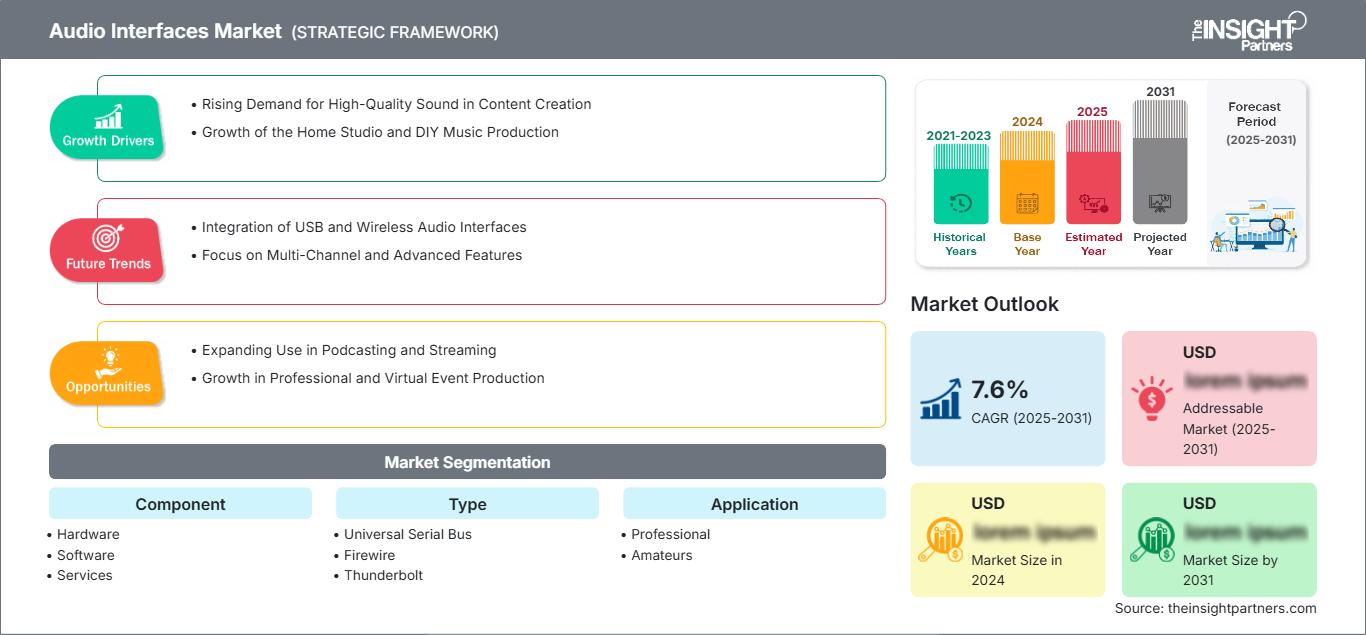
Component
Component is projected to grow at a CAGR of 6.8–7.5% during 2026–2034. Audio Interfaces Market scope covers Hardware, Software, and Services. Selection depends on user requirements, production workflows, and integration needs. Hardware leads through physical connectivity, preamp quality, and converter performance, delivering essential signal conversion and monitoring capabilities for recording applications.
- Hardware interfaces provide analog-to-digital and digital-to-analog conversion, preamplifiers, and connectivity options. These devices serve as the physical bridge between audio sources and computing platforms.
- Software platforms include driver applications, control panels, and virtual mixers that manage signal routing, latency, and system configuration across recording environments.
- Services encompass technical support, driver updates, firmware upgrades, installation assistance, and training programs that ensure optimal system performance and user satisfaction.
Type
Type is forecast to grow at a CAGR of 6.5–7.2% during 2026–2034. Universal Serial Bus, Firewire, Thunderbolt, and Musical Instrument Digital Interface interfaces are becoming more strategic as professionals and consumers standardize connectivity protocols, device compatibility, and data transfer requirements. Connectivity intensity rises when recording sessions involve multiple channels, high sample rates, and low-latency performance demands.
- Universal Serial Bus interfaces remain the most widely adopted type due to broad compatibility, plug-and-play functionality, and cost-effective connectivity across entry-level and mid-range recording applications.
- Firewire interfaces serve professional applications requiring reliable high-bandwidth data transfer, though adoption continues declining with the shift toward Thunderbolt and USB-C standards.
- Thunderbolt interfaces deliver ultra-low latency and high-bandwidth performance, making them preferred for professional applications requiring multiple input channels and high sample rates.
- Musical Instrument Digital Interface interfaces connect synthesizers, controllers, and electronic instruments for music production, supporting note data, control signals, and synchronization across devices.
Application
Application is expected to grow at a CAGR of 7.2–7.9% during 2026–2034. Professional audio production remains the anchor application, while amateur production, content creation, and education adopt interfaces where audio quality, ease of use, and portability elevate product requirements. Procurement increasingly favors integrated production platforms rather than standalone devices.
- Professional application demand is tied to music studios, broadcast facilities, post-production houses, and live sound environments requiring high channel counts, pristine audio quality, and reliable performance.
- Amateurs includes home studios, content creators, podcasters, educators, and hobbyists requiring accessible, affordable, and easy-to-use interfaces for recording and production.
Opportunity Snapshot
| Application | Revenue Contribution | Trend Tag | Adoption Stage |
|---|---|---|---|
| Professional | High | Studio Production | Mature |
| Amateurs | High | Home Recording | Scaling |
Audio Interfaces Market Growth Drivers and Impact Analysis
Content Creator Economy Fuels Audio Interface Adoption
The global expansion of content creator ecosystems spanning podcasting, music production, live streaming, and video production has created significant demand for audio interfaces. Independent creators require accessible, high-quality recording solutions that deliver professional results without complex studio infrastructure. As creator economy platforms generate revenue opportunities, investment in production equipment continues rising. The practical impact is increased spending on portable interfaces, broadcast-quality preamps, and user-friendly software that enables professional audio production across home and mobile environments.
Podcasting and Streaming Drive Interface Innovation
Podcasting and live streaming have emerged as major demand drivers for audio interfaces, with creators requiring multi-channel input capabilities for interviews and remote collaboration. The pandemic accelerated remote production workflows, making interfaces with built-in DSP, loopback functionality, and streaming-optimized features increasingly valuable. Broadcasters and content creators prioritize interfaces that simplify setup and deliver reliable connectivity. This driver benefits suppliers that combine hardware, software, and streaming integrations, enabling creators to focus on content production.
Music Production Democratization Expands Addressable Market
Accessible digital audio workstations and affordable recording equipment have democratized music production, enabling aspiring musicians to create professional-quality recordings at home. This trend has expanded the addressable market beyond traditional recording studios to include bedrooms, project studios, and mobile setups. Consumers increasingly seek interfaces with high-resolution audio, low-latency monitoring, and intuitive operation. The market impact is a premium for products that balance affordability with professional features, expanding adoption across emerging markets.
Audio Interfaces Market Future Trends
Integrated DSP Processing Reshapes Interface Capabilities
Audio Interfaces Market trends point toward integrated digital signal processing that enables low-latency monitoring with effects processing, reducing dependence on computer resources. The next product cycle will combine on-board DSP, zero-latency monitoring, and software integration to deliver studio-quality processing within the interface. This shift matters because creators increasingly measure interface value by DSP capabilities as well as conversion quality. Vendors with strong DSP architectures and software ecosystems will be better positioned as interfaces become more intelligent and self-contained.
USB-C and Thunderbolt Adoption Accelerates Connectivity Evolution
The transition toward USB-C and Thunderbolt connectivity is reshaping interface specifications, enabling higher channel counts, lower latency, and bus-powered operation. Next-generation interfaces will leverage these standards to deliver professional performance with simplified cabling and reduced setup complexity. Future procurement will scrutinize connectivity standards, compatibility, and power delivery. Suppliers that document protocol support and device compatibility will gain credibility with professional and amateur users seeking reliable connectivity.
Audio Interfaces Market Opportunities
Integrated Audio Production Bundles for Content Creators
Audio Interfaces Market Forecasts support investment in integrated production bundles that combine interfaces, microphones, headphones, and software for content creators. Creators seek turnkey solutions that simplify purchasing decisions and reduce compatibility concerns. Providers can create value by assembling complete production kits with training resources and ongoing support. The opportunity is strongest where users seek accessible entry points into professional-quality content production.
Emerging Creator Markets in Asia Pacific and Latin America
Rising internet penetration, platform accessibility, and creator economy growth in developing markets creates demand for affordable, capable audio interfaces. Many creators need professional recording solutions but cannot justify premium products. Vendors can win by offering localized distribution, training, and support programs. This opportunity rewards companies that translate global expertise into accessible solutions for emerging creator ecosystems.
Recent Developments
- July 2026: MOTU recently completed Milan Certification for its 16A, 848, and 10pre audio interfaces, which are equipped with two Gigabit AVB Networking Ethernet ports that enable them to share, route, and distribute hundreds of channels of audio with other devices on a Milan AVB network.
- October 2025: The MIPI Alliance, an international organization that develops specifications that standardize wired interfaces for mobile and other connected ecosystems, announced the release of SoundWire I3S (MIPI SWI3S v1.0). The new specification provides a transformative approach to audio transport by unifying control and data over a single scalable and power-efficient interface.
- May 2024: The culmination of nearly 30 years of PreSonus expertise, Quantum delivers newly-redesigned MAX-HD preamps, class-leading converters, front-facing instrument inputs co-developed with industry-leading experts at Fender, and stunning, high-fidelity performance for self-made audio creators and professional studio sessions. Sleek, stylish, and packed with premium features, these USB-C audio interfaces are available in four distinct models: Quantum ES 2, ES 4, HD 2, and HD 8.
Frequently Asked Questions

- Comprehensive Market Sizing and Forecast Analysis
- Detailed Segmentation Analysis
- In-Depth Market Dynamics Assessment
- Regional and Country-Level Insights
- Competitive Landscape and Company Benchmarking
- Strategic Business Intelligence
Recent Reports
Testimonials

The Insight Partners' SCADA System Market report is comprehensive, with valuable insights on current trends and future forecasts. The team was highly professional, responsive, and supportive throughout. We are very satisfied and highly recommend their services.
RAN KEDEM Partner, Reali Technologies LTDs
I requested a report on a very specific software market and the team produced the report in a few days. The information was very relevant and well presented. I then requested some changes and additions to the report. The team was again very responsive and I got the final report in less than a week.
JEAN-HERVE JENN Chairman, Future Analytica
We worked with The Insight Partners for an important market study and forecast. They gave us clear insights into opportunities and risks, which helped shape our plans. Their research was easy to use and based on solid data. It helped us make smart, confident decisions. We highly recommend them.
PIYUSH NAGPAL Sr. Vice President, High Beam Global
The Insight Partners delivered insightful, well-structured market research with strong domain expertise. Their team was professional and responsive throughout. The user-friendly website made accessing industry reports seamless. We highly recommend them for reliable, high-quality research services
YUKIHIKO ADACHI CEO, Deep Blue, LLC.
This is the first time I have purchased a market report from The Insight Partners.While I was unsure at first, I visited their web site and felt more comfortable to take the risk and purchase a market report.I am completely satisfied with the quality of the report and customer service. I had several questions and comments with the initial report, but after a couple of dialogs over email with their analyst I believe I have a report that I can use as input to our strategic planning process.Thank you so much for taking the extra time and making this a positive experience.I will definitely recommend your service to others and you will be my first call when we need further market data.
JOHN SUZUKI President and Chief Executive Officer, Board Director, BK Technologies
I wish to appreciate your support and the professionalism you displayed in the course of attending to my request for information regarding to infectious disease IVD market in Nigeria. I appreciate your patience, your guidance, and the fact that you were willing to offer a discount, which eventually made it possible for us to close a deal. I look forward to engaging The Insight Partners in the future, all thanks to the impression you have created in me as a result of this first encounter.
DR CHIJIOKE ONYIA MANAGING DIRECTOR, PineCrest Healthcare Ltd.Reason to Buy
- Informed Decision-Making
- Understanding Market Dynamics
- Competitive Analysis
- Identifying Emerging Markets
- Customer Insights
- Market Forecasts
- Risk Mitigation
- Boosting Operational Efficiency
- Strategic Planning
- Investment Justification
- Tracking Industry Innovations
- Aligning with Regulatory Trends





 Get Free Sample for