
Automated Industrial Quality Control Market Trends, Growth and Size - 2034
Coverage: By Type (Hardware and software solutions, Service); Application (Automotive, Metal, Electronics, Others), and Geography (North America, Europe, Asia Pacific, and South and Central America)
- Status : Data Released
- Report Code : TIPRE00003699
- Category : Electronics and Semiconductor
- No. of Pages : 150
- Available Report Formats :


- Last update date : July 20, 2026


2025 Market Size
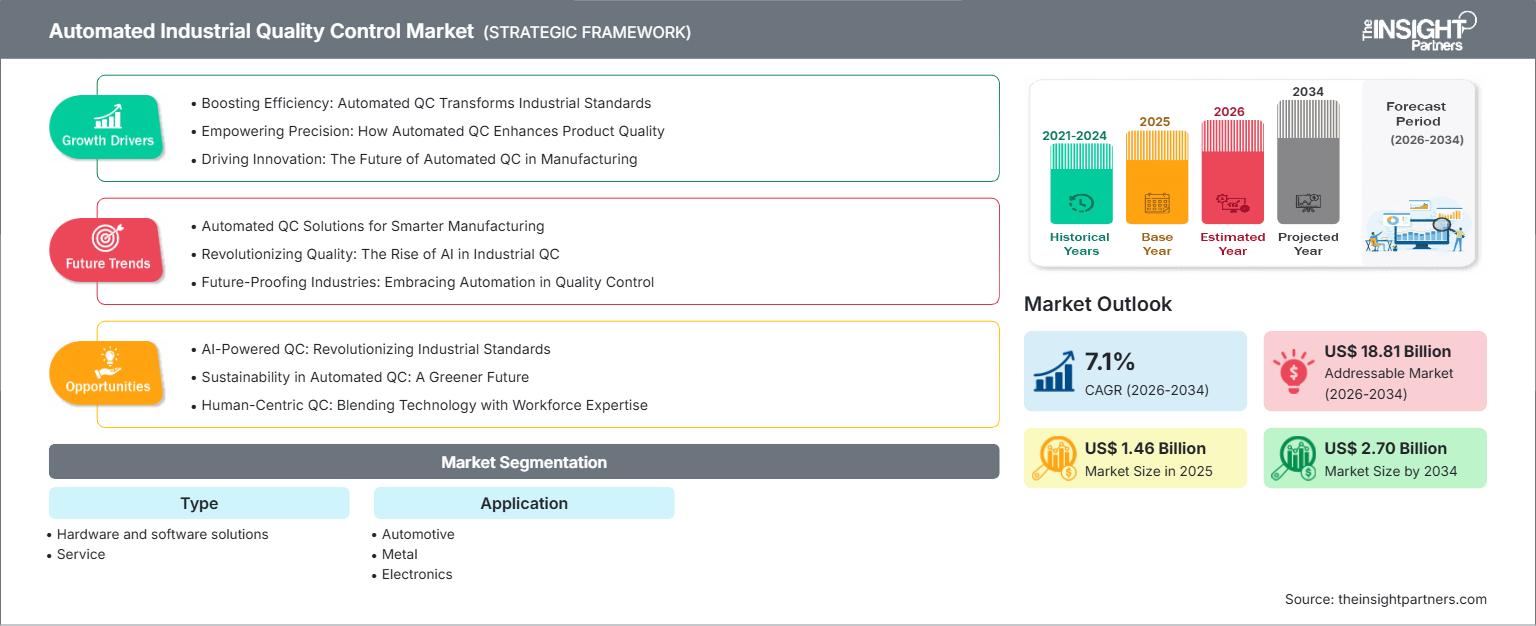
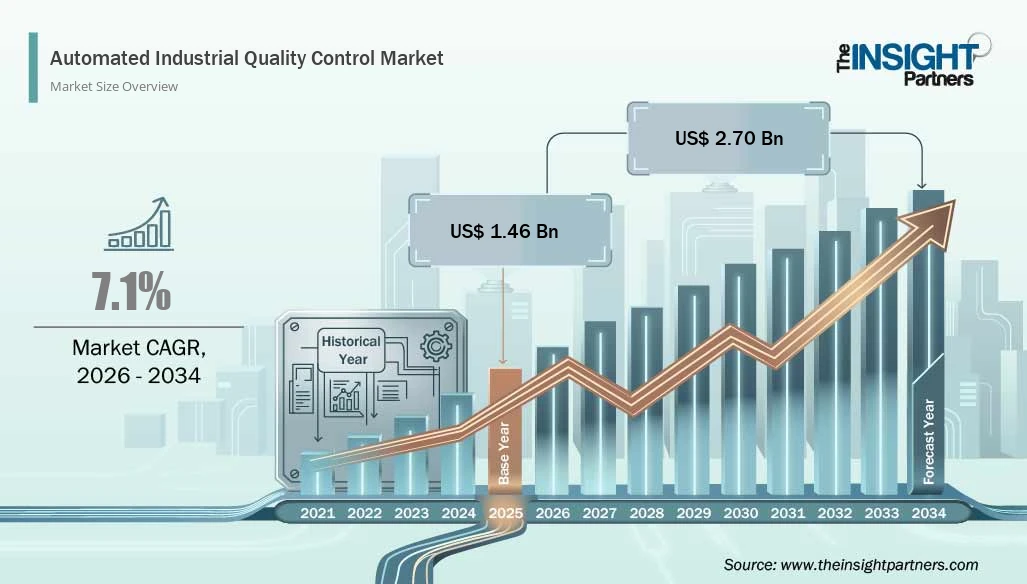
US$ 1.46 Bn
Base year value
2034 Forecast
US$ 2.70 Bn
Projected by 2034
CAGR 2026-2034
7.1 %
Growth rate
Addressable Market
US$ 18.81 Bn
(2026-2034)
The Automated Industrial Quality Control Market was valued at US$ 1.46 Billion in 2025 and is projected to reach US$ 2.70 Billion by 2034, registering a CAGR of 7.1% during 2026–2034. Adoption is being shaped by inline inspection, AI-enabled defect detection, robot-assisted metrology, and production traceability across automotive, metal, and electronics manufacturing.
North America remains a central adoption hub, with regional expansion estimated at a 6.6–7.2% CAGR as manufacturers modernize inspection cells, automate metrology workflows, and connect quality data with production analytics. The Automated Industrial Quality Control Market size is supported by reshoring-linked factory investments, electronics miniaturization, and stricter automotive quality requirements that increase demand for repeatable, high-speed inspection.
Automated Industrial Quality Control Market Assessment and Insights
- North America held 30–33% share in 2025 and is projected to grow at a CAGR between 6.6–7.2% during 2026–2034, supported by automotive reshoring, aerospace precision manufacturing, and AI-based inspection upgrades.
- US represented 76–79% of North America in 2025 and is expected to grow at a 6.7–7.3% CAGR through 2034, led by electronics and EV production lines.
- Europe accounted for 26–29% share in 2025 and is forecast to expand at a 6.3–6.9% CAGR, with Germany, the UK, France, and Italy leading metrology-driven adoption.
- Asia Pacific captured 31–34% share in 2025 and is projected to grow at a 7.6–8.4% CAGR, driven by China, Japan, South Korea, and India electronics and automotive output.
- Largest Segment Hardware and software solutions held 68–72% market share in 2025 and is expected to grow at a 6.8–7.4% CAGR during 2026–2034.
- High Growth Segment Electronics held 25–28% market share in 2025 and is forecast to grow at a 7.8–8.6% CAGR, driven by miniaturized components and semiconductor inspection.
- Key companies analyzed in detail: ABB Ltd., ATS Corporation, Carl Zeiss GOM Metrology GmbH, Honeywell International Inc., IVISYS AB, KEYENCE CORPORATION, MasterControl Solutions, Inc., Nanotronics Imaging, Inc., Intelitek, Inc., Renishaw plc.
Source: The Insight Partners' analysis based on proprietary research, government publications, company annual reports, investor presentations, industry databases, and expert interviews.
Inspection in factories has transitioned from sample-based and manual testing to sensor-led continuous quality assurance. Development in the sector is taking place through the use of machine vision cameras, coordinate measuring machines, laser scanning, artificial intelligence classifiers, and closed-loop feedback systems, which can identify dimensional deviation earlier during manufacturing. Faster confirmation is now required for automotive welding, machined metal components, and small electronics because cost increases rapidly after defect detection.
The coming requirement will include wider coverage in Mexico, India, Southeast Asia, and Eastern Europe, where manufacturers will integrate local manufacturing with more certifications. Investments will be made in modular inspection stations, quality data management systems using the cloud, and predictive analytics. Regulations concerning product safety, traceability, and process validation have also been driving suppliers to prove repeatable testing and not depend on line rejects only.
Automated Industrial Quality Control Market Report Scope
| Report Attribute | Details |
|---|---|
| Market size in 2025 | US$ 1.46 Billion |
| Market Size by 2034 | US$ 2.70 Billion |
| Global CAGR (2026 - 2034) | 7.1% |
| Historical Data | 2021-2024 |
| Forecast period | 2026-2034 |
Automated Industrial Quality Control Market Analysis
The link between market growth and manufacturer demands for reduced scrap rates, improved tolerances, and shorter product certification cycles exists. The machine vision, intelligent sensors, and automatic gauges minimize variation in inspections on high volume assembly lines, whereas quality information helps in root cause analysis. The highest demand is seen in cases where safety, warranties, and size reduction of components lead to expensive defect detection.
The industry consists of sensors manufacturers, metrology equipment manufacturers, automation system suppliers, software for inspection, and production analytics systems. From the supply perspective, companies able to integrate optics, motion control, calibration, and reporting process will have an advantage. The industry is additionally benefiting from low costs of edge computing and interoperability with PLC, MES, and SCADA systems.
Competitive Analysis of Automated Industrial Quality Control Market
ABB Ltd., KEYENCE CORPORATION, Renishaw plc, Honeywell International Inc., and ATS Corporation are leading players competing in terms of automation capability, software ease-of-use, and services coverage in the automated industrial quality control market.
Specialized players, like Carl Zeiss GOM Metrology GmbH, IVISYS AB, Nanotronics Imaging, Inc., MasterControl Solutions, Inc., and Intelitek, Inc., improve inspection in specific niches.
Increasing investments in AI-based set-up, no-programming-inspection coding, and digital record keeping for minimizing engineering effort. The key positions will be focused on providing turnkey cells for automotive & metals, cloud-based quality systems for regulated production, and high-resolution imaging for electronics markets. Pressure on prices continues, but life-cycle service, calibration services, and yield improvements ensure higher pricing.
● REPORT CUSTOMIZATION
Tailor This Report To Align With Your Specific Business Requirements
This report can be customized to align precisely with your business objectives, scope, and target markets. Customization options include tailored segmentation, geography, competitive analysis, and strategic insights to support informed decision-making.
Customize This Report →WHAT YOU CAN ADJUST
- ● Segmentations
- ● Geography
- ● Competitive Analysis
- ● Language Preferences
Automated Industrial Quality Control Market: Strategic Insights
Regional Insights
North America Automated Industrial Quality Control Market
North America accounted for 30–33% share in 2025 and is expected to advance at a 6.6–7.2% CAGR through 2034. The Automated Industrial Quality Control Market share in the region reflects advanced automotive manufacturing, aerospace component certification, and higher use of AI-assisted machine vision on assembly and machining lines.
The local market is supported by reshoring, labor shortages, and the requirement of proving that products meet specifications within the supply chain network. Automation equipment is being purchased for EV battery trays, machined housing, electronic circuit boards, and metal fabrication. Suppliers can leverage automation systems that enable upgrade of existing factories instead of designing new plants.
U.S. Automated Industrial Quality Control Market
In 2025, the U.S. accounted for 76–79% of North America and was forecasted to experience a CAGR of 6.7–7.3%. Adoption of this product is limited to plants engaged in automotive, electronics, aerospace, and precision metal manufacturing that have bottlenecks related to inspection processes.
Firms hold good penetration in the automation, machine vision, and metrology channels. The products from KEYENCE CORPORATION are involved in visual inspection and measurement, while Honeywell International Inc. is developing industrial analytics software and Renishaw plc caters to precision metrology. Examples of U.S. application areas include battery, PCB defect, weld, and machined part inspections.
Europe Automated Industrial Quality Control Market
Market share of Europe was between 26–29%, and expected growth was anticipated at 6.3–6.9% CAGR; Germany being the prominent country owing to automotive, machinery, and precision engineering capabilities. In the UK market, emphasis is placed on aerospace, medical components, and advanced manufacturing processes requiring certification of inspection procedures.
Expertise of machine tool technology in Germany enables automated tending of CMM, robot guidance for metrology and in-process gauging. The involvement of France, Italy and Spain occurs through automotive supply chains, aerospace manufacturing, metalworking industries and electronics assembly. Need arises due to traceability and energy efficient production systems.
APAC Automated Industrial Quality Control Market
APAC held 31–34% market share in 2025 and will exhibit growth at 7.6–8.4% CAGR, thereby being the fastest growing regional base. China is the largest producer among the regions, trailed by Japan, South Korea, India, and Australia on the basis of capabilities in electronics, automobiles, semiconductor packaging, and metal fabrication.
Advanced manufacturing policies, automated manufacturing processes, and electronics manufacturing capabilities are driving inspection improvements. The Japanese and South Korean manufacturing industries focus on metrological precision whereas India’s PLI policies promote scaleable quality management systems. The Australian share is modest; however, its role is significant in mining equipment, military production, and industrial maintenance applications.
Middle East & Africa Automated Industrial Quality Control Market
Middle East and Africa is expected to grow at a 5.8–6.5% CAGR as Saudi Arabia, the UAE, and South Africa add automation to metals, energy equipment, packaging, and industrial assembly. Saudi Arabia is the leading country because industrial diversification programs are expanding local manufacturing capacity.
Energy and infrastructure projects create demand for quality verification of fabricated structures, rotating equipment, electrical assemblies, and pipeline components. Adoption remains selective because skilled integration resources are uneven, but service-led inspection models and modular systems are improving accessibility for mid-sized manufacturers across the rest of MEA.
Segmentation Analysis
Type
The Type segment is expected to grow at a 6.9–7.5% CAGR during 2026–2034. The market scope covers hardware-intensive inspection cells and service-led deployments, with buyers balancing upfront system cost against repeatability, data traceability, calibration needs, and reduced manual inspection dependency.
- Hardware and software solutions dominate installations because cameras, sensors, gauges, motion platforms, and analytics software form the core inspection stack for high-throughput factories.
- Service demand rises where manufacturers require calibration, validation, integration, operator training, and lifecycle support to maintain accuracy across changing product lines.
Application
The Application segment is projected to grow at a 7.2–7.8% CAGR during 2026–2034. Automotive, metal, and electronics manufacturers use automated inspection differently, but all prioritize defect prevention, faster release decisions, and quality records that can support supplier audits, warranty claims, and continuous improvement programs.
- Automotive remains a mature application area, using inline inspection for welds, castings, battery structures, body panels, and precision assemblies where repeatability affects safety and warranty exposure.
- Metal applications focus on dimensional conformity, surface defects, tool wear signals, and fabricated part verification, especially in machining, casting, forming, and industrial equipment supply chains.
- Electronics is the high-growth application because miniaturized boards, connectors, sensors, and semiconductor-related assemblies require rapid detection of microscopic defects and process drift.
Opportunity Snapshot
| Application | Revenue Contribution | Trend Tag | Adoption Stage |
| Automotive | High | EV Inspection | Mature |
| Metal | Medium | Inline Gauging | Scaling |
| Electronics | High | Micro Defects | Scaling |
Automated Industrial Quality Control Market Growth Drivers and Impact Analysis
Rising Need for Defect Prevention in High-Volume Manufacturing
Manufacturers are replacing end-of-line rejection with earlier defect prevention because late-stage scrap carries material, labor, energy, and delivery penalties. The market benefits as inline cameras, laser measurement, and automated gauges identify drift before a batch moves forward. Automotive and electronics lines are especially exposed because one dimensional error can affect downstream fit, electrical performance, or safety. Real-world impact includes shorter containment cycles, fewer manual rechecks, improved first-pass yield, and stronger supplier accountability. As production mixes become more variable, automated systems also help plants maintain consistent acceptance criteria across shifts, sites, and product variants.
Integration of AI Vision with Factory Automation Platforms
AI-enabled vision reduces the engineering effort required to detect variable defects such as scratches, missing features, misalignment, and surface anomalies. The market gains from models that learn acceptable variation, reduce false rejects, and feed alerts into PLC, MES, and analytics platforms. This integration changes inspection from a standalone checkpoint into a production intelligence layer. Plants can correlate defects with tool wear, material batches, temperature shifts, or operator interventions. The outcome is faster troubleshooting and fewer recurring quality escapes, particularly in electronics assembly, precision metalworking, and flexible automotive component manufacturing.
Growing Compliance and Traceability Requirements
Industrial customers increasingly require auditable quality records rather than simple pass-or-fail inspection results. The market is supported by demand for digital evidence that links measurement data, calibration status, operator actions, and production lots. This is important in automotive safety components, aerospace parts, medical device manufacturing, and electronics supply chains. Automated inspection platforms reduce documentation gaps while enabling faster customer audits and warranty investigations. Their impact is strongest where suppliers must demonstrate process capability, maintain certification, and prove that corrective actions have been implemented consistently across multiple production sites.
Automated Industrial Quality Control Market Future Trends
Closed-Loop Quality Control at the Machine Level
The next phase of Automated Industrial Quality Control Market trends will connect inspection outputs directly with machining, welding, assembly, and robotic handling parameters. Instead of flagging a defect after production, systems will recommend or execute process corrections when measurements move toward control limits. This trend will favor vendors that combine metrology accuracy with automation logic and secure data exchange. Manufacturers will gain shorter feedback loops, lower engineering workload, and more stable yields during product changeovers. Adoption will be gradual because validation requirements are high, but high-value components will justify early investment.
Low-Code Inspection Programming for Flexible Production
Inspection programming is moving toward low-code workflows that allow engineers to import drawings, define tolerances, train AI models, and generate reports with less specialist intervention. This trend will expand adoption among mid-sized manufacturers that lack large metrology teams. It also supports shorter product lifecycles because inspection routines can be adapted faster when part geometry or materials change. Vendors with intuitive interfaces, simulation capability, and embedded validation checks will gain advantage. Over time, easier deployment will shift automated quality from premium factories toward broader industrial operations.
Automated Industrial Quality Control Market Opportunities
Electronics Miniaturization and Semiconductor-Adjacent Inspection
Electronics manufacturing offers one of the strongest Automated Industrial Quality Control Market Forecasts because component density, solder-joint complexity, and connector tolerances continue to tighten. Investors can target high-resolution optics, 3D inspection, AI classification, and data platforms that identify microscopic process drift before yield losses escalate. The opportunity is not limited to semiconductor fabs; it extends to PCB assembly, sensors, power electronics, and consumer device supply chains. Suppliers that package inspection hardware with actionable analytics can help manufacturers reduce false rejects, shorten debugging cycles, and meet customer traceability expectations.
Service-Led Quality Automation for Mid-Sized Manufacturers
Mid-sized manufacturers often recognize the value of automated inspection but face barriers around capital cost, integration skills, calibration, and validation. Service-led models create an opportunity for vendors and integrators to bundle equipment, software, maintenance, training, and performance monitoring into scalable programs. This approach can accelerate adoption in metal fabrication, contract electronics, and automotive supplier tiers. Commercial success will depend on proving measurable gains such as reduced rework, faster release, and fewer customer returns. Flexible financing and standardized deployment templates can make quality automation accessible beyond large multinational factories.
Recent Developments
- July 2026: Belgian food-tech startup Polysense raised $10.7 million in an oversubscribed seed funding round led by Felix Capital to expand its AI-powered quality control platform for food manufacturing. The company's technology uses computer vision and artificial intelligence to inspect every product in real time, detect quality variations, and automatically adjust production line settings to reduce waste and improve consistency. Already deployed across major food manufacturers in Europe, the United States, and the Middle East, the platform has delivered measurable results, including reducing potato peeling time by 45% at one processing facility. The new funding will support international expansion, product development, and wider adoption of autonomous quality control systems across the food industry.
- December 2025: Hexagon announced the acquisition of IconPro, a German industrial AI company specializing in intelligent asset maintenance and machine condition monitoring. The acquisition brings Apollo, IconPro's AI-powered maintenance platform, into Hexagon's Manufacturing Intelligence division, enabling manufacturers to continuously monitor machine health, detect anomalies, and predict equipment failures before they occur. By combining AI-driven analytics with data from connected metrology systems, Hexagon aims to improve equipment reliability, reduce unplanned downtime, optimize maintenance schedules, and enhance productivity across industrial manufacturing operations. The acquisition also strengthens Hexagon's broader strategy of integrating AI into smart manufacturing and digital factory solutions to deliver more predictive and autonomous asset management capabilities.
- July 2026: Comau completed the acquisition of Invent Smart Intralogistics Solutions, a Brazilian specialist in warehouse automation and intralogistics, strengthening its end-to-end automation portfolio. The acquisition combines Invent's AI-driven warehouse orchestration software and expertise in box handling, order fulfillment, and logistics management with Comau's industrial automation capabilities and Automha's automated storage technologies. Together, the companies aim to deliver fully integrated solutions that connect production, storage, material handling, and distribution while improving operational efficiency across manufacturing and fulfillment centers. The deal also expands Comau's presence in Latin America and provides greater access to the growing U.S. mid-market intralogistics sector, supporting the company's strategy to build a globally connected automation ecosystem.
Frequently Asked Questions

- Comprehensive Market Sizing and Forecast Analysis
- Detailed Segmentation Analysis
- In-Depth Market Dynamics Assessment
- Regional and Country-Level Insights
- Competitive Landscape and Company Benchmarking
- Strategic Business Intelligence
Recent Reports
Testimonials

The Insight Partners' SCADA System Market report is comprehensive, with valuable insights on current trends and future forecasts. The team was highly professional, responsive, and supportive throughout. We are very satisfied and highly recommend their services.
RAN KEDEM Partner, Reali Technologies LTDs
I requested a report on a very specific software market and the team produced the report in a few days. The information was very relevant and well presented. I then requested some changes and additions to the report. The team was again very responsive and I got the final report in less than a week.
JEAN-HERVE JENN Chairman, Future Analytica
We worked with The Insight Partners for an important market study and forecast. They gave us clear insights into opportunities and risks, which helped shape our plans. Their research was easy to use and based on solid data. It helped us make smart, confident decisions. We highly recommend them.
PIYUSH NAGPAL Sr. Vice President, High Beam Global
The Insight Partners delivered insightful, well-structured market research with strong domain expertise. Their team was professional and responsive throughout. The user-friendly website made accessing industry reports seamless. We highly recommend them for reliable, high-quality research services
YUKIHIKO ADACHI CEO, Deep Blue, LLC.
This is the first time I have purchased a market report from The Insight Partners.While I was unsure at first, I visited their web site and felt more comfortable to take the risk and purchase a market report.I am completely satisfied with the quality of the report and customer service. I had several questions and comments with the initial report, but after a couple of dialogs over email with their analyst I believe I have a report that I can use as input to our strategic planning process.Thank you so much for taking the extra time and making this a positive experience.I will definitely recommend your service to others and you will be my first call when we need further market data.
JOHN SUZUKI President and Chief Executive Officer, Board Director, BK Technologies
I wish to appreciate your support and the professionalism you displayed in the course of attending to my request for information regarding to infectious disease IVD market in Nigeria. I appreciate your patience, your guidance, and the fact that you were willing to offer a discount, which eventually made it possible for us to close a deal. I look forward to engaging The Insight Partners in the future, all thanks to the impression you have created in me as a result of this first encounter.
DR CHIJIOKE ONYIA MANAGING DIRECTOR, PineCrest Healthcare Ltd.Reason to Buy
- Informed Decision-Making
- Understanding Market Dynamics
- Competitive Analysis
- Identifying Emerging Markets
- Customer Insights
- Market Forecasts
- Risk Mitigation
- Boosting Operational Efficiency
- Strategic Planning
- Investment Justification
- Tracking Industry Innovations
- Aligning with Regulatory Trends





 Get Free Sample for