
Automated People Mover System Market Growth, Share & Trends by 2034
Coverage: By Product Type (Monorail, Duorail, Automated Guide Way Transit Or Maglev, Others); Application (Airports, Urban Transit, Amusement Parks, Shopping or Commercial Center, Others) , and Geography (North America, Europe, Asia Pacific, and South and Central America)
- Status : Data Released
- Report Code : TIPRE00020789
- Category : Electronics and Semiconductor
- No. of Pages : 150
- Available Report Formats :


- Last update date : July 21, 2026


2025 Market Size
US$ 1.33 Bn
Base year value
2034 Forecast
US$ 2.13 Bn
Projected by 2034
CAGR 2026-2034
5.33 %
Growth rate
Addressable Market
US$ 15.66 Bn
(2026-2034)
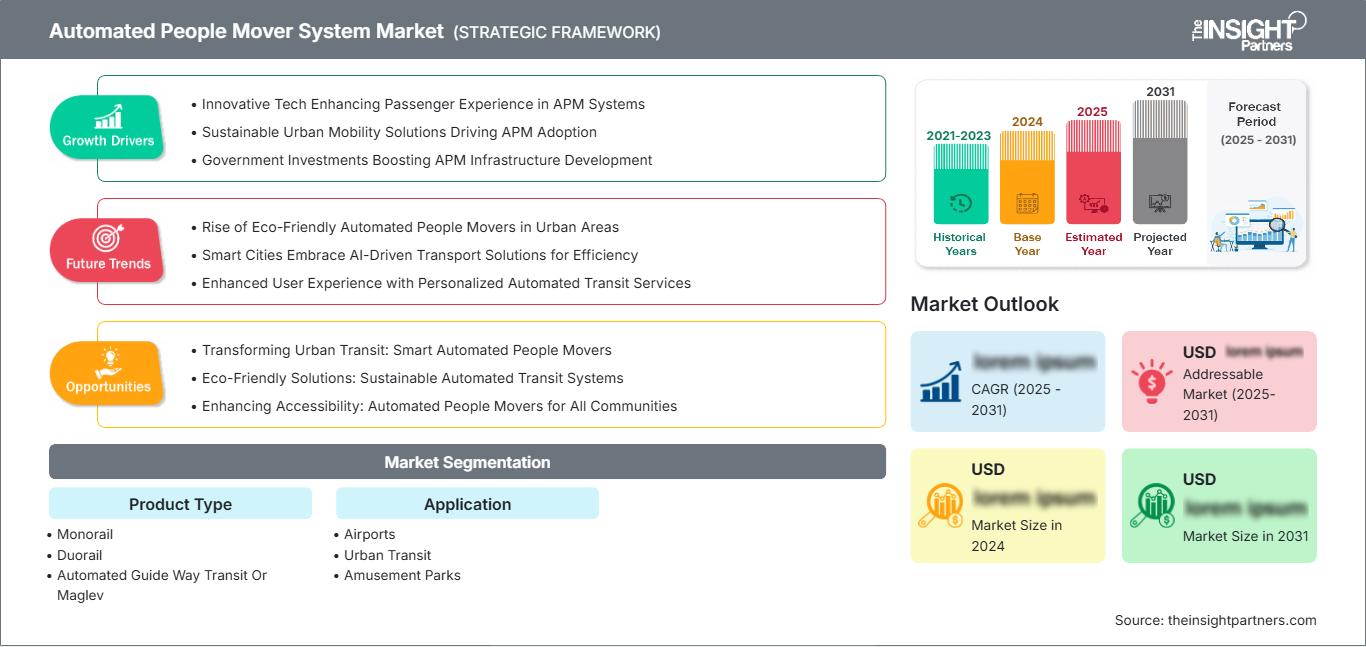
The Automated People Mover System Market was valued at US$ 1.33 Billion in 2025 and is projected to reach US$ 2.13 Billion by 2034, growing at a CAGR of 5.33% during 2026–2034. Demand reflects rising investment in driverless, grade-separated passenger mobility across airports, dense urban corridors, amusement destinations, and high-footfall commercial complexes requiring dependable short-distance circulation.
North America is positioned as a mature but investment-active region, with an estimated CAGR range of 4.6–5.1% during 2026–2034. The Automated People Mover System Market size in the region is supported by airport terminal expansion, aging airport train replacement, and stronger links between terminals, parking, rental car centers, and rail stations. Urban redevelopment around airports is also improving the business case for automated shuttle systems.
Automated People Mover System Market Assessment and Insights
- North America: The region holds 32–36% share in 2025 and grows at a CAGR range of 4.6–5.1% during 2026–2034, driven by terminal modernization, rental car connectivity, and replacement of aging airport train assets.
- US: The country represents 72–76% of North America in 2025 and grows at a CAGR range of 4.8–5.3% during 2026–2034, led by airport capacity programs.
- Europe: The region accounts for 24–28% share in 2025 and grows at a CAGR range of 4.2–4.7% during 2026–2034, with Germany, France, the UK, Italy, and Spain leading adoption.
- Asia Pacific: The region holds 30–34% share in 2025 and grows at a CAGR range of 6.2–6.7% during 2026–2034, led by China, Japan, South Korea, India, and Singapore.
- Largest Segment: Airports hold 56–60% market share in 2025 and grow at a CAGR range of 5.1–5.6% during 2026–2034 as hub terminals add capacity.
- High Growth Segment: Urban Transit holds 20–24% market share in 2025 and grows at a CAGR range of 6.3–6.8% during 2026–2034 through compact city mobility projects.
- Key companies analyzed in detail: Mitsubishi Heavy Industries, Ltd.; Alstom SA; Hitachi Rail STS S.p.A.; TPI Composites, Inc.; Strukton Groep N.V.; Doppelmayr Cable Car GmbH; Chance Rides Manufacturing, Inc.; Parry People Movers Ltd.; POMA SAS; Siemens Mobility GmbH.
Source: The Insight Partners' analysis based on proprietary research, government publications, company annual reports, investor presentations, industry databases, and expert interviews.
Automated short-distance rail has evolved from airport circulators into a broader mobility layer linking terminals, parking, intermodal stations, theme parks, and commercial districts. Suppliers are shifting from bespoke civil-heavy projects toward modular vehicles, standardized guideway interfaces, condition monitoring, and operations contracts. Production dynamics are shaped by long qualification cycles, safety certification, propulsion choices, and local construction partners, making project execution capability as important as vehicle technology.
Future demand will come from airport capacity programs, transit-oriented development, and urban districts where conventional buses face congestion or labor constraints. Investment tailwinds include aviation recovery, smart-city policy, decarbonization targets, and public-private infrastructure funding. Vendors with proven automatic train control, energy-efficient propulsion, and lifecycle service models will be better positioned in emerging hubs across Asia, the Middle East, and North America.
Automated People Mover System Market Report Scope
| Report Attribute | Details |
|---|---|
| Market size in 2025 | US$ 1.33 Billion |
| Market Size by 2034 | US$ 2.13 Billion |
| Global CAGR (2026 - 2034) | 5.33% |
| Historical Data | 2021-2024 |
| Forecast period | 2026-2034 |
Automated People Mover System Market Analysis
The Automated People Mover System Market growth is underpinned by the need to move passengers predictably across constrained land-side and air-side environments. Airports Council International reported that global passenger traffic was expected to reach 9.5 billion in 2024 and exceed 12 billion by 2030, strengthening the requirement for automated internal transport. Airports, campuses, and commercial districts value systems that cut transfer time, reduce curbside congestion, and operate continuously without driver scheduling limitations.
The ecosystem spans vehicle OEMs, guideway contractors, propulsion suppliers, signaling providers, system integrators, civil engineers, airport authorities, transit agencies, and operations partners. Supply dynamics favor firms that can manage rolling stock, automatic train control, platform screen doors, communications, power distribution, and maintenance under one project schedule. Buyers increasingly assess lifecycle availability, not only upfront capital cost, because 24-hour service reliability defines passenger acceptance.
The Automated People Mover System Market analysis indicates a concentrated competitive field combining global rail suppliers, cable-propelled specialists, and project-focused engineering companies. Mitsubishi Heavy Industries, Ltd. and Alstom SA have strong airport references, while Doppelmayr Cable Car GmbH and POMA SAS compete in cable-propelled systems. Hitachi Rail STS S.p.A. strengthens signaling depth, and Siemens Mobility GmbH supports automation, electrification, and train-control integration.
Investment trends are shifting toward replacement, refurbishment, and capacity upgrades rather than only greenfield builds. Operators want proven technologies that can be installed with minimal service disruption, especially in live airport environments. Strategic positioning favors companies that offer domestic manufacturing options, local maintenance teams, and documented energy performance. TPI Composites, Inc., Strukton Groep N.V., Chance Rides Manufacturing, Inc., and Parry People Movers Ltd. address specialized elements of the broader mobility chain.
● REPORT CUSTOMIZATION
Tailor This Report To Align With Your Specific Business Requirements
This report can be customized to align precisely with your business objectives, scope, and target markets. Customization options include tailored segmentation, geography, competitive analysis, and strategic insights to support informed decision-making.
Customize This Report →WHAT YOU CAN ADJUST
- ● Segmentations
- ● Geography
- ● Competitive Analysis
- ● Language Preferences
Automated People Mover System Market: Strategic Insights
Regional Insights
North America Automated People Mover System Market
North America holds 32–36% share in 2025 and is projected to grow at a CAGR range of 4.6–5.1% during 2026–2034. The Automated People Mover System Market share is supported by airport redevelopment, replacement of legacy people movers, and stronger intermodal links between terminals, parking, rental car centers, and regional rail. ACI’s traffic outlook reinforces the need for higher passenger-processing capacity.
Canada and Mexico add project depth through airport modernization, tourism gateways, and manufacturing corridors requiring predictable passenger circulation. Regional demand is not uniform because APM projects require major civil works and long procurement cycles. However, airport authorities are increasingly prioritizing systems that improve passenger experience, reduce road congestion, and support 24-hour movement without adding large operating workforces.
U.S. Automated People Mover System Market
The U.S. represents 72–76% of North America in 2025 and grows at a CAGR range of 4.8–5.3% during 2026–2034. Airport applications dominate as Denver, Atlanta, Tampa, Newark, Orlando, and Washington Dulles demonstrate continuing investment in automated terminal and landside links. Alstom SA, Mitsubishi Heavy Industries, Ltd., Doppelmayr Cable Car GmbH, and Siemens Mobility GmbH are relevant through vehicles, operations, electrification, and automation roles.
Application trends are moving from simple terminal transfers toward full airport circulation networks connecting rail stations, parking, rental car centers, hotels, and consolidated security zones. U.S. projects also emphasize domestic manufacturing, resilience, cybersecurity, and maintainability because airport train failures create immediate passenger bottlenecks. Procurement increasingly evaluates long-term operations, spare parts availability, and peak-hour capacity rather than only fleet size.
Europe Automated People Mover System Market
Europe accounts for 24–28% share in 2025 and grows at a CAGR range of 4.2–4.7% during 2026–2034. Germany is the leading country because airport infrastructure, rail automation expertise, and engineering contractors support technically complex projects. France and the UK remain active through airport capacity planning, intermodal links, and urban redevelopment where grade-separated shuttle systems can manage concentrated passenger flows.
Italy, Spain, and the Nordics add selective opportunities through tourism gateways, convention districts, and airport rail connections. European buyers emphasize energy efficiency, noise control, safety validation, and integration with existing rail and metro assets. Hitachi Rail STS S.p.A., Siemens Mobility GmbH, Doppelmayr Cable Car GmbH, POMA SAS, Strukton Groep N.V., and Alstom SA remain relevant where signaling, guideway, and operations expertise intersect.
APAC Automated People Mover System Market
APAC holds 30–34% share in 2025 and is projected to grow at a CAGR range of 6.2–6.7% during 2026–2034. China is the leading country, while Japan, South Korea, India, Australia, and Singapore support demand through airports, theme parks, urban districts, and transit hubs. Manufacturing scale and airport expansion remain the strongest structural drivers.
Policy-led infrastructure investment, tourism recovery, and smart-city programs are raising interest in compact automated links. Local partners are important because civil works, system certification, and integration with rail, metro, or airport operations determine delivery risk.
Middle East & Africa Automated People Mover System Market
Middle East & Africa is projected to grow at a CAGR range of 5.8–6.3% during 2026–2034. Saudi Arabia is the leading country as airport expansion, tourism districts, and economic diversification programs support automated passenger circulation. The UAE adds demand through major hubs, exhibition districts, and premium commercial developments.
South Africa and Rest of MEA remain more project-based, with adoption tied to airport upgrades, resort infrastructure, and mining-town mobility needs. Energy-efficient systems can support sustainability targets, but financing certainty and local maintenance capacity will decide execution pace.
Segmentation Analysis
Product Type
Product Type is projected to grow at a CAGR range of 5.0–5.5% during 2026–2034. The Automated People Mover System Market scope across product types depends on route length, curve radius, passenger capacity, civil footprint, energy profile, and operating philosophy. Monorail and duorail systems remain common in airport and urban settings, while automated guideway transit or maglev options serve projects requiring smoother ride quality, lower noise, or advanced positioning.
- Monorail: Monorail systems are selected where elevated alignment, compact guideway design, and visual identity matter, especially in airports, amusement parks, and dense commercial districts.
- Duorail: Duorail systems support higher-capacity automated movement on fixed guideways, making them suitable for terminal links, urban connectors, and routes requiring stable operation under heavy passenger flows.
- Automated Guideway Transit or Maglev: Automated guideway transit or maglev systems target premium projects where smooth ride quality, low noise, advanced control, and differentiated passenger experience justify higher engineering complexity.
Application
Application is expected to grow at a CAGR range of 5.3–5.8% during 2026–2034. Airports remain the largest application because passenger connections must be predictable, high frequency, and available around the clock. Urban transit creates the fastest expansion path as planners look for lower-labor feeder links. Amusement parks and commercial centers use automated mobility to reduce walking burden and improve asset circulation.
- Airports: Airports dominate demand because terminal-to-terminal, terminal-to-parking, and rail-link routes require dependable automated circulation, short headways, and high availability during peak travel periods.
- Urban Transit: Urban transit applications are scaling as cities test grade-separated shuttles for business districts, campuses, waterfronts, and intermodal nodes where road-based services face congestion.
- Amusement Parks: Amusement parks use people movers to connect gates, hotels, parking, and themed zones, improving guest distribution while reducing operational complexity in high-season periods.
- Shopping or Commercial Center: Shopping or commercial centers adopt compact automated links when large mixed-use sites require convenient access between retail, offices, parking, hotels, and entertainment venues.
Opportunity Snapshot
| Segment Name | Revenue Contribution | Trend Tag | Adoption Stage |
| Airports | High | Terminal Links | Mature |
| Urban Transit | Medium | City Connectors | Scaling |
| Amusement Parks | Medium | Guest Flow | Scaling |
| Shopping or Commercial Center | Low | Mixed Access | Emerging |
Automated People Mover System Market Growth Drivers and Impact Analysis
Airport Capacity Expansion and Passenger Flow Reliability
Airports are investing in automated movers because terminal growth can quickly create bottlenecks at security zones, gates, parking, and rental car facilities. ACI’s 2024 passenger outlook indicated 9.5 billion global passengers, with volumes expected to exceed 12 billion by 2030, making internal mobility a capacity issue rather than a passenger amenity. The impact is strongest at hub airports where missed connections, curbside congestion, and long walking distances directly affect service quality. Automated systems allow operators to move travelers continuously, support remote concourses, and reduce dependence on shuttle buses that compete with road traffic. This driver also supports refurbishment projects where older airport trains must be modernized without disrupting live operations.
Urban Congestion and Demand for Grade-Separated Mobility
The city planners are studying the implementation of compact automated transportation modes in areas where roads are congested, space is scarce, and conventional buses cannot operate at regular intervals. An aerial people mover can connect metro stations, commercial centers, hospitals, educational institutions, and other mixed-use developments without using any road transport vehicles. The market potential is an expanded addressable audience, from just an airport solution to a corridor with many pedestrians in a small space. The projects need to make sense financially in terms of civil infrastructure construction costs, and they are economically viable because the vehicles can be operated at frequent intervals by central control.
Lifecycle Modernization of Existing Automated Systems
Many installed systems are approaching refurbishment cycles involving signaling, communications, propulsion, vehicles, platform equipment, and control software. The modernization process has become an increasingly important driver of material demand, as airport and urban infrastructure operators cannot replace the mobility assets when the system breaks down. Modernization projects ensure that the material supplier can work in the current facility environment, where nighttime work, commissioning procedures, and passenger safety become important considerations. There is thus greater reliability of revenues arising from upgrades, operations, and maintenance, as opposed to new construction contracts. Modernization helps owners improve the energy efficiency of assets, enhance their cybersecurity, diagnostics, and spare parts availability, thereby extending their lifespan without disrupting passenger services.
Automated People Mover System Market Future Trends
Predictive Operations and Condition-Based Maintenance
Automated People Mover System Market trends will increasingly focus on predictive operations that use sensor data, control-system logs, and maintenance analytics to prevent service interruptions. The operators will require continuous information on the health of the propulsion system, the frequency of door openings, wheel or guideway wear, energy efficiency, and communication capabilities. The implication of this development for procurement is that buyers will consider the capabilities of digital services, in addition to the vehicle's reliability. Suppliers who use operational data to develop maintenance plans will minimize unexpected breakdowns and increase customer satisfaction. This technology will be most applicable in airport operations.
Lower-Carbon Propulsion and Lightweight Vehicle Design
Energy efficiency is bound to play an increasingly important role as airports, cities, and commercial property owners purchase infrastructure that aligns with their objectives related to emissions and cost efficiency. Light vehicle weight, regenerative braking, power electronics optimization, and traction system improvements can reduce electrical energy consumption during extended hours of operation. The future market will favor solutions that consume less energy throughout their lifecycle without sacrificing capacity or ride comfort. This tendency further reinforces the importance of composites, guideway interface optimization, and power supply systems.
Automated People Mover System Market Opportunities
Airport Refurbishment Packages with Operations Contracts
Automated People Mover System Market Forecasts point to a practical opportunity in bundled refurbishment programs that combine vehicles, signaling, communications, platform equipment, and multi-year operations support. There is a preference for partners who can renew live installations without disrupting passengers' operations; therefore, the delivery approach is an important factor. Vendors can add value through their phased renewal strategy, energy-efficiency evaluation, spare-parts strategy, and reliability assurance. This represents an interesting opportunity for vendors in North America, Europe, and at highly developed airports in Asia that require updates to their first-generation airport systems.
Compact Links for Mixed-Use Urban Districts
The mixed-use development provides the opportunity for small-scale automated systems that will link car parks, offices, shops, hotels, hospitals, campuses, and stations to one another over short distances. Property values can be increased by developers and local authorities by using people movers to reduce traffic within a project development and provide a reliable means of transportation for visitors. Such an opportunity requires a comprehensive approach at the early stage of master planning, as the route layout, station locations, and utility services are critical to costs. Suppliers have an opportunity to demonstrate their competitiveness in terms of scalability, noise reduction, and capacity studies.
Recent Developments
- March 2026: Alstom announced that four Innovia R automated people mover (APM) vehicles began to serve passengers at Tampa International Airport (TPA) on Friday, a key part of an extensive modernization of the airport to serve a growing metropolitan region. TPA has ordered a total of 16 state-of-the-art Innovia R cars to replace 30-year-old APM cars (also made by Alstom), which have logged more than 1 million miles each.
- April 2026: Sumitomo Corporation and Sumitomo Corporation of Americas, through Crystal Mover Services, Inc., a joint venture with Mitsubishi Heavy Industries, Ltd., entered into a comprehensive contract with the City of Atlanta, Department of Aviation, the operator of Hartsfield-Jackson Atlanta International Airport in Georgia, USA, for a comprehensive equipment renewal project aimed at upgrading the Automated People Mover (APM)*1. The contract period spans 10 years, from March 2026 to March 2036.
- March 2026: Alstom was selected by George Bush Intercontinental Airport (IAH) in Houston to replace its existing Skyway automated people mover (APM) system and provide operations and maintenance services for 15 years. The contract includes a new Operations Control Center, upgraded Automatic Train Control and communications systems, 16 new Innovia APM R vehicles, modernized station doors across all terminals, and continued operations and maintenance of the system.
Frequently Asked Questions

- Comprehensive Market Sizing and Forecast Analysis
- Detailed Segmentation Analysis
- In-Depth Market Dynamics Assessment
- Regional and Country-Level Insights
- Competitive Landscape and Company Benchmarking
- Strategic Business Intelligence
Recent Reports
Testimonials

The Insight Partners' SCADA System Market report is comprehensive, with valuable insights on current trends and future forecasts. The team was highly professional, responsive, and supportive throughout. We are very satisfied and highly recommend their services.
RAN KEDEM Partner, Reali Technologies LTDs
I requested a report on a very specific software market and the team produced the report in a few days. The information was very relevant and well presented. I then requested some changes and additions to the report. The team was again very responsive and I got the final report in less than a week.
JEAN-HERVE JENN Chairman, Future Analytica
We worked with The Insight Partners for an important market study and forecast. They gave us clear insights into opportunities and risks, which helped shape our plans. Their research was easy to use and based on solid data. It helped us make smart, confident decisions. We highly recommend them.
PIYUSH NAGPAL Sr. Vice President, High Beam Global
The Insight Partners delivered insightful, well-structured market research with strong domain expertise. Their team was professional and responsive throughout. The user-friendly website made accessing industry reports seamless. We highly recommend them for reliable, high-quality research services
YUKIHIKO ADACHI CEO, Deep Blue, LLC.
This is the first time I have purchased a market report from The Insight Partners.While I was unsure at first, I visited their web site and felt more comfortable to take the risk and purchase a market report.I am completely satisfied with the quality of the report and customer service. I had several questions and comments with the initial report, but after a couple of dialogs over email with their analyst I believe I have a report that I can use as input to our strategic planning process.Thank you so much for taking the extra time and making this a positive experience.I will definitely recommend your service to others and you will be my first call when we need further market data.
JOHN SUZUKI President and Chief Executive Officer, Board Director, BK Technologies
I wish to appreciate your support and the professionalism you displayed in the course of attending to my request for information regarding to infectious disease IVD market in Nigeria. I appreciate your patience, your guidance, and the fact that you were willing to offer a discount, which eventually made it possible for us to close a deal. I look forward to engaging The Insight Partners in the future, all thanks to the impression you have created in me as a result of this first encounter.
DR CHIJIOKE ONYIA MANAGING DIRECTOR, PineCrest Healthcare Ltd.Reason to Buy
- Informed Decision-Making
- Understanding Market Dynamics
- Competitive Analysis
- Identifying Emerging Markets
- Customer Insights
- Market Forecasts
- Risk Mitigation
- Boosting Operational Efficiency
- Strategic Planning
- Investment Justification
- Tracking Industry Innovations
- Aligning with Regulatory Trends





 Get Free Sample for