
Automatic Power Factor Controller Market Demand, Share & Growth by 2034
Coverage: By By Type (Active APFCs, Passive APFCs); By Component (Capacitors, Displays, Microcontrollers, Relays, Resistors, Switches); By Installation Type (Self Standing APFCs Panel, Wall Mounted APFCs Panel) , and Geography (North America, Europe, Asia Pacific, and South and Central America)
- Status : Data Released
- Report Code : TIPRE00029294
- Category : Electronics and Semiconductor
- No. of Pages : 150
- Available Report Formats :


- Last update date : July 17, 2026


2025 Market Size
US$ 4.59 Bn
Base year value
2034 Forecast
US$ 6.44 Bn
Projected by 2034
CAGR 2026-2034
3.83 %
Growth rate
Addressable Market
US$ 50.09 Bn
(2026-2034)
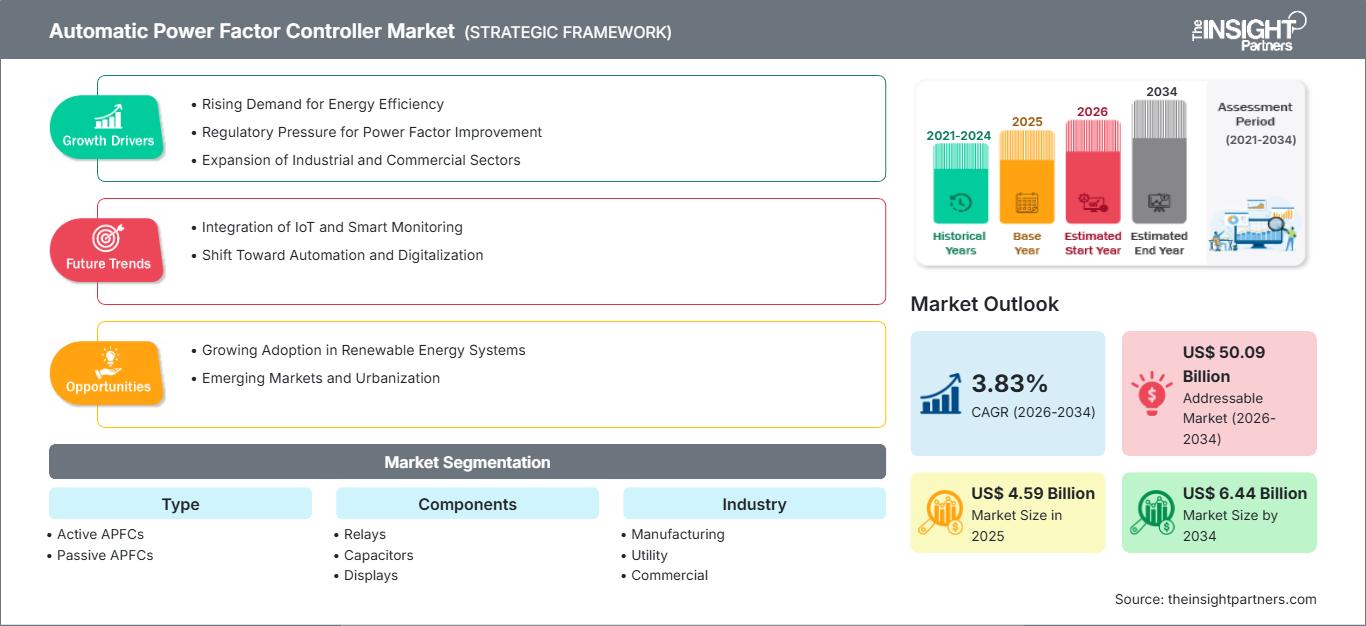
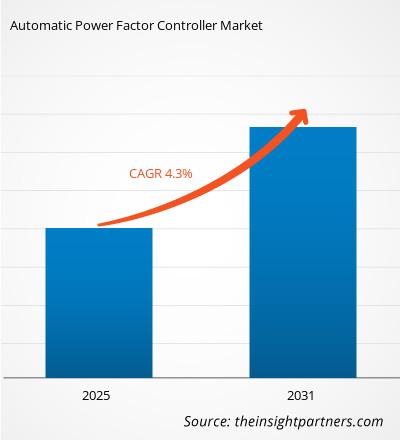
The Automatic Power Factor Controller Market was valued at US$ 4.59 Billion in 2025 and is projected to reach US$ 6.44 Billion by 2034; it is expected to register a CAGR of 3.83% during 2026–2034. Demand is being shaped by facility-level energy optimization, rising power-quality requirements, and wider use of automated capacitor switching in industrial, utility, commercial, enterprise, and military electrical networks.
Across North America, the Automatic Power Factor Controller Market size is supported by a mature manufacturing base, utility power-quality programs, and replacement of aging power distribution assets. The region is assessed to expand at a 3.2–3.8% CAGR during 2026–2034, with stronger adoption in data centers, heavy industry, and commercial campuses that need lower reactive power penalties and better voltage stability.
Automatic Power Factor Controller Market Assessment and Insights
- North America accounted for 28–31% share in 2025 and is projected to grow at a CAGR of 3.2–3.8% during 2026–2034, supported by grid modernization, energy audits, and industrial retrofit spending.
- US represented 78–82% of North America in 2025 and is expected to grow at a CAGR of 3.3–3.9% during 2026–2034.
- Europe held 23–26% share in 2025 and is expected to grow at a CAGR of 3.0–3.6% during 2026–2034, led by Germany, the UK, France, Italy, and Spain.
- Asia Pacific captured 33–36% share in 2025 and is projected to grow at a CAGR of 4.2–4.8% during 2026–2034, with China, India, Japan, South Korea, and Australia leading demand.
- Largest Segment Active APFCs held 58–62% market share in 2025 and is projected to grow at a CAGR of 4.0–4.6% during 2026–2034.
- High Growth Segment Utility held 24–28% market share in 2025 and is projected to grow at a CAGR of 4.4–5.0% during 2026–2034.
- Key companies analyzed in detail: Eaton Corporation plc, TDK Electronics AG, Larsen & Toubro Limited, ABB Ltd., General Electric Company, Schneider Electric SE, onsemi, STMicroelectronics N.V., Fujitsu Limited, Siemens AG.
Source: The Insight Partners' analysis based on proprietary research, government publications, company annual reports, investor presentations, industry databases, and expert interviews.
Technology migration is moving the Automatic Power Factor Controller Market from electromechanical relay logic toward microcontroller-based, communication-enabled panels that monitor load variation and switch capacitor steps with lower response delay. Production dynamics remain closely linked to capacitor film availability, power electronics sourcing, and panel integration capacity. Suppliers are differentiating through detuned filters, harmonic protection, compact enclosures, and diagnostics that reduce commissioning time for factories, utilities, and commercial buildings.
Forward demand is expected to broaden as emerging industrial clusters, electrified logistics facilities, and distributed generation assets increase reactive power variability. Regulatory emphasis on energy efficiency, power-quality compliance, and reduced network losses should support procurement across Southeast Asia, the Gulf, India, and North America. Investment will favor modular APFC panels that integrate monitoring, alarms, and maintenance data into plant energy management systems.
Automatic Power Factor Controller Market Report Scope
| Report Attribute | Details |
|---|---|
| Market size in 2025 | US$ 4.59 Billion |
| Market Size by 2034 | US$ 6.44 Billion |
| Global CAGR (2026 - 2034) | 3.83% |
| Historical Data | 2021-2024 |
| Forecast period | 2026-2034 |
Automatic Power Factor Controller Market Analysis
Automatic Power Factor Controller Market growth is driven by higher electricity costs, stricter utility penalties for low power factor, and the expansion of nonlinear loads from drives, HVAC systems, compressors, and power converters. End users are prioritizing automated correction because it reduces apparent power demand, improves feeder capacity, and supports stable voltage profiles without requiring major redesign of distribution infrastructure.
The value chain combines capacitor manufacturers, relay and controller suppliers, panel builders, EPC contractors, distributors, and facility energy managers. Supply dynamics are shaped by metallized polypropylene film availability, semiconductor controllers, contactors, and enclosure fabrication. Procurement decisions increasingly consider lifecycle reliability, harmonic conditions, and the ability to interface with supervisory control and energy monitoring platforms.
Automatic Power Factor Controller Market analysis indicates a moderately consolidated competitive field where Schneider Electric SE, Eaton Corporation plc, ABB Ltd., Siemens AG, General Electric Company, Larsen & Toubro Limited, and TDK Electronics AG compete through complete power-quality portfolios, service reach, and system integration capabilities. onsemi, STMicroelectronics N.V., and Fujitsu Limited support the ecosystem through control, sensing, and electronics expertise.
Investment is shifting toward smart panels, digital metering, and retrofit programs that reduce energy losses while improving equipment utilization. Strategic positioning favors suppliers that combine capacitors, relays, displays, microcontrollers, switches, and resistors with harmonic mitigation. Buyers are also weighing vendor capability in commissioning, remote diagnostics, and compliance documentation, particularly in regulated utilities, military facilities, and mission-critical enterprise campuses.
● REPORT CUSTOMIZATION
Tailor This Report To Align With Your Specific Business Requirements
This report can be customized to align precisely with your business objectives, scope, and target markets. Customization options include tailored segmentation, geography, competitive analysis, and strategic insights to support informed decision-making.
Customize This Report →WHAT YOU CAN ADJUST
- ● Segmentations
- ● Geography
- ● Competitive Analysis
- ● Language Preferences
Automatic Power Factor Controller Market: Strategic Insights
Regional Insights
North America Automatic Power Factor Controller Market
North America held 28–31% Automatic Power Factor Controller Market share in 2025 and is projected to grow at a 3.2–3.8% CAGR during 2026–2034. Demand is strongest in the US and Canada, where power-quality compliance, energy-management upgrades, and utility tariff structures encourage automated correction. Industrial users are replacing manual capacitor switching with controller-led systems that reduce reactive penalties and improve feeder headroom.
Large commercial campuses, data centers, water treatment plants, and manufacturing facilities are adopting APFC panels to manage fluctuating inductive loads and distributed backup power assets. Eaton Corporation plc, Schneider Electric SE, ABB Ltd., and Siemens AG benefit from established channel networks and certified product portfolios. Regional purchases also reflect growing attention to power monitoring, harmonic filtering, and lifecycle maintenance contracts.
U.S. Automatic Power Factor Controller Market
The USA Automatic Power Factor Controller Market accounted for 78–82% of North America in 2025 and is projected to grow at a CAGR of 3.3–3.9% during 2026–2034. Factors behind adoption include high energy demand in manufacturing, cloud computing data centers, food processing plants, metals industries, and municipal utilities. Most of these establishments have high motor loads and variable-frequency drives, which create a continuous need for reactive power compensation and harmonics-aware switching.
Some of the players active in the market include Eaton Corporation plc, General Electric Company, Schneider Electric SE, ABB Ltd., Siemens AG, onsemi, and STMicroelectronics N.V. The applications in which the market is experiencing higher demand include brownfield panel retrofitting, facility electrification, and power quality analysis to avoid demand charges and ensure uninterrupted operation of the process.
Europe Automatic Power Factor Controller Market
Europe accounted for 23–26% share in 2025 and is projected to grow at a 3.0–3.6% CAGR during 2026–2034. Germany is the dominant country owing to its manufacturing facilities, machine exports, automotive plants, and strict energy management methods. The United Kingdom is making progress in commercial buildings, hospitals, rail networks, and industrial estates by leveraging increased cost pressures and resilience considerations to upgrade correction panels.
The contributions from France, Italy, and Spain are via process industries, utilities, transport infrastructure, and commercial retrofits. Europe has buyers who like equipment that complies with IEC standards, detuned filters, and safety performance, where they favor suppliers with panels. The main competitors in the market are TDK Electronics AG, Siemens AG, Schneider Electric SE, ABB Ltd., and Eaton Corporation plc, positioned in capacitors, controllers, and power quality solutions.
APAC Automatic Power Factor Controller Market
Asia Pacific had 33–36% market share in 2025 and is expected to witness growth at a 4.2–4.8% CAGR for the period 2026–2034. The major countries include China, India, Japan, South Korea, and Australia. Growth drivers include industrial expansion, electronics production, mining, commercial construction, and improvements in power distribution networks.
The government's emphasis on reducing technical losses and increasing energy efficiency across industries drives the adoption of APFC in new installations and retrofits. Key companies involved include Larsen & Toubro Limited, ABB Ltd., Schneider Electric SE, Siemens AG, TDK Electronics AG, STMicroelectronics N.V., and Fujitsu Limited, which participate through panels, components, automation, or electronics supply chains.
Middle East & Africa Automatic Power Factor Controller Market
The Middle East & Africa is projected to grow at a 3.6–4.2% CAGR during 2026–2034, led by Saudi Arabia and the UAE, while South Africa and the rest of MEA will see increased demand driven by infrastructure needs. Facilities in oil and gas plants, desalination plants, airports, and industrial zones require power-quality equipment to safeguard their assets.
Growing utility expansions, commercial buildings, and reliability programs are driving the demand for APFC panels in both medium- and low-voltage applications. Robustness, thermal protection, and harmonic filtering are desirable in systems operating under extreme heat and fluctuating loads.
Segmentation Analysis
Type
The Type segment is projected to grow at a 3.7–4.3% CAGR during 2026–2034. The Automatic Power Factor Controller Market scope across type categories reflects the balance between low-cost correction, dynamic load management, harmonic conditions, and plant-level automation. Active APFCs dominate new industrial installations, while passive APFCs remain relevant for stable loads and budget-sensitive retrofits.
- Active APFCs hold the strongest position because they respond better to load variation, support advanced switching logic, and fit facilities with drives, compressors, elevators, and dynamic industrial equipment.
- Passive APFCs remain strategically important in predictable load environments where simplicity, lower upfront cost, and proven capacitor-bank architecture outweigh the need for rapid compensation.
Components
The Components segment is projected to grow at a 3.6–4.2% CAGR during 2026–2034. Component demand follows the shift toward compact, safer, and more communicative APFC panels. Capacitors remain the compensation core, while relays, displays, microcontrollers, switches, and resistors define responsiveness, protection, usability, and maintenance efficiency across low- and medium-voltage installations.
- Relays are essential for step control and protection, especially in panels requiring reliable switching sequences, fault response, and integration with alarms or supervisory systems.
- Capacitors carry the largest functional importance because they provide reactive power compensation, reduce apparent power demand, and determine panel capacity, durability, and thermal performance.
- Displays improve operator visibility by showing power factor, alarm status, step operation, and system parameters, making them valuable for maintenance teams and energy managers.
- Microcontrollers enable smarter correction logic, data processing, communication interfaces, and adaptive switching, supporting digital panels used in variable-load industrial and commercial facilities.
- Switches support safe capacitor step engagement and isolation, with demand tied to load cycling, response speed, endurance, and compliance with electrical safety expectations.
- Resisters support discharge, balancing, and circuit stability functions, helping panels manage stored energy safely and reduce operational risk during maintenance or switching events.
Industry
The Industry segment is projected to grow at a 3.8–4.4% CAGR during 2026–2034. Adoption is strongest where inductive loads, tariff penalties, and uptime requirements intersect. Manufacturing remains broad-based, utilities are increasing deployment for network efficiency, and commercial, enterprise, and military users are adding APFC panels to stabilize electrical performance in mission-relevant assets.
- Manufacturing is a core demand base because motors, welders, pumps, compressors, and production lines create reactive load swings that affect billing, capacity, and voltage stability.
- Utility users deploy APFC systems to reduce distribution losses, support voltage management, and improve asset utilization across substations, feeders, and grid-connected industrial customers.
- Commercial buildings adopt panels in malls, hospitals, offices, hotels, and campuses where HVAC systems and elevators increase reactive power demand during operating peaks.
- Enterprise adoption is rising in data centers, corporate campuses, and technology parks that require reliable power quality, monitored energy performance, and lower electrical operating costs.
- Military facilities require robust correction systems for bases, maintenance depots, radar assets, and secured infrastructure where reliability, resilience, and controlled electrical performance are critical.
Opportunity Snapshot
| Segment Name | Revenue Contribution | Trend Tag | Adoption Stage |
| Manufacturing | High | Motor Loads | Mature |
| Utility | High | Grid Losses | Scaling |
| Commercial | Medium | HVAC Peaks | Scaling |
| Enterprise | Medium | Data Centers | Emerging |
| Military | Low | Resilient Power | Emerging |
Automatic Power Factor Controller Market Growth Drivers and Impact Analysis
Rising Electricity Tariffs and Reactive Power Penalties
Customers in commercial and industrial areas have been analyzing electricity bills for demand charges, penalties for reactive power, and risks associated with peak loads. The APFC panels enable customers to reduce apparent power demand by automatically switching off the capacitors whenever the power factor changes. Thus, these increase the efficiency of transformers, cables, and switchgear. The greatest market opportunity is in companies that use motors, compressors, welding machines, pumps, and heating, ventilation, and air conditioning systems, because reactive power demand in these systems varies with production.
Expansion of Industrial Automation and Nonlinear Loads
Increased use of automation leads to greater use of drives, robotics, power supplies, and electronically operated devices that may generate varying load patterns. This situation reduces the effectiveness of fixed compensation techniques and necessitates controllers capable of switching stages, managing harmonics, and monitoring operations. The Automatic Power Factor Controller Market will benefit from upgrades to plant electrical rooms, as well as the automation of production. Manufacturers of Automatic Power Factor Controllers who integrate relays, capacitors, displays, microcontrollers, switches, and resistors into tested panels can address reliability issues.
Grid Modernization and Distribution Loss Reduction
Utility companies and large electricity consumers are investing to improve the efficiency of distribution networks due to the higher currents and losses associated with reactive power. APFCs can help control voltage levels and reduce stress on the infrastructure by improving the power factor closer to the load. This incentive is evident in industrial estates, business zones, renewable-based lines, and infrastructure developments where maintaining a stable voltage level is necessary. In addition to lower bills, good power quality could reduce overheating, extend equipment lifetimes, and help manage increasing demand without network strengthening.
Automatic Power Factor Controller Market Future Trends
Smart APFC Panels with Connected Diagnostics
The Automatic Power Factor Controller Market trends indicate a move towards connectivity for diagnostic information on capacitor health, step operation, temperature warnings, harmonic monitoring, and power factor trends. Future automatic power factor controller systems will be increasingly integrated into building management systems, industrial SCADA systems, and energy monitoring software via standardized communication protocols. This trend will mark a change in the role of the APFC from simply a correction tool to a monitoring tool that supports preventive maintenance and energy monitoring.
Hybrid Correction for Harmonic-Rich Electrical Networks
As variable-speed drives, EV chargers, renewable inverters, and power systems for data centers become increasingly prevalent, future systems will require correction solutions that consider both reactive power and harmonic distortion. Hybrid APFC configurations utilizing capacitors, detuned reactors, fast switching, and monitoring would become increasingly important in critical electrical networks. This shift will affect the language used in specifications, with buyers encouraged to evaluate resonance dangers, transients, and harmonic distortion in addition to the target power factor. Companies with solutions for harmonic distortion stand to win larger contracts.
Automatic Power Factor Controller Market Opportunities
Retrofit Programs in Brownfield Industrial Facilities
Replacement potential is huge for brownfield applications because several facilities use old capacitors, undersized panels, or manual correction systems, all of which were designed before automation requirements were in place. Automatic Power Factor Controller Market Forecasts indicate consistent retrofit potential for sites that have expanded their production capacity, thereby changing their load profile without upgrading their electrical equipment. Companies may approach facilities with energy audits, complete replacement packages, or service-based proposals, highlighting savings on tariffs and recovered capacities.
Utility and Infrastructure Procurement for Network Efficiency
Opportunities for APFC equipment include utilities companies, transport providers, airports, ports, water utility companies, and infrastructure asset owners, all of whom are characterized by the need to manage their load on a large scale, the necessity for reliability, and extended planning processes. APFC providers should focus on offering solutions to improve feeder efficiency, voltages, and reduce technical losses. The procurement process needs to stress design certifications, harmonic studies, commissioning services, and life-cycle services. The optimal opportunities will be those that combine demand-side management and energy-efficiency reporting.
Recent Developments
- February 2026: WATTMORE has launched Intellect PPC, its Power Plant Controller and the newest product in the Intellect platform. Every utility-scale battery energy storage system connected to the grid requires a PPC, making it a necessity rather than an option. Intellect PPC is now available as an integrated component of Intellect Operate, providing grid compliance, real-time control, and economic optimization within a single platform.
- March 2026: The Swedish cleantech company Comsys AB has announced the launch of the ADF P100 G4, the latest generation of its active harmonic filter designed to reduce installation effort and simplify the delivery of clean, compliant power quality. The ADF P100 G4 builds on Comsys’ established filtering technology while addressing practical challenges encountered during specification, installation, and commissioning. Featuring a more compact design and simplified electrical integration, the new system is engineered to integrate more easily into industrial and commercial environments.
- April 2026: Schneider Electric, a global energy technology leader, hosted its largest-ever Innovation Summit India 2026 at Yashobhoomi, New Delhi, unveiling more than 30 new technology solutions for the Indian market. The event showcased over 400 energy technology solutions aimed at strengthening India’s energy resilience. The two-day Innovation Summit brought together more than 5,000 customers, partners, CEOs, policymakers, and industry influencers. The event featured a 60,000+ sq. ft. Innovation Hub and a CEO Forum with participation from around 50 leading Indian business leaders.
Frequently Asked Questions

- Comprehensive Market Sizing and Forecast Analysis
- Detailed Segmentation Analysis
- In-Depth Market Dynamics Assessment
- Regional and Country-Level Insights
- Competitive Landscape and Company Benchmarking
- Strategic Business Intelligence
Recent Reports
Testimonials

The Insight Partners' SCADA System Market report is comprehensive, with valuable insights on current trends and future forecasts. The team was highly professional, responsive, and supportive throughout. We are very satisfied and highly recommend their services.
RAN KEDEM Partner, Reali Technologies LTDs
I requested a report on a very specific software market and the team produced the report in a few days. The information was very relevant and well presented. I then requested some changes and additions to the report. The team was again very responsive and I got the final report in less than a week.
JEAN-HERVE JENN Chairman, Future Analytica
We worked with The Insight Partners for an important market study and forecast. They gave us clear insights into opportunities and risks, which helped shape our plans. Their research was easy to use and based on solid data. It helped us make smart, confident decisions. We highly recommend them.
PIYUSH NAGPAL Sr. Vice President, High Beam Global
The Insight Partners delivered insightful, well-structured market research with strong domain expertise. Their team was professional and responsive throughout. The user-friendly website made accessing industry reports seamless. We highly recommend them for reliable, high-quality research services
YUKIHIKO ADACHI CEO, Deep Blue, LLC.
This is the first time I have purchased a market report from The Insight Partners.While I was unsure at first, I visited their web site and felt more comfortable to take the risk and purchase a market report.I am completely satisfied with the quality of the report and customer service. I had several questions and comments with the initial report, but after a couple of dialogs over email with their analyst I believe I have a report that I can use as input to our strategic planning process.Thank you so much for taking the extra time and making this a positive experience.I will definitely recommend your service to others and you will be my first call when we need further market data.
JOHN SUZUKI President and Chief Executive Officer, Board Director, BK Technologies
I wish to appreciate your support and the professionalism you displayed in the course of attending to my request for information regarding to infectious disease IVD market in Nigeria. I appreciate your patience, your guidance, and the fact that you were willing to offer a discount, which eventually made it possible for us to close a deal. I look forward to engaging The Insight Partners in the future, all thanks to the impression you have created in me as a result of this first encounter.
DR CHIJIOKE ONYIA MANAGING DIRECTOR, PineCrest Healthcare Ltd.Reason to Buy
- Informed Decision-Making
- Understanding Market Dynamics
- Competitive Analysis
- Identifying Emerging Markets
- Customer Insights
- Market Forecasts
- Risk Mitigation
- Boosting Operational Efficiency
- Strategic Planning
- Investment Justification
- Tracking Industry Innovations
- Aligning with Regulatory Trends





 Get Free Sample for