
Automation Testing Market Size, Growth & Trends by 2034
Coverage: by Offering (Testing Type, Services); Testing Type (Static Testing, Dynamic Testing); Services Type (Managed Services, Professional Services); Organization Size (Small And Medium-Sized Enterprises, Large Enterprises) , and Geography (North America, Europe, Asia Pacific, and South and Central America)
- Status : Data Released
- Report Code : TIPRE00007499
- Category : Technology, Media and Telecommunications
- No. of Pages : 150
- Available Report Formats :


- Last update date : September 03, 2026


2025 Market Size
US$ 31.1 Bn
Base year value
2034 Forecast
US$ 92.76 Bn
Projected by 2034
CAGR 2026-2034
14.64 %
Growth rate
Addressable Market
US$ 589.35 Bn
(2026-2034)
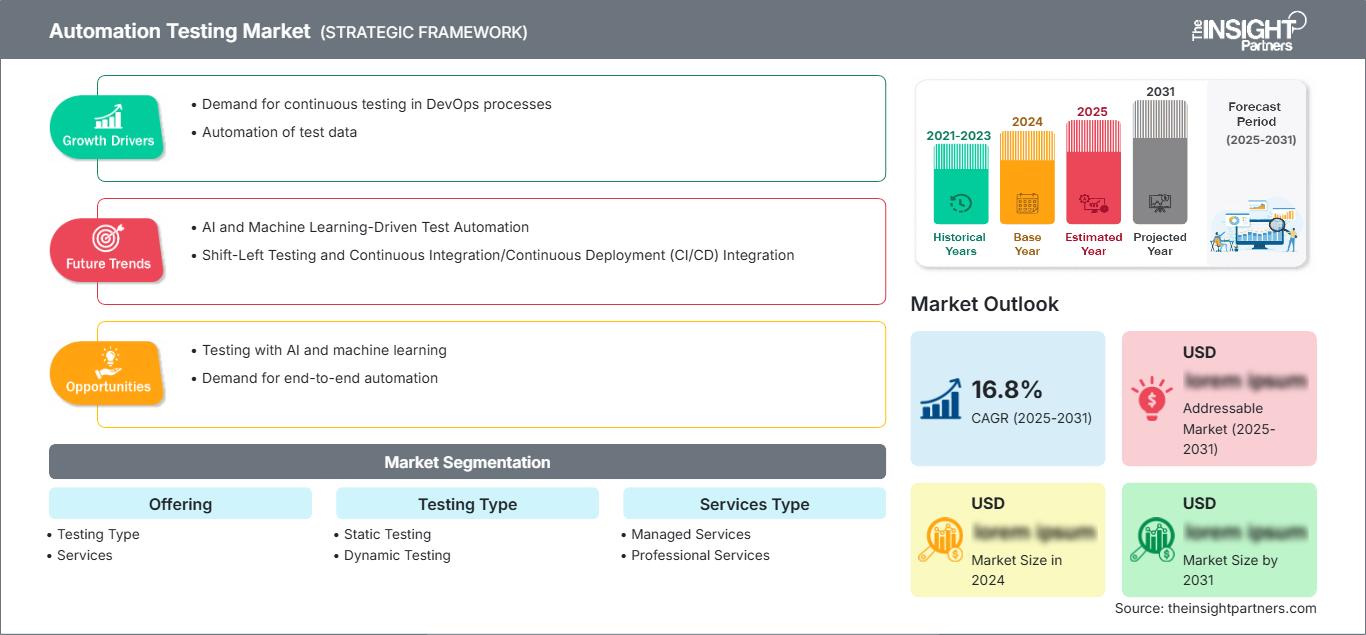
The automation testing market was valued at US$ 31.1 Billion in 2025 and is projected to reach US$ 92.76 Billion by 2034, growing at a CAGR of 14.64% during 2026–2034. Enterprises are increasing automated validation across web, mobile, cloud, embedded, and enterprise applications as software release cycles shorten and quality risks become more expensive to manage.
North America remains a major demand center as cloud-native software delivery, DevOps maturity, and regulated digital platforms support the automation testing market size expansion. The region is estimated to hold 36–39% share in 2025 and grow at a CAGR of 13.8–14.5% during 2026–2034, supported by enterprise modernization, AI-enabled test orchestration, and the broad adoption of managed quality engineering services.
Automation Testing Market Assessment and Insights
- North America holds 36–39% share in 2025 and grows at a CAGR between 13.8–14.5% during 2026–2034, supported by cloud testing, DevOps pipelines, and enterprise-grade compliance validation.
- US accounts for 86–90% of North America in 2025 and grows at a CAGR between 13.7–14.4% during 2026–2034, led by hyperscale cloud, financial services, and software-led retail.
- Europe holds 24–27% share in 2025 and grows at a CAGR between 12.9–13.7% during 2026–2034, with the UK, Germany, France, Italy, and Spain driving quality engineering adoption.
- Asia Pacific accounts for 28–32% share in 2025 and grows at a CAGR between 15.3–16.1% during 2026–2034, led by India, China, Japan, South Korea, and Australia.
- Largest Segment: Services holds 54–58% market share in 2025 and grows at a CAGR between 14.0–14.8% during 2026–2034 because enterprises outsource framework design, test maintenance, and managed execution.
- High Growth Segment: Small And Medium-Sized Enterprises holds 31–35% share in 2025 and grow at a CAGR between 15.5–16.4% during 2026–2034 as low-code and cloud tools reduce adoption barriers.
- Key companies analyzed in detail: Amazon Web Services, Inc., Datalogic S.p.A., Fujitsu Limited, Honeywell International Inc., Ingenico, KUKA AG, NCR Corporation, Pricer AB, Toshiba Global Commerce Solutions Inc., and Zebra Technologies Corp.
Source: The Insight Partners' analysis based on proprietary research, government publications, company annual reports, investor presentations, industry databases, and expert interviews.
Quality assurance has shifted from being an after-the-fact testing process to becoming an ongoing engineering discipline integrated into the software delivery pipeline. The landscape has developed as companies embrace CI/CD workflows, cloud-based testing environments, API verification, and automated script management with help from artificial intelligence. Production trends will become increasingly geared towards frameworks for automation, service-based delivery, and platform integration for validation of frequent releases without having to expand the manual testing team.
Future demand will grow because regulated industries, retail automation, industrial software solutions, and digital payments will need scalable validation solutions. Funding will focus on managed services, consulting services, and smart testing platforms for secure releases in hybrid clouds. The Asia Pacific region will accelerate the development by leveraging its strengths in IT services, while North America and Europe will focus on governance and reliability.
Automation Testing Market Report Scope
| Report Attribute | Details |
|---|---|
| Market size in 2025 | US$ 31.1 Billion |
| Market Size by 2034 | US$ 92.76 Billion |
| Global CAGR (2026 - 2034) | 14.64% |
| Historical Data | 2021-2024 |
| Forecast period | 2026-2034 |
Automation Testing Market Analysis
Growth in the market is spurred by fast release cycles, complex applications, and growing costs of defective manufacturing processes. Companies require regression, integration, performance, and security testing that work constantly in a distributed network environment. There are cloud providers, system integrators, testing services companies, device vendors, and enterprise software vendors in the value chain that are aimed at quicker validation, less defect leakage, and release confidence measurement.
There is a new trend in supply dynamics towards reusable test assets, AI-assisted prioritization, and execution management. Customers look for vendors who can offer tooling, test data, environment provision, and analytics. The new trend favors testing service providers who have an understanding of industry processes and technology companies that can integrate testing into cloud, retail, automation, and payments environments without adding to complexity.
The market analysis reveals an ecosystem comprising cloud infrastructure providers, retail automation vendors, industrial systems, and device-based software providers. Amazon Web Services, Inc. offers cloud infrastructure for scalable testing, whereas Fujitsu Limited is developing AI-enabled software lifecycle automation. Honeywell International Inc., KUKA AG, Zebra Technologies Corp., Datalogic S.p.A., NCR Corporation, Pricer AB, Toshiba Global Commerce Solutions Inc., and Ingenico are active in testing environments, which demand automated software testing.
Investments shall focus on test development via AI support, automated modernization testing, software embedded testing, and service models aimed at lowering dependency on scarce quality engineering skills. Strategic alignment shall be based on vendors' ability to align software testing with workflow management, hardware ecosystems, security needs, and continuous deployment. Those companies that possess integration capabilities can turn quality assurance from a cost burden into a release accelerator.
● REPORT CUSTOMIZATION
Tailor This Report To Align With Your Specific Business Requirements
This report can be customized to align precisely with your business objectives, scope, and target markets. Customization options include tailored segmentation, geography, competitive analysis, and strategic insights to support informed decision-making.
Customize This Report →WHAT YOU CAN ADJUST
- ● Segmentations
- ● Geography
- ● Competitive Analysis
- ● Language Preferences
Automation Testing Market: Strategic Insights
Regional Insights
North America automation testing market
North America holds 36–39% share in 2025 and grows at a CAGR between 13.8–14.5% during 2026–2034. The automation testing market share in the region is supported by cloud-first modernization, mature DevOps practices, and large digital platforms that require continuous validation before production deployment.
Demand is strongest in banking, retail, healthcare, industrial software, and logistics, where downtime creates direct financial or compliance exposure. Enterprises are investing in test automation suites, managed quality engineering, and AI-assisted defect prediction to reduce manual effort. Hyperscale cloud infrastructure also supports elastic test environments and distributed performance testing.
U.S. automation testing Market
The U.S. accounts for 86–90% of North America in 2025 and grows at a CAGR between 13.7–14.4% during 2026–2034. Enterprise cloud migration, digital banking, e-commerce, and software-defined industrial operations make the country the largest regional contributor.
Amazon Web Services, Inc., Honeywell International Inc., NCR Corporation, Zebra Technologies Corp., and Toshiba Global Commerce Solutions Inc. have strong relevance through cloud, industrial, retail, and frontline workflow software. U.S. buyers prioritize test scalability, release speed, cybersecurity validation, and integration with DevOps toolchains.
Europe automation testing Market
Europe holds 24–27% share in 2025 and grows at a CAGR between 12.9–13.7% during 2026–2034. The UK leads service-led adoption through financial services, public sector digital programs, and software outsourcing. Germany contributes through automotive, industrial automation, and manufacturing software validation.
France, Italy, and Spain are expanding automation across retail, telecom, payment terminals, and enterprise modernization programs. European buyers emphasize data protection, auditability, and high-quality releases across multilingual and multi-country platforms. KUKA AG, Ingenico, Datalogic S.p.A., Pricer AB, and Fujitsu Limited support regional relevance through automation, payment, retail, and IT transformation portfolios.
APAC automation testing Market
APAC accounts for 28–32% share in 2025 and grows at a CAGR between 15.3–16.1% during 2026–2034. India leads service delivery and quality engineering talent, while China adds scale through digital platforms and industrial software.
Japan, South Korea, and Australia contribute through enterprise modernization, cloud adoption, and embedded software validation. Regional demand benefits from large IT services ecosystems, rising digital payments, and mobile-first applications that require frequent automated testing across devices, operating systems, and networks.
Middle East & Africa automation testing Market
Middle East & Africa grows at a CAGR between 11.8–12.6% during 2026–2034, led by the UAE, Saudi Arabia, and South Africa. National digital government programs, banking modernization, and smart infrastructure projects are expanding software quality requirements.
Saudi Arabia leads value growth through public sector platforms and energy technology modernization. The UAE supports cloud and financial technology testing demand, while South Africa adds banking and telecom validation. The rest of MEA remains at an earlier stage but benefits from managed service adoption.
Segmentation Analysis
Offering
Offering grows at a CAGR between 14.1–14.9% during 2026–2034. The market scope across offerings is shaped by whether buyers invest in testing technologies directly or outsource delivery through service partners. Services lead because many enterprises need a framework strategy, migration support, test case maintenance, and continuous execution expertise.
- Testing Type demand reflects enterprise's need to automate static and dynamic validation across code, APIs, workflows, and user interfaces before defects reach production environments.
- Services remain strategically important because organizations require consulting, implementation, managed execution, and optimization support to scale automation beyond isolated tool purchases.
Testing Type
Testing Type grows at a CAGR between 13.9–14.7% during 2026–2034. Static and dynamic approaches complement each other as software teams attempt to detect defects earlier while still validating real application behavior. Adoption is strongest where quality gates are embedded directly into continuous development pipelines.
- Static Testing helps identify code quality, security, documentation, and standards issues before execution, reducing rework and improving development discipline in regulated software environments.
- Dynamic Testing validates application behavior under real or simulated execution conditions, making it critical for regression, performance, integration, and user experience assurance.
Services Type
Services Type grows at a CAGR between 14.3–15.1% during 2026–2034. Enterprises use service partners to accelerate automation maturity, improve test coverage, and reduce internal skill shortages. Managed services are attractive for repetitive execution, while professional services help define architecture, toolchain design, and governance.
- Managed Services provide recurring test execution, maintenance, reporting, and environment management, helping enterprises stabilize quality operations while controlling staffing requirements.
- Professional Services support assessment, framework development, tool selection, migration, and integration work that enables organizations to build scalable automation foundations.
Organization Size
Organization Size grows at a CAGR between 14.6–15.4% during 2026–2034. Large enterprises dominate spending because they run complex software estates, but smaller firms are accelerating adoption as cloud platforms and low-code automation reduce entry costs and infrastructure requirements.
- Small And Medium-Sized Enterprises are increasing adoption through subscription tools, cloud test labs, and managed services that provide automation capability without large internal QA teams.
- Large Enterprises remain the largest buyers because they operate mission-critical applications, distributed teams, compliance-heavy workflows, and high-volume release pipelines.
Opportunity Snapshot
| Organization Size | Revenue Contribution | Trend Tag | Adoption Stage |
| Small And Medium-Sized Enterprises | Medium | Cloud QA | Scaling |
| Large Enterprises | High | CI/CD | Mature |
Automation Testing Market Growth Drivers and Impact Analysis
DevOps and Continuous Delivery Adoption
Faster releases of software teams are necessitating more automated testing than manual regression testing because of the time required for such tests. Automated testing helps organizations perform checks on their builds, APIs, integration, and workflows before releasing them to production. The effect will be felt most in organizations that earn money from or have liabilities through digital channels. It saves developers' time and decreases the leakage of defects while allowing for more effective release management practices.
AI-Assisted Quality Engineering
AI is transforming the creation, prioritization, maintenance, and defect prediction of tests. The automated process has the capability to determine potentially risky modifications of the software, advise on test coverage, and fix any broken scripts due to modifications in the user interface. All these help to minimize the major hurdle for automation by cutting down the costs of maintenance. Impact on the market is seen in the increasing requirements for solutions with analytics, orchestration, and integration capabilities.
Rising Software Risk in Regulated Industries
The following industries include software in their operations where failure may lead to non-compliance, security threats, or financial risk: financial services, health care, governments, payments, and industrial automation. Automated testing helps maintain an audit trail, repetitive validation, and proof-based releases. The requirement for companies to prove consistent testing of changes is increasing. This demand makes organizations look for managed services, test documentation, security validation, and performance assurance.
Automation Testing Market Future Trends
Autonomous Test Generation and Self-Healing Scripts
The automation testing market trends will increasingly center on systems that create and maintain tests with limited human intervention. AI models will interpret requirements, analyze code changes, generate cases, and update scripts as interfaces evolve. This will reduce maintenance burden and make automation more accessible to teams without large specialist resources. The shift will also increase demand for governance, explainability, and validation controls because enterprises must trust AI-created tests before using them in critical release pipelines.
Cloud-Based Testing for Distributed Digital Products
Cloud-enabled testing frameworks would be of utmost importance in relation to the reality that applications function on multiple browsers, mobiles, APIs, embedded environments, and regional data centers. By utilizing an elastic environment, organizations can execute parallel testing and ensure application performance without needing huge test labs. Future testing platforms would be equipped with device farms, artificial data, observability, and security testing within the same testing framework.
Automation Testing Market Opportunities
Managed Testing for Mid-Market Digital Transformation
The automation testing market Forecasts indicate a strong opportunity among mid-sized organizations that need software reliability but lack large internal QA teams. Providers can package assessment, tool setup, script creation, and recurring execution into subscription-style services. This lowers adoption risk and converts testing from a capital project into an operating model. The opportunity is especially attractive in retail, healthcare, payments, logistics, and regional banking, where digital systems are business-critical, but engineering resources remain constrained.
Embedded and Industrial Software Validation
Reliable embedded software is needed in automation systems, robots, warehouses, scanners, payment equipment, and other retail infrastructure. The vendors can grow through developing an automation solution that validates the firmware, software, edge applications, and cloud connectivity altogether. It is a perfect solution for vendors that work in automation hardware and software ecosystems. With increasing physical processes controlled by software, it will be necessary to have repeatable testing.
Frequently Asked Questions

- Comprehensive Market Sizing and Forecast Analysis
- Detailed Segmentation Analysis
- In-Depth Market Dynamics Assessment
- Regional and Country-Level Insights
- Competitive Landscape and Company Benchmarking
- Strategic Business Intelligence
Recent Reports
Testimonials

The Insight Partners' SCADA System Market report is comprehensive, with valuable insights on current trends and future forecasts. The team was highly professional, responsive, and supportive throughout. We are very satisfied and highly recommend their services.
RAN KEDEM Partner, Reali Technologies LTDs
I requested a report on a very specific software market and the team produced the report in a few days. The information was very relevant and well presented. I then requested some changes and additions to the report. The team was again very responsive and I got the final report in less than a week.
JEAN-HERVE JENN Chairman, Future Analytica
We worked with The Insight Partners for an important market study and forecast. They gave us clear insights into opportunities and risks, which helped shape our plans. Their research was easy to use and based on solid data. It helped us make smart, confident decisions. We highly recommend them.
PIYUSH NAGPAL Sr. Vice President, High Beam Global
The Insight Partners delivered insightful, well-structured market research with strong domain expertise. Their team was professional and responsive throughout. The user-friendly website made accessing industry reports seamless. We highly recommend them for reliable, high-quality research services
YUKIHIKO ADACHI CEO, Deep Blue, LLC.
This is the first time I have purchased a market report from The Insight Partners.While I was unsure at first, I visited their web site and felt more comfortable to take the risk and purchase a market report.I am completely satisfied with the quality of the report and customer service. I had several questions and comments with the initial report, but after a couple of dialogs over email with their analyst I believe I have a report that I can use as input to our strategic planning process.Thank you so much for taking the extra time and making this a positive experience.I will definitely recommend your service to others and you will be my first call when we need further market data.
JOHN SUZUKI President and Chief Executive Officer, Board Director, BK Technologies
I wish to appreciate your support and the professionalism you displayed in the course of attending to my request for information regarding to infectious disease IVD market in Nigeria. I appreciate your patience, your guidance, and the fact that you were willing to offer a discount, which eventually made it possible for us to close a deal. I look forward to engaging The Insight Partners in the future, all thanks to the impression you have created in me as a result of this first encounter.
DR CHIJIOKE ONYIA MANAGING DIRECTOR, PineCrest Healthcare Ltd.Reason to Buy
- Informed Decision-Making
- Understanding Market Dynamics
- Competitive Analysis
- Identifying Emerging Markets
- Customer Insights
- Market Forecasts
- Risk Mitigation
- Boosting Operational Efficiency
- Strategic Planning
- Investment Justification
- Tracking Industry Innovations
- Aligning with Regulatory Trends





 Get Free Sample for