
Automotive 3D Printing Market Demand, Trends & Forecast by 2034
Coverage: By Technology Type (Selective Laser Sintering (SLS), Stereo Lithography (SLA), Digital Light Processing (DLP), Electronic Beam Melting (EBM), Selective Laser Melting (SLM), and Fused Deposition Modeling (FDM)), Application Type (Production And Prototyping/R&D), Component Type (Hardware, Software, and Service), Material Type (Metal, Polymer, and Ceramic), and Geography
- Status : Data Released
- Report Code : TIPTE100000330
- Category : Electronics and Semiconductor
- No. of Pages : 150
- Available Report Formats :


- Last update date : July 17, 2026


2025 Market Size
US$ 6.11 Bn
Base year value
2034 Forecast
US$ 20.52 Bn
Projected by 2034
CAGR 2026-2034
14.42 %
Growth rate
Addressable Market
US$ 114.48 Bn
(2026-2034)
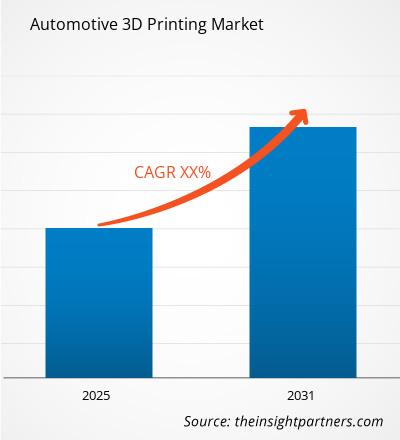
The Automotive 3D Printing Market size will increase from US$ 6.11 Billion in 2025 to US$ 20.52 Billion by 2034, achieving a Compound Annual Growth Rate of 14.42% between 2026 and 2034. The increase is due to an increased application of additive manufacturing in the areas of prototyping, tooling, developing lightweight parts, producing complex parts, and exterior trim.
The market in North America will be propelled by electric vehicle programs, motorsports, and factory on-demand tooling with the market in North America expected to grow at a CAGR of 13.8–14.6% between 2026 and 2034. Additive manufacturing facilities have been established locally, and there has been an adoption of polymer tooling as well as qualification activities.
Automotive 3D Printing Market Assessment and Insights
- North America accounted for 34–37% share in 2025 and is expected to grow at a CAGR of 13.8–14.6% between 2026–2034, driven by EV engineering centers, tooling automation, and supplier-led polymer adoption.
- US represented 78–82% of North America in 2025 and is projected to grow at a 13.9–14.7% CAGR between 2026–2034 through OEM additive labs and motorsport use cases.
- Europe held 27–30% share in 2025 and may grow at a 13.2–14.1% CAGR between 2026–2034, led by Germany, the UK, France, Italy, and Spain.
- Asia Pacific captured 25–28% share in 2025 and is expected to advance at a 15.2–16.4% CAGR between 2026–2034, led by China, Japan, South Korea, and India.
- Largest Segment Prototyping and Tooling held 48–52% market share in 2025, growing at a CAGR of 12.8–13.6% between 2026–2034 as design iteration remains the core use case.
- High Growth Segment Manufacturing Complex Components held 28–32% market share in 2025, growing at a CAGR of 16.4–17.8% between 2026–2034 as metal and composite parts scale.
- Key companies analyzed in detail: 3D Systems, Inc.; 3DGence sp. z o.o.; EOS GmbH; Desktop Metal, Inc.; ExOne Operating, LLC; Hoganas AB; UltiMaker BV; Prodways Group; Stratasys Ltd.; Materialise NV
Source: The Insight Partners' analysis based on proprietary research, government publications, company annual reports, investor presentations, industry databases, and expert interviews.
The adoption of automotive additive manufacturing has evolved from modeling to tooling, polymer fixturing, and certain end-use parts as print capabilities, materials, and software become repeatable. The US$21.9 billion figure of the global additive manufacturing industry in 2024 reported by industry using ASTMs framework for reporting growth at 9.1% suggests wider industrial base for automotive applications. Automakers can now employ 3D printing technologies to reduce design validation time, cut wastage and enable decentralized parts supply.
In terms of the future, production level application of 3D printing technology will be driven by qualification methods, certified powder sources, software traceability and post-processing cost. Geographies which are currently emerging in the field of additive manufacturing have been developing capacities for additive manufacturing by encouraging electric vehicles, local suppliers, and industrial automation policies. This makes the market poised to take advantage of regional manufacturing, lightweight designs, and sustainability.
Automotive 3D Printing Market Report Scope
| Report Attribute | Details |
|---|---|
| Market size in 2025 | US$ 6.11 Billion |
| Market Size by 2034 | US$ 20.52 Billion |
| Global CAGR (2026 - 2034) | 14.42% |
| Historical Data | 2021-2024 |
| Forecast period | 2026-2034 |
Automotive 3D Printing Market Analysis
Demand is influenced by model cycle time, EV platform design, lightweighting, and tooling changes. The market growth is higher where engineering departments have the ability to substitute machined fixtures, airflow components validation, or low volume brackets with no extensive procurement lead times. Polymer solutions are essential in the manufacture of factory aids, but the use of metal solutions becomes increasingly important in thermal management, powertrain, and structural components.
Value chain includes printer manufacturers, material suppliers, software developers, service providers, and Tier automotive suppliers. Supply conditions are becoming more favorable due to validated powders, carbon reinforced polymers, and process control solutions that minimize qualification concerns. The preference for in-house additive manufacturing facilities is rising among OEMs because of the confidential nature of their designs and speed.
Based on the Automotive 3D Printing Market analysis, there is an evident highly competitive market, which is dominated by integrated hardware, materials, and software features instead of printer sales. The main players in this industry are 3D Systems, Inc., Stratasys Ltd., EOS GmbH, Materialise NV, and Desktop Metal, Inc., who compete using application engineering, validated workflow, and references of their automotive clients, whereas UltiMaker BV and 3DGence sp. z o.o. target engineering and professional polymer applications.
Nowadays, there is an increasing investment in scalable materials, automation, and software that reduces preparation time. In 2025, the new release of the 2025 Magics by Materialise highlighted a fast processing of complex geometries, and at the same time, Stratasys described a one-day tooling workflow by Toyota in 2025.
● REPORT CUSTOMIZATION
Tailor This Report To Align With Your Specific Business Requirements
This report can be customized to align precisely with your business objectives, scope, and target markets. Customization options include tailored segmentation, geography, competitive analysis, and strategic insights to support informed decision-making.
Customize This Report →WHAT YOU CAN ADJUST
- ● Segmentations
- ● Geography
- ● Competitive Analysis
- ● Language Preferences
Automotive 3D Printing Market: Strategic Insights

Regional Insights
North America Automotive 3D Printing Market
North America held 34–37% share in 2025, giving the region the leading Automotive 3D Printing Market share. The region is forecast to grow at a 13.8–14.6% CAGR through 2034 as US and Canadian manufacturing hubs use additive workflows for jigs, fixtures, battery tooling, aerodynamic validation, and motorsport components.
Structural growth is reinforced by high vehicle R&D spending, reshoring of advanced manufacturing, and close links between printer suppliers and automakers. Factory-floor use cases are particularly resilient because they deliver measurable lead-time savings without requiring full vehicle part homologation. This makes North America a practical proving ground for serial additive adoption.
U.S. Automotive 3D Printing Market
The US made up 78–82% of North America market shares in 2025 and is expected to grow at a CAGR of 13.9–14.7%. Additive manufacturing technologies are applied by automotive companies and Tier manufacturers for the production of assembly tools, spares, battery enclosures for electric vehicles, wind tunnel models, and small-run parts for performance cars.
Companies have an extensive presence, as the major players such as 3D Systems, Inc., Stratasys Ltd., Desktop Metal, Inc., ExOne Operating, LLC, and Materialise NV offer their solutions for automotive sector using hardware, binder jetting, polymers, and workflow software. Applications tend toward one-day tooling, ergonomic aids for factory, and race-inspired aerodynamics that can be validated faster than machining.
Europe Automotive 3D Printing Market
Europe accounted for 27–30% share in 2025 and is forecast to grow at a 13.2–14.1% CAGR. Germany remains the leading country because BMW, Volkswagen suppliers, EOS GmbH, Materialise NV customers, and advanced materials companies have built dense additive engineering clusters around automotive production.
The UK shows strength in motorsport, performance vehicles, and specialist engineering services, where rapid aerodynamic development and low-volume parts justify additive costs. Germany leads industrialization through factory labs, WAAM trials, and metal powder qualification. France, Italy, and Spain add demand through EV components, trim customization, tooling modernization, and supplier-led prototyping programs across established vehicle platforms.
APAC Automotive 3D Printing Market
In 2025, APAC had a share of 25–28% which is projected to increase with a CAGR of 15.2–16.4%, which is the highest regional CAGR. China holds the leading position in the region owing to its EV production, favorable government policies and faster supplier qualifications for tooling and lightweight parts.
Japan and South Korea promote precise manufacturing and electronics-related thermal applications, whereas India and Australia focus on increasing localized prototyping, motorsport and aftermarket applications. Favorable government policies for local manufacturing, EV localization and advanced materials will continue driving APAC’s strong growth rate.
Middle East & Africa Automotive 3D Printing Market
Middle East & Africa region is anticipated to register a growth rate of 12.4–13.3%, with UAE being the front runner for adopting additive manufacturing technologies, logistics optimization, and mobility solutions. Industrial development in Saudi Arabia is in line with diversification strategies and localization of parts.
The contribution by South Africa comes from the existing automotive assembly and tooling market needs, and the remaining MEA regions adopt on a project basis. Energy infrastructure, spare parts needs, and harsh environment services drive the selective adoption of additive manufacturing technologies for polymer jigs and replacement parts.
Segmentation Analysis
Technology
Technology is expected to grow at a 14.0–15.1% CAGR during 2026–2034 as automotive users combine polymer extrusion, powder-bed systems, binder jetting, and electron beam approaches according to material, accuracy, and throughput needs. The Automotive 3D Printing Market scope is widening as validated software, process monitoring, and post-processing improve repeatability for industrial applications.
- Three Dimensional Inject Printing supports binder-based and inkjet-style production of molds, sand cores, and complex shapes, offering strategic value where geometry flexibility and batch customization outweigh traditional tooling economics.
- Fused Deposition Modeling remains widely used for fixtures, jigs, ergonomic aids, and large polymer prototypes because it offers accessible materials, lower operating cost, and straightforward shop-floor deployment.
- Selective Laser Sintering is favored for durable polymer prototypes and functional components, especially where design freedom, nesting efficiency, and repeatable mechanical properties support small-batch automotive applications.
- Electron Beam Melting serves high-performance metal parts where vacuum processing, low residual stress, and strong material properties matter, although adoption is concentrated in specialized engineering and performance applications.
Application
Application is projected to grow at a 14.2–15.3% CAGR during 2026–2034 as users progress from concept validation toward factory aids and selected end-use parts. Prototyping remains essential, but complex component manufacturing is gaining attention as EV thermal management, lightweight structures, and short-run performance vehicles create demand for geometries difficult to machine or cast.
- Prototyping and Tooling remains the largest application because design validation, assembly fixtures, ergonomic aids, and test tools deliver fast payback without requiring complex production-part certification.
- Manufacturing Complex Components is strategically important for lightweight brackets, ducts, heat exchangers, and optimized structures, particularly where EV platforms and motorsport programs prioritize performance and part consolidation.
- Exterior Trim supports customization, low-volume styling, and replacement part flexibility, with demand strongest in premium, specialty, and aftermarket vehicles requiring design variation without expensive tooling.
Opportunity Snapshot
| Application | Revenue Contribution | Trend Tag | Adoption Stage |
| Prototyping and Tooling | High | Rapid Tooling | Mature |
| Manufacturing Complex Components | Medium | Lightweight Parts | Scaling |
| Exterior Trim | Low | Custom Trim | Emerging |
Automotive 3D Printing Market Growth Drivers and Impact Analysis
Acceleration of EV Platform Engineering
Electric vehicle architectures require frequent redesign of battery housings, cooling channels, cable routing, lightweight brackets, and underbody components. Additive manufacturing helps engineering teams test design alternatives quickly before committing to hard tooling. This driver has practical impact because EV programs often run parallel variants across body styles, battery chemistries, and regional regulations. By reducing prototype lead times from weeks to days, automotive 3D printing supports faster design freezes and lowers rework risk. It also enables suppliers to demonstrate manufacturability earlier, improving collaboration between OEM engineering, materials teams, and Tier suppliers.
Factory Tooling and Ergonomic Aid Deployment
Production sites increasingly use 3D printed fixtures, gauges, end-of-arm tools, and alignment jigs because these parts are customized to line conditions and updated frequently. The impact is measurable in reduced downtime, lower external procurement dependence, and safer handling for operators. Toyota’s collaboration with Stratasys showed how factory teams can move from sketch to usable tooling within one day, a workflow that traditional machining rarely matches. As more plants build internal additive labs, the market gains recurring demand from maintenance, production engineering, and continuous improvement budgets.
Complex Geometry and Lightweighting Requirements
Automakers are using design-for-additive methods to consolidate parts, reduce mass, and improve fluid or thermal performance. Conventional casting and machining can constrain internal channels, lattice structures, and topology-optimized shapes, while additive processes allow engineers to build these forms directly. The market impact is strongest in motorsport, premium vehicles, and EV subsystems where performance benefits justify qualification effort. As metal powders, polymer composites, and simulation tools mature, complex components can move from demonstration projects into repeatable low-volume production, strengthening long-term demand for certified additive workflows.
Automotive 3D Printing Market Future Trends
Software-Led Qualification and Digital Thread Integration
Automotive 3D Printing Market trends will increasingly center on digital traceability, automated build preparation, and closed-loop quality data. Software releases that handle complex implicit geometries, process native CAD data, and connect build processors to production records will reduce manual preparation errors. This trend matters because automotive qualification depends on repeatability, documentation, and controlled change management. Over the forecast period, software will become a key differentiator, allowing manufacturers to compare print history, material batches, inspection results, and post-processing records within one workflow.
Regionalized Spare-Part and Tooling Networks
Vehicle manufacturers and Tier suppliers are expected to build distributed additive networks for low-volume service parts, production aids, and emergency tooling. Instead of storing every slow-moving component, companies can maintain qualified digital inventories and print locally when demand appears. The shift will require strict material controls, cybersecurity safeguards, and standardized inspection protocols. Its strategic value is high for older vehicle models, remote service locations, and supply chain disruption scenarios where conventional tooling or warehousing is expensive.
Automotive 3D Printing Market Opportunities
Scaling Certified Metal Components for EV Thermal Systems
Thermal management is becoming a priority as EV charging rates, battery density, and power electronics performance increase. Additive manufacturing can produce heat exchangers, cold plates, and ducts with internal channels that improve heat transfer while lowering weight. Automotive 3D Printing Market Forecasts point to investment opportunities in qualified aluminum alloys, corrosion-resistant metals, and automated finishing lines. Suppliers that combine design engineering with validated process data can target premium EVs, motorsport, and commercial vehicle electrification programs where performance gains justify higher unit costs.
Expanding Additive Manufacturing Services for Tier Suppliers
Many Tier suppliers need additive capability but lack capital budgets, operators, or qualification knowledge for every technology. This creates an opportunity for service providers to offer application development, printing, post-processing, inspection, and documentation as a managed workflow. Demand will be strongest among suppliers serving multiple OEM platforms, where short lead times and design confidentiality are critical. Providers that maintain automotive-grade quality systems, material traceability, and regional production capacity can become strategic partners rather than transactional printing vendors.
Recent Developments
- September 2025: MacLean-Fogg Company (MFC) and Fraunhofer Institute for Laser Technology ILT (Fraunhofer ILT) have achieved a new milestone in automotive additive manufacturing by producing the world's largest 3D-printed nearly solid die-casting tooling insert, weighing 350 lbs., for Toyota Europe's Yaris hybrid transmission housing.
- February 2026: Hawk Ridge Systems is proud to announce a new partnership with Stratasys (NASDAQ: SSYS), a global leader in polymer additive manufacturing, to expand its 3D printing solutions. This partnership broadens Hawk Ridge Systems' manufacturing portfolio with production-grade technologies that offer advanced prototyping, tooling and end-use manufacturing applications to customers across several industries, such as aerospace, automotive, medical and dental, industrial equipment and consumer markets.
- April 2025: Materialise NV — unveiled the 2025 Magics release at RAPID + TCT, adding nTop implicit geometry processing, enhanced build preparation, and partnerships with Raplas and One Click Metal to improve scalability across aerospace, healthcare, and automotive additive manufacturing workflows.
Frequently Asked Questions

- Comprehensive Market Sizing and Forecast Analysis
- Detailed Segmentation Analysis
- In-Depth Market Dynamics Assessment
- Regional and Country-Level Insights
- Competitive Landscape and Company Benchmarking
- Strategic Business Intelligence
Recent Reports
Testimonials

The Insight Partners' SCADA System Market report is comprehensive, with valuable insights on current trends and future forecasts. The team was highly professional, responsive, and supportive throughout. We are very satisfied and highly recommend their services.
RAN KEDEM Partner, Reali Technologies LTDs
I requested a report on a very specific software market and the team produced the report in a few days. The information was very relevant and well presented. I then requested some changes and additions to the report. The team was again very responsive and I got the final report in less than a week.
JEAN-HERVE JENN Chairman, Future Analytica
We worked with The Insight Partners for an important market study and forecast. They gave us clear insights into opportunities and risks, which helped shape our plans. Their research was easy to use and based on solid data. It helped us make smart, confident decisions. We highly recommend them.
PIYUSH NAGPAL Sr. Vice President, High Beam Global
The Insight Partners delivered insightful, well-structured market research with strong domain expertise. Their team was professional and responsive throughout. The user-friendly website made accessing industry reports seamless. We highly recommend them for reliable, high-quality research services
YUKIHIKO ADACHI CEO, Deep Blue, LLC.
This is the first time I have purchased a market report from The Insight Partners.While I was unsure at first, I visited their web site and felt more comfortable to take the risk and purchase a market report.I am completely satisfied with the quality of the report and customer service. I had several questions and comments with the initial report, but after a couple of dialogs over email with their analyst I believe I have a report that I can use as input to our strategic planning process.Thank you so much for taking the extra time and making this a positive experience.I will definitely recommend your service to others and you will be my first call when we need further market data.
JOHN SUZUKI President and Chief Executive Officer, Board Director, BK Technologies
I wish to appreciate your support and the professionalism you displayed in the course of attending to my request for information regarding to infectious disease IVD market in Nigeria. I appreciate your patience, your guidance, and the fact that you were willing to offer a discount, which eventually made it possible for us to close a deal. I look forward to engaging The Insight Partners in the future, all thanks to the impression you have created in me as a result of this first encounter.
DR CHIJIOKE ONYIA MANAGING DIRECTOR, PineCrest Healthcare Ltd.Reason to Buy
- Informed Decision-Making
- Understanding Market Dynamics
- Competitive Analysis
- Identifying Emerging Markets
- Customer Insights
- Market Forecasts
- Risk Mitigation
- Boosting Operational Efficiency
- Strategic Planning
- Investment Justification
- Tracking Industry Innovations
- Aligning with Regulatory Trends





 Get Free Sample for