
Automotive Automatic Transmission Market Size, Growth & Trends by 2034
Coverage: By Type (Automatic Transmission, Automated Manual Transmission, Dual Clutch Transmission, Continuously Variable Transmission); Fuel Type (Gasoline, Diesel, Electric Vehicle, Hybrid); Vehicle Type (Passenger Cars, Light Commercial Vehicles, Heavy Commercial Vehicles), and Geography
- Status : Data Released
- Report Code : TIPRE00007448
- Category : Automotive and Transportation
- No. of Pages : 150
- Available Report Formats :


- Last update date : August 11, 2026


2025 Market Size
US$ 40.48 Bn
Base year value
2034 Forecast
US$ 65.06 Bn
Projected by 2034
CAGR 2026-2034
5.41 %
Growth rate
Addressable Market
US$ 478.52 Bn
(2026-2034)
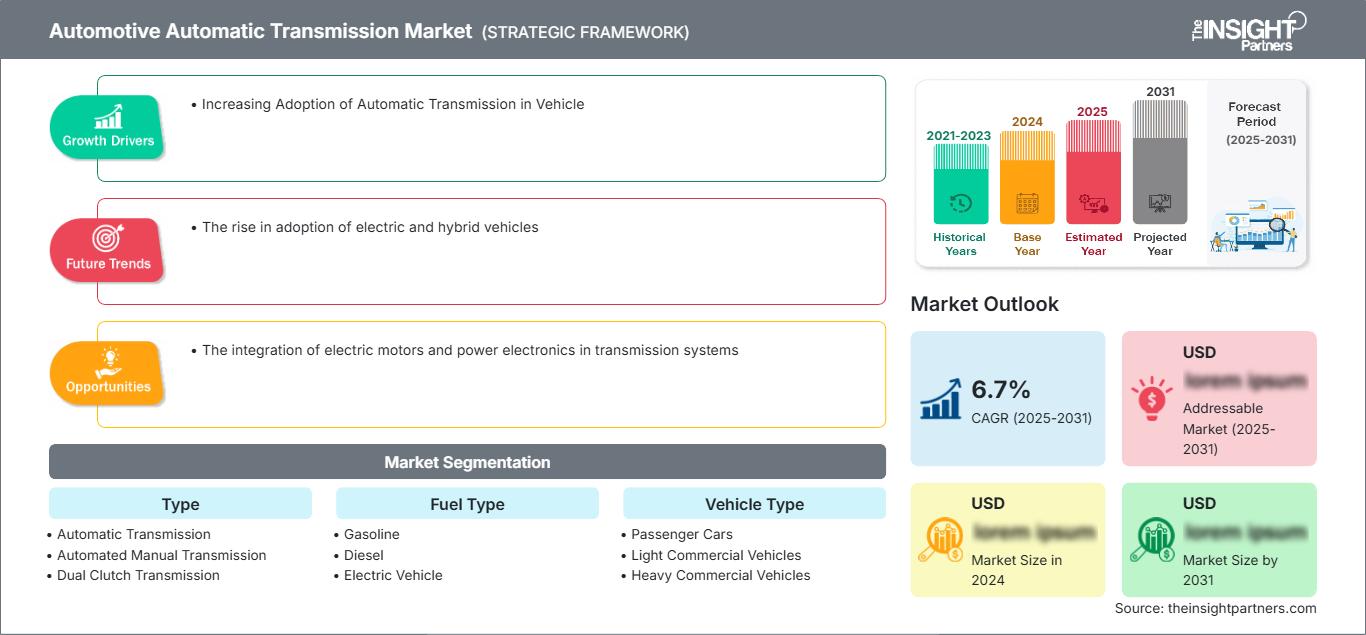
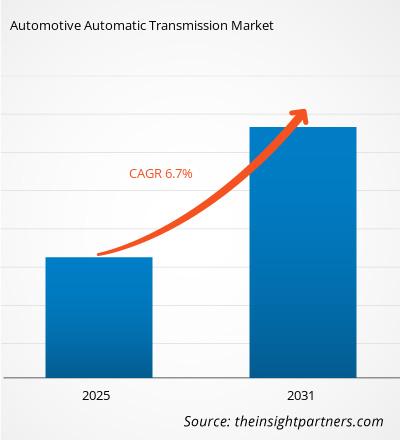
The automotive automatic transmission market was valued at US$ 40.48 Billion in 2025 and is projected to reach US$ 65.06 Billion by 2034, registering a CAGR of 5.41% during 2026–2034. Growth is supported by consumer preference for low-effort driving, wider use of multi-speed automatic gearboxes, hybrid powertrain expansion, and stricter fuel-efficiency requirements across passenger and commercial vehicle programs.
North America remains a mature but strategically important demand base as pickup trucks, SUVs, light commercial vehicles, and hybrid models continue to use electronically controlled automatic systems. The automotive automatic transmission market size in the region is supported by fleet replacement, premium vehicle penetration, and heavy-duty transmission demand, with growth expected to track a CAGR range of 4.7–5.5% during 2026–2034.
Automotive Automatic Transmission Market Assessment and Insights
- North America: Held 24–27% share in 2025 and is expected to grow at a CAGR of 4.7–5.5% during 2026–2034, supported by SUVs, pickups, hybrid models, and commercial fleet replacement.
- US: Accounted for 78–82% of North America in 2025 and is forecast to grow at a CAGR of 4.8–5.6% during 2026–2034, led by automatic-heavy passenger and truck platforms.
- Europe: Represented 22–25% share in 2025 and is projected to grow at a CAGR of 4.4–5.2% during 2026–2034, with Germany, the UK, France, Italy, and Spain leading adoption.
- Asia Pacific: Captured 41–44% share in 2025 and is expected to grow at a CAGR of 5.4–6.3% during 2026–2034, led by China, Japan, South Korea, India, and Australia.
- Largest Segment: Automatic Transmission held 45–49% market share in 2025 and is projected to grow at a CAGR of 4.8–5.6% during 2026–2034.
- High Growth Segment: Dual Clutch Transmission held 15–18% share in 2025 and is expected to grow at a CAGR of 6.1–7.0% during 2026–2034 as hybrid and performance applications expand.
- Key companies analyzed in detail: BorgWarner Inc., Mercedes-Benz Group AG, Continental AG, Aptiv PLC, Eaton Corporation plc, FPT Industrial S.p.A., JATCO Ltd, NSK Ltd., Valeo SE, AISIN CORPORATION, Allison Transmission Holdings, Inc.
Source: The Insight Partners' analysis based on proprietary research, government publications, company annual reports, investor presentations, industry databases, and expert interviews.
Transmission technology has moved from hydraulically controlled gearboxes toward electronic control, torque optimization, shift-by-wire integration, and hybrid-compatible architectures. The automotive automatic transmission market is evolving around smoother driving, lower emissions, better calibration, and reduced mechanical losses. OEMs increasingly design transmission families around shared platforms to lower cost while serving gasoline, diesel, hybrid, and selected electric vehicle applications.
Future demand will be shaped by urban congestion, hybrid growth, regional fuel-economy rules, and rising automatic penetration in emerging markets. Suppliers are investing in compact designs, efficient torque converters, dual-clutch systems, and transmission control software. Regulatory pressure to reduce CO2 emissions favors systems that improve engine operating efficiency without compromising drivability.
Automotive Automatic Transmission Market Report Scope
| Report Attribute | Details |
|---|---|
| Market size in 2025 | US$ 40.48 Billion |
| Market Size by 2034 | US$ 65.06 Billion |
| Global CAGR (2026 - 2034) | 5.41% |
| Historical Data | 2021-2024 |
| Forecast period | 2026-2034 |
Automotive Automatic Transmission Market Analysis
The automotive automatic transmission market growth is driven by demand for driving comfort, lower driver fatigue, and improved fuel efficiency in congested cities. Passenger cars remain the highest-volume application, while light commercial vehicles increasingly adopt automatic systems to improve delivery productivity and reduce clutch-related maintenance in stop-start operations.
Supply dynamics depend on precision manufacturing, electronic control modules, gearset durability, transmission fluids, and software calibration. OEMs prefer scalable transmission platforms that can serve multiple vehicle lines. Hybridization also changes procurement because transmissions must handle regenerative braking, electric torque blending, and more frequent operating mode changes.
The automotive automatic transmission market analysis shows competition across global Tier-1 suppliers, commercial vehicle specialists, and powertrain technology companies. BorgWarner Inc., AISIN CORPORATION, JATCO Ltd, Allison Transmission Holdings, Inc., Eaton Corporation plc, Valeo SE, Continental AG, NSK Ltd., Aptiv PLC, FPT Industrial S.p.A., and Mercedes-Benz Group AG support different parts of the transmission value chain.
Investment is concentrated in hybrid-ready transmissions, DCT capacity, electronic controls, and localized production. Strategic positioning increasingly depends on long-term OEM supply contracts, regional manufacturing, software integration, and the ability to reduce weight, friction, and packaging complexity while meeting durability requirements across passenger and commercial vehicles.
● REPORT CUSTOMIZATION
Tailor This Report To Align With Your Specific Business Requirements
This report can be customized to align precisely with your business objectives, scope, and target markets. Customization options include tailored segmentation, geography, competitive analysis, and strategic insights to support informed decision-making.
Customize This Report →WHAT YOU CAN ADJUST
- ● Segmentations
- ● Geography
- ● Competitive Analysis
- ● Language Preferences
Automotive Automatic Transmission Market: Strategic Insights
Regional Insights
North America automotive automatic transmission market
North America held 24–27% automotive automatic transmission market share in 2025 and is expected to grow at a CAGR of 4.7–5.5% during 2026–2034. Demand is anchored by pickup trucks, SUVs, heavy-duty vehicles, and automatic-heavy passenger car platforms where comfort and towing performance remain important purchase factors.
Hybrid SUVs, commercial vans, and fleet vehicles are increasing the need for electronically controlled transmissions with durable torque delivery. Localized production and aftermarket service networks also support replacement demand. Suppliers benefit from high automatic penetration, although battery electric vehicle growth gradually shifts some demand toward e-drive reduction systems.
U.S. automotive automatic transmission Market
The US accounted for 78–82% of North America in 2025 and is forecast to grow at a CAGR of 4.8–5.6% during 2026–2034. The country remains the largest regional demand center because automatic transmissions dominate passenger vehicles, SUVs, pickups, and on-highway commercial applications.
Allison Transmission Holdings, Inc., BorgWarner Inc., Eaton Corporation plc, Aptiv PLC, and Continental AG strengthen the domestic ecosystem through commercial transmission systems, electronic controls, mechatronics, and powertrain components. Hybrid truck and van platforms will sustain demand for durable multi-speed automatic systems.
Europe automotive automatic transmission Market
Europe represented 22–25% share in 2025 and is projected to grow at a CAGR of 4.4–5.2% during 2026–2034. Germany leads through premium vehicle production, DCT adoption, and powertrain engineering, while the UK supports performance vehicles, fleet upgrades, and light commercial applications.
France, Italy, and Spain contribute through compact cars, commercial vehicles, and hybrid passenger platforms. Emission rules and CO2 targets encourage efficient automatic, AMT, and DCT systems that reduce losses. Europe’s shift toward hybrids supports dual-clutch and electronically controlled architectures more than older hydraulic designs.
APAC automotive automatic transmission Market
APAC held 41–44% share in 2025 and is expected to grow at a CAGR of 5.4–6.3% during 2026–2034. China leads regional demand through vehicle production scale, hybrid adoption, and higher automatic penetration in passenger cars.
Japan and South Korea contribute advanced transmission engineering, while India is moving from manual-dominant fleets toward AMT, CVT, and automatic variants in urban passenger vehicles. Australia adds demand through SUVs and light commercial vehicles. Regional manufacturing scale supports cost reduction and wider adoption.
Middle East & Africa automotive automatic transmission Market
The Middle East and Africa market is projected to grow at a CAGR of 3.9–4.8% during 2026–2034. Saudi Arabia and the UAE lead demand due to SUV preference, premium vehicle imports, and long-distance driving conditions that favor smooth automatic systems.
South Africa and the rest of MEA contribute through light commercial vehicles, replacement parts, and fleet modernization. Adoption remains uneven because affordability affects transmission choice, but automatic penetration is increasing in urban markets, imported passenger vehicles, and commercial fleets requiring lower driver fatigue.
Segmentation Analysis
Type
Type is expected to grow at a CAGR of 5.0–5.8% during 2026–2034. The automotive automatic transmission market scope is shaped by the need to balance comfort, cost, efficiency, torque delivery, and hybrid compatibility across different vehicle platforms.
- Automatic Transmission remains the largest type because torque-converter systems provide smooth shifting, strong launch performance, and proven durability across SUVs, pickups, passenger cars, and commercial vehicles.
- Automated Manual Transmission is used in cost-sensitive vehicles because it automates clutch and shifting functions while retaining a manual gearbox structure, making it attractive in emerging markets.
- Dual Clutch Transmission supports quick gear changes and efficiency, making it relevant in performance vehicles, hybrids, and compact models where acceleration response and fuel economy matter.
- Continuously Variable Transmission is important in compact cars and hybrids because it keeps engines operating in efficient ranges, supporting smooth acceleration and lower fuel consumption.
Fuel Type
Fuel Type is projected to grow at a CAGR of 4.9–5.7% during 2026–2034 as automatic systems adapt to gasoline, diesel, hybrid, and electric vehicle architectures. Hybrid powertrains are especially important because they need torque blending and efficient shift management.
- Gasoline remains a major demand base because most passenger cars and SUVs using automatic transmissions continue to rely on gasoline engines in North America and several APAC markets.
- Diesel supports commercial vehicles and long-distance applications where torque delivery, durability, and fuel economy make automatic or automated systems attractive for fleet operators.
- Electric Vehicle demand is selective because many EVs use single-speed reduction gears, but multi-speed systems are gaining interest for performance, towing, and efficiency optimization.
- Hybrid platforms create strong demand for specialized automatic and DCT systems that coordinate combustion engines, electric motors, regenerative braking, and low-speed electric operation.
Vehicle Type
Vehicle Type is forecast to grow at a CAGR of 5.1–5.9% during 2026–2034 as automatic penetration increases across passenger and commercial fleets. Vehicle manufacturers are using automatic systems to improve comfort, productivity, resale value, and compliance.
- Passenger Cars hold the strongest demand because urban drivers prefer clutch-free operation, smoother acceleration, and fuel-efficient automatic, CVT, AMT, or DCT options across compact and premium models.
- Light Commercial Vehicles are adopting automatic systems to reduce driver fatigue in delivery operations, improve shift consistency, and lower maintenance linked to clutch wear in dense urban routes.
- Heavy Commercial Vehicles rely on automated and fully automatic systems for durability, torque control, and efficiency under heavy loads, particularly in buses, vocational trucks, and defense applications.
Opportunity Snapshot
| Vehicle Type | Revenue Contribution | Trend Tag | Adoption Stage |
| Passenger Cars | High | Urban Comfort | Mature |
| Light Commercial Vehicles | Medium | Fleet Automation | Scaling |
| Heavy Commercial Vehicles | Medium | Torque Control | Scaling |
Automotive Automatic Transmission Market Growth Drivers and Impact Analysis
Rising Preference for Clutch-Free Urban Driving
Increasing traffic congestion is causing drivers to favor automatic vehicles that lower fatigue from constant braking, accelerating, and driving slowly. The trend can be seen in developing nations, where first-time buyers have a tendency to choose an AMT, CVT, or automatic vehicle that was earlier only available in high-end models. The effect on the market is wide-ranging as the adoption of automatic technology helps in increasing the content of transmissions per vehicle and allows for better pricing of higher-grade versions. Suppliers stand to gain if they can provide compact and cost-effective systems that also help retain fuel economy.
Hybrid Powertrain Expansion
There are demands for transmissions that enable coordination between the combustion engine, electric motor, regeneration, and shift function without compromising the drive ability of the vehicle. Such requirements justify the demand for electronically controlled automatic, DCT, and hybrid transmission technologies. It will have a strategic impact since the use of hybrids is increasing in those areas where charging infrastructure and consumer acceptance make fully electric vehicles impractical. The strategy of transmission providers to safeguard their business models lies in designing for electric torque delivery, instead of being solely dependent on internal combustion platforms.
Commercial Fleet Productivity Requirements
Fleet vehicle manufacturers are now employing automatic transmissions, which provide more consistency, less operator fatigue, and reduced maintenance caused by clutch abuse. There are advantages for delivery trucks, buses, vocational trucks, and heavy-duty trucks in terms of smooth gear changes, effective power transfer, and fuel management. The effect of the market would be significant since, in this type of purchase decision, commercial buyers consider the total cost of ownership. Reliable automatic transmission systems can minimize downtime and increase residual value. Manufacturers that offer heavy-duty performance, calibration, and service capabilities will have an advantage here.
Automotive Automatic Transmission Market Future Trends
Software-Calibrated Shift Optimization
Automotive automatic transmission market trends are moving toward software-calibrated shift strategies that adjust gear behavior by driving mode, terrain, load, battery state, and traffic conditions. Future systems will use connected data and predictive controls to select gears before driver demand changes. This will improve fuel economy, comfort, and component life while supporting over-the-air calibration updates. Suppliers able to combine mechanical design with embedded software and cybersecurity readiness will gain stronger positions in software-defined vehicle platforms.
Electrified Multi-Speed Architectures
Concepts of multi-speed transmissions for hybrids and select electrics will have more significance in areas where factors like towing, efficiency at high speeds, and performance are significant. While most electrics are equipped with single-speed reducers, there might be cases when it would be helpful to have a higher number of ratios for expensive vehicles and commercial applications. Such an approach will demand compact gearing systems, effective heat management systems, and precise synchronization of the torque of motors.
Automotive Automatic Transmission Market Opportunities
Localized Production for Emerging Automatic Adoption
Emerging markets offer opportunities as consumers shift from manual vehicles toward AMT, CVT, and cost-efficient automatic options. Localized production can reduce import costs, improve OEM responsiveness, and support calibration for regional driving conditions. automotive automatic transmission market Forecasts point to strong upside in India, Southeast Asia, and selected Middle East markets, where urban congestion is changing buyer preferences. Suppliers that combine affordable hardware with robust service support can win high-volume programs and build long-term OEM relationships as automatic penetration rises.
Hybrid Transmission Platforms for Fleet and SUV Programs
An opportunity exists for suppliers that are capable of providing high torque transmissions that are electronically controllable and have high durability. The automotive manufacturers require transmissions that will be able to handle electric assist, regenerative braking, towing loads, and smooth switching between modes. The opportunity is very practical since automobile makers are redesigning their platforms for emissions compliance without changing the shape and design of their vehicles. Vendors of hybrid transmissions, software, and manufacturing facilities will secure multi-year supply contracts from automakers.
Frequently Asked Questions

- Comprehensive Market Sizing and Forecast Analysis
- Detailed Segmentation Analysis
- In-Depth Market Dynamics Assessment
- Regional and Country-Level Insights
- Competitive Landscape and Company Benchmarking
- Strategic Business Intelligence
Recent Reports
Testimonials

The Insight Partners' SCADA System Market report is comprehensive, with valuable insights on current trends and future forecasts. The team was highly professional, responsive, and supportive throughout. We are very satisfied and highly recommend their services.
RAN KEDEM Partner, Reali Technologies LTDs
I requested a report on a very specific software market and the team produced the report in a few days. The information was very relevant and well presented. I then requested some changes and additions to the report. The team was again very responsive and I got the final report in less than a week.
JEAN-HERVE JENN Chairman, Future Analytica
We worked with The Insight Partners for an important market study and forecast. They gave us clear insights into opportunities and risks, which helped shape our plans. Their research was easy to use and based on solid data. It helped us make smart, confident decisions. We highly recommend them.
PIYUSH NAGPAL Sr. Vice President, High Beam Global
The Insight Partners delivered insightful, well-structured market research with strong domain expertise. Their team was professional and responsive throughout. The user-friendly website made accessing industry reports seamless. We highly recommend them for reliable, high-quality research services
YUKIHIKO ADACHI CEO, Deep Blue, LLC.
This is the first time I have purchased a market report from The Insight Partners.While I was unsure at first, I visited their web site and felt more comfortable to take the risk and purchase a market report.I am completely satisfied with the quality of the report and customer service. I had several questions and comments with the initial report, but after a couple of dialogs over email with their analyst I believe I have a report that I can use as input to our strategic planning process.Thank you so much for taking the extra time and making this a positive experience.I will definitely recommend your service to others and you will be my first call when we need further market data.
JOHN SUZUKI President and Chief Executive Officer, Board Director, BK Technologies
I wish to appreciate your support and the professionalism you displayed in the course of attending to my request for information regarding to infectious disease IVD market in Nigeria. I appreciate your patience, your guidance, and the fact that you were willing to offer a discount, which eventually made it possible for us to close a deal. I look forward to engaging The Insight Partners in the future, all thanks to the impression you have created in me as a result of this first encounter.
DR CHIJIOKE ONYIA MANAGING DIRECTOR, PineCrest Healthcare Ltd.Reason to Buy
- Informed Decision-Making
- Understanding Market Dynamics
- Competitive Analysis
- Identifying Emerging Markets
- Customer Insights
- Market Forecasts
- Risk Mitigation
- Boosting Operational Efficiency
- Strategic Planning
- Investment Justification
- Tracking Industry Innovations
- Aligning with Regulatory Trends





 Get Free Sample for