
Automotive Chassis Systems Market Growth, Trends & Forecast by 2034
Coverage: By Chassis Type (Backbone Chassis, Ladder Chassis, Monocoque Chassis, Modular Chassis); Material (High Strength Steel, Aluminium Alloy, Mild Steel, Carbon Fiber Composite); Vehicle Type (Passenger Car, Commercial Vehicle), and Geography (North America, Europe, Asia Pacific, and South and Central America)
- Status : Data Released
- Report Code : TIPRE00010257
- Category : Automotive and Transportation
- No. of Pages : 150
- Available Report Formats :


- Last update date : August 26, 2026


2025 Market Size
US$ 98,889.28 Mn
Base year value
2034 Forecast
US$ 149,458.53 Mn
Projected by 2034
CAGR 2026-2034
4.70 %
Growth rate
Addressable Market
US$ 1,127,650.48 Mn
(2026-2034)
The automotive chassis systems market was valued at US$ 98,889.28 million in 2025 and is projected to reach US$ 149,458.53 million by 2034, registering a CAGR of 4.70% during 2026–2034. The market is supported by increasing vehicle production, rising adoption of advanced safety technologies, and continuous innovation in lightweight structural systems that improve vehicle dynamics, occupant protection, and energy efficiency. The growing transition toward electric mobility continues to reshape chassis system design and engineering worldwide.
North America continues to represent a technologically mature market characterized by strong automotive manufacturing capabilities and high adoption of advanced vehicle technologies. The region is projected to register a CAGR of 4.1–4.6% during 2026–2034, supported by increasing production of electric vehicles, stringent safety regulations, and continuous investments in lightweight vehicle platforms. The automotive chassis systems market size across the region also benefits from growing integration of intelligent suspension technologies and modular chassis architectures.
Automotive Chassis Systems Market Assessment and Insights
- North America: North America accounted for 30–34% share in 2025 and is expected to grow at a CAGR of 4.1–4.6% during 2026–2034. Strong OEM investments, advanced manufacturing infrastructure, and increasing adoption of electric vehicle platforms continue to support regional market expansion.
- US: The U.S. represented 75–79% of the North American market in 2025 and is projected to register a CAGR of 4.2–4.7% during 2026–2034, driven by rising electric vehicle production, domestic manufacturing expansion, and rapid deployment of advanced chassis technologies.
- Europe: Europe held 26–30% share in 2025 and is forecast to expand at a CAGR of 4.0–4.5% during 2026–2034. Germany, France, Italy, and the UK continue leading regional demand through strong automotive production and regulatory emphasis on lightweight, energy-efficient vehicle architectures.
- Asia Pacific: Asia Pacific captured 35–39% share in 2025 and is anticipated to record the fastest regional expansion at a CAGR of 5.2–5.7% during 2026–2034. China, Japan, South Korea, and India remain key manufacturing hubs supported by increasing electric vehicle production and expanding automotive investments.
- Largest Segment: Monocoque Chassis accounted for a market share of 57–61% in 2025 and is expected to expand at a CAGR of 4.8–5.3% during 2026–2034, owing to its superior structural efficiency, safety performance, and compatibility with modern passenger vehicle platforms.
- High Growth Segment: Aluminum Alloy represented 24–28% market share in 2025 and is projected to register a CAGR of 5.9–6.4% during 2026–2034, driven by aggressive lightweighting strategies and increasing production of battery electric vehicles.
- Key companies analyzed in detail: Schaeffler AG, Hyundai Motor Company, Aisin Corporation, Magna International Inc., Continental AG, ZF Friedrichshafen AG, Tower International, BENTELER International AG, CIE Automotive S.A., REE Automotive Ltd.
Source: The Insight Partners' analysis based on proprietary research, government publications, company annual reports, investor presentations, industry databases, and expert interviews.
Progression in vehicle engineering keeps on affecting the development of chassis systems through the incorporation of lighter-weight materials, modular structures and digital manufacturing technologies. Many automotive companies have started using high-strength steel, aluminum and composites to enhance the crash resistance while keeping the weight of vehicles lower. At the same time, electrification of vehicles has been increasing the demand for special chassis systems which would be able to support battery packs, suspension modules and intelligent systems.
The future industry developments will depend upon increasing production of electric vehicles, stricter regulations and investment in new manufacturing technologies. Newly emerging manufacturing centers in the Asia Pacific region and some selected countries from the Middle East region keep on receiving investments in manufacturing centers for chassis systems. Innovation in scalable platforms, sustainable materials and intelligent chassis systems is anticipated to enhance the competitive advantage.
Automotive Chassis Systems Market Report Scope
| Report Attribute | Details |
|---|---|
| Market size in 2025 | US$ 98,889.28 Million |
| Market Size by 2034 | US$ 149,458.53 Million |
| Global CAGR (2026 - 2034) | 4.70% |
| Historical Data | 2021-2024 |
| Forecast period | 2026-2034 |
Automotive Chassis Systems Market Analysis
Growing production of passenger vehicles, commercial vehicles, and battery electric vehicles continues to strengthen demand for advanced chassis technologies worldwide. Manufacturers increasingly prioritize lightweight structural systems capable of improving crash safety, vehicle handling, ride comfort, and overall energy efficiency. Consequently, the automotive chassis systems market growth is supported by tightening fuel economy regulations, increasing integration of active safety technologies, and rising adoption of modular vehicle platforms capable of supporting multiple propulsion systems. Frequent investments in automation, manufacturing and precision engineering will increase efficiencies in production while lowering lifecycle costs.
The auto manufacturing supply chain is changing as OEMs and component suppliers are working better together with material producers. The integration of advanced forming techniques, robotics, digital engineering, and product development using simulation will allow manufacturers to innovate faster while increasing the quality of their products. The increased use of recyclable materials and localized facilities will make the supply chain more resilient.
Competition remains highly dynamic as major manufacturers continue investing in lightweight structural technologies, intelligent chassis solutions, and scalable vehicle platforms. The automotive chassis systems market analysis indicates that Magna International Inc., ZF Friedrichshafen AG, Continental AG, Schaeffler AG, BENTELER International AG, Aisin Corporation, CIE Automotive S.A., and REE Automotive Ltd. continue strengthening their competitive positions through research and development, strategic collaborations, and advanced manufacturing capabilities. Their investments support growing demand for integrated chassis systems designed for conventional, hybrid, and electric vehicle applications.
Increasingly, manufacturers are directing investments into smart manufacturing technology, modular platform design, and innovative sustainable materials to enhance efficiency and competitiveness in their operations. The establishment of electric vehicle manufacturing plants, the increased use of digital engineering software, and cooperation with automotive manufacturers would further drive technological development and offer unique chassis system designs.
● REPORT CUSTOMIZATION
Tailor This Report To Align With Your Specific Business Requirements
This report can be customized to align precisely with your business objectives, scope, and target markets. Customization options include tailored segmentation, geography, competitive analysis, and strategic insights to support informed decision-making.
Customize This Report →WHAT YOU CAN ADJUST
- ● Segmentations
- ● Geography
- ● Competitive Analysis
- ● Language Preferences
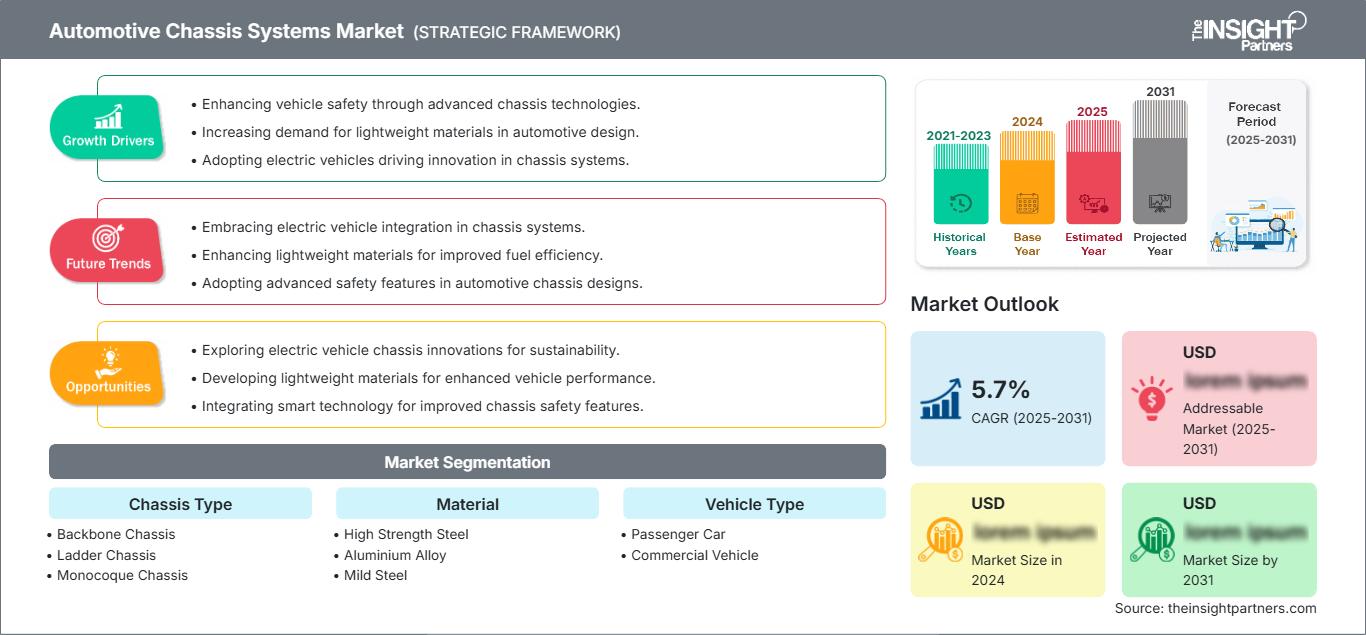
Automotive Chassis Systems Market: Strategic Insights
Regional Insights
North America Automotive Chassis Systems Market
North America accounted for 30–34% of the automotive chassis systems market share in 2025 and is projected to expand at a CAGR of 4.1–4.6% during 2026–2034. The region benefits from a mature automotive manufacturing ecosystem, strong investments in electric mobility, and widespread adoption of advanced vehicle safety technologies. Lightweight chassis systems, electronically-controlled suspension technology and modular vehicle structures continue to be utilized in automotive manufacturing to enhance fuel economy, vehicle performance and crashworthiness. The rising volume of production of electric pickups, sports utility vehicles (SUVs) and commercial vehicles provides another driver for chassis systems to include batteries and intelligent vehicle control technology.
The United States, Canada and Mexico have well-developed automotive supply chains that enable efficient manufacture of chassis parts and complete vehicle platforms. Investments in advanced welding technology, engineering, robotic manufacturing and metal shaping continue to improve production capacity in the region. Cooperation between OEMs and chassis system producers is contributing towards the rapid development of future-generation chassis systems meeting new safety and environmental requirements.
U.S. Automotive Chassis Systems Market
The U.S. represented 75–79% of the North American automotive chassis systems market in 2025 and is expected to register a CAGR of 4.2–4.7% during 2026–2034. Strong domestic automotive production, increasing electric vehicle manufacturing, and continued investment in advanced engineering technologies continue to support market expansion. Vehicle manufacturers increasingly adopt lightweight chassis systems, intelligent suspension technologies, and modular vehicle platforms that improve manufacturing flexibility while enhancing vehicle safety and ride comfort.
Magna International Inc., ZF Friedrichshafen AG, Continental AG, Schaeffler AG, and Aisin Corporation, among other major firms, remain committed to the continuous enhancement of engineering expertise and production operations in the USA. The increased application of aluminum-intensive structures and high-strength steel, as well as digital manufacturing techniques, facilitates the creation of chassis systems able to meet the changing demands of electric vehicles.
Europe Automotive Chassis Systems Market
Europe accounted for 26–30% of the global automotive chassis systems market in 2025 and is projected to grow at a CAGR of 4.0–4.5% during 2026–2034. Germany remains the leading regional market owing to its advanced automotive engineering capabilities, premium vehicle manufacturing, and strong supplier ecosystem. Increasing regulatory emphasis on vehicle safety, carbon emission reduction, and electrification continues to encourage the adoption of lightweight chassis systems and advanced structural technologies.
The United Kingdom is making steady advances into its investments in the development of electric vehicles, intelligent manufacturing and automotive research with the help of collaboration between automotive companies, materials suppliers and engineers who work on constant innovations in the design of modular chassis systems.
Germany is keeping its leading position due to the best engineering skills, automotive manufacturing capabilities, and investments in the latest chassis innovations. The use of lightweight aluminum-intensive platforms, intelligent suspensions and digital manufacturing techniques is helping Germany maintain its competitive advantage in the European automobile industry.
France, Italy and Spain make collective contributions to the growth of the market by modernizing the manufacturing plants for automobiles, producing more electric vehicles and growing needs for lightweight chassis. Incentives towards sustainability and innovations keep encouraging further investments in chassis innovations in these countries.
APAC Automotive Chassis Systems Market
Asia Pacific accounted for 35–39% of the global automotive chassis systems market in 2025 and is anticipated to register the highest regional growth at a CAGR of 5.2–5.7% during 2026–2034. The Chinese market is the key market in the region due to the presence of highly developed capacity for automotive manufacturing, a rapidly growing EV industry, and government support of innovative automotive technologies.
Investments in vehicle platform design, lightweighting technologies, and innovative manufacturing technologies are enhancing regional demand in Japan, South Korea, India, and Australia. The development of domestic automotive manufacturing, supportive industrial policy, and growing exports of passenger and commercial vehicles will contribute to the sustained growth of the market in the Asia Pacific.
Middle East & Africa Automotive Chassis Systems Market
The Middle East & Africa automotive chassis systems market is expected to register a CAGR of 3.7–4.2% during 2026–2034, supported by expanding vehicle assembly operations, industrial diversification initiatives, and increasing investments in automotive manufacturing infrastructure. Saudi Arabia remains the largest regional market, followed by the UAE and South Africa, where automotive production capabilities continue expanding.
Government initiatives promoting industrial localization, transportation infrastructure development, and domestic manufacturing are encouraging investments in automotive component production across the region. Growing demand for passenger vehicles, commercial fleets, and advanced mobility solutions is expected to create long-term opportunities for chassis system manufacturers operating in Middle Eastern and African markets.
Segmentation Analysis
Type
The Type segment is expected to expand at a CAGR of 4.6–5.1% during 2026–2034. Growing vehicle electrification, increasing safety requirements, and the industry's transition toward modular vehicle architectures continue driving innovation across chassis system designs. Manufacturers are prioritizing lightweight structures that enhance crash performance, improve driving dynamics, and simplify integration of electric powertrains and battery systems. The automotive chassis systems market scope continues to expand as scalable platform strategies enable manufacturers to reduce production costs while supporting multiple vehicle models across global markets.
- Backbone Chassis – Backbone chassis continue serving specialized automotive applications requiring high torsional rigidity and compact structural design. Although their adoption remains limited compared to other chassis configurations, they continue to find applications in performance-oriented and niche vehicle categories.
- Ladder Chassis – Ladder chassis remain widely adopted across heavy commercial vehicles, pickup trucks, buses, and off-road vehicles because of their superior load-bearing capacity, durability, and ease of maintenance. Continuous improvements in material engineering further enhance structural performance while reducing vehicle weight.
- Monocoque Chassis – Monocoque chassis continue dominating passenger vehicle production owing to their excellent strength-to-weight ratio, superior crash performance, enhanced ride comfort, and compatibility with battery-electric vehicle platforms. Their widespread adoption supports improved manufacturing efficiency and vehicle safety.
- Modular Chassis – Modular chassis are witnessing increasing adoption among global automotive manufacturers because they enable standardized production, faster product development, lower engineering costs, and greater flexibility for conventional, hybrid, and electric vehicle platforms.
Material
The Material segment is anticipated to register a CAGR of 5.0–5.5% during 2026–2034. Material innovation continues playing a central role in improving fuel efficiency, reducing emissions, enhancing structural rigidity, and extending electric vehicle driving range. Automotive manufacturers increasingly adopt multi-material construction strategies that balance weight reduction with durability and manufacturing efficiency.
- Aluminium Alloy – Aluminum alloy represents the fastest-growing material category because of its lightweight properties, corrosion resistance, recyclability, and ability to improve vehicle efficiency. Its increasing utilization across battery electric vehicles significantly supports long-term market expansion.
- Carbon Fibre Composite – Carbon fiber composite materials continue gaining adoption within premium, luxury, and high-performance vehicle segments where superior strength-to-weight characteristics justify higher manufacturing costs and deliver exceptional structural performance.
- Steel – Advanced high-strength steel remains the most extensively utilized chassis material because of its affordability, excellent crash energy absorption, mature manufacturing ecosystem, and suitability for mass automotive production across passenger and commercial vehicles.
Vehicle Type
The Vehicle Type segment is projected to expand at a CAGR of 4.4–4.9% during 2026–2034. Increasing global vehicle production, expanding electric mobility, and stricter safety regulations continue strengthening demand for advanced chassis systems across multiple vehicle categories. Manufacturers are designing application-specific chassis platforms to optimize payload capacity, passenger safety, energy efficiency, and overall driving performance.
- Passenger Cars – Passenger cars account for the largest market share because of high global production volumes, increasing electrification, and continuous adoption of lightweight modular chassis systems that improve efficiency, handling, and occupant protection.
- LCVs – Light commercial vehicles increasingly adopt lightweight chassis technologies to improve payload efficiency, reduce operating costs, and support rapidly expanding logistics, e-commerce, and urban delivery applications.
- HCVs – Heavy commercial vehicles require reinforced chassis systems capable of supporting substantial payloads while meeting increasingly stringent durability, emission, and safety standards across freight and industrial transportation applications.
Opportunity Snapshot
| Vehicle Type | Revenue Contribution | Trend Tag | Adoption Stage |
|---|---|---|---|
| Passenger Cars | High | Vehicle Electrification | Mature |
| LCVs | Medium | Urban Logistics | Scaling |
| HCVs | Medium | Smart Fleet Modernization | Scaling |
Automotive Chassis Systems Market Growth Drivers and Impact Analysis
Increasing Electrification of Passenger and Commercial Vehicles
The trend towards electrification and associated changes in the chassis sector is gaining momentum and is likely to further shape the future of the chassis industry. The development of the chassis systems of the future will have to be focused on the integration of battery packs, motor drives, cooling equipment, as well as high-level electronic components into the chassis frame without sacrificing its durability and safety performance. More manufacturers are turning to the development of chassis platforms that incorporate lightweight structures, balanced design, and modularity. The trends towards zero-emission transportation and better fuel efficiency, together with government investments in the infrastructure for EVs make the manufacturing of such vehicles more efficient. Thus, there is going to be an increasing demand for smart chassis with lightweight components, advanced suspensions, and vehicle dynamics systems.
Growing Adoption of Lightweight Materials Across Vehicle Platforms
The car manufacturers are still focused on making the vehicles lighter in order to enhance their fuel efficiency, driving range of electric vehicles, and to meet more demanding environmental standards. The aluminum alloys, high-strength steels, and carbon fiber materials have started to form an essential part of chassis systems in the coming generation of vehicles as they help in reducing weight and providing exceptional stiffness and crash performance properties. Innovation in materials also helps in improving the handling features and the efficiency of brakes and overall riding comfort. The advanced forming processes, robot welding, precise casting, and digital manufacturing are still being invested by the car makers for enhancing production efficiencies and reducing material wastage.
Expansion of Intelligent Vehicle Dynamics and Safety Systems
Increasing consumer demand for safer and more comfortable automobiles is motivating car manufacturers to incorporate electronically controlled suspension systems, adaptive dampers, steer-by-wire technology, and sophisticated chassis control modules in their cars. Intelligent chassis systems constantly evaluate driving conditions and make adjustments to optimize vehicle performance by enhancing vehicle stability, handling, and ride comfort. Integration with advanced driver-assist systems also improves the crash prevention ability of the vehicle. Growing trends towards software-based vehicle architectures have facilitated seamless connectivity between the chassis and the vehicle control system. Car manufacturers and chassis system suppliers are continuously making investments in R&D to provide scalable chassis systems that meet regulatory compliance requirements as well as enhance vehicle performance.
Automotive Chassis Systems Market Future Trends
Development of Software-Defined Chassis Architectures
The automotive chassis systems market trends increasingly reflect the industry's transition toward software-defined vehicle platforms capable of integrating intelligent control systems with mechanical chassis components. Manufacturers are developing electronically controlled steering, braking, suspension, and stability systems that improve vehicle responsiveness while supporting autonomous driving technologies. Continuous advancements in digital engineering, predictive diagnostics, and over-the-air software updates are expected to enhance chassis functionality, improve lifecycle performance, and reduce maintenance requirements throughout the forecast period.
Expansion of Multi-Material Structural Engineering
The automakers are speeding up the implementation of hybrid construction techniques that employ aluminum, advanced high-strength steel, and composites in one vehicle chassis. This method ensures optimal performance of the construction while ensuring lower weight of the vehicle and enhanced efficiency in production processes. Progress in the development of joining techniques, structural adhesives, laser welding, and digital modeling helps to implement multi-material solutions effectively. Investment into recyclable lightweight materials and sustainable manufacturing processes is likely to enhance the competitiveness of the industry in the future.
Automotive Chassis Systems Market Opportunities
Localized Production of Advanced Electric Vehicle Chassis Systems
Expansion of electric vehicle manufacturing facilities across Asia Pacific, North America, and Europe presents substantial opportunities for chassis system suppliers. The automotive chassis systems market Forecasts indicate sustained investment in dedicated electric vehicle platforms requiring lightweight modular chassis systems, integrated battery support structures, and intelligent suspension technologies. Manufacturers establishing localized production facilities and engineering centers can improve supply chain resilience, reduce logistics costs, and strengthen partnerships with automotive original equipment manufacturers. Continued regional investments in advanced manufacturing capabilities are expected to generate significant long-term growth opportunities throughout the forecast period.
Innovation in Sustainable Manufacturing and Smart Chassis Technologies
The growing pressure from increasing regulation and changing customer demands is presenting opportunities for the development of recyclable materials, efficient manufacturing processes, and digitized chassis systems. Businesses that have invested in intelligent manufacturing, closed-loop recycling, automation, and AI in engineering will achieve efficient operations, which will reduce the environmental footprint at the same time. Collaboration with OEMs in the automobile industry, material producers, and tech businesses will quicken the launch of future generation chassis systems that will be suitable for traditional, hybrid, self-driving, and battery electric vehicles.
Frequently Asked Questions

- Comprehensive Market Sizing and Forecast Analysis
- Detailed Segmentation Analysis
- In-Depth Market Dynamics Assessment
- Regional and Country-Level Insights
- Competitive Landscape and Company Benchmarking
- Strategic Business Intelligence
Recent Reports
Testimonials

The Insight Partners' SCADA System Market report is comprehensive, with valuable insights on current trends and future forecasts. The team was highly professional, responsive, and supportive throughout. We are very satisfied and highly recommend their services.
RAN KEDEM Partner, Reali Technologies LTDs
I requested a report on a very specific software market and the team produced the report in a few days. The information was very relevant and well presented. I then requested some changes and additions to the report. The team was again very responsive and I got the final report in less than a week.
JEAN-HERVE JENN Chairman, Future Analytica
We worked with The Insight Partners for an important market study and forecast. They gave us clear insights into opportunities and risks, which helped shape our plans. Their research was easy to use and based on solid data. It helped us make smart, confident decisions. We highly recommend them.
PIYUSH NAGPAL Sr. Vice President, High Beam Global
The Insight Partners delivered insightful, well-structured market research with strong domain expertise. Their team was professional and responsive throughout. The user-friendly website made accessing industry reports seamless. We highly recommend them for reliable, high-quality research services
YUKIHIKO ADACHI CEO, Deep Blue, LLC.
This is the first time I have purchased a market report from The Insight Partners.While I was unsure at first, I visited their web site and felt more comfortable to take the risk and purchase a market report.I am completely satisfied with the quality of the report and customer service. I had several questions and comments with the initial report, but after a couple of dialogs over email with their analyst I believe I have a report that I can use as input to our strategic planning process.Thank you so much for taking the extra time and making this a positive experience.I will definitely recommend your service to others and you will be my first call when we need further market data.
JOHN SUZUKI President and Chief Executive Officer, Board Director, BK Technologies
I wish to appreciate your support and the professionalism you displayed in the course of attending to my request for information regarding to infectious disease IVD market in Nigeria. I appreciate your patience, your guidance, and the fact that you were willing to offer a discount, which eventually made it possible for us to close a deal. I look forward to engaging The Insight Partners in the future, all thanks to the impression you have created in me as a result of this first encounter.
DR CHIJIOKE ONYIA MANAGING DIRECTOR, PineCrest Healthcare Ltd.Reason to Buy
- Informed Decision-Making
- Understanding Market Dynamics
- Competitive Analysis
- Identifying Emerging Markets
- Customer Insights
- Market Forecasts
- Risk Mitigation
- Boosting Operational Efficiency
- Strategic Planning
- Investment Justification
- Tracking Industry Innovations
- Aligning with Regulatory Trends





 Get Free Sample for