
Automotive Door Hinges Market Trends, Size & Forecast by 2034
Coverage: By Material (Stainless Steel, Aluminium Alloy); Application (Doors, Bonnets, Boot Lids); End User (Commercial Vehicle, Passenger Vehicle, Off Road Highway Vehicle) , and Geography (North America, Europe, Asia Pacific, and South and Central America)
- Status : Data Released
- Report Code : TIPRE00005237
- Category : Automotive and Transportation
- No. of Pages : 150
- Available Report Formats :


- Last update date : August 12, 2026


2025 Market Size
US$ 6.45 Bn
Base year value
2034 Forecast
US$ 8.82 Bn
Projected by 2034
CAGR 2026-2034
3.55 %
Growth rate
Addressable Market
US$ 69.39 Bn
(2026-2034)
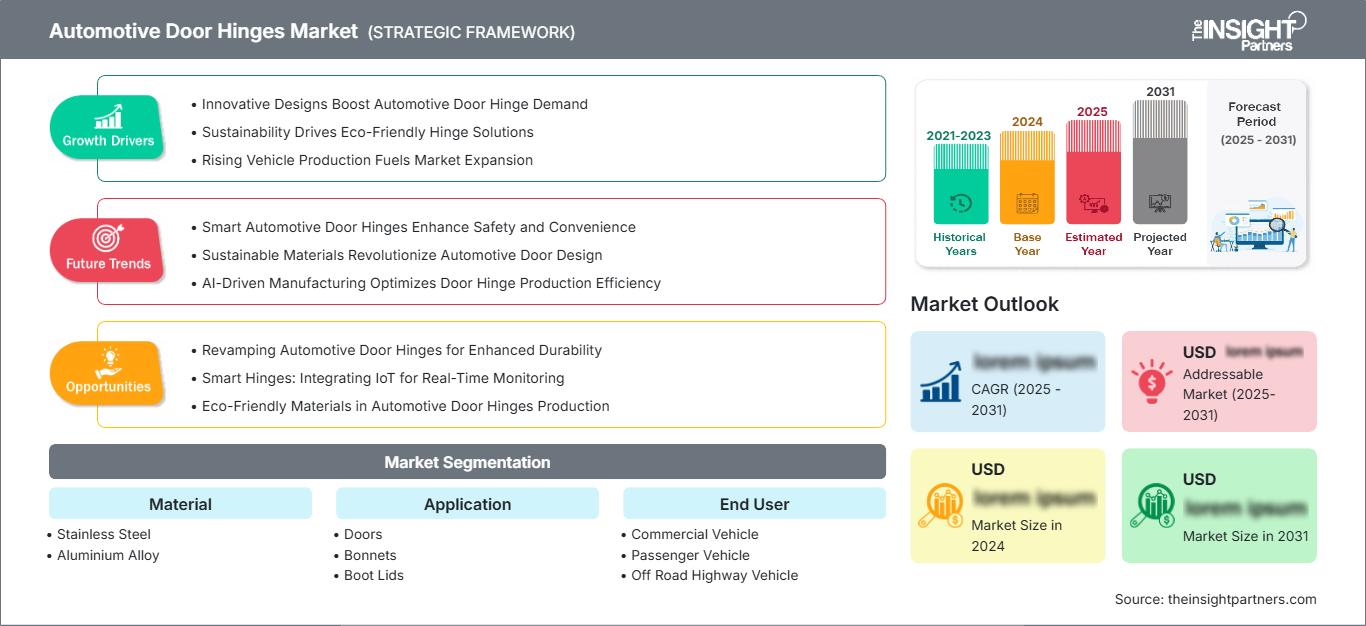
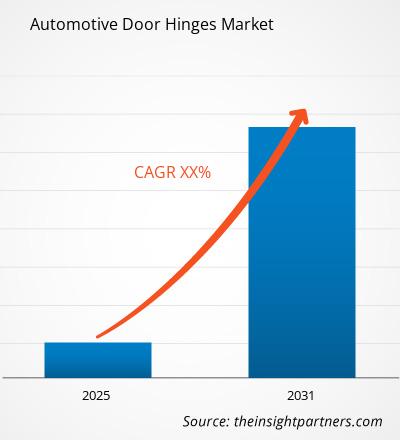
The global automotive door hinges market value was US$ 6.45 Billion in 2025 and is expected to be US$ 8.82 Billion by 2034, growing with a CAGR of 3.55 % during 2026–2034. Factors contributing to the market growth include constant car production, demand for replacements, need for structural safety, and increased usage of corrosion-proof stainless steel and aluminum alloy hinges used in doors, bonnets, boot lids, and utility vehicles.
North America continues to be an important growth segment due to the increasing automotive door hinges market size in SUVs, pickups, commercial vans, and replacement automotive market segments. The market is expected to grow at a CAGR of 3.2–3.8% from 2026 to 2034, driven by the need for durable closures and OEM preference for lightweight hinge solutions.
Automotive Door Hinges Market Assessment and Insights
- North America accounted for 25–28% share in 2025 and is expected to grow at a CAGR range of 3.2–3.8% between 2026–2034, supported by pickup, SUV, van, and replacement demand.
- US represented 78–82% of North America in 2025 and is expected to grow at a CAGR range of 3.3–3.9% between 2026–2034, led by commercial fleets and collision repair channels.
- Europe held 23–26% share in 2025 and is projected to grow at a CAGR range of 3.0–3.6% between 2026–2034, with Germany, the UK, France, Italy, and Spain leading demand.
- Asia Pacific captured 38–42% share in 2025 and is forecast to grow at a CAGR range of 3.8–4.4% between 2026–2034, led by China, Japan, South Korea, India, and Australia.
- Largest Segment Stainless steel held 62–66% market share in 2025 and is expected to grow at a CAGR range of 3.1–3.7% during 2026–2034 because durability and cost balance remain critical.
- High Growth Segment Aluminium alloy held 34–38% market share in 2025 and is expected to grow at a CAGR range of 4.2–4.8% during 2026–2034 as lightweighting gains priority.
- Key companies analyzed in detail: Aisin Corporation, Brano Group, DURA Automotive Systems, ER Wagner, Gestamp Automoción S.A., Global Rollforming Systems LLC, Magna International Inc., Milan Metal System LLC, Multimatic Inc., Saint-Gobain S.A.
Source: The Insight Partners' analysis based on proprietary research, government publications, company annual reports, investor presentations, industry databases, and expert interviews.
Market trends have shifted from standard stamped hinge mechanisms to engineered closure systems, which help maintain body alignment, crash worthiness, corrosion resistance, pedestrian safety, and ease of operation. Automotive door hinges need to adapt not only to the architectural design of the car, but also its mass, the painting process and automated assembly procedures.
Future demand will depend on the development of EV architecture, commercial vehicle applications, and localized production. Manufacturers that have developed solutions for aluminum-based design, high strength steel forming, anti-corrosion coating, and bonnet/boot lid hinges should benefit from OEM’s desire to reduce mass without sacrificing load bearing capacity and reparability.
Automotive Door Hinges Market Report Scope
| Report Attribute | Details |
|---|---|
| Market size in 2025 | US$ 6.45 Billion |
| Market Size by 2034 | US$ 8.82 Billion |
| Global CAGR (2026 - 2034) | 3.55% |
| Historical Data | 2021-2024 |
| Forecast period | 2026-2034 |
Automotive Door Hinges Market Analysis
Growth of the automotive door hinges market is dependent on vehicle production, testing of safety aspects, and increasing closures complexity per vehicle. Automotive door, bonnet, and boot-lid hinges are small in size, yet these have a great impact on vehicle fit, finish, crashworthiness, noise/vibration, and future perceptions. The evaluation of hinges now includes the whole body in white and hang-on components system by Original Equipment Manufacturers (OEM).
It is the supply chain dynamics that will benefit the manufacturers having metal forming, stamping, roll forming, forging, coating, and precise assembly facilities. The automakers need constant tolerances due to geometrical issues affecting door gaps and sealing ability. Aluminium alloys are gaining popularity due to weight saving aspects; however, stainless steel still has its place in the industry.
automotive door hinges market analysis shows a competitive base of global body, closure, and hinge specialists. Aisin Corporation, Gestamp Automoción S.A., Magna International Inc., Multimatic Inc., DURA Automotive Systems, Brano Group, ER Wagner, Global Rollforming Systems LLC, Milan Metal System LLC, and Saint-Gobain S.A. support OEM and industrial requirements through metal components, closure systems, forming know-how, and material expertise.
Investment is moving toward lightweight closure hardware, automated manufacturing compatibility, and designs that reduce assembly time. Gestamp has highlighted large-format body and lightweighting innovation, while Multimatic presents side door, hood, liftgate, and decklid hinge systems. These capabilities show how hinge suppliers are positioning around safety, mass reduction, and platform flexibility.
● REPORT CUSTOMIZATION
Tailor This Report To Align With Your Specific Business Requirements
This report can be customized to align precisely with your business objectives, scope, and target markets. Customization options include tailored segmentation, geography, competitive analysis, and strategic insights to support informed decision-making.
Customize This Report →WHAT YOU CAN ADJUST
- ● Segmentations
- ● Geography
- ● Competitive Analysis
- ● Language Preferences
Automotive Door Hinges Market: Strategic Insights
Regional Insights
North America automotive door hinges market
North America accounted for 25–28% automotive door hinges market share in 2025 and is expected to grow at a CAGR range of 3.2–3.8% through 2034. The region benefits from strong pickup, SUV, and commercial van production, where larger doors and rear closures require durable hinge systems.
Fleet maintenance and collision repair also support recurring demand. OEMs in the region prioritize corrosion resistance, predictable door alignment, and fatigue performance under high-use conditions. Aluminium alloy adoption is rising in selected premium and EV platforms, while stainless steel remains the preferred option for cost-sensitive light trucks.
U.S. automotive door hinges Market
The U.S. represented 78–82% of North America in 2025 and is projected to grow at a CAGR range of 3.3–3.9% during 2026–2034. Demand is reinforced by domestic pickup and utility vehicle output, large repair networks, and commercial fleet utilization.
Supplier presence is strengthened by closure engineering, metal forming, and aftermarket distribution capabilities. Application trends favor reinforced hinges for vans and work trucks, lightweight assemblies for EV programs, and serviceable replacement parts for high-mileage vehicles operating in construction, delivery, and public service fleets.
Europe automotive door hinges Market
Europe held 23–26% share in 2025 and is expected to grow at a CAGR range of 3.0–3.6% between 2026–2034. Germany leads regional demand because premium OEMs, body engineering specialists, and metal component suppliers are concentrated around advanced vehicle platforms.
The UK supports niche premium and performance vehicle requirements, while France, Italy, and Spain contribute through compact cars, vans, and regional assembly networks. European demand is shaped by lightweighting, pedestrian protection, anti-corrosion standards, and door-closing refinement across passenger and commercial models.
APAC automotive door hinges Market
APAC accounted for 38–42% share in 2025 and is forecast to grow at a CAGR range of 3.8–4.4% through 2034. China leads due to high vehicle production, EV expansion, and localized component sourcing.
Japan and South Korea contribute precision manufacturing, while India adds volume growth from passenger cars and commercial vehicles. Australia remains replacement-led but benefits from utility vehicle demand. Regional suppliers are scaling stamped and coated hinge production to match OEM localization strategies.
Middle East & Africa automotive door hinges Market
Middle East & Africa is expected to grow at a CAGR range of 2.8–3.4% during 2026–2034. Saudi Arabia and the UAE lead through SUV, pickup, and premium vehicle ownership, where heat, dust, and corrosion resistance matter.
South Africa and the Rest of MEA are more dependent on replacement demand and commercial vehicle servicing. Growth will depend on vehicle parc expansion, parts availability, and repair network maturity across fleet, mining, logistics, and utility applications.
Segmentation Analysis
Material
Material is expected to grow at a CAGR range of 3.4–4.0% during 2026–2034. The automotive door hinges market scope is widening as OEMs balance strength, corrosion resistance, manufacturability, and weight reduction. Stainless steel remains dominant for durability, while aluminium alloy is gaining priority where EV range, emissions compliance, and lightweight body structures influence design choices.
- Stainless Steel remains the preferred material for high-volume hinges because it offers strength, corrosion resistance, fatigue durability, and cost balance across passenger cars, commercial vehicles, bonnets, and boot lids.
- Aluminium Alloy is gaining importance in EVs, premium vehicles, and lightweight closures because it reduces component mass while supporting efficient vehicle architecture and improved energy performance.
Application
Application is expected to grow at a CAGR range of 3.3–3.9% during 2026–2034 as hinge systems remain essential across doors, bonnets, and boot lids. Doors dominate value because they require precise alignment and repeated-cycle durability, while bonnets and boot lids gain attention through pedestrian protection and cargo-access convenience.
- Doors account for the largest application because every vehicle requires multiple side-door hinges that must support alignment, sealing, repetitive loading, crash performance, and long service life.
- Bonnets require hinges that balance access, pedestrian protection, packaging, and corrosion resistance, especially as EV frunks and compact engine bays reshape front-end closure design.
- Boot Lids use hinge systems to improve cargo access, opening stability, and packaging efficiency in sedans, SUVs, hatchbacks, and utility vehicles.
End User
End User is expected to grow at a CAGR range of 3.5–4.1% during 2026–2034 as passenger vehicles provide the highest volume base, commercial vehicles sustain durability-led replacement, and off road highway vehicles create demand for reinforced hinge hardware under severe operating conditions.
- Commercial Vehicle demand is driven by vans, trucks, buses, and fleet vehicles that require robust hinges for frequent opening cycles, payload duty, and lower downtime.
- Passenger Vehicle adoption is supported by global production volume, SUV growth, EV launches, and rising expectations for smooth operation, precise gaps, and quiet closure performance.
- Off Road Highway Vehicle applications need heavy-duty hinge systems that withstand vibration, dust, mud, shock loads, and field maintenance across mining, agriculture, and construction equipment.
Opportunity Snapshot
| End User | Revenue Contribution | Trend Tag | Adoption Stage |
| Commercial Vehicle | Medium | Fleet Repair | Mature |
| Passenger Vehicle | High | EV Lightweighting | Scaling |
| Off Road Highway Vehicle | Low | Rugged Duty | Emerging |
Automotive Door Hinges Market Growth Drivers and Impact Analysis
Vehicle Production Recovery Supports Closure Hardware Demand
Rising vehicle production directly increases demand for hinges because every passenger car, van, truck, and utility vehicle uses multiple closure points. The impact is strongest in high-volume platforms where doors, bonnets, and boot lids are assembled at scale and require consistent fit quality. OEMs also need reliable hinge supply during model launches because a hinge delay can disrupt body assembly. This makes local manufacturing, tooling readiness, and quality validation critical purchasing factors for automakers and Tier 1 suppliers.
Lightweighting Priorities Shift Material Selection
Automakers are reducing vehicle mass to improve fuel economy, EV range, and emissions performance. This creates demand for aluminium alloy hinges, optimized steel thickness, and advanced coatings that maintain strength while reducing weight. The market impact is a gradual shift from purely cost-led material selection toward lifecycle performance. Suppliers that can validate lightweight designs for fatigue, corrosion, and crash behavior gain stronger access to EV and premium programs where every closure component contributes to efficiency targets.
Aftermarket Replacement Creates Stable Baseline Revenue
Door hinges face repeated opening cycles, vibration, weather exposure, corrosion, and collision damage. Commercial vans, taxis, delivery vehicles, and off road highway vehicles experience especially high wear because access points are used frequently. This creates a resilient aftermarket base even when new vehicle production slows. Replacement demand supports regional distributors, repair shops, and hinge specialists. As vehicles age, demand rises for affordable, correctly fitted, corrosion-resistant hinge assemblies that restore alignment, door sealing, and safe closure performance.
Automotive Door Hinges Market Future Trends
Aluminium Hinges Gain EV Platform Relevance
automotive door hinges market trends indicate rising use of aluminium alloy hinges in EVs and premium vehicles as automakers pursue mass reduction across closure systems. The transition will not be uniform because cost, durability, galvanic corrosion, and repair practices still favor stainless steel in many platforms. However, aluminium designs should gain share in vehicles where lightweight doors, frunks, and liftgates are part of the brand’s efficiency strategy. Suppliers able to combine aluminium forming, coating, and validation expertise will be better positioned for future contracts.
Integrated Closure Engineering Becomes Standard
Future hinge development will be increasingly coordinated with doors, latches, check arms, seals, and body structures rather than treated as a standalone hardware decision. This shift supports better gap control, door-closing feel, crash performance, and manufacturing repeatability. OEMs will expect suppliers to participate earlier in vehicle architecture planning, especially for EVs with new front storage layouts and larger liftgates. Modular hinge families that can be adapted across platforms will reduce validation time and improve cost efficiency.
Automotive Door Hinges Market Opportunities
Modular Lightweight Hinge Families
The most attractive opportunity is developing modular hinge families that support multiple vehicle programs with shared pivots, brackets, coatings, and validation packages. automotive door hinges market Forecasts remain favorable where suppliers help OEMs reduce tooling complexity and accelerate launch timing. A modular approach can serve passenger vehicles, vans, and EV platforms while allowing material changes between stainless steel and aluminium alloy. This improves scale economics, lowers engineering cost, and gives suppliers a stronger role in early closure system design.
Commercial Fleet Replacement Programs
Fleet operators offer a practical growth opportunity because hinge wear affects uptime, sealing, driver convenience, and safety. Suppliers can build targeted replacement programs for delivery vans, service trucks, buses, and utility vehicles with high door-cycle intensity. Value can be added through corrosion-resistant kits, fitment databases, fast distribution, and installer guidance. This opportunity is strongest in North America, Europe, and urban APAC markets where fleet utilization is high and operators track maintenance costs closely.
Frequently Asked Questions

- Comprehensive Market Sizing and Forecast Analysis
- Detailed Segmentation Analysis
- In-Depth Market Dynamics Assessment
- Regional and Country-Level Insights
- Competitive Landscape and Company Benchmarking
- Strategic Business Intelligence
Recent Reports
Testimonials

The Insight Partners' SCADA System Market report is comprehensive, with valuable insights on current trends and future forecasts. The team was highly professional, responsive, and supportive throughout. We are very satisfied and highly recommend their services.
RAN KEDEM Partner, Reali Technologies LTDs
I requested a report on a very specific software market and the team produced the report in a few days. The information was very relevant and well presented. I then requested some changes and additions to the report. The team was again very responsive and I got the final report in less than a week.
JEAN-HERVE JENN Chairman, Future Analytica
We worked with The Insight Partners for an important market study and forecast. They gave us clear insights into opportunities and risks, which helped shape our plans. Their research was easy to use and based on solid data. It helped us make smart, confident decisions. We highly recommend them.
PIYUSH NAGPAL Sr. Vice President, High Beam Global
The Insight Partners delivered insightful, well-structured market research with strong domain expertise. Their team was professional and responsive throughout. The user-friendly website made accessing industry reports seamless. We highly recommend them for reliable, high-quality research services
YUKIHIKO ADACHI CEO, Deep Blue, LLC.
This is the first time I have purchased a market report from The Insight Partners.While I was unsure at first, I visited their web site and felt more comfortable to take the risk and purchase a market report.I am completely satisfied with the quality of the report and customer service. I had several questions and comments with the initial report, but after a couple of dialogs over email with their analyst I believe I have a report that I can use as input to our strategic planning process.Thank you so much for taking the extra time and making this a positive experience.I will definitely recommend your service to others and you will be my first call when we need further market data.
JOHN SUZUKI President and Chief Executive Officer, Board Director, BK Technologies
I wish to appreciate your support and the professionalism you displayed in the course of attending to my request for information regarding to infectious disease IVD market in Nigeria. I appreciate your patience, your guidance, and the fact that you were willing to offer a discount, which eventually made it possible for us to close a deal. I look forward to engaging The Insight Partners in the future, all thanks to the impression you have created in me as a result of this first encounter.
DR CHIJIOKE ONYIA MANAGING DIRECTOR, PineCrest Healthcare Ltd.Reason to Buy
- Informed Decision-Making
- Understanding Market Dynamics
- Competitive Analysis
- Identifying Emerging Markets
- Customer Insights
- Market Forecasts
- Risk Mitigation
- Boosting Operational Efficiency
- Strategic Planning
- Investment Justification
- Tracking Industry Innovations
- Aligning with Regulatory Trends





 Get Free Sample for