
Automotive Electronic Stability Control Market Overview, Growth, Trends, Analysis 2034
Coverage: By Type (Electrical Brake Distribution, Anti-Lock Brake System, Traction Control System, Vehicle Dynamic Control, Others); Vehicle Type (Passenger Cars, LCVs, M and HCVs) , and Geography (North America, Europe, Asia Pacific, and South and Central America)
- Status : Data Released
- Report Code : TIPRE00004973
- Category : Automotive and Transportation
- No. of Pages : 150
- Available Report Formats :


- Last update date : August 12, 2026


2025 Market Size
US$ 8.76 Bn
Base year value
2034 Forecast
US$ 16.11 Bn
Projected by 2034
CAGR 2026-2034
7.0 %
Growth rate
Addressable Market
US$ 112.27 Bn
(2026-2034)
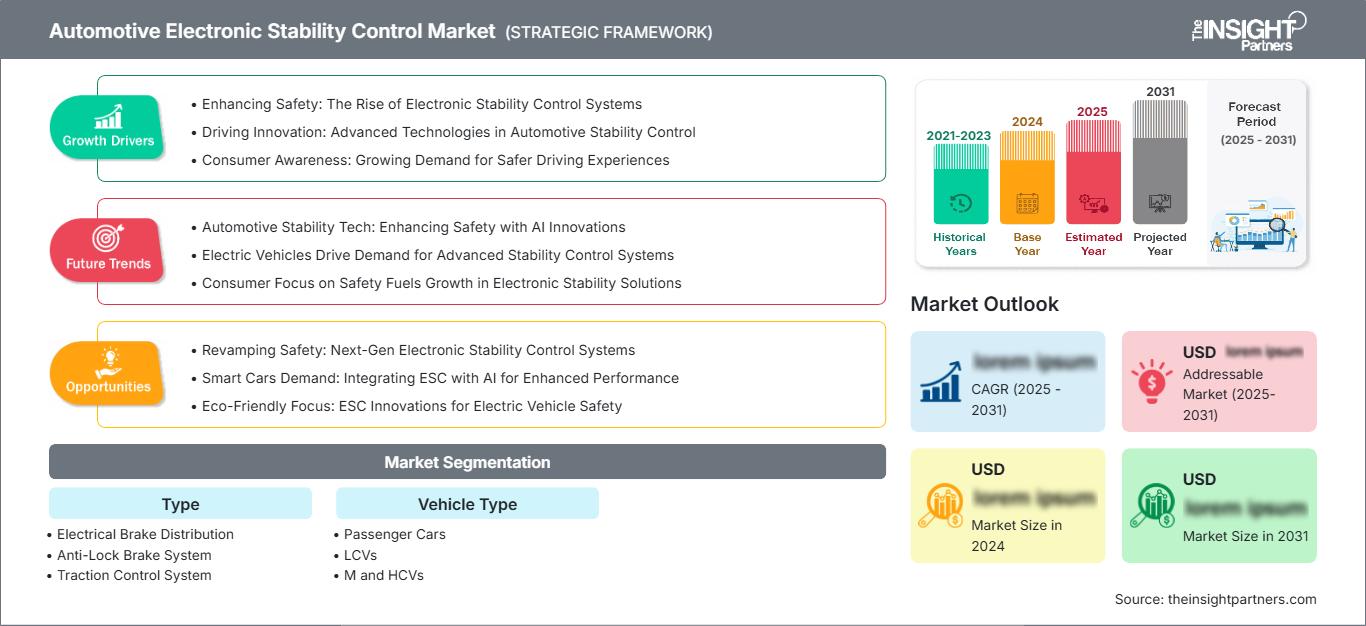
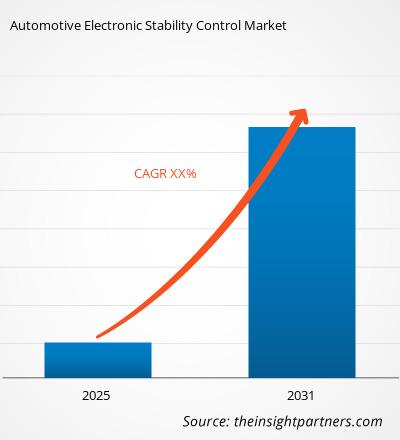
The automotive electronic stability control market is projected to grow from US$ 8.76 Billion in 2025 to US$ 16.11 Billion by 2034, registering a CAGR of 7.0 % during 2026–2034. Growth is supported by mandatory safety fitment, wider vehicle electrification, and integration of stability control with braking, traction, and vehicle dynamics software across passenger and commercial vehicle platforms.
North America remains a structurally important region as automakers combine mandated stability control with ADAS, brake-by-wire readiness, and software-defined chassis programs. The automotive electronic stability control market size in the region is supported by high safety-feature penetration, fleet replacement, and premium vehicle production, while expected regional growth remains broadly aligned with mature but technology-intensive automotive demand.
Automotive Electronic Stability Control Market Assessment and Insights
- North America: Accounted for an estimated 24–26% share in 2025 and is expected to grow at a CAGR of 6.2–6.8% during 2026–2034, supported by safety regulations and ADAS-linked chassis control.
- US: Represented nearly 78–82% of North America demand in 2025 and is projected to expand at a CAGR of 6.1–6.7% through 2034.
- Europe: Held an estimated 28–31% share in 2025 and is forecast to grow at 6.4–7.0%, led by Germany, France, the UK, Italy, and Spain.
- Asia Pacific: Captured about 33–36% share in 2025 and is projected to grow at 7.8–8.6%, led by China, Japan, South Korea, and India.
- Largest Segment: Passenger Cars held 60–64% share in 2025 and is expected to expand at 6.6–7.2% during 2026–2034.
- High Growth Segment: Traction Control System held 18–22% share in 2025 and is expected to grow at 7.8–8.6% through 2034.
- Key companies analyzed in detail: ADVICS CO., LTD.; Autoliv Inc.; Continental AG; Fujitsu Limited; Hitachi, Ltd.; Hyundai Mobis Co., Ltd.; Johnson Electric Holdings Limited; Robert Bosch GmbH; WABCO Holdings Inc.; ZF Friedrichshafen AG.
Source: The Insight Partners' analysis based on proprietary research, government publications, company annual reports, investor presentations, industry databases, and expert interviews.
ESC market has transitioned from independent skid-prevention systems to a dynamic system layer that combines wheel speed sensors, yaw rate information, hydraulic actuation, and electrical control functions. The market shift from ESC being an optional feature to becoming a standard configuration is due to regulatory requirements in the major economies that produce vehicles. However, at the same time, more control is needed on braking and regenerative systems in electric vehicles, which enhances the importance of integrating systems.
ESC growth in the future will depend on platform-level integration, affordable localization, and vehicle growth in new markets. APAC production volume will ensure a continued competitive environment among suppliers, while software-based chassis functionality will be prioritized by European and North American automakers. With the growing influence of active safety on vehicle safety ratings, stability control will become a starting point for further development.
Automotive Electronic Stability Control Market Report Scope
| Report Attribute | Details |
|---|---|
| Market size in 2025 | US$ 8.76 Billion |
| Market Size by 2034 | US$ 16.11 Billion |
| Global CAGR (2026 - 2034) | 7.0% |
| Historical Data | 2021-2024 |
| Forecast period | 2026-2034 |
Automotive Electronic Stability Control Market Analysis
The automotive electronic stability control market growth is driven by compulsory fitment rules, rising consumer safety awareness, and the need to stabilize increasingly powerful electric and hybrid vehicles. Current ESCs provide anti-lock braking, brake force distribution, traction control, and vehicle dynamic control. They create a system of interlinked safety components rather than a standalone correction mechanism.
Supply dynamics depend on the availability of semiconductors, the accuracy of sensors, and validation cycles of software. The tier-1 suppliers with brake, steering, and chassis software have an opportunity to develop modular platforms that would simplify the work of OEMs. It is beneficial for incumbents due to the standardization of vehicle platforms and safety regulation harmonization.
automotive electronic stability control market analysis shows that Robert Bosch GmbH, Continental AG, ZF Friedrichshafen AG, ADVICS CO., LTD., Hyundai Mobis Co., Ltd., and Hitachi, Ltd. compete through system integration, validation capability, and OEM relationships. WABCO, Autoliv Inc., Johnson Electric Holdings Limited, and Fujitsu Limited strengthen the ecosystem through commercial vehicle safety, electronics, actuation, and control expertise.
Investment is moving toward brake-by-wire, centralized chassis control, and software-defined motion management. Suppliers are positioning ESC as a gateway to predictive stability functions, where sensor fusion and real-time algorithms intervene before loss of control becomes severe. This transition supports pricing resilience despite pressure from vehicle cost optimization.
● REPORT CUSTOMIZATION
Tailor This Report To Align With Your Specific Business Requirements
This report can be customized to align precisely with your business objectives, scope, and target markets. Customization options include tailored segmentation, geography, competitive analysis, and strategic insights to support informed decision-making.
Customize This Report →WHAT YOU CAN ADJUST
- ● Segmentations
- ● Geography
- ● Competitive Analysis
- ● Language Preferences
Automotive Electronic Stability Control Market: Strategic Insights
Regional Insights
North America automotive electronic stability control market
North America is expected to maintain 24–26% automotive electronic stability control market share in 2025, with growth projected at a 6.2–6.8% CAGR during 2026–2034. Strong fitment in passenger cars, pickup trucks, SUVs, and light commercial vehicles supports demand. Safety compliance, insurance-linked risk reduction, and ADAS integration reinforce stable procurement by OEMs.
The region also benefits from high consumer acceptance of advanced safety features and a large installed base of vehicles moving toward replacement. ESC increasingly interacts with lane keeping, adaptive cruise control, and emergency braking, making it part of a broader automated safety stack rather than a separate braking feature.
U.S. automotive electronic stability control Market
The US accounted for an estimated 78–82% of North American demand in 2025 and is expected to grow at a 6.1–6.7% CAGR through 2034. Large pickup and SUV volumes make stability control essential because these vehicles require precise rollover mitigation and wheel-specific braking intervention under demanding driving conditions.
OEM engineering centers and supplier operations support domestic validation, calibration, and software updates. Companies including Robert Bosch GmbH, Continental AG, ZF Friedrichshafen AG, and Hyundai Mobis Co., Ltd. remain important to regional programs as automakers align chassis control with electrification, ADAS, and vehicle safety rating requirements.
Europe automotive electronic stability control Market
Europe represented about 28–31% share in 2025 and is projected to grow at a 6.4–7.0% CAGR during 2026–2034. Germany leads through premium vehicle production and supplier concentration, while France, the UK, Italy, and Spain contribute through light vehicle manufacturing, fleet renewal, and regulatory emphasis on active safety systems.
European automakers increasingly integrate ESC with brake-by-wire, steering control, and chassis software to support electric platforms. The region’s strict homologation culture encourages robust validation, creating demand for suppliers that can deliver proven hardware, redundant control logic, and scalable software functions across multiple vehicle classes.
APAC automotive electronic stability control Market
APAC held an estimated 33–36% share in 2025 and is expected to record a 7.8–8.6% CAGR during 2026–2034. China leads on a regional scale, while Japan and South Korea contribute advanced supplier ecosystems. India and Southeast Asia are increasing adoption as safety requirements tighten and mid-range vehicles add electronic safety functions.
Cost-efficient manufacturing, EV penetration, and expanding passenger car production strengthen APAC’s position. Localized electronics, hydraulic control units, and sensor assembly help reduce system costs, enabling ESC adoption beyond premium models and supporting broader fitment in LCVs and mass-market passenger vehicles.
Middle East & Africa automotive electronic stability control Market
Middle East & Africa is projected to grow at a 5.8–6.5% CAGR during 2026–2034. Saudi Arabia and the UAE lead demand through premium imports, fleet modernization, and harsh driving conditions that increase the value of stability technologies. South Africa contributes through vehicle assembly and safety-led replacement demand.
Infrastructure expansion, logistics activity, and rising commercial vehicle safety expectations support gradual adoption. Although the region remains smaller than APAC, Europe, and North America, OEM standardization means ESC penetration will increase as imported vehicle platforms arrive with integrated active safety systems.
Segmentation Analysis
Type
The type segment is expected to grow at a CAGR of 6.8–7.6% during 2026–2034. The Automotive Electronic Stability Control Market Report highlights that the market scope includes electronic brake distribution (EBD), anti-lock braking systems (ABS), traction control systems (TCS), and vehicle dynamic control technologies. These systems contribute to an integrated vehicle stability framework that helps prevent skidding, oversteer, understeer, and wheel lock during braking or cornering. Growing emphasis on vehicle safety regulations and advanced driver assistance systems is further supporting adoption across passenger and commercial vehicle segments.
- Electrical Brake Distribution balances braking force across axles and wheels, improving stopping stability under variable load conditions and supporting smoother intervention during emergency braking.
- Anti-Lock Brake System remains foundational because wheel-lock prevention enables steering control during hard braking, making it central to safety compliance and ESC performance.
- The Traction Control System is gaining strategic importance as EV torque delivery requires precise wheel-slip management during acceleration, cornering, and low-grip driving.
- Vehicle Dynamic Control coordinates yaw, steering, braking, and acceleration inputs, making it the most software-intensive layer within the stability control architecture.
Vehicle Type
The vehicle type segment is expected to grow at a CAGR of 6.7–7.4% during 2026–2034. Passenger cars dominate because ESC is widely standardized across new models, while LCVs and M and HCVs are gaining traction as fleet operators, safety regulators, and logistics companies prioritize vehicle control, load stability, and accident reduction.
- Passenger Cars generate the largest revenue contribution because high production volumes, safety ratings, and consumer preference for active safety make ESC standard across many models.
- LCVs show rising demand as e-commerce logistics and urban delivery fleets require stability control for variable payloads, frequent braking, and dense traffic operation.
- M and HCVs benefit from rollover prevention, trailer stability, and fleet safety programs, especially where commercial vehicle regulations continue to strengthen.
Opportunity Snapshot
| Vehicle Type | Revenue Contribution | Trend Tag | Adoption Stage |
| Passenger Cars | High | Standard Safety | Mature |
| LCVs | Medium | Fleet Control | Scaling |
| M and HCVs | Medium | Rollover Safety | Scaling |
Automotive Electronic Stability Control Market Growth Drivers and Impact Analysis
Mandatory active safety fitment across major vehicle markets
Regulatory requirements continue to be the key structural driver owing to the fact that ESC has become more than just an optional product in major car markets. Vehicle manufacturers have to incorporate sensors for measuring wheel speed, yaw control, and wheel-specific brakes as part of their vehicle platforms, thereby enhancing economies of scale for the suppliers. This effect is highly significant in smaller and mid-size cars as initial adoption relied heavily on packaging options offered in certain trims.
Electric vehicle torque management and brake blending needs
New demands are imposed on stability control in electric vehicles by factors like the instantaneous torque capability, regenerative brakes, and uneven battery weight distribution. The stability control in electric vehicles needs to balance mechanical braking with the regenerative function and keep the vehicle's traction reliable. In such conditions, the need for fast controllers, reliable sensors, and complex software for handling several operating states arises. The effect will be better supplier differentiation, especially in suppliers with integrated braking, driving, and chassis control.
ADAS integration shifts ESC into vehicle motion control
The operation of the advanced driving assistance system is based on the stability and controllability of the car during automatic braking, steering, and avoidance of obstacles. As such, ESC will be used as the backbone for the control system as opposed to its original role in the prevention of vehicle skidding. In cases of potential danger detected by the sensors, stability control can be applied to maintain control of the vehicle on the desired course.
Automotive Electronic Stability Control Market Future Trends
Software-defined chassis control
The automotive electronic stability control market trends point toward centralized software that coordinates braking, steering, damping, and propulsion. Instead of independent modules, future vehicles will use integrated control layers that update through software releases and calibrate performance by vehicle type. This trend will favor suppliers with embedded software capabilities, cybersecurity readiness, and system-level validation experience. It also supports differentiated driving feel, predictive intervention, and more consistent safety performance across global platforms.
Brake-by-wire and predictive intervention
The implementation of brake-by-wire technology will revolutionize the ESC system design, as it will eliminate its reliance on mechanics and allow for more precise and faster pressure control. The predictive stability functions will be able to take into account data from cameras, radars, steering, and friction at the road surface before a situation of critical slip occurs. This will enhance safety in EVs, high-end cars, and commercial fleets.
Automotive Electronic Stability Control Market Opportunities
Localized ESC platforms for emerging vehicle production
Automotive electronic stability control market Forecasts highlight a clear opportunity for localized, cost-efficient systems in India, Southeast Asia, Latin America, and parts of the Middle East. As safety regulations tighten, OEMs need ESC platforms that meet compliance requirements without adding high cost. Suppliers can win by localizing sensors, hydraulic units, and calibration services while offering modular software. This approach can accelerate adoption in small cars, LCVs, and entry-level SUVs.
Commercial vehicle stability and fleet safety solutions
The increasing potential offered by commercial vehicles is due to the payload variability, high miles, and risk of rollovers, which makes stability control economically beneficial. By requiring their fleets to install ESC-based safety systems, fleet owners can benefit from reduced accident costs, decreased downtime, and lower insurance premiums. Suppliers can increase their customer base by offering stability control for trailers, variable-load braking systems, diagnostics tools, and aftermarket solutions.
Frequently Asked Questions

- Comprehensive Market Sizing and Forecast Analysis
- Detailed Segmentation Analysis
- In-Depth Market Dynamics Assessment
- Regional and Country-Level Insights
- Competitive Landscape and Company Benchmarking
- Strategic Business Intelligence
Recent Reports
Testimonials

The Insight Partners provided valuable market intelligence that supported our global go-to-market strategy. Their team was professional, responsive, and attentive to our feedback, providing thoughtful analysis and helpful methodological clarifications throughout the project.
Junmo Kim Chief Financial Officer (CFO), Enertech Co., Ltd.
The Insight Partners' SCADA System Market report is comprehensive, with valuable insights on current trends and future forecasts. The team was highly professional, responsive, and supportive throughout. We are very satisfied and highly recommend their services.
RAN KEDEM Partner, Reali Technologies LTDs
I requested a report on a very specific software market and the team produced the report in a few days. The information was very relevant and well presented. I then requested some changes and additions to the report. The team was again very responsive and I got the final report in less than a week.
JEAN-HERVE JENN Chairman, Future Analytica
We worked with The Insight Partners for an important market study and forecast. They gave us clear insights into opportunities and risks, which helped shape our plans. Their research was easy to use and based on solid data. It helped us make smart, confident decisions. We highly recommend them.
PIYUSH NAGPAL Sr. Vice President, High Beam Global
The Insight Partners delivered insightful, well-structured market research with strong domain expertise. Their team was professional and responsive throughout. The user-friendly website made accessing industry reports seamless. We highly recommend them for reliable, high-quality research services
YUKIHIKO ADACHI CEO, Deep Blue, LLC.
This is the first time I have purchased a market report from The Insight Partners.While I was unsure at first, I visited their web site and felt more comfortable to take the risk and purchase a market report.I am completely satisfied with the quality of the report and customer service. I had several questions and comments with the initial report, but after a couple of dialogs over email with their analyst I believe I have a report that I can use as input to our strategic planning process.Thank you so much for taking the extra time and making this a positive experience.I will definitely recommend your service to others and you will be my first call when we need further market data.
JOHN SUZUKI President and Chief Executive Officer, Board Director, BK Technologies
I wish to appreciate your support and the professionalism you displayed in the course of attending to my request for information regarding to infectious disease IVD market in Nigeria. I appreciate your patience, your guidance, and the fact that you were willing to offer a discount, which eventually made it possible for us to close a deal. I look forward to engaging The Insight Partners in the future, all thanks to the impression you have created in me as a result of this first encounter.
DR CHIJIOKE ONYIA MANAGING DIRECTOR, PineCrest Healthcare Ltd.Reason to Buy
- Informed Decision-Making
- Understanding Market Dynamics
- Competitive Analysis
- Identifying Emerging Markets
- Customer Insights
- Market Forecasts
- Risk Mitigation
- Boosting Operational Efficiency
- Strategic Planning
- Investment Justification
- Tracking Industry Innovations
- Aligning with Regulatory Trends





 Get Free Sample for