
Automotive Ethernet Market Demand, Size & Forecast by 2034
Automotive Ethernet Market Size and Forecasts (2021 - 2034), Global and Regional Share, Trends, and Growth Opportunity Analysis by Components (Software, Hardware, and Services); Vehicle Type (Passenger Cars and Commercial Vehicles); Application (Chassis, Infotainment, Driver Assistance, Power Train, Body and Comfort, and Others); and Geography
- Status : Data Released
- Report Code : TIPRE00005811
- Category : Electronics and Semiconductor
- No. of Pages : 150
- Available Report Formats :


- Last update date : July 17, 2026


2025 Market Size
US$ 3.53 Bn
Base year value
2034 Forecast
US$ 11.30 Bn
Projected by 2034
CAGR 2026-2034
13.80 %
Growth rate
Addressable Market
US$ 64.07 Bn
(2026-2034)
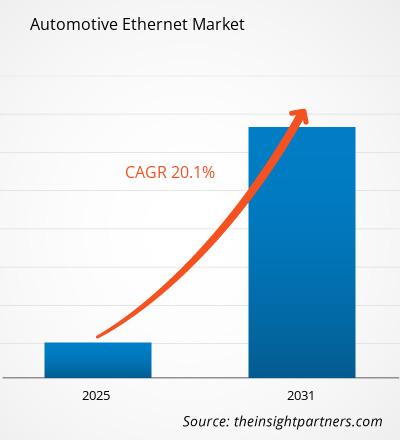
The Automotive Ethernet Market size is set to rise from US$ 3.53 Billion in 2025 to US$ 11.30 Billion by 2034; it is anticipated to achieve a CAGR of 13.80% between 2026 and 2034. Growth drivers include high-bandwidth vehicular networking, software-defined vehicles, consolidation of ADAS domains, and scalable communications backbone to aid in developing future-ready connected, electric, and autonomous mobility frameworks.
North America continues to be one of the key markets for automakers, Tier 1 suppliers, and semiconductor companies with anticipated CAGR ranging between 12.5-14.0% during 2034. In North America, the market is driven by high ADAS integration, early zonal architecture adoption, and semiconductor design innovations. The U.S.-based automotive companies are also speeding up Ethernet deployment for simplifying wiring, better diagnostics, and over-the-air software applications.
Automotive Ethernet Market Assessment and Insights
- North America held a 20–22% share in 2025 and is expected to grow at a CAGR range of 12.5–14.0% during 2026–2034, supported by ADAS integration and software-defined vehicle programs.
- US represented 83–86% of North America in 2025 and is expected to grow at a CAGR range of 12.8–14.2% during 2026–2034.
- Europe accounted for a 24–26% share in 2025 and is expected to grow at a CAGR range of 12.0–13.5% during 2026–2034, led by Germany, the UK, France, Italy, and Spain.
- Asia Pacific captured a 46–49% share in 2025 and is expected to grow at a CAGR range of 14.0–15.5% during 2026–2034, led by China, Japan, South Korea, and India.
- Largest Segment Passenger Cars held a market share range of 68–72% in 2025 and is expected to grow at a CAGR range of 13.0–14.2% during 2026–2034.
- High Growth Segment Driver Assistance held a market share range of 32–36% in 2025 and is expected to grow at a CAGR range of 15.0–16.5% during 2026–2034.
- Key companies analyzed in detail: Broadcom Inc., Cadence Design Systems, Inc., Marvell Technology, Inc., Microchip Technology Incorporated, Molex, LLC, NXP Semiconductors N.V., System-on-Chip Engineering S.L., Texas Instruments Incorporated, TTTech Auto AG, Vector Informatik GmbH
Source: The Insight Partners' analysis based on proprietary research, government publications, company annual reports, investor presentations, industry databases, and expert interviews.
Automotive networking architecture is shifting from distributed domain controllers to zonal or centralized computing systems, which alters the requirements for bandwidth, latency, and cabling. Ethernet is increasingly being used to connect cameras, radars, gateways, infotainment, and backbones due to the benefits of 100BASE-T1, 1000BASE-T1, and multi-gigabit networks for minimizing harnessing complexity and deterministic communications. Production readiness is focused on standards for interoperability, electromagnetic compatibility, safety certification, and supplier readiness.
Forward-looking requirements will increase with the rollout of centralized computing platforms by the OEMs into premium, electric, and volume passenger cars. Geographies emerging are projected to adopt Ethernet-based platforms based on increased regulation for safety, availability of advanced driver assistance systems, and connectivity within the connected cockpits. Investment by semiconductor vendors, OPEN alliance standards, and IEEE single-pair Ethernet standards will ensure supplier readiness.
Automotive Ethernet Market Report Scope
| Report Attribute | Details |
|---|---|
| Market size in 2025 | US$ 3.53 Billion |
| Market Size by 2034 | US$ 11.30 Billion |
| Global CAGR (2026 - 2034) | 13.80% |
| Historical Data | 2021-2024 |
| Forecast period | 2026-2034 |
Automotive Ethernet Market Analysis
Automotive Ethernet Market growth is propelled by the increasing amount of data generated by high resolution cameras, radar, lidar sensors, digital cockpits, and connectivity features. Traditional CAN, LIN, and FlexRay protocols have their use cases for slower in-vehicle control, but they cannot be scaled effectively for sensor fusion and centralized computing. Ethernet offers a more scalable architecture, light cable weight, and faster diagnostics throughout the vehicle.
Market players comprise semiconductor manufacturers, connector manufacturers, software stack companies, testing equipment providers, Tier 1 companies, and OEM architecture groups. Market dynamics will benefit those players who will be able to combine physical layer, switch, gateway, timing software, and qualification testing solutions. The qualification process is time-consuming due to strict automotive Ethernet requirements related to temperature, electromagnetic compatibility, latency, cybersecurity, and functional safety.
The Automotive Ethernet Market Analysis suggests that the industry is dominated by a few key players who are currently competing in the areas of PHYs, switches, silicon roadmaps; meanwhile, Cadence Design Systems, Inc., Vector Informatik GmbH, TTTech Auto AG, Molex, LLC, and System-on-Chip Engineering S.L. are enhancing their capabilities in design, tooling, timing, connector, and integration areas.
The focus of investment is moving towards multi-gigabit Ethernet, time-sensitive networking, cybersecurity ready gateways, and software-defined vehicle validation. The position of strategic advantage can be achieved through securing design wins with global OEMs, openness to OPEN Alliance standards, and capability of supporting zonal architecture across several generations of vehicles.
● REPORT CUSTOMIZATION
Tailor This Report To Align With Your Specific Business Requirements
This report can be customized to align precisely with your business objectives, scope, and target markets. Customization options include tailored segmentation, geography, competitive analysis, and strategic insights to support informed decision-making.
Customize This Report →WHAT YOU CAN ADJUST
- ● Segmentations
- ● Geography
- ● Competitive Analysis
- ● Language Preferences
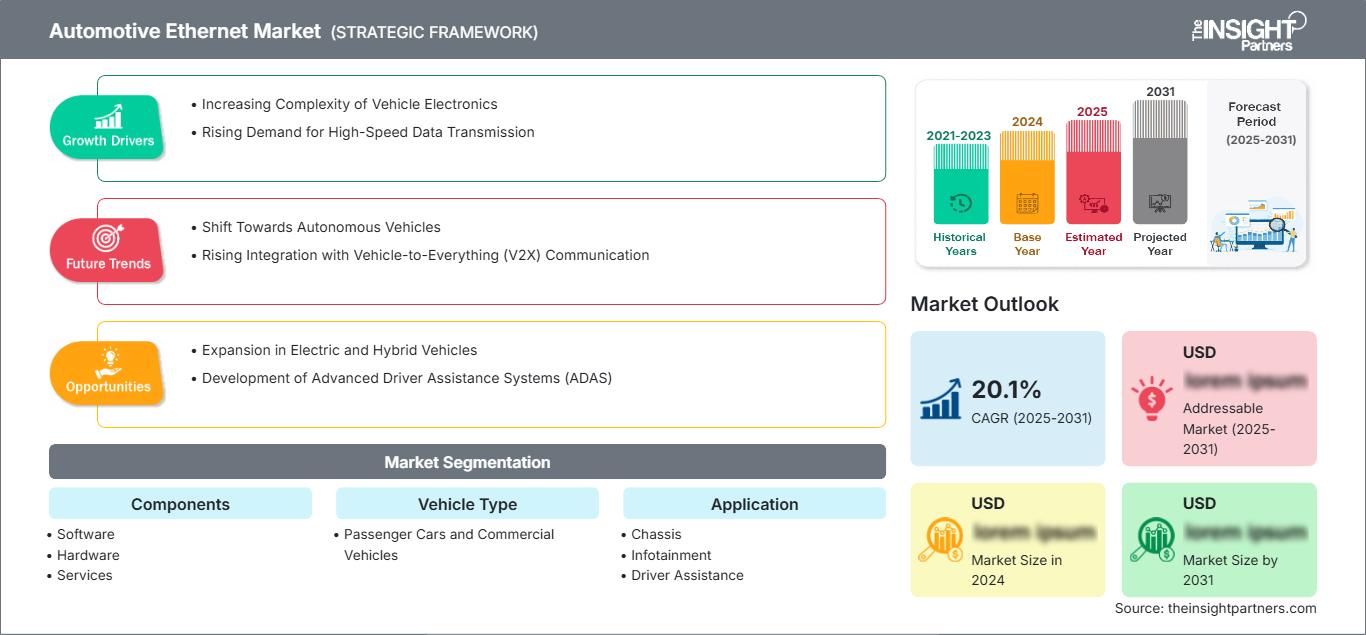
Automotive Ethernet Market: Strategic Insights
Regional Insights
North America Automotive Ethernet Market
North America accounted for a 20–22% share in 2025 and is forecast to expand at a CAGR range of 12.5–14.0% during 2026–2034. Automotive Ethernet Market share is supported by premium vehicle electronics content, ADAS deployment, cloud-connected diagnostics, and early adoption of zonal electrical architectures by established OEMs and technology-led suppliers.
Regional demand benefits from semiconductor design centers, validation labs, and close collaboration between automakers and connectivity suppliers. The U.S. leads regional deployment, while Canada and Mexico contribute through assembly footprints and supplier integration. Ethernet adoption is strongest in driver assistance, infotainment, and gateway applications, where bandwidth, update readiness, and reduced wiring complexity create measurable platform value.
U.S. Automotive Ethernet Market
The U.S. represented 83–86% of North America in 2025 and is projected to grow at a CAGR range of 12.8–14.2% from 2026 to 2034. Demand is tied to high ADAS fitment, digital cockpit programs, electric pickup and SUV platforms, and strong software-defined vehicle investment by domestic and global automakers.
Company presence is broad across silicon, tools, and integration. Broadcom Inc., Microchip Technology Incorporated, Texas Instruments Incorporated, Marvell Technology, Inc., and Cadence Design Systems, Inc. support product design and validation, while OEM programs increasingly deploy Ethernet in ADAS, infotainment, body networking, and centralized gateway applications. The market also benefits from strong venture activity around autonomous and connected mobility software.
Europe Automotive Ethernet Market
The European region had a market share of 24–26% in 2025 and is forecasted to have a CAGR of 12.0–13.5% between 2026 and 2034. Germany dominates the demand due to rapid advancements of zone-based architectures, high-speed backbones, safety controllers, and scalable vehicle platforms for electric and connected fleets.
This is done by premium OEMs and Tier 1 suppliers. The UK adds value through connected-vehicle engineering, motorsport electronics, and software validation. France, Italy, and Spain add demand due to passenger vehicle manufacturing, supplier network, and electrification. Vector Informatik GmbH, TTTech Auto AG, NXP Semiconductors N.V., and System-on-Chip Engineering S.L. provide ecosystem tools in Europe.
APAC Automotive Ethernet Market
APAC held a 46–49% market share in 2025 and is expected to exhibit a CAGR of 14.0–15.5% from 2026 to 2034. Leading countries include China, owing to its scale in electric vehicles, ADAS localization, intelligent cockpits, and centralized compute architecture implementations.
Advanced electronics suppliers and automotive manufacturing companies from Japan and South Korea have driven growth, whereas emerging use cases in connected mobility in India and Australia are driving growth. Government incentives in EVs, semiconductor development, and investments in software-defined vehicles have increased opportunities in Ethernet technology for applications such as passenger car, commercial fleet, infotainment, powertrain, and driver assistive technologies.
Middle East & Africa Automotive Ethernet Market
The Middle East and Africa region will witness a CAGR of 10.5-12.0% during the forecast period, 2026-2034. The adoption will be led by smart mobility investments, high-end cars, and diversified industries in Saudi Arabia, and connected vehicle initiatives and fleet modernization in the UAE.
The manufacturing hub in South Africa will play an important role in the adoption in the Rest of MEA segment. There is a scope for robust Ethernet-enabled gateway, infotainment, body, and comfort systems due to energy industry logistics, smart city initiatives, and need for high temperature performance.
Segmentation Analysis
Components
The components segment is expected to grow at a CAGR range of 13.2–14.5% during 2026–2034. Automotive Ethernet Market scope across components is expanding from discrete PHYs and switches toward integrated software, testing, connectors, and lifecycle services. Adoption is influenced by OEM platform reuse, supplier validation, cybersecurity readiness, and the need for reliable communication across harsh automotive environments.
- Software supports configuration, diagnostics, protocol stacks, and network management, becoming strategically important as OEMs validate time-sensitive networking, cybersecurity, and over-the-air update workflows across multiple vehicle platforms.
- Hardware remains the largest component base because switches, PHYs, gateways, connectors, and cabling are essential for high-speed in-vehicle communication, safety functions, and electromagnetic compatibility compliance.
- Services are gaining relevance as automakers seek architecture consulting, testing, interoperability validation, and integration support to reduce launch risk across complex software-defined vehicle programs.
Vehicle Type
The vehicle type segment is forecast to grow at a CAGR range of 13.0–14.4% during 2026–2034. Passenger cars dominate because premium and mid-range models increasingly include ADAS, infotainment, digital clusters, and connected services. Commercial vehicles are adopting Ethernet for fleet diagnostics, driver monitoring, telematics, and safety systems, particularly as electrified vans and trucks become more software intensive.
- Passenger Cars lead adoption because consumer expectations for safety, connectivity, digital cockpit features, and OTA updates require scalable networks that can support high data throughput.
- Commercial Vehicles show rising demand from fleet management, camera monitoring, electrified powertrains, and uptime-focused diagnostics, making Ethernet relevant for logistics, public transport, and specialty vehicles.
Application
The application segment is projected to grow at a CAGR range of 13.5–15.0% during 2026–2034. Ethernet is moving beyond infotainment into safety, power train, body, and comfort domains as automakers consolidate ECUs and increase sensor data exchange. Application demand is strongest where latency, reliability, and bandwidth affect user experience, vehicle safety, and platform scalability.
- Chassis uses Ethernet for coordinated control data, suspension systems, and safety-related communication where deterministic performance and fast diagnostics support advanced ride, handling, and stability features.
- Infotainment remains a major application because high-definition displays, streaming, navigation, smartphone integration, and cockpit domain controllers require reliable high-bandwidth links across vehicle interiors.
- Driver Assistance is strategically critical as cameras, radar, lidar, and sensor fusion units generate large data flows that depend on low-latency communication and scalable network backbones.
- Power Train demand is growing with electric propulsion, battery management, thermal control, and inverter communication, where robust data exchange supports efficiency, diagnostics, and safety oversight.
- Body and Comfort benefits from zonal controllers, smart lighting, seat electronics, climate systems, and access functions that can be consolidated through Ethernet-enabled network architectures.
Opportunity Snapshot
| Application | Revenue Contribution | Trend Tag | Adoption Stage |
| Chassis | Medium | Ride Control | Scaling |
| Infotainment | High | Digital Cockpit | Mature |
| Driver Assistance | High | Sensor Fusion | Scaling |
| Power Train | Medium | EV Control | Scaling |
| Body and Comfort | Medium | Zonal Comfort | Scaling |
| Others | Low | Gateway Links | Emerging |
Automotive Ethernet Market Growth Drivers and Impact Analysis
Shift to Zonal and Centralized Vehicle Architectures
Automakers have begun modifying their E/E architectures in order to simplify their wiring architecture as well as enable the development of features at an enhanced pace. Zonal architecture involves computing and gateway components located near the sensors and actuators, which require Ethernet connections capable of transferring data from one zone to another as well as the centralized processors. Such a modification will help to increase scalability, decrease harness mass, and make it easier to manage networking throughout different domains. The market effect will be seen first in luxury and electric cars followed by mass-market vehicles through leveraging the validated design.
Rising Data Loads from ADAS and Digital Cockpits
Advanced driver assistance and cockpit systems are increasing the volume of data moving inside vehicles. Multiple cameras, radar sensors, surround-view systems, displays, and domain controllers need synchronized, low-latency communication that legacy networks cannot deliver at scale. Ethernet provides bandwidth headroom and supports deterministic performance for safety-relevant functions. The commercial impact is visible in higher semiconductor content per vehicle and broader demand for validation tools, connectors, and services. As mid-range vehicles adopt more safety and display features, Automotive Ethernet Market demand becomes less dependent on luxury platforms and more tied to mainstream vehicle electronics.
Standardization and Supplier Ecosystem Maturity
OPEN Alliance specifications and IEEE single-pair Ethernet standards are reducing interoperability barriers across OEMs and suppliers. Standardized testing helps automakers qualify multi-vendor solutions, while component makers can scale products across global platforms. This maturity lowers adoption risk and supports procurement confidence for long lifecycle vehicles. Market impact also comes from faster toolchain development, better diagnostics, and improved electromagnetic compatibility practices. As standards cover more speeds and use cases, Ethernet becomes a platform technology rather than an isolated infotainment connection, strengthening long-term design-win visibility for semiconductor, connector, software, and engineering service providers.
Automotive Ethernet Market Future Trends
Multi-Gigabit Backbones for Software-Defined Vehicles
Automotive Ethernet Market trends will increasingly center on multi-gigabit backbones that connect centralized compute, sensor clusters, and digital cockpit domains. As vehicles handle more perception data and cloud-linked functions, OEMs will require network designs that support higher throughput without excessive cabling weight. Multi-gigabit Ethernet will also support modular software deployment because high-speed links make diagnostics, updates, and data logging more efficient. The trend favors suppliers with scalable portfolios across 100 Mbps, 1 Gbps, and 10 Gbps links, particularly when combined with robust validation and cybersecurity support.
Time-Sensitive Networking in Safety-Critical Domains
Time-sensitive networking is expected to become more important as Ethernet moves into safety-critical domains such as driver assistance, chassis coordination, and power train control. Deterministic communication enables predictable latency, which is essential when multiple sensors and controllers share a common backbone. Future platforms will likely specify tighter synchronization, redundancy, and monitoring functions to support automated driving features. This creates opportunities for silicon vendors, middleware providers, and testing companies that can prove compliance under real operating conditions and deliver validated architectures across several vehicle classes.
Automotive Ethernet Market Opportunities
Platform-Level Design Wins with Global OEMs
Automotive Ethernet Market Forecasts point to strong opportunity in platform-level design wins because automakers are reusing network architectures across multiple models and regions. A single qualified Ethernet solution can support several vehicle programs, creating multiyear revenue visibility for semiconductor, connector, and software suppliers. Vendors should prioritize early engagement with OEM architecture teams, offer reference designs, and support compliance testing. The most attractive opportunities will arise where suppliers combine physical-layer components with tools, diagnostics, cybersecurity features, and lifecycle support that reduce launch risk for high-volume software-defined vehicle platforms.
Localization in High-Volume Electric Vehicle Markets
High-volume electric vehicle markets present an opportunity for localized Ethernet ecosystems. China, India, and parts of Southeast Asia are building stronger automotive electronics supply chains, while domestic OEMs are adding ADAS, connected cockpit, and fleet software features to differentiated EV platforms. Suppliers that localize application engineering, compliance testing, and customer support can shorten validation timelines and improve design-win conversion. The opportunity is not limited to silicon; it includes connectors, harness design, protocol stacks, network simulation, and integration services tailored to cost-sensitive but software-rich vehicle programs.
Recent Developments
- June 2026: Molex, a global electronics and connectivity company, has expanded its proven HSAutoLink Interconnect portfolio, which has delivered more than 700 million connectors to the automotive industry since 2008. The new HSAutoLink G Connector System provides multi-gig Ethernet connectivity of up to 25Gbps in a compact, USCAR-compatible interface, designed to meet the growing bandwidth demands of Advanced Driver-Assistance Systems (ADAS), radar, LiDAR, zonal architecture, immersive displays, and central compute modules.
- June 2026: HMS Networks has announced the launch of its first Automotive Ethernet product under the PEAK brand, representing a major expansion of its in-vehicle networking (IVN) portfolio. The new PAE-Media Converter is a compact and rugged device designed to connect Automotive Ethernet networks based on 100BASE-T1 and 1000BASE-T1 standards with traditional Ethernet networks using 100BASE-TX and 1000BASE-T technologies.
- February 2026: KD is a technology provider specializing in optical transceiver solutions for high-performance communication systems. Its products support the reliable transmission of high-bandwidth data and are designed for use in demanding automotive and industrial environments. The partnership integrates KD’s KD7251 optical Ethernet transceiver with Vector’s VN5650 Ethernet Interface. This enables the validation and testing of optical Automotive Ethernet links within Vector’s established Ethernet measurement and simulation environment.
Frequently Asked Questions

- Comprehensive Market Sizing and Forecast Analysis
- Detailed Segmentation Analysis
- In-Depth Market Dynamics Assessment
- Regional and Country-Level Insights
- Competitive Landscape and Company Benchmarking
- Strategic Business Intelligence
Recent Reports
Testimonials

The Insight Partners' SCADA System Market report is comprehensive, with valuable insights on current trends and future forecasts. The team was highly professional, responsive, and supportive throughout. We are very satisfied and highly recommend their services.
RAN KEDEM Partner, Reali Technologies LTDs
I requested a report on a very specific software market and the team produced the report in a few days. The information was very relevant and well presented. I then requested some changes and additions to the report. The team was again very responsive and I got the final report in less than a week.
JEAN-HERVE JENN Chairman, Future Analytica
We worked with The Insight Partners for an important market study and forecast. They gave us clear insights into opportunities and risks, which helped shape our plans. Their research was easy to use and based on solid data. It helped us make smart, confident decisions. We highly recommend them.
PIYUSH NAGPAL Sr. Vice President, High Beam Global
The Insight Partners delivered insightful, well-structured market research with strong domain expertise. Their team was professional and responsive throughout. The user-friendly website made accessing industry reports seamless. We highly recommend them for reliable, high-quality research services
YUKIHIKO ADACHI CEO, Deep Blue, LLC.
This is the first time I have purchased a market report from The Insight Partners.While I was unsure at first, I visited their web site and felt more comfortable to take the risk and purchase a market report.I am completely satisfied with the quality of the report and customer service. I had several questions and comments with the initial report, but after a couple of dialogs over email with their analyst I believe I have a report that I can use as input to our strategic planning process.Thank you so much for taking the extra time and making this a positive experience.I will definitely recommend your service to others and you will be my first call when we need further market data.
JOHN SUZUKI President and Chief Executive Officer, Board Director, BK Technologies
I wish to appreciate your support and the professionalism you displayed in the course of attending to my request for information regarding to infectious disease IVD market in Nigeria. I appreciate your patience, your guidance, and the fact that you were willing to offer a discount, which eventually made it possible for us to close a deal. I look forward to engaging The Insight Partners in the future, all thanks to the impression you have created in me as a result of this first encounter.
DR CHIJIOKE ONYIA MANAGING DIRECTOR, PineCrest Healthcare Ltd.Reason to Buy
- Informed Decision-Making
- Understanding Market Dynamics
- Competitive Analysis
- Identifying Emerging Markets
- Customer Insights
- Market Forecasts
- Risk Mitigation
- Boosting Operational Efficiency
- Strategic Planning
- Investment Justification
- Tracking Industry Innovations
- Aligning with Regulatory Trends





 Get Free Sample for