
Automotive HMI Market Trends, Size & Forecast by 2034
Coverage: By Component (Hardware, Software, Services); Product (Instrument Cluster, Head-Up Display, Steering Mounted Control, Multifunction Switches, Others); Technology (Visual Interface, Haptic Interface, Mechanical Interface, Acoustic Interface, Others); End-User (Economic Passenger Car, Mid-Price Passenger Car, Luxury Passenger Car) , and Geography (North America, Europe, Asia Pacific, and South and Central America)
- Status : Data Released
- Report Code : TIPTE100000888
- Category : Electronics and Semiconductor
- No. of Pages : 150
- Available Report Formats :


- Last update date : July 17, 2026


2025 Market Size
US$ 27.83 Bn
Base year value
2034 Forecast
US$ 81.86 Bn
Projected by 2034
CAGR 2026-2034
12.74 %
Growth rate
Addressable Market
US$ 478.37 Bn
(2026-2034)
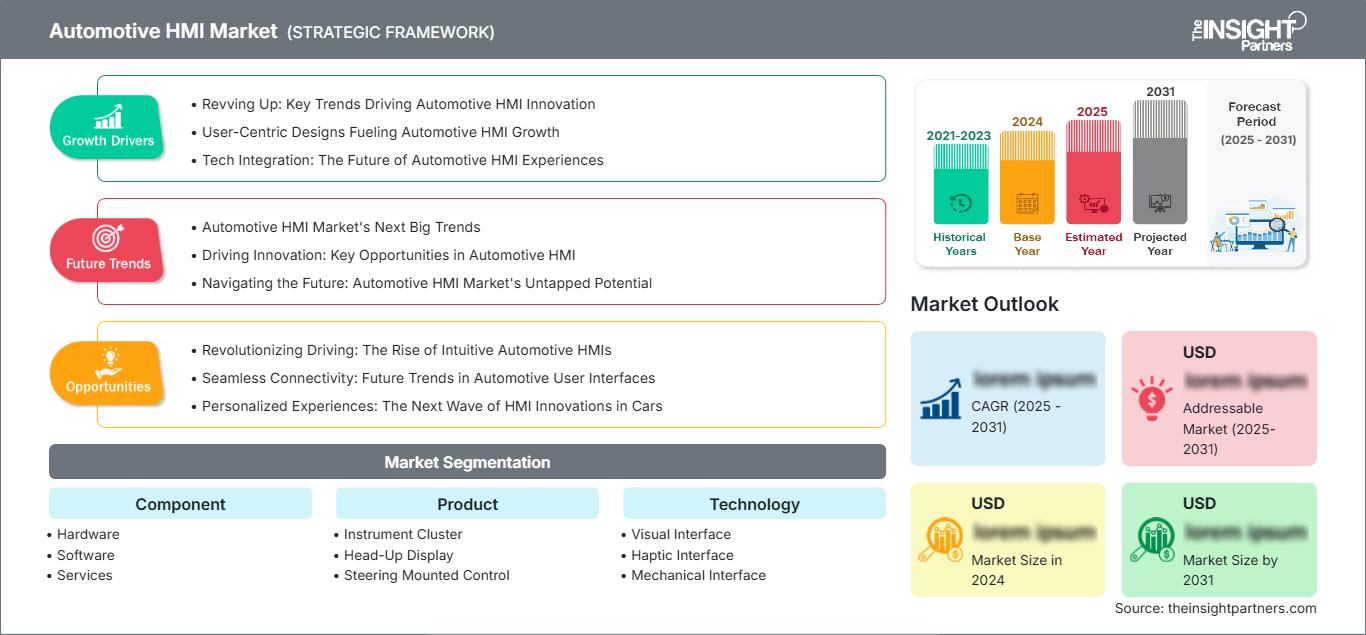
The Automotive HMI Market is projected to expand from US$ 27.83 Billion in 2025 to US$ 81.86 Billion by 2034, registering a CAGR of 12.74% during 2026–2034. The market exhibits growth in terms of integration of digital cluster, heads-up display, steer-by-wire, software-defined cockpit, and multimodal interface in passenger vehicles, due to the efforts made by manufacturers in designing the cabin with safer and easier interaction between drivers and their vehicles.
North America is forecast to be one of the key regions, with a projected CAGR in the range of 11.8%–12.4% till 2034. North America Automotive HMI Market size is driven by high adoption of advanced driver assistance systems (ADAS), connectivity services, and customer preference for bigger screens.
Automotive HMI Market Assessment and Insights
- North America accounted for 36–38% share in 2025 and is projected to grow at a CAGR of 11.8–12.4% between 2026–2034, led by connected vehicles, ADAS, and premium cockpit demand.
- US represented 78–82% of North America in 2025 and is expected to grow at a CAGR of 11.9–12.5% between 2026–2034, supported by EV launches and software ecosystems.
- Europe held 27–29% share in 2025 and is forecast to grow at a CAGR of 11.2–11.8% between 2026–2034, with Germany, France, and the UK leading regulated cockpit innovation.
- Asia Pacific captured 28–30% share in 2025 and is likely to grow at a CAGR of 13.8–14.6% between 2026–2034, led by China, Japan, South Korea, and India.
- Largest Segment Hardware held 54–57% market share in 2025 and is expected to grow at a CAGR of 11.5–12.1% during 2026–2034 as displays and controllers scale.
- High Growth Segment Software held 25–28% market share in 2025 and is projected to grow at a CAGR of 14.8–15.6% during 2026–2034 on cockpit OS demand.
- Key companies analyzed in detail: ALPS ALPINE CO., LTD.; Clarion Co., Ltd.; Continental AG; HARMAN International Industries, Incorporated; Intellias Ltd.; Luxoft, a DXC Technology Company; Marelli Holdings Co., Ltd.; Robert Bosch GmbH; Valeo SE; Visteon Corporation.
Source: The Insight Partners' analysis based on proprietary research, government publications, company annual reports, investor presentations, industry databases, and expert interviews.
Cockpit design in the automotive industry has progressed from standalone switches to digital cockpits where display, voice, haptic, and safety are combined. The production programs have shifted from viewing HMI as an optional software and electronics solution to one of the common solutions used by all models. Factors that influence procurement include semiconductor availability, display modules acquisition, security issues, and ownership of the software by the OEMs.
Between now and 2034, new geographies are adopting the digital cockpit owing to EV platform adoption, connected car services, and safety legislation beyond luxury cars. Investments are flowing into areas such as augmented reality head-up displays, artificial intelligence voice assistants, local interfaces and over-the-air cockpit software updates. Pressure to minimize distraction for the driver will drive adoption of the multimodal cockpit which presents information contextually.
Automotive HMI Market Report Scope
| Report Attribute | Details |
|---|---|
| Market size in 2025 | US$ 27.83 Billion |
| Market Size by 2034 | US$ 81.86 Billion |
| Global CAGR (2026 - 2034) | 12.74% |
| Historical Data | 2021-2024 |
| Forecast period | 2026-2034 |
Automotive HMI Market Analysis
There is increasing demand due to increased electronic content per vehicle, alerts in advanced driver assistance systems, and consumer requirements of cockpit usability similar to smartphones. The Automotive HMI market growth can be attributed to migration from analog instrument clusters to configurable displays where navigation, energy status, entertainment and safety warnings are handled through software layers.
The supply chain comprises of display companies, embedded software companies, Tier-1 companies, semiconductor companies, cloud computing companies and OEMs. There is an increase in influence of cockpit domain controllers, availability of OLED and mini LED displays, functional safety certification and human factor testing in platform development.
It is focused around players that are able to provide hardware reliability together with scalability of software solutions. Based on Automotive HMI Market report, it can be stated that such companies as Robert Bosch GmbH, Continental AG, Valeo SE, Visteon Corporation, and HARMAN International Industries, Incorporated operate in areas of cockpit electronics, infotainment, displays, and connectivity experience.
Specialists like Intellias Ltd. and Luxoft, a DXC Technology Company are becoming more relevant as OEMs delegate development of user interface, middleware and validation. ALPS ALPINE CO., LTD., Clarion Co., Ltd., and Marelli Holdings Co., Ltd. reinforce supply chain with controls, infotainment, and cockpit modules designed for regional vehicles.
● REPORT CUSTOMIZATION
Tailor This Report To Align With Your Specific Business Requirements
This report can be customized to align precisely with your business objectives, scope, and target markets. Customization options include tailored segmentation, geography, competitive analysis, and strategic insights to support informed decision-making.
Customize This Report →WHAT YOU CAN ADJUST
- ● Segmentations
- ● Geography
- ● Competitive Analysis
- ● Language Preferences
Automotive HMI Market: Strategic Insights
Regional Insights
North America Automotive HMI Market
North America held 36–38% share in 2025 and is expected to grow at a CAGR of 11.8–12.4% during 2026–2034. The Automotive HMI Market share is supported by high adoption of connected infotainment, premium trims, and advanced driver assistance. Regional OEMs are integrating larger clusters, embedded navigation, and voice-enabled controls into mainstream passenger vehicles.
Structural growth is tied to EV launches, software-defined vehicle architectures, and consumer willingness to pay for digital cabin upgrades. Suppliers with U.S. engineering centers use the region for early cockpit validation, cybersecurity testing, and cloud-connected feature deployment before global rollout.
U.S. Automotive HMI Market
The U.S. represented 78–82% of North America in 2025 and is projected to expand at a CAGR of 11.9–12.5% through 2034. Demand is anchored in electric pickups, SUVs, premium sedans, and connected service platforms. Automakers are prioritizing digital clusters, central displays, and driver-monitoring prompts that reduce cognitive load.
Company presence is strong across Tier-1 integration, software engineering, and display validation. HARMAN International Industries, Incorporated, Visteon Corporation, Robert Bosch GmbH, and Continental AG support U.S. programs with infotainment platforms, domain controllers, AR display concepts, and connected cockpit software aligned with OEM brand differentiation.
Europe Automotive HMI Market
Europe accounted for 27–29% share in 2025 and is forecast to grow at a CAGR of 11.2–11.8% during 2026–2034, with Germany leading. With the help of EU’s safety regulations, adoption of driver monitoring technologies, and premium cockpit designs, suppliers are being encouraged towards certified HMI software, redundancy systems for alerting mechanisms, and user experience standards.
While the United Kingdom is concerned about the provision of connected services and validation of software, Germany focuses on the scale up of digital cockpit owing to its luxury and performance vehicles. France, Italy, and Spain have contributions in this regard owing to their compact passenger cars, infotainment localization, and supplier manufacturing presence.
APAC Automotive HMI Market
APAC held 28–30% share in 2025 and is projected to grow at a CAGR of 13.8–14.6% during 2026–2034, making it the fastest-growing region. China leads on EV cockpit integration, while Japan and South Korea contribute display, semiconductor, and premium interface expertise.
India and Australia add demand through connected passenger vehicles, safety upgrades, and rising mid-price car digitalization. Policy support for EVs, local electronics production, and high consumer engagement with in-car digital services accelerate regional content growth.
Middle East & Africa Automotive HMI Market
Middle East & Africa is expected to grow at a CAGR of 9.8–10.6% through 2034. Adoption is led by Saudi Arabia and UAE with premium import vehicles, EV infrastructure and smart mobility strategies, and South Africa with passenger vehicle manufacturing and aftermarket infotainment systems upgrades.
Diversification of energy resources, investments in urban infrastructure, and fleet updates are making connected cockpits more compelling. The rest of MEA region’s adoption will be selective with applications limited to high trim models, navigation, safety warnings, and climate controls.
Segmentation Analysis
Component
The component segment is projected to grow at a CAGR of 12.0–12.8% during 2026–2034. Automotive HMI Market forecast across components covers cockpit electronics, embedded applications, integration services, testing, and lifecycle updates. Hardware remains essential, but software and services gain value as OEMs extend functions through over-the-air releases.
- Hardware includes displays, controllers, sensors, switches, and haptic modules. Demand remains high because every digital cockpit requires durable automotive-grade electronics validated for temperature, vibration, and safety standards.
- Software manages graphics, voice interaction, personalization, diagnostics, and safety alerts. Strategic importance is rising as automakers seek flexible cockpit platforms that can be updated after vehicle sale.
- Services cover integration, UI design, validation, cybersecurity testing, and maintenance. Demand is strongest where OEMs lack internal cockpit software scale or require regional interface localization.
Product
The product segment is expected to grow at a CAGR of 12.2–13.0% during 2026–2034. Product demand is shifting from isolated cockpit elements toward coordinated display and control systems. Instrument clusters dominate current deployment, while head-up displays and steering controls gain importance as safety information moves closer to the driver’s field of view.
- Instrument Cluster remains the anchor cockpit display, presenting speed, alerts, navigation, and EV status. Digital versions help OEMs standardize layouts across trims and vehicle platforms.
- Head-Up Display is gaining strategic value by projecting navigation, ADAS warnings, and speed information into the driver’s sightline, reducing eye movement and improving premium differentiation.
- Steering Mounted Control supports safer interaction by keeping key functions within reach. Demand is strongest in vehicles with audio, driver assistance, and display menus controlled from the wheel.
- Multifunction Switches remain relevant where tactile confirmation is required. They balance digital cockpit migration by preserving dependable physical control for lighting, wipers, indicators, and comfort functions.
Technology
The technology segment is projected to grow at a CAGR of 12.4–13.2% during 2026–2034. Interface design is becoming multimodal as visual, haptic, mechanical, and acoustic cues are combined to lower driver distraction. Automakers increasingly tune interaction modes by driving context, vehicle speed, user preference, and regulatory constraints.
- Visual Interface leads adoption through clusters, center displays, and HUDs. Its role expands as vehicles communicate ADAS status, battery data, navigation, and connected service information.
- Haptic Interface adds touch confirmation to screens, switches, and steering controls. It supports safer interaction by reducing uncertainty when drivers use controls without extended visual attention.
- Mechanical Interface remains important for dependable tactile operation. Physical knobs, stalks, and switches are retained for functions where immediate feedback and regulatory familiarity matter.
- Acoustic Interface includes voice prompts, alerts, and natural language commands. Demand rises as hands-free interaction becomes central to navigation, climate control, communication, and infotainment.
End-User
The end-user segment is forecast to grow at a CAGR of 12.3–13.1% during 2026–2034. Adoption is spreading from luxury cabins into mid-price and economic passenger cars as display costs decline and digital features become purchase criteria. Luxury vehicles still introduce advanced systems first, but mass adoption increasingly determines volume growth.
- Economic Passenger Car demand centers on cost-efficient clusters, basic infotainment, and essential alerts. Strategic value lies in scaling standardized digital controls without increasing vehicle pricing sharply.
- Mid-Price Passenger Car is the largest adoption base, combining digital clusters, larger displays, connected navigation, and steering controls. OEMs use this tier to mainstream cockpit technology.
- Luxury Passenger Car drives advanced HUDs, OLED displays, AI assistants, and personalized interfaces. Innovations validated here often migrate to mid-price platforms within one or two vehicle cycles.
Opportunity Snapshot
| End-User | Revenue Contribution | Trend Tag | Adoption Stage |
| Economic Passenger Car | Medium | Basic Digital | Scaling |
| Mid-Price Passenger Car | High | Connected Cockpit | Mature |
| Luxury Passenger Car | High | AR HUD | Scaling |
Automotive HMI Market Growth Drivers and Impact Analysis
Software-Defined Vehicle Architectures Reshape Cockpit Design
SDVs are transforming procurement of HMIs as cockpit applications have become dependent on computing systems, middleware, cloud, and upgradable GUI. OEMs are transitioning from numerous discrete control units to domain controllers which enable management of cluster graphics, infotainment, driving notifications, and personalization. This results in higher software value per unit and longer supplier involvement post launch. Market influence is evident through long-term platform deals, increased validation demand, and supplier negotiating power with the right combination of hardware with automotive capabilities and software engineering.
ADAS Expansion Increases Demand for Contextual Driver Alerts
The proliferation of ADAS is causing an increase in the number of safety-critical messages that have to be conveyed without diverting the attention of the driver. Lane warning, adaptive cruise control status, blind spot warnings, parking aid, and driver monitoring prompts necessitate a coordinated use of visual, auditory, and haptic channels of communication. As these ADAS functions expand to reach mid-range cars, the HMI system becomes crucial for meeting the requirements for compliance and usability. The commercial implication is the move towards safety layers in the cockpit of the future.
EV Adoption Raises the Value of Digital Cabin Information
The electric cars need much better communication with the driver compared to traditional vehicles. Information about the status of the battery, range estimates, charging routing, regenerative braking, thermal information, and energy consumption analysis rely on effective HMI visualization. Such demands raise the importance of having configurable displays, maps, and personalization options. The market effect will be especially evident where new EV platforms are created, which will allow car manufacturers to combine the cockpit software with the battery management system and the telematics of charging stations.
Automotive HMI Market Future Trends
AI-Led Multimodal Cockpits Become Standardized
The Automotive HMI Market trends show the move towards AI-driven cockpit that is an integration of voice recognition, touch, eyes movement, haptic feedback, and predictive recommendation under one interaction layer. In the future, such technology would recognize users’ preferred routes, climate preferences, entertainment options, and recharging patterns and would adapt their display according to their driving situation. The future trend would benefit suppliers that would be able to provide natural language processing, edge computing, and safe personalization technology. Eventually, there would be a need for multimodal architectures.
Augmented Reality Displays Shift Toward Wider Adoption
Augmented Reality Head-Up Displays are likely to evolve from being exclusive differentiators for luxury vehicles to becoming part of wider automotive programs as display technologies, optics, and windshields continue to develop. These types of displays are capable of providing such data as navigation routes, lane information, potential hazards, and Advanced Driver Assistance System statuses. Their successful deployment will rely on their affordability, sun resistance, calibration, and conformity to distraction standards. Suppliers combining optical engineering with software will have an advantage in meeting OEMs' growing requirements.
Automotive HMI Market Opportunities
Mid-Price Passenger Cars Create Scalable Cockpit Programs
Mid-range passenger vehicles present the most promising volume potential since today’s consumer is expecting connected navigation, digital cockpits, smartphone connectivity, and configurability of interfaces without paying a premium price tag. According to the Automotive HMI Market Forecast, suppliers will be able to increase their profitability with the development of modular solutions in terms of displays and software for regional platform applications. The rationale behind this idea is based on reusable UI architectures, validation libraries, and flexible hardware requirements.
Localized Interface Engineering Expands Supplier Differentiation
The possibility of localization has emerged as a practical one due to the growing sales of connected cars by carmakers in various markets where languages, driver behavior, navigational habits, and regulations are different. The interface design today incorporates not only typography but also voice recognition and alert timing, map behavior, and user expectations regarding touch and voice commands. Value creation may occur at the level of regional testing, human factors study, and software adjustment after the go-live phase. This option is particularly relevant to Intellias Ltd. and Luxoft, a DXC Technology Company.
Recent Developments
- June 2026: Volkswagen Group's e.solutions partnered with HCLTech for a multi-year collaboration to develop next-generation software-defined infotainment and connectivity solutions for vehicles. The partnership will focus on AI-enabled platforms built on Android Automotive, supporting advanced in-car digital experiences and connected vehicle features. HCLTech will contribute to the development, integration, and validation of human-machine interface (HMI) software for multiple vehicle programs across global markets.
- June 2026: Volkswagen Group's e.solutions partnered with HCLTech through a multi-year strategic agreement to develop next-generation automotive infotainment and connectivity solutions. The collaboration will focus on AI-enabled, software-defined vehicle platforms based on Android Automotive, supporting advanced digital cockpit experiences. HCLTech will help develop, integrate, and validate human-machine interface (HMI) software for multiple vehicle programs across global markets, strengthening Volkswagen's connected vehicle ecosystem.
- June 2026: Candera and Magic Lane announced a strategic partnership to integrate advanced navigation capabilities into human-machine interfaces (HMIs) developed with Candera’s CGI Studio platform. The collaboration will provide reference implementations for automotive in-vehicle infotainment (IVI), motorcycles, and e-bike applications across different hardware platforms. By combining Candera’s HMI development tools with Magic Lane’s navigation technology, OEMs and Tier 1 suppliers can accelerate the creation of connected, navigation-enabled digital cockpit experiences.
Frequently Asked Questions

- Comprehensive Market Sizing and Forecast Analysis
- Detailed Segmentation Analysis
- In-Depth Market Dynamics Assessment
- Regional and Country-Level Insights
- Competitive Landscape and Company Benchmarking
- Strategic Business Intelligence
Recent Reports
Testimonials

The Insight Partners' SCADA System Market report is comprehensive, with valuable insights on current trends and future forecasts. The team was highly professional, responsive, and supportive throughout. We are very satisfied and highly recommend their services.
RAN KEDEM Partner, Reali Technologies LTDs
I requested a report on a very specific software market and the team produced the report in a few days. The information was very relevant and well presented. I then requested some changes and additions to the report. The team was again very responsive and I got the final report in less than a week.
JEAN-HERVE JENN Chairman, Future Analytica
We worked with The Insight Partners for an important market study and forecast. They gave us clear insights into opportunities and risks, which helped shape our plans. Their research was easy to use and based on solid data. It helped us make smart, confident decisions. We highly recommend them.
PIYUSH NAGPAL Sr. Vice President, High Beam Global
The Insight Partners delivered insightful, well-structured market research with strong domain expertise. Their team was professional and responsive throughout. The user-friendly website made accessing industry reports seamless. We highly recommend them for reliable, high-quality research services
YUKIHIKO ADACHI CEO, Deep Blue, LLC.
This is the first time I have purchased a market report from The Insight Partners.While I was unsure at first, I visited their web site and felt more comfortable to take the risk and purchase a market report.I am completely satisfied with the quality of the report and customer service. I had several questions and comments with the initial report, but after a couple of dialogs over email with their analyst I believe I have a report that I can use as input to our strategic planning process.Thank you so much for taking the extra time and making this a positive experience.I will definitely recommend your service to others and you will be my first call when we need further market data.
JOHN SUZUKI President and Chief Executive Officer, Board Director, BK Technologies
I wish to appreciate your support and the professionalism you displayed in the course of attending to my request for information regarding to infectious disease IVD market in Nigeria. I appreciate your patience, your guidance, and the fact that you were willing to offer a discount, which eventually made it possible for us to close a deal. I look forward to engaging The Insight Partners in the future, all thanks to the impression you have created in me as a result of this first encounter.
DR CHIJIOKE ONYIA MANAGING DIRECTOR, PineCrest Healthcare Ltd.Reason to Buy
- Informed Decision-Making
- Understanding Market Dynamics
- Competitive Analysis
- Identifying Emerging Markets
- Customer Insights
- Market Forecasts
- Risk Mitigation
- Boosting Operational Efficiency
- Strategic Planning
- Investment Justification
- Tracking Industry Innovations
- Aligning with Regulatory Trends





 Get Free Sample for