
Automotive IoT Market Trends, Size & Growth by 2034
Automotive IoT Market Size and Forecasts (2021 - 2034), Global and Regional Share, Trends, and Growth Opportunity Analysis Report Coverage : By Offering (Hardware, Software, Services), Connectivity Form Factor (Embedded, Tethered, Integrated), Application (Navigation, Telematics, Infotainment)
- Status : Data Released
- Report Code : TIPRE00039739
- Category : Electronics and Semiconductor
- No. of Pages : 150
- Available Report Formats :


- Last update date : July 20, 2026


2025 Market Size
US$ 214.95 Bn
Base year value
2034 Forecast
US$ 599.05 Bn
Projected by 2034
CAGR 2026-2034
12.06 %
Growth rate
Addressable Market
US$ 3,568.11 Bn
(2026-2034)
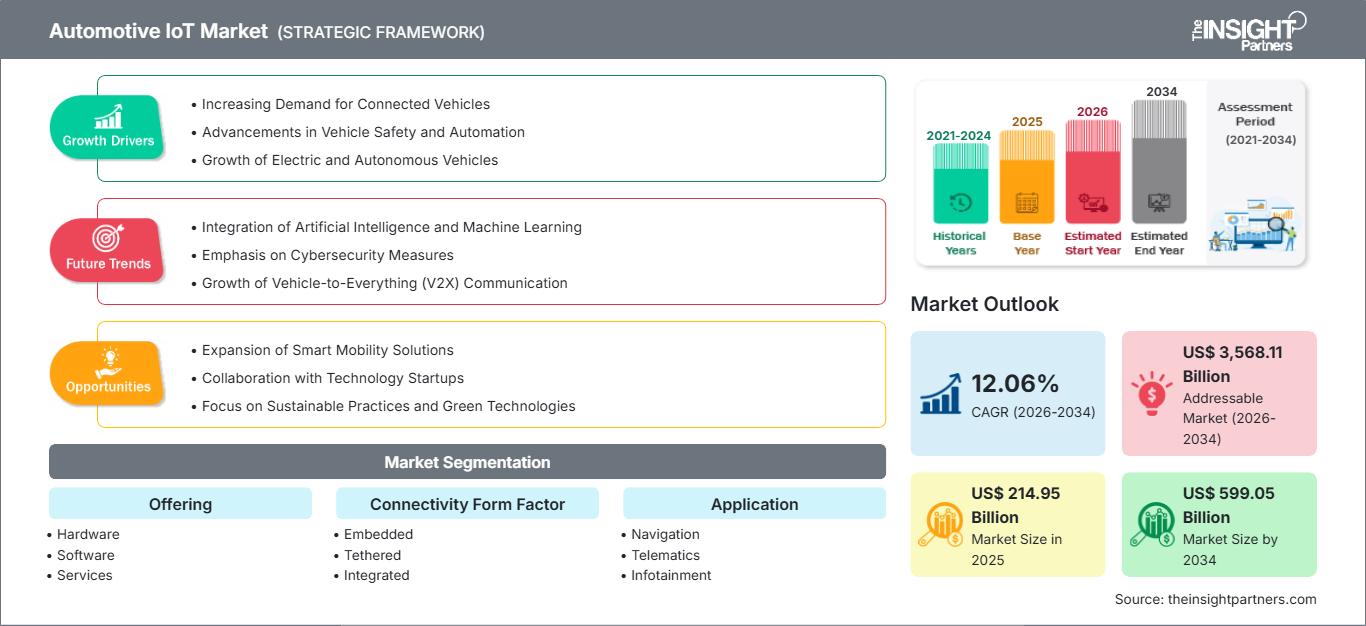
The Automotive IoT market was valued at US$ 214.95 billion in 2025 and is projected to reach US$ 599.05 billion by 2034, registering a CAGR of 12.06% during 2026–2034. Demand is expanding as connected vehicles, software-defined platforms, telematics control units, cloud analytics, embedded sensors, and secure vehicle networks become central to vehicle safety, ownership experience, fleet efficiency, and post-sale digital services.
Across North America, Automotive IoT market size expansion is expected to track a CAGR of 10.8–12.4% during 2026–2034, supported by connected fleet modernization and OEM investment in over-the-air software capability. Growth is reinforced by 5G coverage, insurance telematics, electric vehicle diagnostics, and data-driven maintenance programs that require reliable embedded connectivity and cybersecurity-ready platforms.
Automotive IoT Market Assessment and Insights
- North America accounted for 29–33% share in 2025 and is growing at a CAGR of 10.8–12.4% during 2026–2034, led by fleet telematics, embedded connectivity, cybersecurity investment, and software-defined vehicle launches.
- US represented 77–81% of North American revenue in 2025 and is growing at a CAGR of 11.0–12.6% during 2026–2034, driven by connected fleets and EV diagnostics.
- Europe held 24–28% share in 2025 and is growing at a CAGR of 10.2–11.8% during 2026–2034, with Germany, the UK, France, Italy, and Spain leading regulatory and OEM adoption.
- Asia Pacific held 31–35% share in 2025 and is growing at a CAGR of 12.8–14.6% during 2026–2034, led by China, Japan, South Korea, India, and Australia.
- Largest Segment Hardware held 43–47% market share in 2025 and is growing at a CAGR of 10.4–11.9% during 2026–2034 because embedded modules, sensors, gateways, and control units remain foundational.
- High Growth Segment Services represented 22–26% market share in 2025 and is growing at a CAGR of 13.6–15.4% during 2026–2034, supported by analytics, subscriptions, and managed connectivity.
- Key companies analyzed in detail: NXP Semiconductors N.V.; HARMAN International Industries, Inc.; Robert Bosch GmbH; Thales S.A.; TomTom N.V.; IBM Corporation; Geotab Inc.; Intel Corporation; Renesas Electronics Corporation; STMicroelectronics N.V.; Infineon Technologies AG; Texas Instruments Incorporated.
Source: The Insight Partners' analysis based on proprietary research, government publications, company annual reports, investor presentations, industry databases, and expert interviews.
Vehicle connectivity has moved from infotainment add-ons to a core design layer linking powertrain controls, safety systems, navigation, cloud platforms, digital cockpit functions, and fleet operations. Automotive IoT suppliers now compete on secure edge processing, embedded connectivity, low-latency data exchange, and scalable software update capability. Production dynamics are shifting as OEMs consolidate electronic architectures, reduce fragmented control units, and demand platforms that support long vehicle lifecycles.
Forward demand will be shaped by connected commercial fleets, electric mobility, AI-enabled diagnostics, and regulatory emphasis on road safety and emergency response. Asia Pacific should remain the fastest expanding region, while North America and Europe prioritize high-value software, cybersecurity, and compliance-driven deployments. Investment will increasingly flow toward embedded telematics, secure identity, cloud analytics, and services that convert vehicle data into operational decisions.
Automotive IoT Market Report Scope
| Report Attribute | Details |
|---|---|
| Market size in 2025 | US$ 214.95 Billion |
| Market Size by 2034 | US$ 599.05 Billion |
| Global CAGR (2026 - 2034) | 12.06% |
| Historical Data | 2021-2024 |
| Forecast period | 2026-2034 |
Automotive IoT Market Analysis
Automotive IoT market growth is being driven by the rising share of vehicles designed as connected computing platforms rather than isolated mechanical products. The IEA reported electric car sales exceeding 17 million units in 2024 and expected global sales above 20 million in 2025, increasing demand for battery diagnostics, charging intelligence, and predictive maintenance. Connected car volumes also continue rising as OEMs embed telematics for safety, navigation, remote services, and lifecycle software upgrades.
The value chain includes semiconductor vendors, module makers, connectivity providers, software developers, cloud platforms, cybersecurity specialists, Tier 1 integrators, insurers, fleet operators, mapping firms, and vehicle manufacturers. Supply dynamics depend on automotive-grade chips, cellular modules, eSIM management, validation capacity, data governance, and compliance with safety and privacy requirements. Buyers increasingly evaluate interoperability, uptime, security certification, and data monetization potential.
Automotive IoT market analysis indicates a competitive landscape where semiconductor breadth, cloud integration, software capability, and automotive qualification depth define positioning. NXP Semiconductors N.V., Infineon Technologies AG, STMicroelectronics N.V., Texas Instruments Incorporated, Renesas Electronics Corporation, and Intel Corporation strengthen the hardware base. HARMAN International Industries, Inc., Robert Bosch GmbH, Thales S.A., TomTom N.V., IBM Corporation, and Geotab Inc. expand value through platforms, data, cybersecurity, mapping, and fleet services.
Investment is moving toward secure vehicle gateways, telematics control units, satellite-assisted connectivity, edge AI, digital twins, and managed data services. Strategic positioning depends on the ability to support global OEM programs while adapting to regional network standards and privacy rules. Suppliers with proven security, over-the-air update orchestration, and analytics partnerships can capture higher recurring value than vendors selling standalone hardware.
● REPORT CUSTOMIZATION
Tailor This Report To Align With Your Specific Business Requirements
This report can be customized to align precisely with your business objectives, scope, and target markets. Customization options include tailored segmentation, geography, competitive analysis, and strategic insights to support informed decision-making.
Customize This Report →WHAT YOU CAN ADJUST
- ● Segmentations
- ● Geography
- ● Competitive Analysis
- ● Language Preferences
Automotive IoT Market: Strategic Insights
Regional Insights
North America Automotive IoT Market
North America accounted for 29–33% of Automotive IoT market share in 2025 and is projected to grow at a CAGR of 10.8–12.4% during 2026–2034. Demand is supported by fleet electrification, usage-based insurance, connected commercial vehicles, and strong cloud infrastructure. The region benefits from early adoption of embedded telematics in pickups, premium cars, logistics fleets, and public safety vehicles.
OEMs and suppliers emphasize cybersecurity, over-the-air updates, remote diagnostics, and compliance-ready data handling. The United States leads because of software investment, connected fleet density, and active participation from semiconductor, cloud, and telematics companies. Canada and Mexico contribute through vehicle production, cross-border logistics, and regional connected mobility programs.
U.S. Automotive IoT Market
The U.S. represented 77–81% of North American revenue in 2025 and is expected to grow at a CAGR of 11.0–12.6% during 2026–2034. Company presence is deep, with HARMAN International Industries, Inc., IBM Corporation, Intel Corporation, Texas Instruments Incorporated, Geotab Inc., and major automotive suppliers supporting connectivity, cloud analytics, vehicle compute, and fleet intelligence.
Application trends favor telematics, predictive maintenance, digital cockpit personalization, electric vehicle charging support, and remote software management. Fleet operators use connected data to reduce downtime, monitor driver behavior, and optimize routing. OEMs increasingly connect vehicles at launch because post-sale software services can protect margins even when vehicle sales cycles soften.
Europe Automotive IoT Market
Europe’s market share in 2025 is 24–28%, while its CAGR for 2026–2034 is 10.2–11.8%. Germany is the leader in Europe due to the importance of secure vehicle networks and software-defined systems for premium OEMs, Tier 1 providers, and the semiconductor ecosystem. The UK adds through insurance telematics, fleet management, and connected mobility projects.
France, Italy, and Spain contribute through the production of passenger cars and commercial fleets, the digitization of public transportation, and eCall-related requirements. European customers are highly concerned about data protection, functional safety, and software governance during the life cycle. Suppliers who can offer both security and mapping, along with data processing in compliance, are getting an advantage in connected service deployments.
APAC Automotive IoT Market
Asia Pacific region held a market share of 31-35% in 2025 and is expected to witness a CAGR of 12.8%-14.6% during 2026-2034. It is led by China, given its leadership in electric vehicle technology, digital cockpits, cloud-based ecosystems, and the implementation of connected navigation and vehicle data services.
Japan and South Korea continue to succeed in semiconductors and electronics, whereas India and Australia have some potential in emerging technologies such as telematics, logistics, and fleet management. Electric vehicles, smart-city ideas, and local electronics production are fueling this segment of the market.
Middle East & Africa Automotive IoT Market
The Middle East & Africa market is projected to grow at a CAGR of 9.4–10.8% during 2026–2034. Saudi Arabia leads as smart city projects, EV infrastructure, logistics modernization, and premium vehicle demand raise the need for connected platforms. The UAE supports adoption through mobility services, connected fleets, and digital infrastructure.
The significance of South Africa is evident in fleet tracking, aftermarket telematics, and regional vehicle manufacturing, while the Rest of the MEA market sees a boost in demand driven by mining, oil and gas logistics, public transport, and safety. Harsh climates increase the value of ruggedized hardware and reliable network fallback.
Segmentation Analysis
Offering
Offering is projected to grow at a CAGR of 11.4–13.0% during 2026–2034. The Automotive IoT market scope covers hardware, software, and services that jointly convert vehicle signals into operational intelligence. Hardware enables data capture, software manages analytics and applications, while services support connectivity management, cybersecurity, updates, and lifecycle optimization. Adoption is strongest where OEMs and fleets can reduce downtime or create recurring revenue.
- Hardware holds the largest position because sensors, gateways, embedded modules, telematics control units, and processors are required before connectivity, data exchange, or remote diagnostics can operate reliably.
- Software demand is increasing as automakers deploy analytics, operating layers, cybersecurity tools, navigation intelligence, update orchestration, and user experience platforms across vehicle programs.
- Services carry strategic importance because managed connectivity, data platforms, predictive maintenance, fleet support, and cybersecurity monitoring convert installed systems into recurring operational value.
Connectivity Form Factor
Connectivity Form Factor is forecast to grow at a CAGR of 11.8–13.4% during 2026–2034. Embedded systems are favored for safety, compliance, and long-term control, while tethered and integrated formats remain relevant for consumer-driven experiences. Automakers increasingly choose form factors based on cybersecurity responsibility, data ownership, update requirements, and expected service revenue throughout the vehicle lifecycle.
- Embedded solutions dominate mission-critical use because built-in connectivity supports emergency calling, remote diagnostics, software updates, fleet visibility, and secure vehicle-cloud communication.
- Tethered connectivity remains useful in cost-sensitive vehicles where smartphone links support navigation, entertainment, and selected data functions without full embedded hardware investment.
- Integrated systems appeal to OEMs seeking seamless cockpit experiences, combined device access, app ecosystems, and vehicle services that blend embedded hardware with personal devices.
Application
Application is projected to grow at a CAGR of 12.2–13.8% during 2026–2034. Navigation, telematics, and infotainment represent the visible value of connected vehicles, but their strategic importance extends into safety, retention, fleet productivity, and data-based services. Growth is strongest when applications use real-time vehicle signals, location data, and cloud intelligence to improve decisions for drivers, operators, and OEMs.
- Navigation benefits from real-time traffic, charging station visibility, route optimization, and map updates that improve driver convenience and support electric vehicle range planning.
- Telematics is the most operationally critical application because it supports fleet monitoring, diagnostics, emergency response, usage-based insurance, maintenance planning, and regulatory reporting.
- Infotainment remains strategically important as connected cabins, content services, voice assistants, app stores, and personalization influence brand experience and post-sale monetization.
Opportunity Snapshot
| Application | Revenue Contribution | Trend Tag | Adoption Stage |
| Navigation | Medium | Route Intelligence | Scaling |
| Telematics | High | Fleet Uptime | Mature |
| Infotainment | Medium | Digital Cabin | Scaling |
Automotive IoT Market Growth Drivers and Impact Analysis
Connected fleets convert vehicle data into operating savings
The commercial fleet industry has begun using connected systems to minimize downtime, control fuel or battery consumption, ensure safety, and track vehicle performance. Telematics data enables them to identify harsh driving, inefficient routes, maintenance risks, and asset underutilization before they become costly. The market effect is powerful because fleets can calculate their return on investment in terms of fewer breakdowns, more effective dispatching, and improved regulatory compliance. As a result, purchases will be made not for the tracking solutions but for the vehicle data service packages.
Software-defined vehicles require secure embedded connectivity
The continuous flow of information among sensors, processors, cloud services, apps, and service providers is inherent to software-defined cars. Connected devices enable over-the-air upgrades, feature unlocking, cybersecurity upgrades, diagnostics, and individualization. From a market perspective, there is a shift from the existing pattern of offering connectivity as a post-purchase add-on to vehicles to offering more of it at launch. To address these requirements, car manufacturers need platforms that are safe over extended periods, comply with the privacy regulations of different regions, and enable new features without significant hardware changes.
Electric vehicles increase diagnostic and charging data needs
New data needs arise in the areas of battery condition, charging habits, thermal systems, range estimates, and vehicle-grid interactions due to electric cars. Diagnostics in connected systems will enable carmakers to recognize anomalies in the battery system, make informed decisions about warranty claims, advise motorists on charging opportunities, and schedule charging optimally. Route planning, energy management at depots, and reliability are among the benefits fleet operators can gain from this technology. The implications for the industry include a need for more embedded sensors, connectivity modules, analysis platforms, and cloud computing solutions integrated with power electronics.
Automotive IoT Market Future Trends
Vehicle-to-cloud intelligence moves closer to the edge
Automotive IoT market trends related to automotive IoT it can be observed that further analysis will move from remote cloud systems towards edge gateways and onboard computation systems. In the future, the connectivity solution will be able to perform the analysis onboard, report critical events, and provide local processing for better security, diagnostics, and customization. This will help reduce network congestion, improve latency, and process sensitive data. It will result in competition between semiconductor vendors and software firms for secure processing, AI acceleration, and development tools. The trend should strengthen demand for integrated hardware-software platforms that support scalable data governance across global vehicle fleets.
Satellite and hybrid connectivity expand service continuity
Vehicles of the future would integrate various types of connections, including cellular, Wi-Fi, Bluetooth, satellite, and even direct connections between devices, to ensure service continuity while traveling through rural areas, mining facilities, remote routes, ports, and even emergency regions. Hybrid connectivity is crucial for safety alerts, premium navigation, fleet management, and high-quality software solutions. The assessment criteria for connectivity will go beyond bandwidth to include coverage, switching, and lifecycle costs. This development opens opportunities for telematics service providers, module manufacturers, and cybersecurity experts.
Automotive IoT Market Opportunities
Managed telematics platforms for mid-sized fleets
Automotive IoT Market Forecasts indicate potential in the managed telematics market among mid-sized fleets without large teams specializing in analytics. Such customers will want easy implementation, fixed subscriptions, service alerts, driver coaching, compliance reports, and integration with routing or ERP software. It is possible to create a competitive advantage through modular solutions tailored for different types of fleets, ROI dashboards, and local presence. This opportunity exists since small and mid-size businesses have similar problems with fuel costs, personnel, safety, and uptime as large logistics companies.
Secure vehicle data marketplaces for OEM services
Revenue streams could be opened to OEMs by providing consent-based vehicle data for applications such as maintenance, insurance, smart cities, charging optimization, and residual values. The challenge will be to provide secure identity management, anonymization, consent controls, and governance to ensure that the data products meet the privacy requirements. Technology companies could assist OEMs by providing cloud, analytics, security, and data model solutions in this space, which differs from connectivity in that its value lies in the commercialization of data in a trusted manner. Companies that solve compliance and interoperability issues can become long-term infrastructure partners.
Recent Developments
- February 2026: STMicroelectronics (NYSE: STM), a global semiconductor leader serving customers across the spectrum of electronics applications, announced the Stellar P3E, the first automotive microcontroller (MCU) with built-in AI acceleration for automotive edge intelligence. Designed for future software-defined vehicles, the Stellar P3E simplifies multi-function integration for X-in-1 Electronic Control Units (ECUs) that reduce system cost, weight, and complexity.
- September 2025: Telenor IoT, a global leader in IoT connectivity, announces the launch of IoT Drive, a purpose-built solution designed to meet the evolving needs of the automotive industry. IoT Drive delivers ultra-reliable, regulatory-compliant connectivity, empowering automakers to overcome the growing connectivity challenges of the software-defined vehicle era.
- September 2024: Ericsson (NASDAQ: ERIC) announced the launch of two innovative routers—the Ericsson Cradlepoint R980 and S400 —designed to provide enterprises with seamless, secure, and scalable connectivity for enabling AI, computer vision, data analysis, and other advanced applications across IoT environments and vehicle networks. Integrated with Ericsson’s NetCloud platform, including NetCloud SASE Secure Connect, these routers offer seamless deployment, management, and robust, zero-trust security across large-scale IoT and vehicle endpoints.
Frequently Asked Questions

- Comprehensive Market Sizing and Forecast Analysis
- Detailed Segmentation Analysis
- In-Depth Market Dynamics Assessment
- Regional and Country-Level Insights
- Competitive Landscape and Company Benchmarking
- Strategic Business Intelligence
Recent Reports
Testimonials

The Insight Partners' SCADA System Market report is comprehensive, with valuable insights on current trends and future forecasts. The team was highly professional, responsive, and supportive throughout. We are very satisfied and highly recommend their services.
RAN KEDEM Partner, Reali Technologies LTDs
I requested a report on a very specific software market and the team produced the report in a few days. The information was very relevant and well presented. I then requested some changes and additions to the report. The team was again very responsive and I got the final report in less than a week.
JEAN-HERVE JENN Chairman, Future Analytica
We worked with The Insight Partners for an important market study and forecast. They gave us clear insights into opportunities and risks, which helped shape our plans. Their research was easy to use and based on solid data. It helped us make smart, confident decisions. We highly recommend them.
PIYUSH NAGPAL Sr. Vice President, High Beam Global
The Insight Partners delivered insightful, well-structured market research with strong domain expertise. Their team was professional and responsive throughout. The user-friendly website made accessing industry reports seamless. We highly recommend them for reliable, high-quality research services
YUKIHIKO ADACHI CEO, Deep Blue, LLC.
This is the first time I have purchased a market report from The Insight Partners.While I was unsure at first, I visited their web site and felt more comfortable to take the risk and purchase a market report.I am completely satisfied with the quality of the report and customer service. I had several questions and comments with the initial report, but after a couple of dialogs over email with their analyst I believe I have a report that I can use as input to our strategic planning process.Thank you so much for taking the extra time and making this a positive experience.I will definitely recommend your service to others and you will be my first call when we need further market data.
JOHN SUZUKI President and Chief Executive Officer, Board Director, BK Technologies
I wish to appreciate your support and the professionalism you displayed in the course of attending to my request for information regarding to infectious disease IVD market in Nigeria. I appreciate your patience, your guidance, and the fact that you were willing to offer a discount, which eventually made it possible for us to close a deal. I look forward to engaging The Insight Partners in the future, all thanks to the impression you have created in me as a result of this first encounter.
DR CHIJIOKE ONYIA MANAGING DIRECTOR, PineCrest Healthcare Ltd.Reason to Buy
- Informed Decision-Making
- Understanding Market Dynamics
- Competitive Analysis
- Identifying Emerging Markets
- Customer Insights
- Market Forecasts
- Risk Mitigation
- Boosting Operational Efficiency
- Strategic Planning
- Investment Justification
- Tracking Industry Innovations
- Aligning with Regulatory Trends





 Get Free Sample for