
Automotive Micro Switch Market Size, Trends & Growth by 2034
Coverage: By Product (Knob, Lever, Button, Touchpad); Types (Single Pole Single Throw, Single Pole Double Throw, Double Pole Single Throw and Double Pole Double Throw); Actuator (Pin Plunger, Roller and Others) and Application (Passenger Vehicle and Commercial Vehicle) and Geography
- Status : Data Released
- Report Code : TIPTE100001000
- Category : Electronics and Semiconductor
- No. of Pages : 150
- Available Report Formats :


- Last update date : July 20, 2026


2025 Market Size
US$ 1.34 Bn
Base year value
2034 Forecast
US$ 2.44 Bn
Projected by 2034
CAGR 2026-2034
6.89 %
Growth rate
Addressable Market
US$ 17.08 Bn
(2026-2034)
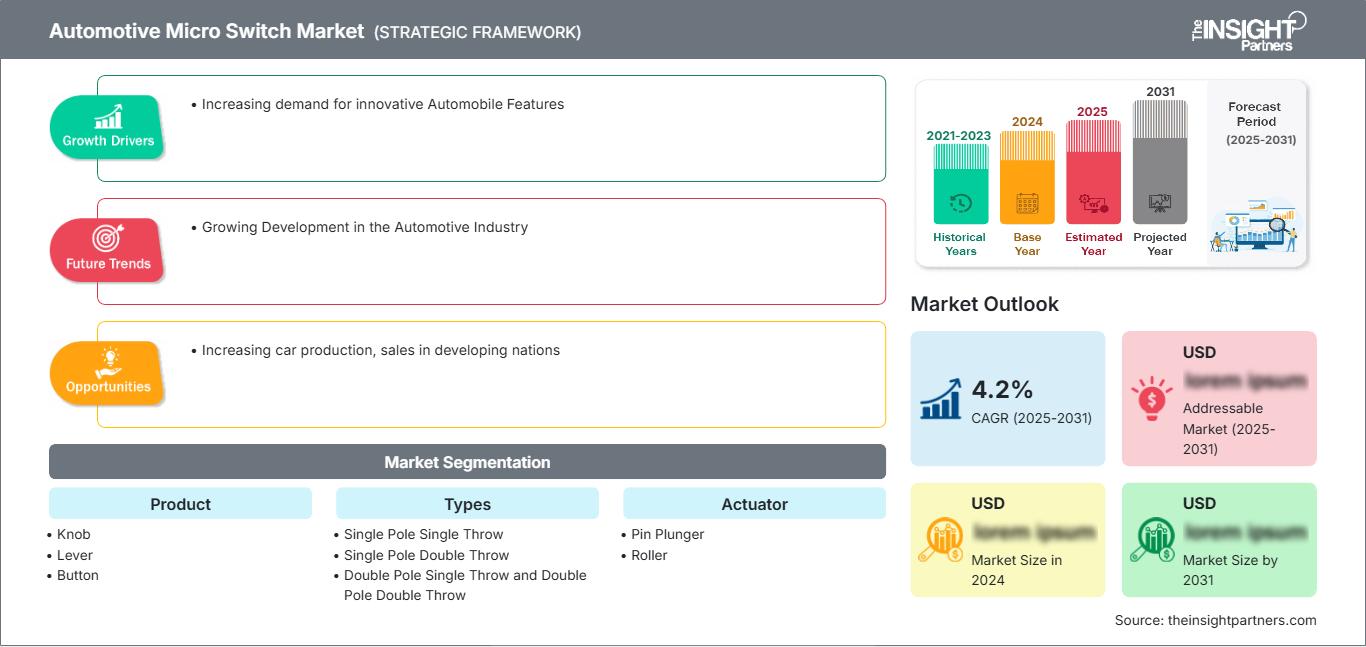
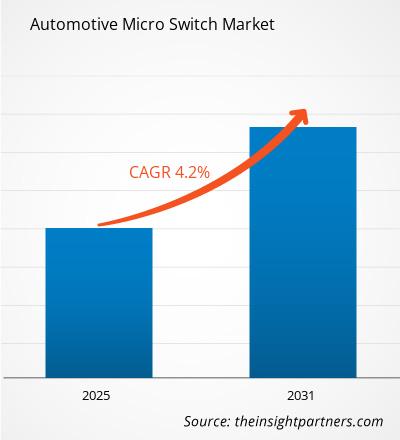
The Automotive Micro Switch market was valued at US$ 1.34 Billion in 2025 and is projected to reach US$ 2.44 Billion by 2034, registering a CAGR of 6.89% during 2026–2034. Demand is expanding as vehicle platforms add electric parking brakes, door interlocks, seat position sensors, battery safety interfaces, steering controls, charging ports, and compact human-machine interfaces requiring precise snap-action detection.
Across North America, Automotive Micro Switch market size expansion is expected to track a CAGR of 5.9–6.7% during 2026–2034, supported by safety electronics, commercial vehicle uptime programs, and localized supply for Tier 1 assemblies. Growth is reinforced by electric pickup launches, fleet replacement cycles, and demand for sealed switches capable of withstanding vibration, moisture, and temperature exposure.
Automotive Micro Switch Market Assessment and Insights
- North America accounted for 24–28% share in 2025 and is growing at a CAGR of 5.9–6.7% during 2026–2034, led by safety interlocks, EV programs, and commercial vehicle electronics.
- US represented 76–80% of North American revenue in 2025 and is growing at a CAGR of 6.1–6.9% during 2026–2034, driven by pickup, SUV, and fleet applications.
- Europe held 22–26% share in 2025 and is growing at a CAGR of 5.5–6.3% during 2026–2034, with Germany, France, Italy, Spain, and the UK leading adoption.
- Asia Pacific held 38–42% share in 2025 and is growing at a CAGR of 7.4–8.2% during 2026–2034, led by China, Japan, South Korea, and India.
- Largest Segment Passenger Vehicle held 68–72% market share in 2025 and is growing at a CAGR of 6.4–7.1% during 2026–2034 because comfort, safety, and cabin electronics use high switch volumes.
- High Growth Segment Commercial Vehicle represented 28–32% market share in 2025 and is growing at a CAGR of 7.2–8.0% during 2026–2034, supported by fleet durability, telematics-related service access, and electrified logistics vehicles.
- Key companies analyzed in detail: Johnson Electric Holdings Limited; Alps Alpine Co., Ltd.; Panasonic Holdings Corporation; C&K Components, LLC; Camsco Electric Co., Ltd.; Crouzet Automatismes SAS; Honeywell International Inc.; APEM SAS; Omron Corporation; TE Connectivity Ltd.
Source: The Insight Partners' analysis based on proprietary research, government publications, company annual reports, investor presentations, industry databases, and expert interviews.
Automotive switching has progressed from simple cabin controls toward engineered sensing points embedded across safety, power management, body electronics, and electrified drivetrains. Suppliers now compete on miniaturization, contact stability, ingress protection, low actuation force, and endurance under heat and vibration. Production dynamics are also changing as automakers reduce mechanical complexity while retaining tactile, low-cost, fail-safe switching for redundant functions where software-only sensing is insufficient.
Forward demand will be shaped by Asia Pacific vehicle output, EV localization, higher electronic content per vehicle, and regulatory emphasis on braking, lighting, door, and restraint reliability. The International Organization of Motor Vehicle Manufacturers reported China, Japan, India, Germany, and South Korea among the largest 2025 production bases, anchoring switch consumption close to vehicle assembly clusters. Investment should favor sealed, low-profile, and diagnostics-ready products.
Automotive Micro Switch Market Report Scope
| Report Attribute | Details |
|---|---|
| Market size in 2025 | US$ 1.34 Billion |
| Market Size by 2034 | US$ 2.44 Billion |
| Global CAGR (2026 - 2034) | 6.89% |
| Historical Data | 2021-2024 |
| Forecast period | 2026-2034 |
Automotive Micro Switch Market Analysis
Automotive Micro Switch market growth is being driven by rising vehicle electrification, safety interlocks, electronic parking brakes, power seats, door latches, charging interfaces, and compact cockpit controls. The International Energy Agency reported electric car sales exceeded 17 million units in 2024 and projected sales above 20 million in 2025, increasing demand for battery, charging, and actuator feedback. Each added electric function creates more switching points that must deliver repeatable signals through long vehicle lifecycles.
The value chain includes contact material suppliers, precision molding firms, spring and terminal producers, switch assemblers, Tier 1 module integrators, distributors, and vehicle manufacturers. Supply dynamics depend on automated assembly, IATF-oriented quality systems, plating availability, tooling capacity, and regional logistics. Buyers increasingly evaluate operating life, IP rating, contact resistance, force tolerance, temperature range, and compatibility with low-voltage electronic control units.
Automotive Micro Switch market analysis indicates a competitive landscape where global scale, application engineering, automotive qualification, and custom actuator design define supplier positioning. Johnson Electric Holdings Limited, Alps Alpine Co., Ltd., Omron Corporation, and Honeywell International Inc. bring broad electromechanical capabilities, while C&K Components, LLC, Crouzet Automatismes SAS, APEM SAS, Camsco Electric Co., Ltd., Panasonic Holdings Corporation, and TE Connectivity Ltd. strengthen specialized switch, connector, and interface portfolios.
Investment is moving toward sealed subminiature formats, double-circuit redundancy, quiet actuation, PFAS-conscious materials, and automated testing for zero-defect programs. Strategic positioning depends on supporting global OEM platforms while customizing levers, plungers, terminals, housings, and wiring exits for regional modules. Suppliers that combine proven cycle life with fast design-in support can defend margins better than vendors competing only on commodity pricing.
● REPORT CUSTOMIZATION
Tailor This Report To Align With Your Specific Business Requirements
This report can be customized to align precisely with your business objectives, scope, and target markets. Customization options include tailored segmentation, geography, competitive analysis, and strategic insights to support informed decision-making.
Customize This Report →WHAT YOU CAN ADJUST
- ● Segmentations
- ● Geography
- ● Competitive Analysis
- ● Language Preferences
Automotive Micro Switch Market: Strategic Insights
Regional Insights
North America Automotive Micro Switch Market
North America accounted for 24–28% of Automotive Micro Switch market share in 2025 and is projected to grow at a CAGR of 5.9–6.7% during 2026–2034. Demand is supported by pickup and SUV electronics, seat adjustment systems, liftgate controls, door latches, EV charging inlets, and commercial fleet serviceability. Regional buyers prioritize sealed components, quick replacement, and qualification evidence for harsh-use vehicles.
Automakers and Tier 1 suppliers emphasize local sourcing resilience, IATF-aligned production, and components that maintain signal accuracy despite dust, vibration, and wide temperature swings. The US leads because it concentrates major vehicle platforms, fleet operators, and electronics engineering resources. Canada and Mexico contribute through assembly capacity, supplier parks, and cross-border module manufacturing linked to North American vehicle programs.
U.S. Automotive Micro Switch Market
The U.S. accounted for 76-80% of the North American Automotive Micro Switch market share in 2025 and is anticipated to register a CAGR of 6.1-6.9% in 2026-2034. Market presence is substantial through Honeywell International Inc., TE Connectivity Ltd., and C&K Components, LLC, sales networks, as well as import lines of switches from specialists in Asia and Europe targeting seat, door, brake, and cockpit assemblies.
Automotive Micro Switch Market dynamics indicate a preference for lever seals, button actuators, and redundant switch poles in safety-relevant modules. Electrification of the fleet is boosting market growth in areas such as charging doors, service panels, lift gates, steering controls, and diagnosis access. The trend among OEMs is to source verified parts that avoid warranty claims, since a cheap switch may render an expensive electronic module useless.
Europe Automotive Micro Switch Market
Europe had a 22%–26% market share in 2025 and is expected to have a CAGR of 5.5%–6.3% from 2026 to 2034. Germany is the major market due to the need for precision switching in braking, seating, cockpit, and body electronics among high-end OEMs, Tier 1 companies, and high-reliability electronics.
The UK participates in demand creation through its use of specialty vehicles, the aftermarket, and fleet electronics. France, Italy, and Spain participate through their high volumes of passenger vehicles, light commercial vehicles, public transportation replacement programs, and European platform manufacturers. European consumers value functional safety, recyclability, material specification, and lifetime certification when buying products. Suppliers of compact, low-noise, and low-contact-resistance products gain from the acoustic environment inside an electric vehicle.
APAC Automotive Micro Switch Market
Asia Pacific accounted for 38–42% share in 2025 and is projected to grow at a CAGR of 7.4–8.2% during 2026–2034. China is dominant due to large-scale car production, EV adoption, supply chain strength, and the implementation of electronic parking brake systems, electric charging interfaces, and smart cabin control systems.
Japan and South Korea emphasize detailed electromechanical engineering, while India leads the market in passenger car sales and localization projects, and is transitioning from two-wheelers to four-wheelers. Australia's contribution is small but steady in terms of usage across the aftermarket and commercial segments.
Middle East & Africa Automotive Micro Switch Market
The Middle East & Africa will grow at a CAGR of 4.8–5.6% in 2026–2034. Saudi Arabia will lead the region in mobility investments, fleet logistics, and the development of automotive service infrastructure. In the UAE, there is a need for reliable switches due to luxury car sales and fleet management services.
South Africa will continue to be significant for vehicle assembly, mining fleets, and aftermarket repairs, whereas growth in the Rest of the MEA market is driven by buses, oil & gas logistics, public transport, and used imported vehicles. Harsh climatic conditions increase the need for switches in sealed housings, corrosion-resistant terminals, and heat-, dust-, and vibration-resistant switches.
Segmentation Analysis
Product
Product is projected to grow at a CAGR of 6.2–7.0% during 2026–2034. The Automotive Micro Switch market scope covers actuator styles used to translate driver input or mechanical movement into electrical signals. Selection depends on packaging space, tactile feel, operating force, sealing, and required travel. Growth is strongest where switches support safety feedback, compact cabin controls, and durable body electronics.
- Knob designs support rotary or selector-style interfaces where drivers need clear tactile positioning, making them relevant for HVAC controls, drive modes, lighting panels, and compact cabin modules.
- Lever switches remain important for door locks, seat tracks, pedals, liftgates, and parking systems because they accommodate mechanical travel while maintaining repeatable snap-action signaling.
- Button formats fit cockpit controls, start-stop functions, electronic parking brakes, and service panels where low travel, defined tactile response, and compact integration are important.
- Touchpad interfaces use micro switch support in selected haptic or confirmation mechanisms, helping automakers blend digital surfaces with dependable physical actuation feedback.
Types
Types is forecast to grow at a CAGR of 6.0–6.8% during 2026–2034. Circuit configuration is chosen according to redundancy, current path, signal logic, and safety requirements. Single-pole designs fit cost-sensitive modules, while double-pole designs support independent circuits or fail-safe validation. Demand rises as OEMs add diagnostics and redundant sensing to compact vehicle systems.
- Single Pole Single Throw switches are widely used where a simple open-close signal is sufficient, supporting cost-effective deployment in basic position detection and auxiliary vehicle functions.
- Single Pole Double Throw switches provide changeover capability, making them useful when control units need alternate signal states for door, brake, latch, or actuator feedback.
- Double Pole Single Throw formats support two linked circuits, improving design flexibility where separate loads or signal lines must be switched together within one compact housing.
- Double Pole Double Throw switches address more complex control logic and redundancy needs, particularly where safety-related modules benefit from independent circuit confirmation.
Actuator
Actuator is expected to grow at a CAGR of 6.3–7.2% during 2026–2034. Actuator selection determines how mechanical motion reaches the switch mechanism and affects reliability under vibration, misalignment, and wear. Plunger formats suit direct movement, while roller formats reduce friction where sliding or cam motion is present. Engineering teams specify actuator style early because it influences mounting geometry and service life.
- Pin Plunger actuators fit compact, direct-contact installations where movement is linear, tolerances are controlled, and designers need consistent actuation force within limited module space.
- Roller actuators are preferred where cams, levers, or sliding parts contact the switch, reducing wear and improving repeatability in door, seat, and pedal mechanisms.
Application
Application is projected to grow at a CAGR of 6.6–7.4% during 2026–2034. Passenger vehicles dominate unit demand because every model uses multiple switches across cabin, body, safety, and convenience systems. Commercial vehicles are gaining momentum as fleets electrify, add service monitoring, and demand rugged components for high-cycle operations. Application growth reflects both new vehicle production and replacement demand.
- Passenger Vehicle applications hold the largest position because seats, doors, pedals, steering interfaces, infotainment controls, lighting, and charging components require numerous compact switching points per vehicle.
- Commercial Vehicle applications are strategically important because trucks, vans, buses, and specialty fleets require durable switches for service doors, lift mechanisms, safety systems, and harsh-duty controls.
Opportunity Snapshot
| Application | Revenue Contribution | Trend Tag | Adoption Stage |
| Passenger Vehicle | High | Cabin Safety | Mature |
| Commercial Vehicle | Medium | Fleet Durability | Scaling |
Automotive Micro Switch Market Growth Drivers and Impact Analysis
Vehicle electrification increases switching points in safety systems
The electric vehicle industry needs consistent feedback for charging door actuators, battery service disconnect actuators, brake-by-wire, thermal management, and electronic parking brake control. This market driver has a significant impact, as electric vehicles typically use an electromechanical unit in place of the traditional mechanical system and thus require position feedback. It is to the advantage of the switch manufacturers, since the designs would require a sealed housing, low-current signal reliability, and redundancy. The market driver sets certain qualification requirements, as the failure could affect charging, warning, or immobilization of the vehicle.
Safety and comfort electronics raise component density per vehicle
Modern automobiles incorporate a wide range of sensors and switches in seats, doors, pedals, steering columns, tailgates, restraints, and control panels. As touchscreens become more common, switches will continue to have an important place when tactile feedback, reliability, or cheap and robust detection is needed. The market ramifications will include an increase in component content per vehicle, especially in regular vehicles that offer choices previously exclusive to luxury models. It will be essential to balance component size, contact reliability, and noise suppression. As a consumer that offers a wide range of actuators and can customize terminals for module assembly.
Commercial fleets demand rugged parts that reduce downtime
Commercial vehicle duty cycles are longer and are subject to regular door, seating, lift, and service-panel actions. Fleet managers like switches that work reliably amidst dust, moisture, vibration, and maintenance. The market implication is evident in increased demand for sealed roller, plunger, and lever types on vans, buses, trucks, and specialized vehicles. Reliable switches may help avoid roadside troubleshooting and incorrect fault codes that affect vehicle performance. Manufacturers who produce reliable switches, provide traceability, and ensure continuity in replacements can secure both aftermarket and OE programs for logistics, municipal fleets, and electric deliveries.
Automotive Micro Switch Market Future Trends
Diagnostics-ready switches will support smarter vehicle modules
The Automotive Micro Switch market trends indicate increased demand for components that help electronic control units distinguish between normal switch operation and wiring problems. In the future, switch features would include resistor selection, contact reliability at low currents, and diagnostics. It is expected that this trend will coincide with the development of software-based cars, when even small parts will need to be digitally monitored. Suppliers will have to outperform their competitors by miniaturizing, demonstrating known electrical properties, and obtaining certification for the automotive environment.
Quiet and compact actuation will influence EV cabin design
The introduction of electric cars reveals the smaller operational sounds that had been drowned out by the combustion engine, thereby making switch sounds crucial in parking brake, control panel, and console switches. There is also a need for smaller switch sizes due to competition among touch screens, storage areas, and interior modularity in packaging. The future development of the Automotive Micro Switch market will thus focus on quieter switch sounds, low actuation forces, small sizes, and uniform tactility.
Automotive Micro Switch Market Opportunities
Localized supply programs for regional vehicle platforms
Automotive Micro Switch Market Forecasts include the localization of tooling, assembly, and quality services in proximity to high-volume vehicle assembly plants. The advantages are reduced logistics risk, faster engineering response time, and the achievement of OEMs' content goals. This trend is relevant to North America, India, China, and Mexico, as new vehicle assembly and supplier parks are developed in these countries. The steps that a company can take include building distributor relationships, qualifying a second production line, and enabling quick customization. Localized sourcing is a good choice due to its high impact on the system during shortages.
Sealed switch upgrades for aftermarket and service channels
The demand in the aftermarket segment is practical because cars in use need replacement switch parts for car doors, seating areas, lift gates, brake pedals, and service panels. Speed and reliability of installation are assets for the workshops and fleet management organizations. Sealed substitutes, cross-references, and packaging for repair segments can help suppliers tap into this market. This differs from the OEM segment, in which the availability, compatibility, and reliability of products are key considerations in purchase decisions.
Recent Developments
- May 2026: Huizhou Micro Switch Technology Co., Ltd. has newly launched the G10B-A001 micro switch. With its precise design, excellent performance, and stable reliability, it focuses on the two core application scenarios of automotive door locks and large-scale agricultural equipment, providing efficient and durable control solutions for industry customers, further expanding the application boundary of micro switches, and boosting industrial upgrading with detailed innovation.
- March 2026: STMicroelectronics (NYSE: STM), a global semiconductor leader serving customers across the spectrum of electronics applications, introduces an ultra-wideband (UWB) chip family that comprehensively supports the next-generation wireless standard for localizing and tracking devices at distances up to several hundred meters. This UWB chip family combines extended range with greater processing power and robustness to enable new and improved automotive, consumer, and industrial use cases, including secure digital access control, presence and motion sensing, and precise approach detection.
- June 2023: With the MICON 5 S, MICON 5 SL, and MICON 5 SAFETY series, RAFI has launched a new generation of robust, ultra-small tactile switches. The extremely compact micro-switches measure just 5.1 x 6.4 x 3.85 mm. Thanks to their optimized sealing system, they achieve an IP67 degree of protection and can therefore be installed on PCBs protected by casting or painting. The extreme temperature resistance from -40°C to +125°C meets current automotive industry standards. High-quality gold contacts ensure permanent switching reliability.
Frequently Asked Questions

- Comprehensive Market Sizing and Forecast Analysis
- Detailed Segmentation Analysis
- In-Depth Market Dynamics Assessment
- Regional and Country-Level Insights
- Competitive Landscape and Company Benchmarking
- Strategic Business Intelligence
Recent Reports
Testimonials

The Insight Partners provided valuable market intelligence that supported our global go-to-market strategy. Their team was professional, responsive, and attentive to our feedback, providing thoughtful analysis and helpful methodological clarifications throughout the project.
Junmo Kim Chief Financial Officer (CFO), Enertech Co., Ltd.
The Insight Partners' SCADA System Market report is comprehensive, with valuable insights on current trends and future forecasts. The team was highly professional, responsive, and supportive throughout. We are very satisfied and highly recommend their services.
RAN KEDEM Partner, Reali Technologies LTDs
I requested a report on a very specific software market and the team produced the report in a few days. The information was very relevant and well presented. I then requested some changes and additions to the report. The team was again very responsive and I got the final report in less than a week.
JEAN-HERVE JENN Chairman, Future Analytica
We worked with The Insight Partners for an important market study and forecast. They gave us clear insights into opportunities and risks, which helped shape our plans. Their research was easy to use and based on solid data. It helped us make smart, confident decisions. We highly recommend them.
PIYUSH NAGPAL Sr. Vice President, High Beam Global
The Insight Partners delivered insightful, well-structured market research with strong domain expertise. Their team was professional and responsive throughout. The user-friendly website made accessing industry reports seamless. We highly recommend them for reliable, high-quality research services
YUKIHIKO ADACHI CEO, Deep Blue, LLC.
This is the first time I have purchased a market report from The Insight Partners.While I was unsure at first, I visited their web site and felt more comfortable to take the risk and purchase a market report.I am completely satisfied with the quality of the report and customer service. I had several questions and comments with the initial report, but after a couple of dialogs over email with their analyst I believe I have a report that I can use as input to our strategic planning process.Thank you so much for taking the extra time and making this a positive experience.I will definitely recommend your service to others and you will be my first call when we need further market data.
JOHN SUZUKI President and Chief Executive Officer, Board Director, BK Technologies
I wish to appreciate your support and the professionalism you displayed in the course of attending to my request for information regarding to infectious disease IVD market in Nigeria. I appreciate your patience, your guidance, and the fact that you were willing to offer a discount, which eventually made it possible for us to close a deal. I look forward to engaging The Insight Partners in the future, all thanks to the impression you have created in me as a result of this first encounter.
DR CHIJIOKE ONYIA MANAGING DIRECTOR, PineCrest Healthcare Ltd.Reason to Buy
- Informed Decision-Making
- Understanding Market Dynamics
- Competitive Analysis
- Identifying Emerging Markets
- Customer Insights
- Market Forecasts
- Risk Mitigation
- Boosting Operational Efficiency
- Strategic Planning
- Investment Justification
- Tracking Industry Innovations
- Aligning with Regulatory Trends





 Get Free Sample for