
Automotive NFC Market Size, Trends & Demand by 2034
Coverage: By Type (106 Kbit/s, 212 Kbit/s, and 424 Kbit/s); and Application (On board Units and Car Keys), and Geography
- Status : Data Released
- Report Code : TIPTE100001131
- Category : Electronics and Semiconductor
- No. of Pages : 150
- Available Report Formats :


- Last update date : July 20, 2026


2025 Market Size
US$ 1.26 Bn
Base year value
2034 Forecast
US$ 2.00 Bn
Projected by 2034
CAGR 2026-2034
5.28 %
Growth rate
Addressable Market
US$ 14.80 Bn
(2026-2034)
The Automotive NFC Market was valued at US$ 1.26 Billion in 2025 and is projected to reach US$ 2.00 Billion by 2034, registering a CAGR of 5.28% from 2026 to 2034. Demand is anchored in secure vehicle access, authenticated onboard communication, and contactless convenience as OEMs align digital cockpit architectures with smartphone-based mobility.
North America remains a high-value adoption base, with regional expansion estimated in a 5.0–5.7% CAGR range as connected car penetration, digital key pilots, and premium vehicle electronics scale. The Automotive NFC Market size is supported by higher software-defined vehicle content, stronger consumer familiarity with tap-based authentication, and OEM investment in secure access modules for shared mobility and fleet use cases.
Automotive NFC Market Assessment and Insights
- North America accounted for 32–35% share in 2025 and is projected to grow at a CAGR of 5.0–5.7% between 2026–2034, supported by digital key certification, premium vehicle mix, and connected fleet deployments.
- US represented 78–82% of North America in 2025 and is expected to grow at a CAGR of 5.1–5.8% between 2026–2034 as OEM programs scale.
- Europe held 27–30% share in 2025 and is forecast to grow at a CAGR of 4.8–5.5% between 2026–2034, led by Germany, France, the UK, Italy, and Spain.
- Asia Pacific captured 25–28% share in 2025 and is projected to grow at a CAGR of 5.6–6.3% between 2026–2034, led by China, Japan, South Korea, and India.
- Largest Segment Car Keys held 54–58% market share in 2025 and is expected to grow at a CAGR of 5.4–6.1% between 2026–2034.
- High Growth Segment 424 Kbit/s held 39–43% market share in 2025 and is expected to grow at a CAGR of 5.8–6.5% between 2026–2034.
- Key companies analyzed in detail: STMicroelectronics N.V., Samsung Electronics Co., Ltd., Polaris Inc., Sony Group Corporation, NXP Semiconductors N.V., Broadcom Inc., SMARTRAC N.V., Alpine Electronics, Inc., Infineon Technologies AG, Texas Instruments Incorporated.
Source: The Insight Partners' analysis based on proprietary research, government publications, company annual reports, investor presentations, industry databases, and expert interviews.
While cars have been dependent upon the traditional lock-and-key access systems, the automotive industry is increasingly relying on advanced NFC solutions like mobile credentials, card emulation technology, and reader modules embedded within the door handles, center consoles, and other in-vehicle devices. Such developments have revolutionized vehicle access, start, and management. Nevertheless, automotive companies still encounter production difficulties related to the development of compact antenna design, energy-efficient detection of cards and devices, efficient performance in communication, and integration issues associated with diverse smartphones and OS, as well as vehicles. Accordingly, the Automotive NFC Market will be developing from being regarded as an additional convenient option to becoming an integral part of the modern vehicle security architecture. The market is being supported by the trends of vehicle electrification, software-defined vehicles, over-the-air software updates, connected mobility, and fleet management solutions.
During the forecast period, market demand is set to be dominated by globally certified NFC controllers, secure elements integration, and NFC readers that meet global digital keys standards defined by industrial associations. Automotive companies will start giving preference to secure and standardized solutions to facilitate smartphone access and vehicle sharing and provide contactless authentication. Developing countries will become an important source of revenue thanks to the growing popularity of connected two-wheelers, electric compact cars, ride-sharing applications, and app-based fleets. Moreover, the growing trend towards digital payments, vehicle subscriptions, and personalized services will open new areas of opportunity for NFC usage. However, the implementation of more stringent cybersecurity standards, payment authentication standards, and data protection standards will make market players face higher validation and certification needs. Companies that can offer automotive-grade hardware, reliable software stacks, secure embedded solutions, and strong OEM partnerships will find themselves in a position to take advantage of growing market opportunities.
Automotive NFC Market Report Scope
| Report Attribute | Details |
|---|---|
| Market size in 2025 | US$ 1.26 Billion |
| Market Size by 2034 | US$ 2.00 Billion |
| Global CAGR (2026 - 2034) | 5.28% |
| Historical Data | 2021-2024 |
| Forecast period | 2026-2034 |
Automotive NFC Market Analysis
There will be demand where the convergence of vehicle identification, payment authorization, and driver personalization takes place. Growth in the Automotive NFC Market will also be driven by smartphone wallets, CCC Digital Key certification, and the fallback access requirements of OEMs when device batteries are low. The short range of operation of NFC technology allows for user intention, making it less vulnerable than longer-range access technologies.
Participants include semiconductor companies, antenna manufacturers, Tier 1 module suppliers, automakers, mobile OS providers, and certification organizations. Suppliers benefit from those that can integrate RF capability, secure element functionality, and automotive certification. On-board units must operate reliably under noisy electrical conditions, while car key products require small size, secure credential storage, and phone and vehicle platform interoperability.
Positioning is done through NXP Semiconductors N.V. and STMicroelectronics N.V., with Infineon Technologies AG and Texas Instruments Incorporated enhancing their secure connectivity product lines. In addition, the report on the Automotive NFC Market will consider Samsung Electronics Co., Ltd., Sony Group Corporation, Broadcom Inc., SMARTRAC N.V., Alpine Electronics, Inc., and Polaris Inc., which are adjacent to devices, tags, mobility, and automotive electronics.
The investments in the market will be in the direction of certified digital key platforms, smaller readers that will facilitate installation near the B-pillar and door handle areas, and charger protection enabled by NFC. The strategic advantage will come from design in depth rather than chip prices, while security certification and software support will make a difference.
● REPORT CUSTOMIZATION
Tailor This Report To Align With Your Specific Business Requirements
This report can be customized to align precisely with your business objectives, scope, and target markets. Customization options include tailored segmentation, geography, competitive analysis, and strategic insights to support informed decision-making.
Customize This Report →WHAT YOU CAN ADJUST
- ● Segmentations
- ● Geography
- ● Competitive Analysis
- ● Language Preferences
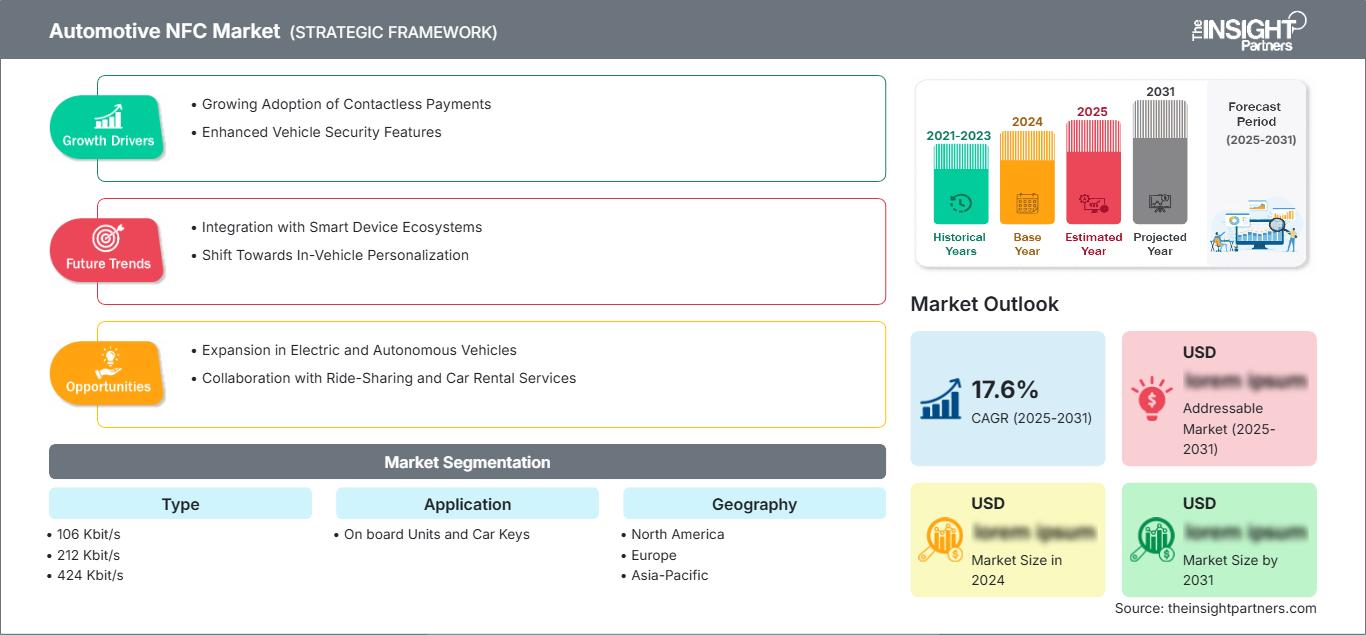
Automotive NFC Market: Strategic Insights
Regional Insights
North America Automotive NFC Market
North America represented 32–35% share in 2025 and is expected to expand at a CAGR of 5.0–5.7% through 2034. The Automotive NFC Market share reflects high penetration of connected vehicles, premium trims, rental fleets, and smartphone-based access pilots. Automakers are embedding NFC readers in door handles, center consoles, and charging areas to support authenticated entry, engine start, pairing, and credential sharing.
Regional growth is supported by CCC Digital Key adoption, mature contactless payment behavior, and strong semiconductor supplier engagement. Fleet operators are testing digital credential issuance to reduce key logistics, while EV platforms use NFC for charger protection and user identification. North America also benefits from cybersecurity governance because authenticated short-range communication aligns with vehicle access risk controls.
U.S. Automotive NFC Market
The U.S. accounted for 78–82% of North America in 2025 and is projected to grow at a CAGR of 5.1–5.8% between 2026 and 2034. Adoption is focused on high-end passenger vehicles, electric vehicles, and connected mobility solutions where digital keys enable better onboarding, temporary access, and service procedures. Vehicle access is being aligned with mobile wallet ecosystems by local OEMs and technology suppliers.
Company coverage is extensive, with NXP Semiconductors N.V., STMicroelectronics N.V., Broadcom Inc., and Texas Instruments Incorporated providing components required for RF, secure element, and communication functionality. Application opportunities are greatest in car keys and secondly in onboard units that facilitate pairing, authentication, and in-car services. Digitization of fleets creates additional demand for credential management.
Europe Automotive NFC Market
Europe held 27–30% share in 2025 and is projected to register a CAGR of 4.8–5.5% during 2026–2034. Germany is ahead due to its premium OEMs, advanced supplier engineering, and early use of certified digital key ecosystems. The UK is helped by connected fleet solutions and telematics-based insurance, whereas France focuses on secure mobility services and electric vehicle charging verification.
The German advantage is also aided by luxury cars and Tier 1 validation capacity. France, Italy, and Spain also play a role in urban mobility, rental fleets, and connected vehicle updates for the mass market. The European cyber security regulations and vehicle approval processes favor certified access systems, where NFC is well-suited due to user intent, interoperability, and credential revocation.
APAC Automotive NFC Market
APAC accounted for 25–28% share in 2025 and is projected to grow at a CAGR of 5.6–6.3% through 2034. Regional requirements are being driven by China, where EV manufacturers are adopting smartphone keys, app customization, and connected cockpits. Electronics supply chains from Japan and South Korea make additional contributions, whereas India and Australia provide further demand for connected mobility solutions.
Industry drivers include a large number of smartphones, the manufacture of EVs locally, and policies that promote digital transactions and smart transport. The adoption of NFC in combination with UWB and Bluetooth is being adopted by OEMs in China and South Korea to enable multi-tiered access solutions.
Middle East & Africa Automotive NFC Market
The Middle East & Africa is expected to grow at a CAGR of 4.3–5.0% between 2026 and 2034, with Saudi Arabia and the UAE leading adoption. Premium imports, smart city mobility programs, and high contactless payment familiarity support NFC-enabled vehicle access. South Africa contributes through fleet, rental, and security-focused vehicle applications.
Energy and infrastructure investment shape demand, particularly where EV charging, gated communities, and corporate fleets need authenticated access. Adoption remains selective because vehicle electronics content varies widely across price bands. However, luxury vehicle penetration and connected logistics platforms provide a practical base for NFC integration over the forecast period.
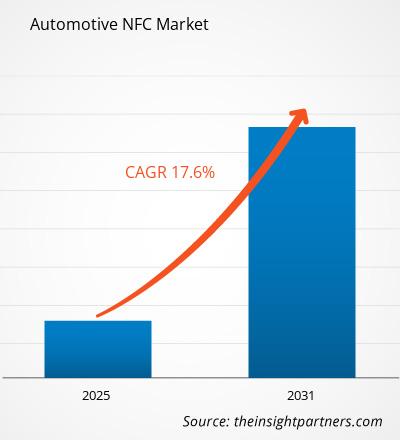
Segmentation Analysis
Type
Type is projected to grow at a CAGR of 5.2–5.9% between 2026 and 2034 as OEMs balance cost, data speed, and security requirements. The Automotive NFC Market scope across speed classes reflects different design priorities, from simple credential exchange to faster pairing and richer cockpit interactions. Faster variants gain relevance as digital key and infotainment use cases converge.
- 106 Kbit/s remains relevant for cost-sensitive access and identification tasks where short credential exchange, proven reliability, and broad device compatibility matter more than advanced data-transfer capability.
- 212 Kbit/s serves mid-tier implementations requiring improved responsiveness for pairing, user profile exchange, and authenticated access while maintaining manageable integration cost for higher-volume vehicle programs.
- 424 Kbit/s is strategically important for premium digital key and cockpit applications because faster exchange supports smoother user experience, stronger feature bundling, and future software-defined vehicle interactions.
Application
Application is projected to grow at a CAGR of 5.3–6.0% from 2026 to 2034 as secure access expands beyond locking into onboarding, payment, personalization, and service authentication. Car keys lead because consumers understand phone-based entry, while onboard units gain value as vehicles become connected platforms requiring deliberate, short-range identity confirmation.
- On-board units support device pairing, authenticated service access, charging protection, and in-cabin personalization, making them important as cockpit electronics and connected vehicle services become more software-defined.
- Car Keys dominate demand because NFC enables intentional tap-to-unlock, credential sharing, and low-battery access, addressing security and convenience needs across private, rental, and fleet vehicles.
Opportunity Snapshot
| Application | Revenue Contribution | Trend Tag | Adoption Stage |
| On board Units | Medium | Cockpit Pairing | Scaling |
| Car Keys | High | Digital Access | Mature |
Automotive NFC Market Growth Drivers and Impact Analysis
Certified Digital Key Ecosystems Reduce Fragmentation
Digital keys software standardization is building OEM trust due to the requirement of compatibility between phone, OS and brand. Digital key certification by the Car Connectivity Consortium and NFC Forum standards provides a common process of verification for secure credentials management, tap-to-enter functionality, and low battery access. It helps minimize duplicated R&D costs and interoperability risks for car manufacturers. Commercially, digital key certification enables quicker procurement due to pre-certification of the suppliers ahead of vehicle platform nomination. This effect is particularly visible in premium and electric vehicle categories as digital access becomes an integrated part of application-based ownership and service booking.
Software-Defined Vehicles Need Trusted Short-Range Identity
With the rise of vehicles as software-defined products, identity verification becomes necessary to unlock, start, pair, pay, and load profiles. NFC enables a targeted short-distance experience, which helps augment Bluetooth and UWB, resulting in a multi-layered entry system. This is even more important when there is a need for deliberate authorization from the driver for transactions or in case of fallback in the event of a failure of passive entry. This driver enables OEMs to have more addressable content for each vehicle since they can deploy readers in handles, consoles, chargers, and service stations.
EV Charging and In-Cabin Payments Expand Use Cases
Use of electric vehicles and connected cabins makes the application of NFC go beyond just doors. Center console charging of devices requires protection and ID of the card/device, but more importantly, public charging and parking increasingly demand security and contactless identification. NFC would be useful in linking the driver, car, and the account using the tap method, thus making payments and authorizations easier. Commercially, there is potential for greater installation of NFC readers/controllers within EVs, especially when the manufacturers link their charging or mobility services into native apps.
Automotive NFC Market Future Trends
Multi-Radio Access Architectures Become Standard
The leading Automotive NFC Market trends point toward NFC operating as one layer within access systems that also use UWB and Bluetooth Low Energy. NFC will remain important because it confirms user intent at close range and works as a reliable fallback when passive entry is unavailable. Future vehicles are expected to shift from single-function readers to distributed access nodes across doors, consoles, chargers, and service interfaces. This will increase design complexity but improve resilience, cybersecurity, and user experience. Suppliers offering integrated reference designs, security stacks, and certification support will gain an advantage as OEMs standardize multi-radio architectures across global platforms.
Digital Credentials Extend into Fleet and Shared Mobility
The trend will be towards digital credentialing for rentals, corporates, logistics, and subscriptions. Fleet managers will require key issuance, revocation, and traceability without any need to manage physical keys, and NFC allows a convenient "tap" method for verification of drivers or fleet maintenance people. As mobility services continue to grow, NFC-based vehicle access could help avoid idle time of vehicles, increase the utilization of assets, and offer controlled access based on time, location, or personnel. The technology will favor OEMs and suppliers who could integrate the hardware of the vehicle with cloud-based credential management.
Automotive NFC Market Opportunities
Platform Design Wins in Compact NFC Readers
Automakers need compact NFC readers that can fit into door handles, B-pillars, consoles, and charging pads without compromising RF performance. This creates an opportunity for semiconductor suppliers and module integrators to secure platform-level design wins early in vehicle development cycles. The Automotive NFC Market Forecasts indicate stronger value capture for vendors that combine small packages, high sensitivity, automotive qualification, and support for CCC-compatible digital key functions. Winning a vehicle platform can generate multi-year revenue because access hardware is typically carried across model variants. Suppliers should prioritize reference designs, antenna tuning support, and production validation tools.
Emerging Market EVs and Connected Two-Wheelers
Opportunities in emerging markets are selectively available as electric vehicle companies, scooter companies, and mobility apps utilize the phone-enabled approach to access. NFC becomes an interesting choice due to its familiarity, lower power consumption, and compatibility with popular mobile phones and card types. Connected two-wheelers will be able to leverage NFC for anti-theft access control, battery switching verification, and activating a user profile, whereas small electric vehicles will be able to use NFC similarly to access and charge the battery. Suppliers joining these programs should strive to maintain a balance between cost and security needs.
Recent Developments
- October 2025: OMNIVISION introduced the automotive industry's first 5MP global shutter HDR image sensor for in-cabin driver and occupant monitoring. The new sensor delivers clearer images in challenging lighting conditions, improving driver monitoring accuracy while enabling a more compact and flexible camera design for automakers.
- December 2025: Littelfuse launched a new family of automotive-qualified current sensors for EV battery management, motor control, and safety systems. The Hall-effect sensors provide precise, isolated current measurement with analog and digital outputs, helping improve EV performance, efficiency, and functional safety.
- April 2024: STMicroelectronics introduced the Stellar with xMemory automotive microcontroller family, integrating phase-change memory (PCM) to enable faster software updates, improved functional safety, and greater flexibility for software-defined vehicles. The solution simplifies ECU design while supporting the growing computational demands of next-generation vehicles.
Frequently Asked Questions

- Comprehensive Market Sizing and Forecast Analysis
- Detailed Segmentation Analysis
- In-Depth Market Dynamics Assessment
- Regional and Country-Level Insights
- Competitive Landscape and Company Benchmarking
- Strategic Business Intelligence
Recent Reports
Testimonials

The Insight Partners' SCADA System Market report is comprehensive, with valuable insights on current trends and future forecasts. The team was highly professional, responsive, and supportive throughout. We are very satisfied and highly recommend their services.
RAN KEDEM Partner, Reali Technologies LTDs
I requested a report on a very specific software market and the team produced the report in a few days. The information was very relevant and well presented. I then requested some changes and additions to the report. The team was again very responsive and I got the final report in less than a week.
JEAN-HERVE JENN Chairman, Future Analytica
We worked with The Insight Partners for an important market study and forecast. They gave us clear insights into opportunities and risks, which helped shape our plans. Their research was easy to use and based on solid data. It helped us make smart, confident decisions. We highly recommend them.
PIYUSH NAGPAL Sr. Vice President, High Beam Global
The Insight Partners delivered insightful, well-structured market research with strong domain expertise. Their team was professional and responsive throughout. The user-friendly website made accessing industry reports seamless. We highly recommend them for reliable, high-quality research services
YUKIHIKO ADACHI CEO, Deep Blue, LLC.
This is the first time I have purchased a market report from The Insight Partners.While I was unsure at first, I visited their web site and felt more comfortable to take the risk and purchase a market report.I am completely satisfied with the quality of the report and customer service. I had several questions and comments with the initial report, but after a couple of dialogs over email with their analyst I believe I have a report that I can use as input to our strategic planning process.Thank you so much for taking the extra time and making this a positive experience.I will definitely recommend your service to others and you will be my first call when we need further market data.
JOHN SUZUKI President and Chief Executive Officer, Board Director, BK Technologies
I wish to appreciate your support and the professionalism you displayed in the course of attending to my request for information regarding to infectious disease IVD market in Nigeria. I appreciate your patience, your guidance, and the fact that you were willing to offer a discount, which eventually made it possible for us to close a deal. I look forward to engaging The Insight Partners in the future, all thanks to the impression you have created in me as a result of this first encounter.
DR CHIJIOKE ONYIA MANAGING DIRECTOR, PineCrest Healthcare Ltd.Reason to Buy
- Informed Decision-Making
- Understanding Market Dynamics
- Competitive Analysis
- Identifying Emerging Markets
- Customer Insights
- Market Forecasts
- Risk Mitigation
- Boosting Operational Efficiency
- Strategic Planning
- Investment Justification
- Tracking Industry Innovations
- Aligning with Regulatory Trends





 Get Free Sample for