
Backhoe Loaders Market Growth, Size & Forecast by 2034
Coverage: by Engine Power (Below 80 HP, 80-100 HP, Above 100 HP); End-user (Mining, Construction, Agriculture and Forestry, Others) , and Geography (North America, Europe, Asia Pacific, and South and Central America)
- Status : Data Released
- Report Code : TIPRE00010516
- Category : Manufacturing and Construction
- No. of Pages : 150
- Available Report Formats :


- Last update date : August 26, 2026


2025 Market Size
US$ 20.25 Bn
Base year value
2034 Forecast
US$ 37.44 Bn
Projected by 2034
CAGR 2026-2034
7.07 %
Growth rate
Addressable Market
US$ 260.46 Bn
(2026-2034)
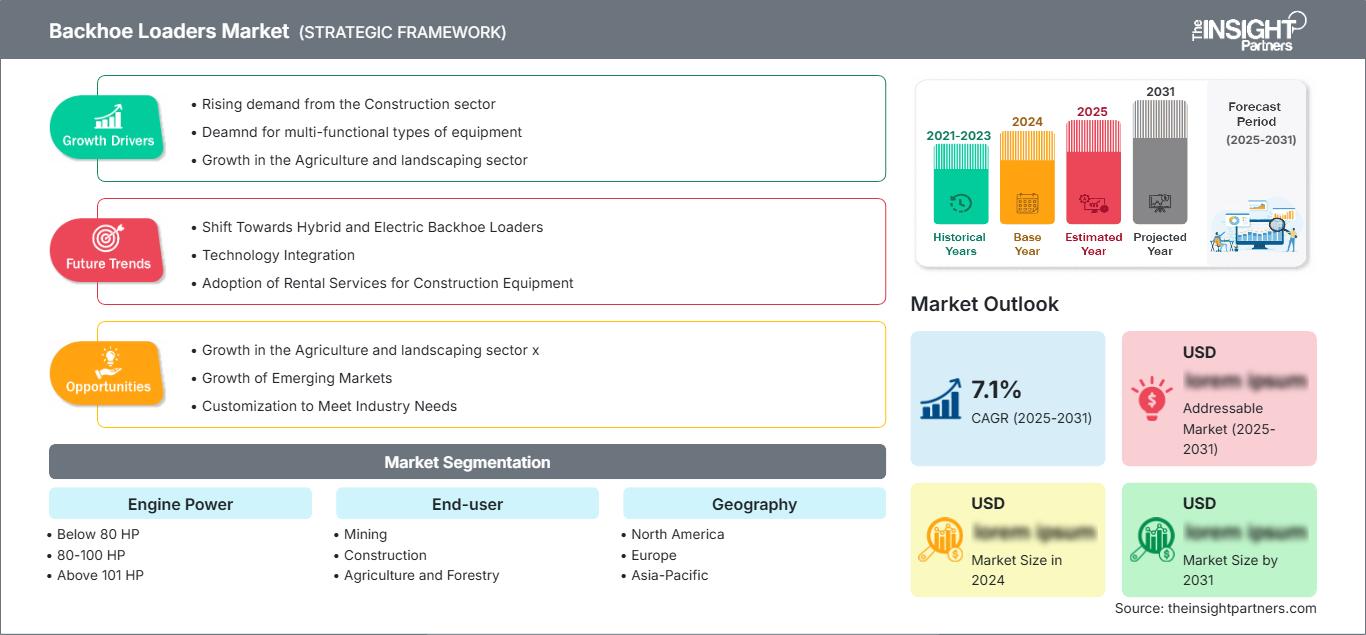
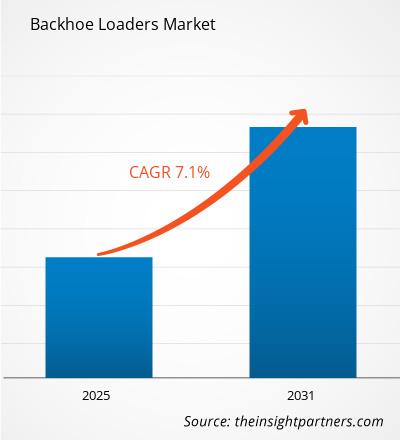
The backhoe loaders market was valued at US$ 20.25 Billion in 2025 and is projected to reach US$ 37.44 Billion by 2034, expanding at a CAGR of 7.07% during 2026–2034. This trajectory reflects sustained demand for mobile, multipurpose earthmoving equipment across construction, mining, agriculture, forestry, and municipal work, where one platform can dig, load, trench, grade, and travel efficiently between dispersed sites.
North American backhoe loaders market size is supported by an estimated 5.8–6.6% CAGR, driven by utility-network renewal, municipal fleet replacement, and contractors’ preference for roadable machines that combine excavation and loading. Telematics, attachment flexibility, and Tier 4 Final compliance strengthen replacement economics, although compact excavators and track loaders constrain unit growth in selected urban applications.
Backhoe Loaders Market Assessment and Insights
- North America accounted for 18–22% Backhoe Loaders Market Share in 2025 and is expected to record a CAGR between 2026 – 2034 of 5.8–6.6%, supported by utility renewal, municipal replacement, and rental demand.
- US represented 78–82% of North America in 2025, advancing at 5.7–6.5% through fleet renewal and road, water, and broadband trenching programs.
- Europe held 16–20% Share in 2025 and is projected to grow at 5.2–6.0%, led by the UK and Germany, with France, Italy, and Spain supporting replacement demand.
- Asia Pacific captured 44–50% Share in 2025 and should expand at 8.0–8.8%, led by India and China, while Japan, South Korea, and Australia sustain premium equipment demand.
- Largest Segment Construction held 52–58% market share in 2025 and is expected to register a 7.0–7.8% CAGR during 2026–2034.
- High Growth Segment Above 101 HP represented 20–24% market share in 2025 and is projected to achieve an 8.1–8.9% CAGR during 2026–2034.
- Key companies analyzed in detail: Caterpillar Inc., CNH Industrial N.V., Deere & Company, J.C. Bamford Excavators Limited, Komatsu Ltd., Mahindra & Mahindra Limited, Sany Heavy Industry Co., Ltd., Tata Hitachi Construction Machinery Company Private Limited, Bobcat Company, and XCMG Construction Machinery Co., Ltd.
Source: The Insight Partners' analysis based on proprietary research, government publications, company annual reports, investor presentations, industry databases, and expert interviews.
The development in platform technology now encompasses electronically-controlled hydraulic systems, programmable functions, telematics, and increased attachment flexibility, as compared to the previous mechanical control and single function machines. Standardization of engine and electronics technologies across families of machines is a growing trend in order to reduce parts complexity and operator familiarity. Manufacturing has been kept regionally balanced between advanced specification machines from North America and Europe and cost-effective machines from Asia. This results in a product range that has been designed for fuel efficiency, serviceability, cab ergonomics, and precise modulation instead of power.
From 2022 to 2034, growth will be the highest in South Asia, Southeast Asia, and selected countries in Middle East and Africa, especially in infrastructure development areas. Government spending in public transportation, water, sanitation, housing, and rural electrification will drive procurement activities, while strict emissions regulations will drive new engines and alternate power sources. Rental companies, utilities, and municipalities will be attracted to machines that provide remote diagnostics, common attachments, consistent residual values, and uptime support.
Backhoe Loaders Market Report Scope
| Report Attribute | Details |
|---|---|
| Market size in 2025 | US$ 20.25 Billion |
| Market Size by 2034 | US$ 37.44 Billion |
| Global CAGR (2026 - 2034) | 7.07% |
| Historical Data | 2021-2024 |
| Forecast period | 2026-2034 |
Backhoe Loaders Market Analysis
Backhoe loaders market growth is driven by the capability of the machine to combine two separate excavating and loading equipment on fragmented sites. Municipalities, utility companies, farmers, and smaller construction firms require portability, compactness, and fast attachment changes. Customer demand comes via dealers, rental services, finance companies, attachment makers, and service networks, thus uptime and parts availability become the primary selection criteria.
Supply chain dynamics depend on the engine certification expenses, availability of hydraulic components, tires, and steel prices, and localized production considerations. The companies minimize risks by using common platforms and localized manufacturing; dealers are now offering bundled financing, preventive maintenance, telematics, and secondary equipment sales. Such supply chain allows generating after-sales revenues regularly and facilitates customers’ decision-making process based on total ownership cost rather than acquisition price.
Market analysis of backhoe loaders identifies competition based on dealership network size, hydraulic capabilities, operator's convenience, and residual value of the machines. Caterpillar Inc., Deere & Company, CNH Industrial N.V., and J.C. Bamford Excavators Limited secure their position in mature markets relying on product upgrades and connected-service solutions. Mahindra & Mahindra Limited, Sany Heavy Industry Co., Ltd., Tata Hitachi Construction Machinery Company Private Limited, and XCMG Construction Machinery Co., Ltd. focus on value, local adaptation, and emerging markets expansion.
There is investment in areas of modular electronics, load-sensing hydraulics, engines with reduced emissions, remote diagnostics, and alternative power systems. Komatsu Ltd and Bobcat Company enhance choice through the provision of differentiating compact and standard machines. Competitive success will lie in the combination of a good range of machines together with finance, attachment system, service capability, and data, as customer usage assurance is sought.
● REPORT CUSTOMIZATION
Tailor This Report To Align With Your Specific Business Requirements
This report can be customized to align precisely with your business objectives, scope, and target markets. Customization options include tailored segmentation, geography, competitive analysis, and strategic insights to support informed decision-making.
Customize This Report →WHAT YOU CAN ADJUST
- ● Segmentations
- ● Geography
- ● Competitive Analysis
- ● Language Preferences
Backhoe Loaders Market: Strategic Insights
Regional Insights
North America backhoe loaders market
North America represented an 18–22% backhoe loaders market share in 2025 and is projected to expand at a 5.8–6.6% CAGR through 2034. The needs for water mains replacement, road rehabilitation, broadband construction, and municipality maintenance maintain the requirement for roadworthy machines capable of trenching, loading, lifting, and plowing snow without being constantly moved from one short-term job to another.
Replacement drives purchases as established machine owners evaluate productivity, emissions regulations, and residual value against repair cost. Rental firms prefer standardized controls and telematic capabilities, whereas contractors are opting for auxiliary hydraulics, boom extensions, couplers, and implements. Competition from compact excavators prevents some urban uses, but backhoes enjoy an edge when travel speed and bucket capacity and one-man operation are factors in daily use.
U.S. Backhoe Loaders Market
The U.S. accounted for 78–82% of North American Backhoe Loaders Market demand in 2025 and is expected to post a 5.7–6.5% CAGR through 2034. Municipal buying, utility repair, road maintenance, land preparation, and rental replacements form the base of volumes. Texas and other states with heavy construction operations offer focused activity, while public works vehicle fleets have an interest in lawful road transport and speedy repositioning.
The companies that compete in the market include Caterpillar Inc., Deere & Company, CNH Industrial N.V., J.C. Bamford Excavators Limited, Bobcat Company, and Sany Heavy Industry Co., Ltd. The applications have moved to utility trenching, stormwater services, landscaping, and emergency services. Large horsepower equipment is used for heavy lifting and excavating operations, whereas compact machines cater to restricted space situations.
Europe Backhoe Loaders Market
Europe held 16–20% share in 2025 and is forecast to grow at 5.2–6.0% through 2034. The UK is ahead of others regarding regional demand due to the appropriateness of side-shift models for tight streets, utility work, and renting. Stage V compliance, operator safety considerations, noiseless purchase, and flexibility of attachments encourage upgrading of older machinery and benefit manufacturers with a large service network.
Germany focuses on municipal construction, fiber, water and transport maintenance with a high regard for efficiency and maintenance of machinery life cycle. France, Italy and Spain supplement the list of applications with civil construction, agriculture, landscape construction and local infrastructure work. Everywhere in the region, compact excavators stay powerful competitors, therefore the positioning of backhoes focuses on mobility, loading capabilities, versatility and reduced fleet management.
APAC Backhoe Loaders Market
Asia Pacific captured 44–50% share in 2025 and should expand at an 8.0–8.8% CAGR. Volume comes from India via roads, rural connections, housing, irrigation, and mechanization of contracting, while China facilitates fleets based on municipal and industrial applications.
Japan and South Korea prefer efficiency and technologically advanced machines, whereas Australia demands strong machines for construction, agricultural and resource-related operations. Localization, availability of finance, coverage of dealers and operators' training play a role in adoption, and increasing public infrastructure investments and rentals help smaller contractors gain access.
Middle East & Africa Backhoe Loaders Market
The Middle East & Africa market is projected to register a 6.4–7.2% CAGR through 2034. Saudi Arabia leads on transport, utilities, housing, and destination development, while the UAE supports premium fleet replacement and rental activity.
South Africa contributes mining support, agriculture, and municipal maintenance; the rest of MEA offers selective upside from roads, water, and energy corridors. Harsh-duty cooling, filtration, parts availability, and technician coverage strongly influence procurement, favoring suppliers that combine robust specifications with dependable regional distribution.
Segmentation Analysis
Engine Power
The backhoe loaders market scope by engine power reflects tradeoffs among fuel use, mobility, hydraulic capability, and attachment requirements. The segment is expected to expand at a 6.9–7.6% CAGR during 2026–2034. Contractors increasingly select output according to duty cycle and transport needs, while manufacturers use shared engines, controls, and service parts to cover multiple performance tiers efficiently.
- Below 80 HP machines serve agriculture, landscaping, light construction, and owner-operators requiring affordability, maneuverability, and lower fuel consumption for intermittent digging and loading.
- 80-100 HP platforms balance excavation force, loader productivity, transportability, and operating cost, making them strategically important for general contractors, municipalities, and rental fleets.
- Above 101 HP equipment addresses deeper excavation, heavier lifting, demanding attachments, and high-utilization infrastructure work where productivity and hydraulic capacity outweigh acquisition cost.
End-user
End-user demand is projected to rise at a 7.0–7.7% CAGR during 2026–2034, led by construction while mining, agriculture, and forestry supply diversified utilization. Purchasing criteria vary by uptime, terrain, attachments, dealer proximity, and finance access. Rental penetration broadens adoption among contractors with variable workloads, and public-sector procurement supports predictable replacement cycles for multipurpose fleets.
- Mining users deploy backhoes for site services, drainage, road upkeep, cleanup, and support tasks, valuing durability, filtration, tire performance, and rapid field maintenance.
- Construction remains the largest outlet, covering trenching, foundations, loading, grading, demolition support, and utilities across residential, commercial, transport, and municipal projects.
- Agriculture and Forestry demand centers on drainage, land clearing, material handling, road maintenance, fencing, and seasonal work, favoring versatile attachments and accessible service.
Opportunity Snapshot
| End-user | Revenue Contribution | Trend Tag | Adoption Stage |
| Mining | Medium | Site Support | Scaling |
| Construction | High | Utility Trenching | Mature |
| Agriculture and Forestry | Medium | Rural Mechanization | Scaling |
| Others | Low | Municipal Fleets | Emerging |
Backhoe Loaders Market Growth Drivers and Impact Analysis
Infrastructure renewal favors multipurpose fleets
Transportation, water, sanitation, energy, and telecommunications projects entail repeated earthmoving and loading operations both in developed and developing nations. Backhoes prove most useful in situations where crews operate from several different locations where it would be impractical to transport individual excavator and loader equipment. Governments and private firms may thus increase equipment usage efficiency, decrease mobilization efforts, and make operator assignment easy. It is most evident in cases of utility repair, rural road repairs, municipal work, and small-scale civil works that involve a different scope of work on a daily basis. The purchasing pattern has shifted to favor equipment with couplers, auxiliary hydraulic circuits, high travel speeds, stable lifting ability, and reliable dealer backup systems.
Mechanization improves productivity for smaller operators
Factors such as labor shortages, time constraints, and increasing safety considerations promote the use of mechanized excavation, loading, grading, and lifting by smaller operators, farmers, and municipalities. One machine, the backhoe, combines a number of jobs which would otherwise be done manually or using a variety of other equipment. Financing, leasing, and renting have reduced the barriers to entry, whereas second-hand equipment has helped maintain residual value. The commercial consequence of this reality is that there will be a greater demand for middle-range machines with easy controls, robust power-train, and easily fitted attachments. Manufacturers who combine machines with operator training, service agreements, and financing can make a one-time sale a recurring one.
Connected service raises fleet uptime
Telematics, diagnostics, and standardization permit monitoring of hours used, fuel used, machine location, fault codes, and maintenance intervals from afar. Improved information enables preventive servicing, fewer unexpected breakdowns, and the ability of rental fleets to balance fleet size with regional use. The manufacturer benefits from more accurate parts forecasting, loyalty, and feedback, while the dealer is able to act before a breakdown causes project delays. The market effect goes beyond high-end machines as telematic systems are increasingly becoming common throughout machine lines. Consumers begin to weigh the promised uptime and service life more than the advertised features, favoring companies that have well-established tech support and IT capabilities.
Backhoe Loaders Market Future Trends
Alternative propulsion moves from demonstration to deployment
The backhoe loaders market trends will increasingly reflect battery-electric and hydrogen-combustion development, especially for urban, municipal, and regulated jobsites. Adoption will remain application-specific because duty cycle, charging or refueling access, climate, payload, and acquisition cost differ widely. Early fleets will prioritize low-noise operation, local emissions reduction, and predictable daily routes. Diesel will remain central across remote and high-utilization work, but modular powertrain engineering can reduce development risk. Suppliers that combine alternative machines with energy partnerships, technician training, residual-value support, and transparent performance data will be better positioned to convert pilot projects into repeat orders as infrastructure and regulation mature.
Automation will improve consistency rather than replace operators
Electronic controls will support grade assistance, return-to-dig functions, programmable modulation, payload guidance, and attachment recognition. These capabilities can shorten learning curves, reduce rework, and improve fuel efficiency without removing the operator from varied jobsites. Future differentiation will depend on interfaces that remain intuitive across mixed-experience crews and harsh environments. Data captured from hydraulic demand and cycle patterns will inform maintenance and operator coaching. The strongest adoption is likely among rental fleets, utilities, and contractors managing standardized processes, where measurable productivity gains justify software and sensor costs. Cybersecurity, repairability, and backward-compatible tools will become important procurement considerations.
Backhoe Loaders Market Opportunities
Build localized ecosystems in high-growth regions
The backhoe loaders market forecasts support investment in assembly, parts depots, technician training, financing, and attachment supply across India, Southeast Asia, the Middle East, and selected African markets. Localized operations can reduce lead times, currency exposure, and ownership costs while aligning specifications with climate, fuel quality, road conditions, and operator practices. Manufacturers should prioritize dealer productivity, mobile service, remanufactured components, and credit partnerships rather than pursue unit sales alone. Regional suppliers can differentiate through rapid parts fulfillment and application-specific packages for roads, irrigation, housing, and utilities. A phased approach combining imported kits, localized components, and demand-linked capacity can protect capital while building a durable installed base.
Expand rental and outcome-based service models
Rental fleets provide a route to customers facing seasonal workloads, uncertain project pipelines, or limited access to capital. Manufacturers and dealers can create value through maintenance-inclusive leases, hourly usage plans, certified used programs, and attachment subscriptions. These models improve affordability while generating recurring service and data revenue. Success requires accurate residual-value forecasting, remote monitoring, standardized configurations, and disciplined refurbishment. Bundling operator familiarization and job-specific attachments can raise utilization and reduce misuse. Providers should segment offers by municipality, utility contractor, farmer, and small builder, because each group has different cash-flow and uptime requirements. Strong remarketing channels complete the model by efficiently placing returned machines.
Recent Developments
- October 2025: The next generation Cat 440 and 450 Backhoe Loaders feature improved machine performance, an advanced hydraulic system and increased versatility compared to previous models. Offering more operator choice and advanced machine control, these new models also feature the efficient Cat C3.6 engine and the latest Product Link technology.
- August 2024: CASE Construction Equipment has expanded its EV toolbox for municipal crews, utility teams, urban construction and other contractors with the commercial release of its 580EV, the industry’s first electric backhoe loader. Marking a new milestone in emissions-free productivity on the jobsite, CASE’s EV backhoe loader will soon be followed by the commercial availability of two additional EV machines the CX25EV 2.5-metric ton mini excavator and the CL36EV 3.6-metric ton compact wheel loader. The new equipment increases CASE’s EV lineup to five models, including the previously launched CX15EV electric mini excavator and the SL22EV small articulated loader.
Frequently Asked Questions

- Comprehensive Market Sizing and Forecast Analysis
- Detailed Segmentation Analysis
- In-Depth Market Dynamics Assessment
- Regional and Country-Level Insights
- Competitive Landscape and Company Benchmarking
- Strategic Business Intelligence
Recent Reports
Testimonials

The Insight Partners' SCADA System Market report is comprehensive, with valuable insights on current trends and future forecasts. The team was highly professional, responsive, and supportive throughout. We are very satisfied and highly recommend their services.
RAN KEDEM Partner, Reali Technologies LTDs
I requested a report on a very specific software market and the team produced the report in a few days. The information was very relevant and well presented. I then requested some changes and additions to the report. The team was again very responsive and I got the final report in less than a week.
JEAN-HERVE JENN Chairman, Future Analytica
We worked with The Insight Partners for an important market study and forecast. They gave us clear insights into opportunities and risks, which helped shape our plans. Their research was easy to use and based on solid data. It helped us make smart, confident decisions. We highly recommend them.
PIYUSH NAGPAL Sr. Vice President, High Beam Global
The Insight Partners delivered insightful, well-structured market research with strong domain expertise. Their team was professional and responsive throughout. The user-friendly website made accessing industry reports seamless. We highly recommend them for reliable, high-quality research services
YUKIHIKO ADACHI CEO, Deep Blue, LLC.
This is the first time I have purchased a market report from The Insight Partners.While I was unsure at first, I visited their web site and felt more comfortable to take the risk and purchase a market report.I am completely satisfied with the quality of the report and customer service. I had several questions and comments with the initial report, but after a couple of dialogs over email with their analyst I believe I have a report that I can use as input to our strategic planning process.Thank you so much for taking the extra time and making this a positive experience.I will definitely recommend your service to others and you will be my first call when we need further market data.
JOHN SUZUKI President and Chief Executive Officer, Board Director, BK Technologies
I wish to appreciate your support and the professionalism you displayed in the course of attending to my request for information regarding to infectious disease IVD market in Nigeria. I appreciate your patience, your guidance, and the fact that you were willing to offer a discount, which eventually made it possible for us to close a deal. I look forward to engaging The Insight Partners in the future, all thanks to the impression you have created in me as a result of this first encounter.
DR CHIJIOKE ONYIA MANAGING DIRECTOR, PineCrest Healthcare Ltd.Reason to Buy
- Informed Decision-Making
- Understanding Market Dynamics
- Competitive Analysis
- Identifying Emerging Markets
- Customer Insights
- Market Forecasts
- Risk Mitigation
- Boosting Operational Efficiency
- Strategic Planning
- Investment Justification
- Tracking Industry Innovations
- Aligning with Regulatory Trends





 Get Free Sample for